

Global Isoamylene Market Size and Forecast – 2026 To 2033
The Global Isoamylene Market is estimated to be valued at USD 270.4 Mn in 2026 and is expected to reach USD 388.2 Mn by 2033, exhibiting a compound annual growth rate (CAGR) of 5.3% from 2026 to 2033. Market growth is supported by isoamylene consumption in polymer antioxidants, fragrance ingredients, agrochemical intermediates, adhesives, peroxides, and pharmaceutical synthesis.
In March 2026, Aarti Industries secured a multi-year contract worth approximately USD 150 million to supply a critical agrochemical intermediate through March 2030. The agreement indicates expanding procurement of high-value specialty intermediates and reliable, scalable chemical manufacturing, supporting the downstream demand environment relevant to isoamylene producers.
Key Takeaways of the Global Isoamylene Market
- The high purity isoamylene is expected to hold 61.4 % of the global isoamylene market in 2026 because fragrance, antioxidant, adhesive, and performance-additive producers prioritize consistent reactivity, lower contaminant loads, and simpler downstream purification. In May 2026, Lummus Technology commercially launched Thermacrack C5, offering improved conversion, selectivity, reduced byproducts, and high-purity isoamylene production.
- C5 fraction separation is expected to account for 55.8 % of the global isoamylene market in 2026 because it monetizes existing naphtha-cracker streams, supports integrated petrochemical economics, and supplies multiple co-products without dedicated upstream synthesis. In May 2026, Zeon approved a new Mizushima GPI facility using proprietary extractive distillation to recover highly pure active components from C5 fractions.
- Flavors and fragrances segment is expected to command 27.8 % of the global isoamylene market in 2026 because isoamylene serves as a reactive intermediate for aroma molecules used across personal care, home care, fine fragrance, and flavor formulations. In April 2026, BASF commissioned world-scale menthol, linalool, and citral plants, expanding supply reliability across the aroma-ingredient value chain.
- Asia Pacific is expected to account for 37.4 % of the global isoamylene market in 2026, supported by integrated petrochemical clusters, specialty-chemical conversion capacity, and manufacturing bases serving fragrance, polymer-additive, agrochemical, and healthcare customers. In September 2025, Givaudan broke ground on an automated Fragrance and Beauty facility in Guangzhou, strengthening local creative, application, and production capabilities.
- Europe is expected to hold 28.9 % of the global isoamylene market in 2026 and remain the fastest-growing region due to premium fragrance formulation, advanced specialty-chemical processing, established perfumery clusters, and investment in high-value ingredients. In July 2025, Symrise’s subsidiary, SFA NEROLI opened a fragrance campus in Grasse, combining creative, research, production, and supply-chain capabilities.
- Purity-Led Contracting and Supplier Qualification: Buyers are shifting from commodity purchasing toward specification-led supply agreements covering impurity profiles, batch consistency, storage stability, and traceability. This favors producers with advanced purification, analytical testing, and reliable logistics. Suppliers that can document performance across fragrance, antioxidant, pharmaceutical, and adhesive formulations should gain preferred-vendor status, support premium pricing, and reduce qualification barriers for customers.
- Feedstock Flexibility and Multi-Route Production Strategies: Producers are increasingly evaluating multiple routes, including C5 separation, ether decomposition, selective hydrogenation, and renewable-feedstock pathways, to balance cost, availability, and environmental performance. Flexible assets can respond more effectively to refinery-stream variability and customer sustainability requirements. This trend will redirect investment toward modular process design, energy-efficient purification, and partnerships linking petrochemical operators with specialty-chemical converters.
Segmental Insights
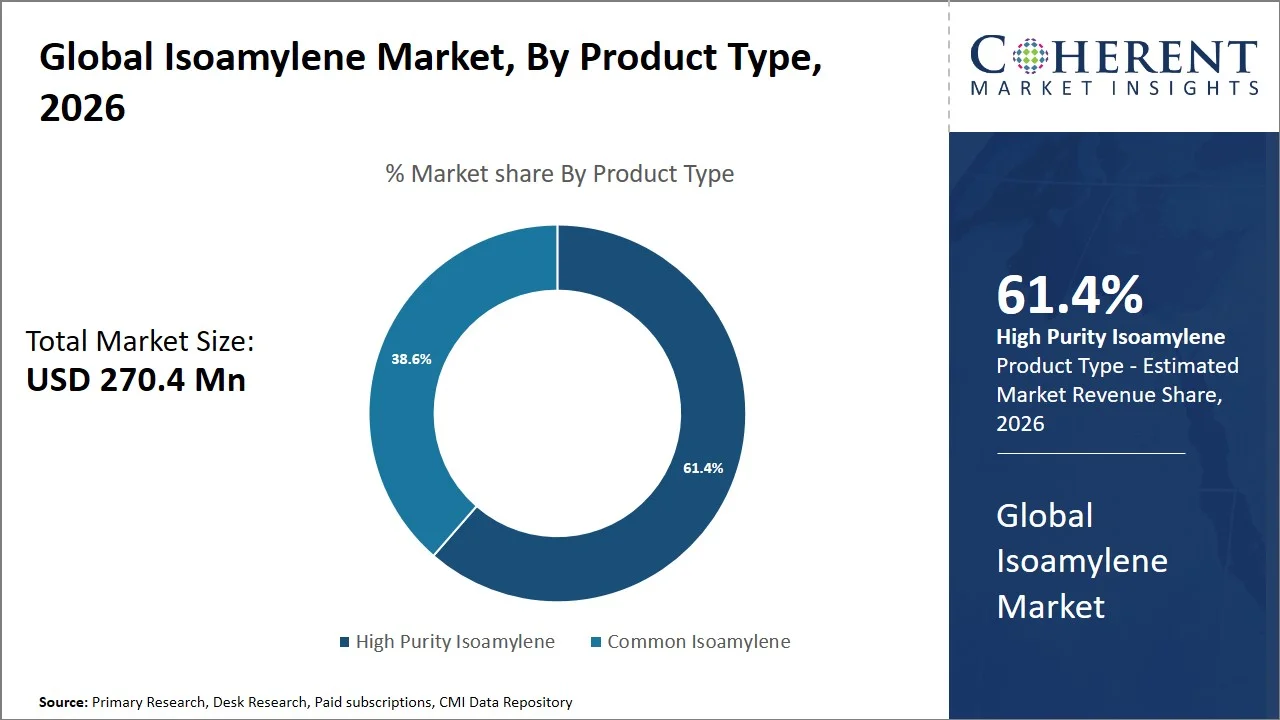
Why Does High Purity Isoamylene Dominate the Global Isoamylene Market?
The high purity isoamylene is expected to command 61.4% of the global isoamylene market in 2026 because downstream synthesis depends on tightly controlled isomer composition, color, moisture, and trace contaminants. Fragrance, peroxide, antioxidant, pharmaceutical, UV-stabilizer, and specialty-resin producers prefer high-purity feedstock to improve reaction selectivity, reduce purification losses, protect catalysts, and maintain repeatable product specifications. These operating advantages lower rejected batches and shorten customer qualification cycles, enabling suppliers to secure longer contracts and stronger margins than common-grade material. Integrated producers also benefit from stable cracker-derived feedstock and established purification assets. In December 2022, INEOS Oligomers announced a 25% debottlenecking of its Cologne isoamylene unit, explicitly linking the project to customer requirements for high product quality, supply stability, and applications including fragrances, peroxides, antioxidants, and fungicides.
- Current Industry Events of 2026
- Market Size Estimation
- Regional Breakdown
- Competitive Landscape
- Customer Intelligence
- Segmental Analysis
- Pricing Analysis
- Key Market Drivers, Challenges & Future Trends
- Customized Insights Section
Why Does C5 Fraction Separation Represent the Largest Production Route in the Global Isoamylene Market?
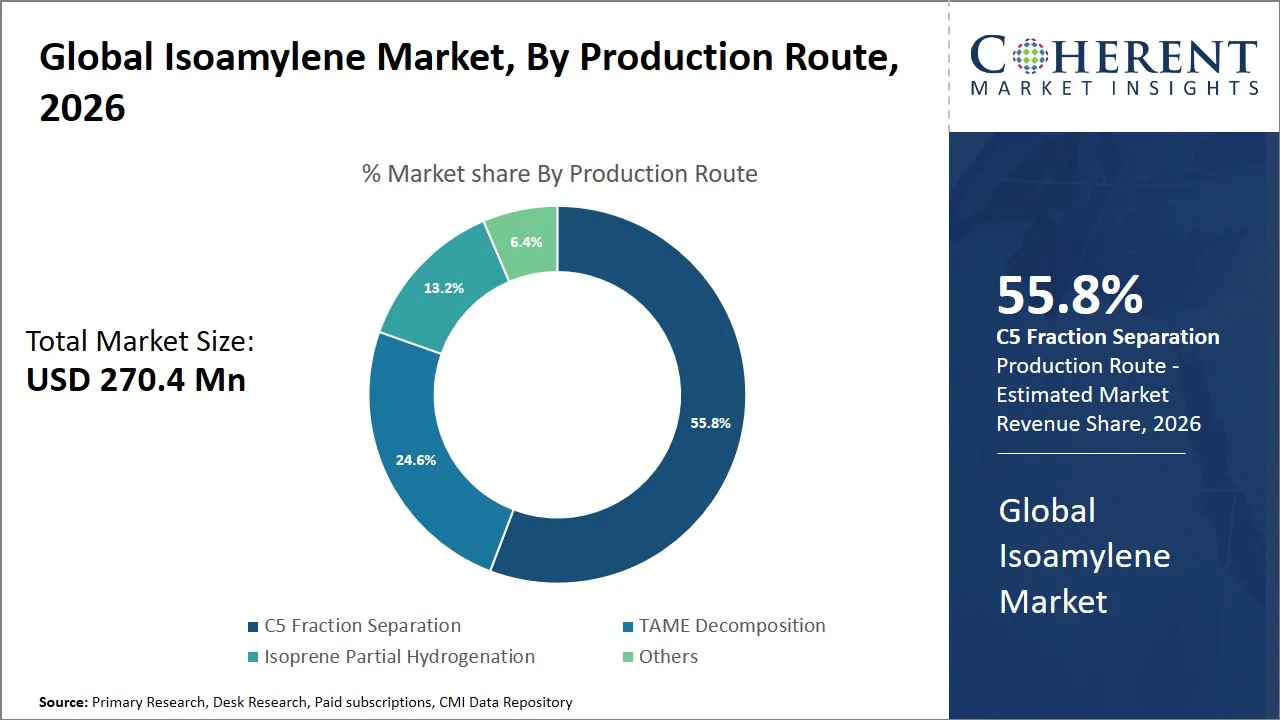
C5 fraction separation is expected to represent 55.8% of the global isoamylene market in 2026 because it converts an available steam-cracker or refinery side stream into a higher-value specialty intermediate. The route benefits from existing fractionation columns, utilities, tankage, and logistics, reducing incremental capital requirements compared with dedicated TAME decomposition or selective hydrogenation facilities. Operators can also optimize the wider C5 slate by recovering multiple saleable components rather than treating the stream as low-value blending material. This supports competitive production costs and dependable industrial-scale availability for chemical manufacturers. In April 2024, Ningbo Jinhai Chenguang Chemical reported that it was recognized at the Asian C5/C9 and Petroleum Resin Industry Conference as China’s leading annual producer of isoprene, piperylene, and dicyclopentadiene monomers, as well as C5-series petroleum resins. This demonstrates the scale and multiproduct value achievable through integrated C5 separation.
Why Do Flavors and Fragrances Dominate the Application Segment of the Global Isoamylene Market?
The flavors and fragrances segment is expected to hold 27.8% of the global isoamylene market share in 2026 because aroma-chemical manufacturers use reactive C5 intermediates to create differentiated molecules for fine fragrance, personal care, home care, beverages, and processed foods. The segment benefits from frequent product launches, regional scent and taste preferences, and continuous reformulation by consumer brands. Buyers value odor consistency, low off-note risk, and dependable small-batch supply, making qualified isoamylene more commercially important than a purely commodity input. This application also supports higher-value customer relationships through technical collaboration and customized specifications. In August 2025, dsm-firmenich inaugurated an expanded seasoning plant in Kerala and broke ground on a new flavor manufacturing facility in Gujarat, India, strengthening regional capacity for sweet, savory, beverage, and encapsulated flavor solutions.
Current Events and their Impact
Current Event | Description and Its Impact |
U.S. OSHA Hazard Communication Standard Update – May 2024 |
|
U.S. EPA TSCA Chemical Data Reporting Cycle – May 2024 |
|
Revised EU Classification, Labelling and Packaging Regulation – December 2024 |
|
Global Isoamylene Market Dynamics
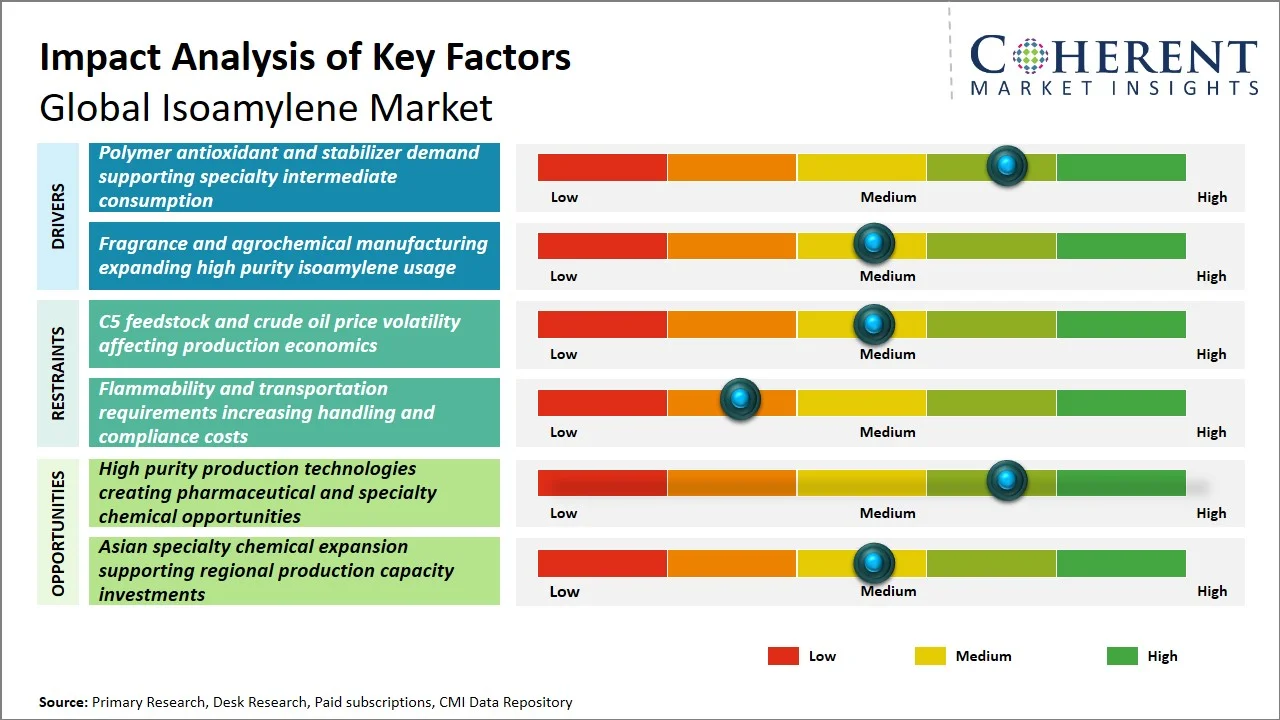
Key Market Drivers
- Polymer Antioxidant and Stabilizer Demand Supporting Specialty Intermediate Consumption: Polymer antioxidant and stabilizer consumption supports isoamylene demand because the molecule is used as a reactive C5 building block for hindered phenols, UV-protection chemistries, and other performance additives. Plastics, elastomers, coatings, fibers, and adhesives require stabilizers that preserve color, mechanical strength, and processing reliability under heat, oxygen, and light exposure. This creates recurring demand from additive formulators rather than one-time project purchasing. High-purity isoamylene suppliers benefit through qualification-based contracts, while integrated C5 processors gain opportunities to upgrade lower-value refinery streams. In July 2026, SONGWON announced that its SONGNOX 1076 phenolic antioxidant had received RSPO certification, with commercial introduction planned for the second half of the year. The development reinforces the importance of traceable upstream intermediates and favors suppliers capable of maintaining consistent specifications, sourcing documentation, and dependable delivery.
- Fragrance and Agrochemical Manufacturing Expanding High-Purity Isoamylene Usage: Fragrance and agrochemical manufacturing expands the addressable market for high-purity isoamylene because both industries rely on controlled organic synthesis, reproducible reaction yields, and low-contaminant intermediates. Fragrance houses use C5 chemistry to create differentiated aroma molecules for personal care, home care, and fine perfumery, while crop-protection manufacturers require specialty building blocks for active ingredients, intermediates, and formulation components. These customers typically impose tighter odor, color, moisture, and impurity limits than commodity chemical buyers, supporting premium grades and long qualification cycles. In October 2025, MANE began the construction of the second phase of its Pinghu facility in China, with the expansion focused on fragrance production and advanced delivery formats. The project illustrates how localized fragrance manufacturing increases regional procurement of qualified aroma-chemical inputs and rewards isoamylene suppliers offering technical support, small-batch flexibility, and reliable hazardous-material logistics.
Emerging Market Trends
- Shift Toward Application-Qualified Isoamylene Grades: Buyers are moving beyond basic purity specifications toward grades tailored to specific downstream reactions. Antioxidant producers prioritize catalyst compatibility, fragrance manufacturers require odor neutrality, and pharmaceutical and agrochemical companies demand stronger documentation. Suppliers offering narrow specifications, application-focused certificates, retained samples, and technical qualification support can command better margins. Competition will increasingly depend on product consistency, downstream performance, and effective management of formulation or process changes.
- Carbon-Accountable and Traceable C5 Supply Chains: Carbon measurement and feedstock traceability are becoming important purchasing criteria for specialty chemicals. Customers increasingly seek clarity on whether isoamylene originates from refinery, steam-cracker, recycled, or renewable-attributed streams. Producers will need stronger mass-balance systems, emissions tracking, and chain-of-custody documentation. Suppliers offering credible traceability can strengthen premium positioning, while companies lacking verified environmental data may lose access to sustainability-focused fragrance, packaging, personal-care, and export customers.
Regional Insights
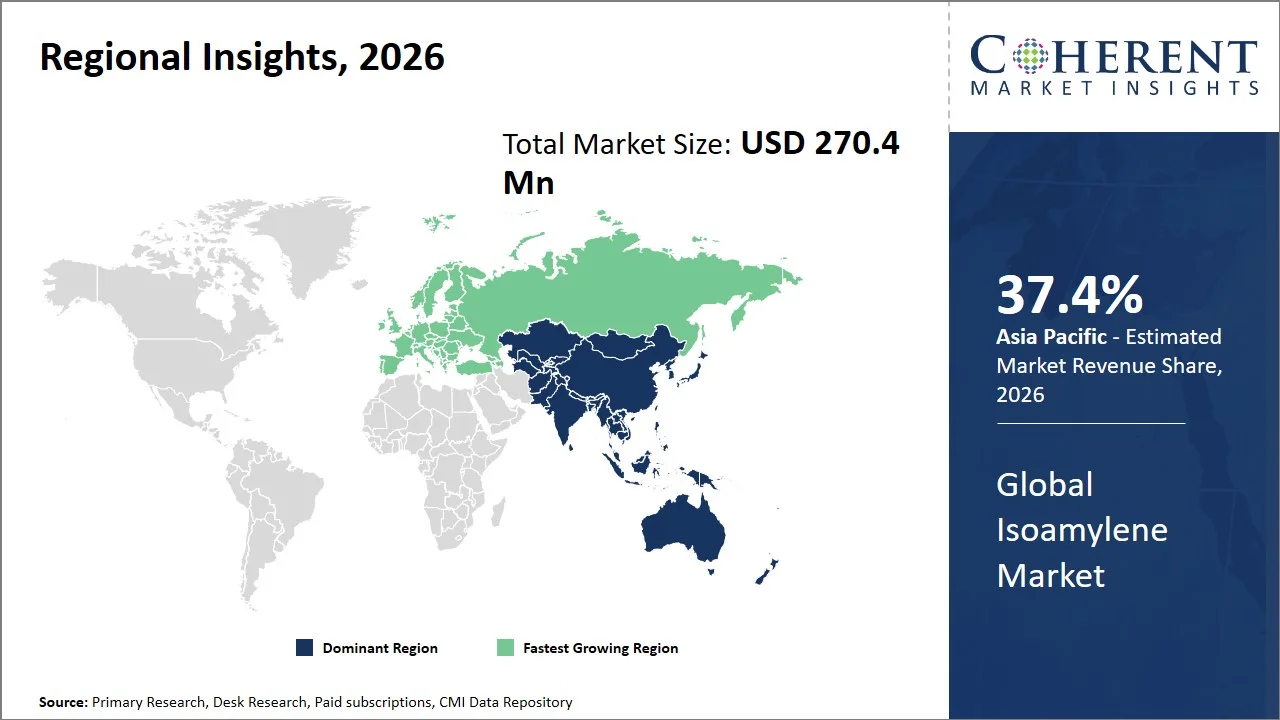
Why Does Asia Pacific Dominate the Global Isoamylene Market?
Asia Pacific is expected to hold 37.4% of the global isoamylene market in 2026 because the region combines large petrochemical and refinery capacities with extensive downstream specialty-chemical manufacturing. China, India, South Korea, and Japan support consumption across polymer antioxidants, UV stabilizers, fragrances, agrochemicals, rubber additives, adhesives, and pharmaceutical intermediates. Regional C5 processing facilities provide access to mixed hydrocarbon streams used for isoamylene recovery, while integrated chemical clusters improve feedstock sourcing, utilities, storage, and distribution efficiency. Expanding consumer-product, plastics, automotive, agricultural, and personal-care industries further strengthen demand for high-purity grades. Asia Pacific’s leadership therefore reflects its broad manufacturing base, cost-competitive processing capabilities, growing domestic consumption, and established export supply chains serving global specialty-chemical customers.
Why is Europe Emerging as the Fastest-Growing Region in the Global Isoamylene Market?
Europe is expected to represent 28.9% of the global isoamylene market in 2026 and expand the fastest as specialty-chemical buyers reformulate products for circularity, safer chemistry, traceability, and lower environmental impact. The region has dense clusters of fragrance houses, polymer-additive producers, adhesive formulators, agrochemical companies, and pharmaceutical manufacturers that purchase performance intermediates against demanding technical specifications. Growth opportunities are particularly strong where isoamylene-derived antioxidants and stabilizers help maintain polymer performance through recycling and repeated processing. In February 2025, the European Commission confirmed that the Packaging and Packaging Waste Regulation had entered into force, creating new requirements and commercial opportunities around recyclable, reusable, and resource-efficient packaging. This transition should encourage formulation work, additive qualification, and supplier collaboration across the European plastics value chain.
Global Isoamylene Market Outlook for Key Countries
Why is the U.S. a Key Market for the Isoamylene Market?
The U.S. is a key isoamylene market because it links large-scale refining and petrochemical operations with high-value downstream manufacturing. Domestic demand spans rubber compounds, polymer stabilization, adhesives, flavors, fragrances, crop-protection intermediates, and selected healthcare chemicals, allowing suppliers to serve several customer groups from the same C5-based value chain. U.S. buyers generally prioritize reliable delivery, high-purity grades, technical documentation, and domestic inventory because isoamylene requires controlled handling and can be costly to qualify from new sources. Local production also reduces exposure to port congestion and long-distance hazardous-material logistics. In September 2025, LANXESS announced the first U.S. production of selected rubber processing promoters at its South Carolina facility to improve supply reliability for automotive, pharmaceutical, and industrial-rubber customers. The investment illustrates the continuing localization of specialty-additive supply chains that support demand for reactive chemical intermediates.
Why is India Important in the Global Isoamylene Market?
India is important in the global isoamylene market because its expanding fragrance, personal-care, agrochemical, pharmaceutical, adhesive, and polymer-processing industries require a growing range of specialty intermediates. The country offers cost-competitive formulation and manufacturing capabilities, but high-purity hydrocarbon intermediates may still depend on qualified domestic producers and imports, creating opportunities for distributors with compliant storage and reliable technical support. Demand is also becoming more specification-led as Indian consumer brands develop premium scents, differentiated home-care products, and performance-oriented packaging. In October 2025, International Flavors & Fragrances (IFF) announced a new scent creative center in Mumbai, planned to be operational in the first half of 2026, with advanced laboratories, evaluation facilities, and closer customer collaboration. The investment supports faster fragrance development and strengthens an end-use ecosystem in which isoamylene-based aroma intermediates can gain commercial relevance.
Why Does China Support Growth in the Isoamylene Market?
China supports growth in the global isoamylene market through its extensive C5 processing base, integrated refining and petrochemical complexes, and large downstream manufacturing network. Isoamylene suppliers can address demand from polymer antioxidants, UV stabilizers, rubber chemicals, pesticides, growth regulators, adhesives, flavors, fragrances, and pharmaceutical intermediates. Industrial clustering in coastal and inland chemical zones improves access to feedstocks, utilities, toll processing, and export logistics, while local buyers increasingly seek stable quality and shorter qualification cycles. In June 2026, SI Group and Shengxiao Group formed a joint venture to expand specialty-monomer capacity in China and strengthen regional supply for high-performance polymers used in electronics, automotive, and medical applications. The investment demonstrates China’s broader strategy of localizing specialty monomers and additive inputs, supporting a favorable commercial environment for isoamylene conversion, formulation, and distribution.
Why is Germany a Strategic Country in the Isoamylene Market?
Germany is a strategic country in the global isoamylene market because it combines advanced chemical engineering, precision formulation, export-oriented plastics production, premium fragrance capabilities, and demanding product-quality standards. German customers use specialty intermediates within polymer additives, rubber compounds, coatings, adhesives, agrochemicals, and pharmaceutical manufacturing, where consistency and regulatory documentation can outweigh unit-price considerations. The country’s machinery, automotive, packaging, and industrial-materials sectors also create sustained demand for antioxidants and stabilizers that protect products during processing and long service lives. In October 2025, Clariant used K 2025 in Düsseldorf to present multifunctional stabilization, PFAS-free processing, bio-based wax, and other additive solutions for plastics. The event highlighted Germany’s role as a commercialization and technology-validation center, where material suppliers, converters, and equipment companies jointly influence specifications that can shape purchasing of isoamylene-derived performance chemicals.
Why is Brazil an Important Growth Market for the Isoamylene Market?
Brazil is an important growth market for the global isoamylene market because it combines a large consumer-products economy with strong agriculture, plastics, rubber, adhesives, cosmetics, flavors, and fragrances industries. Demand can arise from aroma-chemical synthesis, pesticide and plant-growth-regulator production, polymer stabilization, and specialty resin formulation. The country’s distance from major Asian and European suppliers increases the value of regional inventory, dependable import channels, and distributors capable of handling flammable chemical intermediates. Local customers also require formulations adapted to tropical climate conditions, including heat, humidity, and ultraviolet exposure, supporting performance-additive consumption. In June 2026, Robertet inaugurated one of its largest creative centers in Brazil to strengthen local co-creation and develop fragrance, flavor, and natural-ingredient solutions. This investment expands the downstream innovation base that can translate consumer preferences into demand for specialized aroma intermediates, including isoamylene-derived chemistries.
Technology Adoption Landscape in the Global Isoamylene Market
Technology | Adoption Level | Key Application Area | Business Impact |
High-Efficiency Multicolumn Fractional Distillation | High | Separation and purification of refinery or steam-cracker C5 fractions | Improves isoamylene recovery and specification control but requires careful energy and column-integration management. |
Extractive Distillation | Medium | Separation of close-boiling C5 hydrocarbons and removal of difficult impurities | Enables higher product purity and better isomer recovery where conventional fractionation alone is insufficient. |
TAME Catalytic Decomposition and Backcracking | Medium | Production of high-purity isoamylene from tertiary-amyl methyl ether | Provides an alternative route with strong purity potential and greater independence from direct C5 recovery economics. |
Selective Isoprene Hydrogenation | Medium | Conversion of isoprene-rich streams into isoamylene | Expands feedstock flexibility but requires selective catalysts and precise control to limit over-hydrogenation and byproducts. |
Online Gas Chromatography and Process Analytical Technology | High | Continuous monitoring of isomer composition, moisture, and trace impurities | Reduces off-specification production, accelerates process adjustments, and strengthens batch-level quality documentation. |
Advanced Adsorptive C5 Isomer Separation | Low | Deep purification and separation of structurally similar C5 molecules | Offers potential energy savings and higher selectivity but remains limited by adsorbent cost, regeneration, and scale-up requirements. |
How are Regional Small-Lot Supply and Qualification Services Creating New Growth Opportunities in the Global Isoamylene Market?
A high-potential opportunity lies in serving smaller pharmaceutical, agrochemical, fragrance, and specialty-additive manufacturers that need qualified isoamylene in limited volumes but cannot efficiently contract full bulk shipments. These buyers often face long lead times, hazardous-material storage constraints, inconsistent repackaging quality, and limited access to application support. Producers and distributors can capture this gap through regional inventory hubs, validated drum and intermediate-bulk-container filling, tamper-evident packaging, retained samples, and digital batch traceability. Commercial differentiation should include narrow impurity specifications, change-notification agreements, documentation packages, and technical guidance for storage and reaction handling. Participation requires compliant warehousing, trained dangerous-goods logistics partners, analytical laboratories, and disciplined lot segregation. The opportunity is likely to favor specialist distributors and vertically integrated suppliers that can combine bulk procurement economics with small-lot service. New entrants without chemical-handling infrastructure may struggle, while established producers can expand margins by treating distribution, documentation, and qualification support as part of the product rather than an administrative cost.
Market Players, Key Development, and Competitive Landscape
Key Developments
- In July 2026, Evonik announced a USD 100 million modernization of its drug-substance manufacturing site in Indiana, including upgraded reactors, automation, and systems for complex active pharmaceutical ingredients. This is important for the global isoamylene market because expanding small-molecule synthesis capacity increases procurement opportunities for high-purity, well-documented intermediates serving pharmaceutical and healthcare chemical production.
- In May 2026, Nouryon introduced Perkadox PM-60ST-GR, an organic peroxide technology designed to restore the processing performance of recycled polypropylene. This is important for the global isoamylene market because innovation in organic peroxide-enabled polymer modification expands the commercial value of the peroxide and catalyst application chain and creates demand for reliable specialty intermediates used by additive manufacturers.
- In May 2025, B. Fuller expanded its manufacturing capabilities in India, the Middle East, and Africa to include pressure-sensitive and non-pressure-sensitive hot-melt adhesive production. This is important for the global isoamylene market because additional regional adhesive capacity broadens downstream consumption of tackifiers, resins, stabilizers, and specialty chemical intermediates while increasing the value of localized supply and technical distribution.
Competitive Landscape
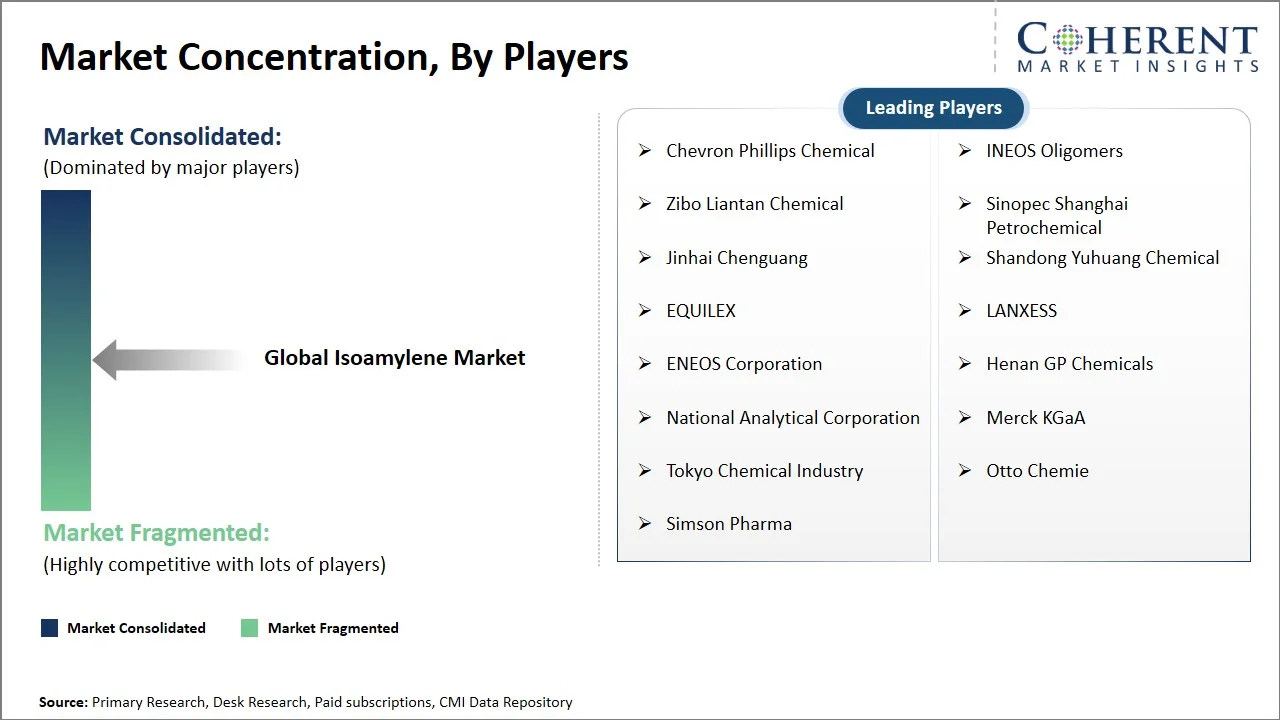
The global isoamylene market is best characterized as moderately consolidated at the high-purity bulk-production level and more fragmented across regional distribution, repackaging, and laboratory-grade supply. Integrated petrochemical producers compete with specialized C5 processors, alternative-route manufacturers, regional chemical companies, and technical distributors. Competitive advantage depends on consistent purity, feedstock access, processing economics, supply continuity, regulatory documentation, and the ability to qualify material for demanding downstream synthesis. Regional suppliers can compete effectively where shorter delivery times, smaller packaging formats, local language documentation, and application support outweigh global production scale.
Key focus areas include
- Purity consistency: Control of isomer composition, moisture, color, sulfur compounds, dienes, and trace contaminants influences customer qualification.
- Feedstock integration: Access to refinery, cracker, TAME, or isoprene streams improves cost control and production flexibility.
- Process efficiency: Conversion selectivity, energy consumption, catalyst life, and separation yield determine manufacturing competitiveness.
- Supply reliability: Customers value inventory availability, dual-site supply, contingency planning, and predictable delivery schedules.
- Regulatory assurance: Accurate SDS documentation, transport classification, chemical registration, and change-control procedures support market access.
- Technical collaboration: Reaction troubleshooting, sample qualification, impurity analysis, and customized specifications strengthen customer retention.
- Regional distribution: Compliant warehouses, dangerous-goods logistics, validated repackaging, and small-lot availability expand access to specialist buyers.
Market Report Scope
Isoamylene Market Report Coverage
| Report Coverage | Details | ||
|---|---|---|---|
| Base Year: | 2025 | Market Size in 2026: | USD 270.4 Mn |
| Historical Data for: | 2020 To 2024 | Forecast Period: | 2026 To 2033 |
| Forecast Period 2026 to 2033 CAGR: | 5.3% | 2033 Value Projection: | USD 388.2 Mn |
| Geographies covered: |
| ||
| Segments covered: |
| ||
| Companies covered: | Chevron Phillips Chemical, INEOS Oligomers, Zibo Liantan Chemical, Sinopec Shanghai Petrochemical, Jinhai Chenguang, Shandong Yuhuang Chemical, EQUILEX, LANXESS, ENEOS Corporation, Henan GP Chemicals, National Analytical Corporation, Merck KGaA, Tokyo Chemical Industry, Otto Chemie, and Simson Pharma | ||
| Growth Drivers: |
| ||
| Restraints & Challenges: |
| ||
Analyst Opinion (Expert Opinion)
- Future global isoamylene market leadership is likely to shift from maximizing isoamylene production volume toward controlling customer qualification, route flexibility, and contractual supply assurance. Producers that combine multiple feedstock options with application laboratories and structured change management will be able to sell continuity and performance rather than only chemical volume. This transition should strengthen long-term supplier relationships and make unqualified spot material less attractive to sophisticated buyers.
- Changes in refinery operating rates and steam-cracker feedstocks could alter the availability and composition of merchant C5 streams, challenging companies dependent on a single production route. A sustained reduction in suitable byproduct feedstock would reshape industry economics, raise the strategic value of ether-decomposition and selective-hydrogenation routes, and pressure distributors that rely on opportunistic sourcing. Feedstock-agnostic producers are consequently positioned to gain influence.
- The global isoamylene market participants should prioritize flexible debottlenecking, online analytical control, long-term C5 supply agreements, and regional hazardous-material inventory. Investments should target applications where qualification requirements protect margins, particularly specialty additives, fragrance intermediates, and regulated synthesis. Companies should avoid excessive single-route capacity additions without secured feedstock or customer contracts, as energy costs, refinery-stream variability, and lengthy downstream validation can weaken asset utilization.
Speak to the analyst
Want personalized insights?
Take the findings above to one of our principal consultants, or have the report rebuilt around the segments, geographies and competitors you actually track.
Market Segmentation
- Product Type Insights (Revenue, USD Mn, 2021 - 2033)
- High Purity Isoamylene
- Common Isoamylene
- Production Route Insights (Revenue, USD Mn, 2021 - 2033)
- C5 Fraction Separation
- TAME Decomposition
- Isoprene Partial Hydrogenation
- Others
- Application Insights (Revenue, USD Mn, 2021 - 2033)
- Flavors and Fragrances
- Polymer Antioxidants
- Pesticides and Growth Regulators
- UV Stabilizers
- Phenolic Resins and Hot Melt Adhesives
- Pharmaceuticals and Healthcare
- Peroxides and Catalysts
- Others
- End-use Industry Insights (Revenue, USD Mn, 2021 - 2033)
- Chemicals
- Household and Personal Care
- Plastics and Rubber
- Agrochemicals
- Pharmaceuticals
- Textiles and Adhesives
- Others
- Regional Insights (Revenue, USD Mn, 2021 - 2033)
- North America
- U.S.
- Canada
- Latin America
- Brazil
- Argentina
- Mexico
- Rest of Latin America
- Europe
- Germany
- U.K.
- Spain
- France
- Italy
- Russia
- Rest of Europe
- Asia Pacific
- China
- India
- Japan
- Australia
- South Korea
- ASEAN
- Rest of Asia Pacific
- Middle East
- GCC Countries
- Israel
- Rest of Middle East
- Africa
- South Africa
- North Africa
- Central Africa
- North America
- Key Players Insights
- Chevron Phillips Chemical
- INEOS Oligomers
- Zibo Liantan Chemical
- Sinopec Shanghai Petrochemical
- Jinhai Chenguang
- Shandong Yuhuang Chemical
- EQUILEX
- LANXESS
- ENEOS Corporation
- Henan GP Chemicals
- National Analytical Corporation
- Merck KGaA
- Tokyo Chemical Industry
- Otto Chemie
- Simson Pharma
Sources
Primary Research Interviews
- Isoamylene manufacturers, C5 processors, refiners, petrochemical companies, specialty chemical producers, distributors, exporters, and contract manufacturers
- R&D, procurement, production, quality, regulatory, logistics, sustainability, marketing, and sales executives
Stakeholders
- Polymer antioxidant, UV stabilizer, fragrance, agrochemical, pharmaceutical, resin, adhesive, peroxide, and catalyst manufacturers
- Technology licensors, testing laboratories, tank terminals, chemical warehouses, logistics providers, traders, importers, and B2B distributors
End-use Sectors
- Polymer additives, antioxidants, UV stabilizers, and rubber chemicals
- Flavors, fragrances, personal care, and household products
- Agrochemicals, pharmaceuticals, phenolic resins, hot-melt adhesives, peroxides, and catalysts
Regulatory & Government Bodies
- U.S. EPA, OSHA, and Department of Transportation
- European Commission, ECHA, and EFSA
- UK HSE, India CPCB, PESO, DGFT, and BIS
- China MEE, SAMR, and General Administration of Customs
- Japan METI and NITE, along with relevant Brazilian chemical and environmental authorities
Databases
- UN Comtrade, ITC Trade Map, WTO, Eurostat, USITC DataWeb, World Bank, OECD, and UNIDO
- ECHA, EPA ChemView, PubChem, eChemPortal, NITE-CHRIP, Espacenet, company filings, product catalogues, pricing records, and trade databases
- Magazines and Journals:
- ICIS, Chemical Week, Hydrocarbon Processing, Chemical Engineering, and Specialty Chemicals Magazine
- Separation and Purification Technology, Industrial & Engineering Chemistry Research, Polymer Degradation and Stability, and Flavour and Fragrance Journal
Associations
- American Chemistry Council
- Cefic and Petrochemicals Europe
- European Petrochemical Association
- China Petroleum and Chemical Industry Federation
- Japan Chemical Industry Association
- International Fragrance Association
- CropLife International
Public Domain Sources
- Government, customs, chemical-safety, transport, environmental, fragrance, agrochemical, and pharmaceutical authorities
- Annual reports, patents, safety data sheets, certificates of analysis, sustainability reports, company press releases, production data, trade records, and peer-reviewed studies
- Key Standards and Regulations:
- U.S. TSCA, OSHA Hazard Communication Standard, and hazardous-material transport rules
- EU REACH, CLP, Seveso III, and dangerous-goods regulations
- UK REACH, India hazardous chemical rules, China chemical registration requirements, Japan CSCL, and relevant ISO standards
Proprietary Elements
- CMI Data Analytics Tool, Proprietary CMI Existing Repository of information for last 10 years.
Get access to 250+ pages report
Every segment, forecast, competitor profile and data table behind the analysis above — available for instant download.
- ESOMAR Member
- ISO 9001:2015 Certified
- D-U-N-S Registered
- GDPR & CCPA Compliant
Missing comfort of reading report in your local language? Find your preferred language:
Transform your Strategy with Exclusive Trending Reports
Frequently Asked Questions
The CAGR of the global isoamylene market is projected to be 5.3% from 2026 to 2033.
The global isoamylene market is estimated to be valued at USD 270.4 million in 2026 and is expected to reach USD 388.2 million by 2033.
Isoamylene is widely used in flavors and fragrances, polymer antioxidants, agrochemicals, UV stabilizers, adhesives, pharmaceuticals, peroxides, and catalysts.
C5 fraction separation is the most widely used production route because it enables the recovery of isoamylene from mixed petrochemical streams.
High purity isoamylene offers better reaction consistency, lower impurity levels, improved catalyst compatibility, and more reliable downstream product quality.
Polymer antioxidant and stabilizer demand supporting specialty intermediate consumption and fragrance and agrochemical manufacturing expanding high purity isoamylene usage are the major factors driving the growth of the global isoamylene market.
C5 feedstock and crude oil price volatility affecting production economics and flammability and transportation requirements increasing handling and compliance costs are the major factors hampering the growth of the global isoamylene market.