

Global Less Than Truckload Market Size and Forecast – 2026-2033
The global less than truckload market is estimated to be valued at USD 1.40 Bn in 2026 and is expected to reach USD 2.65 Bn by 2033, exhibiting a compound annual growth rate (CAGR) of 9.5% from 2026 to 2033.
Key Takeaways of the Global Less Than Truckload Market
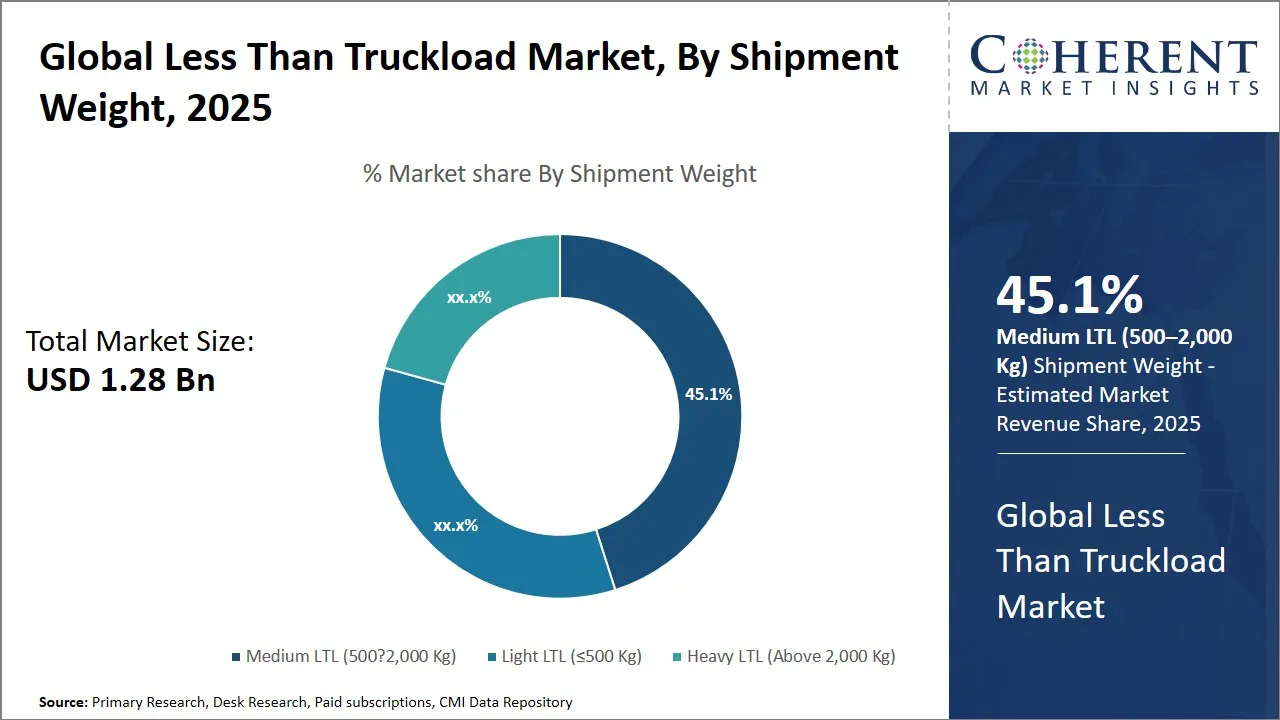
- The medium LTL (500-2,000 Kg) segment is expected to lead the market holding a share of 46.1 % in 2026.
- The retail & e-commerce segment dominates with a share of 21.1 % in 2026.
- North America, holding an expected share of 35.1 % in 2026, and projected to dominate the market.
- Asia Pacific, holding an estimated share of 28.3 % in 2026, and shows the fastest growth in the market.
Market Overview
The market is seeing the use of advanced technologies such as IoT, AI, and automated logistics management systems. These innovations enhance route optimization, real-time tracking, and freight consolidation, improving operational efficiency. Also, the rising adoption of e-commerce and changing consumer expectations for faster deliveries are pushing logistics providers to invest in flexible and scalable LTL services, further adding to the market expansion during the forecast period.
Current Events and Its Impact
Current Events | Description and its Impact |
Infrastructure Investment and Jobs Act (IIJA) — U.S. federal transportation funding (ongoing implementation) |
|
EU Carbon Border Adjustment Mechanism (CBAM) rollout |
|
Global diesel supply chain disruption & fuel-price volatility (sanctions, refinery outages, seasonal demand) |
|
Segmental Insights
- Current Industry Events of 2026
- Market Size Estimation
- Regional Breakdown
- Competitive Landscape
- Customer Intelligence
- Segmental Analysis
- Pricing Analysis
- Key Market Drivers, Challenges & Future Trends
- Customized Insights Section
Global Less Than Truckload Market Insights, By Shipment Weight - Medium LTL (500–2,000 Kg) Leads Because of its Balance of Cost-Efficiency and Flexibility
The medium LTL (500–2,000 Kg) segment, commanding an estimated 46.1% share in 2026, dominates the market because of its balance between cost efficiency and shipment flexibility. It allows businesses to optimize freight expenses while maintaining frequent deliveries, suited for SMEs and manufacturers that depend on lean supply chains and just-in-time logistics.
Advances in transportation management systems (TMS) and real-time tracking, improving route optimization and shipment visibility, add to segment growth. These tools improve reliability, reduce idle time, and support multimodal integration. Sustainability goals further add to the segment, as medium LTL loads maximize truck use and reduce emissions per ton-kilometer. Old Dominion Freight Line reported continued expansion of its “OD-Promise” time-critical LTL services in 2024, targeting medium-weight shipments that need speed and cost balance. The company noted strong uptake from manufacturing and retail clients seeking mid-volume flexibility without full-truckload costs.
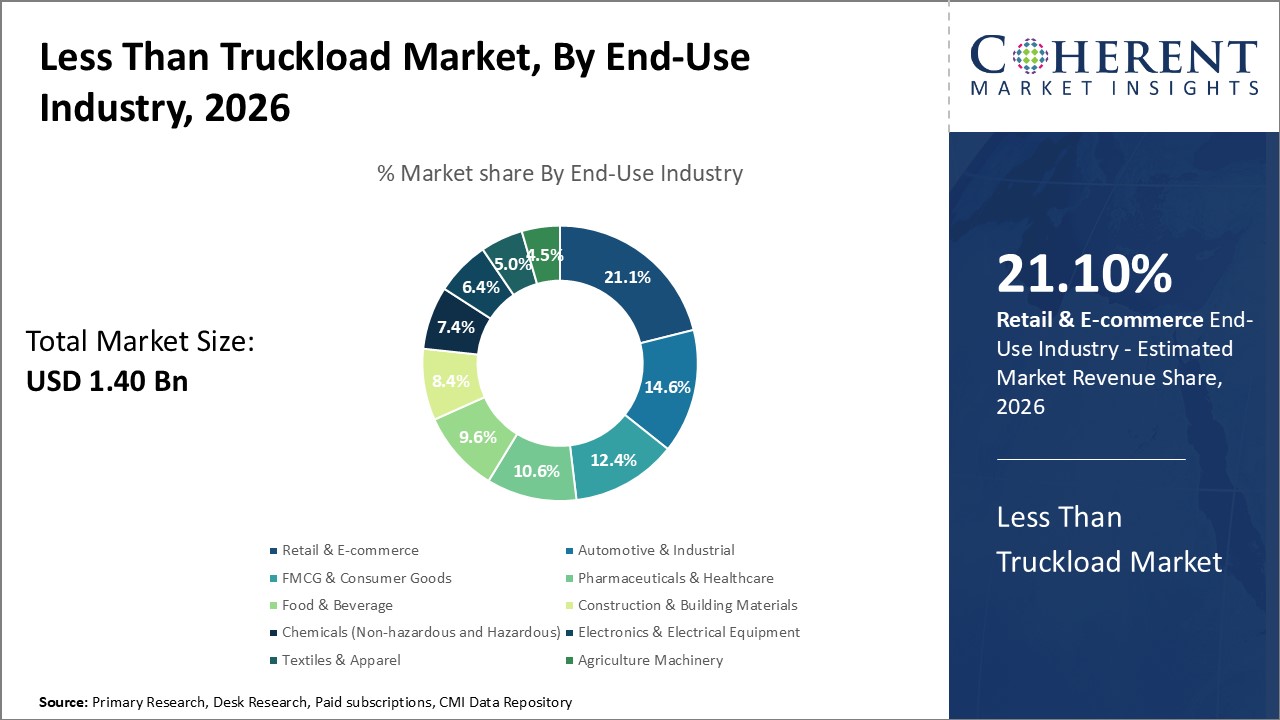
Global Less Than Truckload Market Insights, By End-Use Industry – Retail & E-commerce Leads Due to Changing Consumer Buying Behaviors and Rising Digital Commerce
The retail & e-commerce sector, holding about 21.1% of the market share in 2026, and the largest and fastest-growing LTL end-user segment. The rise in online shopping and omnichannel retail has moved logistics toward frequent, smaller, mixed-SKU shipments—perfectly aligned with LTL service capabilities.
LTL freight supports faster stock replenishment between fulfillment centers and stores, allowing just-in-time inventory models and shorter delivery cycles.
FedEx Freight expanded its “Priority One” LTL service for large e-commerce retailers in North America in 2025, adding predictive delivery windows with warehouse automation systems to support Amazon-style fulfillment speed and visibility.
Pricing Analysis of the Less Than Truckload Market
Shipment Weight Range | Approximate Rate (USD) |
Light LTL (up to ~500 kg) | ~ US $45–60 per 100 lbs (USD 99–132 per 100 kg) |
Medium LTL (500–2,000 kg) | ~ US $30–40 per 100 lbs (USD 66–88 per 100 kg) |
Heavy LTL (>2,000 kg but less than full truckload) | ~ US $20–30 per 100 lbs (USD 44–66 per 100 kg) |
General-Rate Increase (GRI) example | +4.9% effective Nov 2025 (U.S. carrier) |
Regional Insights
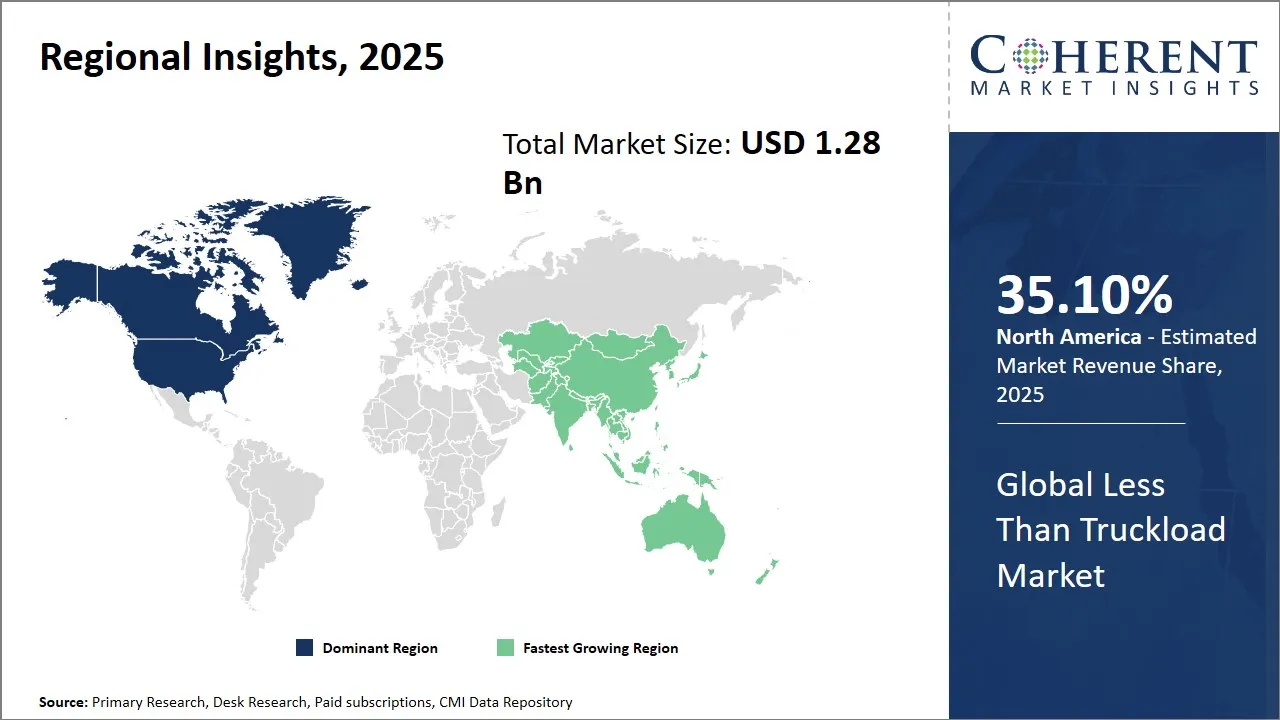
North America Less Than Truckload Market Analysis and Trends
North America, holding a share of 35.1% in 2026, dominates the global less than truckload market because of a highly developed logistics infrastructure, strong industrial base, and advanced technological integration in transportation services. The U.S. plays a big role because of its extensive highway networks, supportive government policies such as investments in transportation infrastructure, and regulatory frameworks that enhance safety and efficiency in freight movement.
The presence of big logistics and transportation companies like FedEx Freight, Old Dominion Freight Line, and XPO Logistics has also added to the region’s leadership by offering comprehensive LTL services with extensive coverage and customer-centric innovations. Also, trade dynamics involving cross-border freight between the United States, Canada, and Mexico under agreements like USMCA fuel consistent demand for efficient regional and international LTL solutions. These factors collectively make a robust ecosystem encouraging market expansion and maintaining North America’s leading position globally.
Asia Pacific Less Than Truckload Market Analysis and Trends
Asia Pacific, holding a share of 28.3% in 2026, shows the fastest growth in the less than truckload market because of fast industrialization, globalization of supply chains, and rising e-commerce penetration. Countries like China, India, and Southeast Asian nations are big contributors to this burgeoning demand, supported by government initiatives aimed at improving road infrastructure and reforming logistics policies to reduce freight costs. The region also sees a growing manufacturing sector and increasing urbanization, making a strong need for flexible and cost-effective freight solutions that LTL transportation offers.
Big players such as YTO Express, ZTO Express, and SF Express in China and India’s Blue Dart Express and DTDC have been growing their LTL networks to capitalize on regional demand. The growing focus on digitization within logistics operations and public-private partnerships enhancing connectivity further add to market growth, making Asia Pacific a highly dynamic and rapidly evolving market.
Global Less Than Truckload Market Outlook for Key Countries
U.S. Less Than Truckload Market Analysis and Trends
The U.S. is a global powerhouse in the less than truckload market, with a competitive landscape dominated by industry leaders like FedEx Freight, Old Dominion, and Estes Express Lines. These companies invest a lot in service network expansion, technology integration, and sustainability initiatives, which highly enhance operational efficiencies and customer satisfaction. The U.S. government’s continuous investments in maintaining and upgrading the national highway infrastructure also support the smooth movement of LTL freight across vast geographies, reinforcing the country’s market leadership position.
China Less Than Truckload Market Analysis and Trends
China less than truckload market sees fast industrial growth and the government’s focus on logistics modernization as part of its broader Belt and Road Initiative. Growing firms such as SF Express, YTO Express, and JD Logistics are leveraging innovative warehousing solutions and last-mile delivery capabilities to improve service offerings. Also, technology adoption like AI-driven route optimization and electronic documentation streamlines processes, attracting more shippers to choose LTL solutions over traditional full truckload shipments.
India Less Than Truckload Market Analysis and Trends
India less than truckload market is growing in response to rising demand from burgeoning small- and medium-sized enterprises and the rise in e-commerce activities. Big players including Blue Dart Express, DTDC, and SafeExpress have made extensive LTL networks covering both urban and rural areas. Government reforms focusing on logistics efficiency, such as the Goods and Services Tax (GST) and infrastructure projects like the Dedicated Freight Corridors, are enabling faster and more cost-effective movement of goods, creating adoption of LTL services.
Germany Less Than Truckload Market Analysis and Trends
Germany continues to lead Europe less than truckload market because of a well-established logistics infrastructure and strategic location in the heart of the continent. Companies like DHL Freight, DB Schenker, and Dachser operate sophisticated LTL networks that cater to intra-European trade flows. Strong governmental policies promoting digitalization in logistics and sustainability measures are encouraging innovation and greener transportation modes, enhancing service reliability and attractiveness for regional shippers.
Brazil Less Than Truckload Market Analysis and Trends
Brazil less than truckload market growth grows because of increasing industrial output and improvements in road connectivity across the country. Firms such as JSL Logística and Tegma Gestão Logística play a big role by offering integrated freight and logistics solutions tailored to complex regional requirements. Despite challenges like infrastructure bottlenecks in certain areas, government investments in logistics modernization and trade facilitation are making a more favorable environment for less than truckload market expansion.
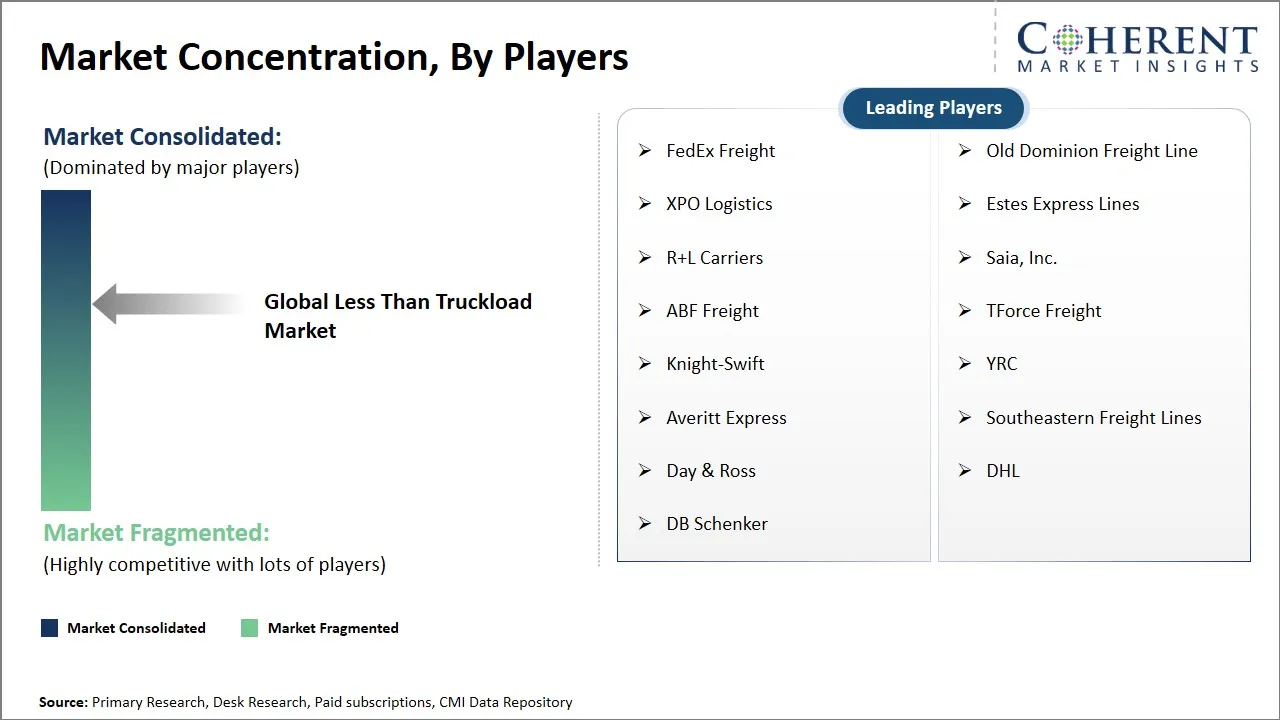
Market Players, Key Development, and Competitive Intelligence
Key Developments
- On October 6, 2025, FedEx, appointed former company executive Mr. Marshall Witt as the finance chief of its freight trucking unit, completing the leadership team for the division that is set to spin off in June 2026.
- In March 2025, Estes, the largest, privately owned freight carrier in North America, recently became a member of Smart Freight Centre (SFC), a globally recognized nonprofit dedicated to reducing emissions and making freight transportation more sustainable.
- In February 2025, Old Dominion Freight Line announced plans to invest USD 575 million in its less-than-truckload (LTL) network in 2025.
- In November 2024, TFI International bought truckload and less-than-truckload carrier Keystone Western for an undisclosed sum. Keystone Western specializes in dry van, flatbed and heavy haul carriage.
Top Strategies Followed by Less Than Truckload Market Players
- Established industry leaders invest a lot in research and development (R&D) to innovate and deliver high-performance products that meet evolving customer demands.
- FedEx Freight and Old Dominion Freight Line have both invested in AI-driven dynamic routing and automated freight handling systems.
- Mid-level players in the less than truckload market use differentiated strategies centered on providing cost-effective solutions that strike a balance between quality and affordability.
- Saia, Inc. and Estes Express Lines have put in place zone-based pricing models and regional service expansions to reduce shipping costs for SMEs.
- Small-scale players carve out unique positions within the global less than truckload market by concentrating on specialized features or innovative products that differentiate them from larger competitors.
- Day & Ross and Custom Companies Inc. focus on white-glove and temperature-sensitive LTL segments, offering specialized handling and delivery for high-value or delicate goods.
Market Report Scope
Less Than Truckload Market Report Coverage
| Report Coverage | Details | ||
|---|---|---|---|
| Base Year: | 2025 | Market Size in 2026: | USD 1.40 Bn |
| Historical Data for: | 2020 To 2024 | Forecast Period: | 2026 To 2033 |
| Forecast Period 2026 to 2033 CAGR: | 9.5% | 2033 Value Projection: | USD 2.65 Bn |
| Geographies covered: |
| ||
| Segments covered: |
| ||
| Companies covered: | FedEx Freight, Old Dominion Freight Line, XPO Logistics, Estes Express Lines, R+L Carriers, Saia, Inc., ABF Freight, TForce Freight, Knight-Swift, YRC, Averitt Express, Southeastern Freight Lines, Day & Ross, DHL, and DB Schenker | ||
| Growth Drivers: |
| ||
| Restraints & Challenges: |
| ||
Market Dynamics
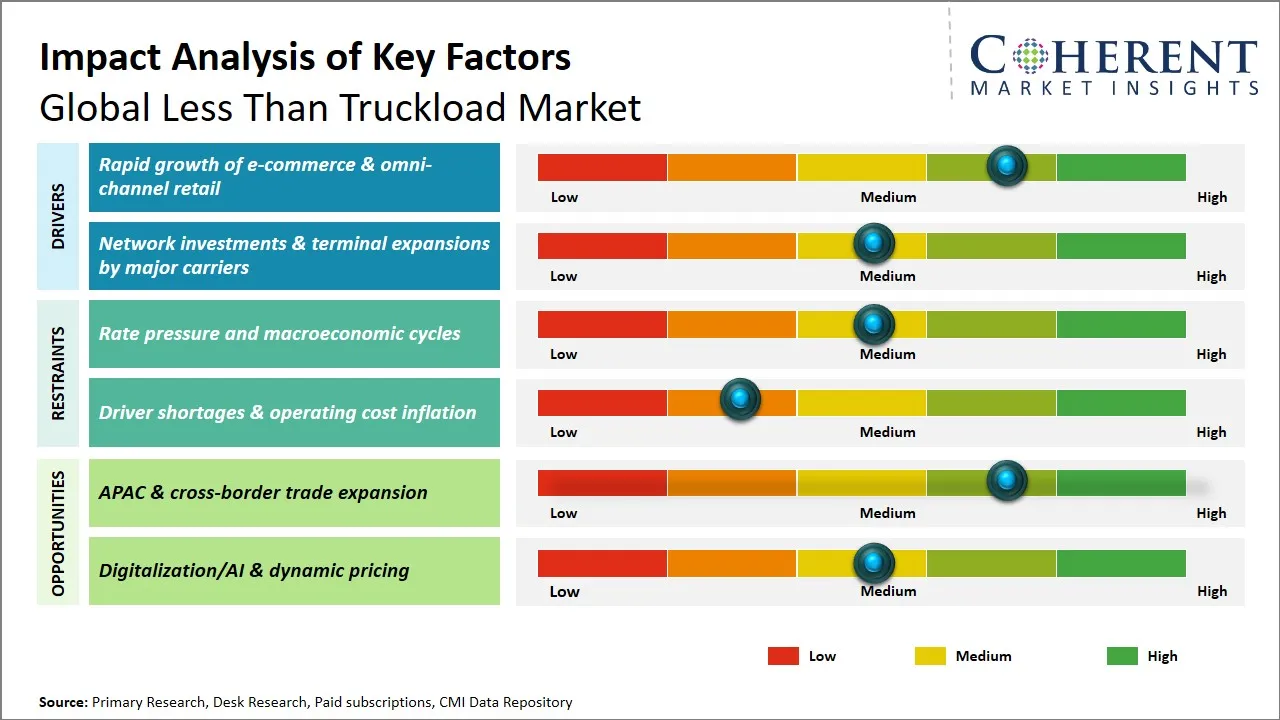
Global Less Than Truckload Market Driver – Rapid Growth of E-Commerce & Omni-Channel Retail
The surge in e-commerce and omni-channel retailing has sharply increased demand for LTL services, as retailers now manage higher shipment frequency and smaller order sizes across multiple distribution channels. LTL’s ability to consolidate partial loads allows faster, more cost-efficient delivery while supporting just-in-time inventory strategies needed for online retail operations. As omni-channel models expand, linking online orders, store pickups, and warehouse replenishment, retailers depend on agile LTL networks to manage fragmented fulfillment flows.
FedEx Freight launched its Priority One service in 2024 to support retailers like Walmart and Target in managing smaller, high-frequency e-commerce replenishments.
Global Less Than Truckload Market Opportunity – APAC & Cross-Border Trade Expansion
The Asia Pacific (APAC) region is becoming a major growth hub for the less than truckload market because of industrialization, booming e-commerce, and expanding cross-border trade under the RCEP framework. Modern logistics parks, digital freight platforms, and improved road connectivity are making LTL more viable for small and mid-sized consignments moving between markets like China, India, Vietnam, and Australia. As manufacturing relocates toward Southeast Asia, LTL networks are being strengthened to support shorter-haul, intra-regional shipments and export-oriented production.
DB Schenker expanded its cross-border LTL service between China and ASEAN nations in 2025, leveraging new logistics hubs in Thailand and Vietnam. This initiative reduced average transit times by 20% and directly tapped into rising regional trade volumes under RCEP.
Analyst Opinion (Expert Opinion)
- The less than truckload market is caught in a profitability squeeze. With rising operational costs—fuel, labor, and equipment maintenance—paired with aggressive rate competition among carriers, maintaining healthy margins has become increasingly difficult. Analysts argue that many mid-tier players are undercutting prices to retain contracts, which may drive short-term volume gains but erodes long-term financial sustainability.
- Despite advances in logistics technology, outdated road networks, inconsistent freight handling infrastructure, and congestion in urban delivery zones continue to hamper efficiency. In emerging markets especially, fragmented logistics networks lead to longer transit times and higher last-mile delivery costs—challenges that the industry has been slow to structurally address.
- While leading players are investing in AI-driven route optimization and real-time shipment visibility, a large portion of the LTL ecosystem remains technologically laggard. The lack of digital integration between shippers, carriers, and 3PLs limits transparency and operational coordination. This digital divide is stifling scalability and leaving smaller operators vulnerable to being outpaced by tech-savvy competitors and digital freight platforms.
Speak to the analyst
Want personalized insights?
Take the findings above to one of our principal consultants, or have the report rebuilt around the segments, geographies and competitors you actually track.
Market Segmentation
- Shipment Weight Insights (Revenue, USD Bn, 2021 - 2033)
- Medium LTL (500–2,000 Kg)
- Light LTL (≤500 Kg)
- Heavy LTL (Above 2,000 Kg)
- End-Use Industry Insights (Revenue, USD Bn, 2021 - 2033)
- Retail & E-commerce
- Automotive & Industrial
- FMCG & Consumer Goods
- Pharmaceuticals & Healthcare
- Food & Beverage
- Construction & Building Materials
- Chemicals (Non-hazardous and Hazardous)
- Electronics & Electrical Equipment
- Textiles & Apparel
- Agriculture Machinery
- Regional Insights (Revenue, USD Bn, 2021 - 2033)
- North America
- U.S.
- Canada
- Latin America
- Brazil
- Argentina
- Mexico
- Rest of Latin America
- Europe
- Germany
- U.K.
- Spain
- France
- Italy
- Russia
- Rest of Europe
- Asia Pacific
- China
- India
- Japan
- Australia
- South Korea
- ASEAN
- Rest of Asia Pacific
- Middle East
- GCC Countries
- Israel
- Rest of Middle East
- Africa
- South Africa
- North Africa
- Central Africa
- North America
- Key Players Insights
- FedEx Freight
- Old Dominion Freight Line
- XPO Logistics
- Estes Express Lines
- R+L Carriers
- Saia, Inc.
- ABF Freight
- TForce Freight
- Knight-Swift
- YRC
- Averitt Express
- Southeastern Freight Lines
- Day & Ross
- DHL
- DB Schenker
Sources
Primary Research Interviews
Stakeholders
- Freight Forwarding Companies and Logistics Service Providers
- Trucking Companies and Fleet Operators
- Third-Party Logistics (3PL) Providers and Freight Brokers
- Supply Chain Managers in Retail, Manufacturing, and E-commerce Firms
- Customs and Cross-Border Trade Officials
- Transportation and Freight Policy Regulators
- Technology Solution Providers (TMS, Telematics, and Route Optimization Software Developers)
- Warehousing and Distribution Center Managers
Databases
- U.S. Bureau of Transportation Statistics (BTS)
- Eurostat
- UNCTAD Freight Statistics
- Transport Intelligence (Ti) Database
- World Bank Logistics Performance Index
- OECD Transport Database
Magazines
- Transport Topics
- Logistics Management Magazine
- Freight Business Journal (FBJ)
- Supply Chain Digital
- Global Transport Update
- Modern Materials Handling
Journals
- International Journal of Physical Distribution & Logistics Management
- Journal of Transport Geography
- Maritime Economics & Logistics
- Transportation Research Part E: Logistics and Transportation Review
- Journal of Supply Chain Management and Logistics
Newspapers
- The Wall Street Journal (Logistics Section)
- The Economic Times (India)
- The Guardian (Business & Transport Section)
- Financial Express (India)
- Logistics Insight Asia
- Transport News International
Associations
- American Trucking Associations (ATA)
- International Road Transport Union (IRU)
- National Private Truck Council (NPTC)
- Freight Transport Association (FTA) – UK
- Canadian Trucking Alliance (CTA)
- Asia-Pacific Logistics Federation (APLF)
- European Logistics Association (ELA)
Public Domain Sources
- U.S. Department of Transportation (DOT)
- EUROSTAT
- World Bank
- United Nations Economic Commission for Europe (UNECE)
- ResearchGate
- International Transport Forum (ITF)
- World Trade Organization (WTO) Logistics Reports
Proprietary Elements
- CMI Data Analytics Tool, Proprietary CMI Existing Repository of Information for Last 8 Years
Get access to 250+ pages report
Every segment, forecast, competitor profile and data table behind the analysis above — available for instant download.
- ESOMAR Member
- ISO 9001:2015 Certified
- D-U-N-S Registered
- GDPR & CCPA Compliant
Missing comfort of reading report in your local language? Find your preferred language:
Transform your Strategy with Exclusive Trending Reports
Frequently Asked Questions
The global less than truckload market is estimated to be valued at USD 1.40 billion in 2026 and is expected to reach USD 2.65 billion by 2033.
The CAGR of the global less than truckload market is projected to be 9.5% from 2026 to 2033.
Rapid growth of e-commerce & omni-channel retail and network investments & terminal expansions by major carriers are the major factor driving the growth of the global less than truckload market.
Rate pressure and macroeconomic cycles and driver shortages & operating cost inflation are the major factor hampering the growth of the global less than truckload market.
In terms of shipment weight, the medium LTL (500–2,000 Kg) is estimated to dominate the market revenue share in 2026.
The LTL market involves transporting small freight shipments that don’t require a full truckload, combining goods from multiple shippers in one vehicle.
Technologies like AI-based route optimization, TMS platforms, and real-time tracking are improving efficiency and transparency.