

Global Liqueurs Market Size and Forecast – 2026 To 2033
The global liqueurs market is estimated to be valued at USD 132.78 Bn in 2026 and is expected to reach USD 173.56 Bn by 2033, growing at a compound annual growth rate (CAGR) of 3.9% from 2026 to 2033. Market expansion is supported by consumer interest in premium and flavor-led liqueurs, wider retail and on-trade availability, and product innovation that creates new cocktail and after-dinner consumption occasions. Producers are increasingly combining established liqueur categories with differentiated fruit, coffee, botanical, and indulgent flavor profiles to broaden consumer choice.
In June 2026, Luxardo introduced Luxardo Decaf Espresso Liqueur exclusively in the U.S., using Arabica coffee beans and a decaffeinated formulation designed to expand espresso-based cocktail consumption into additional day and evening occasions. The launch illustrates how established liqueur producers are using formulation innovation to address evolving consumption preferences while creating new usage occasions within premium coffee liqueurs.
Key Takeaways of the Global Liqueurs Market
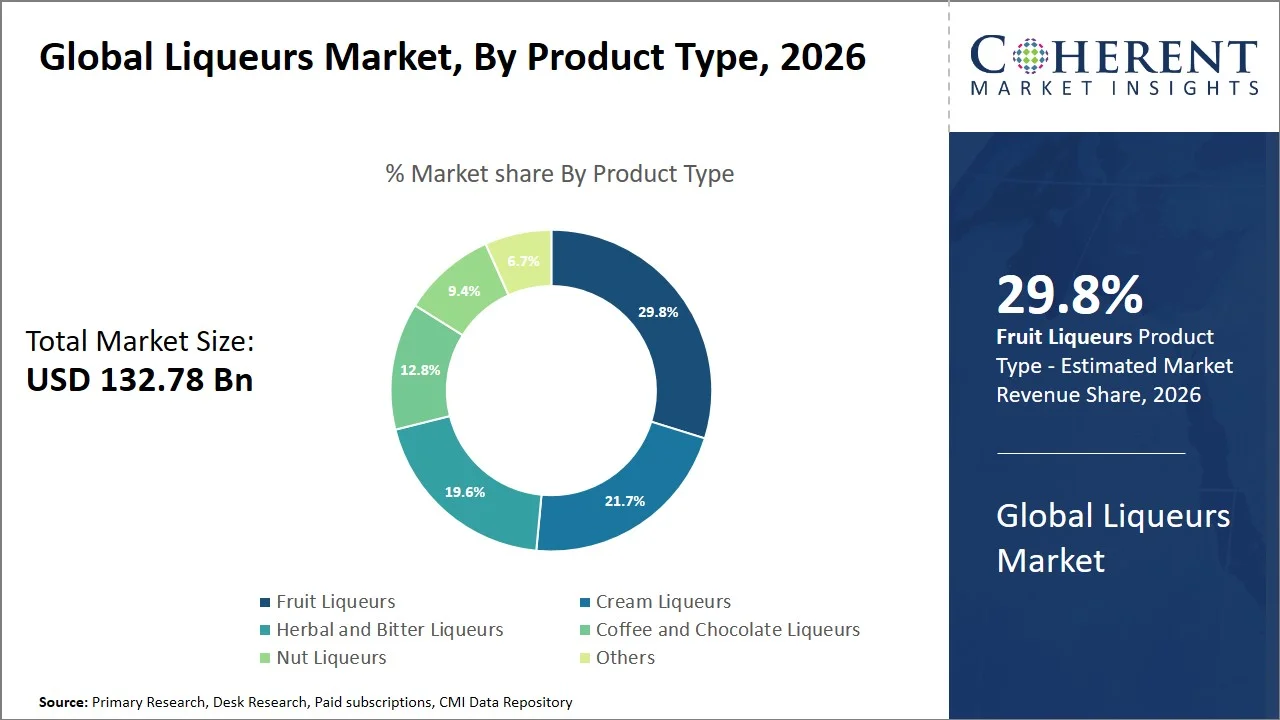
- Fruit Liqueurs are estimated to expand at a CAGR of 4.3% during 2026–2033 and are expected to hold 29.8% of the global liqueurs market in 2026. Their lead reflects cocktail versatility, recognizable citrus and tropical profiles, and frequent flavor innovation across retail and bars. In April 2025, Lucas Bols launched Bols Blue 1575, a 29.5% ABV orange-peel-based Blue Curaçao for U.S. retail and hospitality channels.
- 15% to 30% ABV liqueurs are projected to record an estimated 4.1% CAGR during 2026–2033 while representing 54.6% of the market in 2026. The band balances flavor intensity, mixability, and session-friendly consumption better than many higher-proof alternatives. In October 2025, Kahlúa promoted its new Dunkin’ Caramel Swirl Cream Liqueur nationwide in the U.S.; the product is bottled at 16% ABV.
- Mass liqueurs are expected to advance at an estimated CAGR of 3.5% during 2026–2033 and capture 48.8% of global revenue in 2026. Their scale rests on familiar brands, wide grocery and convenience placement, gifting occasions, and lower purchase barriers than premium or luxury bottles. In September 2025, Diageo rolled Baileys x Terry’s Chocolate Orange Irish Cream Liqueur into major UK grocers, Amazon, Co-op, and selected Greene King venues.
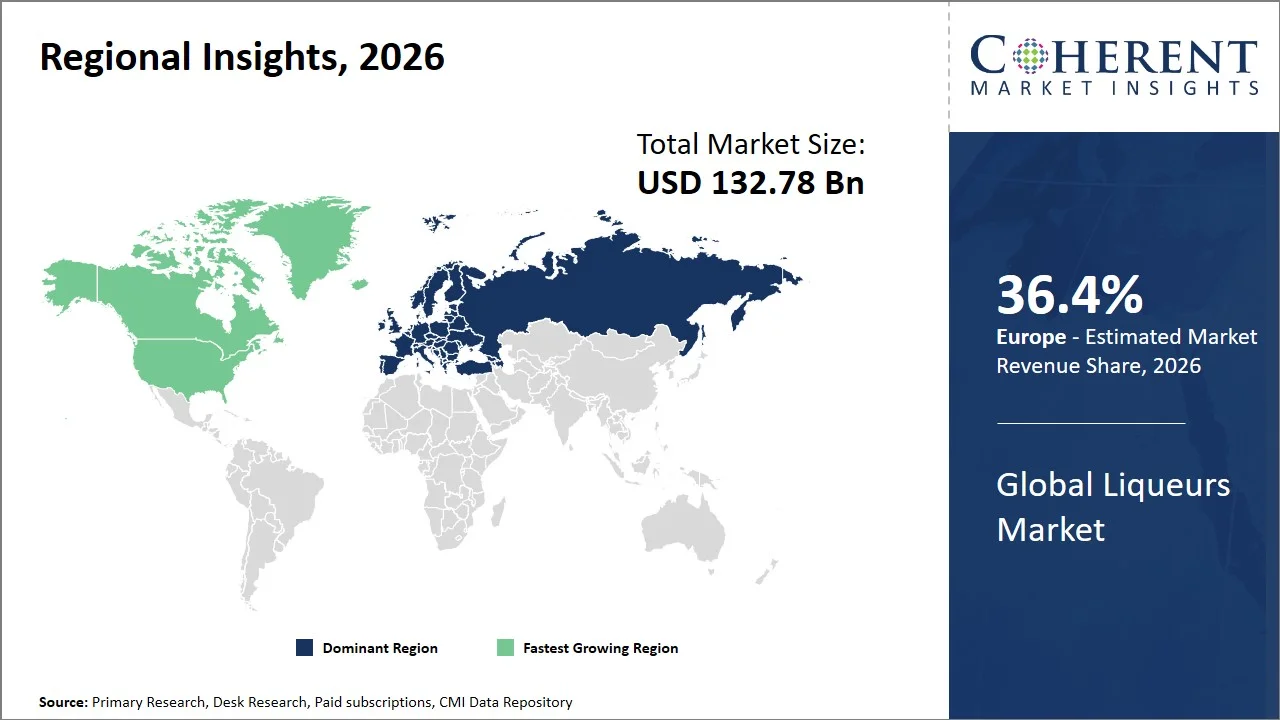
- Europe is projected to grow at an estimated 3.5% CAGR during 2026–2033 while accounting for 36.4% of the global liqueurs market in 2026. Leadership reflects established liqueur-producing countries, mature cocktail and aperitif cultures, dense hospitality networks, and strong export capability. In April 2025, Eurostat reported that EU exports of spirits and liqueurs reached USD 10.31 billion in 2024, reinforcing the region’s production depth and international reach.
- North America is estimated to post the fastest regional CAGR of 4.7% during 2026–2033 and hold 28.6% of the global liqueurs market in 2026. Expansion is supported by cocktail-led consumption, strong off-premise access, flavor experimentation, and brand investment around convenient serves. In July 2025, Rémy Cointreau reported significant U.S. growth in Liqueurs & Spirits, supported by Cointreau, while the division rose 17.3% organically.
Segmental Insights
Why Do Fruit Liqueurs Dominate the Global Liqueurs Market?
Fruit Liqueurs are expected to lead the product-type category with expected share 29.8% in 2026 because they combine broad flavor familiarity with strong formulation flexibility across cocktails, spritzes, shots, desserts, and neat serves. Producers can work with citrus, tropical, berry, stone-fruit, and orchard profiles, allowing portfolios to respond quickly to seasonal preferences without changing the basic liqueur production platform. Their sensory accessibility also lowers the trial barrier for consumers who may find herbal or bitter variants more polarizing. For manufacturers and distributors, this creates repeat innovation opportunities across both on-trade menus and retail shelves while supporting differentiated premium and mainstream offerings. In June 2026, Chinola Fresh Fruit Liqueurs introduced Chinola Guava Liqueur, crafted from fresh pink guava and positioned for cocktails and sipping, extending its tropical portfolio beyond passion fruit, mango, and pineapple.
- Current Industry Events of 2026
- Market Size Estimation
- Regional Breakdown
- Competitive Landscape
- Customer Intelligence
- Segmental Analysis
- Pricing Analysis
- Key Market Drivers, Challenges & Future Trends
- Customized Insights Section
Why Does 15% to 30% ABV Represent the Largest Alcohol Content Segment in the Global Liqueurs Market?
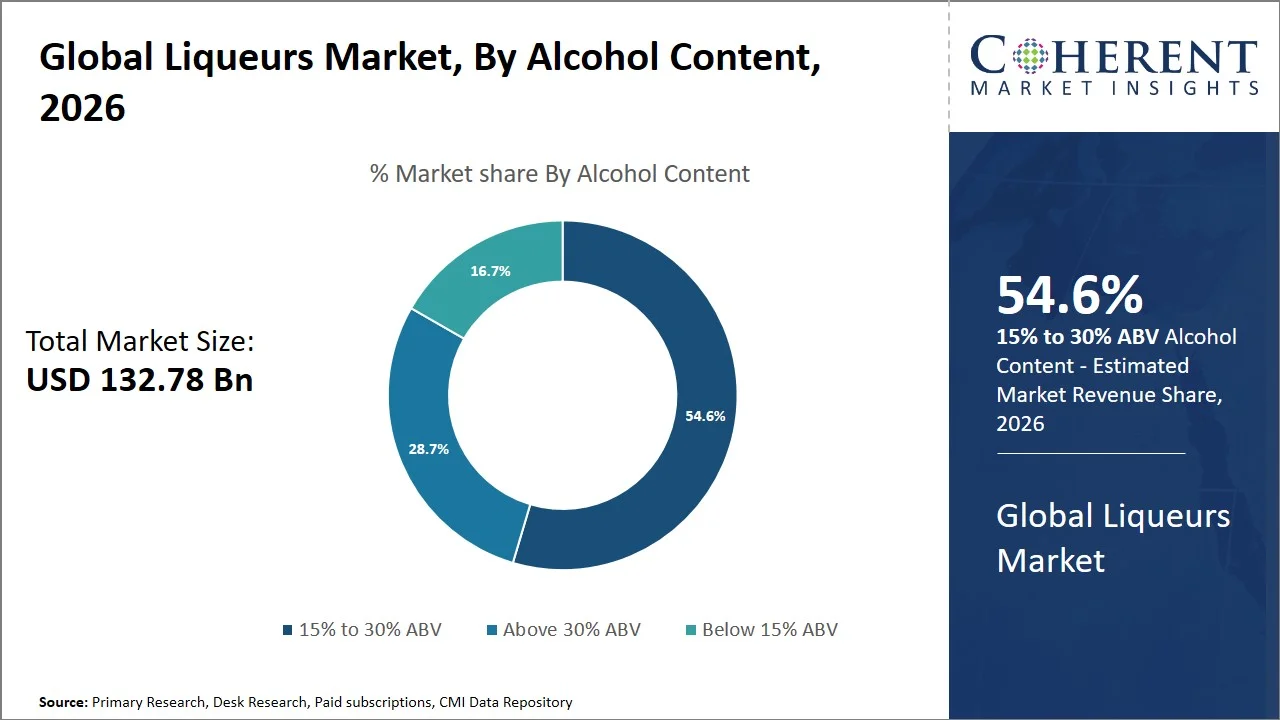
The 15% to 30% ABV segment is expected to remain the largest alcohol-content category with expected market share 54.6% in 2026 because this strength range gives liqueur producers enough alcohol to carry flavor and maintain product stability while remaining more approachable than many full-strength base spirits. It is particularly compatible with cream, fruit, coffee, citrus, and cocktail-oriented formulations where the liqueur acts as a flavor modifier rather than the primary alcohol component. The range also suits chilled shots, spritz-style serves, long drinks, and home mixing, widening consumption occasions. From a supply perspective, producers can adjust sweetness, texture, and flavor concentration within this band without sacrificing recognizable liqueur character. In June 2026, Stock Spirits Group launched Sierra Lime at 18% ABV in Germany across retail and on-trade channels, combining lime, sweetness, and mild chili while positioning the product for social and mixed-drink occasions.
Why Does the Mass Segment Dominate the Price Range of the Global Liqueurs Market?
Mass-priced liqueurs are expected to dominate the price-range category with expected 48.8% share in 2026 because accessible shelf pricing allows consumers to experiment with flavors without the commitment associated with premium or luxury bottles. This is especially important in off-trade channels, where purchase decisions are influenced by promotional visibility, seasonal occasions, gifting budgets, and the ability to use one bottle across cocktails, desserts, coffee, or simple over-ice serves. Large retailers also give mass products efficient national distribution, rapid stock rotation, and frequent opportunities for limited-edition flavor testing. Manufacturers that combine reliable contract production, cost-controlled packaging, and fast flavor refreshes are positioned to benefit from this model. In May 2025, Aldi launched three Ballycastle dessert-inspired country cream liqueurs in England and Wales at USD 8.68 per 70cl bottle, demonstrating how low entry pricing and supermarket availability can broaden trial across seasonal liqueur occasions.
Current Events and their Impact
Current Event | Description and Its Impact |
February 2026 – UK Alcohol Duty Rates Uprated |
|
January 2025 – U.S. TTB Expanded Distilled Spirits Standards of Fill |
|
September 2025 – Ireland Amended Alcohol Health-Labelling Implementation Timetable |
|
Global Liqueurs Market Dynamics
Key Market Drivers
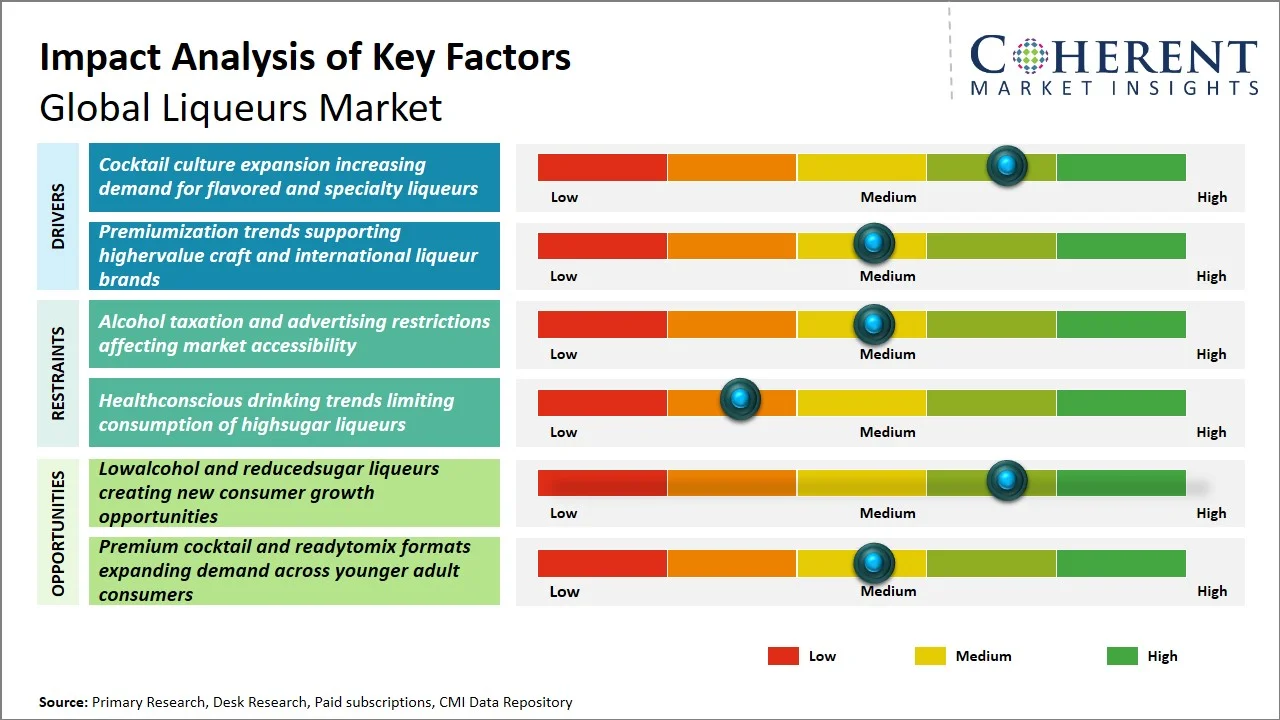
- Cocktail culture expansion increasing demand for flavored and specialty liqueurs: Cocktail culture is expanding the role of liqueurs beyond after-dinner consumption into spritzes, highballs, and signature mixed drinks. Flavored liqueurs let bartenders add aroma, sweetness, bitterness, or fruit character efficiently, while familiar recipes support at-home cocktail preparation. This benefits brand owners, specialist producers, distributors, and on-trade operators by creating multiple consumption occasions for the same bottle. In May 2026, Bacardi launched a global ST-GERMAIN campaign centered on the ST-GERMAIN Spritz and reported increased worldwide Google search interest for the serve during 2025, reinforcing the commercial relevance of liqueur-led cocktails.
- Premiumization trends supporting higher value craft and international liqueur brands: Premiumization is shifting competition toward provenance, distinctive recipes, imported credentials, and products that justify higher shelf and menu pricing. Consumers are trading up through gifting, curated cocktails, specialty retail, and higher-value botanical, citrus, coffee, and dessert-style liqueurs. International producers particularly benefit from importers offering compliant market access, bartender education, and selective distribution. In August 2025, Monika Alcobev launched Zamora Company’s Licor 43 in India, initially introducing the Spanish liqueur in Goa and Mumbai alongside Chocolate and Crème Brûlée variants, highlighting targeted expansion of premium international liqueur portfolios through urban retail and hospitality channels.
Emerging Market Trends
- Drier and More Structured Flavor Architecture Is Redefining Liqueur Formulation: Drier and more structured flavor profiles are changing how liqueurs are formulated and positioned. Producers are balancing sweetness with bitterness, acidity, spice, tea, floral notes, and savory botanicals to support aperitif, food-pairing, and cocktail occasions. This places greater emphasis on aroma release, mouthfeel, stability, and intended serve rather than sweetness alone. Flavor houses, botanical suppliers, and specialist distillers can benefit from more precise flavor layering, while legacy sweet-profile brands may need sharper occasion positioning. Over the forecast period, successful innovation is likely to focus on recognizable flavor direction and controlled complexity, allowing liqueurs to expand into broader consumption occasions while retaining their distinctive indulgent character.
- Cross-Category Hybridization Is Reshaping Liqueur Portfolio Architecture: Cross-category hybridization is encouraging liqueurs to adopt cues from coffee, confectionery, whisky, agave spirits, aperitifs, and culinary ingredients. Rather than adding flavors purely for novelty, producers are creating products that bridge established drinking occasions and offer retailers and bartenders clearer reasons for trial. This favors companies with flexible formulation, sensory testing, and regulatory-classification capabilities, as hybrid products can create challenges around ingredients, alcohol strength, stability, and communication. Smaller specialists may lead unusual combinations, while larger groups can scale successful concepts through wider distribution. Over the forecast period, innovation is likely to shift toward occasion-specific extensions with repeatable serves rather than short-lived flavor launches.
Regional Insights
Why Does Europe Dominate the Global Liqueurs Market?
Europe is expected to retain leadership with an expected market share of 36.4% in 2026 for the global liqueurs market because the region combines deep production heritage with established aperitif, digestif, cocktail, and after-dinner consumption occasions. Italy, France, Germany, the Netherlands, and other European markets support a broad supplier base spanning fruit liqueurs, herbal bitters, cream liqueurs, limoncello-style products, and cocktail modifiers. Dense hospitality networks and mature specialist retail also help established brands maintain visibility while regional producers monetize provenance and traditional recipes. Europe’s regulatory framework further supports origin-based differentiation, which is commercially important for heritage spirits competing at premium price points. In May 2024, the European Commission’s new geographical-indications regulation for wine, spirit drinks, and agricultural products entered into force, strengthening GI protection, including online protection and protection when GIs are used as ingredients. This reinforces brand authenticity and export defensibility for qualifying European spirit producers.
Why Is North America Emerging as the Fastest-Growing Region in the Global Liqueurs Market?
North America is expected to be the fastest-growing region with an expected 28.6% share in the global liqueurs market as cocktail experimentation, flavored alcoholic beverages, and convenient mixed-drink formats expand the number of occasions in which liqueurs are used. The U.S. provides a particularly large bartender, restaurant, retail, and home-mixology ecosystem, while consumers increasingly encounter liqueurs through familiar dessert, fruit, coffee, and botanical flavor cues rather than traditional after-dinner consumption alone. This gives suppliers room to recruit younger legal-age consumers through accessible serves and cross-category flavor innovation. The region also benefits from strong distributor networks capable of scaling new brands rapidly across major metropolitan markets. In February 2026, the Distilled Spirits Council reported that U.S. spirits-based ready-to-drink cocktail sales reached USD 3.8 billion in 2025, rising 16.4%, highlighting strong commercial momentum around convenient cocktail occasions that can also expand liqueur usage.
Global Liqueurs Market Outlook for Key Countries
Why Is Italy a Key Market for the Global Liqueurs Market?
Italy is a key country for the global liqueurs market because liqueurs are closely embedded in its aperitivo and digestive culture, supported by internationally recognized bitter, citrus, herbal, and nut-based products. Domestic producers benefit from established botanical sourcing, extraction know-how, distinctive regional recipes, and a hospitality system where pre-dinner and after-meal serves create regular consumption occasions. Italy also functions as an export platform for brands that translate local drinking rituals into globally recognizable cocktails, giving manufacturers scale beyond domestic demand. Production investment therefore remains commercially important for both branded liqueurs and aperitif-style products. In April 2024, Campari Group inaugurated a new Aperol bottling line at its Novi Ligure facility as part of an expansion planned to reach USD 86.91 million, increasing the plant’s annual capacity by 100 million bottles. The investment demonstrates continued confidence in Italy-based production serving international aperitif demand.
Why Is the U.S. Important in the Global Liqueurs Market?
The U.S. is important to the global liqueurs market because product discovery is strongly linked to cocktails, entertainment occasions, sports partnerships, restaurant menus, and large-format retail distribution. Liqueurs can participate in multiple need states from shots and mixed drinks to coffee, dessert, and seasonal serves allowing brand owners to build frequency without relying on neat consumption. The market also rewards recognizable flavors and brands that can connect with specific consumer communities through experiential marketing. For suppliers, success depends on distributor reach, bartender advocacy, and sustained activation rather than shelf presence alone. In May 2025, Heaven Hill Brands and UFC announced a multiyear U.S. marketing partnership for Hpnotiq, making the blue liqueur an official UFC partner across selected events, including Fight Nights. The agreement illustrates how liqueur brands are using high-reach cultural platforms to renew relevance among millennial and Gen Z legal-age consumers.
Why Is France Important in the Global Liqueurs Market?
France remains an important country in the global liqueurs market because its spirits ecosystem combines fruit-growing regions, botanical traditions, distillation expertise, gastronomic positioning, and a well-developed export infrastructure. French producers cover styles ranging from fruit and herbal liqueurs to orange, elderflower, coffee, and regional specialty expressions, supporting both cocktail bars and premium retail. The country’s restaurant and culinary culture also favor liqueurs as cocktail ingredients, digestifs, and flavor components in food-led occasions. Export capability is strategically important because smaller specialist producers can access international buyers through an established national spirit’s trade network. In June 2026, FranceAgriMer reported that France was the world’s leading exporter of wines and spirits in 2025, with exports valued at USD 18.77 billion and a 16.4% global share. This broader export strength provides liqueur producers with mature logistics, importer relationships, and international market access.
Why Does China Support Growth in the Global Liqueurs Market?
China supports growth in the global liqueurs market through expanding urban consumption, premium hospitality, imported-spirit availability, and growing interest in cocktails built around fruit, citrus, coffee, cream, and herbal flavor profiles. Liqueurs can fit the market particularly well where consumers prefer sweeter or more aromatic entry points into Western-style mixed drinks rather than high-proof spirits consumed neat. International producers benefit from premium bars, hotels, specialty retailers, and distributors concentrated in major cities, while local operators can adapt serves to regional tastes. Trade performance also indicates scope for imported liqueur portfolios despite a selective consumer environment. In December 2025, Federvini reported that Italian exports of spirits, liqueurs, and grappa to China increased 94.1% during the first nine months of 2025. The increase highlights China’s capacity to absorb distinctive imported spirit categories when brands combine provenance with targeted distribution and consumer education.
Why Is India an Important Growth Market for the Global Liqueurs Market?
India is becoming increasingly relevant to the global liqueurs market as younger legal-age consumers, premium bars, destination restaurants, and home-mixology occasions create room for flavor-led products beyond whisky-dominated consumption. The country offers particular potential for citrus, coffee, cream, fruit, and botanical liqueurs that can be used in approachable cocktails and dessert-linked serves. Local bottling and formulation can also improve affordability versus fully imported products, an important advantage in a market shaped by state-level excise structures and varying retail economics. Distribution expansion must therefore be sequenced state by state. In 2025, the Wine & Spirits Club of India reported that homegrown Mikiamo Limoncello expanded into Karnataka in May and Delhi and Haryana in July after its Goa launch, reaching more than 200 liquor stores, supermarkets, and specialty outlets. The rollout shows how locally bottled liqueurs can widen access while retaining an international flavor proposition.
Why Is South Korea a Strategic Growth Market for the Global Liqueurs Market?
South Korea is an important growth market for the global liqueurs market because its dense urban hospitality sector, café-inspired flavor culture, and sophisticated cocktail scene create receptive occasions for fruit, coffee, chocolate, floral, and herbal liqueurs. Seoul’s premium bars and restaurants provide discovery points for imported brands, while consumers familiar with flavored beverages can transition into lower- or mid-strength cocktail modifiers more easily than into unfamiliar high-proof spirits. Importers and distributors therefore gain value from portfolios that offer distinctive flavors with clear serving suggestions. Market entry also benefits from trade events that connect foreign producers with local buyers. In November 2025, Business France’s Tastin’France South Korea program in Seoul showcased hundreds of French beverage products, including multiple Combier liqueurs such as elderflower, rose, passion fruit, chocolate-mint, and orange triple sec. The assortment illustrates the breadth of liqueur propositions being presented directly to Korean trade buyers.
Technology Adoption Landscape in the Global Liqueurs Market
Technology | Adoption Level | Key Application Area | Business Impact |
Controlled Botanical Maceration and Percolation Systems | High | Extraction of herbs, spices, citrus peel, roots, fruits, and botanicals | Improves extraction consistency and allows producers to control flavor intensity, batch repeatability, and ingredient utilization. |
Vacuum Distillation and Low-Temperature Aroma Recovery | Medium | Delicate fruit, floral, citrus, and botanical flavor fractions | Limits thermal degradation of volatile aroma compounds and supports cleaner, more precise premium flavor profiles. |
Gravimetric Dosing and Recipe-Controlled Blending | High | Alcohol, sugar syrup, flavor concentrate, water, and color addition | Reduces formulation variance, improves batch scalability, and supports efficient changeovers across multi-SKU portfolios. |
High-Pressure Homogenization | Medium | Cream, dairy-based, and plant-based emulsion liqueurs | Creates finer emulsions, improves texture consistency, and reduces separation risks during shelf life. |
Crossflow Membrane Filtration | Medium | Clarification and stabilization of fruit and botanical liqueurs | Improves visual clarity and process efficiency while reducing reliance on disposable filtration media and repeated processing. |
Inline Density, ABV, and Brix Measurement | High | Final blending, proof adjustment, sugar control, and quality assurance | Enables faster batch verification, reduces laboratory rework, and strengthens consistency against recipe and regulatory specifications. |
How Are Dairy-Free Emulsion Systems Creating New Growth Opportunities in the Global Liqueurs Market?
Plant-based cream liqueurs represent an underdeveloped opportunity to extend indulgent liqueur occasions beyond conventional dairy formulations. The commercial opening is strongest where consumers want dessert, coffee, and after-meal serves but prefer non-dairy ingredients, different texture profiles, or products that fit broader plant-based purchasing habits. Producers can capture this space through stable oat, coconut, almond, or other plant-based emulsions engineered for alcohol compatibility, smooth mouthfeel, and dependable shelf life. Success requires more than replacing cream: companies need emulsion expertise, flavor masking, accelerated stability testing, allergen controls, reliable ingredient sourcing, and packaging that communicates both indulgence and formulation differences clearly. Bars, cafés, specialty retailers, gifting channels, and consumers experimenting with home cocktails provide logical entry points. The opportunity is likely to favor established liqueur manufacturers with formulation and distribution scale as well as specialist entrants possessing food-science capabilities. Overinvestment in numerous niche flavors should be avoided until repeat purchase and serve versatility are demonstrated.
Market Players, Key Development, and Competitive Landscape
Key Developments
- In June 2026, DISARONNO GROUP completed the acquisition of Amaro Averna and Zedda Piras from Campari Group after the transaction closed through the transfer of Meridia S.r.l. The addition of Averna strengthens DISARONNO GROUP’s exposure to the herbal and bitter liqueur category while adding an established international amaro platform, particularly relevant to its expansion priorities across the United States, Germany, and Italy. The transaction also illustrates portfolio consolidation around liqueur brands with recognizable provenance and established production assets.
- In March 2025, Mast-Jägermeister SE announced the broader international rollout of Jägermeister ORANGE, with availability beginning in additional European markets, South Africa, Turkey, Norway, and Global Travel Retail following its earlier introduction in the Czech Republic and Slovakia. The citrus-and-herbal extension broadens the brand beyond its original flavor architecture and gives the company an additional route into consumers and occasions that may prefer a fruit-forward expression while retaining recognizable herbal credentials.
Competitive Landscape
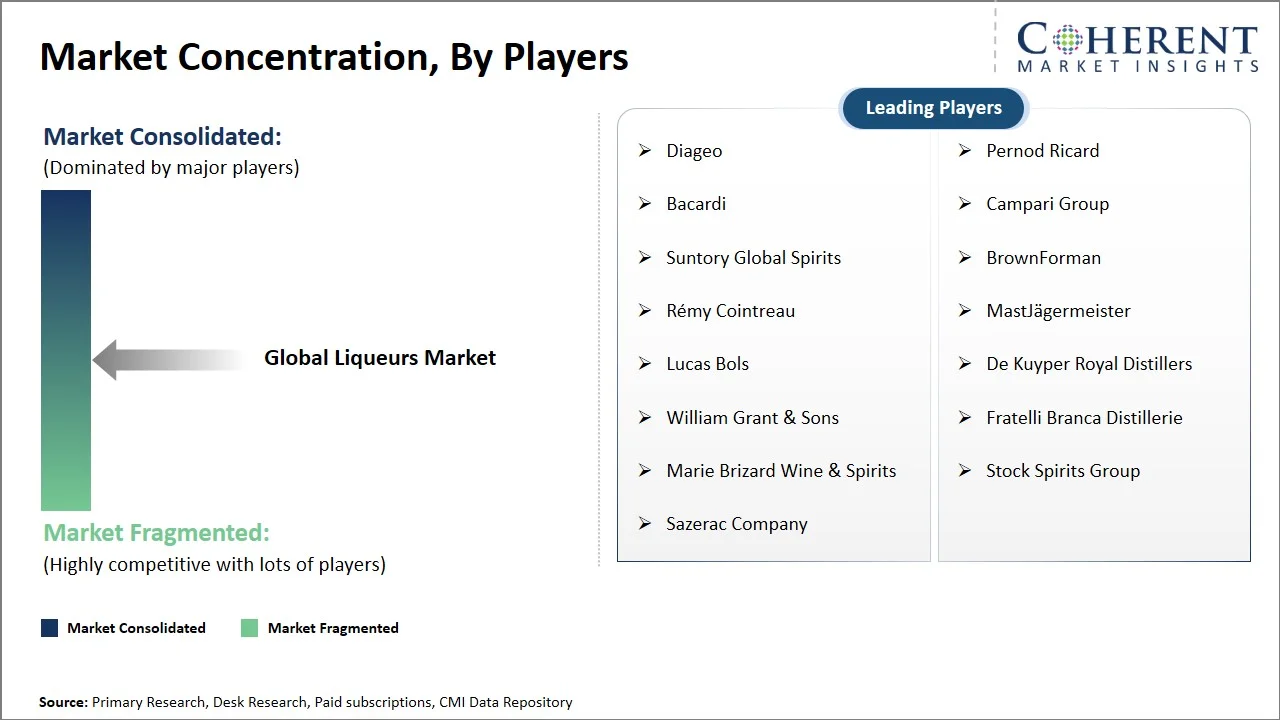
The global liqueurs market is structurally fragmented, with strong brand concentration within individual subcategories. Competition includes multinational spirits groups, heritage brands, regional distillers, craft producers, and private-label suppliers. Competitive advantage depends on distinctive flavor identity, distribution strength, ingredient consistency, regulatory execution, and repeat consumption. Regional specialists remain important due to local botanicals, drinking traditions, and established distributor relationships.
Key focus areas include
- Sensory and recipe differentiation: Distinctive botanical, fruit, cream, coffee, nut, and bitter profiles remain central to brand defensibility.
- Portfolio and price-ladder discipline: Suppliers need clear entry, premium, and prestige propositions without creating excessive SKU duplication.
- Ingredient supply reliability: Stable access to citrus peel, fruits, herbs, dairy inputs, sugar, coffee, cocoa, and specialty extracts protects quality continuity.
- Manufacturing flexibility: Efficient small-batch changeovers and precise blending help producers support seasonal and market-specific products without excessive inventory.
- Regulatory and formulation competence: Accurate ABV, ingredient, allergen, label, and market-entry management lower the cost and risk of international expansion.
- Route-to-market strength: Distributor quality, bartender engagement, specialist retail access, and hospitality relationships determine whether product differentiation converts into repeat sales.
- Packaging economics and execution: Bottle weight, closure systems, decorative finishes, gift packaging, and format flexibility must balance shelf impact with cost and logistical efficiency.
Market Report Scope
Liqueurs Market Report Coverage
| Report Coverage | Details | ||
|---|---|---|---|
| Base Year: | 2025 | Market Size in 2026: | USD 132.78 Bn |
| Historical Data for: | 2020 To 2024 | Forecast Period: | 2026 To 2033 |
| Forecast Period 2026 to 2033 CAGR: | 3.9% | 2033 Value Projection: | USD 173.56 Bn |
| Geographies covered: |
| ||
| Segments covered: |
| ||
| Companies covered: | Diageo, Pernod Ricard, Bacardi, Campari Group, Suntory Global Spirits, BrownForman, Rémy Cointreau, MastJägermeister, Lucas Bols, De Kuyper Royal Distillers, William Grant & Sons, Fratelli Branca Distillerie, Marie Brizard Wine & Spirits, Stock Spirits Group, Sazerac Company | ||
| Growth Drivers: |
| ||
| Restraints & Challenges: |
| ||
Analyst Opinion (Expert Opinion)
- The global liqueurs market is likely to reward portfolio discipline over continuous flavor expansion. Producers that focus on fewer scalable products with clear taste profiles, occasions, price points, and geographic roles can improve marketing efficiency, inventory productivity, and distributor focus.
- Localized finishing and modular flavor systems could reshape international liqueur expansion. Centralizing proprietary extracts while conducting final blending, proof adjustment, or bottling closer to destination markets can improve responsiveness and reduce logistical exposure. Strong flavor IP, quality controls, and reliable co-manufacturing capabilities will become increasingly important.
- Liqueur companies should prioritize sensory consistency, formulation stability, flexible packaging, regulatory capability, and disciplined SKU economics. Margin protection will require tighter management of ingredients, glass, freight, and excise costs, while overinvestment in novelty products without proven repeat consumption should be avoided.
Speak to the analyst
Want personalized insights?
Take the findings above to one of our principal consultants, or have the report rebuilt around the segments, geographies and competitors you actually track.
Market Segmentation
- Product Type Insights (Revenue, USD Bn, 2021 - 2033)
- Fruit Liqueurs
- Cream Liqueurs
- Herbal and Bitter Liqueurs
- Coffee and Chocolate Liqueurs
- Nut Liqueurs
- Others
- Alcohol Content Insights (Revenue, USD Bn, 2021 - 2033)
- 15% to 30% ABV
- Above 30% ABV
- Below 15% ABV
- Price Range Insights (Revenue, USD Bn, 2021 - 2033)
- Mass
- Premium
- Luxury
- Distribution Channel Insights (Revenue, USD Bn, 2021 - 2033)
- Off trade
- On trade
- Regional Insights (Revenue, USD Bn, 2021 - 2033)
- North America
- U.S.
- Canada
- Latin America
- Brazil
- Argentina
- Mexico
- Rest of Latin America
- Europe
- Germany
- U.K.
- Spain
- France
- Italy
- Russia
- Rest of Europe
- Asia Pacific
- China
- India
- Japan
- Australia
- South Korea
- ASEAN
- Rest of Asia Pacific
- Middle East
- GCC Countries
- Israel
- Rest of Middle East
- Africa
- South Africa
- North Africa
- Central Africa
- North America
- Key Players Insights
- Diageo
- Pernod Ricard
- Bacardi
- Campari Group
- Suntory Global Spirits
- BrownForman
- Rémy Cointreau
- MastJägermeister
- Lucas Bols
- De Kuyper Royal Distillers
- William Grant & Sons
- Fratelli Branca Distillerie
- Marie Brizard Wine & Spirits
- Stock Spirits Group
- Sazerac Company
Sources
Primary Research Interviews
- Liqueur manufacturers, distillers, flavor houses, contract bottlers, and private-label producers
- Fruit, botanical, dairy/cream, coffee, cocoa, sugar, alcohol-base, and flavor-ingredient suppliers
- Distributors, importers, exporters, wholesalers, liquor retailers, duty-free operators, and e-commerce platforms
- Bars, restaurants, hotels, cocktail chains, bartenders, mixologists, and hospitality procurement teams
- R&D, formulation, production, procurement, quality, regulatory, marketing, distribution, and sales executives
Stakeholders
- Fruit, cream, herbal/bitter, coffee/chocolate, and nut liqueur manufacturers
- Ethanol, sugar, botanical extract, fruit concentrate, dairy, flavor, color, bottle, closure, and packaging suppliers
- Distillation, maceration, filtration, blending, homogenization, filling, and packaging-equipment providers
- Importers, distributors, wholesalers, retailers, hospitality operators, and travel-retail companies
- Analytical laboratories, certification bodies, excise consultants, and contract manufacturers
End-use Sectors
- Off-trade: supermarkets, liquor stores, specialty retailers, convenience stores, duty-free, and online retail
- On-trade: bars, restaurants, hotels, clubs, cafés, resorts, and cocktail venues
- Home cocktail preparation, gifting, festive consumption, aperitif/digestif occasions, and dessert applications
- Foodservice, bakery, confectionery, coffee, and culinary flavoring applications
Regulatory and Government Bodies
- U.S. Alcohol and Tobacco Tax and Trade Bureau (TTB), FDA, and U.S. Customs and Border Protection
- European Commission, European Food Safety Authority, and national alcohol/excise authorities
- UK HM Revenue & Customs, Food Standards Agency, and Department of Health and Social Care
- Health Canada and Canada Revenue Agency
- China State Administration for Market Regulation and General Administration of Customs
- Japan National Tax Agency and Ministry of Health, Labour and Welfare
- India FSSAI, Central Board of Indirect Taxes and Customs, and state excise departments
- Australia New Zealand Food Standards Code authorities and Australian Taxation Office
Databases
- UN Comtrade, ITC Trade Map, Eurostat, and national customs/trade databases
- U.S. TTB alcohol statistics, permits, labeling, and regulatory databases
- EU Access2Markets and European Commission trade databases
- National excise, import-export, production, and alcohol-consumption statistics
- Company annual reports, investor presentations, product catalogues, and distributor databases
- Retail pricing, e-commerce assortment, menu, SKU, and promotional tracking databases
- Trademark and patent databases including WIPO, USPTO, and Espacenet
Magazines and Journals
- The Spirits Business
- Drinks International
- BeverageDaily
- Just Drinks
- Wine & Spirit International
- Imbibe
- Journal of Food Science
- Food Chemistry
- Beverages
- International Journal of Gastronomy and Food Science
Associations
- Distilled Spirits Council of the United States (DISCUS)
- spiritsEUROPE
- Wine and Spirit Trade Association (WSTA)
- Scotch Whisky Association
- American Craft Spirits Association
- International Alliance for Responsible Drinking
- European Bartender School/industry bartender networks
- National restaurant, hospitality, beverage, and alcohol trade associations
Public Domain Sources
- Liqueur product specifications, ingredient lists, ABV, bottle sizes, flavor profiles, and recommended serves
- Distillation, maceration, infusion, filtration, blending, homogenization, and bottling-process information
- Retail pricing, promotional activity, cocktail menus, distribution coverage, and product availability
- Fruit, botanical, coffee, cocoa, dairy, sugar, neutral-spirit, glass, and packaging input information
- Alcohol consumption, hospitality activity, cocktail trends, import-export flows, and excise-duty data
- Company product launches, acquisitions, manufacturing investments, distribution agreements, and brand expansions
- Labeling, health-warning, advertising, taxation, packaging, and responsible-consumption regulations
Key Standards and Regulations
- EU Regulation (EU) 2019/787 governing spirit-drink definitions, presentation, labeling, and geographical indications
- U.S. 27 CFR Part 5 covering distilled spirits labeling and advertising requirements
- TTB Certificate of Label Approval (COLA) requirements for applicable distilled spirit products
- UK Alcohol Duty framework and strength-based taxation applicable to alcoholic products
- EU Regulation (EU) No 1169/2011, where applicable to food-information requirements
- Country-specific excise-duty, minimum legal drinking age, advertising, promotion, and sales regulations
- Regulations governing allergens, dairy ingredients, colors, flavors, sweeteners, and food additives in liqueur formulations
- Import licensing, customs classification, packaging, recycling, and deposit-return requirements across major markets
Proprietary Elements
- CMI Data Analytics Tool, Proprietary CMI Existing Repository of information for last 10 years.
Get access to 250+ pages report
Every segment, forecast, competitor profile and data table behind the analysis above — available for instant download.
- ESOMAR Member
- ISO 9001:2015 Certified
- D-U-N-S Registered
- GDPR & CCPA Compliant
Missing comfort of reading report in your local language? Find your preferred language:
Transform your Strategy with Exclusive Trending Reports
Frequently Asked Questions
The CAGR of global liqueurs market is projected to be 3.9% from 2026 to 2033.
Major product types include fruit liqueurs, cream liqueurs, herbal and bitter liqueurs, coffee and chocolate liqueurs, nut liqueurs, and other specialty liqueurs.
Off-trade channels are the leading distribution channel, supported by supermarkets, liquor stores, specialty retailers, duty-free outlets, and online alcohol retail platforms.
Key trends include premiumization, cocktail-led consumption, reduced-sweetness formulations, botanical flavor innovation, cross-category liqueur concepts, and growing interest in versatile products suitable for home and on-trade cocktails.
Europe remains strategically important due to its established liqueur-producing heritage, strong aperitif and digestif culture, extensive hospitality sector, presence of major global brands, and well-developed export networks for premium, herbal, fruit, and specialty liqueurs.
The global liqueurs market is estimated to be valued at USD 132.78 billion in 2026 and is expected to reach USD 173.56 billion by 2033.
In terms of product type, fruit liqueurs are estimated to dominate the market revenue share in 2026.