

Latin America Barley Market Analysis & Forecast: (2026-2033)
The Latin America Barley Market is anticipated to grow at a CAGR of 6.2% with USD 46.4 Bn share in 2026 and is expected to reach USD 82.8 Bn in 2033. Rising demand from the brewing industry, Increasing health awareness & food applications, and growth of craft brewing & premiumization trends. Brazil remains the world’s third-largest beer producer.
Key Takeaways
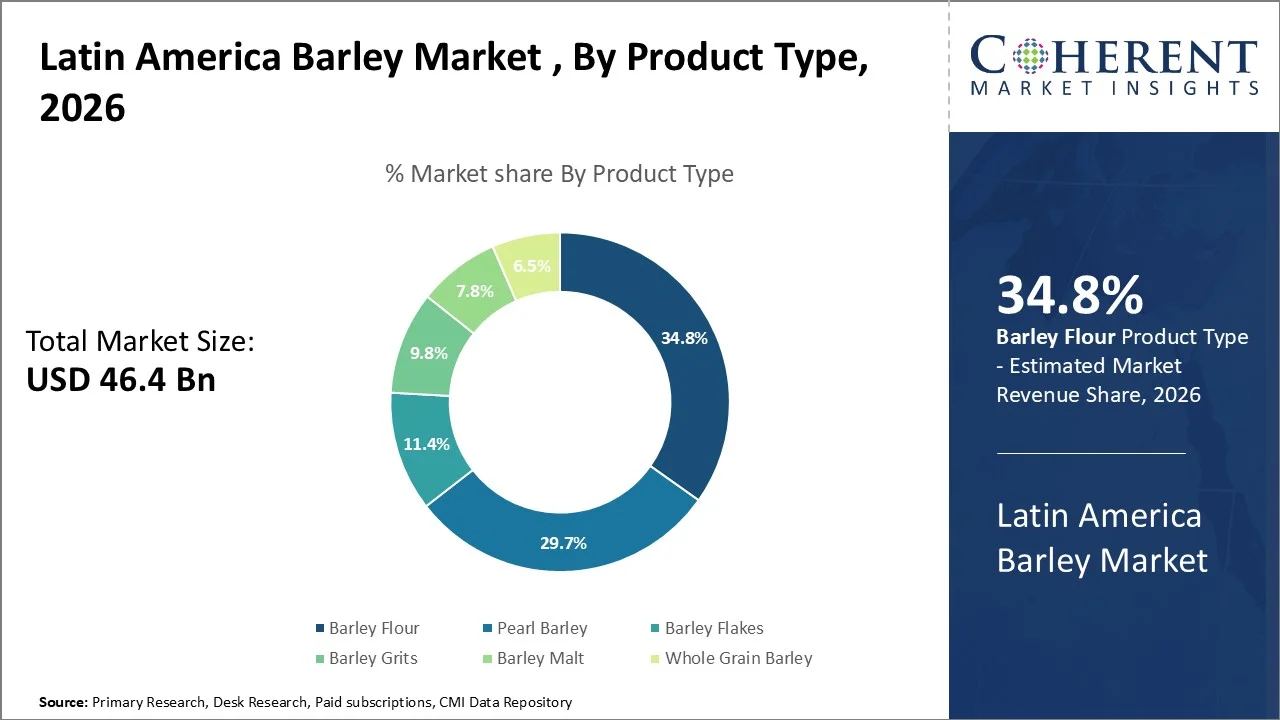
- By Product Type, Barley Flour hold the largest market share of 34.8% in 2026 owing to the rising demand for healthy & functional foods.
- By Grade, Malt Grade expected to hold largest market share of 42.2% in 2026 owing to its strong growth of beer & brewing industry. Brazil consumes about 1.2 million tonnes of barley malt each year.
- By Application, Pharmaceuticals acquired the prominent market share of 38.8% in 2026 owing to the rising prevalence of chronic diseases. Chronic diseases (NCDs) account for about 74% of all deaths in Brazil, with cardiovascular disease, cancer, chronic respiratory disease, and diabetes as the main causes.
- By Country, Argentina is expected to acquire the dominant share of 44.6% in 2026 owing to the strong position as a leading barley producer & exporter. In Argentina, barley production in 2025 is estimated at 5.6 million tonnes, about 16% above the five-year average.
Current Events and Their Impact on the Latin America Barley Market
Current Event | Description and its Impact |
Climate Change and Extreme Weather Patterns in Latin America |
|
Geopolitical and Trade Dynamics |
|
Segmental Insights
- Current Industry Events of 2026
- Market Size Estimation
- Regional Breakdown
- Competitive Landscape
- Customer Intelligence
- Segmental Analysis
- Pricing Analysis
- Key Market Drivers, Challenges & Future Trends
- Customized Insights Section
Why Barley Flour hold the largest market share?
Barley Flour hold the largest market share of 34.8% in 2026 owing to the Indirect push from brewing industry. The data shows a net increase of 118 breweries registered with the ministry, reaching 1,729 by the end of 2023, a 6.8% rise from 2022. São Paulo leads with 410 breweries, followed by Rio Grande do Sul (335), Minas Gerais (235), Santa Catarina (225), Paraná (171), and Rio de Janeiro (129). The report also notes that 15.4 billion liters of beer were produced nationwide in 2023, including 8.2 billion liters from the Southeast region.
Rising consumer demand for healthier, fiber-rich foods and increasing awareness of barley’s nutritional benefits, especially its beta-glucan content, drive the barley flour segment in the Latin America barley market. The expanding food processing industry boosts demand through greater use in bakery products, cereals, and convenience foods.
Malt Grade expected to hold largest market share
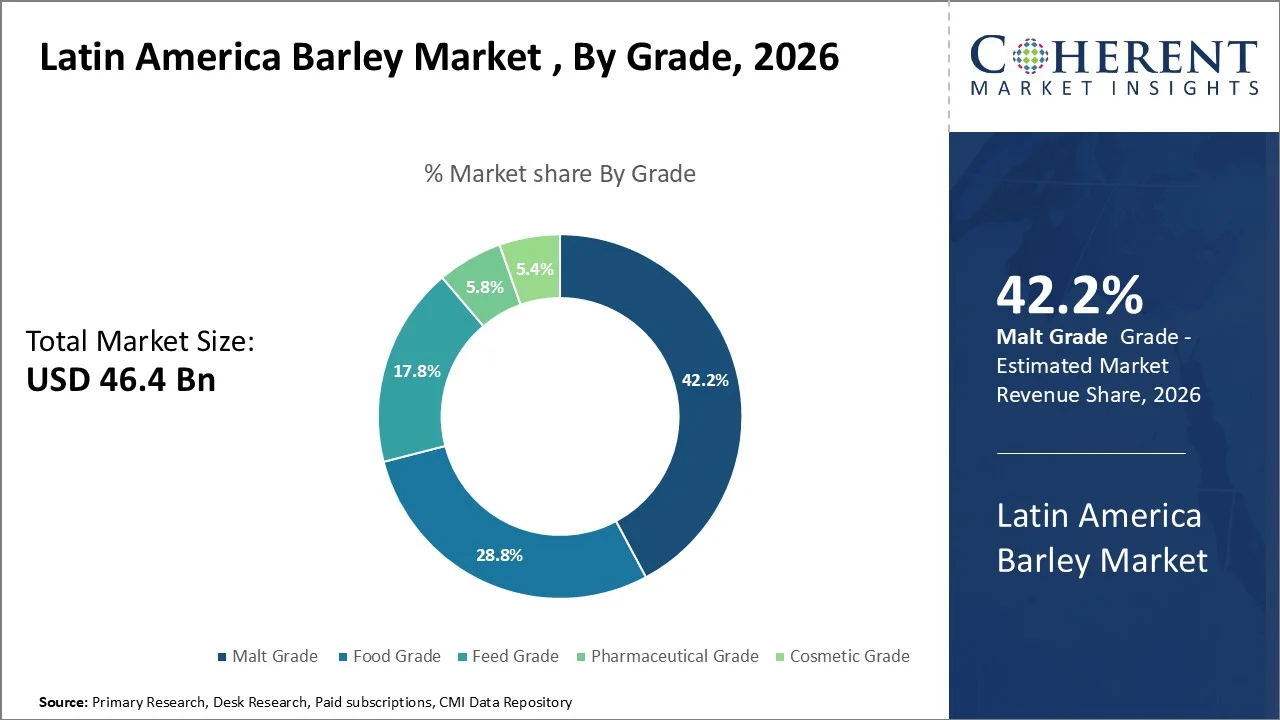
Malt Grade expected to hold largest market share of 42.2% in 2026 owing to its rising demand for craft beer & premium beverages. Strong demand from the brewing industry drives the malt grade segment in the Latin America barley market, with rising beer import and the expansion of craft and premium breweries supporting growth. In 2025, Brazil imported $8.35 million worth of beer, ranking it as the 790th most imported product out of 1,195. Food and beverage manufacturers increasingly use malt in bakery products and malt-based drinks, further boosting demand. For instance, On the Cinco de Mayo national holiday, Compañía Mexicana de OPTACO, S.A. de C.V. unveiled “Xoloitzcuintle” Tamale Flavored Beer. The company brews XOLO at 4.5% alcohol using Mexican oregano (Lippia graveolens) instead of hops and replaces traditional barley malt with spicy, seasoned tamale masa flour.
Industry players invest in malting infrastructure and improved barley varieties to enhance supply and quality. Additionally, consumers’ growing preference for flavored and specialty beverages increases demand for high-quality malt-grade barley across the region.
Pharmaceuticals acquired the prominent market share
Pharmaceuticals acquired the prominent market share of 38.8% in 2026 owing to the Shift toward preventive healthcare & nutraceuticals. Brazil’s pharmaceutical industry is the largest in Latin America and the sixth largest globally, with an estimated market value of USD 28.5–38 billion in 2023–2024. Increasing use of barley-derived beta-glucan in drug formulations drives the pharmaceuticals segment in the Latin America barley market, as it offers immune-boosting and cholesterol-lowering benefits. The rising prevalence of chronic diseases fuels demand for therapeutic and preventive healthcare solutions.
Pharmaceutical companies expand research and development to discover new applications of natural ingredients. Additionally, growing consumer preference for plant-based and clean-label products encourages the adoption of barley-derived compounds in medicines, supplements, and nutraceuticals across the region.
Latin America Barley Market Trends
- Rising demand for healthier and functional food products increases the use of barley flour due to its high fiber content and beta-glucan benefits, supporting growth in bakery and cereal applications.
- Expanding beer and brewing industry, along with rapid growth of craft and premium breweries, strengthens demand for malt-grade barley across the region.
- Increasing adoption of barley-derived ingredients in nutraceuticals and pharmaceuticals enhances demand for beta-glucan due to its cholesterol-lowering and immune-supporting properties.
- Growing animal feed consumption driven by livestock production expansion boosts feed-grade barley utilization and supports overall barley demand in the region.
- Advancements in agricultural practices, improved seed varieties, and better malting infrastructure enhance barley yield, quality, and processing efficiency across Latin America.
Country Insights
Argentina is expected to acquire the dominant share
Argentina is expected to acquire the dominant share of 44.6% in 2026 owing to the favorable agro-climatic conditions. Strong barley production and export capacity position Argentina as a key player in the Latin America barley market, as it acts as a leading regional supplier. Argentina’s barley production is projected to reach about 5.6 million tonnes in 2025/2026, 16% above the five-year average due to strong yields. As a key global supplier, it ranked fourth in barley exports in 2024, with major markets including China, Brazil, and Colombia.
Favorable agro-climatic conditions and fertile growing regions support farmers in producing high-quality yields. The expanding brewing and malting industry increase both domestic and export demand for malt-grade barley. For instance, Louis Dreyfus Co. (LDC), a global merchant and processor of agricultural commodities, has launched operations of a new specialized milling line at its Timbúes agro-industrial complex in Santa Fe province, Argentina. The company is strengthening its strategy by advancing product diversification and promoting regenerative agriculture through the use of rotational crops.
Farmers adopt advanced agronomic practices and improved seed varieties to boost productivity. Additionally, efficient port infrastructure and strong global trade linkages enable large-scale exports and market expansion.
Mexico expected to hold largest share
Growing demand from the brewing industry drives Mexico’s position in the Latin America barley market, as high beer consumption and the strong presence of major breweries increase the use of malt-grade barley. Expanding food and beverage processing industries boost demand for barley-based ingredients in bakery products and packaged foods.
Rising health awareness encourages consumers to choose fiber-rich and functional grains such as barley flour. Additionally, imports from key producing countries ensure a stable supply, while investments in agricultural productivity and supply chains support market development in the country.
Who are the Major Companies in Latin America Barley Industry
Some of the major key players in Latin America Barley Industry are Grain crop Limited, Malteurop Group, Soufflet Group, Crisp Malting Group, Global Malt Gmbh & Co. Kg, Ireks Gmbh, Muntons Plc, Maltexco S.A., Grain Millers, Inc, EverGrain, Malt Products Corporation, and Briess Malt & Ingredients Co.
Key News
- In May 2025, US brewery Meli has launched the country’s first beer brewed entirely with quinoa, making it vegan and gluten-free. The company uses organic quinoa, anti-inflammatory hop flowers, gluten-free yeast, and water to create a refreshing, slightly sweet beverage positioned as an alternative to traditional craft beer and white wine.
Market Report Scope
Latin America Barley Market Report Coverage
| Report Coverage | Details | ||
|---|---|---|---|
| Base Year: | 2025 | Market Size in 2026: | USD 46.4 Bn |
| Historical Data for: | 2020 To 2024 | Forecast Period: | 2026 To 2033 |
| Forecast Period 2026 to 2033 CAGR: | 6.2% | 2033 Value Projection: | USD 82.8 Bn |
| Geographies covered: |
| ||
| Segments covered: |
| ||
| Companies covered: | Grain crop Limited, Malteurop Group, Soufflet Group, Crisp Malting Group, Global Malt Gmbh & Co. Kg, Ireks Gmbh, Muntons Plc, Maltexco S.A., Grain Millers, Inc, EverGrain, Malt Products Corporation, and Briess Malt & Ingredients Co. | ||
Analyst Opinion
- The Latin America barley market is fundamentally supply-and-demand constrained, not trend-driven, and Argentina’s structural dominance proves this clearly. Argentina alone produces around 4.9 million metric tons of barley annually, with a significant share directed toward malt exports, making it one of the most export-oriented barley systems globally. This is not a speculative growth story it is a logistics-and-climate advantage story, where production is locked into a few highly efficient agro-zones such as Buenos Aires and La Pampa.
- What is often underestimated is Argentina’s role as a global malt gateway rather than just a producer. Roughly 70% of its barley output is malt-grade, positioning the country as a strategic supplier to international beer manufacturers across South America, Mexico, and even parts of Asia.
- Feed barley demand also acts as a stabilizer rather than a growth driver. Livestock production in countries like Brazil and Mexico absorbs large volumes of lower-grade barley, but this is reactive demand linked to maize price fluctuations. For example, when corn prices rise, feed mills temporarily substitute barley, but this does not create sustained structural expansion it creates cyclical absorption buffers that prevent price collapse rather than driving long-term growth.
- In contrast, barley flour and pharmaceutical applications remain minor but strategically important niche demand streams. Even though barley beta-glucan is clinically recognized for cholesterol reduction, most Latin American pharmaceutical uptake is still import-dependent and limited to nutraceutical formulations rather than large-scale therapeutic adoption.
Speak to the analyst
Want personalized insights?
Take the findings above to one of our principal consultants, or have the report rebuilt around the segments, geographies and competitors you actually track.
Latin America Barley Market Segmentation
- By Product type
- Pearl Barley
- Barley Flour
- Barley Flakes
- Barley Grits
- Barley Malt
- Whole Grain Barley
- By Grade
- Malt Grade
- Standard
- Specialty
- Food Grade
- Feed Grade
- Pharmaceutical Grade
- Cosmetic Grade
- Malt Grade
- By Application
- Alcoholic Beverages
- Non-Alcoholic Beverages
- Food Industry
- Pharmaceuticals (Supplements)
- Animal Feed
- Personal Care Products
- By Country
- Argentina
- Mexico
- Brazil
- Rest of Latin America
Sources
Primary Research interviews
- Interviews with barley producers, malt processors, brewing industry stakeholders, and agricultural supply chain experts in Latin America
- Discussions with grain traders, export-import managers, and food & beverage manufacturers using barley ingredients
- Insights gathered from agronomists and livestock feed formulators involved in barley utilization
Databases
- FAOSTAT (Food and Agriculture Organization of the United Nations)
- UN Comtrade Database (international barley trade flows)
- World Bank Data (agricultural production indicators)
- OECD-FAO Agricultural Outlook data repository
- National agricultural statistical systems of Argentina, Brazil, and Mexico
Magazines
- Global Agriculture Magazine
- Grain World Magazine
- Brewing & Beverage Industry Publications
- AgriBusiness Global insights
Journals
- Journal of Cereal Science
- Food Chemistry
- Agricultural Systems Journal
- Journal of Agricultural and Food Chemistry
- Field Crops Research
Newspapers
- Reuters Agriculture Coverage
- Bloomberg Agricultural Markets reporting
- Financial Times (commodities section)
- The Wall Street Journal (agri-commodities updates)
- Regional Latin American financial newspapers (e.g., El Cronista, Valor Econômico)
Associations
- International Grains Council (IGC)
- International Barley Genetics Network
- Brewers Association (global and regional chapters)
- Latin American Brewers Association
- Food and Agriculture Organization-related grain networks
- National grain and cereal producer associations in Argentina and Brazil
Public Domain sources
- Government agriculture ministry publications (Argentina, Brazil, Mexico)
- Trade statistics from customs authorities and port reports
- FAO and UN statistical bulletins
- Central bank and export/import trade summaries
- Academic institutional repositories and open-access research papers
Proprietary Elements
- CMI Data Analytics Tool
- Proprietary CMI Existing Repository of information for last 8 years
Get access to 250+ pages report
Every segment, forecast, competitor profile and data table behind the analysis above — available for instant download.
- ESOMAR Member
- ISO 9001:2015 Certified
- D-U-N-S Registered
- GDPR & CCPA Compliant
Missing comfort of reading report in your local language? Find your preferred language:
Transform your Strategy with Exclusive Trending Reports
Frequently Asked Questions
The Latin America barley market is estimated to reach USD 82.2 Bn by the end of 2033.
Major players operating in the Latin America barley market include Grain crop Limited, Malteurop Group, Soufflet Group, Crisp Malting Group, Global Malt Gmbh & Co. Kg, Ireks Gmbh, Muntons Plc, Maltexco S.A., Grain Millers, Inc, EverGrain, Malt Products Corporation, and Briess Malt & Ingredients Co.
Easy availability of substitute of barley such as rice, is one of the major factors that is expected to hamper growth of the market over the forecast period.
Rising demand for clean label products due to shifting preferences of consumer towards natural and organic food, coupled with easy availability of barley in Latin America are some of the major factors that are expected to propel growth of the market over the forecast period.
The Latin America barley market is estimated to exhibit a CAGR of 6.2% over the forecast period.
Among countries, Argentina held a dominant position in the Latin America barley market.