

Global Liquid Flavors Market Size and Forecast – 2026 To 2033
The Global Liquid Flavors Market is estimated to be valued at USD 17,420.4 Mn in 2026 and is expected to reach USD 28,901.3 Mn by 2033, exhibiting a compound annual growth rate (CAGR) of 7.5% from 2026 to 2033. This robust growth is driven by increasing demand across food and beverage industries, alongside rising consumer preference for enhanced sensory experiences, natural ingredients, and customized taste profiles.
The expanding application spectrum in processed foods, beverages, dairy, bakery, confectionery, and functional nutrition products further fuels market expansion globally. For instance, in March 2025, Döhler North America acquired Premier Juices to expand its natural fruit-based ingredients and solutions portfolio across beverage, food, life science, and nutrition applications, thereby strengthening the role of natural fruit flavor systems and ready-to-use ingredient solutions in the liquid flavors market. (Source: Döhler GmbH)
Key Takeaways of the Global Liquid Flavors Market
- The natural flavors segment is expected to hold 63.8 % of the market share in 2026, supported by clean-label reformulation across packaged foods and beverages. Additionally, the segment growth is bolstered by the demand for recognizable ingredients, and wider use of plant-derived extracts across beverages, dairy, bakery, confectionery, and functional foods. Flavor manufacturers are expanding natural portfolios to help brands balance taste, labeling compliance, and premium positioning. In June 2025, Flavorchem launched The Art of Vanilla, a premium vanilla portfolio including organic, clean-label, sustainably produced extracts and natural flavoring solutions for food and beverage applications. (Source: Flavorchem)
- The fruit flavors segment is projected to account for 31.4 % of the market share in 2026, as citrus, berry, and cherry profiles remain highly adaptable across beverages, dairy, confectionery, and snacks. In February 2026, Tastepoint by International Flavors & Fragrances Inc. (IFF) identified mandarin and cherry among key North American flavors, with cherry expected to lead new beverage launches. (Source: International Flavors & Fragrances Inc)
- Beverages are expected to capture 38.6 % of the market share in 2026, reflecting high usage of liquid flavors in carbonated drinks, teas, energy drinks, waters, and juices. Keurig Dr Pepper’s 2026 portfolio included more than 35 new varieties, supported by consumer appetite for bold flavors, nostalgic twists, zero-sugar formats, and energy options. (Source: Keurig Dr Pepper)
- North America is projected to dominate the global liquid flavors market with 30.8 % share in 2026, supported by strong packaged beverage innovation, flavor R&D capacity, and premium foodservice demand. In February 2025, T. Hasegawa USA expanded its Flavor Innovation Center in California. U.S. to strengthen advanced flavor development across North America. (Source: T.Hasegawa USA Inc)
- Europe is expected to hold 26.4 % of the market share in 2026 while recording the fastest growth, supported by demand for familiar yet functional flavor experiences. Kerry’s 2026 Taste Charts highlight European interest in botanical pairings, citrus accents, creamy textures, floral teas, and herb-forward profiles, indicating strong opportunities for natural liquid flavor innovation. (Source: Kerry Group plc)
- Clean-label Reformulation Becomes a Core Growth Trend: Manufacturers are increasingly aligning liquid flavor systems with cleaner ingredient labels, natural positioning, and regulatory-led reformulation. In April 2025, the U.S. FDA and HHS announced measures to transition from petroleum-based synthetic dyes to natural alternatives, creating broader reformulation momentum across food and beverage product development.
- Premium Flavor Storytelling Gains Commercial Relevance: Brands are using distinctive, multi-application flavors to create premium positioning and stronger consumer recall. McCormick’s 2026 Flavor of the Year, Black Currant, was launched across seasoning and finishing sugar formats, highlighting how tart-sweet berry notes can move across beverages, desserts, baked goods, sauces, and culinary applications.
Segmental Insights
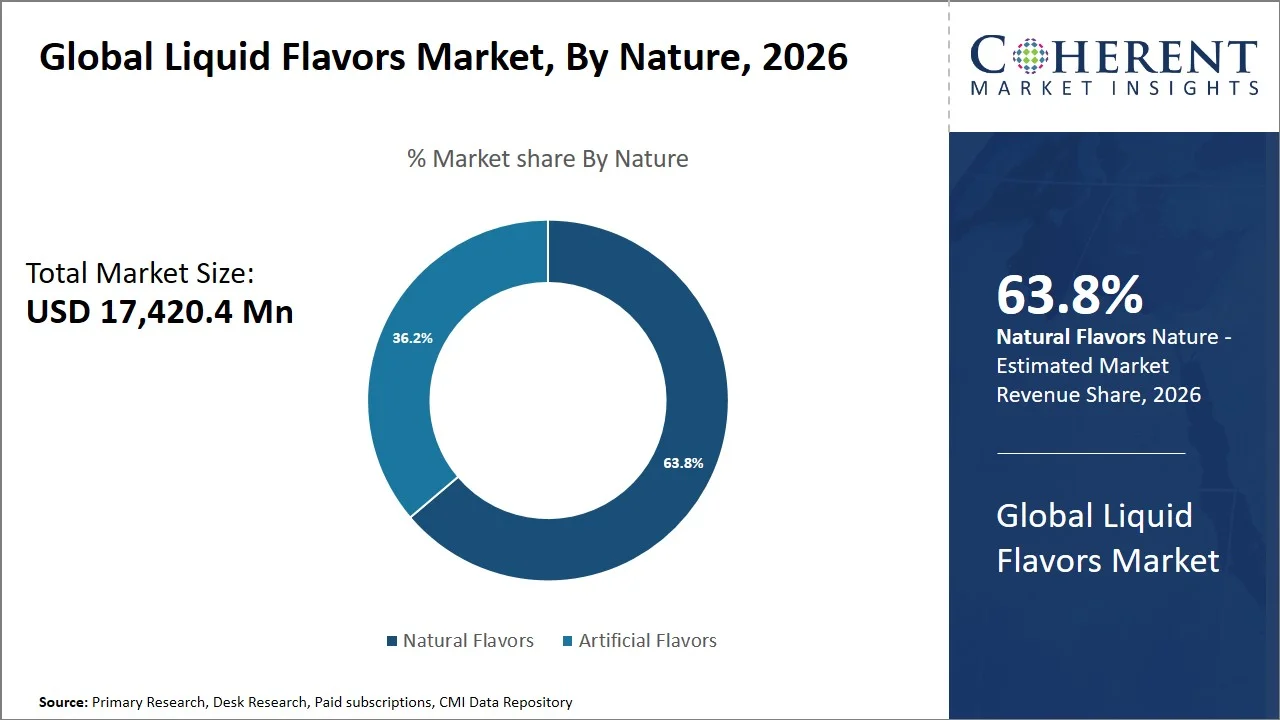
Why Do Natural Flavors Dominate the Global Liquid Flavors Market?
Natural flavors are expected to dominate the global liquid flavors market with 63.8% share in 2026, as food and beverage manufacturers increasingly reformulate products around recognizable, plant-derived, and clean-label ingredients. Demand is especially strong in beverages, dairy, bakery, confectionery, and nutrition products, where consumers expect taste enhancement without artificial positioning. On the supply side, flavor houses are investing in biotechnology, fermentation, and advanced extraction to improve consistency, scalability, and cost efficiency for natural liquid flavor systems. This also helps reduce dependency on weather-sensitive botanical crops. In October 2025, Symrise invested in Cellibre, a U.S.-based biotechnology company, to accelerate commercialization of high-value natural flavor ingredients through precision fermentation, strengthening supply-side innovation for natural flavor development. (Source: Symrise)
- Current Industry Events of 2026
- Market Size Estimation
- Regional Breakdown
- Competitive Landscape
- Customer Intelligence
- Segmental Analysis
- Pricing Analysis
- Key Market Drivers, Challenges & Future Trends
- Customized Insights Section
Why Do Fruit Flavors Represent the Largest Flavor Type Segment in the Market?
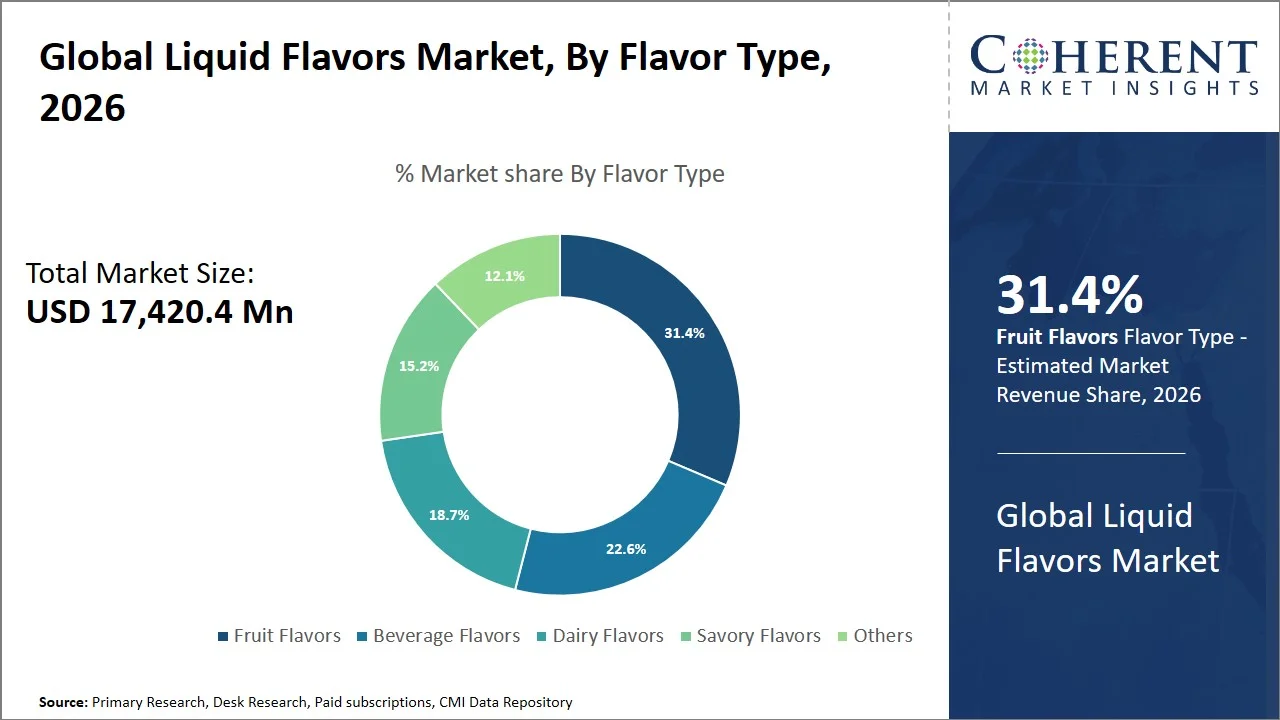
Fruit flavors are projected to represent the largest flavor type segment with 31.4% share in 2026, supported by their strong fit across beverages, confectionery, dairy, bakery fillings, desserts, and wellness-oriented products. Consumers easily recognize fruit profiles such as citrus, berry, tropical, mango, peach, and apple, which helps brands create products that feel fresh, familiar, and indulgent at the same time. From the supply side, flavor houses are using sensory science and trend-mapping tools to identify fruit profiles that can work across multiple applications and regions. In April 2025, Takasago released its Global Pulse TrendSeeds 2025 report, highlighting “Vibrant Harvest” as a key trend focused on fruits, vegetables, flowers, spices, and herbs for future food and beverage innovation. (Source: Takasago International Corporation)
Why Do Beverages Dominate the Application Segment in the Global Liquid Flavors Market?
Beverages are expected to dominate the application segment with 38.6% share in 2026, as liquid flavor formats are highly compatible with carbonated soft drinks, energy drinks, flavored waters, teas, juices, sports drinks, and functional beverages. The segment benefits from faster product launch cycles, seasonal flavor rotations, and high consumer willingness to try new taste combinations in drink formats. Liquid flavors also support uniform dispersion, rapid formulation, and scalable production, making them commercially attractive for beverage manufacturers. End-use relevance is the strongest in low-sugar, zero-sugar, hydration, and premium refreshment launches, where flavor must compensate for reduced sweetness or added functional ingredients. In February 2026, Coca-Cola expanded its cherry beverage portfolio with Coca-Cola Cherry Float and Diet Coke Cherry, reinforcing flavor-led beverage innovation. (Source: The Coca‑Cola Company)
Currents Events and their Impact
Current Events | Description and its Impact |
European Union Withdraws Several Smoke Flavorings from the Market (April 2024 onward) |
|
U.S. FDA Revokes Authorization for Brominated Vegetable Oil in Food and Beverages (July 2024 onward) |
|
U.S. FDA and HHS Push Transition from Petroleum-based Synthetic Dyes to Natural Alternatives (April 2025 onward) |
|
(Source: European Commission, Food and Drug Administration)
Global Liquid Flavors Market Dynamics
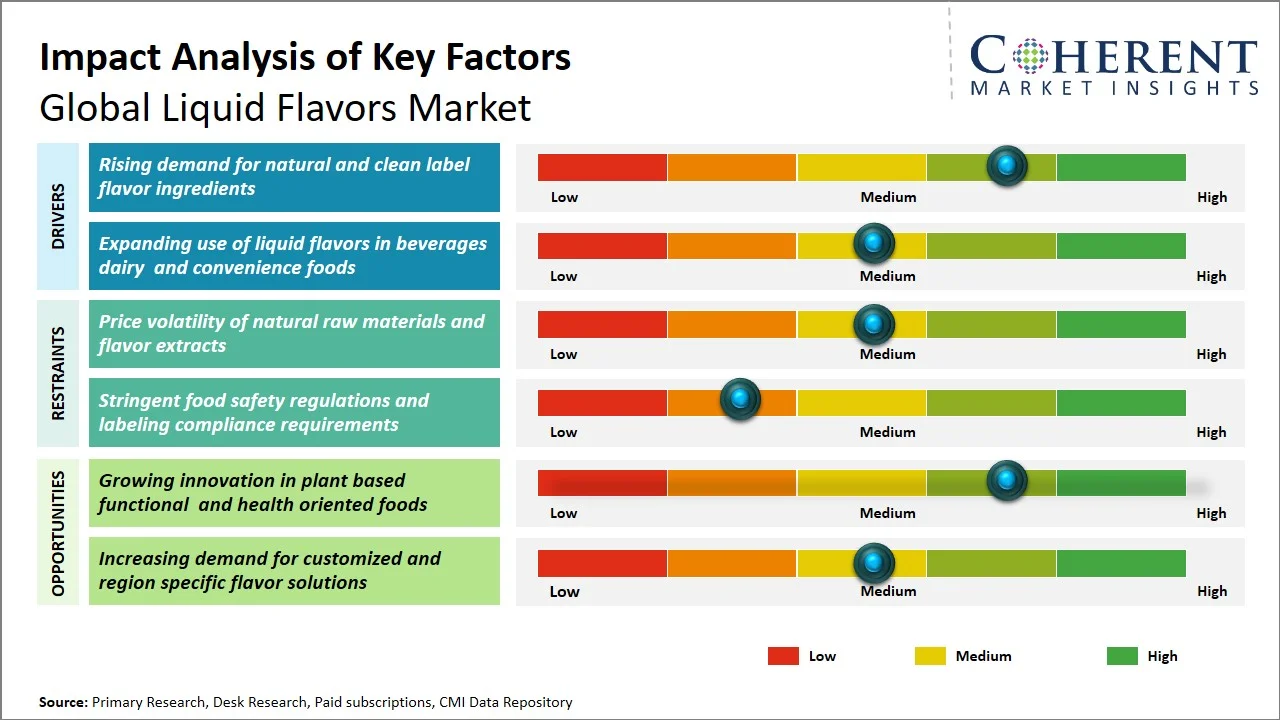
Market Drivers
- Clean-label Reformulation Strengthens Natural Liquid Flavor Demand: Food and beverage brands are shifting from artificial flavoring systems toward natural, extract-based, and label-friendly liquid flavors to protect shelf appeal and support premium positioning. This is especially important in beverages, dairy, bakery, confectionery, and kids’ products, where consumers closely check ingredient lists and brands must balance taste, transparency, and cost. Liquid formats also help manufacturers achieve easier blending, consistent dosing, and faster reformulation in large-scale production.
- Wider Use in Beverages, Dairy, and Convenience Foods Expands Volume Consumption: Liquid flavors are gaining higher commercial relevance because they are easier to disperse in drink bases, dairy systems, sauces, fillings, ready meals, and snack coatings. This improves formulation efficiency for manufacturers working with frequent launches, regional taste customization, and reduced-sugar recipes. Beverages remain the largest use area, but dairy and convenience foods are also increasing demand for creamy, fruit, savory, and indulgent flavor profiles that can create repeat purchase. In December 2025, Prodalim acquired René Laurent, a French beverage flavors company specializing in beverage flavor systems, aromatic ingredients, syrups, liqueurs, naturals, and coffee solutions, strengthening its specialty ingredients and beverage innovation platform. (Source: Prodalim Group)
Emerging Market Trends
- Flavor Modulation for Low-sugar and Functional Formulations: Liquid flavor systems are evolving beyond basic taste addition toward modulation, masking, and mouthfeel enhancement. This trend is commercially important as beverage, dairy, and convenience food brands reduce sugar, add protein, fiber, botanicals, minerals, or functional ingredients, and still need a balanced taste profile. Flavor modulators help cover bitterness, metallic notes, high-intensity sweetener aftertaste, and plant-based off-notes, making better-for-you products more acceptable to mainstream consumers. Ingredion notes that scalable reduced-sugar solutions are transforming food formulation, with taste challenges and stevia-based sweeteners becoming central to product development, which increases the need for advanced flavor-balancing systems.
- Digital Sensory Intelligence Accelerates Flavor Innovation: Flavor development is increasingly moving toward data-led sensory design, where consumer insights, digital tools, and application testing help shorten product development cycles. This is becoming important in the liquid flavors market because brands need faster localization of fruit, beverage, dairy, savory, and indulgent profiles across regions. Digital flavor mapping can help suppliers predict which notes will work in specific applications, reduce trial-and-error formulation, and support more targeted innovation for seasonal and limited-edition products. Givaudan highlighted its focus on digital innovations for the fragrance and flavor industry at VivaTech 2025, showing how technology is becoming a stronger part of flavor creation and consumer engagement.
Regional Insights
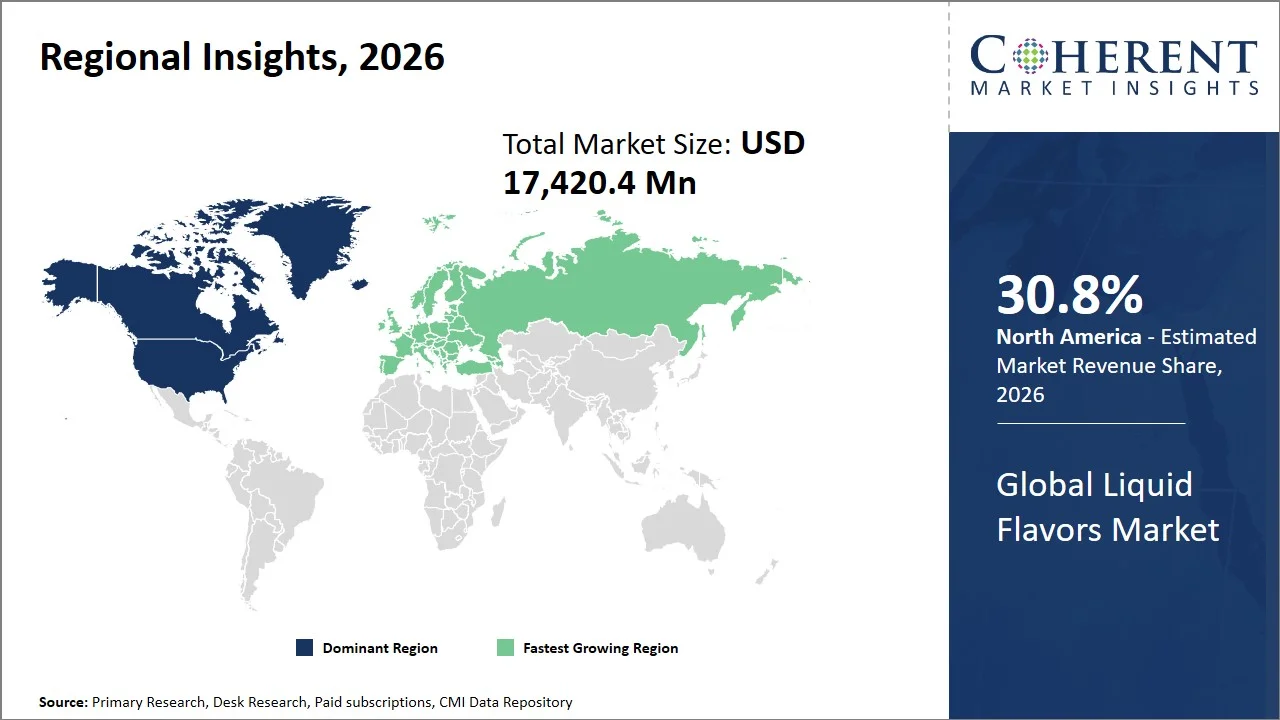
Why Does North America Dominate the Global Liquid Flavors Market?
North America is expected to account for the largest share of the global liquid flavors market with 30.8% in 2026, supported by its mature packaged food, beverage, dairy, snack, and convenience food ecosystem. The region has strong B2B demand from multinational CPG brands, emerging beverage companies, functional nutrition brands, and private-label food manufacturers. Liquid flavors are widely preferred because they enable faster blending, consistent dosing, and quicker scale-up across beverages, dairy products, sauces, bakery, and snacks. In July 2025, FlavorSum announced its acquisition by Warburg Pincus, strengthening a North American pure-play flavor platform focused on custom natural liquid flavors, extracts, and flavor systems for food and beverage applications. (Source: FlavorSum)
Why is Europe Emerging as the Fastest-Growing Region in the Global Liquid Flavors Market?
Europe is expected to emerge as the fastest-growing region with 26.4% share in 2026, supported by growing demand for natural, clean-label, botanical, fruit, and premium flavor systems. Regional food and beverage companies are increasingly using liquid flavors in beverages, dairy, bakery, confectionery, savory foods, and sports nutrition to meet stricter ingredient expectations and localized taste preferences. In 2025, Plant-Ex Europe advanced its expansion in Wysogotowo, Poland, after acquiring Aromacolors, establishing a European hub for production, warehousing, sampling, regional innovation, and product development in natural colors and flavors. (Source: Plant-Ex.)
Global Liquid Flavors Market Outlook for Key Countries
Why is China Becoming a Strategic Demand Center in the Global Liquid Flavors Market?
China is important in the global liquid flavors market due to its large-scale food and beverage manufacturing base, expanding middle-class consumption, and strong demand for localized taste formats. Liquid flavors are widely relevant in ready-to-drink tea, dairy drinks, instant noodles, sauces, snacks, confectionery, bakery, and functional beverages. The country’s market requires region-specific sensory development, as consumer preferences differ across provinces and product categories. Suppliers are therefore investing in local innovation centers to improve speed, application testing, and flavor customization. In July 2024, IFF announced the opening of a 16,000-square-meter Center for Innovation in Shanghai, its largest in Asia, with sensory science facilities, labs, a culinary demo kitchen, instant noodle pilot line, and digital collaboration space to serve China and Greater Asia.
Why is the U.S. at the Forefront of Liquid Flavor Innovation and Commercial Scale-Up?
The U.S. remains a major country-level market for liquid flavors because of its advanced beverage, snack, dairy, bakery, confectionery, and nutrition product industries. Brand owners in the country frequently launch limited-edition flavors, zero-sugar beverages, protein drinks, functional waters, sauces, and indulgent bakery products, creating continuous need for customized liquid flavor systems. The U.S. also has strong pilot-scale testing, regulatory know-how, and manufacturing infrastructure, allowing flavor suppliers to support customers from concept to commercial production. In February 2025, T. Hasegawa USA expanded its California Flavor Innovation Center by more than 50%, adding sweet and savory flavor labs, a dedicated beverage flavor area, application labs, pilot capabilities, and client collaboration spaces. (Source: T. Hasegawa)
Why is India Expanding as a High-Potential Liquid Flavors Market?
India is gaining importance in the global liquid flavors market as packaged beverages, dairy desserts, bakery, confectionery, snacks, wellness drinks, and plant-based products expand across urban and semi-urban consumers. The country’s demand is highly taste-specific, with strong preference for mango, rose, kala khatta, pineapple, strawberry, vanilla, spice, and regional beverage profiles. Liquid flavors are commercially useful because they allow better dispersion, storage stability, and consistent sensory delivery in mass-market beverages, dairy systems, and convenience foods. In December 2025, Keva Flavours highlighted new development across beverage, dairy, confectionery, wellness, and plant-based applications, including fruit and floral emulsions such as orange, red rose, kala khatta, and mango, supported by upgrades in liquid manufacturing and blending operations. (Source: Keva Flavours Pvt. Ltd)
Why is Germany Advancing Production Capability in the Global Liquid Flavors Market?
Germany is a critical European hub for liquid flavor production due to its strong process engineering, food-grade manufacturing standards, automation capability, and presence of global flavor companies. The country supports demand from beverages, yogurt, confectionery, savory ready meals, bakery, and processed foods, where flavor consistency, hygiene, batch flexibility, and clean-label compatibility are essential. Germany’s strength is not only in consumption but also in precision manufacturing of complex liquid flavor systems involving citrus oils, extracts, menthol essences, savory compounds, and natural flavor bases. In November 2025, GEA announced construction of a large-scale liquid flavor mixing plant for Symrise in Holzminden, designed to increase production capacity by up to 50% and shorten delivery timelines, with commissioning planned for spring 2026. (Source: GEA)
Why Does Japan Strengthen Premium and Functional Flavor Development?
Japan plays an important role in the global liquid flavors market because of its sophisticated food culture, strong ready-to-drink beverage sector, advanced confectionery industry, and high expectations for aroma precision. Liquid flavors are highly relevant in teas, coffees, dairy desserts, gummies, bakery products, savory snacks, sauces, and wellness-oriented foods. Japanese flavor companies also contribute global expertise in sensory science, flavor stability, and premium taste design.
Why is Brazil Important for Latin American Liquid Flavor Adoption?
Brazil is important in the global liquid flavors market as a major Latin American food and beverage production base with strong demand for tropical, fruit, indulgent, dairy, bakery, snack, and refreshment profiles. The country’s beverage and processed food sectors require liquid flavor systems that can deliver consistent taste, strong aroma release, and cost-effective localization across mainstream and premium products. Brazil also acts as a regional innovation and distribution platform for companies serving Latin America. In March 2026, IFF expanded its Latin American footprint with a new regional enzyme hub and an application lab at its Brazil Innovation Center, aimed at improving speed, reliability, and locally relevant formulation support across food and related ingredient applications. (Source: IFF)
Technology Adoption Landscape in the Global Liquid Flavors Market
Technology | Key Features | Commercial / Operational Advantage | Market Relevance |
Microencapsulation Technology | Encapsulates volatile flavor compounds using carriers such as gums, starches, proteins, or emulsifiers | Improves flavor stability, controls release, reduces oxidation, and protects sensitive fruit, citrus, dairy, and botanical notes | Highly relevant for beverages, bakery, confectionery, dairy, and functional foods requiring longer shelf life and consistent taste delivery |
Emulsion Technology | Enables uniform dispersion of oil-soluble flavors in water-based systems | Improves cloud stability, mouthfeel, flavor release, and visual consistency in drinks | Strong relevance in carbonated drinks, juices, flavored waters, energy drinks, and dairy beverages |
Precision Fermentation | Uses microbial platforms to produce natural-identical or natural flavor compounds | Supports scalable production of rare or expensive natural flavor molecules with improved supply reliability | Important for natural flavors, vanilla, citrus, botanical, and specialty aroma ingredients where crop dependency and pricing volatility are major concerns |
Cold Extraction / Supercritical CO₂ Extraction | Extracts flavor compounds at low temperatures without harsh solvents | Preserves natural aroma quality, reduces thermal degradation, and supports clean-label positioning | Used for premium natural liquid flavors in beverages, dairy, confectionery, nutraceuticals, and gourmet food applications |
Enzyme-assisted Flavor Development | Uses enzymes to improve extraction yield or generate specific flavor precursors | Enhances natural flavor intensity, improves process efficiency, and supports differentiated taste profiles | Relevant for fruit, dairy, savory, and fermented flavor systems used in clean-label food and beverage products |
Flavor Modulation Technology | Masks bitterness, metallic notes, acidity, and off-notes from sweeteners, proteins, vitamins, or botanicals | Improves taste acceptance in low-sugar, high-protein, plant-based, and functional formulations | Critical for functional beverages, sports nutrition, plant-based dairy, sugar-reduced foods, and fortified products |
AI-based Sensory Analytics | Uses data models, consumer preference mapping, and predictive flavor design | Reduces product development time, improves launch success, and helps localize flavor profiles by region | Increasingly relevant for rapid innovation in beverages, snacks, dairy, confectionery, and limited-edition product launches |
Natural Solubilization Systems | Uses approved carriers and solubilizers to disperse oil-based flavor compounds in aqueous products | Helps replace restricted or less-preferred stabilizers while maintaining clarity and stability | Highly relevant after stricter scrutiny of beverage stabilizers and rising demand for clean-label citrus and fruit beverages |
How are technological advancements in flavor masking and modulation creating new growth opportunities in the global liquid flavors market?
Technological advancements in liquid flavor systems, especially flavor masking, modulation, bitterness control, and mouthfeel balancing, are creating new growth opportunities in the global liquid flavors market. These solutions are becoming important as manufacturers develop high-protein drinks, plant-based foods, reduced-sugar beverages, fortified dairy products, and functional snacks, where off-notes can reduce consumer acceptance. Advanced liquid flavors now help brands improve taste performance while supporting cleaner labels and faster reformulation. For instance, in July 2025, dsm-firmenich launched a new range of ModulaSENSE maskers for its Vertis CanolaPRO plant protein, using receptor-based technology to target bitterness, astringency, and licorice-like notes in ready-to-mix drinks and protein bars. This development highlights how flavor modulation technologies are expanding liquid flavor adoption in functional nutrition and plant-based applications (Source: dsm-firmenich)
Market Players, Key Development, and Competitive Intelligence
Key Developments
- In November 2025, Symrise AG advanced its liquid flavor production capability through a new high-tech mixing plant at Holzminden, increasing liquid flavor capacity by up to 50% and reducing delivery timelines.
- In February 2025, IFF advanced its natural taste and plant-based formulation capabilities for dairy alternatives, beverages, and nutrition applications.
- In October 2024, Givaudan strengthened its beverage flavor innovation capabilities through its Taste & Wellbeing portfolio, including sugar-reduction and clean-label beverage flavor solutions.
Competitive Landscape
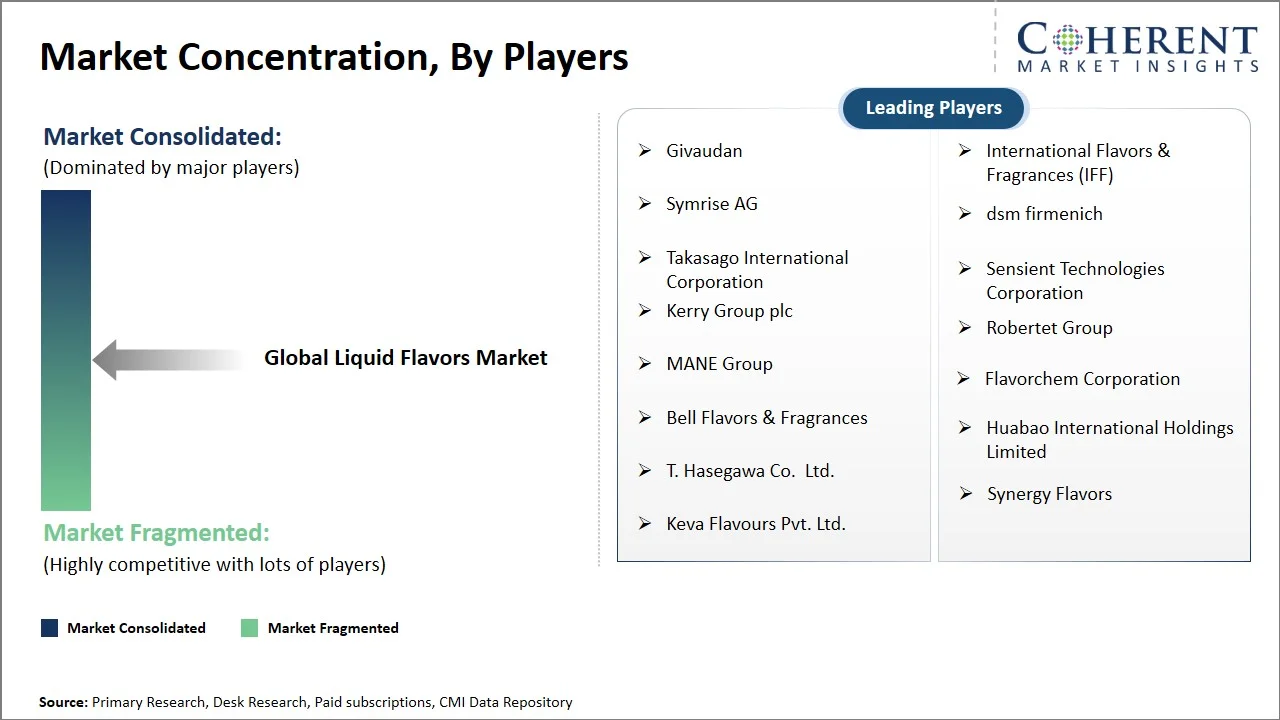
The global liquid flavors market is moderately consolidated, with large multinational flavor houses and specialized regional manufacturers competing on formulation expertise, natural ingredient portfolios, application support, sensory science, and speed of customer customization. Leading players such as Givaudan, IFF, Symrise, Firmenich/dsm-firmenich, Kerry, Takasago, Mane, Sensient Technologies, Flavorchem, T. Hasegawa, and FlavorSum are focused on expanding clean-label, natural, fruit, beverage, dairy, savory, and functional flavor solutions. Competition is increasingly shaped by R&D investments, regional application labs, flavor modulation technologies, sustainable sourcing, and the ability to support beverage and food manufacturers from concept development to scale-up. Givaudan highlights its Taste & Wellbeing business as a food and beverage ingredient platform built around flavors, taste, functional, and nutritional solutions, while IFF positions itself across food, beverage, health, biosciences, scent, and sustainable innovation.
Key focus areas include
- Development of natural and clean-label liquid flavor systems for beverages, dairy, bakery, confectionery, savory foods, and functional nutrition products.
- Expansion of flavor modulation, masking, and sweetness-balancing technologies to support low-sugar, high-protein, plant-based, and fortified formulations.
- Investment in application labs, sensory science, and rapid prototyping platforms to shorten product development cycles for food and beverage manufacturers.
- Regional production expansion and supply-chain localization to reduce lead times, improve customer responsiveness, and serve Asia Pacific, Europe, and North America more effectively.
- Sustainable sourcing and traceability of natural flavor ingredients such as vanilla, citrus, botanicals, fruits, herbs, spices, and fermentation-derived aroma compounds.
- Portfolio diversification through acquisitions, partnerships, and specialty ingredient platforms to strengthen capabilities in beverage flavors, natural extracts, emulsions, and functional taste solutions.
Market Report Scope
Liquid Flavors Market Report Coverage
| Report Coverage | Details | ||
|---|---|---|---|
| Base Year: | 2025 | Market Size in 2026: | USD 17,420.4 Mn |
| Historical Data for: | 2020 To 2024 | Forecast Period: | 2026 To 2033 |
| Forecast Period 2026 to 2033 CAGR: | 7.5% | 2033 Value Projection: | USD 28,901.3 Mn |
| Geographies covered: |
| ||
| Segments covered: |
| ||
| Companies covered: | Givaudan, International Flavors & Fragrances (IFF), Symrise AG, dsm firmenich, Takasago International Corporation, Sensient Technologies Corporation, Kerry Group plc, Robertet Group, MANE Group, Flavorchem Corporation, Bell Flavors & Fragrances, Huabao International Holdings Limited, T. Hasegawa Co. Ltd., Synergy Flavors, and Keva Flavours Pvt. Ltd. | ||
| Growth Drivers: |
| ||
| Restraints & Challenges: |
| ||
Analyst Opinion (Expert Opinion)
- The global liquid flavors market is expected to witness steady long-term growth due to rising demand for natural, clean-label, and application-specific flavor solutions across beverages, dairy, bakery, confectionery, savory foods, pharmaceuticals, and convenience products. Growing consumer preference for recognizable ingredients, low-sugar formulations, functional beverages, and premium taste experiences is expected to support wider adoption of liquid flavors among large food manufacturers, beverage brands, and private-label players.
- The strongest opportunities are likely to emerge in beverages, where liquid flavors are widely used in carbonated drinks, flavored waters, energy drinks, juices, teas, dairy beverages, and functional drinks. North America is expected to remain the leading region due to strong beverage innovation, established food processing infrastructure, and high adoption of natural flavor systems, while Europe is expected to grow faster with rising clean-label demand, regulatory-driven reformulation, and strong interest in botanical, fruit, and premium flavor profiles.
- To gain a competitive advantage, market players should focus on natural flavor extraction, flavor modulation, bitterness masking, emulsion stability, precision fermentation, and rapid application development. Companies that can offer clean-label liquid flavors, consistent sensory performance, strong shelf-life stability, regional taste customization, and technical support for reduced-sugar and functional formulations will be better positioned to capture demand from beverage, dairy, bakery, savory, nutraceutical, and processed food manufacturers.
Speak to the analyst
Want personalized insights?
Take the findings above to one of our principal consultants, or have the report rebuilt around the segments, geographies and competitors you actually track.
Market Segmentation
- Nature Insights (Revenue, USD Mn, 2021 - 2033)
- Natural Flavors
- Artificial Flavors
- Flavor Type Insights (Revenue, USD Mn, 2021 - 2033)
- Fruit Flavors
- Beverage Flavors
- Dairy Flavors
- Savory Flavors
- Others
- Application Insights (Revenue, USD Mn, 2021 - 2033)
- Beverages
- Savory & Snacks
- Bakery & Confectionery
- Dairy Products
- Pharmaceuticals
- Others
- Distribution Channel Insights (Revenue, USD Mn, 2021 - 2033)
- B2B
- B2C
- Regional Insights (Revenue, USD Mn, 2021 - 2033)
- North America
- U.S.
- Canada
- Latin America
- Brazil
- Argentina
- Mexico
- Rest of Latin America
- Europe
- Germany
- U.K.
- Spain
- France
- Italy
- Russia
- Rest of Europe
- Asia Pacific
- China
- India
- Japan
- Australia
- South Korea
- ASEAN
- Rest of Asia Pacific
- Middle East
- GCC Countries
- Israel
- Rest of Middle East
- Africa
- South Africa
- North Africa
- Central Africa
- North America
- Key Players Insights
- Givaudan
- International Flavors & Fragrances (IFF)
- Symrise AG
- dsm firmenich
- Takasago International Corporation
- Sensient Technologies Corporation
- Kerry Group plc
- Robertet Group
- MANE Group
- Flavorchem Corporation
- Bell Flavors & Fragrances
- Huabao International Holdings Limited
- Hasegawa Co. Ltd.
- Synergy Flavors
- Keva Flavours Pvt. Ltd.
Sources
Primary Research Interviews
- Flavor technologists and product development heads from liquid flavor manufacturers
- Food and beverage R&D managers using liquid flavors in beverages, dairy, bakery, confectionery, savory, and convenience foods
- Procurement managers from food processing, beverage, nutraceutical, and dairy companies
- Regulatory and quality assurance professionals handling food flavoring compliance and labeling
- Executives and product managers from flavor houses, ingredient suppliers, and food formulation companies
Stakeholders
- Liquid flavor manufacturers and flavor houses
- Natural extract, aroma chemical, and botanical ingredient suppliers
- Emulsion, stabilizer, and carrier system suppliers
- Food and beverage contract manufacturers
- Ingredient distributors and B2B flavor traders
End-use Sectors
- Beverage manufacturers
- Dairy and plant-based dairy companies
- Bakery and confectionery manufacturers
- Savory snacks and convenience food producers
- Nutraceutical and functional food manufacturers
- Pharmaceutical and oral care product manufacturers
- Foodservice and quick-service restaurant chains
Regulatory & Food Safety Bodies
- U.S. Food and Drug Administration (FDA)
- European Food Safety Authority (EFSA)
- European Commission – Food Safety and Food Additives Framework
- Food Safety and Standards Authority of India (FSSAI)
- Codex Alimentarius Commission
- Joint FAO/WHO Expert Committee on Food Additives (JECFA)
- Health Canada – Food Directorate
- Food Standards Australia New Zealand (FSANZ)
- Ministry of Health, Labour and Welfare (MHLW), Japan
- National Health Commission (NHC), China
Databases
- FDA Food Additive Status List
- FDA GRAS Notices Inventory
- EFSA OpenFoodTox Database
- JECFA Food Additive Evaluations
- Codex General Standard for Food Additives Database
- USDA Foreign Agricultural Service GAIN Reports
- UN Comtrade Database
- ITC Trade Map
- Eurostat Database
- World Bank Data
Magazines
- Food Business News
- Food Ingredients First
- Beverage Daily
- Food Dive
- Dairy Foods
- Baking Business
- Nutraceuticals World
- Food Engineering Magazine
- The World of Food Ingredients
Journals
- Food Chemistry
- Journal of Food Science
- Flavour and Fragrance Journal
- Journal of Agricultural and Food Chemistry
- Molecules
- LWT – Food Science and Technology
- International Journal of Food Science & Technology
- Trends in Food Science & Technology
Newspapers / Business Publications
- The Wall Street Journal
- Financial Times
Associations
- Flavor and Extract Manufacturers Association (FEMA)
- International Organization of the Flavor Industry (IOFI)
- European Flavour Association (EFFA)
- Institute of Food Technologists (IFT)
- Specialty Food Association
- International Dairy Foods Association (IDFA)
- American Beverage Association
- Food and Drink Federation (FDF)
- Federation of Indian Food and Hospitality Industry (FIFHI)
Public Domain Sources
- U.S. FDA – Food Ingredients and Packaging
- EFSA – Food Additives and Flavourings
- European Commission – Food Safety and Food Additives
- FSSAI – Food Additives and Food Safety Regulations
- Codex Alimentarius – Food Additive Standards
- FAO – Food Systems and Food Ingredients Data
- WHO – Food Safety and Nutrition Data
- USDA – Food Processing and Ingredient Trade Reports
- World Bank – Food Industry and Trade Indicators
- UN Comtrade – Flavoring and Extract Trade Data
Proprietary Elements
- CMI Data Analytics Tool, Proprietary CMI Existing Repository of information for last 10 years.
Get access to 250+ pages report
Every segment, forecast, competitor profile and data table behind the analysis above — available for instant download.
- ESOMAR Member
- ISO 9001:2015 Certified
- D-U-N-S Registered
- GDPR & CCPA Compliant
Missing comfort of reading report in your local language? Find your preferred language:
Transform your Strategy with Exclusive Trending Reports
Frequently Asked Questions
The CAGR of the global liquid flavors market is projected to be 7.5% from 2026 to 2033.
The global liquid flavors market is valued at USD 17,420.4 million in 2026 and is expected to reach USD 28,901.3 million by 2033.
Fruit flavors dominate the global liquid flavors market by flavor type, with an expected 31.4% share in 2026.
Rising demand for natural and clean label flavor ingredients and expanding use of liquid flavors in beverages dairy and convenience foods are the major factors driving the growth of the global liquid flavors market.
Price volatility of natural raw materials and flavor extracts and stringent food safety regulations and labeling compliance requirements are the major factors hampering the growth of the global liquid flavors market.
In terms of nature, natural flavors are estimated to dominate the market revenue share in 2026.
Givaudan, International Flavors & Fragrances (IFF), Symrise AG, dsm firmenich, Takasago International Corporation, Sensient Technologies Corporation, Kerry Group plc, Robertet Group, MANE Group, Flavorchem Corporation, Bell Flavors & Fragrances, Huabao International Holdings Limited, T. Hasegawa Co. Ltd., Synergy Flavors, and Keva Flavours Pvt. Ltd. are the major players.