

Global Lithium Iron Phosphate Battery Market Size and Forecast – 2026 To 2033
The Global Lithium Iron Phosphate Battery Market is estimated to be valued at USD 35.71 Bn in 2026 and is expected to reach USD 100.32 Bn by 2033, exhibiting a compound annual growth rate (CAGR) of 15.90% from 2026 to 2033. Market growth is supported by increasing adoption of the Global Lithium Iron Phosphate Battery across electric vehicles, renewable energy integration, utility-scale storage, and industrial backup systems.
Lithium iron phosphate batteries are gaining preference because of their thermal stability, long cycle life, competitive material costs, and lower dependence on nickel and cobalt. In February 2025, BYD Energy Storage signed contracts with Saudi Electricity Company for 12.5 GWh of grid-scale battery storage projects, demonstrating the growing commercial deployment of lithium iron phosphate-based systems for renewable energy balancing and grid reliability.
Key Takeaways of the Global Lithium Iron Phosphate Battery Market
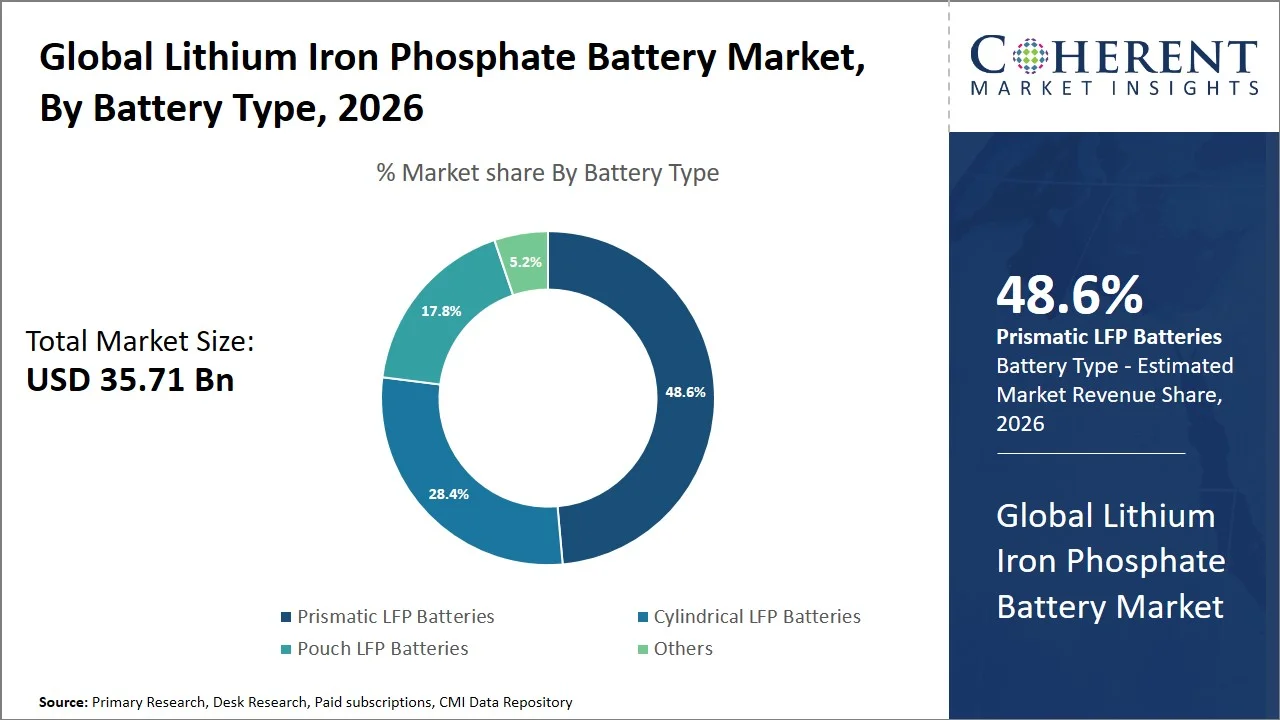
- Prismatic LFP batteries are expected to lead with 48.6 % of the market share in 2026 as they enable efficient packing, thermal management, structural integration, and automated assembly. In August 2025, Ford confirmed that its Universal EV Platform would use prismatic lithium iron phosphate batteries as a structural floor subassembly.
- Above 100 Ah batteries are expected to dominate the capacity segment, accounting for 48.7 % of the market share in 2026. Large-format cells reduce cell count, interconnections, monitoring points, and balance-of-system complexity, improving economics for utility-scale storage and heavy-duty applications. In June 2025, EVE Energy’s 300,000th 628 Ah Mr.Big cell rolled off the dedicated production line at its 60 GWh Super Energy Storage Plant in Jingmen, Hubei, demonstrating the commercial-scale manufacturing of ultra-large energy-storage cells.
- Electric vehicles are expected to account for 46.8 % of the market share in 2026. Lithium iron phosphate chemistry is becoming central to mass-market electrification because it combines cost control, thermal stability, long cycle life, and improving fast-charging performance. In September 2025, CATL launched Shenxing Pro, offering up to 758 km WLTP range and rapid range replenishment for European EV platforms.
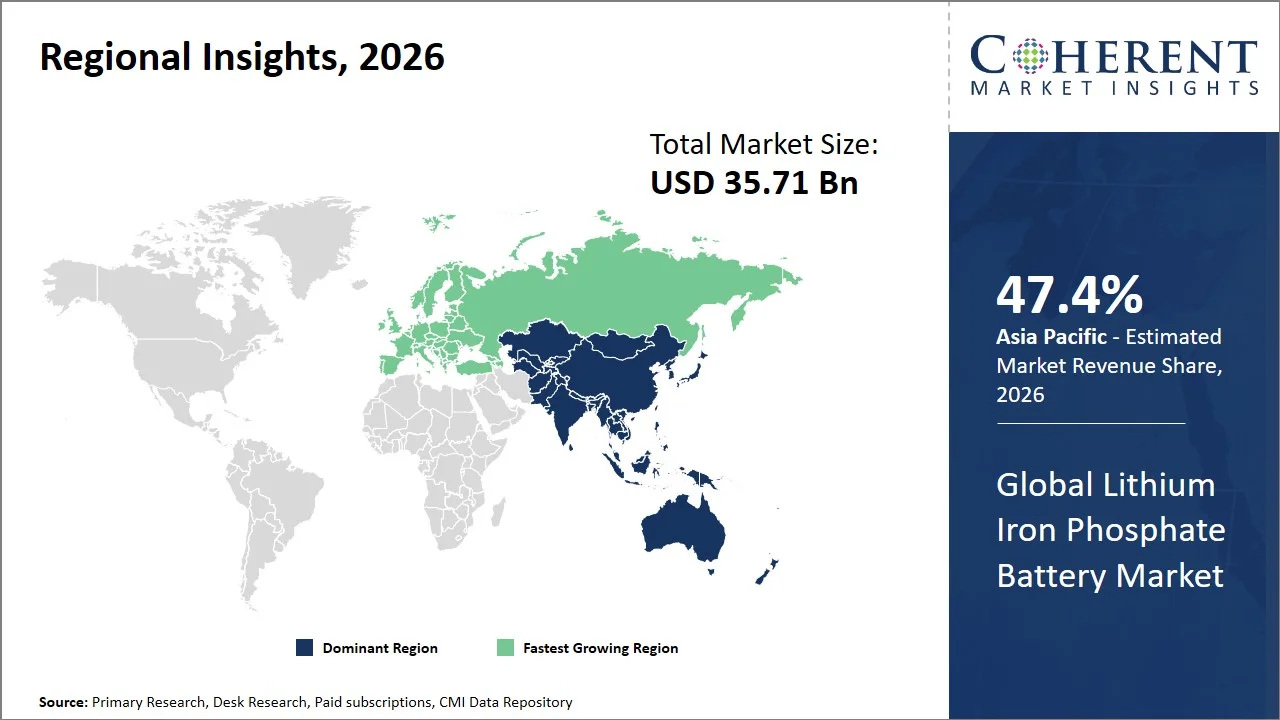
- Asia Pacific is expected to dominate the global market with a 47.4 % share in 2026, supported by concentrated cathode, cell, equipment, pack, and downstream manufacturing capabilities. In April 2025, China rolled out its first batch of ten 1,000-kW battery-powered locomotives equipped with high-capacity LFP batteries, demonstrating regional commercialization beyond passenger vehicles and stationary storage.
- Europe is expected to be the fastest-growing region and hold 23.8 % of the market share in 2026, as automakers localize affordable battery platforms and adapt portfolios to tighter industrial and sustainability requirements. In June 2026, Renault unveiled the France-produced new Megane E-Tech electric with a 67 kWh LFP battery replacing NMC chemistry, extending lithium iron phosphate adoption into mainstream European passenger vehicles.
- Fast-Charging LFP Architectures: Battery developers are shifting competitive differentiation from chemistry cost alone toward charging speed, thermal control, software calibration, and pack-level power delivery. This transition is widening lithium iron phosphate addressable market from entry-level vehicles to higher-performance models. Suppliers combining advanced cells with power electronics, cooling systems, and charging partnerships will gain stronger negotiating leverage with automotive and energy-storage customers.
- Structural Integration and Supply Localization: Cell-to-pack and cell-to-body designs are reducing inactive materials, simplifying assembly, and improving usable pack volume, supporting lower vehicle and system costs. Simultaneously, OEMs are pursuing localized cathode, cell, pack, and recycling networks to limit logistics exposure and regulatory risk. These shifts favor long-term supply agreements, regional joint ventures, and battery manufacturers with integrated engineering capabilities.
Segmental Insights
Why Do Prismatic LFP Batteries Dominate the Global Lithium Iron Phosphate Battery Market?
Prismatic LFP batteries are expected to command 48.6% of the battery type segment in 2026. Their rectangular, rigid-shell construction supports consistent electrode compression, controlled cell swelling, and predictable mechanical tolerances throughout service life. These characteristics are particularly valuable to EV and stationary-storage manufacturers seeking repeatable pack designs, standardized busbar interfaces, and easier supplier qualification across multiple product platforms. On the demand side, automakers and storage integrators favor the format because capacity can be increased through cell-length and thickness variations without redesigning the entire electrical architecture. On the supply side, prismatic production supports high-throughput stacking, automated enclosure welding, and flexible conversion of existing manufacturing assets. In December 2025, Samsung SDI announced a contract worth more than USD 1.3 billion to supply prismatic LFP batteries for U.S. energy-storage projects, with production planned through converted U.S. lines from 2027.
- Current Industry Events of 2026
- Market Size Estimation
- Regional Breakdown
- Competitive Landscape
- Customer Intelligence
- Segmental Analysis
- Pricing Analysis
- Key Market Drivers, Challenges & Future Trends
- Customized Insights Section
Why Does Above 100 Ah Represent the Largest Capacity Segment in the Global Lithium Iron Phosphate Battery Market?
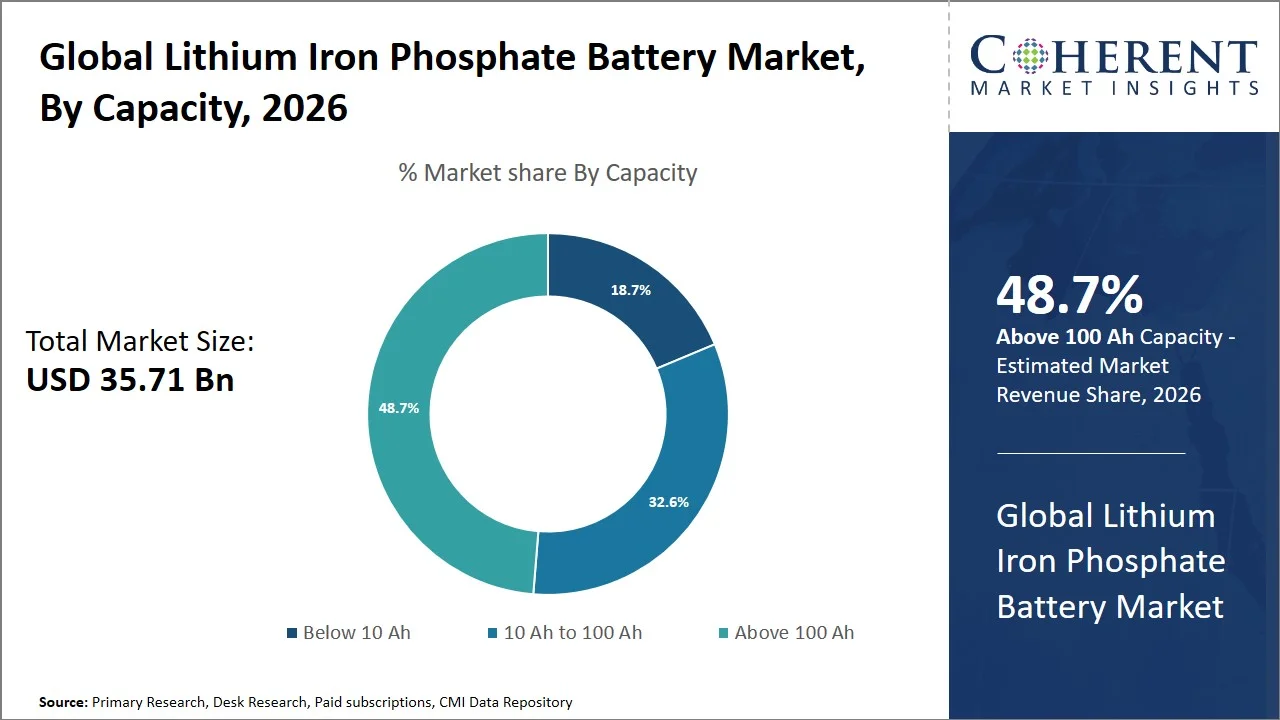
The above 100 Ah segment is expected to hold 48.7% of the capacity category in 2026. Its leadership reflects the shift toward utility-scale and long-duration storage systems that require higher energy throughput from each cell, especially for four-hour renewable-energy shifting, grid balancing, and industrial peak-management projects. Larger-capacity lithium iron phosphate cells improve container-level energy density and lower the proportion of racks, housings, and auxiliary materials relative to stored energy, strengthening project economics where land, installation labor, and enclosure costs are material. Supply-side advancements in wide-width electrode coating, precision stacking, electrolyte filling, and formation processes are also making ultra-large cells commercially reproducible rather than purely developmental. In June 2025, HiTHIUM announced mass production of its 1,175 Ah LFP cell at its Chongqing base; the cell also received UL 1973 and UL 9540A certifications, supporting deployment in long-duration energy-storage projects.
Why Do Electric Vehicles Dominate the Global Lithium Iron Phosphate Battery Market?
Electric vehicles are expected to account for 46.8% of global lithium iron phosphate battery demand in 2026. Segment leadership is anchored in automakers’ need to expand battery-electric portfolios without exposing entry-level and fleet models to high nickel and cobalt costs. Lithium iron phosphate enables manufacturers to protect vehicle pricing, reduce sensitivity to critical-mineral volatility, and offer practical range configurations suited to urban commuting, shared mobility, delivery fleets, and compact sport-utility vehicles. Its stable procurement base also supports multi-year platform planning and regional sourcing strategies. From a product perspective, automakers can use different pack capacities on a common vehicle architecture, creating clear price and range ladders while preserving manufacturing scale. In April 2025, Citroën detailed a more affordable ë-C3 with a 30 kWh LFP battery and an ë-C3 Aircross version using a 54 kWh LFP battery, demonstrating LFP’s role across distinct mass-market EV configurations.
Global Lithium Iron Phosphate Battery Market Dynamics
Key Market Drivers
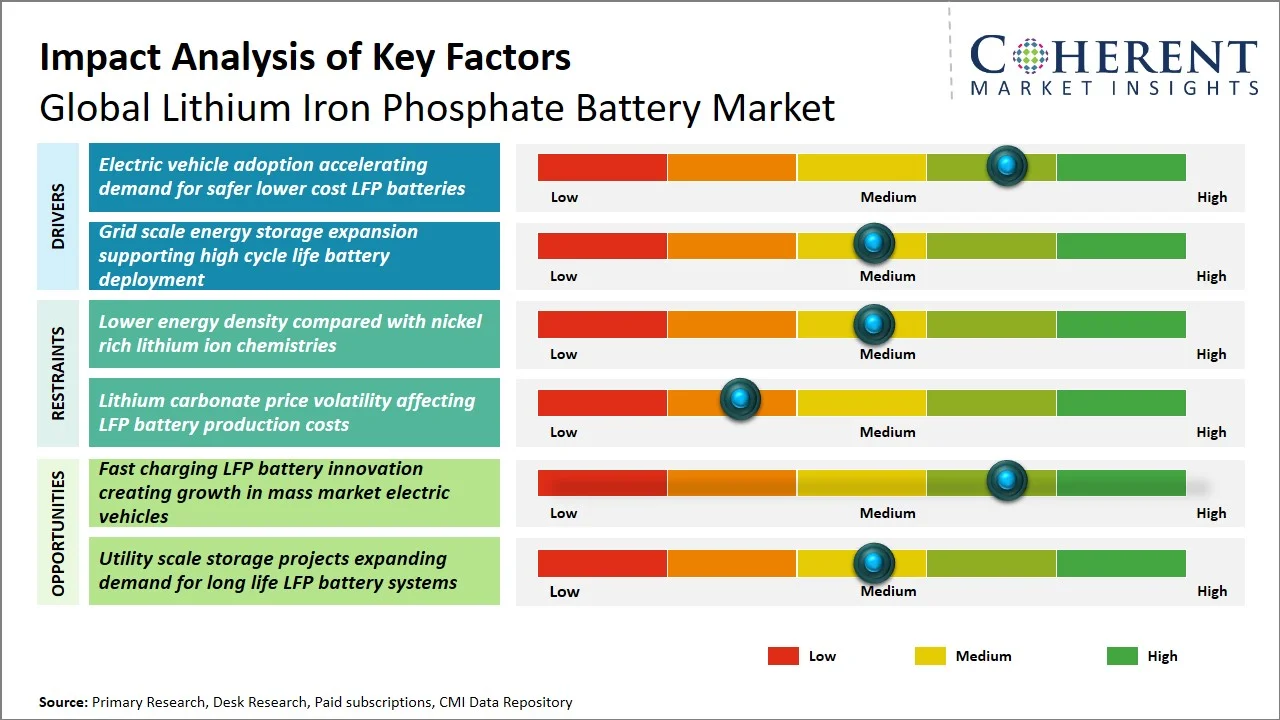
- Electric Vehicle Adoption Accelerating Demand for Safer, Lower-Cost LFP Batteries: Electric vehicle adoption is repositioning lithium iron phosphate from an entry-level chemistry into a core platform for high-volume passenger cars, urban fleets, and commercial vehicles. Automakers value its lower exposure to nickel and cobalt costs, favorable safety profile, and durable operating performance, which support more predictable vehicle pricing and warranty economics. Demand is reinforced by buyers prioritizing affordability, dependable daily range, and lower ownership costs rather than maximum energy density. For suppliers, LFP enables portfolio segmentation: premium vehicles can retain high-energy chemistries while mainstream models use economical packs without compromising essential performance. In July 2025, Ultium Cells announced that its Spring Hill, Tennessee facility would be upgraded to produce low-cost LFP cells, with line conversion beginning in 2025 and commercial production targeted for late 2027. The move demonstrates that major Western OEM supply chains are localizing LFP to support broader EV adoption.
- Grid-Scale Energy Storage Expansion Supporting High-Cycle-Life Battery Deployment: Grid-scale energy storage is becoming a second structural demand engine for lithium iron phosphate because utilities require batteries that can cycle frequently, operate predictably over long project lives, and satisfy increasingly demanding safety and availability requirements. LFP is well suited to renewable-energy shifting, frequency regulation, congestion relief, capacity support, and microgrids, where lifecycle throughput and bankability matter more than maximum gravimetric energy density. Larger cells, liquid cooling, grid-forming controls, and factory-integrated AC blocks are lowering installation complexity and improving revenue availability. This encourages utilities, independent power producers, and infrastructure investors to specify lithium iron phosphate systems for multi-hour projects. In January 2026, Sungrow launched PowerTitan 3.0 for European utility-scale applications, combining large stacked cells, liquid-cooled silicon-carbide power conversion, two-to-eight-hour configurations, and grid-forming capability. The development illustrates how LFP systems are evolving from battery containers into high-value grid assets.
Emerging Market Trends
- Fast-Charging Performance and Structural Pack Integration: LFP competition is shifting from basic cell cost toward charging performance, usable energy, and pack-level integration. Cell manufacturers are improving electrode formulation, lithium-ion transport, electrolyte stability, tab design, and thermal pathways to support higher charge rates without accelerating degradation. At the pack level, cell-to-pack and cell-to-body architectures reduce inactive components and recover volume previously occupied by modules, helping LFP narrow the practical range gap with higher-energy chemistries. This trend expands the addressable market beyond short-range vehicles into mainstream crossovers, light commercial vehicles, buses, and selected premium models. Commercially, suppliers that can validate fast charging across temperature ranges while retaining warranty-grade cycle life will secure stronger OEM positions. The market will increasingly reward integrated engineering capability rather than standalone cell specifications, making battery-management software, cooling design, structural protection, and vehicle-platform compatibility central to differentiation.
- Localization of LFP Manufacturing and Material Supply Chains: Regionalization is becoming a defining trend as governments and customers seek traceable, resilient, and policy-compliant battery supply chains. LFP producers are therefore moving beyond exporting finished cells toward localized cathode-material production, cell manufacturing, pack assembly, testing, recycling, and service support. This shift raises capital requirements but improves access to OEM contracts, domestic-content benefits, public procurement programs, and regional industrial incentives. It also reduces logistics exposure for large-format cells and enables faster responses to customer validation or quality issues. In parallel, buyers are demanding clearer carbon-footprint documentation, responsible sourcing records, and end-of-life pathways, favoring vertically integrated suppliers and partnerships among material companies, cell manufacturers, recyclers, and regional pack producers. Over the forecast period, competitive advantage will depend increasingly on the ability to deliver a compliant regional ecosystem rather than merely offering a low ex-factory cell price.
Current Events and their Impact
Current Events | Description and its Impact |
March 2025 – China issued GB 38031-2025, effective July 2026 |
|
July 2025 – EU postponed battery due-diligence requirements to August 2027 |
|
September 2025 – U.S. clean-vehicle tax credits ended for later acquisitions |
|
Regional Insights
Why Does Asia Pacific Dominate the Global Lithium Iron Phosphate Battery Market?
Asia Pacific is expected to dominate the global lithium iron phosphate battery market with 47.4% share in 2026. The region combines the deepest lithium iron phosphate cathode, graphite, electrolyte, separator, cell, pack, and equipment supply chains with substantial demand from electric cars, buses, two-wheelers, commercial vehicles, and grid storage. High factory utilization, dense supplier clusters, established engineering talent, and rapid product qualification allow manufacturers to reduce cost while scaling new formats faster than competitors. China anchors this position, while Japan and South Korea contribute advanced materials, production equipment, battery management, and automotive integration capabilities. In March 2025, the International Energy Agency reported that China produced more than three-quarters of batteries sold globally and retained a substantial price advantage over Europe and North America, reinforcing Asia Pacific’s scale, export competitiveness, and influence over global LFP pricing.
Why is Europe Emerging as the Fastest-Growing Region in the Global Lithium Iron Phosphate Battery Market?
Europe is expected to emerge as the fastest-growing region and account for 23.8% of the global lithium iron phosphate battery market in 2026. Growth is supported by automakers seeking lower-cost battery options, accelerating renewable-energy integration, stricter lifecycle and traceability requirements, and efforts to reduce reliance on imported cells. Lithium iron phosphate is increasingly attractive for compact electric vehicles, commercial transport, industrial machinery, residential storage, and utility projects because cycle life, safety, and total ownership cost often outweigh maximum energy density. European participants are also building localized cathode, anode, cell-testing, and recycling capabilities to satisfy regional procurement expectations. In February 2025, Serbia-based ElevenEs entered a joint development agreement with Netherlands-based CarbonX to validate advanced anode material for LFP cells. The collaboration reflects Europe’s push to improve locally developed LFP performance while creating a more integrated regional battery-material and cell-manufacturing ecosystem.
Global Lithium Iron Phosphate Battery Market Outlook for Key Countries
Why is the U.S. a Key Market for the Lithium Iron Phosphate Battery Market?
The U.S. is a key market for lithium iron phosphate batteries because it combines large electric-vehicle demand, rapidly expanding utility storage, substantial data-center power requirements, and policy-driven interest in localized battery supply. LFP is gaining relevance where customers prioritize predictable costs, high cycling durability, thermal stability, and reduced exposure to nickel and cobalt supply risks. Stationary storage offers the strongest near-term route to scale, while lower-priced passenger vehicles, delivery fleets, school buses, telecom backup, and commercial energy systems provide additional demand channels. Domestic production is strategically important because imported cells face trade and eligibility constraints, encouraging manufacturers to repurpose existing facilities and qualify regional suppliers. In April 2025, LG Energy Solution stated that it would begin producing lithium iron phosphate batteries for energy storage at its Michigan plant during 2025, one year earlier than previously planned, reflecting the urgency of serving North American storage demand through local capacity.
Why is India Important in the Global Lithium Iron Phosphate Battery Market?
India is important in the global lithium iron phosphate battery market because its electrification profile is led by price-sensitive two-wheelers, three-wheelers, compact cars, light commercial vehicles, telecom infrastructure, and distributed energy systems. These applications align closely with LFP’s safety, cycle-life, and cost characteristics, particularly under high ambient temperatures and intensive daily use. Demand is broadening from imported cells toward domestically engineered packs, battery-management systems, thermal solutions, and eventually local cell manufacturing. Fleet operators also value predictable degradation and lower replacement frequency, while renewable developers require durable storage for solar integration and weak-grid locations. In August 2025, Oben Electric launched the Rorr EZ Sigma electric motorcycle with its LFP battery platform in India. The launch demonstrated how domestic manufacturers are using LFP to differentiate mass-market mobility products through heat tolerance, extended battery life, and application-specific pack engineering rather than competing only on headline vehicle range.
Why Does China Support Growth in the Global Lithium Iron Phosphate Battery Market?
China supports growth in the global lithium iron phosphate battery market through deep integration across phosphate processing, cathode materials, graphite anodes, cell production, pack assembly, electric vehicles, and battery energy storage systems. Large domestic procurement volumes allow manufacturers to validate products quickly, improve yields, and spread development costs across mobility and stationary-storage platforms. Extensive industrial clusters, port infrastructure, and engineering capacity also position Chinese suppliers to export complete battery systems rather than only cells, strengthening their influence over international specifications and project pricing. In May 2025, REPT BATTERO introduced 392 Ah and 587 Ah large-capacity energy-storage cells at the China International Battery Fair. Its official specifications identify the 392 Ah model as an LFP cell with a 12,000-cycle rating. The development illustrates how China’s integrated manufacturing base accelerates the commercialization of high-capacity LFP products for utility and commercial storage.
Why is Germany a Strategic Country in the Lithium Iron Phosphate Battery Market?
Germany is a strategic country in the global lithium iron phosphate battery market because its automotive engineering base, chemical industry, industrial automation capabilities, and demanding qualification standards shape battery adoption across Europe. German automakers require scalable lower-cost chemistries for volume electric vehicles, while machinery, logistics, renewable-energy, and commercial-storage customers create additional demand for robust LFP systems. The country’s competitive role is increasingly shifting upstream from pack integration toward locally produced cathode materials and validated manufacturing processes. This supports shorter supply chains, improved traceability, and closer coordination between material developers, cell producers, and vehicle platforms. In October 2025, IBU-tec signed an agreement with PowerCo to manufacture LFP cathode material for automotive applications at its Weimar site from 2026. The arrangement is commercially important because it establishes a domestic material route for European LFP programs and links German process expertise directly with large-scale automotive battery procurement.
Why is Japan an Important Growth Market for the Lithium Iron Phosphate Battery Market?
Japan is an important growth market for lithium iron phosphate batteries because its automotive, electronics, power-management, and precision-manufacturing industries influence battery specifications well beyond domestic vehicle sales. Japanese companies are strong in separators, electrolytes, production equipment, thermal systems, battery controls, and high-reliability pack engineering, giving the country a valuable role even where cell manufacturing is sourced internationally. LFP adoption can expand in compact vehicles, commercial fleets, backup power, residential storage, and industrial systems, particularly as buyers place greater emphasis on safety, longevity, and lifecycle cost. Japanese OEMs are also adapting global platforms to markets where affordability is central to electrification. In April 2025, Nissan presented the N7 battery-electric sedan with 58 kWh and 73 kWh LFP battery options. The development showed a major Japanese automaker, incorporating LFP into an internationally relevant, cost-focused vehicle platform with differentiated range configurations.
Technology Adoption Landscape in the Global Lithium Iron Phosphate Battery Market
Technology | Adoption Level | Key Application Area | Business Impact |
Cell-to-Pack and Cell-to-Body Integration | High | Passenger EVs, buses, and light commercial vehicles | Eliminates conventional module layers, improves usable pack volume, reduces component count, and supports lower assembly cost per vehicle. |
Liquid-Cooled Thermal Management | High | Utility-scale, C&I storage, and fast-charging EV packs | Maintains tighter cell-temperature uniformity, limits uneven degradation, supports higher charge and discharge rates, and improves system availability. |
Advanced BMS and Predictive Diagnostics | High | EV packs, stationary storage, telecom, and industrial batteries | Improves state-of-charge and state-of-health estimation, enables early fault identification, strengthens warranty control, and reduces unplanned downtime. |
800-Volt and High-C-Rate Charging Architecture | Medium | Passenger EVs, electric buses, and commercial fleets | Reduces charging time and increases vehicle utilization, expanding LFP adoption in fleet applications where operational availability is commercially critical. |
Large-Format Stacked LFP Cells | Medium | Two-to-eight-hour grid-scale energy storage | Raises container-level energy capacity, reduces electrical connections and auxiliary components, and lowers installation and maintenance complexity. |
Grid-Forming Power Conversion Systems | Medium | Renewable integration, weak grids, island systems, and microgrids | Allows storage assets to provide voltage support, frequency control, inertia-like response, and black-start functions, creating additional revenue opportunities. |
How are High-Power Charging and Multi-Hour Storage Creating New Growth Opportunities in the Global Lithium Iron Phosphate Battery Market?
High-power charging and multi-hour storage are creating the most commercially attractive expansion paths for lithium iron phosphate suppliers. In mobility, improved charge acceptance, advanced thermal management, and structurally integrated packs can move LFP into vehicles that previously required higher-energy chemistries, including long-range crossovers, commercial fleets, and high-utilization transport. In stationary storage, larger cells and grid-forming power electronics allow vendors to target renewable shifting, data-center resilience, industrial peak management, and capacity markets with standardized multi-hour systems. The opportunity extends beyond cell sales: suppliers can capture additional value through pack engineering, energy-management software, safety validation, warranties, augmentation planning, maintenance, and recycling services. Companies that design products around total lifecycle economics rather than nominal cell cost can create stronger customer lock-in and improve margins. Regional manufacturing will further strengthen this opportunity by aligning products with domestic-content rules, shorter lead times, local certification requirements, and customer expectations for secure supply. The strongest participants will combine scalable manufacturing with application-specific system integration.
Market Players, Key Development, and Competitive Landscape
Key Developments
- In October 2025, Exide Technologies introduced Solition Mega Five, a liquid-cooled 5 MWh LFP battery energy storage system packaged in a 20-foot container for European utility and commercial applications. The system expands LFP participation in high-capacity grid storage while combining compact design, predictive diagnostics, safety controls, and European data hosting.
- In May 2025, Saft unveiled its Intensium Flex high-energy battery storage system, with production planned to begin by the end of 2025 and commercial launch scheduled for 2026. Based on liquid-cooled LFP technology, the platform is important because it targets high-throughput energy-storage applications requiring flexible configurations, system safety, and intensive daily cycling.
Competitive Landscape
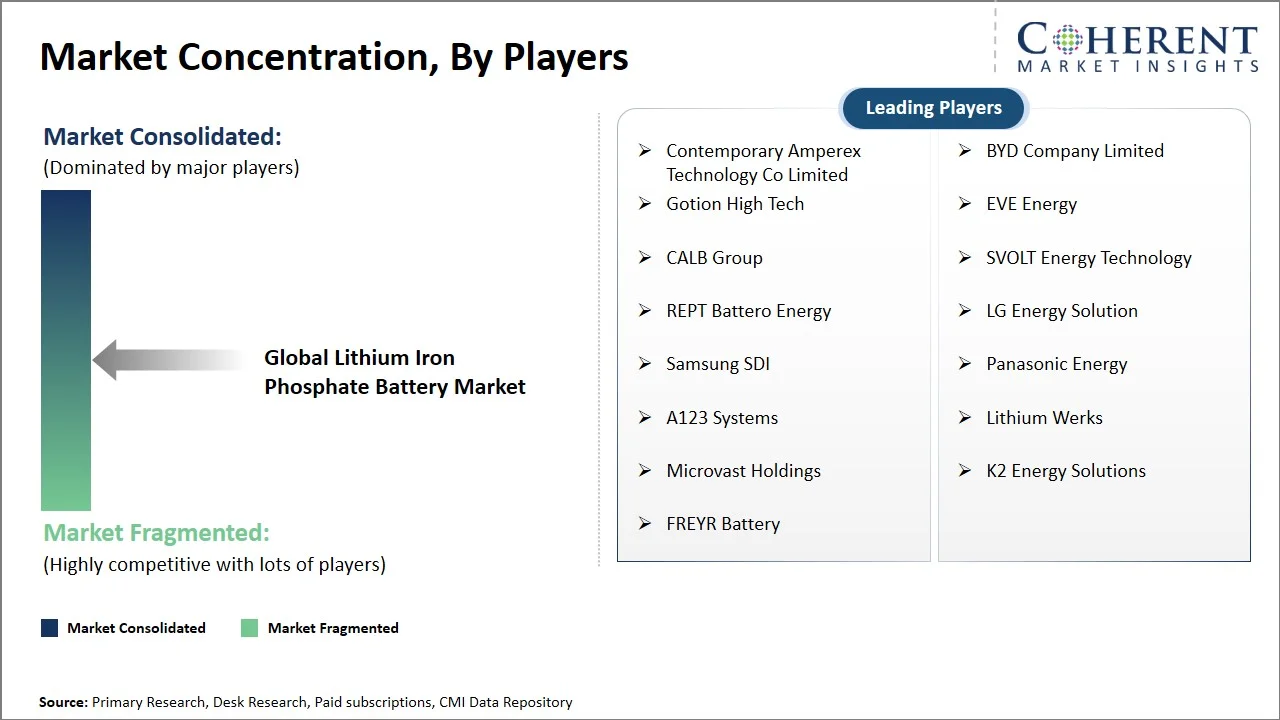
The global lithium iron phosphate battery market is relatively concentrated among large-scale cell and cathode-material manufacturers, while pack assembly, energy-storage integration, aftermarket batteries, and application engineering remain more fragmented. Asian manufacturers retain substantial cost and production-scale advantages, whereas European and North American participants are investing in localized manufacturing, compliance capability, system integration, and customer-specific product development.
Key focus areas include
- Product quality and differentiation: Companies compete through cycle life, charge rate, low-temperature performance, energy density, safety consistency, and degradation control.
- Technology adoption and process efficiency: Automated coating, stacking, electrolyte filling, formation, inspection, and digital manufacturing systems are essential for improving yield and reducing unit costs.
- Pricing and cost competitiveness: Cathode-material sourcing, plant utilization, cell standardization, energy consumption, and manufacturing yield determine sustainable pricing power.
- Capacity expansion and supply reliability: OEMs and utility developers increasingly favor suppliers capable of supporting multi-year contracts, predictable delivery schedules, and regional production continuity.
- Certifications and quality control: Automotive validation, transport compliance, stationary-storage certification, fire testing, traceability, and production consistency strongly influence supplier qualification.
- Product format differentiation: Suppliers compete across prismatic, cylindrical, pouch, large-format storage cells, modular industrial batteries, and application-specific pack configurations.
- Partnerships and supply agreements: Long-term OEM contracts, utility procurement agreements, joint manufacturing ventures, and cathode-material partnerships reduce demand uncertainty and improve capacity planning.
- Lifecycle service capabilities: Battery monitoring, software upgrades, warranty management, augmentation, maintenance, second-life use, and recycling are becoming important sources of recurring revenue.
Market Report Scope
Lithium Iron Phosphate Battery Market Report Coverage
| Report Coverage | Details | ||
|---|---|---|---|
| Base Year: | 2025 | Market Size in 2026: | USD 35.71 Bn |
| Historical Data for: | 2020 To 2024 | Forecast Period: | 2026 To 2033 |
| Forecast Period 2026 to 2033 CAGR: | 15.90% | 2033 Value Projection: | USD 100.32 Bn |
| Geographies covered: |
| ||
| Segments covered: |
| ||
| Companies covered: | Contemporary Amperex Technology Co Limited, BYD Company Limited, Gotion High Tech, EVE Energy, CALB Group, SVOLT Energy Technology, REPT Battero Energy, LG Energy Solution, Samsung SDI, Panasonic Energy, A123 Systems, Lithium Werks, Microvast Holdings, K2 Energy Solutions, and FREYR Battery | ||
| Growth Drivers: |
| ||
| Restraints & Challenges: |
| ||
Analyst Opinion (Expert Opinion)
- Future market leadership in the lithium iron phosphate battery industry will increasingly depend on total system economics rather than cell pricing alone. Manufacturers that integrate cells with thermal management, battery software, power electronics, warranties, and lifecycle services will capture greater value. Grid-storage buyers are expected to place more emphasis on lifetime energy throughput, operational availability, safety performance, and augmentation requirements instead of focusing only on upfront procurement costs.
- Fast-charging LFP platforms and grid-forming storage systems are likely to have the most transformative impact on the market. Higher charging rates can broaden lithium iron phosphate adoption across commercial fleets, intercity transport, and mainstream passenger vehicles, while grid-forming capability can position stationary batteries as critical power-system assets. Asia Pacific will remain the principal manufacturing and supply-chain hub, whereas Europe will offer strong opportunities for localized production, regulatory compliance, recycling, and technical support.
- The market faces risks from oversupply, intense price competition, policy uncertainty, project-level safety concerns, and concentrated material-processing capacity. Manufacturers should avoid undifferentiated capacity expansion and instead prioritize high-yield production, application-specific products, validated safety performance, flexible manufacturing lines, and long-term customer contracts. Competitive advantage will also depend on digital traceability, predictive diagnostics, cybersecurity, battery-passport readiness, and transparent lifecycle data.
Speak to the analyst
Want personalized insights?
Take the findings above to one of our principal consultants, or have the report rebuilt around the segments, geographies and competitors you actually track.
Market Segmentation
- Battery Type Insights (Revenue, USD Bn, 2021 - 2033)
- Prismatic LFP Batteries
- Cylindrical LFP Batteries
- Pouch LFP Batteries
- Others
- Capacity Insights (Revenue, USD Bn, 2021 - 2033)
- Below 10 Ah
- 10 Ah to 100 Ah
- Above 100 Ah
- Application Insights (Revenue, USD Bn, 2021 - 2033)
- Electric Vehicles
- Energy Storage Systems
- Industrial Equipment
- Consumer Electronics
- Marine and Recreational Vehicles
- Others
- End-use Industry Insights (Revenue, USD Bn, 2021 - 2033)
- Automotive
- Energy and Utilities
- Industrial
- Consumer Electronics
- Others
- Regional Insights (Revenue, USD Bn, 2021 - 2033)
- North America
- U.S.
- Canada
- Latin America
- Brazil
- Argentina
- Mexico
- Rest of Latin America
- Europe
- Germany
- U.K.
- Spain
- France
- Italy
- Russia
- Rest of Europe
- Asia Pacific
- China
- India
- Japan
- Australia
- South Korea
- ASEAN
- Rest of Asia Pacific
- Middle East
- GCC Countries
- Israel
- Rest of Middle East
- Africa
- South Africa
- North Africa
- Central Africa
- North America
- Key Players Insights
- Contemporary Amperex Technology Co Limited
- BYD Company Limited
- Gotion High Tech
- EVE Energy
- CALB Group
- SVOLT Energy Technology
- REPT Battero Energy
- LG Energy Solution
- Samsung SDI
- Panasonic Energy
- A123 Systems
- Lithium Werks
- Microvast Holdings
- K2 Energy Solutions
- FREYR Battery
Sources
Primary Research Interviews
- Lithium iron phosphate (LFP) battery manufacturers covering cell production, module assembly, and battery pack integration
- Electric vehicle (EV) manufacturers, energy storage system (ESS) providers, and battery integrators
- Raw material suppliers including lithium, iron phosphate, graphite, and electrolyte producers
- Battery management system (BMS), thermal management, and power electronics solution providers
- Renewable energy developers, grid operators, and utility-scale storage project developers
- Industry experts in battery chemistry, safety standards, recycling, and sustainability
Stakeholders
- Battery manufacturers: CATL, BYD, LG Energy Solution, Samsung SDI, CALB, EVE Energy, Gotion High-Tech, A123 Systems
- Material suppliers: Albemarle, SQM, Livent, Tianqi Lithium, BASF, Umicore, Johnson Matthey
- EV manufacturers: Tesla, BYD Auto, Volkswagen Group, Hyundai, Ford, General Motors, NIO, XPeng
- Energy storage providers: Fluence, Tesla Energy, Sungrow, Wärtsilä, NextEra Energy, Enphase Energy
- End users: automotive OEMs, renewable energy developers, utilities, industrial energy users, and residential storage adopters
Databases
- International Energy Agency (IEA), U.S. Energy Information Administration (EIA), and BloombergNEF
- UN Comtrade, ITC Trade Map, USITC DataWeb, and Eurostat Comext
- U.S. Geological Survey (USGS), World Bank, IMF, and Asian Development Bank
- National Bureau of Statistics (China), U.S. Census Bureau, Eurostat, and Japan METI
- Company annual reports, investor presentations, technical papers, patents, and press releases
- Industry Publications and Journals
- Battery Technology, Energy Storage News, PV Tech, and CleanTechnica
- Journal of Power Sources, Journal of Energy Storage, Electrochimica Acta, and Nature Energy
- IEEE Transactions on Energy Conversion, Applied Energy, and Renewable & Sustainable Energy Reviews
Associations
- International Energy Agency (IEA), Global Battery Alliance, and International Renewable Energy Agency (IRENA)
- Battery Council International, European Battery Alliance, and Advanced Rechargeable & Lithium Batteries Association (RECHARGE)
- Society of Automotive Engineers (SAE), IEEE, ISO, and IEC
- Public Domain Sources
- U.S. Department of Energy (DOE), Environmental Protection Agency (EPA), and Federal Energy Regulatory Commission (FERC)
- European Commission, Eurostat, and European Environment Agency
- China Ministry of Industry and Information Technology (MIIT) and National Development and Reform Commission (NDRC)
- India Ministry of New and Renewable Energy (MNRE) and NITI Aayog
- Japan Ministry of Economy, Trade and Industry (METI) and Korea Ministry of Trade, Industry and Energy
Proprietary Elements
- CMI Data Analytics Tool, Proprietary CMI Existing Repository of information for last 10 years.
Get access to 250+ pages report
Every segment, forecast, competitor profile and data table behind the analysis above — available for instant download.
- ESOMAR Member
- ISO 9001:2015 Certified
- D-U-N-S Registered
- GDPR & CCPA Compliant
Missing comfort of reading report in your local language? Find your preferred language:
Transform your Strategy with Exclusive Trending Reports
Frequently Asked Questions
The CAGR of the global lithium iron phosphate battery market is projected to be 15.90% from 2026 to 2033.
The global lithium iron phosphate battery market is estimated to be valued at USD 35.71 billion in 2026 and is expected to reach USD 100.32 billion by 2033.
Lithium iron phosphate batteries are widely used in electric vehicles, energy storage systems, industrial equipment, consumer electronics, and marine applications.
They are preferred because of their strong thermal stability, long cycle life, low maintenance requirements, and suitability for frequent charging and discharging.
Key trends include fast-charging battery development, cell-to-pack integration, large-format storage cells, localized battery manufacturing, and advanced battery management systems.
Electric vehicle adoption accelerating demand for safer lower cost LFP batteries and grid scale energy storage expansion supporting high cycle life battery deployment are the major factors driving the growth of the global lithium iron phosphate battery market.
Lower energy density compared with nickel rich lithium-ion chemistries and lithium carbonate price volatility affecting LFP battery production costs are the major factors hampering the growth of the global lithium iron phosphate battery market.