

Global Locomotive Market Size and Forecast – 2026-2033
The global locomotive market is estimated to be valued at USD 24.02 Bn in 2026 and is expected to reach USD 45.35 Bn by 2033, exhibiting a compound annual growth rate (CAGR) of 9.5% from 2026 to 2033.
Key Takeaways of the Global Locomotive Market
- The electric segment leads the market holding an estimated share of 49.9 % in 2026.
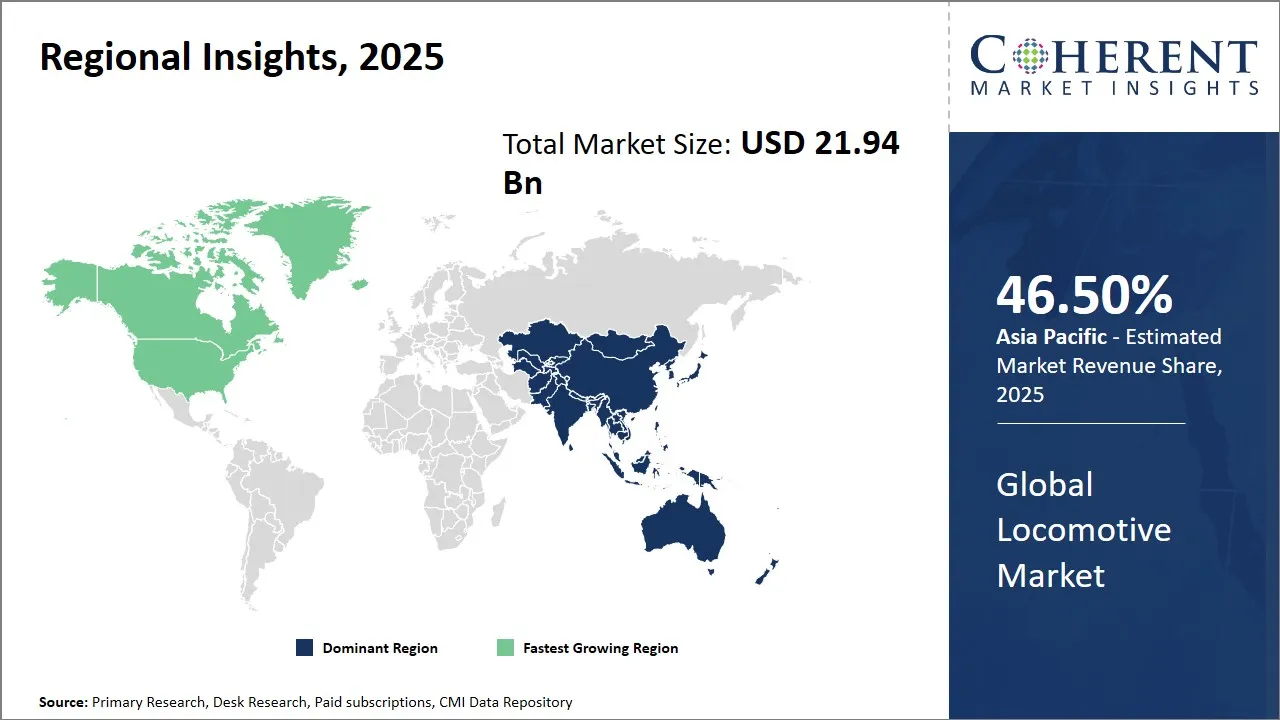
- Asia Pacific is estimated to lead the market with an estimated share of 46.5 % in 2026.
- North America, holding an expected share of 19.3 % in 2026, and it is projected to be the fastest growing region.
Market Overview
Current market trends highlight a strong emphasis on adopting eco-friendly and energy-efficient locomotives, including increased investments in electric and hybrid models to reduce carbon emissions. Innovations in automation and digital technologies, such as predictive maintenance and smart diagnostics, are enhancing operational efficiency. Additionally, government initiatives promoting sustainable transportation and increased funding for rail network upgrades are propelling the market forward, making locomotives a critical component in the global push for greener and smarter mobility solutions.
Current Events and Its Impact
Current Events | Description and its Impact |
Geopolitical and Trade Developments |
|
Economic and Infrastructure Trends |
|
Segmental Insights
- Current Industry Events of 2026
- Market Size Estimation
- Regional Breakdown
- Competitive Landscape
- Customer Intelligence
- Segmental Analysis
- Pricing Analysis
- Key Market Drivers, Challenges & Future Trends
- Customized Insights Section
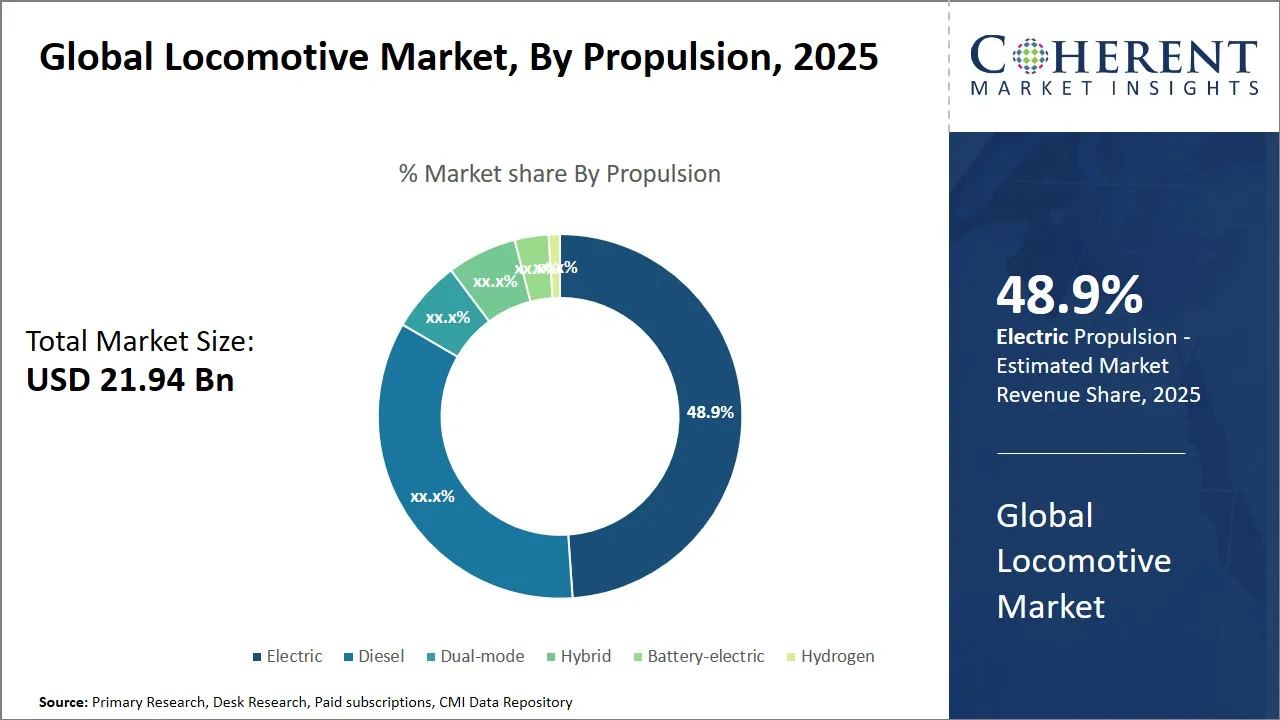
Global Locomotive Market Insights, by Propulsion – Dominance of Electric Segment Driven by Sustainability and Efficiency
The electric segment is projected to account for 49.9% share in 2026. The increasing focus on reducing carbon emissions has propelled electric locomotives into the forefront as a cleaner alternative compared to traditional diesel-powered engines. Governments worldwide are implementing stricter environmental regulations, encouraging rail operators to adopt electric propulsion systems that offer zero on-site emissions, thereby significantly cutting greenhouse gases involved in rail transport. Additionally, electric locomotives benefit from superior energy efficiency. Unlike diesel engines, electric propulsion converts energy with minimal losses, resulting in lower operational costs over the locomotive’s lifecycle. The reduced fuel dependency also translates to improved energy security for operators, minimizing exposure to volatile fossil fuel prices.
Infrastructure development plays a critical role in supporting the electric segment’s growth. Expansion of electrified rail networks, especially in densely populated regions and high-traffic corridors, continues to facilitate the increased deployment of electric locomotives. Investments in modernizing existing rail infrastructures such as overhead catenary systems ensure higher reliability and better performance of electric trains. Moreover, electric locomotives offer advantages in power output and acceleration, enabling higher hauling capacity and faster transit times. The integration of advanced technologies such as smart control systems and automation further enhances their operational effectiveness. Customer preference is shifting toward electric locomotives to meet corporate social responsibility targets and enhance brand image by adopting environmentally friendly transport solutions.
In 2025, Alstom received an order from Slovenia’s national freight operator, SŽ-Tovorni promet, for its Traxx Universal multi-system electric locomotives. These locomotives are designed for cross-border operations across the EU and align directly with the European Union’s decarbonization policies.
Impact of AI on the Locomotive Market
Artificial Intelligence (AI) is transforming the locomotive industry by enabling smarter operations, predictive maintenance, and improved fuel efficiency. AI-driven analytics systems are increasingly being deployed to monitor locomotives in real time, collecting vast amounts of data from sensors on engines, braking systems, and power electronics. These systems use machine learning algorithms to detect anomalies and predict component failures before they occur, reducing unplanned downtime and cutting maintenance costs. For freight operators, AI also helps in optimizing train scheduling, load management, and energy consumption, leading to better fleet utilization and lower emissions.
Wabtec’s Trip Optimizer system uses AI to function like an "autopilot for trains." Already deployed on thousands of locomotives worldwide, it analyzes track conditions, train weight, and speed profiles to optimize throttle and braking in real time.
Regional Insights
Asia Pacific Locomotive Market Analysis and Trends
Asia Pacific region is projected to lead the market with a 46.5% share in 2026, driven by the region’s extensive and rapidly expanding railway infrastructure. Countries like China and India have long-standing commitments to advancing their rail networks to support both passenger and freight transportation needs.
Governments in this region consistently prioritize railway modernization through significant funding and favorable policies, such as subsidies and long-term development plans. The presence of major industry players like China's CRRC Corporation and India’s Banaras Locomotive Works underpins the market’s robust manufacturing capabilities and innovation. Furthermore, the integration of advanced technologies such as electric and high-speed locomotives aligns with the region's sustainability goals and urbanization trends.
North America Locomotive Market Analysis and Trends
North America region is expected to exhibit the fastest growth in the market contributing 19.3% in 2026, buoyed by its focus on upgrading aging locomotive fleets and expanding rail freight capabilities. The U.S. and Canada see strong government support for rail infrastructure improvements, especially geared toward reducing carbon emissions and enhancing energy efficiency. Stringent environmental regulations have accelerated the shift towards electric and hybrid locomotives, prompting established manufacturers like General Electric (GE) Transportation and Progress Rail to innovate aggressively.
North America benefits from an advanced ecosystem of research and development, thanks to collaborations between industry leaders and governmental agencies. Trade policies encouraging domestic production and investments in logistics hubs contribute further to the market growth, particularly in freight-intensive industries like agriculture, energy, and manufacturing.
Global Locomotive Market Outlook for Key Countries
China Locomotive Market Analysis and Trends
China remains the world’s largest locomotive hub, driven by massive investments in high-speed rail and freight corridors. CRRC Corporation, the largest manufacturer globally, operates numerous production and technology centers in China, focusing on electric and hybrid locomotives. The government's “Made in China 2026” initiative emphasizes technological independence and innovation in rail transport, boosting domestic production and exports. China's expanding urbanization and government-driven infrastructure projects, including the Belt and Road Initiative, ensure steady demand and continuous technological advancements.
India Locomotive Market Analysis and Trends
India continues to lead as a critical market due to its vast and heavily utilized rail network. The government prioritizes railway electrification and modernization programs to enhance efficiency and reduce emissions. Companies like Banaras Locomotive Works, Integral Coach Factory, and Indian Railways’ dedicated production units play key roles. Government policies such as “Make in India” encourage indigenous production and technology development. Freight sector expansion and urban transit projects provide a solid foundation for market growth, alongside increasing emphasis on smart locomotives and digital integration.
U.S. Locomotive Market Analysis and Trends
The U.S. locomotive market is shaped by stringent emissions regulations and a strategic focus on modernizing rail assets. Leading manufacturers like GE Transportation, now part of Wabtec Corporation, heavily invest in developing energy-efficient and hybrid locomotives. The freight-dominant rail system supports economic growth in sectors like coal, agriculture, and intermodal transport. Federal infrastructure bills aimed at improving rail safety and performance also influence market development. The U.S. ecosystem benefits from a robust supply chain and considerable R&D activities centered on reducing locomotive emissions and increasing operational efficiency.
Germany Locomotive Market Analysis and Trends
Germany remains a significant player within Europe locomotive market, anchored by its strong industrial base and commitment to sustainable transportation. Siemens Mobility leads with innovations in electric and hydrogen-powered locomotives, supporting the country’s ambitious climate targets. Government incentives promote green mobility and investments in electrified rail infrastructure. Besides domestic demand driven by Deutsche Bahn’s modernization efforts, Germany plays a vital role as an exporter of advanced rail technologies across Europe and beyond. The ecosystem’s strength lies in advanced engineering capabilities and strong collaboration between manufacturers, research institutions, and policymakers.
Brazil Locomotive Market Analysis and Trends
Brazil locomotive market is shaped by its extensive freight rail network vital to the country’s commodity exports, particularly agriculture and mining. Increasing demand for efficient, high-power locomotives encourages domestic assembly combined with imports. Companies such as Wabtec and local manufacturers contribute to fleet upgrades aligning with government initiatives to enhance logistic efficiencies and reduce greenhouse gas emissions. Trade dynamics benefit from Brazil’s export-oriented economy, necessitating robust rail systems to connect inland production zones to port areas. Infrastructure improvement projects and increased private sector participation further stimulate market growth.
Market Players, Key Development, and Competitive Intelligence
Key Developments
- In June 2025, Akiem, the European leader in locomotive and passenger train leasing and maintenance, placed a firm order with Siemens Mobility for 10 Vectron Dual Mode (VDM) locomotives, with an option for 40 additional locomotives. This order is part of the framework agreement signed in August 2021 for the supply of locomotives and associated services. The first locomotives are to be delivered in the 4th quarter of 2026.
- In April 2025, Progress Rail signed three long-term contracts with Egyptian National Railways (ENR) to modernize 100 AA22T locomotives and provide technical services and parts support. These agreements, covering a total of 141 locomotives for up to 15 years, will greatly improve the availability of locomotives for ENR and provide additional capacity for the rail network.
- In March 2025, Wabtec Corporation announced a definitive agreement to acquire Dellner Couplers, a global leader in highly engineered safety-critical train connection systems and services for passenger rail rolling stock. The acquisition brings highly attractive and complementary technologies to Wabtec and positions the Company for accelerated, profitable growth, while strengthening its portfolio of mission critical passenger rail systems.
- In March 2025, Vale announced an agreement with Wabtec Corporation to acquire 50 new Evolution Series Locomotives for Vitória a Minas Railroad (EFVM) and Carajás Railroad (EFC). The order is a major step in Vale’s fleet modernization initiative and decarbonization program to improve the efficiency and reduce emission of its rail operations. Wabtec will manufacture the locomotives at its plant in Contagem, Brazil with deliveries starting in 2026.
Top Strategies Followed by Locomotive Market Players
- Established industry giants invest heavily in research and development (R&D) with a clear focus on innovation, aiming to develop high-performance, energy-efficient, and environmentally friendly locomotive solutions.
- Siemens Mobility is investing significantly in R&D around hybrid and hydrogen-powered locomotives.
- Mid-level competitors in the locomotive market adopt a more balanced strategy, concentrating on offering cost-effective solutions that provide reliable performance without the premium price tag associated with top-tier products.
- Bharat Heavy Electricals Limited (BHEL) in India, focusing on manufacturing electric locomotives under cost-competitive government contracts as part of India’s “Make in India” initiative.
- In contrast, small-scale locomotive manufacturers thrive by specializing in niche markets and focusing on innovative, customized solutions that meet specific regional or operational demands.
- Vossloh Locomotives (Germany), though smaller compared to CRRC or Alstom, specializes in shunting and light-duty locomotives tailored for industrial rail yards and regional operators.
Market Report Scope
Locomotive Market Report Coverage
| Report Coverage | Details | ||
|---|---|---|---|
| Base Year: | 2025 | Market Size in 2026: | USD 24.02 Bn |
| Historical Data for: | 2020 To 2024 | Forecast Period: | 2026 To 2033 |
| Forecast Period 2026 to 2033 CAGR: | 9.5% | 2033 Value Projection: | USD 45.35 Bn |
| Geographies covered: |
| ||
| Segments covered: |
| ||
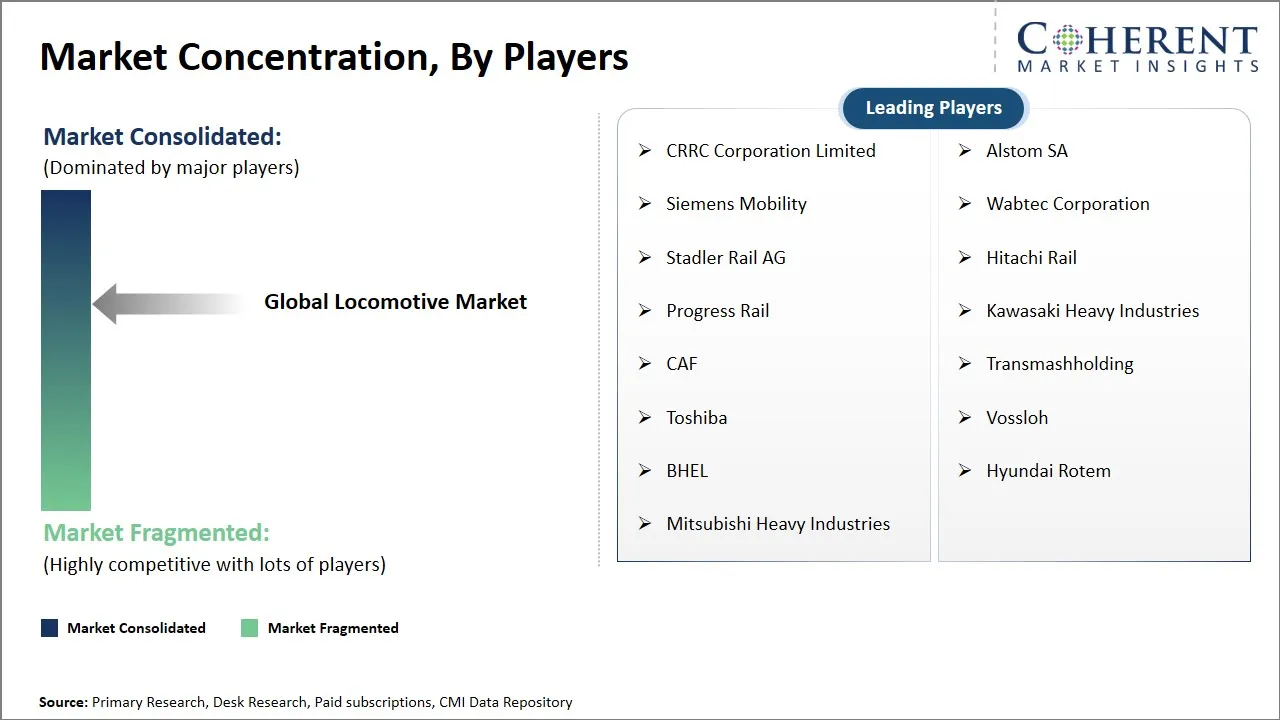
| Companies covered: | CRRC Corporation Limited, Alstom SA, Siemens Mobility, Wabtec Corporation, Stadler Rail AG, Hitachi Rail, Progress Rail, Kawasaki Heavy Industries, CAF, Transmashholding, Toshiba, Vossloh, BHEL, Hyundai Rotem, and Mitsubishi Heavy Industries | ||
| Growth Drivers: |
| ||
| Restraints & Challenges: |
| ||
Market Dynamics
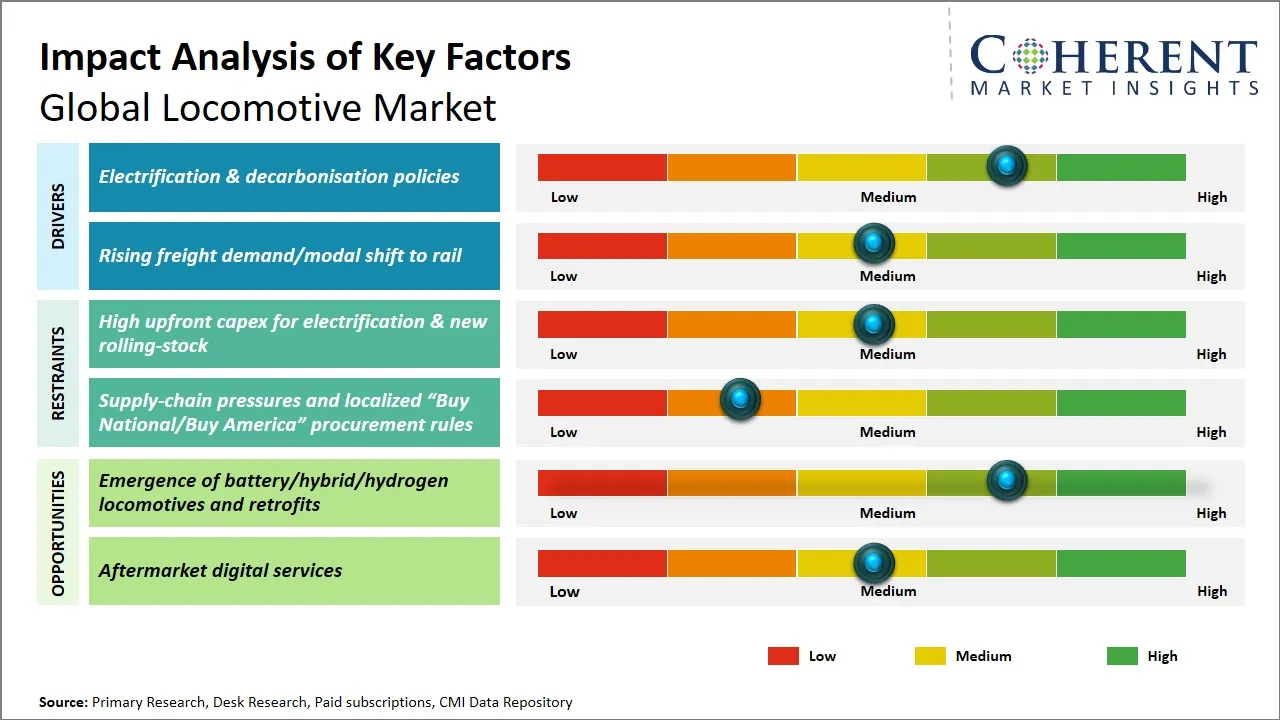
Global Locomotive Market Driver – Electrification & Decarbonisation Policies
Governments worldwide are increasingly implementing regulations aimed at reducing carbon emissions and improving air quality, which is prompting railway operators and manufacturers to prioritize electric and hybrid locomotive technologies. Subsidies and incentives for adopting low-emission solutions further encourage investments in electrified rail infrastructure and the development of advanced propulsion systems, such as battery-electric and fuel cell locomotives. This transition not only aligns with global climate goals but also addresses urban pollution and the growing need for sustainable transportation networks. As a result, electrification initiatives, combined with innovative decarbonisation strategies, are creating significant opportunities for modernization across the railway sector, propelling the adoption of energy-efficient, eco-friendly locomotives that contribute to long-term environmental and operational benefits.
Global Locomotive Market Opportunity – Emergence of Battery, Hybrid, and Hydrogen Locomotives and Retrofits
As governments worldwide impose stringent environmental regulations and prioritize decarbonization targets, rail operators are increasingly exploring alternative propulsion technologies to replace or supplement traditional diesel engines. Battery-electric and hybrid locomotives offer substantial reductions in greenhouse gas emissions and operational costs through improved energy efficiency and regenerative braking capabilities. Additionally, hydrogen fuel cell locomotives present a promising zero-emission technology, leveraging advancements in hydrogen production and storage to enable longer-range and higher-power applications crucial for freight and passenger transport. Retrofitting existing diesel locomotives with battery packs or hydrogen fuel cells provides a cost-effective transitional pathway for operators to modernize fleets without the need for complete replacements, thereby facilitating faster adoption rates. This shift not only aligns with global sustainability agendas but also opens new avenues for manufacturers and service providers specializing in green locomotive technologies, maintenance, and system integration. With increasing investments and pilot projects validating the commercial viability of these solutions, the market is poised for rapid innovation, offering stakeholders lucrative prospects in product development, infrastructure upgrades, and aftermarket services.
Analyst Opinion (Expert Opinion)
- Demonstrations like Wabtec’s FLXdrive battery-electric locomotive prove the viability of zero-emission heavy-haul. Coupled with hybrid models such as Siemens Vectron Dual-Mode, adoption will accelerate in regions with partial electrification, balancing sustainability with operational flexibility.
- Projects like Alstom’s Coradia iLint and CRRC’s hydrogen locomotive prototypes highlight growing investment in hydrogen as a long-term clean alternative. Though infrastructure challenges remain, hydrogen solutions are moving from pilots to regional deployments, especially in Europe and Asia.
- Platforms such as Siemens’ Railigent X and Wabtec’s Trip Optimizer are integrating AI to optimize fuel use, reduce downtime, and extend lifecycle performance. This shift toward digitalization will become a key differentiator for OEMs, creating value not just from equipment sales but also recurring service revenue.
Speak to the analyst
Want personalized insights?
Take the findings above to one of our principal consultants, or have the report rebuilt around the segments, geographies and competitors you actually track.
Market Segmentation
- Propulsion Insights (Revenue, USD Bn, 2021 - 2033)
- Electric
- Diesel
- Dual-mode
- Hybrid
- Battery-electric
- Hydrogen
- Regional Insights (Revenue, USD Bn, 2021 - 2033)
- North America
- U.S.
- Canada
- Latin America
- Brazil
- Argentina
- Mexico
- Rest of Latin America
- Europe
- Germany
- U.K.
- Spain
- France
- Italy
- Russia
- Rest of Europe
- Asia Pacific
- China
- India
- Japan
- Australia
- South Korea
- ASEAN
- Rest of Asia Pacific
- Middle East
- GCC Countries
- Israel
- Rest of Middle East
- Africa
- South Africa
- North Africa
- Central Africa
- North America
- Key Players Insights
- CRRC Corporation Limited
- Alstom SA
- Siemens Mobility
- Wabtec Corporation
- Stadler Rail AG
- Hitachi Rail
- Progress Rail
- Kawasaki Heavy Industries
- CAF
- Transmashholding
- Toshiba
- Vossloh
- BHEL
- Hyundai Rotem
- Mitsubishi Heavy Industries
Sources
Primary Research Interviews
Stakeholders
- National Railway Operators
- Locomotive OEMs and Suppliers
- Freight and Logistics Companies
- Passenger Transit Authorities
- Component Manufacturers
- Sustainability and Decarbonization Experts (focusing on rail electrification, hydrogen, and hybrid technologies)
Databases
- Eurostat
- U.S. Bureau of Transportation Statistics
- International Union of Railways (UIC) Database
- OECD Transport Statistics
- Rail Global Data (made-up industry consortium dataset)
Magazines
- International Railway Journal (IRJ)
- Railway Gazette International
- Railway Age
- Modern Railways Magazine
Journals
- Journal of Rail Transport Planning & Management
- Transportation Research Part C: Emerging Technologies
- Railway Engineering Science Journal
- IEEE Transactions on Intelligent Transportation Systems
Newspapers
- Railway News (UK)
- The Economic Times (India)
- The Guardian (UK)
- Railway Pro Daily News
- Nikkei Asia (Japan, transport section)
Associations
- International Union of Railways (UIC)
- American Railway Engineering and Maintenance-of-Way Association (AREMA)
- Community of European Railway and Infrastructure Companies (CER)
- Railway Industry Association (UK)
- Association of American Railroads (AAR)
Public Domain Sources
- U.S. Department of Transportation (DOT)
- EUROSTAT
- United Nations Economic Commission for Europe (UNECE) – Transport Division
- World Bank Rail Transport Statistics
- ResearchGate (locomotive technology publications)
Proprietary Elements
- CMI Data Analytics Tool
- Proprietary CMI Existing Repository of information for last 8 years
Get access to 250+ pages report
Every segment, forecast, competitor profile and data table behind the analysis above — available for instant download.
- ESOMAR Member
- ISO 9001:2015 Certified
- D-U-N-S Registered
- GDPR & CCPA Compliant
Missing comfort of reading report in your local language? Find your preferred language:
Transform your Strategy with Exclusive Trending Reports
Frequently Asked Questions
The global locomotive market is estimated to be valued at USD 24.02 billion in 2026 and is expected to reach USD 45.35 billion by 2033.
The CAGR of the global locomotive market is projected to be 9.5% from 2026 to 2033.
Electrification & decarbonisation policies and rising freight demand/modal shift to rail are the major factors driving the growth of the global locomotive market.
High upfront capex for electrification & new rolling-stock and supply-chain pressures and localized “Buy National/Buy America” procurement rules are the major factors hampering the growth of the global locomotive market.
The market is fairly consolidated, with top 10 OEMs controlling most share.
AI enables predictive maintenance, smart energy use, and driver-assist systems.
In terms of propulsion, the electric segment is estimated to dominate the market revenue share in 2026.