

Global Machining Centers Market Size and Forecast – 2026 To 2033
The global machining centers market is expected to grow from USD 14 Bn in 2026 to USD 21 Bn by 2033, registering a compound annual growth rate (CAGR) of 6% from 2026 to 2033. The global machining centers market is driven by rising factory automation initiatives and smart manufacturing investments. On June 25, 2026, Okuma announced a major redevelopment of its Konan Plant in Japan with a USD 85 million investment to strengthen automation system production.
Key Takeaways of the Global Machining Centers Market
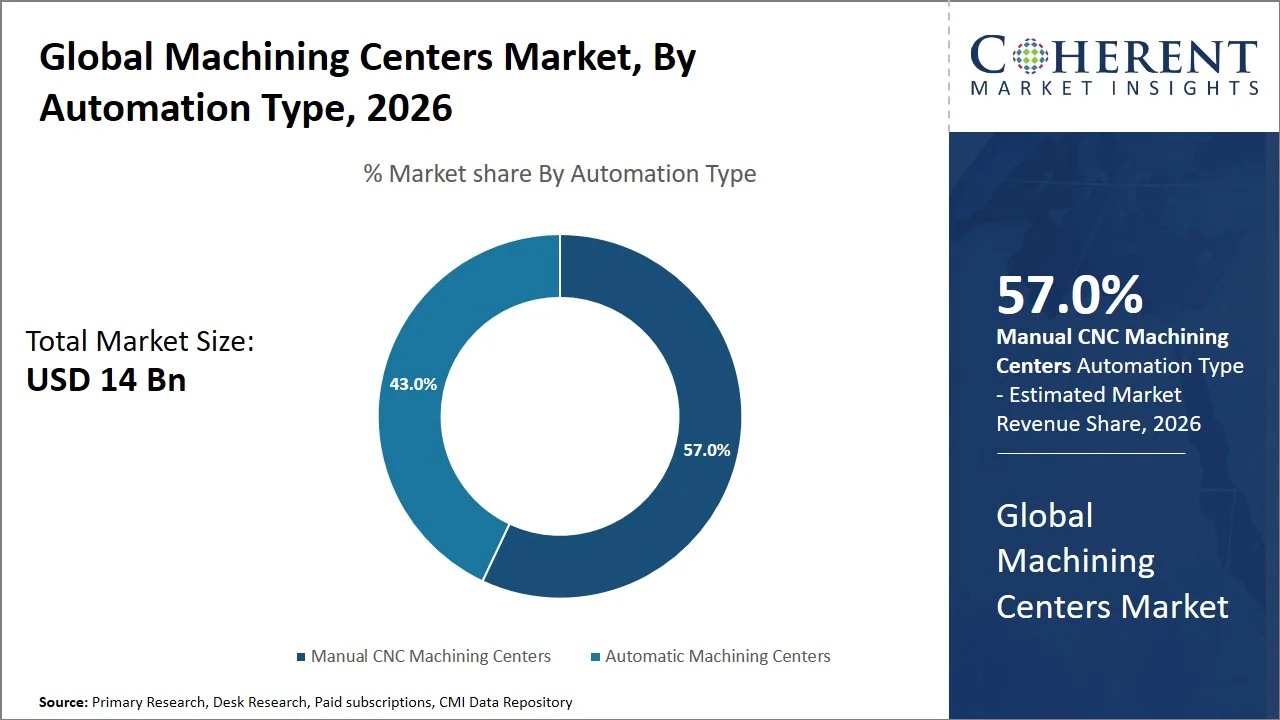
- The manual CNC machining centers segment is expected to account for 57.0 % of the global machining centers market share in 2026. Expansion of electric vehicle production requiring high precision metal cutting is driving the growth of the segment. On December 10, 2025, Makino India announced its increased focus on precision manufacturing solutions for the electric vehicles, aerospace and semiconductor industries as India expands advanced manufacturing capacity.
- The vertical segment is estimated to capture 61.0 % of the market share in 2026. Strong demand for high productivity CNC machining solutions is majorly driving the growth of the segment. On September 23, 2025, Makino unveiled the a630iT five axis horizontal machining center at EMO 2025, featuring a new trunnion table design and high-performance spindle options for automated machining of complex steel, casting and titanium components.
- The five axis machining centers segment is estimated to capture 42.0 % of the market share in 2026. Growing demand from semiconductor equipment manufacturing is driving the growth of the segment. On March 30, 2026, DMG MORI CO., LTD launched the NMV 3000 / 5000 DCG 2nd Generation. Featuring an improved design and cutting-edge technology, the newest generation of 5-axis vertical machining centers delivers new levels of productivity.
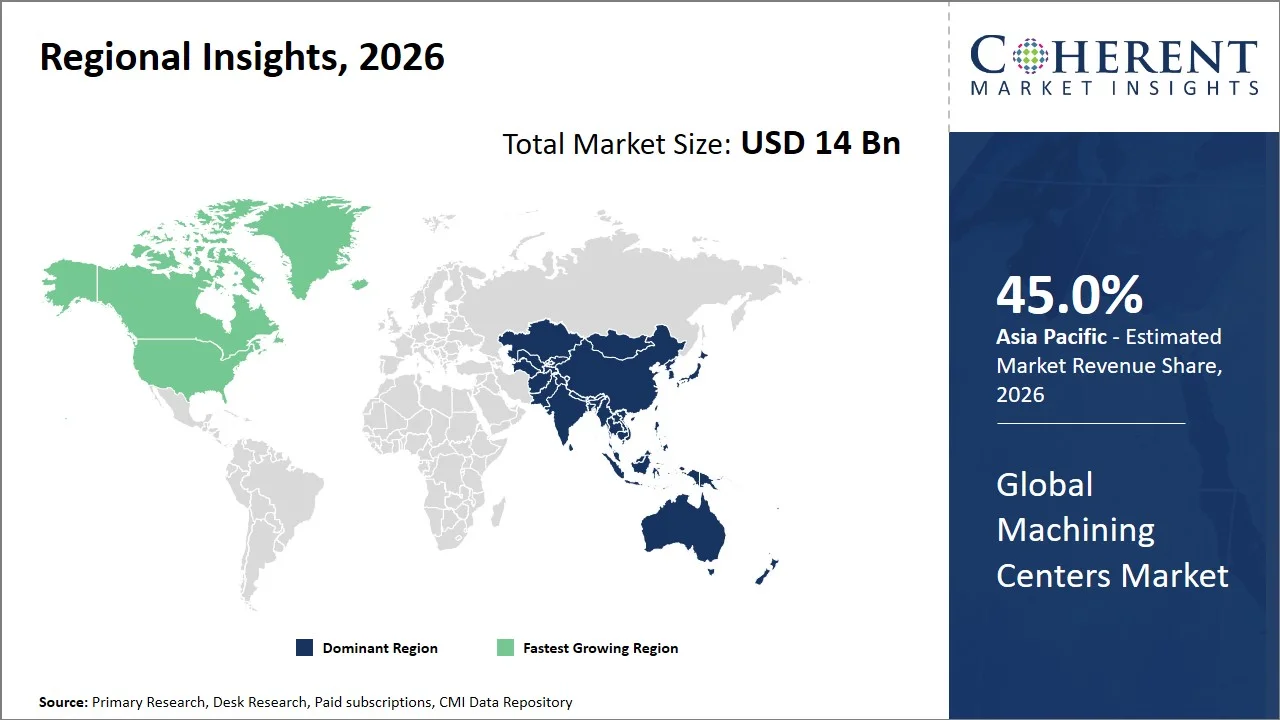
- Asia Pacific is expected to dominate the machining centers market in 2026 with a market share of 45.0 %. Expansion of precision engineering facilities in Asia Pacific is driving the growth of the regional market. On July 8, 2026, GE Aerospace announced an investment of USD 1 billion in its Pune manufacturing facility, further strengthening its manufacturing footprint in India and reinforcing its long-term commitment to the country.
- North America is expected to account for 24.0 % of the market share in 2026 and is projected to record the fastest growth over the forecast period. Increasing use of hybrid machining technologies combining additive and subtractive manufacturing in North America is driving the growth of the regional market. On January 22, 2026, Snowbird Technologies partnered with Meltio to integrate the Meltio Engine Blue into a containerized hybrid manufacturing system for defense applications in the U. S.
- Rapid Adoption of Five Axis and Multi-Tasking Machining Centers: Manufacturers are increasingly replacing conventional three axis machines with five axis and multi-tasking machining centers to minimize setup time, enhance dimensional accuracy and manufacture complex aerospace, medical and electric vehicle components in a single machining operation, thereby improving overall production efficiency.
- AI-Enabled Smart Machining and Predictive Maintenance: Machine tool builders are integrating artificial intelligence, machine learning and industrial IoT technologies into machining centers for real-time process optimization tool condition monitoring, predictive maintenance and remote diagnostics, thus enabling higher machine availability and lower operating costs.
Segmental Insights
Why Do Manual CNC Machining Centers Dominate the Global Machining Centers Market?
The manual CNC machining centers segment is expected to account for 57.0% of the global machining centers market share in 2026. Manual CNC machining centers are still holding a healthy market share mainly due to the lower initial investment costs than automated machining systems. These machines are still popular among small- and medium-sized manufacturers, job shops and custom fabrication facilities because they offer the flexibility to produce a wide variety of parts while keeping capital spending in check. So, they are a practical choice for low-to-medium volume production and frequent product changeovers. On April 28, 2026, Hurco released the TM8MYi turning center to give small to mid-size manufacturers a more affordable option for entering the multi-axis machining landscape. The machine combines y-axis capability, live tooling and Hurco WinMax conversational control, allowing job shops to perform milling, drilling and tapping operations without investing in higher-priced multi-tasking equipment.
- Current Industry Events of 2026
- Market Size Estimation
- Regional Breakdown
- Competitive Landscape
- Customer Intelligence
- Segmental Analysis
- Pricing Analysis
- Key Market Drivers, Challenges & Future Trends
- Customized Insights Section
Why is Vertical the Most Preferred Spindle Orientation?
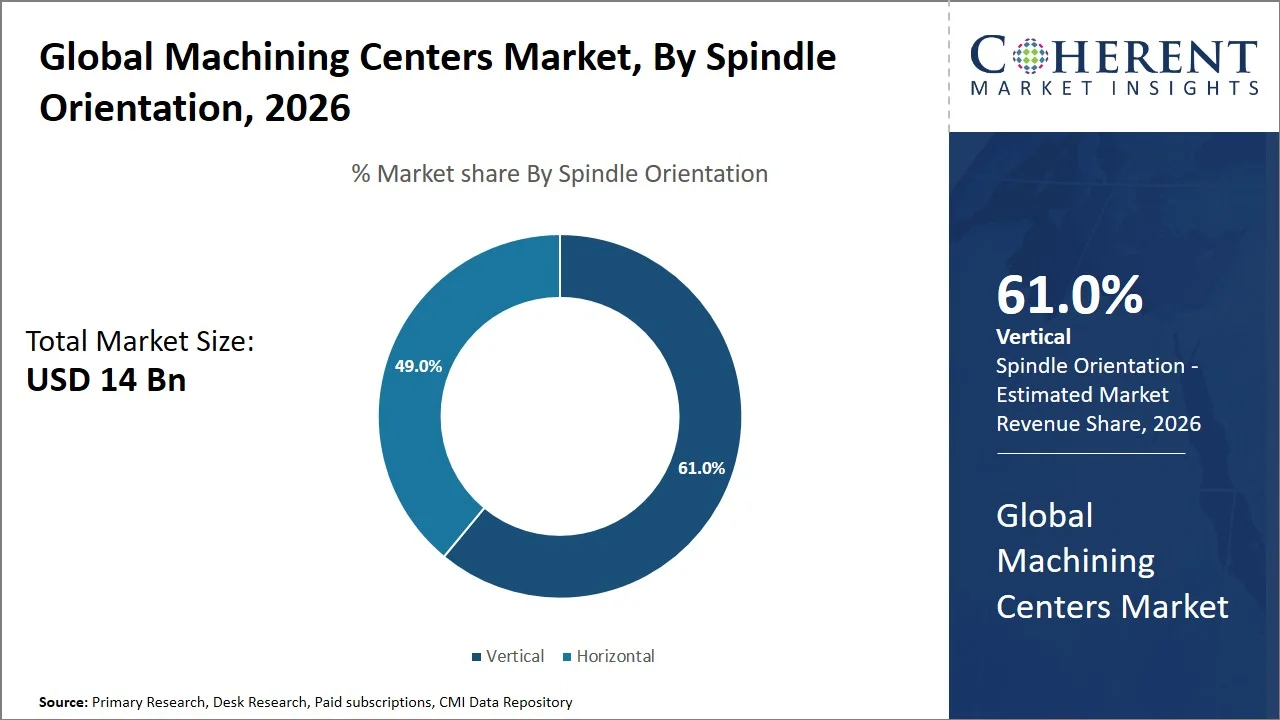
The vertical segment is expected to account for 61.0% of the global machining centers market share in 2026. The vertical orientation of the spindle is the most favored because it offers more flexibility for general-purpose machining applications. The configuration offers easier workpiece setup, improved visibility for the operator and easier tool access, making it ideal for milling, drilling, tapping and contouring operations in the automotive, mold and die, electronics and precision engineering industries. It also reduces setup time and improves overall machining efficiency. On January 23, 2025, Okuma launched the MB-56V II vertical machining center at IMTEX 2025. The company said it is designed to retain machining accuracy even over long production cycles. The machine was positioned for manufacturers requiring reliable vertical machining capability across automotive components, precision engineering parts and industrial applications.
Five Axis Machining Centers Segment Dominates the Global Machining Centers Market
The five axis machining centers segment is expected to account for 42.0% of the global machining centers market share in 2026. Five axis machining centers are widely adopted because they enable complex components to be machined in a single setup with exceptional precision. This ability greatly reduces repositioning errors, reduces production cycles and improves surface finish. Due to these advantages, these machines are highly preferred for manufacturing intricate aerospace components, medical implants, automotive parts and precision industrial equipment where tight dimensional tolerances and high productivity are must. On February 5, 2025, DMG MORI introduced the DMU 60 eVo 2nd Generation five axis universal machining center with enhanced precision, productivity and process integration features. The machine includes technologies such as mill-turn machining and gear skiving capabilities and is aimed for industries that require the fabrication of complicated components with high dimensional accuracy.
Current Events and their Impact
Current Events | Description and its Impact |
European Union – Ecodesign for Sustainable Products Regulation (ESPR) (2024) |
|
U.S. Department of Energy - Energy Conservation Standards for Electric Motors (Final Rule Effective 2024) |
|
Global Machining Centers Market Dynamics
Market Drivers
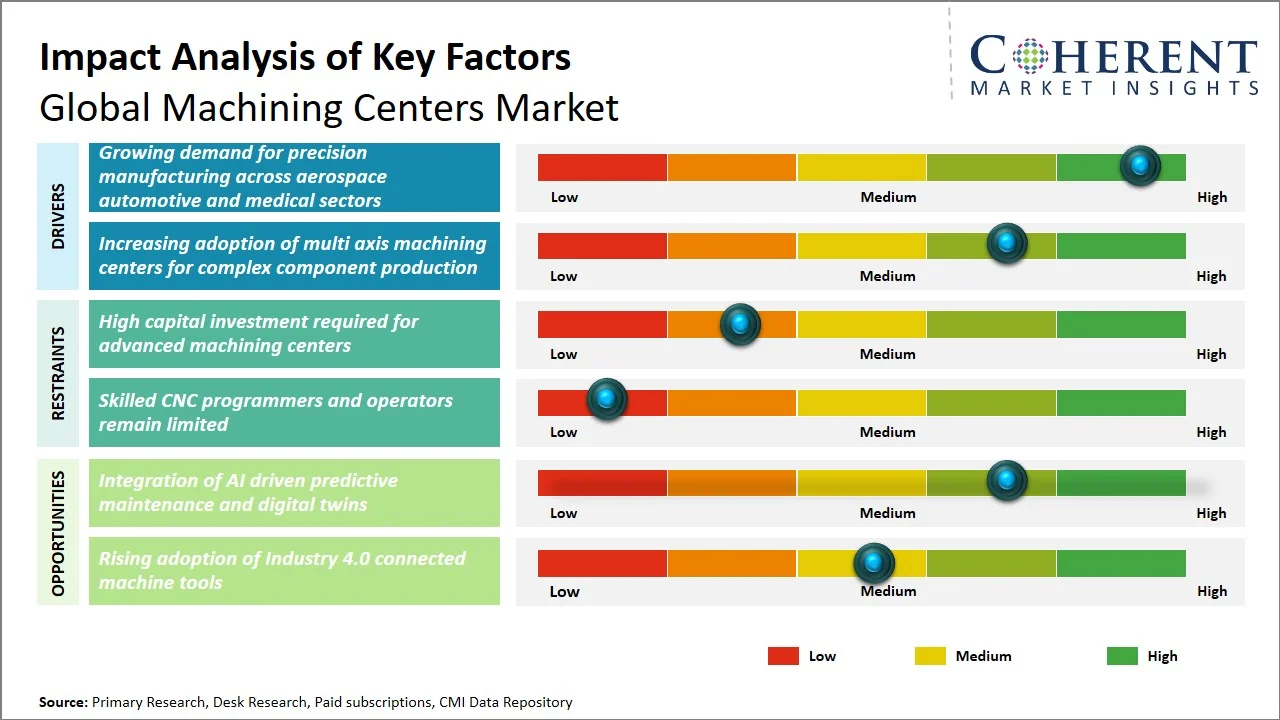
- Growing demand for precision manufacturing across aerospace automotive and medical sectors: The aerospace, automotive and medical industries’ rising demand for highly precise and complex components is encouraging growth of advanced machining centers. Turbine blades, structural airframe components and engine parts for aerospace industries demand high tolerances, while automotive businesses rely on precise machining for electric vehicle powertrains, transmission systems and lightweight aluminum components. Market growth is driven by precision manufacturing, with machining centers being vital for the production of orthopedic implants, surgical instruments and dental components in the medical industry, where they are used to produce objects with excellent dimensional accuracy and better surface finishes. On March 12, 2025, GE Aerospace announced plans to invest nearly USD 1 billion in its U.S. factories and supply chain to strengthen manufacturing and increase the use of innovative new parts and materials needed for the future of flight. This new investment is nearly double last year’s commitment and will help increase engine safety, quality, and delivery, benefitting more than two dozen communities across 16 U.S. states.
- Increasing adoption of multi axis machining centers for complex component production: Manufacturers are increasingly adopting multi axis machining centers because they enable intricate parts to be produced in a single setup with greater precision and efficiency. These systems reduce production time, repositioning errors, and improve surface quality by machining multiple surfaces at the same time. They are well suited for the manufacture of aerospace engine components, medical implants, automotive molds, semiconductor equipment and other geometrically complex parts that require consistent accuracy and high productivity. In May 2026, Hermle expanded the range of applications for its five-axis machining centers with the C-series platforms for precision industries that need to produce complex components.
Emerging Trends
- Expansion of Automation Through Robotic Machine Tending: Automated machining cells with collaborative robots autonomous material handling systems and pallet changers are becoming standard across high volume manufacturing facilities helping address labor shortages increase spindle utilization and support lights out manufacturing.
- Growing Demand for High Speed Precision Machining in EV and Semiconductor Manufacturing: Exponential growth in electric vehicle battery systems power electronics semiconductor equipment and precision industrial components is driving investment in high speed high rigidity machining centers that can deliver micron level accuracy superior surface finishes and consistent production quality.
Regional Insights
Why is Asia Pacific a Strong Market for Machining Centers?
Asia Pacific is expected to account for a market share of 45.0% in 2026. Asia Pacific remains the manufacturing hub for machining centers due to its extensive automotive, electronics, aerospace and industrial equipment production ecosystem. China is developing high-end CNC machine tool production as part of its industrial modernization drive, but Japan is a global leader with businesses such as Yamazaki Mazak, Okuma, Makino and Brother Industries, producing advanced five axis and multi-tasking machining centers. Hyundai WIA and DN Solutions are raising demand in South Korea, offering equipment for the automotive, semiconductor and shipbuilding industries. In addition, Taiwan’s Precision Machinery Research & Development Center and leading builders such as Hartford, Tongtai and Victor Taichung are driving regional exports further. India’s production-linked incentive schemes and the development of aerospace manufacturing clusters in Bengaluru and Hyderabad are creating demand for high-precision machining centers used in aircraft structures, engine components and defense equipment.
Why Does the North America Machining Centers Market Exhibit High Growth?
North America is projected to account for 24.0% of the global machining centers market and is expected to register the fastest growth. North America benefits from strong investments in aerospace, defense, medical device manufacturing and electric vehicle production requiring high-precision machining capabilities. The U.S. hosts major machining center manufacturers including Haas Automation and Hurco, while aerospace companies such as Boeing, Lockheed Martin, RTX and GE Aerospace continue investing in advanced five axis machining for turbine blades, structural components and aircraft assemblies. Medical device manufacturers in Minnesota and Indiana rely extensively on precision machining for orthopedic implants and surgical instruments, and semiconductor equipment manufacturers and contract manufacturers are adding automated machining cells with robotic loading systems to boost productivity and cut production lead times.
Global Machining Centers Market Outlook for Key Countries
Why is China Emerging as a Major Hub in the Machining Centers Market?
China has significantly expanded domestic machining center production through manufacturers such as Shenyang Machine Tool, Qinchuan Machine Tool, Haitian Precision and Ningbo Haitian. Demand for advanced machining centers continues to be driven by large-scale expenditures in aerospace manufacturing, high-speed rail equipment, electric car production and industrial robotics. Automotive manufacturers including BYD, Geely and SAIC are increasingly adopting high speed vertical and five axis machining centers for battery housings, motor casings and lightweight aluminum structural components. Semiconductor equipment manufacturers are also investing in ultra-precision machining technologies to support domestic production of wafer processing equipment and precision industrial machinery.
Is the U.S. the Next Growth Engine for the Machining Centers Market?
The U.S. machining centers market is characterized by high demand for technologically advanced machining centers used in aerospace, defense, medical technology and energy industries. Haas Automation is still one of the major machine tool manufacturers in the country, delivering vertical and horizontal machining centers to thousands of manufacturing plants. Boeing, GE Aerospace, Pratt & Whitney and Northrop Grumman, among other aerospace firms, use advanced five axis machining equipment for engine casings, titanium airframe components and turbine disks. Precision machining operations for implants and surgical devices continue to grow among medical technology businesses and automated machining cells, with industrial robots and digital production monitoring systems, are increasingly being used among electric vehicle manufacturers and battery suppliers.
Germany Machining Centers Market Analysis and Trends
Germany serves as Europe's center for precision machine tool engineering with manufacturers including DMG MORI, CHIRON Group and Hermle supplying advanced machining centers worldwide. Automotive manufacturers such as BMW, Mercedes-Benz, Volkswagen, Porsche and Audi employ highly automated machining lines for engine blocks, transmission housings and lightweight structural components. German aerospace suppliers manufacture complex titanium and nickel alloy components for Airbus programs and industrial automation companies are increasingly integrating machining centers with Siemens digital manufacturing software and fully automated pallet handling systems to increase production efficiency and flexibility.
Japan Machining Centers Market Analysis and Trends
Japan remains one of the world's leading innovators in machining center technology through companies including Yamazaki Mazak, Okuma, Makino, Brother Industries and FANUC. These manufacturers continue developing high-speed five axis machining centers equipped with advanced control systems, thermal compensation and intelligent automation for aerospace, medical and semiconductor applications. Japanese auto makers such as Toyota, Honda, Nissan and Subaru are heavily dependent on precision machining for hybrid and electric powertrain components, and semiconductor equipment makers are making ultra-high-precision parts that need machining precision at the micron level and excellent surface quality.
South Korea Machining Centers Market Analysis and Trends
South Korea has developed a robust machining center sector with the help of manufacturers like Hyundai WIA and DN Solutions, catering to both the domestic and international markets. Manufacturers like Hyundai Motor and Kia, uses sophisticated machining centers for engine parts, transmission systems and electric vehicle drive units, while Samsung Electronics and SK hynix provide steady demand for ultra-precision machining used in semiconductor manufacturing equipment. Other major shipbuilders such as HD Hyundai Heavy Industries and Hanwha Ocean also have large horizontal and gantry machining centers for marine engines, propulsion systems and heavy industrial components, further solidifying the country’s status as a key market for high-performance machine tools.
Global Machining Centers Market - Five Axis And Multi-Axis Machining Adoption Trends
Year | Five axis / multi-axis machining adoption trend | Key industries driving adoption | Major applications |
2024 | Increasing transition from three axis machining toward five axis machining for complex component production | Aerospace, automotive, medical devices, defense | Turbine blades, engine components, orthopedic implants, complex molds |
2025 | Higher adoption of simultaneous five axis machining centers with automation integration | Aerospace, semiconductor equipment, electric vehicles | Titanium aerospace structures, semiconductor processing components, EV motor housings |
Expansion of multi-tasking machining centers combining milling, turning and drilling capabilities | Automotive, industrial machinery, energy | Transmission components, shafts, precision industrial parts | |
Growing use of five axis machining in medical manufacturing for high precision components | Medical devices, healthcare equipment | Surgical instruments, dental implants, orthopedic implants | |
Increased deployment of five axis machining centers in semiconductor equipment manufacturing | Semiconductor, electronics manufacturing | Wafer handling equipment, vacuum chambers, precision equipment parts | |
Adoption of automated multi-axis machining cells with robotic loading and pallet systems | Automotive, aerospace suppliers, contract manufacturers | High-volume precision components and low-volume complex parts | |
2026 | Expansion of AI-enabled five axis machining platforms with predictive monitoring capabilities | Aerospace, automotive, precision engineering | Complex metal components requiring continuous quality monitoring |
Growth of hybrid multi-axis machines combining additive manufacturing and CNC machining | Aerospace, defense, energy | Repair of high-value components, lightweight structures and complex metal parts | |
Increasing adoption of large five axis machining centers for aerospace and heavy engineering applications | Aerospace, defense, shipbuilding | Aircraft structures, large titanium components and industrial equipment parts | |
Rising demand for compact five axis machines among small and medium manufacturers | Job shops, precision engineering, custom manufacturing | Prototypes, small batch components and specialized parts |
How is the Integration of AI-Driven Predictive Maintenance and Digital Twins Offering New Growth Opportunities in the Global Machining Centers Market?
Predictive maintenance and digital twins powered by AI are opening up new growth potential for machining centers, allowing them to maximize production based on real operating conditions, not on fixed maintenance schedules. DMG MORI, Okuma, Mazak and Makino are among the manufacturers who are incorporating machine monitoring platforms that continually measure spindle vibration, servo load, thermal displacement and tool wear to forecast component failures before they occur, decreasing unplanned downtime and prolonging machine life.
Also, digital twin technology enables manufacturers to simulate machining programs, validate tool paths, estimate cycle times and identify potential collisions before physical production, which is especially helpful for machining high-value aerospace components, semiconductor equipment and medical implants where material waste and setup errors are expensive. As more and more manufacturing facilities link their machining centers to manufacturing execution systems and cloud-based analytics platforms, the demand for intelligent machines that can self-diagnose, optimize processes and remotely monitor performance is growing. This trend is generating new revenue streams for machine tool builders through software subscriptions, predictive maintenance services and digital manufacturing solutions.
On March 25, 2026, Mitsubishi Electric Corporation announced that in collaboration with RWTH Aachen University in Germany, it has developed a technology that uses a digital twin to correct machine-tool errors in real time on machine tools equipped with computer numerical control.
Market Players, Key Development, and Competitive Landscape
Key Developments
- On November 30, 2025, DMG MORI CO., LTD. launched the newest generation of horizontal machining centers, the NHX 4000 / 5000 4th Generation. With increased spindle output and feed rates, the NHX 4th Generation delivers shorter cycle times, reduced energy consumption through integrated coolant and inverter control, and minimized maintenance workload due to advanced chip management for fast, stable, and cost-efficient high-precision machining.
- On September 10, 2024, Okuma America Corporation announced a product addition to the company’s line of CNC horizontal machining centers, the MA-4000H. The MA-4000H features one of the largest machining areas of its class and has the spindle power and speed for maximum efficiency and productivity.
Competitive Landscape
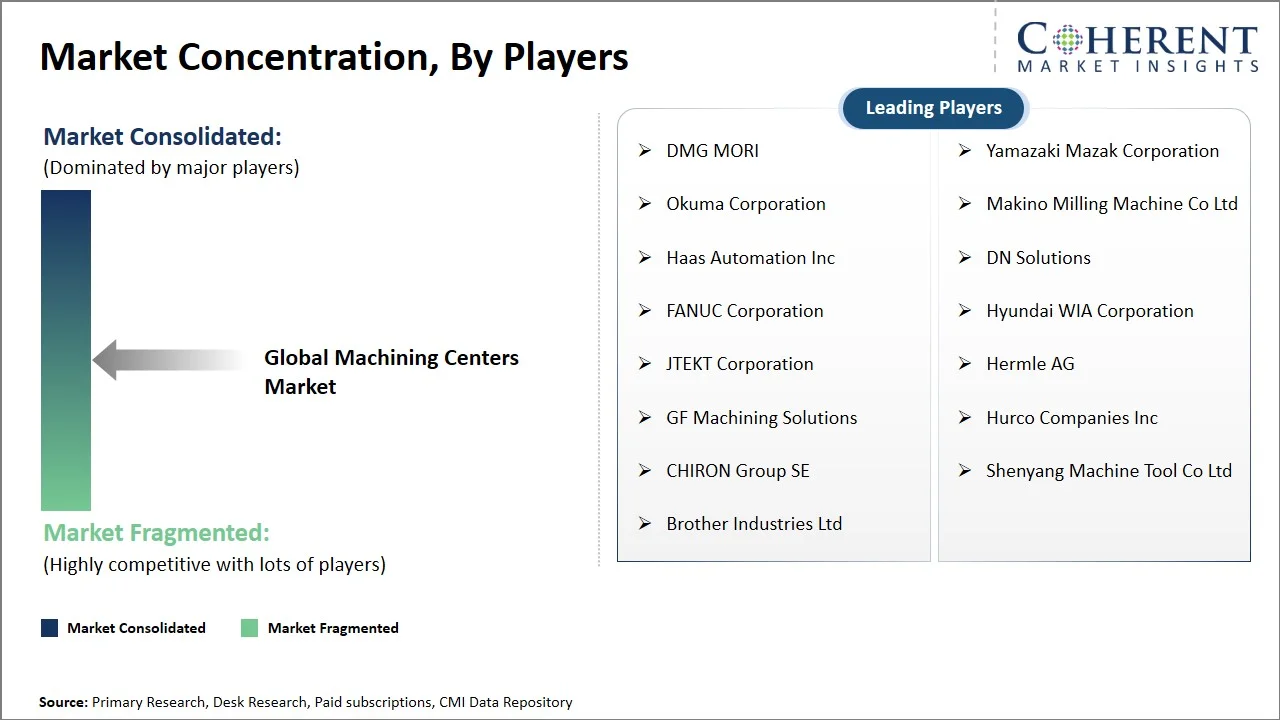
Competition in the machining centers market is led by established manufacturers including DMG MORI, Yamazaki Mazak, Okuma, Makino, Haas Automation, DN Solutions, Hyundai WIA, Hermle and GF Machining Solutions, with differentiation increasingly based on digital manufacturing capabilities rather than machine hardware alone. DMG MORI continues to strengthen its position with the integration of digital platforms CELOS, process automation and autonomous machining cells. Mazak is focusing on multi-tasking and hybrid machining technologies by combining additive and subtractive manufacturing.
Makino focuses on ultra-high precision machining solutions for aerospace and semiconductor sectors, whereas Okuma differentiates itself with intelligent control technologies such as Thermo Friendly Concept and collision avoidance systems. Haas Automation maintains competitiveness by offering cost efficient vertical machining centers for small and medium manufacturers, while Hermle concentrates on premium five axis machining for medical technology, aerospace and precision engineering. DN Solutions and Hyundai WIA are expanding their global presence by supplying high productivity machining centers for electric vehicle, battery and industrial equipment manufacturers, supported by investments in smart factory integration and robotic machine tending.
Market Report Scope
Machining Centers Market Report Coverage
| Report Coverage | Details | ||
|---|---|---|---|
| Base Year: | 2025 | Market Size in 2026: | USD 14 Bn |
| Historical Data for: | 2020 To 2024 | Forecast Period: | 2026 To 2033 |
| Forecast Period 2026 to 2033 CAGR: | 6% | 2033 Value Projection: | USD 21 Bn |
| Geographies covered: |
| ||
| Segments covered: |
| ||
| Companies covered: | DMG MORI, Yamazaki Mazak Corporation, Okuma Corporation, Makino Milling Machine Co Ltd, Haas Automation Inc, DN Solutions, FANUC Corporation, Hyundai WIA Corporation, JTEKT Corporation, Hermle AG, GF Machining Solutions, Hurco Companies Inc, CHIRON Group SE, Shenyang Machine Tool Co Ltd, and Brother Industries Ltd | ||
| Growth Drivers: |
| ||
| Restraints & Challenges: |
| ||
Analyst Opinion (Expert Opinion)
- The future of the machining centers industry is expected to be shaped by software enabled machining centers that combine artificial intelligence, digital twins, industrial internet of things connectivity and autonomous process optimization. As manufacturers increasingly pursue unattended production and higher equipment utilization, demand is likely to shift toward machining centers capable of self-monitoring, predictive maintenance and seamless integration with factory automation platforms rather than standalone CNC machines.
- The strongest growth opportunities are expected in five axis machining centers used for semiconductor manufacturing equipment, aerospace structural components and electric vehicle powertrain production, particularly in China, Japan and the U. S. Precision machining for battery enclosures, wafer fabrication equipment, turbine components and medical implants is anticipated to generate sustained demand as these industries continue expanding investments in advanced manufacturing technologies.
- Manufacturers should focus on expanding intelligent software ecosystems alongside machine tool portfolios by integrating robotics, pallet automation, cloud-based machine monitoring and digital twin capabilities into standard product offerings. Companies that provide complete manufacturing solutions including process simulation, predictive maintenance services, operator training and lifecycle support while strengthening partnerships with aerospace, semiconductor and electric vehicle manufacturers are expected to achieve a stronger competitive advantage.
Speak to the analyst
Want personalized insights?
Take the findings above to one of our principal consultants, or have the report rebuilt around the segments, geographies and competitors you actually track.
Market Segmentation
- Automation Type Insights (Revenue, USD Billion, 2021 - 2033)
- Manual CNC Machining Centers
- Automatic Machining Centers
- Spindle Orientation Insights (Revenue, USD Billion, 2021- 2033)
- Vertical
- Horizontal
- Product Type Insights (Revenue, USD Billion, 2021 - 2033)
- Vertical Machining Centers
- Horizontal Machining Centers
- Universal Machining Centers
- Five Axis Machining Centers
- Gantry Machining Centers
- Application Insights (Revenue, USD Billion, 2021- 2033)
- Automotive
- Aerospace and Defense
- Industrial Machinery
- Medical Devices
- Electronics
- Energy
- Mold and Die
- Others
- Regional Insights (Revenue, USD Billion, 2021 - 2033)
- North America
- U.S.
- Canada
- Latin America
- Brazil
- Argentina
- Mexico
- Rest of Latin America
- Europe
- Germany
- U.K.
- Spain
- France
- Italy
- Russia
- Rest of Europe
- Asia Pacific
- China
- India
- Japan
- Australia
- South Korea
- ASEAN
- Rest of Asia Pacific
- Middle East
- GCC Countries
- Israel
- Rest of Middle East
- Africa
- South Africa
- North Africa
- Central Africa
- North America
- Key Players Insights
- DMG MORI
- Yamazaki Mazak Corporation
- Okuma Corporation
- Makino Milling Machine Co Ltd
- Haas Automation Inc
- DN Solutions
- FANUC Corporation
- Hyundai WIA Corporation
- JTEKT Corporation
- Hermle AG
- GF Machining Solutions
- Hurco Companies Inc
- CHIRON Group SE
- Shenyang Machine Tool Co Ltd
- Brother Industries Ltd
Sources
Primary Research Interviews
- CNC Machine Operators & Manufacturing Engineers
- Machining Center OEMs & Equipment Suppliers
- Automotive & Aerospace Component Manufacturers
- Industrial Automation & Tooling Specialists
Magazines
- Manufacturing Engineering Magazine
- Modern Machine Shop, American Machinist
- Production Machining
Journals
- Journal of Manufacturing Science and Engineering
- International Journal of Machine Tools and Manufacture
- Journal of Manufacturing Processes
Associations
- Association for Manufacturing Technology (AMT)
- International Federation for the Promotion of Mechanism and Machine Science (IFToMM)
- National Tooling and Machining Association (NTMA)
- Precision Machined Products Association (PMPA)
Public Domain Sources
- U.S. Census Bureau – Manufacturing Data
- European Commission – Industrial Policy Reports
- World Bank Open Data
- International Monetary Fund (IMF) Economic Outlook
Proprietary Elements
- CMI Data Analytics Tool
- Proprietary CMI Existing Repository of information for last 10 years
Get access to 250+ pages report
Every segment, forecast, competitor profile and data table behind the analysis above — available for instant download.
- ESOMAR Member
- ISO 9001:2015 Certified
- D-U-N-S Registered
- GDPR & CCPA Compliant
Missing comfort of reading report in your local language? Find your preferred language:
Transform your Strategy with Exclusive Trending Reports
Frequently Asked Questions
The global machining centers market is expected to stand at USD 14 Bn in 2026 and is expected to reach USD 21 Bn by 2033.
The CAGR of the global machining centers market is projected to be 6% from 2026 to 2033.
Growing demand for precision manufacturing across aerospace automotive and medical sectors and increasing adoption of multi axis machining centers for complex component production are the major factors driving the growth of the global machining centers market.
High capital investment required for advanced machining centers and skilled CNC programmers and operators remain limited are the major factors hampering the growth of the global machining centers market.
In terms of automation type, the manual CNC machining centers segment is estimated to dominate the market revenue share in 2026.
They require high precision machining for battery housings, motor casings, gearbox components and lightweight structural parts.
They combine multiple machining operations into one machine, reducing setup time and increasing production throughput.