

Global Marine Control System Market Size and Forecast – 2026-2033
The Global Marine Control System Market is estimated to be valued at USD 8.05 Bn in 2026 and is expected to reach USD 16.40 Bn by 2033, exhibiting a compound annual growth rate (CAGR) of 10.7% from 2026 to 2033.
Key Takeaways of the Global Marine Control System Market
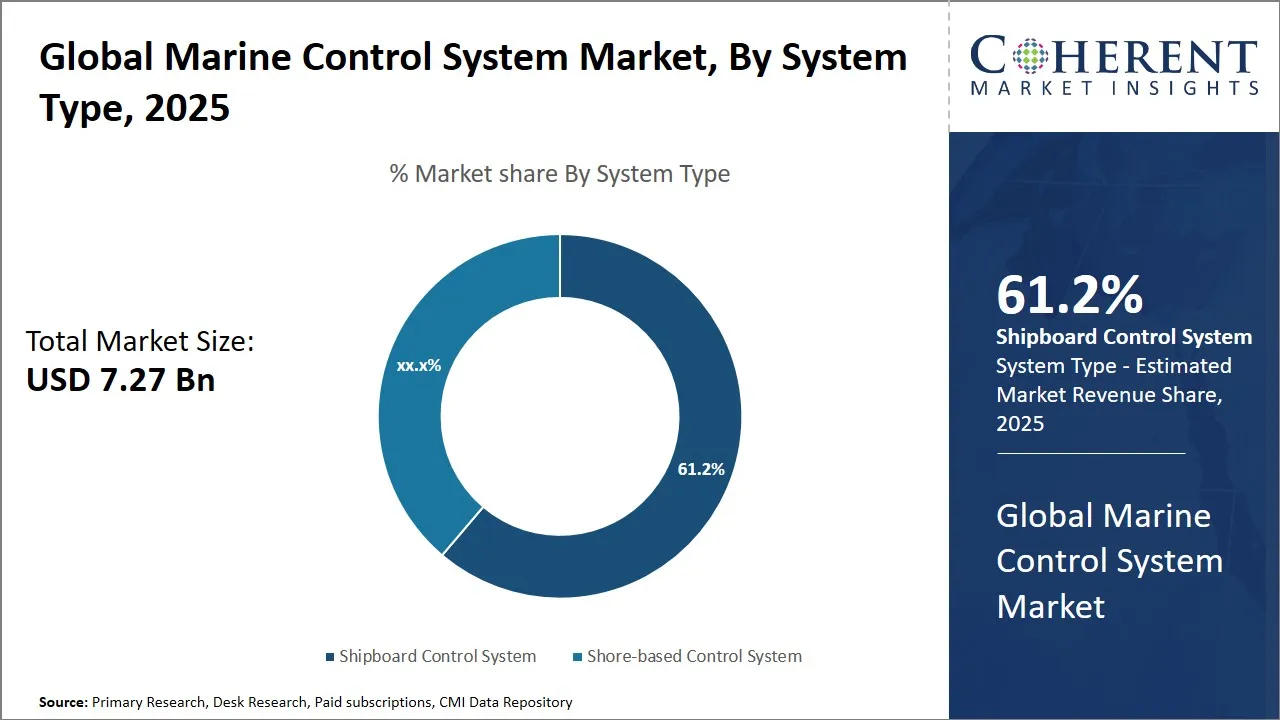
- The shipboard control system segment leads the market, holding an estimated share of 62.2 % in 2026.
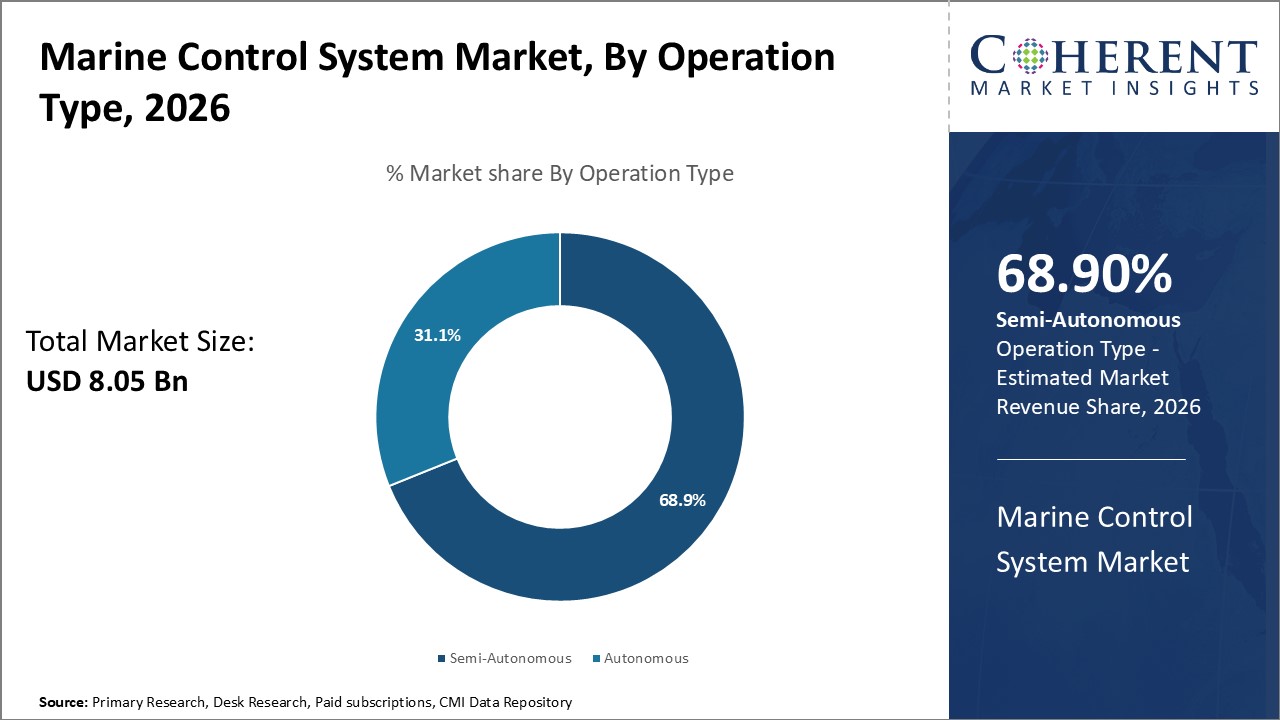
- The semi-autonomous segment dominates with a projected share of 68.9 % in 2026.
- The commercial segment leads the market holding an estimated share of 47.7 % in 2026.
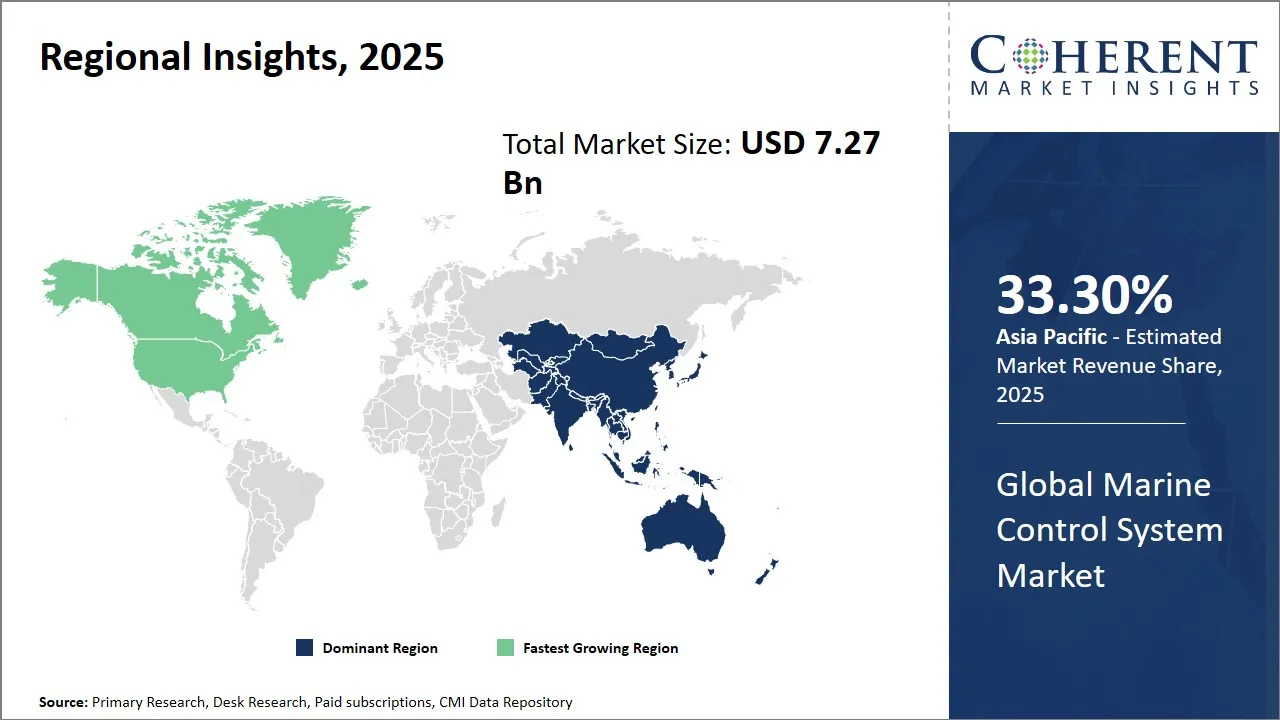
- Asia Pacific, holding an estimated share of 33.3 % in 2026 dominates the market.
- North America, holding a projected share of 21.6 % in 2026, shows the fastest growth in the market.
Market Overview
The market is seeing trends like the integration of IoT and AI technologies to optimize operational efficiency and reduce human errors in marine environments. The growing focus on environmental sustainability is also making demand for energy-efficient control systems that reduce emissions and fuel consumption. Also, improvements in remote monitoring and predictive maintenance solutions are transforming traditional marine operations, enabling real-time data analytics and improved decision-making capabilities.
Current Events and Its Impact
Current Events | Description and its Impact |
Geopolitical and Trade Developments |
|
Economic and Industrial Trends |
|
Segmental Insights
- Current Industry Events of 2026
- Market Size Estimation
- Regional Breakdown
- Competitive Landscape
- Customer Intelligence
- Segmental Analysis
- Pricing Analysis
- Key Market Drivers, Challenges & Future Trends
- Customized Insights Section
Global Marine Control System Market Insights, By System Type – Shipboard Control System’s Dominance is Driven by Integrated Operational Efficiency and Safety Enhancements
The shipboard control system segment, holding an estimated 62.2% share of the global marine control system market in 2026, leads because of its big role in integrating propulsion, navigation, power, and communication functions. These systems allow real-time monitoring and control of onboard operations, improving navigational safety and vessel efficiency while minimizing human error.
Wärtsilä’s Integrated Automation System, installed on many LNG carriers, allows centralized control over propulsion and power systems.
Global Marine Control System Market Insights, By Operation Type – Semi-Autonomous Systems Leads Because of Balanced Human-Machine Collaboration and Regulatory Acceptance
The semi-autonomous segment, holding a 68.9% share of the market in 2026, is expected to dominate because it offers a balance between advanced automation and human oversight. This hybrid approach supports the industry’s move toward full autonomy while maintaining regulatory compliance and safety assurance. Semi-autonomous systems automate routine functions such as route planning and collision avoidance but leave critical decisions to human operators.
Technological progress in AI, sensors, and machine learning continues to strengthen this model. For instance, ABB’s “Ability Marine Pilot Control”, used in hybrid and electric vessels, enables semi-autonomous navigation and real-time decision support, reducing crew workload while enhancing safety and operational reliability.
Global Marine Control System Market Insights, By Ship Type - Commercial Ship Type Segment Thrives due to the Demand for Enhanced Cargo Management and Operational Optimization
The commercial segment is projected to hold the dominant share of 47.7% in the marine control system market in 2026, driven by growing global trade and the demand for efficient cargo management and compliance with environmental regulations. Control systems on commercial vessels—such as container ships and tankers—enable operators to optimize routes, improve turnaround times, and ensure cargo safety.
Environmental mandates are also a key driver, pushing operators to adopt intelligent control systems for fuel optimization and emission tracking. A real-world instance is Kongsberg Gruppen’s integration of advanced control and monitoring systems on Maersk’s container ships, improving operational efficiency and supporting Maersk’s net-zero emission goals.
Impact of AI on the Global Marine Control System
Artificial intelligence (AI) is transforming the marine control system market by enhancing automation, predictive decision-making, and overall vessel efficiency. Traditionally, ship operations relied heavily on manual monitoring and operator expertise; however, AI-driven systems now analyze real-time data from sensors, weather inputs, and navigation routes to optimize performance and fuel consumption. This intelligent automation not only improves safety by detecting anomalies in propulsion, navigation, or engine systems before failures occur, but also reduces crew workload and human error—two persistent challenges in maritime operations. The integration of AI into shipboard control systems represents a shift toward smarter, data-driven fleets that can adapt to changing sea conditions with minimal intervention.
A real-world example of this transformation can be seen in Rolls-Royce’s collaboration with Finnish company Wärtsilä, where AI-based autonomous navigation systems were successfully tested on a ferry operating between Parainen and Nauvo, Finland. The AI system enabled real-time situational awareness and route optimization, automatically adjusting to traffic and environmental changes.
Regional Insights
Asia Pacific Marine Control System Market Analysis and Trends
The Asia Pacific, holding a projected share of 33.3% in 2026, shows the dominant growth in the global marine control system market because of growing industrialization. Countries like China, South Korea, and Japan are leading because of favorable government policies for strengthening maritime trade and improving navigation safety.
The region sees a big pool of manufacturing facilities and research centers that collaborate to develop cost-effective and scalable marine control solutions. Export-oriented economies and rising offshore exploration activities in countries like India and Southeast Asia also contribute to burgeoning demand. Big companies like Hyundai Heavy Industries, Mitsubishi Heavy Industries, and Wartsila play pivotal roles by delivering tailored marine control systems that address region-specific operational challenges.
North America Marine Control System Market Analysis and Trends
North America, holding an estimated share of 21.6% in 2026, shows the fastest growth in the global marine control system market, because of a strong maritime infrastructure, advanced technological ecosystem, and strong governmental support for maritime safety and environmental regulations. The presence of key industry players such as Honeywell International Inc., Emerson Electric Co., and General Electric enhances North America’s competitive edge through continual innovation and system integration capabilities.
Strict regulations by bodies like the U.S. Coast Guard and the adoption of digital automation in commercial and defense marine fleets boost the demand for sophisticated control systems. The well-established shipbuilding and offshore oil & gas sectors add to market growth by necessitating high-performance marine control technologies. Also, trade through hubs like the ports of Los Angeles and Houston facilitates dynamic maritime operations, fueling the market evolution.
Global Marine Control System Market Outlook for Key Countries
U.S. Marine Control System Market Analysis and Trends
The U.S. sees a mature maritime industry focusing on automation, reliability, and compliance with stringent environmental and safety standards. Big players like Emerson and Honeywell add to the adoption of integrated control solutions for commercial shipping, offshore exploration, and naval fleets. The nation’s focus on digital transformation like smart ship technologies and real-time monitoring, makes its marine control system market very innovative. Strong governmental regulations and huge investments in port modernization further stimulate demand in this space.
China Marine Control System Market Analysis and Trends
China marine control system market is expanding rapidly, driven by its position as the world’s largest shipbuilding nation and its ambitions to dominate global maritime trade routes. High governmental support in the form of incentives and maritime strategy initiatives push investment in cutting-edge control systems. Big firms like COSCO Shipping Technology and Wartsila push the domestic development of advanced marine control technologies, focusing on efficiency and emissions reduction. The fast growth of Chinese ports and the Belt and Road Initiative intensify the need for scalable, robust marine control infrastructure.
Japan Marine Control System Market Analysis and Trends
Japan continues to lead the marine control system market because of its focus on precision engineering and advanced technology integration. The country’s strong shipbuilding industry, supported by companies like Mitsubishi Heavy Industries and Japan Radio Co., focuses on safety, automation, and environmentally compliant solutions. Japan’s regulatory environment pushes innovation, pushing players to develop sophisticated control systems that improve vessel fuel efficiency and safety. Also, Japan’s role in servicing a large fleet of commercial and defense vessels makes market demand.
South Korea Marine Control System Market Analysis and Trends
South Korea marine control system market benefits from the presence of major shipbuilders such as Hyundai Heavy Industries and Samsung Heavy Industries, which heavily invest in R&D for marine control system advancements. Government support for improving global maritime competitiveness and environmental stewardship adds to the adoption of digital control solutions. South Korea’s location as a maritime hub and its focus on offshore energy exploration pushes the development of its marine control system sector, catering to increasing safety and efficiency needs.
India Marine Control System Market Analysis and Trends
India marine control system market is growing notably, driven by rising port activities, expanding coastal shipping initiatives, and government-supported maritime infrastructure programs like Sagarmala. The country is seeing increasing collaboration with international technology providers to add to its marine control capabilities. Indian shipbuilding firms and engineering companies are improving their technological expertise, supported by policy reforms focused on boosting indigenous production. Expansion in offshore oil and gas exploration and navy modernization initiatives also underpin market growth.
Market Players, Key Development, and Competitive Intelligence
Key Developments
- On October 8, 2025, Helsing, a defense technology company, announced it is in the process of acquiring of Blue Ocean, an ocean technology company that designs, develops, and operates Autonomous Underwater Vehicles (AUVs). The acquisition will join Blue Ocean’s hardware and manufacturing capabilities with Helsing’s Artificial Intelligence (AI), integrating Blue Ocean’s team and operations into Helsing, with operations continuing in the U.K. and Australia.
- On October 7, 2025, ZF Marine, a specialist in marine propulsion and control systems, signed a Memorandum of Understanding (MOU) with Avikus, HD Hyundai’s autonomous navigation subsidiary. The agreement will join Avikus’ Neuboat Navi with Control Autonomous System to ZF’s TotalCommand electronic control platform, marking a significant step forward in the evolution of intelligent marine operations.
- In June 2025, Valmet, a supplier of ship automation, launched the Valmet DNAe Integrated Automation System for the marine industry. Valmet DNAe is a fully web-based marine control system that integrates seamlessly with all onboard equipment, providing ship owners with a unified platform for efficient operations. It is the first web-based automation system to receive the ISASecure SSA Level 1 certification for its built-in cybersecurity approach.
- In April 2025, Fincantieri and thyssenkrupp Marine Systems signed an Industrial Cooperation Agreement as part of a strategic partnership to provide the Philippine’s Navy with advanced submarine capabilities solutions. As part of the Horizon III military modernization initiative, the Philippine Navy aims to improve its archipelagic defense by acquiring cutting-edge weapon systems. In particular, the introduction of submarines would be a game-changer in securing territorial waters, especially in the South China Sea.
Top Strategies Followed by Marine Control System Market Players
- Leading companies dominate the market by investing a lot in research and development (R&D) to drive innovation and develop high-performance products tailored to the evolving needs of the maritime industry.
- Kongsberg Maritime invests a lot in R&D to develop advanced automation and control systems for vessels like integrated bridge systems and autonomous shipping solutions.
- Mid-level players in the marine control system market use a more cost-focused approach while maintaining the quality and functionality of their offerings.
- Navis provides affordable, modular terminal operating and vessel control software tailored for mid-sized shipping companies and port operators.
- On the other hand, small-scale players carve out their niche by concentrating on unique system features, such as bespoke control modules, user-friendly interfaces, or integration with emerging technologies like augmented reality for navigation.
- Sea Machines Robotics focuses on specialized applications of marine autonomy, such as autonomous workboats, offshore survey vessels, and tugboats.
Market Report Scope
Marine Control System Market Report Coverage
| Report Coverage | Details | ||
|---|---|---|---|
| Base Year: | 2025 | Market Size in 2026: | USD 8.05 Bn |
| Historical Data for: | 2020 To 2024 | Forecast Period: | 2026 To 2033 |
| Forecast Period 2026 to 2033 CAGR: | 10.7% | 2033 Value Projection: | USD 16.40 Bn |
| Geographies covered: |
| ||
| Segments covered: |
| ||
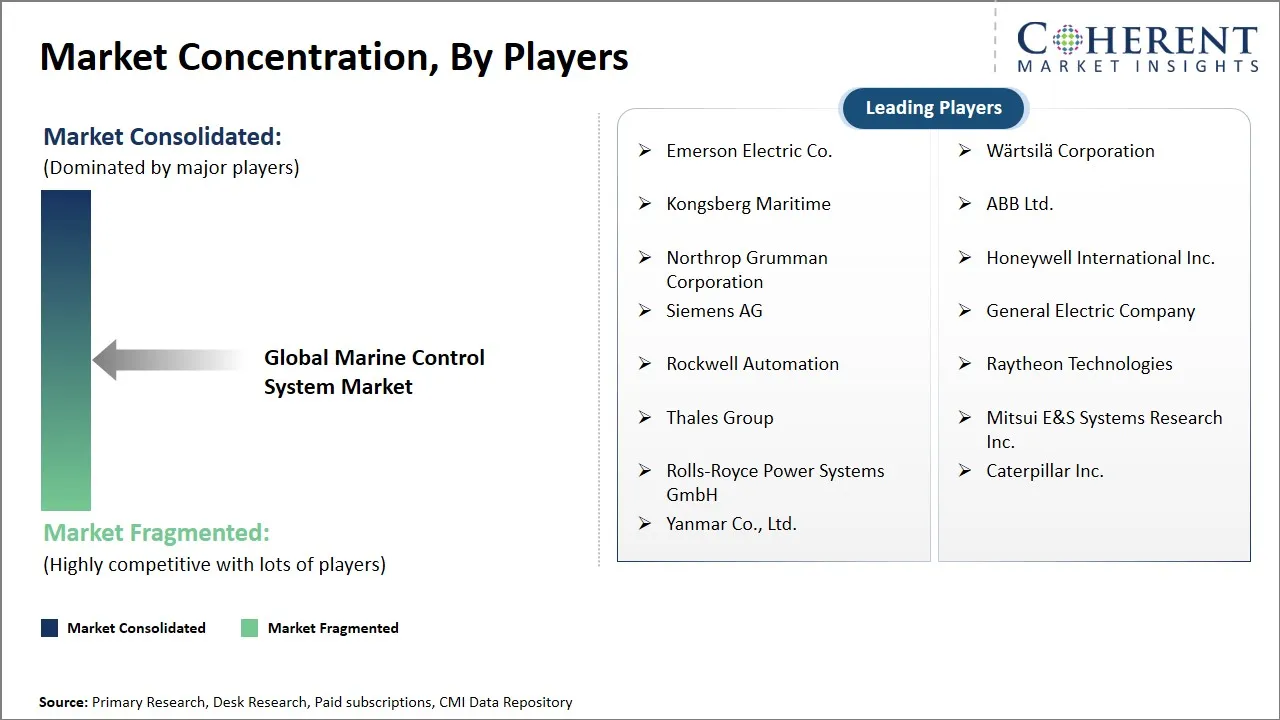
| Companies covered: | Emerson Electric Co., Wärtsilä Corporation, Kongsberg Maritime, ABB Ltd., Northrop Grumman Corporation, Honeywell International Inc., Siemens AG, General Electric Company, Rockwell Automation, Raytheon Technologies, Thales Group, Mitsui E&S Systems Research Inc., Rolls-Royce Power Systems GmbH, Caterpillar Inc., and Yanmar Co., Ltd. | ||
| Growth Drivers: |
| ||
| Restraints & Challenges: |
| ||
Market Dynamics
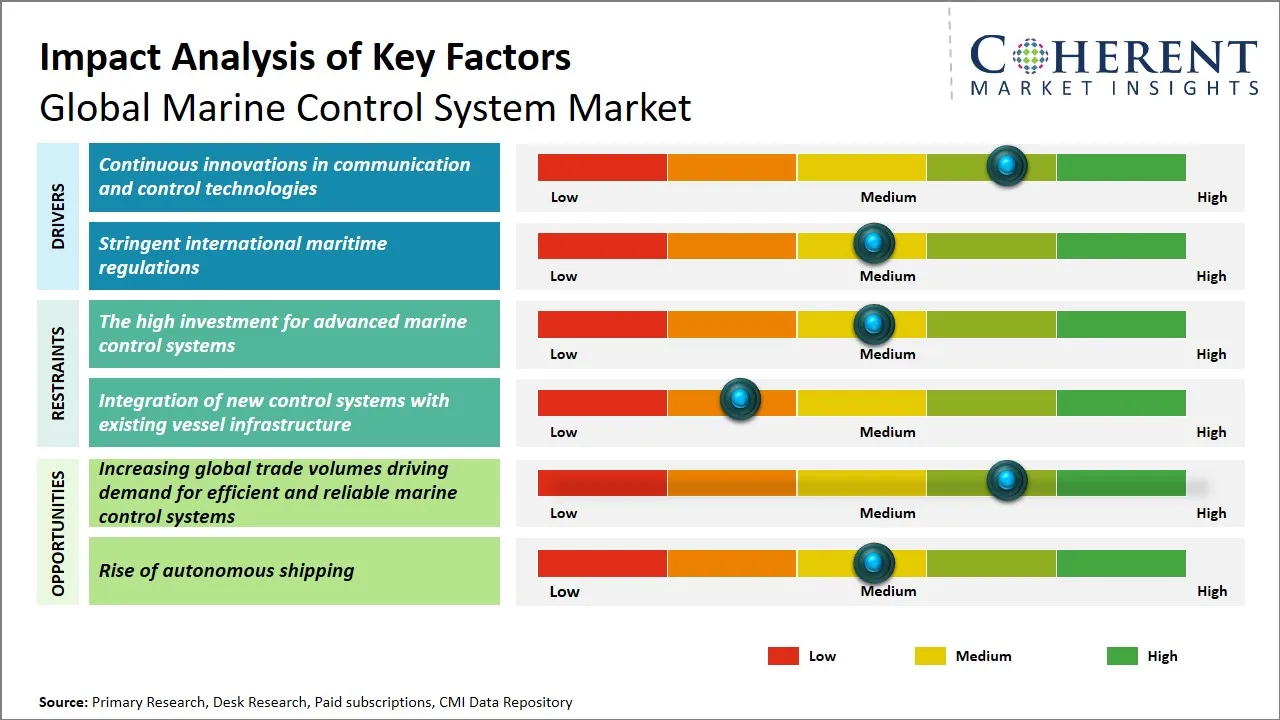
Global Marine Control System Market Driver - Continuous Innovations in Communication and Control Technologies
The marine control system market is significantly propelled by ongoing advancements in communication and control technologies, which are fundamentally transforming vessel operations and navigation efficiency. Innovations such as the integration of Internet of Things (IoT) devices, real-time data analytics, and enhanced automation capabilities have enabled ships to achieve higher precision in maneuvering, monitoring, and system diagnostics. Advanced communication protocols, including satellite communication and 5G networks, facilitate seamless connectivity between offshore vessels and onshore control centers, improving situational awareness and decision-making processes.
Moreover, the adoption of smart sensors and AI-driven control algorithms enhances predictive maintenance and energy management, reducing operational risks and costs. These cutting-edge technologies also support the development of autonomous vessels and remote control capabilities, marking a shift towards smarter and more sustainable maritime operations. Consequently, continuous innovation in communication and control systems plays a crucial role in elevating operational safety, efficiency, and compliance with environmental regulations within the marine sector.
Global Marine Control System Market Opportunity – Rising Global Trade Volumes Fueling Demand for Advanced Marine Control Systems
The rapid growth in global trade volumes presents a significant opportunity for the marine control system market, as increased maritime transportation necessitates more efficient and reliable control solutions. With seaborne trade accounting for over 80% of global trade by volume, the continuous expansion of international commerce is driving the need for enhanced vessel performance, safety, and operational efficiency. Marine control systems, which encompass navigation, propulsion, and automation technologies, play a critical role in optimizing ship operations, reducing fuel consumption, and minimizing downtime.
Also, advancements in digitalization and smart technologies like real-time monitoring, predictive maintenance, and integrated control interfaces are becoming useful for handling the demands of global shipping. This trend is particularly pronounced in emerging markets where port infrastructures are expanding to accommodate higher cargo throughput. Consequently, manufacturers and service providers in the marine control system market are well-positioned to capitalize on the rise in demand because of growing trade.
Analyst Opinion (Expert Opinion)
- Analysts highlight that increasing interest in autonomous shipping and unmanned vessels is driving demand for advanced marine control systems. These systems are used for navigation, safety, and real-time monitoring, making new growth opportunities for both hardware and software providers.
- The adoption of IoT-enabled sensors and real-time data analytics in cargo and passenger ships is becoming a common use case. Analysts note that demand for integrated control systems capable of managing fuel efficiency, emissions, and predictive maintenance is accelerating rapidly.
- With regulatory pressure to reduce maritime emissions, analysts observe growing demand for control systems that support hybrid and fully electric propulsion. Emerging use cases in eco-friendly shipping are prompting both established and mid-level players to innovate solutions tailored for sustainable operations.
Speak to the analyst
Want personalized insights?
Take the findings above to one of our principal consultants, or have the report rebuilt around the segments, geographies and competitors you actually track.
Market Segmentation
- System Type Insights (Revenue, USD Bn, 2021 - 2033)
- Shipboard Control System
- Shore-based Control System
- Operation Insights (Revenue, USD Bn, 2021 - 2033)
- Semi-Autonomous
- Autonomous
- Ship Type Insights (Revenue, USD Bn, 2021 - 2033)
- Commercial
- Government
- Privately-Owned
- Regional Insights (Revenue, USD Bn, 2021 - 2033)
- North America
- U.S.
- Canada
- Latin America
- Brazil
- Argentina
- Mexico
- Rest of Latin America
- Europe
- Germany
- U.K.
- Spain
- France
- Italy
- Russia
- Rest of Europe
- Asia Pacific
- China
- India
- Japan
- Australia
- South Korea
- ASEAN
- Rest of Asia Pacific
- Middle East
- GCC Countries
- Israel
- Rest of Middle East
- Africa
- South Africa
- North Africa
- Central Africa
- North America
- Key Players Insights
- Emerson Electric Co.
- Wartsila Corporation
- Kongsberg Maritime
- ABB Ltd.
- Northrop Grumman Corporation
- Honeywell International Inc.
- Siemens AG
- General Electric Company
- Rockwell Automation
- Raytheon Technologies
- Thales Group
- Mitsui E&S Systems Research Inc.
- Rolls-Royce Power Systems GmbH
- Caterpillar Inc.
- Yanmar Co., Ltd.
Sources
Primary Research Interviews
Stakeholders
- Shipbuilding Companies and Marine Vessel Operators
- Marine Control System Manufacturers and Suppliers
- Naval Architects and Marine Engineers involved in vessel automation projects
- Port Authorities and Maritime Infrastructure Developers
- Equipment Leasing and Marine Automation Service Firms
- Sustainability Experts specializing in green shipping and emission reduction systems
Databases
- MarineTraffic Analytics Database
- Lloyd’s Register Marine Technology Database
- International Maritime Organization (IMO) Publications
- OECD Transport and Maritime Statistics
Magazines
- Maritime Executive
- Marine Technology Reporter
- Shipping & Marine News
- Offshore Engineer Magazine
Journals
- Journal of Marine Engineering & Technology
- Ocean Engineering Journal
- Journal of Navigation & Port Research
- International Journal of Maritime Technology
Newspapers
- The Maritime Standard
- ShippingWatch (Denmark)
- The Financial Times – Maritime Section
- The Economic Times – Shipping & Ports Section
Associations
- International Association of Marine Aids to Navigation and Lighthouse Authorities (IALA)
- Society of Naval Architects and Marine Engineers (SNAME)
- International Marine Contractors Association (IMCA)
- European Maritime Safety Agency (EMSA)
- Marine Technology Society (MTS)
Public Domain Sources
- United Nations Conference on Trade and Development (UNCTAD) – Maritime Trade Reports
- U.S. Department of Transportation – Maritime Administration
- EUROSTAT – Transport and Shipping Statistics
- World Bank – Maritime Logistics and Port Performance
- ResearchGate – Marine Control System Studies
Proprietary Elements
- CMI Data Analytics Tool, Proprietary CMI Existing Repository of information for last 8 years
Get access to 250+ pages report
Every segment, forecast, competitor profile and data table behind the analysis above — available for instant download.
- ESOMAR Member
- ISO 9001:2015 Certified
- D-U-N-S Registered
- GDPR & CCPA Compliant
Missing comfort of reading report in your local language? Find your preferred language:
Transform your Strategy with Exclusive Trending Reports
Frequently Asked Questions
The global marine control system market is estimated to be valued at USD 8.05 billion in 2026 and is expected to reach USD 16.40 billion by 2033.
The CAGR of the global marine control system market is projected to be 10.7% from 2026 to 2033.
Continuous innovations in communication and control technologies and stringent international maritime regulations are the major factors driving the growth of the global marine control system market.
The high investment for advanced marine control systems and integration of new control systems with existing vessel infrastructure are the major factors hampering the growth of the global the marine control system market.
In terms of system type, the shipboard control system segment is estimated to dominate the market revenue share in 2026.
It is an integrated system that manages vessel operations, including propulsion, navigation, communication, and safety systems.
Yes, AI and IoT enable predictive maintenance, optimized fuel consumption, and real-time operational monitoring.