

Global Masterbatch Market Size & Forecast – 2026 To 2033
The Global Masterbatch Market is estimated to be valued at USD 15.82 Bn in 2026 and is expected to reach USD 24.10 Bn by 2033, exhibiting a compound annual growth rate (CAGR) of 6.20% from 2026 to 2033. Market growth is supported by increasing plastic consumption across the packaging, automotive, construction, consumer goods, agriculture, and electrical applications.
Masterbatches provide concentrated pigments and functional additives dispersed in carrier resins, enabling manufacturers to achieve consistent color, UV stability, flame retardancy, process efficiency, barrier performance, and improved recyclability. Sustainability requirements are further encouraging the development of masterbatches compatible with recycled polymers. In July 2025, Avient introduced ColorMatrix Amosorb Oxyloop-1, an oxygen-scavenging additive designed to extend shelf life and enhance the bottle-to-bottle recyclability of PET and rPET packaging, demonstrating the market’s shift toward high-performance circular-material solutions.
Key Takeaways of the Global Masterbatch Market
- Black Masterbatch is expected to lead the type segment with 31.8 % of the market share in 2026, supported by its cost efficiency, UV protection, opacity, conductivity, and extensive use in packaging, automotive, pipes, cables, and consumer products. In May 2024, Cabot launched REPLASBLAK universal circular black masterbatches containing ISCC PLUS-certified sustainable material for automotive plastics.
- Polyethylene is projected to account for 34.6 % of the market share in 2026, owing to its broad compatibility, processing flexibility, dispersion performance, and strong alignment with high-volume flexible and rigid packaging applications. In November 2023, Avient showcased Rejoin PCR colorants formulated with recycled polyolefin carrier resin, enabling converters to produce fully recycled-content colored packaging without materially compromising performance.
- Film and sheet extrusion is anticipated to hold 31.4 % of the market share in 2026, reflecting extensive masterbatch consumption in flexible packaging, agricultural films, construction membranes, labels, and protective sheets. In May 2025, Tosaf introduced matched UV stabilizer and color-masterbatch combinations for polyethylene mulch films, helping manufacturers extend outdoor service life and tailor film colors to specific agricultural applications.
- Asia Pacific is expected to dominate the market with a 39.4 % share in 2026, supported by its extensive plastics-converting base, expanding packaging production, infrastructure investment, and cost-competitive manufacturing ecosystem. In February 2026, Ampacet presented masterbatch and additive technologies tailored for PE, PP, and PET processing across film extrusion, injection molding, and blow molding applications at Plastindia in New Delhi.
- Europe, representing an expected 25.6 % share in 2026, is forecast to record the fastest growth as recyclability requirements, traceable feedstocks, product-carbon reporting, and advanced polymer applications reshape masterbatch procurement. In October 2025, Gabriel-Chemie opened its expanded Hungarian facility, increasing production space and enabling the installation of up to 19 production lines to strengthen regional masterbatch supply.
- Circular and Low-Carbon Formulations: Masterbatch suppliers are increasingly replacing virgin carrier polymers and conventional pigments with recycled, renewable, and mass-balance-certified inputs. This transition enables packaging converters and brand owners to improve recycled-content claims without sacrificing color consistency, dispersion, or processing stability. Competitive advantage will increasingly depend on certification, feedstock traceability, recyclability compatibility, and transparent product-level environmental documentation.
- Functional Masterbatch Integration: Demand is shifting from conventional color concentrates toward multifunctional formulations that combine color, UV stabilization, antistatic performance, flame retardancy, processing assistance, and antimicrobial properties. Combining multiple functions within a single masterbatch simplifies dosing, reduces inventory needs, minimizes production errors, and limits machine downtime. Suppliers offering application-specific formulations and technical processing support will capture greater value than producers competing primarily through volume and price.
Segmental Insights
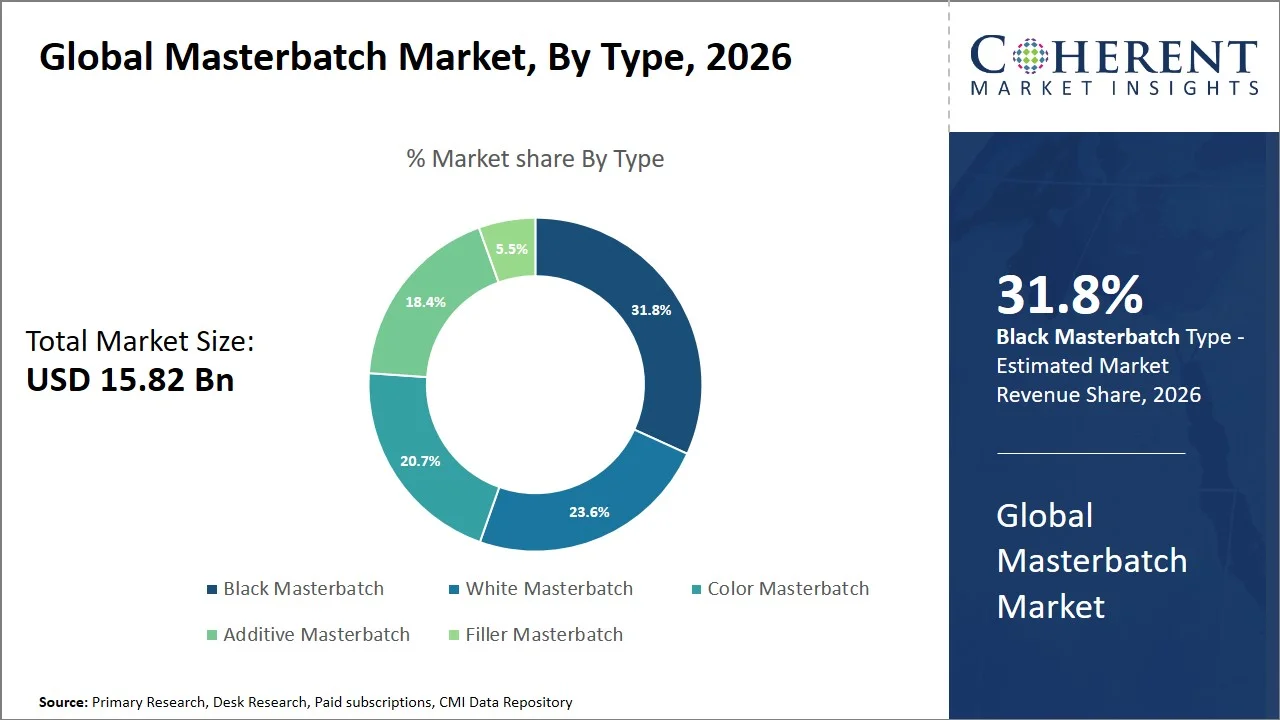
Why Does Black Masterbatch Dominate the Global Masterbatch Market?
Black Masterbatch is expected to account for 31.8% of the market share in 2026, reflecting its central role in high-volume products where uniform coloration must be combined with controlled mechanical and processing performance. Its leadership is reinforced by low let-down requirements, established carbon-black dispersion expertise, and formulations tailored to recycled polymers, pressure pipes, irrigation systems, geomembranes, wire and cable, and automotive components. Converters also favor black concentrates because they help mask feedstock color variations and maintain visual consistency across large production runs. Mature twin-screw compounding infrastructure and regional manufacturing capacity support competitive pricing and reliable delivery. In July 2024, Plastiblends India reported that augmented black masterbatch capacity at its Roorkee and Palsana facilities was receiving a positive market response, with India’s Jal Jeevan Mission supporting demand from water-infrastructure applications.
- Current Industry Events of 2026
- Market Size Estimation
- Regional Breakdown
- Competitive Landscape
- Customer Intelligence
- Segmental Analysis
- Pricing Analysis
- Key Market Drivers, Challenges & Future Trends
- Customized Insights Section
Why Does Polyethylene Represent the Largest Carrier Resin Segment in the Global Masterbatch Market?
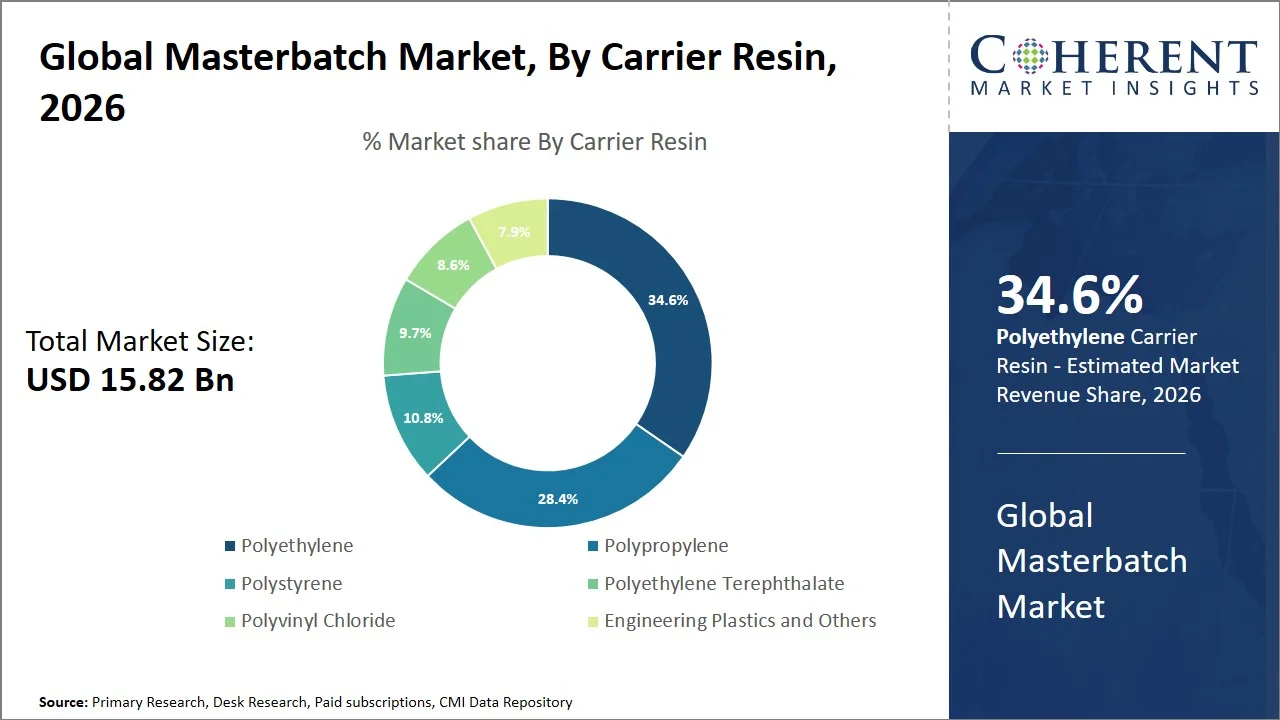
Polyethylene is projected to represent 34.6% of the market share in 2026 because LDPE, LLDPE, and HDPE carriers can be closely matched to the melt behavior of a large installed base of polyethylene converters. This resin-family alignment limits compatibility problems, surface defects, and uneven pigment distribution while allowing suppliers to tailor melt-flow characteristics for blown film, rotational molding, pipe extrusion, cable jacketing, and rigid containers. Its moderate processing temperatures also help protect heat-sensitive pigments and functional additives during compounding. Demand is further supported by recycled polyethylene, which often requires color correction, stabilization, and property-balancing concentrates. In March 2025, a peer-reviewed Polymers study demonstrated that silane-modified pigments prevented agglomeration in polyethylene color masterbatches and materially changed melt rheology, highlighting formulation advances aimed at improving dispersion and processing control.
Why Does Film and Sheet Extrusion Dominate the Global Masterbatch Market?
Film and sheet extrusion is expected to capture 31.4% of the global masterbatch market in 2026 because continuous, high-speed extrusion lines require highly accurate dosing of color and functional concentrates across very thin polymer layers. Multilayer packaging and technical films frequently use separate masterbatches for slip, antiblock, antifog, UV protection, opacity, barrier enhancement, and surface appearance, increasing consumption within each production structure. The segment is strongly represented in flexible packaging, agricultural films, hygiene backsheets, industrial liners, labels, and construction membranes. Supply-side leadership reflects the availability of gravimetric feeding, coextrusion equipment, and concentrated formulations designed to preserve output and minimize defects. In October 2025, Sukano launched an antiblock masterbatch for compostable BOPLA films that enables processing on existing BOPP equipment and supports high transverse stretching, with performance confirmed through trials at Brückner Maschinenbau.
Global Masterbatch Market Dynamics
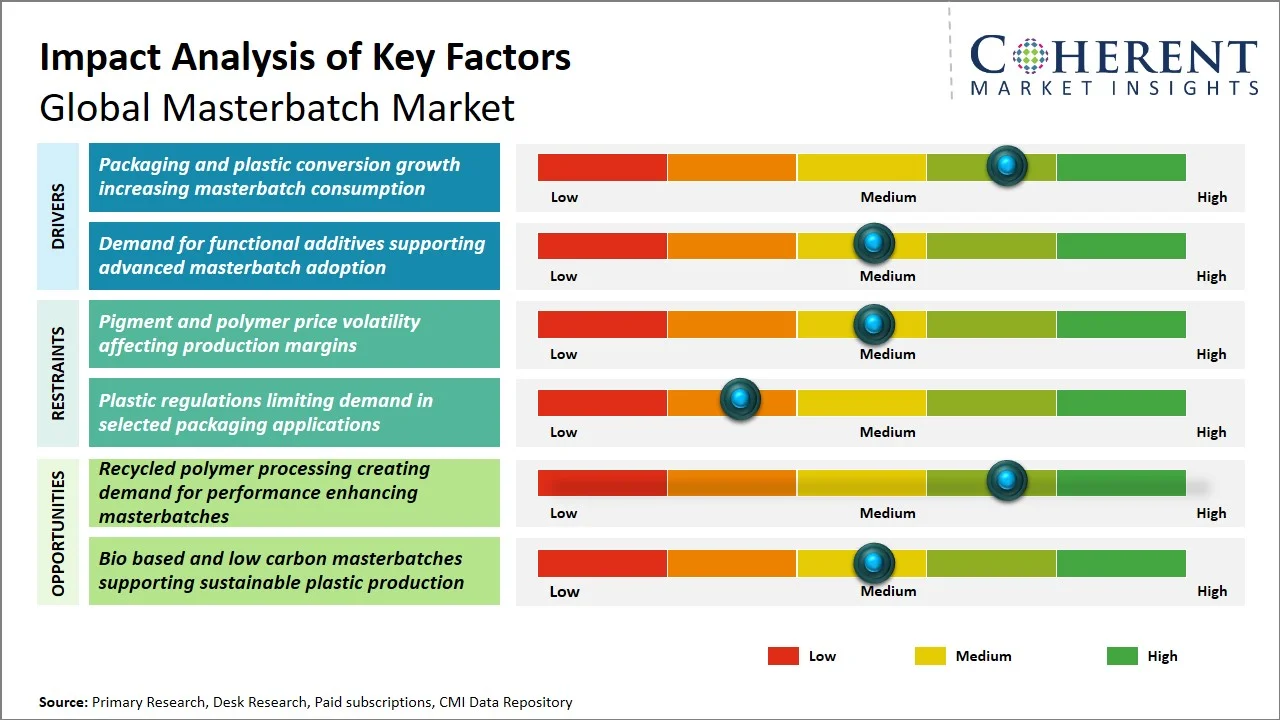
Key Market Drivers
- Packaging and Plastic Conversion Capacity Expansion Broadens Masterbatch Consumption: Packaging remains a major volume engine for masterbatch suppliers because nearly every plastic conversion process requires controlled coloration, opacity, processing assistance, barrier performance, or surface modification. Expansion of bottle, closure, flexible-film, container, and preform capacity creates recurring demand for polyethylene-, polypropylene-, and PET-compatible concentrates. Masterbatch consumption also increases as converters operate more multilayer structures, introduce shorter product runs, and manufacture packaging for food, beverages, personal care, pharmaceuticals, and household products. Localized converting capacity benefits regional masterbatch producers by shortening qualification cycles and enabling application-specific technical support. In February 2025, ALPLA opened a second production plant in Thailand, adding injection molding and one-step injection stretch blow molding capabilities for bottles, preforms, closures, and molded components. The expansion creates an additional downstream consumption base for color, processing, UV, barrier, and recycled-content masterbatches in Southeast Asia.
- Functional Performance Requirements Accelerate Additive Masterbatch Adoption: Plastic processors increasingly use additive masterbatches to resolve multiple production and end-product challenges rather than treating masterbatch solely as a coloring input. Processing aids, UV stabilizers, antioxidants, antistatic agents, flame retardants, antiblock additives, oxygen scavengers, compatibilizers, and nucleating agents allow converters to improve throughput, product life, surface quality, safety, and recyclability. Demand is particularly strong where packaging and technical-plastic producers must comply with food-contact rules, eliminate restricted substances, and maintain performance while reducing material usage. These requirements support higher-value customized formulations and strengthen supplier involvement during product design. In June 2025, Clariant launched its AddWorks PPA range of PFAS-free polymer processing aids for polyolefin extrusion. The products are designed to eliminate melt fracture, improve film surfaces, maintain optical and mechanical properties, and support food-packaging compliance, demonstrating how regulatory substitution is expanding the commercial role of functional masterbatches.
Emerging Market Trends
- Recyclate-Compatible Formulations are Becoming a Core Product-Development Requirement: Masterbatch development is shifting from formulations optimized primarily for virgin polymers toward systems designed to manage the variability of post-consumer and post-industrial recyclates. Recycled resin frequently presents inconsistent base color, contamination, odor, degradation, melt-flow variation, and reduced mechanical performance. Suppliers are therefore developing corrective color systems, odor absorbers, chain extenders, antioxidants, compatibilizers, and process stabilizers that allow converters to use higher recyclate concentrations without losing appearance or productivity. This transition changes the supplier’s role from pigment vendor to material-performance partner. Formulation databases must increasingly account for feedstock origin, previous thermal history, polymer mixtures, and multiple processing cycles. Commercial value will migrate toward masterbatches that provide predictable performance across variable resin streams, support design-for-recycling requirements, and minimize the quantity of virgin resin required to achieve acceptable product specifications. Companies with recycling laboratories and application-testing capabilities will be better positioned than suppliers offering standardized color concentrates alone.
- Combination Masterbatches are Replacing Multiple Single-Function Additive Inputs: Converters are increasingly seeking combination masterbatches that incorporate color and several functional additives within one accurately dosed concentrate. A single formulation may provide pigmentation, UV protection, antistatic behavior, slip control, antiblock performance, processing assistance, and thermal stabilization. This approach reduces the number of raw materials handled on the factory floor and lowers the risk of dosing errors, additive incompatibility, inventory duplication, and inconsistent finished-product performance. Combination products are especially relevant to high-speed film extrusion, injection molding, fibers, automotive plastics, and packaging lines where downtime and formulation variability create significant costs. The trend favors suppliers with strong knowledge of additive interactions, carrier-resin compatibility, migration behavior, and processing conditions. It also supports premium pricing because customers purchase validated performance rather than individual chemical ingredients. Over the forecast period, combination formulations are likely to become more application-specific, with products engineered for particular polymer grades, equipment configurations, recycling streams, and regulatory environments.
Current Events and Their Impact
Current Events | Description and its Impact |
European Union Packaging and Packaging Waste Regulation Enters into Force – February 2025 |
|
Canada Begins Federal Plastics Registry Reporting – September 2025 |
|
Revised EU Classification, Labelling and Packaging Regulation Takes Effect – December 2024 |
|
Regional Insights
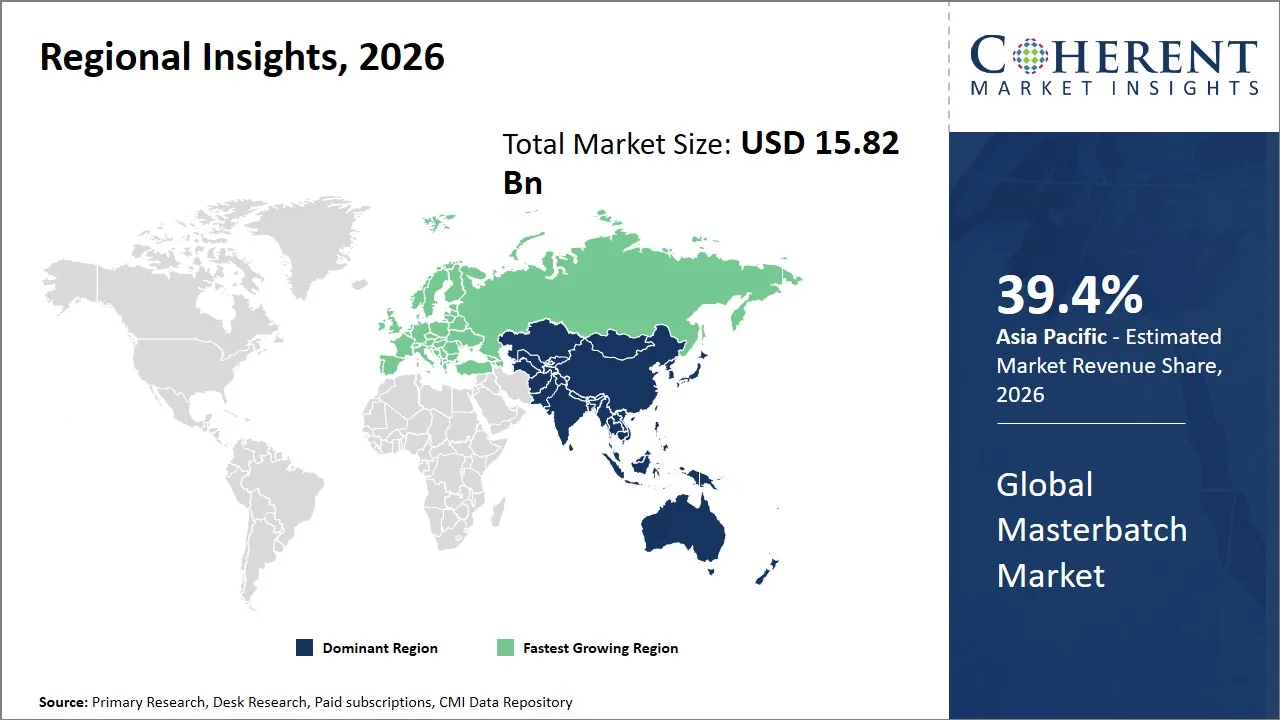
Why Does Asia Pacific Dominate the Global Masterbatch Market?
Asia Pacific is expected to account for 39.4% of the global masterbatch market in 2026, supported by the region’s concentration of plastic resin production, high-volume converting capacity, and rapidly scaling packaging, automotive, electronics, textile, construction, and agricultural-film industries. China and India provide extensive converter networks, while Southeast Asian manufacturing hubs strengthen demand for color, white, black, filler, and process-enhancing masterbatches. Regional suppliers also benefit from proximity to polyolefin feedstocks, competitive conversion costs, and expanding technical-compounding capabilities. These factors enable large-volume standardized production alongside customized formulations for local brands and export-oriented manufacturers. In April 2025, China’s National Bureau of Statistics reported that value added in rubber and plastics products manufacturing increased 6.1% year on year, with January–April growth reaching 7.8%, illustrating the scale of downstream activity supporting masterbatch consumption.
Why is Europe Emerging as the Fastest-Growing Region in the Global Masterbatch Market?
Europe is expected to hold 25.6% of the global masterbatch market in 2026 and emerge as the fastest-growing region as converters accelerate the transition toward recyclable packaging, higher recycled-content use, low-migration pigments, and compliant functional additives. Demand increasingly favors technically validated masterbatches that preserve sorting, mechanical recycling, food-contact safety, and product performance. Europe’s established automotive, packaging, medical, cable, and consumer-goods industries also generate demand for precise color matching and premium additive systems. Suppliers are responding through localized inventories, application support, and distribution partnerships that shorten qualification and delivery cycles. In May 2026, LyondellBasell expanded distribution of its masterbatches and custom performance colors into Germany and Austria through Interpolimeri, citing demand for local availability, technical support, and faster access. The move indicates that service proximity and regulatory-ready formulations are becoming central competitive requirements across Europe.
Global Masterbatch Market Outlook for Key Countries
Why is the U.S. a Key Market for the Global Masterbatch Market?
The U.S. masterbatch market is supported by large-scale production of plastic packaging, molded components, films, fibers, pipes, cables, and medical products. Demand is concentrated in customized color concentrates and additive systems that provide flame retardancy, UV protection, antistatic performance, laser marking, and food-contact compliance. Local converters also require rapid color matching and dependable supply across multiple plants, favoring masterbatch producers with domestic technical centers and manufacturing capacity. In September 2025, the Plastics Industry Association reported that the U.S. plastics value chain, including suppliers, generated USD 754.5 billion in shipments, indicating a substantial downstream customer base for color and additive concentrates.
Why is India Important in the Global Masterbatch Market?
India is important to the global masterbatch market because its downstream plastics industry serves expanding flexible packaging, rigid packaging, irrigation, pipes, household products, appliances, automotive components, pharmaceuticals, and synthetic fibers. A broad base of small and medium-sized converters supports demand for competitively priced black, white, color, filler, and additive masterbatches, while larger export-oriented processors increasingly require tighter dispersion, regulatory documentation, and batch consistency. Domestic masterbatch production benefits from cost-efficient manufacturing, expanding polymer availability, and technical clusters across western, northern, and southern India. In November 2025, India’s Ministry of Commerce and Industry reported that plastics exports reached USD 6.407 billion during April–September 2025, increasing 4.6% from the corresponding previous-year period. This export momentum raises demand for masterbatches meeting international color, food-contact, weatherability, recyclability, and quality specifications, strengthening opportunities for technically capable domestic suppliers.
Why Does China Support Growth in the Global Masterbatch Market?
China supports global masterbatch market growth through its integrated petrochemical value chain, extensive plastics-conversion clusters, and high output across packaging, consumer electronics, electric vehicles, appliances, textiles, construction materials, and industrial components. Large production runs sustain demand for standard black, white, colour, and filler masterbatches, while premium manufacturing increasingly requires flame retardancy, thermal management, conductivity, laser marking, UV resistance, and precise aesthetic effects. Domestic equipment, pigment, additive, and carrier-resin ecosystems allow suppliers to scale formulations rapidly and compete in export markets. China’s circular-economy transition is also increasing demand for colour correction, stabilization, odour control, and compatibility solutions for recycled polymers. In June 2025, China’s State Council Information Office reported that the recycling rate for PET beverage packaging had reached 96.48%. This recovery level expands the commercial need for masterbatches designed to preserve recyclability and improve the appearance and performance of recycled PET.
Why is Germany a Strategic Country in the Global Masterbatch Market?
Germany is a strategic masterbatch market because its plastics processors supply demanding automotive, packaging, electrical, electronics, medical, construction, and engineered-product customers. Buyers emphasize colour repeatability, migration control, weatherability, flame-retardant performance, traceable ingredients, and compatibility with mechanical recycling. The country’s advanced plastics-machinery and testing ecosystem supports precise dosing, multilayer extrusion, digital color matching, and rapid qualification of specialty formulations. Germany also acts as an important European development and distribution center, allowing masterbatch suppliers to serve multinational converters and brand owners across neighboring markets. Market data updated in May 2025 by Germany’s plastic-packaging association showed that 2025 production included approximately 1.414 million tons of packaging films, 744,000 tons of cups, containers, cases, crates and pallets, and 323,000 tons of closures. These converting streams create recurring demand for color, opacity, slip, antiblock, UV, barrier-supporting, and recycled-content-compatible masterbatches.
Why is Brazil an Important Growth Market for the Global Masterbatch Market?
Brazil is an important growth market for masterbatch because it has Latin America’s broadest plastics-conversion base and strong downstream demand from food and beverage packaging, agriculture, household goods, automotive components, construction products, footwear, and personal care. Agricultural films, irrigation equipment, chemical containers, crates, caps, and flexible packaging require colour concentrates and functional additives capable of withstanding UV exposure, heat, moisture, and demanding transportation conditions. Local production helps suppliers respond to currency volatility, import lead times, and customer requirements for smaller batches and technical support. Brazil can also serve as a distribution platform for neighbouring South American markets. In August 2025, Brazil’s national statistics agency reported that rubber and plastic products output increased 1.4% month over month in June 2025. The improvement indicates continuing downstream activity, supporting consumption of black, white, colour, processing-aid, UV-stabilizing, and performance masterbatches across industrial and consumer applications.
Technology Adoption Landscape in the Global Masterbatch Market
Technology | Adoption Level | Key Application Area | Business Impact |
Co-rotating twin-screw extrusion | High | Pigment wetting, additive dispersion, and masterbatch compounding | Produces uniform dispersion, supports high additive loading, and improves batch consistency across colour and functional grades. |
Loss-in-weight gravimetric dosing | High | Accurate feeding of pigments, additives, carriers, and finished masterbatch | Reduces formulation variation, material waste, overdosing, and quality rejection while enabling automated production. |
Digital spectrophotometric colour matching | High | Packaging, automotive, consumer goods, fibers, and branded products | Shortens colour-development cycles, improves repeatability, and enables faster approval across multiple plants and polymer substrates. |
NIR-detectable pigment and masterbatch technology | Medium | Black and dark-colored recyclable packaging | Allows dark plastic products to be recognized by optical sorting equipment, improving recyclability and regulatory compatibility. |
Reactive compatibilizer masterbatches | Medium | Mixed-polymer recyclates, multilayer packaging waste, and recycled compounds | Improves interfacial adhesion and mechanical performance, enabling greater reuse of otherwise incompatible polymer streams. |
Inline rheology and process-monitoring systems | Medium | Continuous extrusion and high-volume masterbatch production | Identifies dispersion, pressure, temperature, and viscosity deviations earlier, reducing off-specification output and unplanned downtime. |
How are Recycled-Polymer Upgrading Technologies Creating New Growth Opportunities in the Global Masterbatch Market?
The largest commercially scalable opportunity lies in masterbatches that enable converters to increase recycled-polymer use while maintaining color, processing stability, strength, odor control, and regulatory compliance. Recycled resin streams are rarely uniform, creating substantial variation in shade, viscosity, contamination, and thermal history. This variability limits direct substitution for virgin resin and creates demand for corrective additive packages. Masterbatch manufacturers can capture greater value by developing modular systems that combine color correction, compatibilization, chain extension, stabilization, deodorization, and processing assistance for specific recycled-polymer streams.
The opportunity extends beyond packaging into automotive components, construction products, agricultural films, pipes, consumer goods, and industrial applications. Suppliers can differentiate through recyclate characterization, pilot-scale processing, formulation databases, and performance guarantees rather than competing solely on pigment price. Regional technical centers located near recyclers and converters can shorten validation periods and support rapid formulation adjustments. Companies that build partnerships across recycling, resin production, and plastic conversion will be positioned to become critical enablers of circular-material adoption and secure longer-term customer contracts.
Market Players, Key Development, and Competitive Landscape
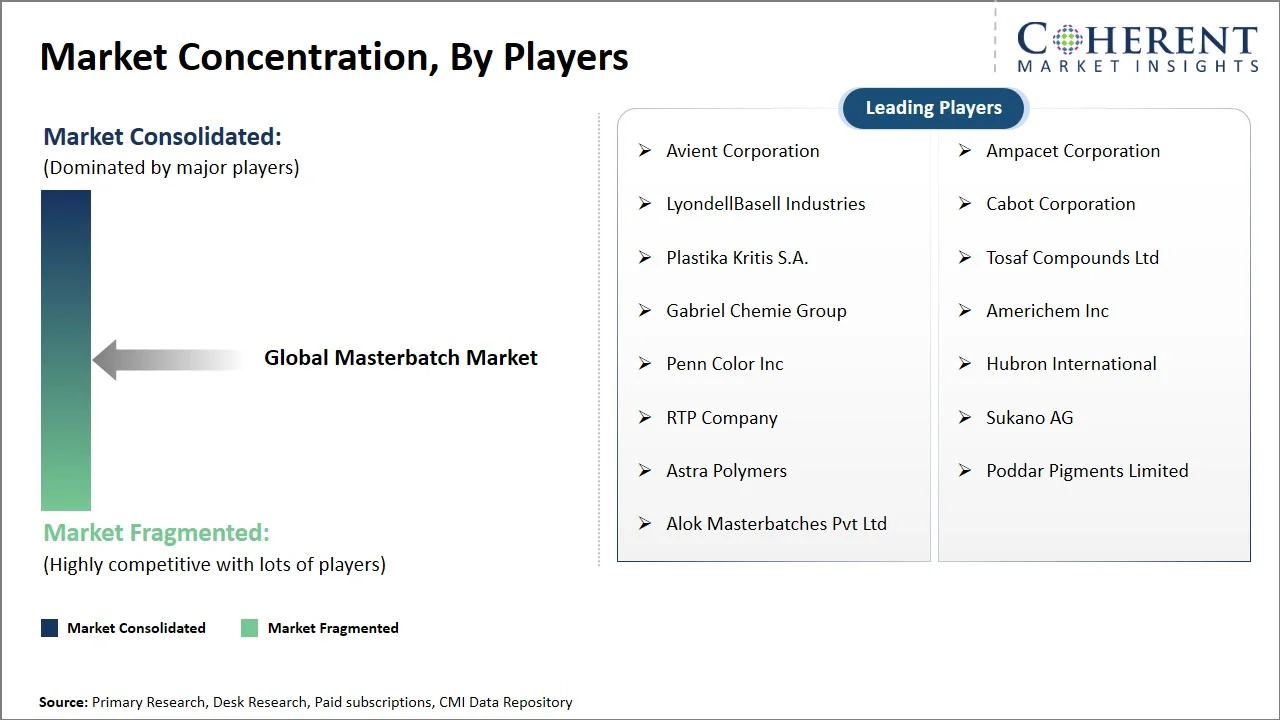
Key Developments
- In June 2026, Americhem launched its Laser Marking Solutions platform, comprising masterbatches and engineered compounds designed to produce permanent, high-contrast and machine-readable markings on polymer components. The technology integrates identification performance directly into the material and reduces dependence on labels, inks, and additional marking operations. This is important for the masterbatch market because traceability, compliance coding, automation, and product authentication are creating new demand for specialized functional concentrates across healthcare, electronics, transportation, packaging, and industrial applications.
- In December 2025, Plastika Kritis presented its KRITILEN masterbatch portfolio for high-performance thermoformed food packaging. The solutions address color, opacity, processing behavior, appearance, and recyclability requirements across thermoformed packaging structures. This is important for the masterbatch market because thermoforming converters increasingly require formulations that perform consistently during sheet extrusion and forming while supporting optical sorting and circular-packaging objectives. Such application-specific portfolios allow masterbatch producers to move beyond standard colour products and participate more directly in packaging design and process optimization.
- In May 2025, Penn Color developed an oxygen-barrier-compatible PET masterbatch for food packaging, maintaining the required color appearance while preserving oxygen-scavenging performance and compatibility with existing injection stretch blow-molding operations. The formulation was designed as a drop-in solution without increasing production costs. This development is important because it demonstrates the growing integration of visual branding and active-packaging functionality within a single masterbatch, allowing packaging producers to protect shelf life without compromising manufacturing efficiency or brand identity.
Competitive Landscape
The global masterbatch market is moderately fragmented, with multinational specialty-material companies competing alongside regional compounders and application-focused manufacturers. Large players benefit from global production networks, regulatory capabilities, and broad product portfolios, while regional suppliers compete through shorter lead times, flexible batch sizes, localized color matching, and cost efficiency. Competition is moving from basic pigment concentration toward engineered formulations that solve processing, recyclability, safety, and performance challenges.
Key focus areas include
- Product quality and dispersion consistency: Suppliers compete on pigment distribution, shade repeatability, thermal stability, and low defect rates.
- Customized formulation capability: Rapid development of application-specific colour and additive systems is becoming essential for securing strategic accounts.
- Technology and process efficiency: Twin-screw compounding, automated dosing, digital colour matching, and inline quality control support higher productivity and tighter tolerances.
- Pricing and raw-material management: Pigment, titanium dioxide, carbon black, additive, and carrier-resin costs directly affect margins and customer pricing.
- Supply security and regional availability: Multiple production locations, safety inventory, and reliable raw-material sourcing are important to high-volume converters.
- Regulatory compliance and documentation: Food-contact approvals, chemical classification, migration testing, recyclability validation, and traceable sourcing influence supplier selection.
- Sustainable and circular product positioning: Recycled carriers, bio-based feedstocks, PFAS-free additives, NIR-sortable colors, and recyclate-enhancement systems support differentiation.
- Technical service and customer reach: On-site processing support, application laboratories, distributor networks, and local development teams improve retention and shorten commercialization cycles.
Market Report Scope
Masterbatch Market Report Coverage
| Report Coverage | Details | ||
|---|---|---|---|
| Base Year: | 2025 | Market Size in 2026: | USD 15.82 Bn |
| Historical Data for: | 2020 To 2024 | Forecast Period: | 2026 To 2033 |
| Forecast Period 2026 to 2033 CAGR: | 6.20% | 2033 Value Projection: | USD 24.10 Bn |
| Geographies covered: |
| ||
| Segments covered: |
| ||
| Companies covered: | Avient Corporation, Ampacet Corporation, LyondellBasell Industries, Cabot Corporation, Plastika Kritis S.A., Tosaf Compounds Ltd, Gabriel Chemie Group, Americhem Inc, Penn Color Inc, Hubron International, RTP Company, Sukano AG, Astra Polymers, Poddar Pigments Limited, and Alok Masterbatches Pvt Ltd | ||
| Growth Drivers: |
| ||
| Restraints & Challenges: |
| ||
Analyst Opinion (Expert Opinion)
- The market’s next phase will be defined less by conventional color demand and more by material intelligence. Masterbatch suppliers will increasingly be expected to predict how pigments, additives, carriers, recycled feedstocks, and processing conditions interact throughout a product’s life cycle. Formulation businesses that combine material science with digital colour control, recyclability testing, and production analytics will gain stronger customer influence.
- The most transformative trend will be the convergence of colour, functionality, and circularity within a single concentrate. Customers will prefer masterbatches that simultaneously achieve appearance, process stability, traceability, recyclability, and regulatory compliance. This will reduce the relevance of low-cost, undifferentiated formulations and support premiumization in technically demanding applications.
- Key risks include volatile pigment and carrier-resin costs, restrictions on chemical additives, inconsistent recycled feedstock, and lengthy customer qualification cycles. Smaller producers may struggle with the cost of regulatory testing and technical documentation. Pricing pressure will remain significant in standard black, white, and filler masterbatch categories where product differentiation is limited.
- Market participants should prioritize recyclate-upgrading solutions, combination masterbatches, PFAS-free processing systems, and application laboratories near major converting clusters. Competitive advantage will depend on fast formulation turnaround, consistent multi-region supply, transparent compliance documentation, and the ability to demonstrate measurable processing or end-product benefits rather than competing primarily through price.
Speak to the analyst
Want personalized insights?
Take the findings above to one of our principal consultants, or have the report rebuilt around the segments, geographies and competitors you actually track.
Market Segmentation
- Type Insights (Revenue, USD Bn, 2021 - 2033)
- Black Masterbatch
- White Masterbatch
- Color Masterbatch
- Additive Masterbatch
- Filler Masterbatch
- Carrier Resin Insights (Revenue, USD Bn, 2021 - 2033)
- Polyethylene
- Polypropylene
- Polystyrene
- Polyethylene Terephthalate
- Polyvinyl Chloride
- Engineering Plastics and Others
- Processing Method Insights (Revenue, USD Bn, 2021 - 2033)
- Film and Sheet Extrusion
- Injection Molding
- Blow Molding
- Fiber Extrusion
- Pipe and Profile Extrusion
- Others
- Application Insights (Revenue, USD Bn, 2021 - 2033)
- Packaging
- Building and Construction
- Automotive
- Consumer Goods
- Agriculture
- Electrical and Electronics
- Others
- Regional Insights (Revenue, USD Bn, 2021 - 2033)
- North America
- U.S.
- Canada
- Latin America
- Brazil
- Argentina
- Mexico
- Rest of Latin America
- Europe
- Germany
- U.K.
- Spain
- France
- Italy
- Russia
- Rest of Europe
- Asia Pacific
- China
- India
- Japan
- Australia
- South Korea
- ASEAN
- Rest of Asia Pacific
- Middle East
- GCC Countries
- Israel
- Rest of Middle East
- Africa
- South Africa
- North Africa
- Central Africa
- North America
- Key Players Insights
- Avient Corporation
- Ampacet Corporation
- LyondellBasell Industries
- Cabot Corporation
- Plastika Kritis S.A.
- Tosaf Compounds Ltd
- Gabriel Chemie Group
- Americhem Inc
- Penn Color Inc
- Hubron International
- RTP Company
- Sukano AG
- Astra Polymers
- Poddar Pigments Limited
- Alok Masterbatches Pvt Ltd
Source
Primary Research Interviews
- Manufacturers of black, white, color, additive, filler, and specialty masterbatches
- Suppliers of pigments, carbon black, titanium dioxide, fillers, stabilizers, flame retardants, processing additives, and carrier resins
- Technical, product development, manufacturing, and quality executives from masterbatch and polymer-compounding companies
- Plastic converters involved in film and sheet extrusion, injection molding, blow molding, fiber extrusion, and pipe and profile extrusion
- Representatives from packaging, automotive, construction, agriculture, consumer goods, electrical, electronics, textile, and healthcare industries
Stakeholders
- Masterbatch, pigment, additive, filler, and polymer-resin manufacturers
- Plastic compounders, converters, recyclers, and custom formulation companies
- OEMs, product designers, packaging manufacturers, and brand owners
End-use Sectors
- Flexible, rigid, food, beverage, pharmaceutical, and healthcare packaging
- Automotive and transportation plastics
- Building materials, pipes, profiles, roofing, and insulation
- Agricultural films, irrigation systems, and greenhouse applications
- Consumer goods, appliances, furniture, footwear, toys, and sports products
Regulatory & Government Bodies
- European Commission, ECHA, EEA, EFSA
- U.S. EPA and FDA
- Environment and Climate Change Canada
- Bureau of Indian Standards and Central Pollution Control Board
- China State Administration for Market Regulation
Databases
- UN Comtrade and International Trade Centre Trade Map
- U.S. ITC DataWeb and Census Bureau
- Eurostat and EU PRODCOM
- World Bank and OECD
- China National Bureau of Statistics
Magazines
- Compounding World
- Plastics Technology
- Plastics Today
- Plastics News
- Packaging Europe
Journals
- Polymer
- Journal of Applied Polymer Science
- Polymer Engineering & Science
- Polymer Composites
- Journal of Polymer Research
Newspapers
- Financial Times
- The Wall Street Journal
- The Economic Times
- Business Standard
- China Daily
Associations
- European Masterbatchers and Compounders Association
- PlasticsEurope
- Plastics Industry Association
- British Plastics Federation
- Plastindia Foundation
Public Domain Sources
- European Commission and Eurostat
- U.S. EPA and Census Bureau
- UN Comtrade and World Bank
- China National Bureau of Statistics
- India Ministry of Statistics
Proprietary Elements
- CMI Data Analytics Tool, Proprietary CMI Existing Repository of information for last 10 years.
Get access to 250+ pages report
Every segment, forecast, competitor profile and data table behind the analysis above — available for instant download.
- ESOMAR Member
- ISO 9001:2015 Certified
- D-U-N-S Registered
- GDPR & CCPA Compliant
Missing comfort of reading report in your local language? Find your preferred language:
Transform your Strategy with Exclusive Trending Reports
Frequently Asked Questions
The CAGR of the global masterbatch market is projected to be 6.20% from 2026 to 2033.
The global masterbatch market is estimated to be valued at USD 15.82 billion in 2026 and is expected to reach USD 24.10 billion by 2033.
Recyclate-compatible formulations, multifunctional additive masterbatches, sustainable carrier resins, and advanced colour-matching technologies are key trends shaping the market.
Polyethylene is the leading carrier resin due to its broad compatibility, processing flexibility, and extensive use in packaging, films, pipes, and molded products.
Film and sheet extrusion generates significant demand due to the extensive use of masterbatches in flexible packaging, agricultural films, labels, construction membranes, and protective sheets.
Packaging and plastic conversion growth increasing masterbatch consumption and demand for functional additives supporting advanced masterbatch adoption are the major factors driving the growth of global masterbatch market.
Pigment and polymer price volatility affecting production margins and plastic regulations limiting demand in selected packaging applications are the major factors hampering the growth of the global masterbatch market.