

Medical Supply Delivery Service Market Size and Trends
The medical supply delivery service market is estimated to be valued at USD 76.48 Bn in 2026 and is expected to reach USD 135.38 Bn by 2033, exhibiting a compound annual growth rate (CAGR) of 8.5% from 2026 to 2033.
Key Takeaways
- Based on the Service Type, the Pharmaceutical Supplies segment is leading the market with 31.1% in 2026, owing to its convenience.
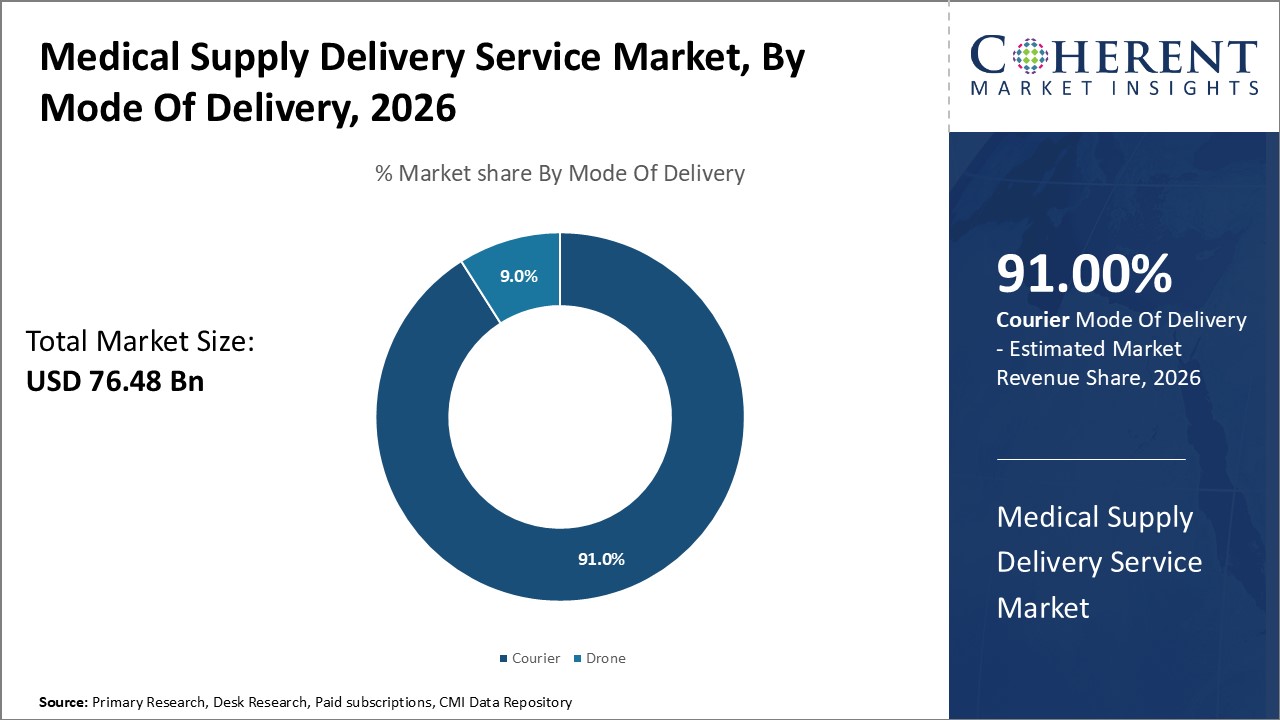
- Based on the Mode of Delivery, the Courier segment is dominating in 2026 with 91%, owing to its efficiency.
- Based on the Delivery Type, the scheduled delivery subsegment is expected to have 37.7%. The growth is attributed to its reliability in scheduled deliveries.
- Based on the End User, the Hospital segment is expected to dominate the market in 2026, owing to the increase in patients and need for timely delivery of critical supplies.
- On the basis of Region, North America is dominating the market with 42.8% of the market share in 2026, owing to the advanced healthcare infrastructure in the region.
Market Overview
The market is expected to witness positive growth over the next few years. Moreover, the rising prevalence of chronic diseases and the growing geriatric population are resulting in higher volumes of medical supplies and equipment needing transport. This growing demand is providing opportunities for established players in this market to expand their service networks and introduce new solutions.
Current Events and Their Impacts
Current Events | Description and its impact |
Advanced Drone Technology Regulatory Changes |
|
Global Healthcare Supply Chain Disruptions |
|
Role of Artificial Intelligence (AI) in Medical Supply Delivery Service Market
Artificial intelligence (AI) is rapidly becoming a foundational technology in the medical supply delivery services market, driving improvements in efficiency, accuracy, and compliance. Advanced AI and machine learning algorithms enable real-time demand forecasting, route optimization, temperature and condition monitoring, and predictive maintenance of supply chains—capabilities that are essential for managing time-sensitive and high-risk medical products.
In April 2025, Lytus Technologies, a platform-based and technology-driven services company, acquired Blod.in—India’s pioneering on-demand blood component management and logistics platform. Blod.in, which operates in Chennai, utilizes advanced AI and machine learning algorithms to optimize its services.
- Current Industry Events of 2026
- Market Size Estimation
- Regional Breakdown
- Competitive Landscape
- Customer Intelligence
- Segmental Analysis
- Pricing Analysis
- Key Market Drivers, Challenges & Future Trends
- Customized Insights Section
End User Feedback and Unmet Needs in the Medical Supply Delivery Service Market
Despite technological advancements, end users—including healthcare providers—continue to report significant gaps in medical supply delivery services. Common feedback highlights issues with inconsistent delivery times, lack of real-time tracking, and inadequate communication during delays or disruptions. For patients dependent on critical supplies such as insulin, wound care products, or oxygen equipment, these shortcomings are not minor inconveniences but risks to health outcomes.
A 2024 patient survey conducted by HealthTrust revealed that 38% of chronic care patients experienced at least one delay or error in medical supply delivery over a six-month period, with nearly half of these incidents causing treatment interruptions. Caregivers consistently report difficulties coordinating deliveries to match patient schedules, citing inflexible delivery windows and limited options for urgent resupply.
Healthcare providers also express frustration over insufficient integration of delivery data with electronic health records (EHRs), which hampers their ability to monitor patient adherence and intervene proactively. According to a 2025 study in Health IT Journal, 62% of home care nurses found delivery tracking systems unreliable or disconnected from clinical workflows, leading to repeated follow-ups and increased administrative burden.
Segmental Insights
Medical Supply Delivery Service Market Insights, By Service Type
Convenience Drives Demand for Pharmaceutical Supplies Segment Growth
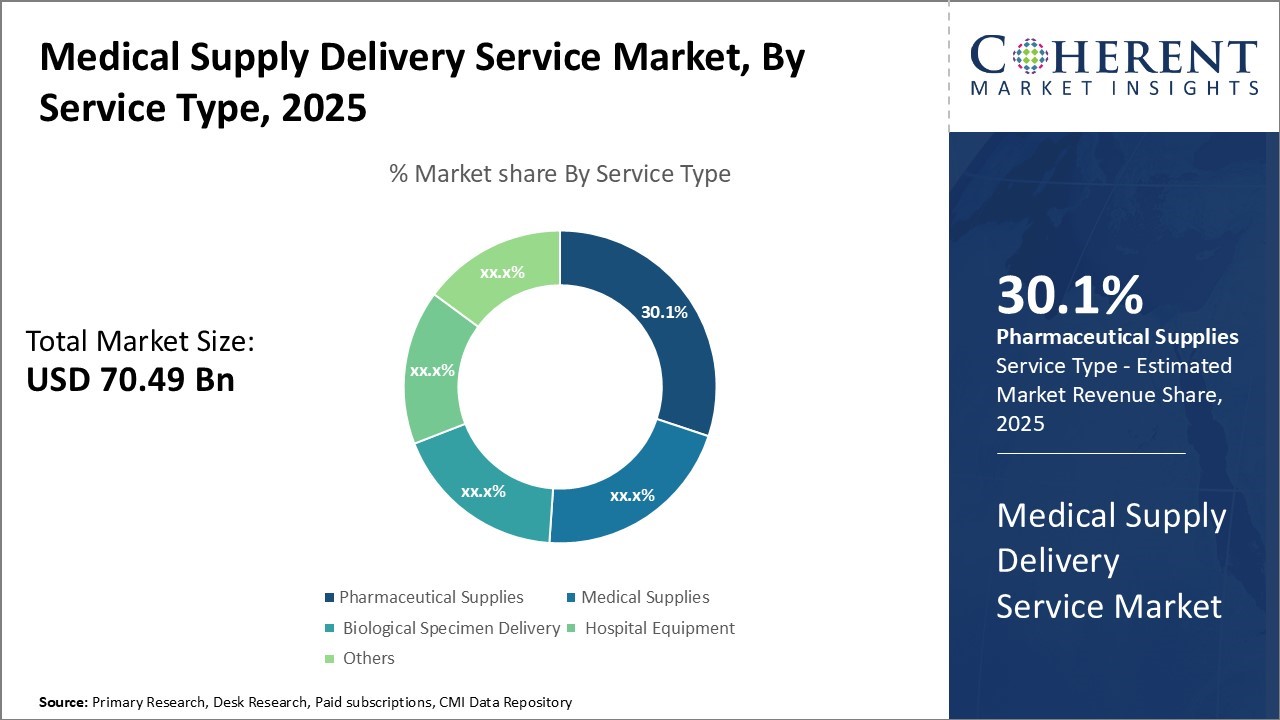
The service type segment includes medical lab supplies, pharmaceutical supplies, biological specimen delivery, hospital equipment, and others. The pharmaceutical supplies segment is estimated to hold 31.1% share of the market in 2026. Pharmacies and hospitals rely heavily on the steady supply of pharmaceutical products to effectively treat patients. However, managing large and complex pharmaceutical inventory takes up valuable time and resources that are better spent on direct patient care. Medical supply delivery services fulfill this important logistical need by delivering the right pharmaceutical products directly to where they are needed, when they are needed. This saves healthcare organizations from having to allocate staff to pharmacy delivery tasks or maintain large on-site pharmaceutical storage. Rather than focusing on supply chain minutiae, hospitals and clinics can focus on their core clinical missions thanks to the reliable and timely delivery of pharmaceutical supplies.
In December 2024, U.S.-based healthcare firm Baxter International launched five new injectable pharmaceuticals in the U.S. market: Micafungin, Cyclophosphamide, Pantoprazole Sodium, Cefazolin, and Levetiracetam, as part of its domestic portfolio.
Medical Supply Delivery Service Market Insights, By Mode of Delivery
Efficiency Powers Courier Delivery Model
The mode of delivery segment includes courier and drone. The courier subsegment is expected to have 91% of the market share in 2026. Unlike other modes of delivery, such as drones, couriers offer a tried-and-tested solution for delivering medical supplies within dense urban environments. Couriers can nimbly navigate complex road networks and traffic conditions to fulfill a high volume of same-day or next-day deliveries. Their flexibility meets the urgent yet varied supply needs of large hospital networks with multiple facilities. Furthermore, courier fleets are already established in most major cities worldwide, offering reliable coverage and rapid deployment when incidents requiring emergency supplies arise. The consistency and scalability of courier services prove invaluable for healthcare logistics that must function seamlessly behind the scenes.
In February 2025, BotswanaPost, the country's local postal service, partnered with the Universal Postal Union (UPU) to launch a nationwide cold chain delivery service for medicines. The initiative, called Post4Health, is designed to improve healthcare access by ensuring the timely distribution of medical supplies using specialized cold chain transport. The service focuses on enhancing cold logistics through newly equipped vehicles for last-mile delivery, maintaining the integrity of vital medicines and vaccines.
Medical Supply Delivery Service Market Insights, By Delivery Type
Reliability Drives Demand for Scheduled Delivery
The delivery type segment includes express/urgent delivery, STAT delivery, scheduled delivery, and others. The scheduled delivery subsegment is expected to have 37.7% of the market share in 2026. While express deliveries fulfill pressing needs, most medical supply transportation is planned rather than emergent. Hospitals and clinics prefer the predictability of scheduled delivery routes that ensure steady replenishment without stockouts or excess waste. Medical staff can accurately anticipate supply levels and order refills in a timely fashion. Suppliers also benefit from the consistency of scheduled routes that streamline transport operations and allow for precise demand forecasting. Furthermore, scheduled time windows reduce unnecessary trips or waiting around for recipients’ availability. The dependability of scheduled logistics is paramount for healthcare’s efficient day-to-day functioning and smooth execution of treatment plans.
Medical Supply Delivery Service Market Insights, By End User
High Volume of Patients Drives the Hospital Segment Growth
Based on the End User, the Hospitals segment is dominating the market in 2026. The Hospitals segment is expected to hold the largest share in the medical supply delivery market. There are a variety of drivers that contribute to this segment’s growth. The rise in demand for critical supplies such as medications, medical instruments, diagnostic kits, etc. is a major driver in the market. Some of the other key drivers also include the large and rapidly increasing number of patients, the need for fast and quick deliveries of life-saving supplies like blood, organs, and vaccines, etc. All of these factors have enabled the Hospital segment to grow rapidly among the other End User segments.
In September 2024, the UK’s National Health Service (NHS) launched a new drone delivery initiative to transport blood samples between two central London hospitals. Developed in collaboration with Wing and Apian, the project aims to improve patient care by streamlining hospital logistics with fast and reliable medical delivery drone.
Regional Insights
North America Medical Supply Delivery Market Trends
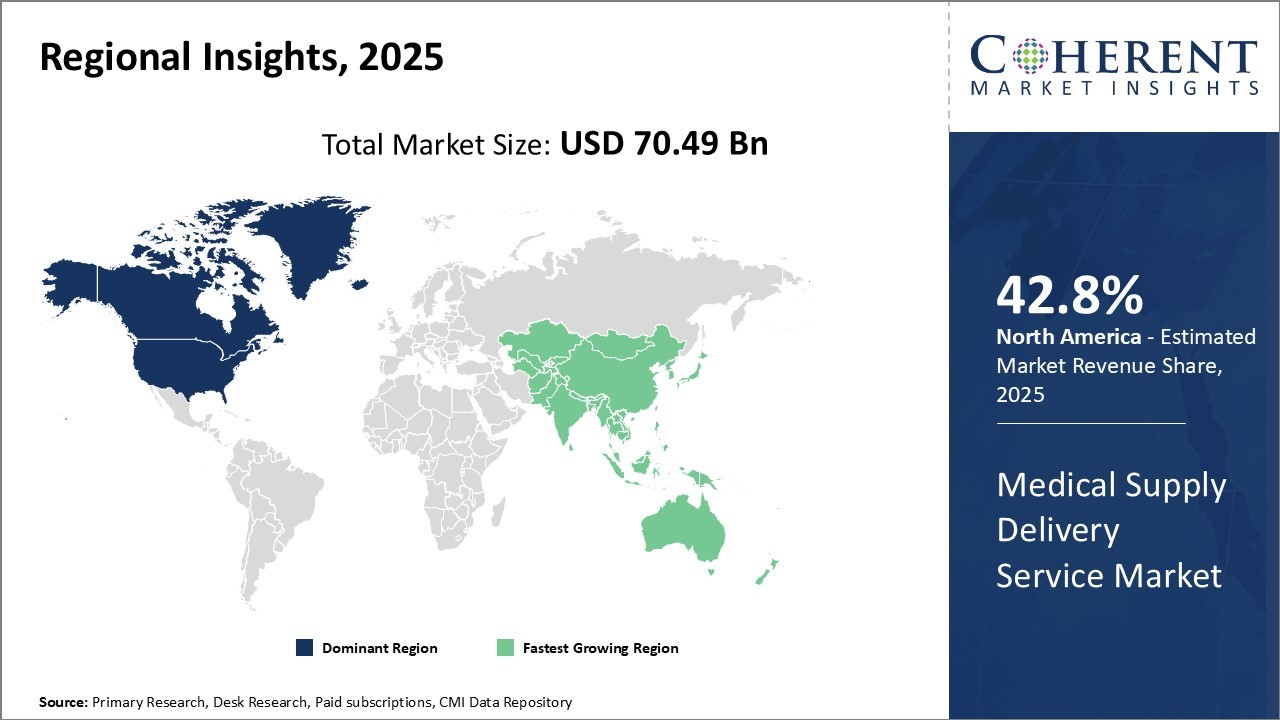
North America currently dominates the global medical supply delivery service market and is anticipated to hold 42.8% of the market share in 2026. With one of the most advanced healthcare infrastructures in the world and a large elderly population, the demand for the timely delivery of medical supplies and equipment is incredibly high.
In June 2026, Gilgal Medical, a leading home medical equipment provider, announced its nationwide expansion with the launch of two new warehouse facilities in Los Angeles and Dallas. Aimed at addressing the ongoing issue of delayed medical supply deliveries.
Asia Pacific Medical Supply Delivery Market Trends
Asia Pacific represents the fastest-growing regional market for medical supply delivery services. Rapid economic development over the past two decades has strengthened the domestic healthcare manufacturing base. Counties such as China, India, and Japan are some of the major economies driving the market growth.
For instance, IDS Medical Systems Group Limited has collaborated with digital health firm WeDoctor Holdings Limited to launch China’s first smart medical supply chain and procurement company. IDS Medical Systems operates a broad distribution network across the Asia Pacific, serving over 10,000 healthcare institutions and representing more than 200 global medical brands, including GE Healthcare, Philips, Maquet, Smiths Medical, Teleflex, and Ansell. This is further propelling the medical supply delivery market revenue.
U.S. Medical Supply Delivery Market
Companies in the U.S. have pioneered supply chain logistics solutions tailored specifically for the healthcare sector over the past few decades. This first-mover advantage has allowed U.S. firms to achieve substantial scale and lower costs through dense networks across major population centers. Furthermore, expansive demand has attracted significant private investment and fostered ongoing innovation in delivery technologies, ranging from fleet management systems to temperature-controlled packaging. For instance, in October 2024, Amazon announced that Amazon Pharmacy planned to expand its same-day delivery to 20 U.S. cities in 2026. This move aimed to make around 45% of its customer base eligible for the same-day delivery services.
Canada Medical Supply Delivery Market
Canada is also witnessing a rapid growth in the healthcare industry. The various challenges in the rural parts of the nation have been promptly acknowledged by the government. The government is exploring drone deliveries for urgent medical supplies. There are a few companies, like Drone Delivery Canada, that are collaborating with healthcare institutions.
India Medical Supply Delivery Market
India is an emerging market for medical supply delivery. The growth in this country can be attributed to the increase in population, a rise in demand for last-mile delivery, and several startups. For instance, in March 2026, Bengaluru, India, welcomed its first commercial drone delivery service, deployed by Skye Air. It aims to do ultra-fast deliveries of medicines and other commodities.
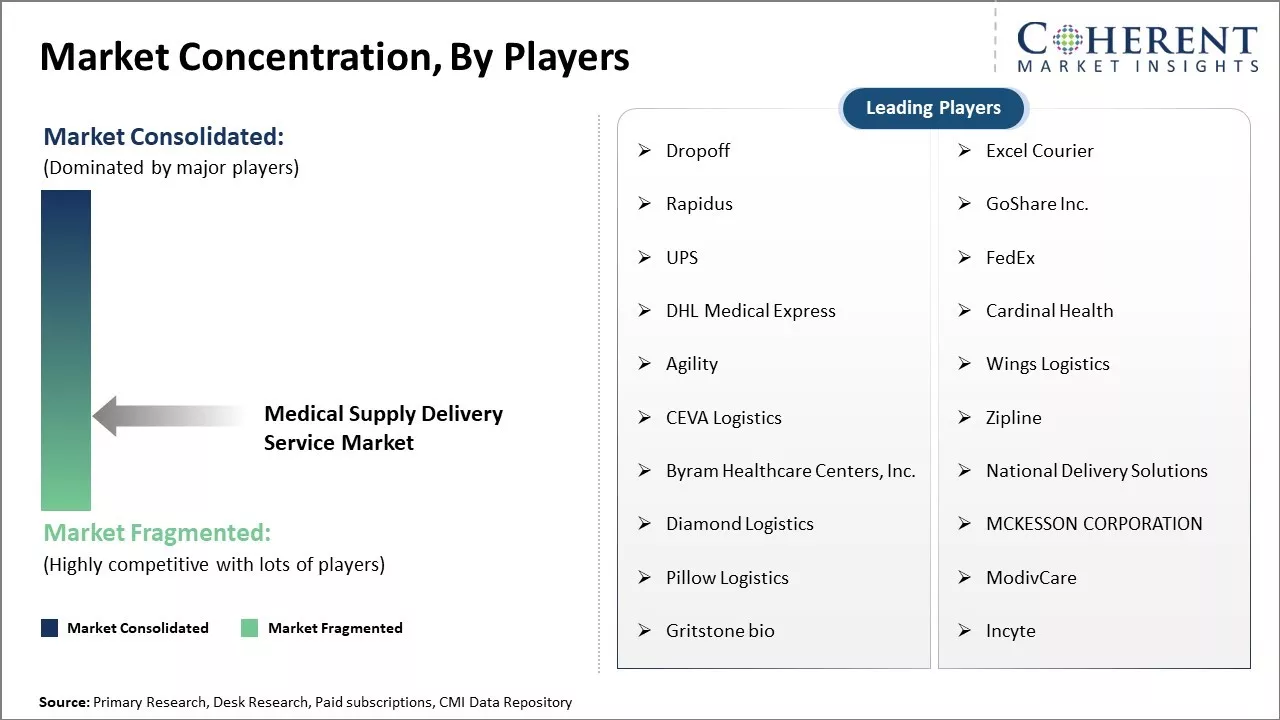
Market Concentration and Competitive Landscape
Key Developments
- In June 2025, Aviation Sans Frontières partnered with UK-based Windracers, a developer and operator of autonomous heavy-lift cargo drones, to launch a dual-drone system aimed at tackling the logistical barriers of delivering medical supplies to remote communities.
- In April 2025, PhonePe’s ecommerce platform, Pincode, introduced a 10-minute medicine delivery service in Bengaluru, Pune, and Mumbai. Available 24/7, the service connects users with local pharmacies for both prescription and over-the-counter medicines, with no delivery fees.
- In February 2025, Apollo Hospitals partnered with TECHEAGLE, India’s top autonomous drone logistics firm, to launch the country’s first 10-Minute Diagnostic Drone Delivery (D3) service.
- In December 2024, CareCentrix, a home-centered care leader, launched DME Navigator—an end-to-end solution for health plans that streamlines care delivery through improved workflows, order processing, utilization management, and payment accuracy. The integrated platform also enhances service quality with real-time insights for clinicians, members, and suppliers.
- In September 2024, UPS acquired two German temperature-controlled logistics firms, Frigo-Trans and BPL. This acquisition aimed to enhance UPS’s healthcare logistics capabilities.
- In September 2023, the U.S. Federal Aviation Administration granted UPS Flight Forward and uAvionix approval for BVLOS drones. This empowered UPS to expand its drone deliveries beyond hospital premises.
- In October 2020, Merck announced its partnership with the drone startup Volansi. It was done to enable the delivery of temperature-sensitive medications directly from the manufacturing plants.
Medical Supply Delivery Service Market Trends
Rising telehealth and virtual care services
With rapid advancements in technologies over the past few years, telehealth services and virtual care have seen tremendous growth. Patients are increasingly comfortable communicating with their doctors remotely through online video calls and digital platforms. This has required healthcare providers and hospitals to build robust telehealth infrastructure to provide virtual care services to patients from the comfort of their homes. As more consultations and follow-ups move online, there has been a significant increase in demand for delivery of medications, diagnostic samples, and medical equipment directly to patients.
Medical supply delivery services play a crucial role in ensuring patients have access to required prescriptions and products virtually. By offering convenient home delivery options, these services help enable the expansion of telehealth and ensure patients can continue their treatment journey seamlessly without having to visit clinics frequently. With telehealth predicted to play an ever-increasing role in how healthcare is delivered in the future, medical supply delivery services are well positioned to benefit from this major shift in the healthcare landscape.
Rise of e-pharmacies and online medical product sales
In addition to telehealth, e-pharmacies and online platforms for purchase of medical products have seen tremendous growth in recent years. Patients are increasingly looking at the convenience and comfort of ordering medications and other healthcare essentials from the ease of their homes through digital interfaces. Several e-pharmacy startups have emerged that allow customers to consult doctors online, get prescriptions electronically and order medications for home delivery within a few days. Similarly, established pharmacy retailers have also strengthened their online presence and delivery capabilities.
On the product side, sale of durable medical equipment, monitoring devices, testing kits, and others through e-commerce websites has witnessed a significant rise. All these digital healthcare channels require reliable partners for fulfillment and last-mile delivery of ordered medical supplies. This growing demand from e-pharmacies and online retailers of medical products opens up massive opportunities for medical supply delivery service providers, further escalating the medical supply delivery market demand.
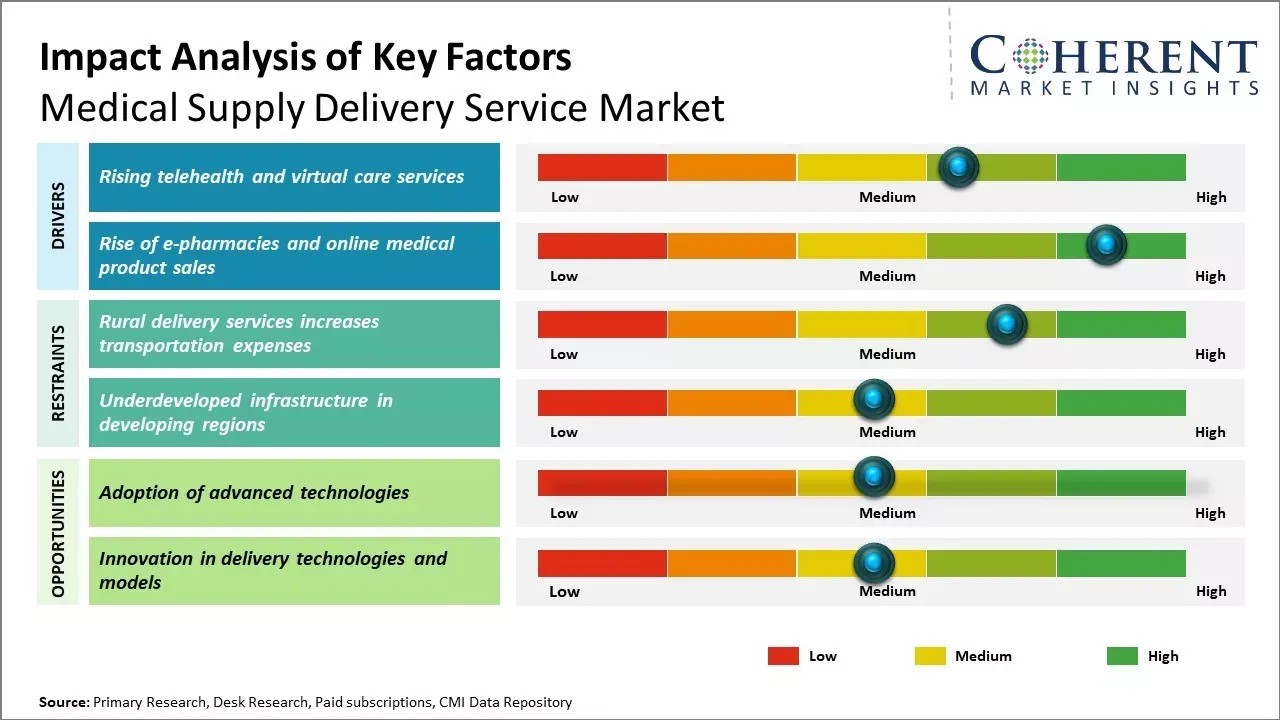
Medical Supply Delivery Market Opportunities – Adoption of advanced technologies
The aging population is driving greater demand for healthcare services and medical equipment. Home healthcare is a growing field as patients seek treatment outside of hospitals. This increases the need for medical supplies to be regularly delivered to private homes. New technologies now enable real-time tracking of shipments, dynamic routing, and digital proof of deliveries. Advanced technologies present a significant opportunity to revolutionize the medical supply delivery service market. The integration of Internet of Things (IoT), Artificial intelligence (AI), and robotics allows for contactless, efficient delivery of critical supplies directly to hospitals, clinics, and patients. This reduces potential exposure and ensures supplies reach their destination safely and securely.
Market Report Scope
Medical Supply Delivery Service Market Report Coverage
| Report Coverage | Details | ||
|---|---|---|---|
| Base Year: | 2025 | Market Size in 2026: | USD 76.48 Bn |
| Historical Data for: | 2020 To 2024 | Forecast Period: | 2026 To 2033 |
| Forecast Period 2026 to 2033 CAGR: | 8.5% | 2033 Value Projection: | USD 135.38 Bn |
| Geographies covered: |
| ||
| Segments covered: |
| ||
| Companies covered: | Dropoff, Excel Courier, Rapidus, GoShare Inc., UPS, FedEx, DHL Medical Express, Cardinal Health, Agility, Wings Logistics, CEVA Logistics, Zipline, Byram Healthcare Centers, Inc., National Delivery Solutions, Diamond Logistics, MCKESSON CORPORATION, Pillow Logistics, ModivCare, Gritstone bio, Incyte | ||
| Growth Drivers: |
| ||
| Restraints & Challenges: |
| ||
Analyst Viewpoint
- The medical supply delivery service market is undergoing a critical transformation. This is no longer just about transporting items from one location to another. It is becoming a core function of healthcare delivery, especially as more care shifts from hospitals to homes.
- Medical supply delivery is often treated as a logistics problem. This view is outdated. In reality, it is a clinical service that demands precision, reliability, and regulatory compliance at a much higher standard than traditional logistics. A 2023 study published in JAMA showed that even a one-day delay in delivering critical supplies such as insulin can lead to a 12% increase in emergency room visits among diabetic patients. This underlines the clinical importance of timely delivery.
- Amazon Pharmacy has attempted to enter this space using its existing logistics network. However, it continues to face challenges, especially with temperature-sensitive medications. In contrast, Ro has developed its own cold-chain delivery system, which ensures high compliance. Internal audits from Ro in 2024 reported over 96% temperature compliance in overnight deliveries of hormone therapies. This difference reflects a deeper understanding of the healthcare requirements, not just logistical efficiency.
- Specialist firms like Zipline and NowRx are showing how tailored approaches can outperform generalist systems. Zipline uses autonomous drones to deliver blood and vaccines in both rural and urban settings. It reports a 98% on-time delivery rate, even in hard-to-reach areas. NowRx, which integrates pharmacy operations with its delivery service, uses automation and regulatory tagging to maintain a compliance incident rate of under 1%, compared to an industry average above 4%.
- The medical supply delivery market is separating into two paths. On one side are the traditional logistics providers, who face increasing pressure and shrinking margins. On the other are specialized healthcare delivery networks, which are positioned to capture higher-value, compliance-driven segments.
Market Segmentation
- Service Type Insights (Revenue, USD BN, 2021 - 2033)
- Medical Lab Supplies
- Pharmaceutical Supplies
- Biological Specimen Delivery
- Hospital Equipment
- Others
- Mode Of Delivery Insights (Revenue, USD BN, 2021 - 2033)
- Courier
- Drone
- Delivery Type Insights (Revenue, USD BN, 2021 - 2033)
- Express/Urgent Delivery
- STAT Delivery
- Scheduled Delivery
- Others
- End User Insights (Revenue, USD BN, 2021 - 2033)
- Hospitals
- Diagnostic Laboratories
- Pharmacies
- Blood Banks
- Government Agencies
- Others
- Regional Insights (Revenue, USD BN, 2021 - 2033)
- North America
- U.S.
- Canada
- Latin America
- Brazil
- Argentina
- Mexico
- Rest of Latin America
- Europe
- Germany
- U.K.
- Spain
- France
- Italy
- Russia
- Rest of Europe
- Asia Pacific
- China
- India
- Japan
- Australia
- South Korea
- ASEAN
- Rest of Asia Pacific
- Middle East
- GCC Countries
- Israel
- Rest of Middle East
- Africa
- South Africa
- North Africa
- Central Africa
- North America
- Key Players Insights
- Dropoff
- Excel Courier
- Rapidus
- GoShare Inc.
- UPS
- FedEx
- DHL Medical Express
- Cardinal Health
- Agility
- Wings Logistics
- CEVA Logistics
- Zipline
- Byram Healthcare Centers, Inc.
- National Delivery Solutions
- Diamond Logistics
- MCKESSON CORPORATION
- Pillow Logistics
- ModivCare
- Gritstone bio
- Incyte
Sources
Primary Research Interviews
- Interviews with hospital supply chain managers
- Discussions with logistics providers and courier companies
- Expert opinions from healthcare administrators and procurement heads
- Feedback from medical supply manufacturers and distributors
Databases
- World Bank Health Data
- WHO Global Health Observatory
- IMF eLibrary
- OECD Health Statistics
- Indian Health Ministry’s National Health Stack
- U.S. Census Bureau – Health Data
Magazines
- Healthcare Global
- Medical Device & Diagnostic Industry (MD+DI)
- Logistics Management
- Fleet Owner
- Healthcare Purchasing News
Journals
- Journal of Healthcare Management
- Health Affairs
- American Journal of Managed Care
- International Journal of Health Planning and Management
- Journal of Supply Chain Management
Newspapers
- The Economic Times – Healthworld
- The Hindu – Business Line (Healthcare)
- New York Times – Health Section
- Financial Times – Healthcare & Pharma
- Mint (Livemint) – Healthcare and Startups
Associations
- World Health Organization (WHO)
- Healthcare Distribution Alliance (HDA)
- Association for Health Care Resource & Materials Management (AHRMM)
- National Association of Boards of Pharmacy (NABP)
- International Air Transport Association (IATA) – Medical Logistics
- Indian Federation of Healthcare Industry (IFHI)
Public Domain Sources
- Government health ministry websites (e.g., Ministry of Health and Family Welfare – India, HHS.gov – USA)
- U.S. FDA and Indian CDSCO
- Press releases of key players (e.g., UPS Healthcare, DHL Supply Chain, FedEx, etc.)
- WHO publications and technical briefs
- Annual reports and investor presentations of listed companies in logistics and healthcare delivery
- Patent databases (e.g., Google Patents, WIPO)
Get access to 250+ pages report
Every segment, forecast, competitor profile and data table behind the analysis above — available for instant download.
- ESOMAR Member
- ISO 9001:2015 Certified
- D-U-N-S Registered
- GDPR & CCPA Compliant
Missing comfort of reading report in your local language? Find your preferred language:
Transform your Strategy with Exclusive Trending Reports
Frequently Asked Questions
The Medical Supply Delivery Service Market is estimated to be valued at USD 76.48 Bn in 2026, and is expected to reach USD 135.38 Bn by 2033.
The CAGR of the Medical Supply Delivery Service Market is projected to be 8.5% from 2026 to 2033.
Rising telehealth and virtual care services and Rise of e-pharmacies and online medical product sales are the major factor driving the growth of Medical Supply Delivery Service Market.
Rural delivery services increase transportation expenses and Underdeveloped infrastructure in developing regions are the major factor hampering the growth of Medical Supply Delivery Service Market.
In terms of Service Type, Pharmaceutical Supplies, estimated to dominate the market revenue share 2026.
Dropoff, Excel Courier, Rapidus, GoShare Inc., UPS, FedEx, DHL Medical Express, Cardinal Health, Agility, Wings Logistics, CEVA Logistics, Zipline, Byram Healthcare Centers, Inc., National Delivery Solutions, Diamond Logistics, MCKESSON CORPORATION, Pillow Logistics, ModivCare, Gritstone bio, Incyte are the major players.
North America is expected to lead the Medical Supply Delivery Service Market.