

Global Mesh Gateway Market Size and Forecast – 2026-2033
The Global Mesh Gateway Market is estimated to be valued at USD 1.85 Bn in 2026 and is expected to reach USD 3.99 Bn by 2033, exhibiting a compound annual growth rate (CAGR) of 11.6% from 2026 to 2033.
Key Takeaways of the Global Mesh Gateway Market
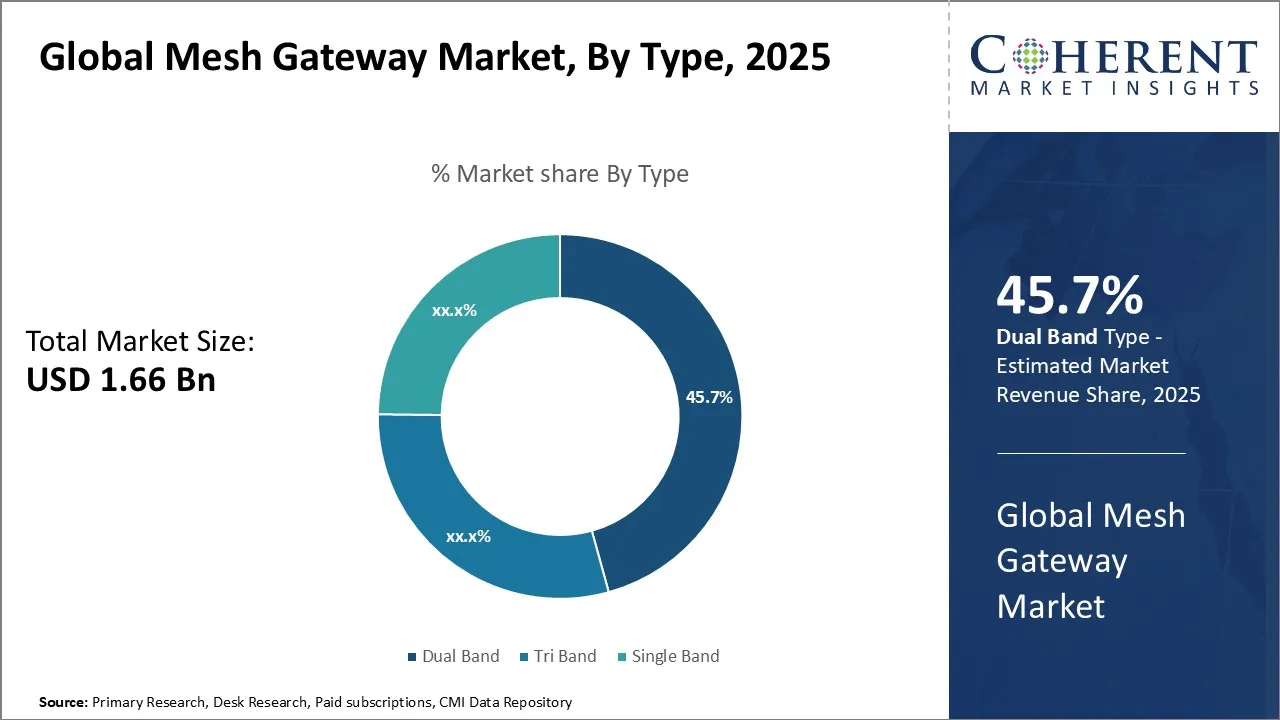
- The dual band segment leads the market, holding an estimated share of 46.7% in 2026.
- The predictive maintenance segment leads the market, holding an estimated share of 22.3% in 2026.
- North America is estimated to lead the market with a share of 32. 4% in 2026. Asia Pacific, holding a share of 29.2% in 2026, is projected to be the fastest growing region.
Market Overview
The mesh gateway market is witnessing several key trends, including the integration of advanced technologies like artificial intelligence (AI) and machine learning (ML) to optimize network performance and enable predictive maintenance. Also, the development of 5G networks is will add to the adoption of mesh gateways, as they facilitate seamless connectivity and low-latency communication.
Current Events and Its Impact
Current Events | Description and its impact |
Increased Adoption of IoT and Smart City Initiatives Globally |
|
Geopolitical Tensions and Supply Chain Disruptions |
|
Segmental Insights
- Current Industry Events of 2026
- Market Size Estimation
- Regional Breakdown
- Competitive Landscape
- Customer Intelligence
- Segmental Analysis
- Pricing Analysis
- Key Market Drivers, Challenges & Future Trends
- Customized Insights Section
Global Mesh Gateway Market Insights, by Type – Dual Band Leads Due to its Superior Performance and Versatility
Dual band mesh gateways are expected to emerge as the dominant force in the global mesh gateway market, capturing the highest share of 46.7% in 2026. Dual band mesh gateways can operate on two distinct frequency bands, typically 2.4 GHz and 5 GHz. The 2.4 GHz band can penetrating walls and obstacles, making long-range communication possible, while the 5 GHz band offers faster data transmission speeds and reduced interference from other devices. Moreover, the dual band mesh gateways are versatile, being suited for many applications and user requirements.
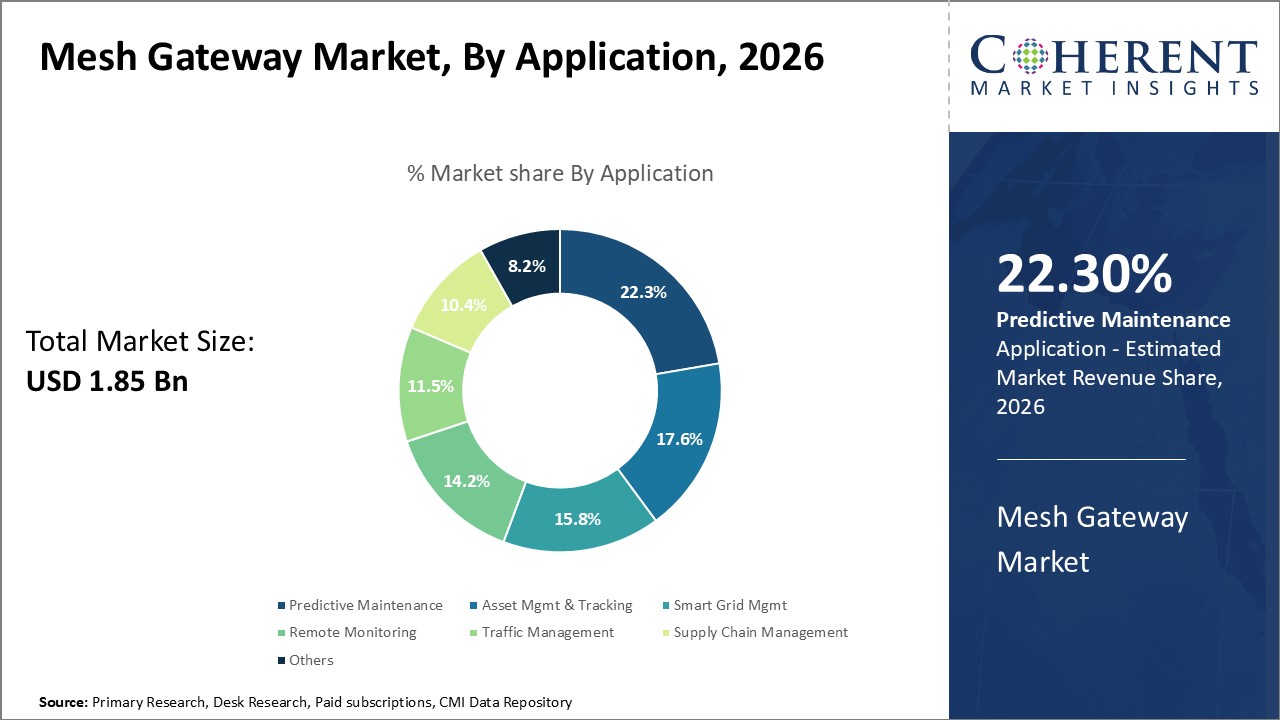
Global Mesh Gateway Market Insights, by Application – Predictive Maintenance Leads due to its Critical role in Ensuring Operational Efficiency and Reducing Downtime
Predictive maintenance has emerged as the leading application segment in the global mesh gateway market, capturing the highest share of 22.3% in 2026.
In today's fast-paced and competitive business landscape, organizations across various industries are recognizing the importance of proactive maintenance strategies. Predictive maintenance leverages advanced technologies, such as sensors, data analytics, and machine learning algorithms, to monitor the health and performance of assets in real-time. By collecting and analyzing vast amounts of data from connected devices and equipment, predictive maintenance enables organizations to identify potential issues before they escalate into costly failures.
One of the key drivers behind the growth of Predictive Maintenance is its ability to significantly reduce unplanned downtime. Equipment failures and breakdowns can lead to substantial financial losses, decreased productivity, and customer dissatisfaction. By continuously monitoring the condition of assets and predicting potential failures, organizations can schedule maintenance activities at optimal times, minimizing disruptions to operations. This proactive approach not only enhances operational efficiency but also extends the lifespan of assets, resulting in significant cost savings over time.
Moreover, predictive maintenance offers valuable insights into asset performance, enabling organizations to make data-driven decisions. By analyzing historical and real-time data, maintenance teams can identify patterns, trends, and anomalies that may indicate potential issues. This information allows for targeted maintenance interventions, ensuring that resources are allocated effectively and efficiently. Predictive maintenance also enables organizations to optimize spare parts inventory management, reducing the need for excessive stockpiling and minimizing the risk of stock-outs.
Impact of Artificial Intelligence (AI) in the Market
Artificial intelligence (AI) plays a pivotal role in enhancing the functionality, efficiency, and security of mesh gateway networks. AI algorithms are increasingly being integrated into mesh gateways to enable adaptive routing, predictive maintenance, and automated network optimization. These smart gateways can analyze traffic patterns, detect anomalies, and dynamically adjust routing paths to ensure reliable and low-latency communication, especially critical in industrial IoT, smart grids, and connected infrastructure. AI also empowers mesh gateways to self-heal by identifying weak nodes and rerouting traffic, thereby reducing downtime and maintenance costs.
Cisco’s Meraki mesh gateways, for instance, utilize AI to continuously monitor network health and client behavior, enabling proactive mitigation of performance bottlenecks and security risks.
Regional Insights
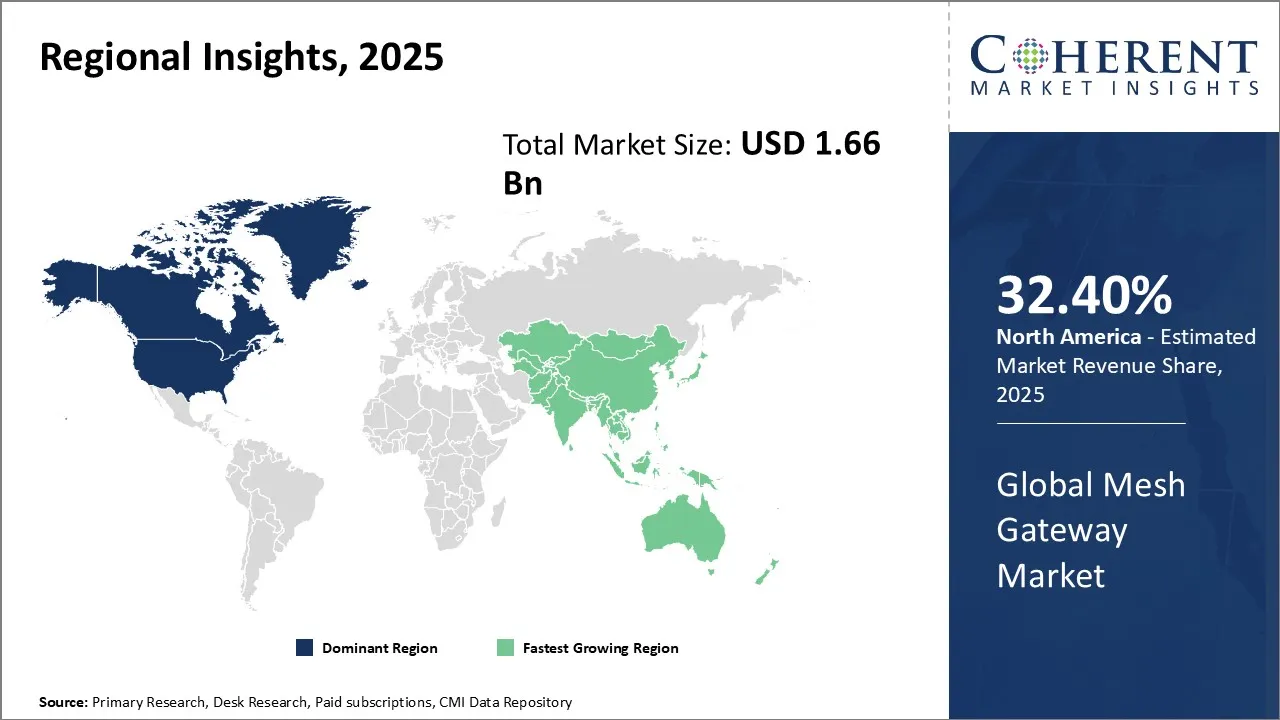
North America Mesh Gateway Market Analysis and Trends
North America, holding a share of 32.4% in 2026 is estimated to dominate the global mesh gateway market. The region boasts a well-established market ecosystem, characterized by the presence of major industry players, advanced technological infrastructure, and a strong emphasis on research and development. Notable companies in North America, such as Cisco Systems, Aruba Networks (a Hewlett Packard Enterprise company), and Rajant Corporation, have been instrumental in driving innovation and market growth through their cutting-edge mesh gateway offerings. In October 2024, Cisco Systems launched its Nexus 9800 mesh gateway series, designed to integrate Wi‑Fi 7, AI-driven network analytics, and enhanced edge security features.
Asia Pacific Mesh Gateway Market Analysis and Trends
The Asia Pacific region, holding a share of 29.4% in 2026, is expected to exhibit the fastest growth in the global mesh gateway market. The rapid urbanization, increasing population, and the surge in smart city initiatives across countries like China, Japan, South Korea, and India have created a fertile ground for the adoption of mesh gateway solutions. Governments in these countries have been actively investing in the development of smart infrastructure, including intelligent transportation systems, smart grids, and smart buildings, which heavily rely on mesh gateway technology for seamless connectivity and data exchange.
Companies, such as Huawei Technologies, ZTE Corporation, and NEC Corporation, have been at the forefront of mesh gateway deployments in the Asia Pacific region, leveraging their expertise and local market understanding to capture significant market share.
Global Mesh Gateway Market Outlook for Key Countries
U.S. Mesh Gateway Market Analysis and Trends
The U.S. mesh gateway market is characterized by a strong focus on innovation and the adoption of advanced networking technologies. The country's well-established telecommunications infrastructure and the presence of major industry players have been key drivers of market growth. The increasing demand for reliable and scalable connectivity solutions in various sectors, including transportation, utilities, and public safety, has further fueled the adoption of mesh gateways. Leading companies such as Cisco Systems and Aruba Networks have been instrumental in shaping the market landscape through their cutting-edge offerings and strategic partnerships.
China Mesh Gateway Market Analysis and Trends
China mesh gateway market has experienced significant growth, driven by the country's rapid urbanization and the government's ambitious smart city initiatives. The increasing deployment of IoT devices and the need for seamless connectivity across vast urban areas have created a strong demand for mesh gateway solutions. Chinese companies, such as Huawei Technologies and ZTE Corporation, have been at the forefront of mesh gateway deployments, leveraging their technological expertise and extensive market reach to capture a significant market share.
Japan Mesh Gateway Market Analysis and Trends
Japan’s highly developed telecommunications infrastructure and the strong presence of major industry players have been key factors driving market growth. Japanese companies, such as NEC Corporation and Fujitsu, have been actively involved in the development and deployment of mesh gateway solutions, catering to the needs of various industries, including transportation, energy, and public safety.
Germany Mesh Gateway Market Analysis and Trends
Germany mesh gateway market has been driven by the country's strong focus on Industry 4.0 and the increasing adoption of IoT technologies across various sectors. The manufacturing industry, in particular, has been a key adopter of mesh gateway solutions, leveraging them for enabling seamless connectivity and data exchange within smart factories. German companies, such as Siemens and Bosch, have been at the forefront of mesh gateway deployments, offering innovative solutions tailored to the needs of the industrial sector.
Market Players, Key Development, and Competitive Intelligence
Key Developments:
- In March 2025, Genexis, the European leader of innovative broadband products for the home, announced the acquisition of the European residential-Wi-Fi business of Heimgard Technologies. This strategic move further strengthens Genexis’ position in the residential Wi-Fi market.
- In October 2024, Nokia launched the Beacon 19, a new Wi-Fi 7 gateway designed to provide seamless, high-capacity mesh networking enabling operators to deliver a superior broadband experience.
- In October 2024, at Network X 2024 and Futurecom 2024, SDMC showcased the AX3000 Mesh Router with Matter Gateway. Combining high-speed, reliable mesh networking with a versatile smart home hub, this innovative router enhances connectivity and streamlines the management of smart home devices.
- In September 2024, MSI launched its WiFi 7 Roamii BE Lite Mesh System, made to provide seamless home connectivity for an increasing number of WiFi 7-supported mobile devices and AI-accelerated applications
Top Strategies Followed by Global Mesh Gateway Market Players
- Established players are investing heavily in R&D to develop cutting-edge technologies that enhance the capabilities of mesh gateways.
- Qualcomm Technologies Inc. is significantly investing in the development of Wi‑Fi 7 and AI-driven mesh gateway chipsets, aiming to enable ultra-low latency, enhanced security, and greater spectral efficiency. Its latest Qualcomm Networking Pro Series Gen 3 platform is designed to power next-generation mesh gateways with AI-based network management and dynamic traffic steering
- Mid-level players are adopting strategies focused on delivering cost-effective solutions to price-sensitive consumers.
- TP-Link Technologies Co. Ltd. has been expanding its portfolio of affordable mesh Wi-Fi systems, such as the Deco X20 and X50 series, offering Wi‑Fi 6 features at budget-friendly prices.
- Small-scale players are focusing on specific market segments, such as smart homes, industrial automation, or remote monitoring, and developing tailored solutions to meet the specific requirements of these niches.
- Wirepas Oy, a smaller player, focuses on industrial mesh gateway solutions tailored for smart metering, asset tracking, and building automation. Its Wirepas Mesh 2.4 GHz technology offers massive-scale, low-power mesh networks that can connect millions of devices in dense environments.
Market Report Scope
Mesh Gateway Market Report Coverage
| Report Coverage | Details | ||
|---|---|---|---|
| Base Year: | 2025 | Market Size in 2026: | USD 1.85 Bn |
| Historical Data for: | 2020 To 2024 | Forecast Period: | 2026 To 2033 |
| Forecast Period 2026 to 2033 CAGR: | 11.6% | 2033 Value Projection: | USD 3.99 Bn |
| Geographies covered: |
| ||
| Segments covered: |
| ||
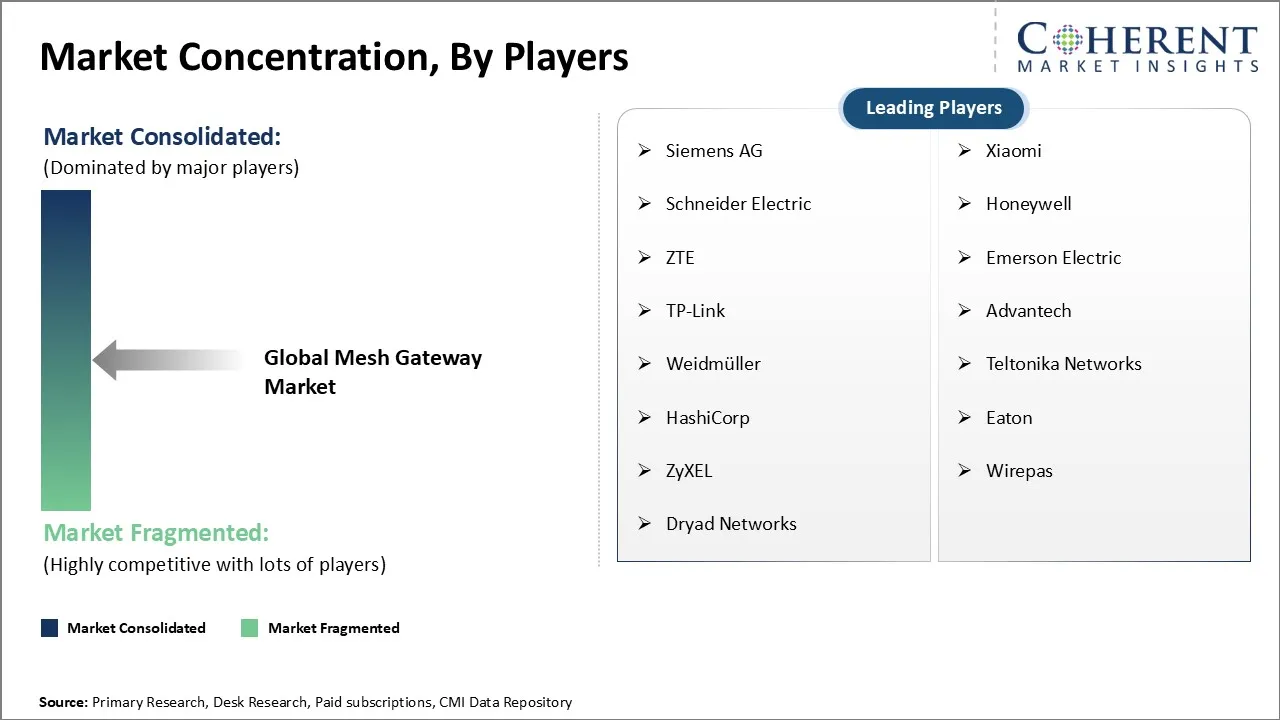
| Companies covered: | Siemens AG, Xiaomi, Schneider Electric, Honeywell, ZTE, Emerson Electric, TP‑Link, Advantech, Weidmüller, Teltonika Networks, HashiCorp, Eaton, ZyXEL, Wirepas, and Dryad Networks | ||
| Growth Drivers: |
| ||
| Restraints & Challenges: |
| ||
Market Dynamics
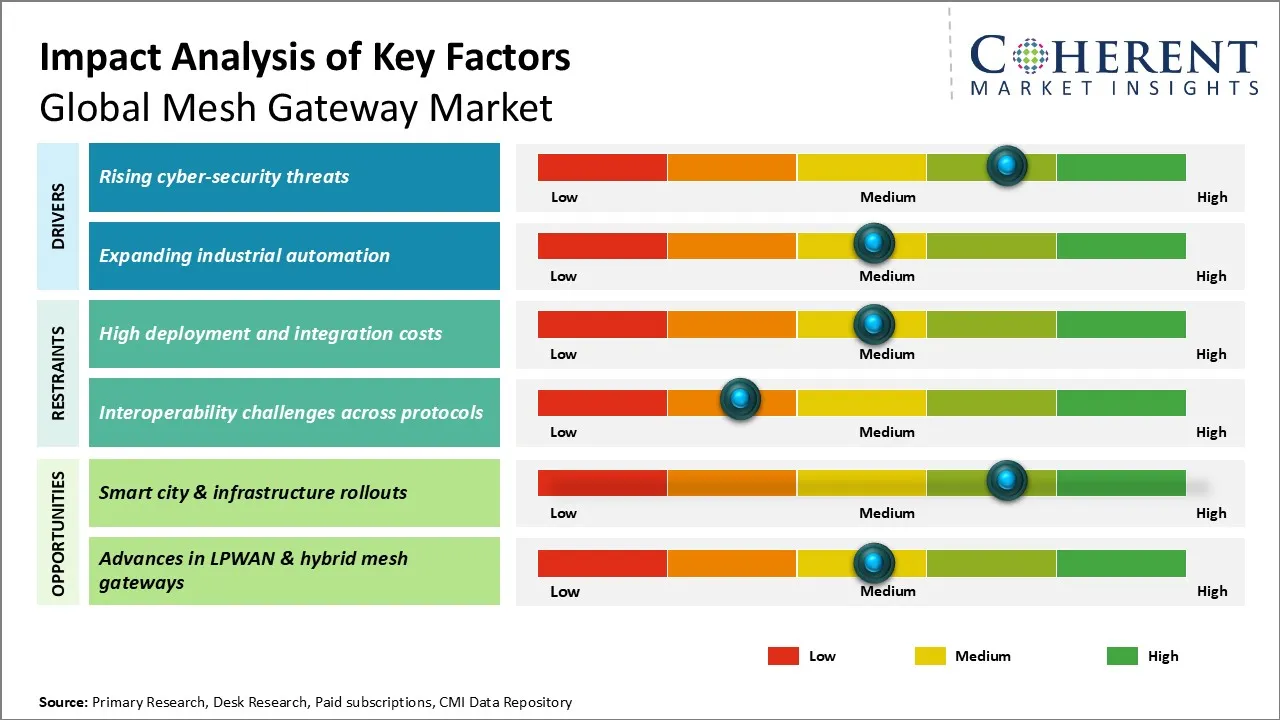
Global Mesh Gateway Market Driver – Rising cybersecurity threats
As the frequency and sophistication of cyberattacks continue to escalate, businesses are recognizing the critical need to fortify their networks and protect sensitive data from unauthorized access and breaches. This heightened focus on cybersecurity has emerged as a significant driver for the global mesh gateway market. Mesh gateway solutions offer a robust and resilient approach to network security, enabling organizations to establish secure communication channels and mitigate the risks associated with cyber threats.
By leveraging advanced encryption techniques, access control mechanisms, and intrusion detection capabilities, mesh gateways provide an additional layer of protection against malicious actors seeking to exploit vulnerabilities in traditional network architectures. In 2024, Siemens launched its Industrial Mesh Security Gateway as part of its Scalance portfolio, designed specifically to address growing cybersecurity concerns in industrial networks.
Global Mesh Gateway Market Opportunity – Smart City & Infrastructure Rollouts
As governments and municipalities worldwide invest in the development of smart cities, the demand for reliable and efficient communication networks becomes paramount. Mesh gateways play a crucial role in enabling seamless connectivity and data exchange within smart city ecosystems. They facilitate the integration of various smart city applications, such as intelligent transportation systems, smart utilities, public safety, and environmental monitoring. The ability of mesh gateways to support large-scale, low-latency communication makes them well-suited for smart city deployments.
The Barcelona Smart City project has used mesh gateways from Cisco and local partners to build a resilient, city-wide wireless infrastructure.
Analyst Opinion (Expert Opinion)
- AI-enabled gateways are shifting from simple data routers to intelligent edge nodes capable of real-time inference. Edge AI not only improves latency and security by processing data locally, but it also enables features like anomaly detection, video analytics, and autonomous decision-making. At Embedded World 2025, industry leaders showcased gateways running large, multimodal AI models (LLMs/VLMs) using onboard NPUs and GPUs—for example, Advantech demoed live chat and video analysis via its AIR-540 system using AMD accelerators.
- Leading mesh gateways are being re-engineered to support ultra-fast Wi‑Fi 7 alongside 5G and UWB, enabling diverse, simultaneous use-cases. Devices equipped with Wi‑Fi 7 now deliver multi-gigabit throughput, but the real value lies in mixing connectivity modalities—g., combining Wi‑Fi, UWB, and cellular for real-time video analytics, precise indoor positioning, and ultra-low-latency control in industrial settings.
- The mesh gateway is evolving into a context-aware platform that goes beyond connectivity to offer intelligent services at the edge. Examples include smart-building systems that adjust energy usage based on occupancy via mesh sensors; remote environmental monitoring where AI-equipped mesh nodes summarize high-bandwidth sensor data video before relaying insights; and industrial predictive maintenance with on-site anomaly detection.
Speak to the analyst
Want personalized insights?
Take the findings above to one of our principal consultants, or have the report rebuilt around the segments, geographies and competitors you actually track.
Market Segmentation
- Type Insights (Revenue, USD Bn, 2021 - 2033)
- Dual Band
- Tri Band
- Single Band
- Application Insights (Revenue, USD Bn, 2021 - 2033)
- Predictive Maintenance
- Asset Mgmt & Tracking
- Smart Grid Mgmt
- Remote Monitoring
- Traffic Management
- Supply Chain Management
- Others
- Regional Insights (Revenue, USD Bn, 2021 - 2033)
- North America
- U.S.
- Canada
- Latin America
- Brazil
- Argentina
- Mexico
- Rest of Latin America
- Europe
- Germany
- U.K.
- Spain
- France
- Italy
- Russia
- Rest of Europe
- Asia Pacific
- China
- India
- Japan
- Australia
- South Korea
- ASEAN
- Rest of Asia Pacific
- Middle East
- GCC Countries
- Israel
- Rest of Middle East
- Africa
- South Africa
- North Africa
- Central Africa
- North America
- Key Players Insights
- Siemens AG
- Xiaomi
- Schneider Electric
- Honeywell
- ZTE
- Emerson Electric
- TP‑Link
- Advantech
- Weidmüller
- Teltonika Networks
- HashiCorp
- Eaton
- ZyXEL
- Wirepas
- Dryad Networks
Sources
Primary Research Interviews
Stakeholders
- Telecommunications Companies and Internet Service Providers (e.g., Network Architects, Technical Leads)
- Mesh Gateway Manufacturers and Component Suppliers (e.g., Cisco, TP-Link, Advantech)
- System Integrators and IoT Solution Providers
- Smart City Project Authorities and Urban Planners
- Industrial Automation Companies using mesh networks
- Cybersecurity Consultants specializing in wireless infrastructure
Databases
- Global ICT Indicators Database (International Telecommunication Union)
- U.S. Federal Communications Commission (FCC) Network Data
- Asian Network Infrastructure Repository (ANIR)
- OECD Digital Economy Database
Magazines
- Wireless Today Magazine
- IoT Now
- Network Infrastructure Monthly
- Smart City Connect Magazine
Journals
- Journal of Wireless Communications and Networking
- International Journal of Distributed Sensor Networks
- IEEE Internet of Things Journal
- Journal of Network and Computer Applications
Newspapers
- Telecoms.com News
- Light Reading
- The Economic Times (India)
- The Guardian (UK)
Associations
- Wi-Fi Alliance
- LoRa Alliance
- Wireless Broadband Alliance (WBA)
- Industrial Internet Consortium (IIC)
Public Domain Sources
- U.S. Census Bureau
- EUROSTAT
- United Nations Economic Commission for Europe (UNECE)
- World Bank
- ResearchGate
Proprietary Elements
- CMI Data Analytics Tool, Proprietary CMI Existing Repository of information for the last 8 years
Get access to 250+ pages report
Every segment, forecast, competitor profile and data table behind the analysis above — available for instant download.
- ESOMAR Member
- ISO 9001:2015 Certified
- D-U-N-S Registered
- GDPR & CCPA Compliant
Missing comfort of reading report in your local language? Find your preferred language:
Transform your Strategy with Exclusive Trending Reports
Frequently Asked Questions
The global mesh gateway market is estimated to be valued at USD 1.85 billion in 2026 and is expected to reach USD 3.99 billion by 2033.
The CAGR of the global mesh gateway market is projected to be 11.6% from 2026 to 2033.
The rising cyber‑security threats and expanding industrial automation are the major factors driving the growth of the global mesh gateway market.
High deployment and integration costs and interoperability challenges across protocols are the major factors hampering the growth of the global mesh gateway market.
In terms of type, the dual band segment is estimated to dominate the market revenue share in 2026.
Siemens AG, Xiaomi, Schneider Electric, Honeywell, ZTE, Emerson Electric, TP‑Link, Advantech, Weidmüller, Teltonika Networks, HashiCorp, Eaton, ZyXEL, Wirepas, and Dryad Networks are the major players.
North America is expected to lead the global mesh gateway market in 2026.