

Free Space Optics Communication Market Size and Forecast — 2026-2033
The Global Free Space Optics Communication Market size is estimated to be valued at USD 2.09 billion in 2026 and is expected to reach USD 4.88 billion by 2033, exhibiting a compound annual growth rate (CAGR) of 12.9% from 2026 to 2033.
Overview
Free Space Optics (FSO) communication systems transmit data through light propagation in the air, using lasers or LEDs instead of traditional fiber cables. These products include transmitters, receivers, and modems designed for high-speed, line-of-sight communication. FSO systems offer bandwidth comparable to fiber optics while eliminating the need for physical cabling, making them ideal for temporary, remote, or urban environments. They are widely used in last-mile connectivity, enterprise networking, military communications, and disaster recovery operations. Advanced systems now feature adaptive optics and hybrid RF-FSO solutions to mitigate weather-related signal degradation and improve reliability.
Key Takeaways
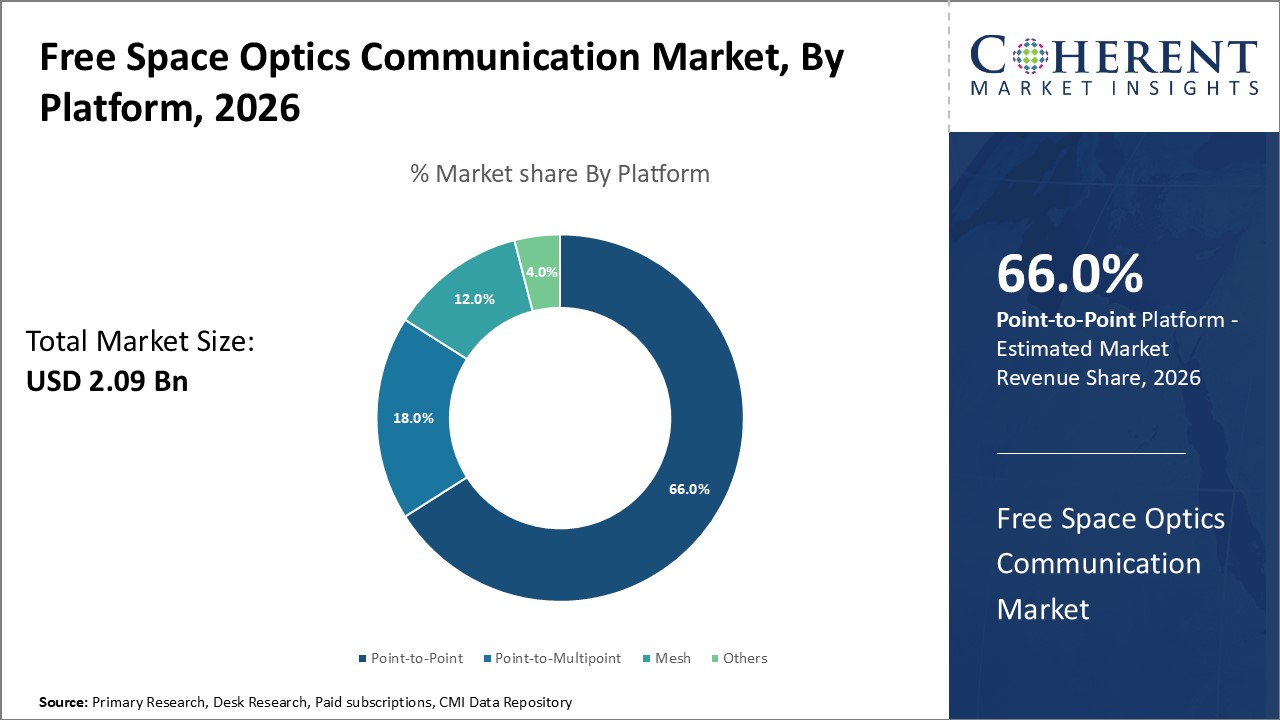
The Point-to-Point segment dominates the Free Space Optics Communication market, capturing approximately 66% of the industry share, largely due to its simplicity and reliability in urban network backhauling.
The Transmitter component leads with significant demand for miniaturized, high-power laser diodes, which have become a critical determinant of link performance.
Among applications, Telecommunication holds the lion’s share owing to the deployment in 5G/6G network infrastructures.
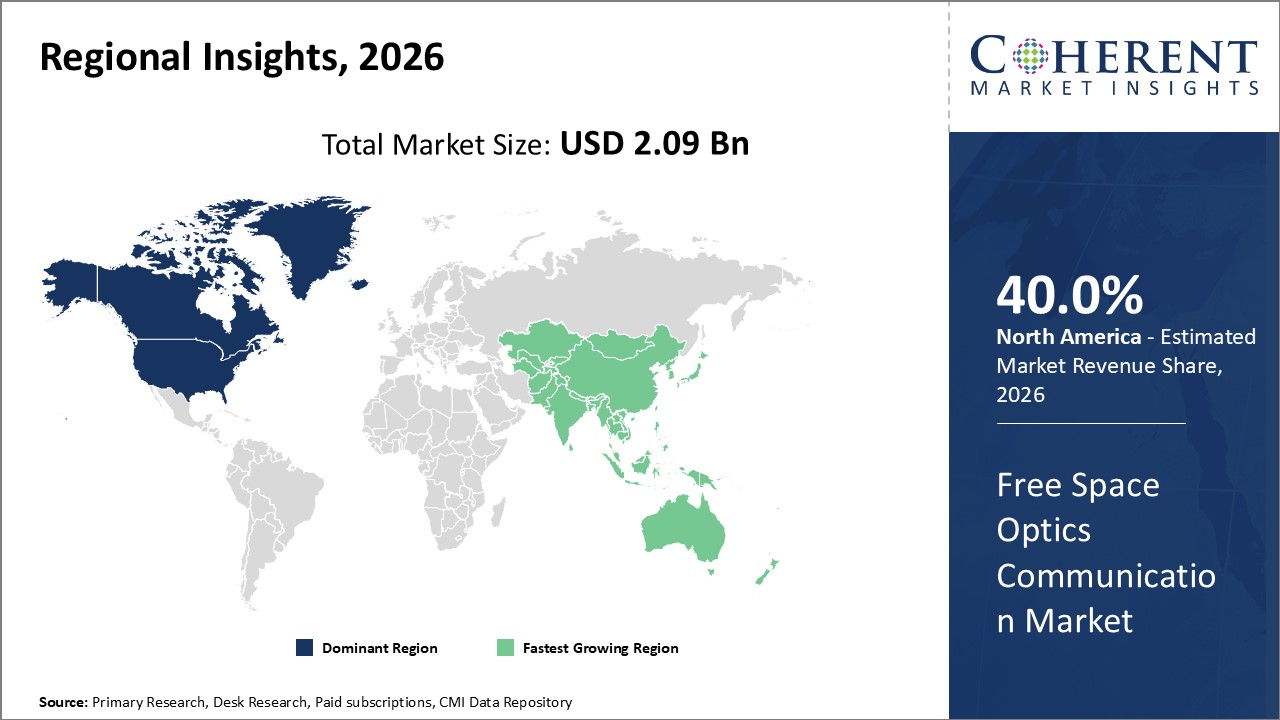
Regionally, North America leads the Free Space Optics Communication market with over 40% market share, supported by robust technology adoption and infrastructure investments, especially in the U.S. Asia Pacific emerges as the fastest-growing region, fueled by governmental policies supporting broadband expansion in India and China and a burgeoning enterprise market demanding agile connectivity.
Europe’s steady performance is backed by widespread government funding into research and development for hybrid communication technologies.
Free Space Optics Communication Market Segmentation Analysis
Free Space Optics Communication Market Insights, By Platform
Point-to-Point dominates the market share with approximately 66%. This dominance stems from its straightforward implementation and high reliability in carrying large data volumes over urban backhaul links for 5G networks. The fastest-growing subsegment is Point-to-Multipoint, benefiting from increasing enterprise adoption for campus-level connectivity given its scalability and cost efficiencies. Mesh platforms, while currently niche, offer promising opportunities in military communications due to their resilience and flexibility. The Others category includes hybrid configurations tailored for specialized industrial applications but remains relatively small.
Free Space Optics Communication Market Insights, By Component
The Transmitter segment leads the market share, driven by advancements in laser diode power output and miniaturization. The ability to produce compact, energy-efficient transmitters is crucial for dense urban installations and mobile platforms, making it the highest demand segment. Optical Amplifiers are the fastest-growing subsegment, benefiting from technologies that extend FSO link range and mitigate atmospheric losses. These amplifiers are increasingly deployed in long-range telecom backhauls and disaster recovery operations
Free Space Optics Communication Market Insights, By End-User
Telecommunication holds the largest share, fueled by ongoing 5G rollouts and the increasing need for high-throughput backhaul solutions in densely populated urban zones. Its dominance reflects industry demand for alternative link technologies that overcome fiber optic rollout delays and spectrum congestion. The Disaster Recovery application is the fastest-growing subsegment, as rapid deployment capabilities and cost advantages make FSO ideal during network outages caused by natural disasters. Military applications continue to grow due to the requirement for secure, line-of-sight communications.
Free Space Optics Communication Market Trends
The Free Space Optics Communication market is witnessing rapid expansion driven by hybrid technology integration and enhanced adaptive controls.
For instance, in 2025, several European firms pioneered AI-enabled FSO systems that dynamically compensate for atmospheric interference, achieving link uptimes previously unattainable.
Moreover, growing interest in indoor applications such as data centers and smart buildings is shifting market dynamics, with projection models indicating a 31% rise in indoor FSO deployments by 2026.
Regulatory easing for low-spectrum wireless solutions globally, especially in developing markets, reinforces this growth trajectory.
Additionally, the rise in hybrid RF/FSO networks for backhauling 5G infrastructure exemplifies the evolving market landscape, emphasizing resilience and throughput as primary performance metrics.
Free Space Optics Communication Market Insights, By Geography
North America Free Space Optics Communication Market Analysis and Trends
In North America, the dominance in the Free Space Optics Communication market is primarily driven by the United States, accounting for over 40% of the market share. This is supported by substantial investments in next-generation telecom infrastructure, growing collaboration between market companies and leading telecom providers, and government-led initiatives promoting broadband and wireless innovation. Companies such as Lumentum Holdings and JDS Uniphase are notably impactful here, supplying advanced FSO components and systems used in metropolitan backhaul networks.
Asia Pacific Free Space Optics Communication Market Analysis and Trends
Meanwhile, the Asia Pacific exhibits the fastest growth, with a CAGR exceeding 15% fueled by infrastructure expansions in India and China, low-cost manufacturing hubs, and robust demand from enterprise sectors. Government policies encouraging digital inclusivity and broadband penetration significantly boost industry trends here. Leading regional firms and global market players alike are capitalizing on this momentum by establishing local partnerships and R&D centers to tailor FSO communication solutions to regional climatic and operational conditions.
Free Space Optics Communication Market Outlook for Key Countries
USA Free Space Optics Communication Market Analysis and Trends
The USA's market constitutes the largest share of the Free Space Optics Communication industry, driven by cutting-edge technology adoption and widespread 5G network rollouts, notably in metropolitan centers like New York and San Francisco. The U.S. Department of Defense has also significantly funded FSO technology for secure military communications, exemplified by contracts awarded to companies such as NEC Corporation and Lumentum.
India Free Space Optics Communication Market Analysis and Trends
India's market is rapidly evolving as one of the most promising gateways in the Asia Pacific for Free Space Optics Communication. Government-backed digital infrastructure schemes like Digital India and Smart Cities are accelerating demand for FSO solutions to overcome urban density challenges and extend broadband access. Market companies have responded by customizing affordable, climate-resilient FSO products suitable for Indian environmental conditions.
Analyst Opinion
The surge in demand for high-capacity backhaul links in 5G and beyond networks is a pivotal supply-side indicator driving market growth. In 2025, several metropolitan deployments in the U.S. demonstrated a 36% improvement in data transfer speeds using Free Space Optics (FSO) compared to traditional microwave links, underlining its importance in urban telecommunication infrastructures.
Pricing dynamics reveal that the reduction in component costs—particularly laser diodes and photodetectors—has improved market accessibility. For instance, during 2026 Q1, manufacturing cost reductions by over 20% in Asia Pacific manufacturers have enabled expansion into mid-tier enterprise communications, expanding market revenue streams.
Demand-side indicators include the growing adoption of FSO in disaster recovery scenarios and military communications. The use case in Japan’s disaster-prone regions in 2025 saw a 41% faster network restoration time with FSO systems compared to wired alternatives, highlighting the critical role of FSO in resilient network architectures.
Nano-scale and micro-indicators, such as increased investments in R&D for hybrid RF/FSO solutions, have led to better link availability. A 2026 pilot project in Europe reported a 25% reduction in atmospheric attenuation issues, significantly enhancing FSO's reliability as a mainstream communication method.
- Current Industry Events of 2026
- Market Size Estimation
- Regional Breakdown
- Competitive Landscape
- Customer Intelligence
- Segmental Analysis
- Pricing Analysis
- Key Market Drivers, Challenges & Future Trends
- Customized Insights Section
Market Scope
| Report Coverage | Details | ||
|---|---|---|---|
| Base Year: | 2025 | Market Size in 2026: | USD 2.09 billion |
| Historical Data for: | 2020 To 2024 | Forecast Period: | 2026 To 2033 |
| Forecast Period 2026 to 2033 CAGR: | 12.9% | 2033 Value Projection: | USD 4.88 billion |
| Geographies covered: |
| ||
| Segments covered: |
| ||
| Companies covered: | Lumentum Holdings Inc., Oplink Communications, Inc., JDS Uniphase Corporation, NEC Corporation, Lightwire Ltd., BridgeWave Communications, Inc., Laser Components GmbH, Corning Incorporated, FSONA Communications Inc., III-V Lab, Reflex Photonics, PureLiFi Ltd. | ||
| Growth Drivers: |
| ||
Free Space Optics Communication Market Growth Factors
The exponential rise in demand for ultra-high bandwidth in metropolitan areas, propelled by cloud computing and edge data centers, has significantly augmented Free Space Optics Communication market growth in recent years.
Advancements in adaptive optics and modulation techniques have reduced atmospheric attenuation, enhancing link robustness and widening practical deployment scenarios, as demonstrated by successful trials in North America in 2026.
Regulatory shifts encouraging low-spectrum usage and ease of deployment for FSO systems have accelerated business growth in emerging markets like India and Brazil, with these regions reporting over 16% year-over-year revenue growth in 2025.
The need for rapid network restoration and temporary communication channels during natural disasters is further boosting adoption, evident from successful deployment case studies in Japan and the U.S. amid recent extreme weather events.
Free Space Optics Communication Market Development
In February 2026, China Unicom launched its first Free-Space Optical (FSO) communication service, marking a significant advancement in its efforts to integrate optical and satellite networks. This initiative is part of the company's broader strategy to develop high-speed, low-latency communication solutions for urban and remote areas.
In July 2026, General Dynamics Mission Systems achieved a significant milestone by establishing a 52-kilometer Free-Space Optics (FSO) communication link using its PhantomLink™ system at Fort Huachuca, Arizona. This demonstration successfully supported data rates up to 10 Gbps, facilitating high-quality data transmission, video, and voice communications.
Key Players
Leading Companies of the Market
Lumentum Holdings Inc.
Oplink Communications, Inc.
JDS Uniphase Corporation
NEC Corporation
Lightwire Ltd.
BridgeWave Communications, Inc.
Laser Components GmbH
Corning Incorporated
FSONA Communications Inc.
III-V Lab
Reflex Photonics
PureLiFi Ltd.
Several leading market players have adopted aggressive market growth strategies, including strategic acquisitions and partnerships, to expand portfolio capabilities. For instance, in late 2025, a major U.S.-based company entered a joint venture with a prominent Asian manufacturer, leading to a 31% increase in market share in the Asia Pacific and accelerated product innovation cycles. Additionally, investments focused on hybrid FSO/Li-Fi solutions have unlocked new enterprise connectivity avenues observable in several pilot projects across Europe and North America.
Free Space Optics Communication Market Future Outlook
In the future, the Free Space Optics communication market is expected to expand rapidly as 5G and satellite communication networks grow. Hybrid FSO-RF systems, capable of self-adapting to weather disruptions, will become more prevalent in urban and defense applications. Emerging technologies such as AI-powered alignment correction, high-power semiconductor lasers, and quantum communication protocols are expected to enhance transmission reliability and security. Additionally, FSO’s cost-effectiveness, low latency, and scalability make it ideal for next-generation network expansion. As global data demand surges and fiber deployment remains cost-prohibitive in certain terrains, FSO communication will become an essential complement to conventional fiber and radio-based networks.
Free Space Optics Communication Market Historical Analysis
Free Space Optics (FSO) communication systems have evolved from specialized research applications to practical high-speed communication solutions. Initially developed for military and aerospace use, early FSO systems faced challenges related to weather conditions, alignment sensitivity, and limited transmission distance. The technology advanced significantly with improvements in laser diodes, photodetectors, and adaptive optics, enabling faster and more stable data transmission. Over the years, the rise of wireless broadband and bandwidth demand accelerated FSO adoption for short-range urban connectivity and enterprise backhaul. Its ability to provide fiber-like speeds without trenching or spectrum licensing made it an attractive solution for dense urban environments and emergency deployments.
Sources
Primary Research interviews:
Telecom Network Engineers
Optical Communication Researchers
Satellite Communication Specialists
IT Infrastructure Managers
Databases:
IEEE Xplore Digital Library
ITU Telecommunication Statistics
Magazines:
Lightwave
Optical Networking News
Telecom Review
Laser Focus World
Journals:
Optics Express
IEEE Photonics Technology Letters
Journal of Optical Communications
Applied Optics
Newspapers
The Economic Times (Telecom)
Business Standard (Technology)
The Guardian (Tech)
The New York Times (Science & Innovation)
Associations:
International Telecommunication Union (ITU)
Optical Society (OSA)
Institute of Electrical and Electronics Engineers (IEEE)
Photonics Society
Get access to 250+ pages report
Every segment, forecast, competitor profile and data table behind the analysis above — available for instant download.
- ESOMAR Member
- ISO 9001:2015 Certified
- D-U-N-S Registered
- GDPR & CCPA Compliant
Missing comfort of reading report in your local language? Find your preferred language:
Transform your Strategy with Exclusive Trending Reports
Frequently Asked Questions
The market is led by major companies such as Lumentum Holdings Inc., Oplink Communications, and NEC Corporation, which have demonstrated significant market share through extensive R&D investments and strategic partnerships.
The market size is projected to grow from USD 2.09 billion in 2026 to USD 4.88 billion by 2033, reflecting a CAGR of around 12.9%, driven by rising demand in the telecommunication and enterprise sectors.
The telecommunication industry remains the largest growth driver owing to the integration of FSO in high-speed backhaul links needed for advanced 5G and emerging 6G networks.
Market trends indicate a substantial rise in hybrid communication technologies combining FSO with RF or Li-Fi to enhance reliability, as well as increased use in disaster recovery and enterprise connectivity.
Communication market?
What go-to-market strategies are commonly adopted in the Free Space Optics Communication market?