

Wireless Broadband in Public Safety Market Analysis & Forecast: (2026-2033)
Wireless broadband in public safety market size is estimated to be valued at USD 55.77 Bn in 2026 and is expected to reach USD 179.71 Bn in 2033, exhibiting a compound annual growth rate (CAGR) of 18.68% from 2026 to 2033.
Key Takeaways
- Based on Type, the Mobile Wireless Broadband segment is expected to lead the market with 58% share in 2026.
- Based on Application, the Video Surveillance & Monitoring segment is expected to hold 42% share in 2026.
- Based on End User, the Police Department segment is projected to account for 47% share in 2026.
- Based on Region, North America is set to lead the wireless broadband in public safety market with 42% share in 2026. While, Asia Pacific is anticipated to be the fastest growing region.
Market Overview
Wireless broadband plays a vital role in public safety since it helps provide situational awareness for public safety entities in cases of emergency. Wireless broadband is majorly used by the emergency service organizations including fire services and medical services due to the urgent need for effective wireless communication. Moreover, wireless broadband helps in multiple applications including video surveillance & monitoring, automatic vehicle tracking, geographic information system (GIS), and others.
Current Events and Its Impacts on the Wireless Broadband in Public Safety Market
Current Event | Description and its Impact |
5G Network Infrastructure Deployment and Standardization |
|
Cybersecurity Regulatory Framework Evolution |
|
Could IoT sensors and 5G‑powered drones redefine public safety by 2026 and beyond?
- IoT Integration in Public Safety
- By 2026, over 65% of public safety agencies worldwide are expected to deploy IoT sensors (traffic, environmental, health) connected via wireless broadband.
- These sensors feed real‑time data into command centers, improving predictive policing, disaster alerts, and crowd management.
- Drones & Robotics
- Public safety drones connected via LTE/5G reduce search‑and‑rescue times by up to 40%.
- In China, drone fleets are projected to cover 30% of urban surveillance needs by 2030.
- Current Industry Events of 2026
- Market Size Estimation
- Regional Breakdown
- Competitive Landscape
- Customer Intelligence
- Segmental Analysis
- Pricing Analysis
- Key Market Drivers, Challenges & Future Trends
- Customized Insights Section
Segmental Insights
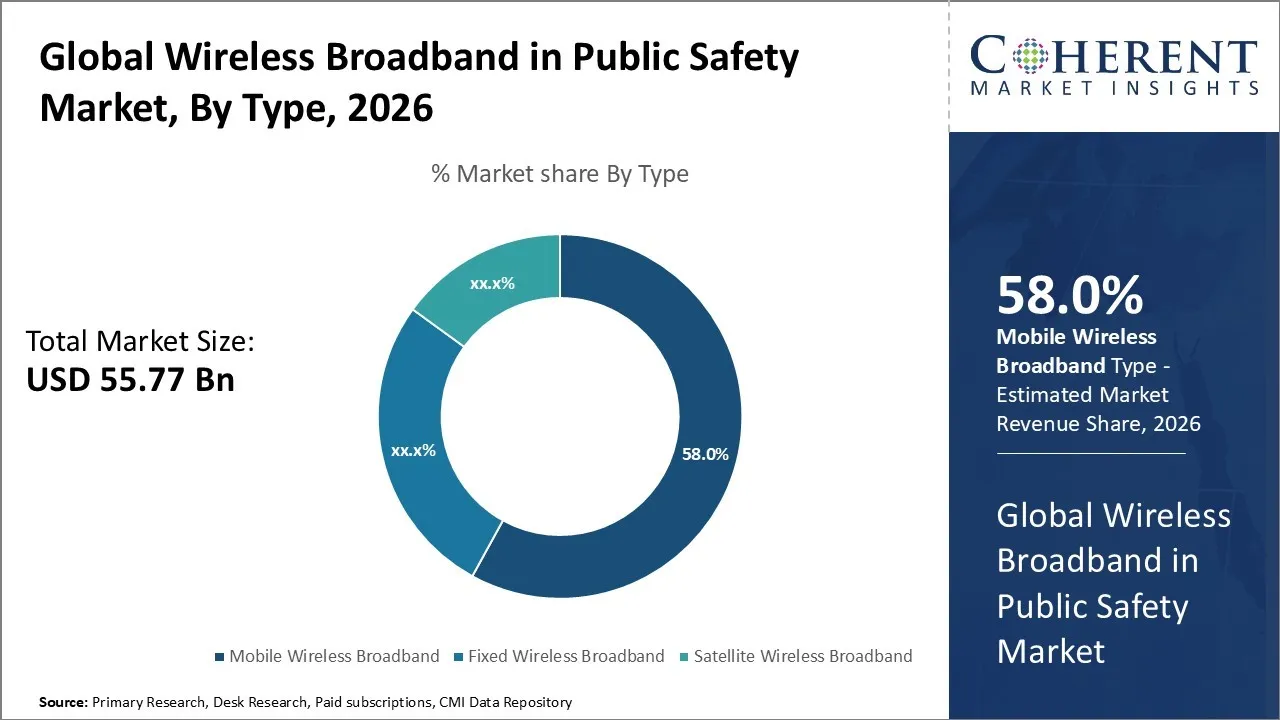
Wireless Broadband in Public Safety Market Insights, By Type - Mobile Wireless Broadband leads powering real‑time connectivity for public safety agencies
in terms of type, the mobile wireless broadband segment is expected to hold 58% share of the market in 2026, driven by the widespread adoption of LTE and 5G networks. Public safety agencies rely on mobile broadband for real-time communication, rapid data transfer, and seamless connectivity in dynamic environments. Unlike fixed or satellite options, mobile broadband ensures low latency and high reliability, which are critical for police patrols, fire response, and emergency medical services. Its flexibility and scalability make it the backbone of modern public safety communication systems.
For instance, in September 2025, the PIB release addresses BSNL's own 4G and 5G rollout, which is directly related to Mobile Wireless Broadband. It makes communication in real time better for police, fire, and emergency medical services by adding almost 98,000 towers and 4.86 lakh 5G base stations. This infrastructure helps with surveillance, GPS tracking, and incident management, which makes the internet safer for everyone in the country.
Wireless Broadband in Public Safety Market Insights, By Application - Video Surveillance & Monitoring dominance is driven by demand for AI‑enhanced live monitoring
In terms of application, the video surveillance & monitoring segment is expected to lead the market with 42% share in 2026, reflecting its crucial role in crime prevention, crowd control, and disaster management. Public safety agencies increasingly deploy AI-powered analytics and high-definition video feeds to enhance situational awareness. Real-time monitoring allows faster decision-making, proactive threat detection, and improved resource allocation. Integration with IoT sensors and smart city infrastructure further boosts its importance, making surveillance the most dominant application in the wireless broadband public safety ecosystem.
For instance, the NYPD's use of a public housing internet program as a surveillance network is a direct example of the ways that Video Surveillance & Monitoring can help keep people safe. Authorities use broadband infrastructure for real-time monitoring to improve crime prevention and situational awareness. This shows how wireless broadband can be used for surveillance-driven public safety apps in cities.
Wireless Broadband in Public Safety Market Insights, By End User - Police Departments leads reflecting their heavy investment in broadband‑enabled surveillance and patrol systems
In terms of end user, the police departments segment is projected to account for 47% share of the market in 2026, as it invests heavily in broadband-enabled technologies for surveillance, patrol coordination, and incident response. Police forces depend on mobile broadband to access live video feeds, GPS tracking, and secure communication channels. Their larger budgets compared to other public safety agencies allow them to adopt advanced solutions like AI-driven analytics and body-worn cameras. This makes police departments the primary drivers of demand in the wireless broadband public safety market.
For instance, by upgrading broadband infrastructure, the City of Buffalo's partnership with Verizon Business improves communications for public safety. Police departments benefit from secure, real-time connections that help with coordinating patrols, video surveillance, and responding to incidents. This project makes law enforcement better at what they do and shows how wireless broadband can improve public safety in cities.
Regional Insights
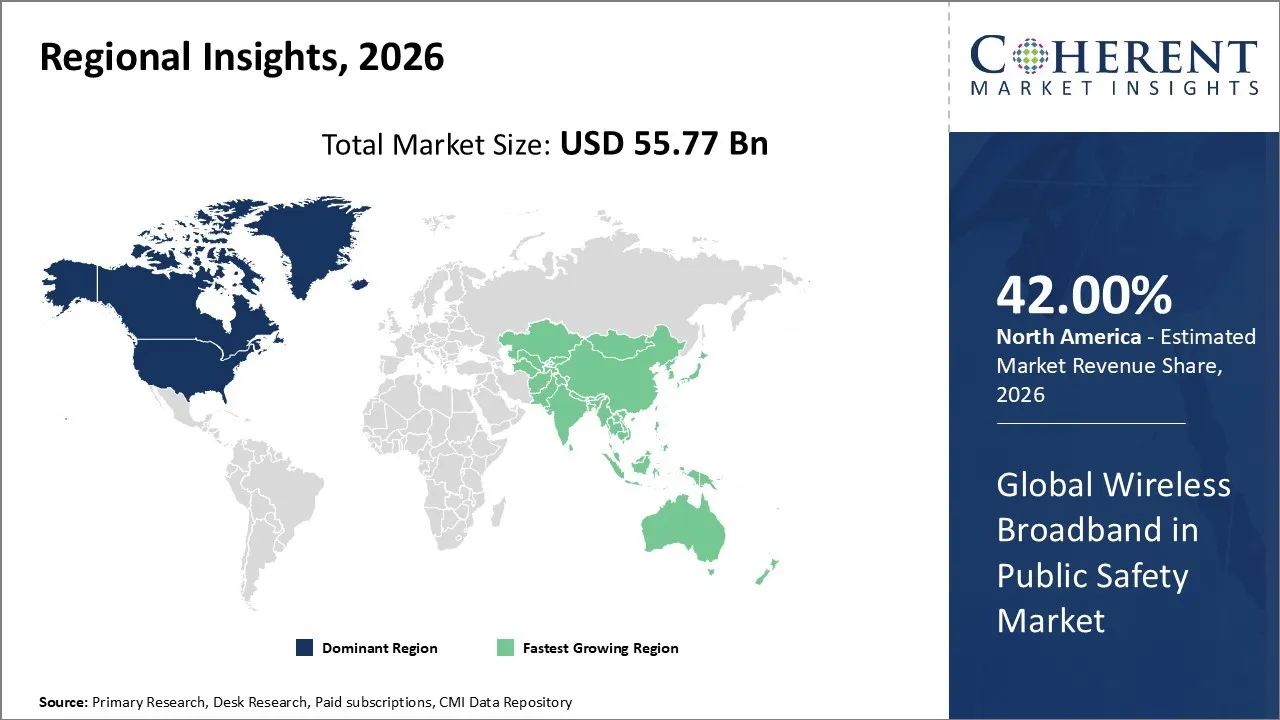
North America Wireless Broadband in Public Safety Market Analysis & Trends
North America is expected to dominate the wireless broadband in public safety market with 42% share in 2026, because of strong government initiatives like FirstNet, widespread 5G and LTE deployment, and significant investments in advanced communication systems for police, fire, and emergency medical services. Public safety agencies require reliable, low‑latency broadband to support real‑time video surveillance, GPS tracking, and incident management. With larger budgets and a focus on modernizing emergency response, North America leads adoption, making it the dominant region in this market.
For instance, in October 2025, the GSMA Open Gateway project in the US made it possible to test APIs for drone connectivity between different carriers for public safety. Drones can provide real-time surveillance, disaster response, and emergency support by making sure that mobile broadband works smoothly across networks. This makes wireless broadband even more important for improving safety and situational awareness across the country.
Asia Pacific Wireless Broadband in Public Safety Market Analysis & Trends
Asia Pacific is expected to exhibit the fastest growth, due to rapid 5G deployment, extensive smart city initiatives, and rising investments in public safety infrastructure across countries like China, India, and Japan. Urbanization and growing populations increase the need for reliable broadband to support video surveillance, emergency response, and incident management. Governments are prioritizing modern communication systems to enhance disaster preparedness and law enforcement efficiency, making Asia-Pacific the fastest-growing region in this market.
For instance, in March 2025, Vodafone's emergency service, which was first used in Germany, provides safe 4G and 5G connections for police, fire, and medical responders. By putting resilient broadband first, it makes communication, surveillance, and incident response in real time better. This project shows the way serious Europe is about making public safety better by building better wireless broadband networks.
Wireless Broadband in Public Safety Market Outlook Country-Wise
The U.S. Wireless Broadband in Public Safety Market Trends
The Wireless Broadband in Public Safety Market is highly demanding in the United States in 2026 due to the nationwide FirstNet program, rapid 5G and LTE deployment, and strong federal and state investments in emergency communication systems. Police, fire, and EMS agencies rely on secure, low‑latency broadband for real‑time video surveillance, GPS tracking, and incident management. With advanced infrastructure, high budgets, and a focus on modernizing public safety, the U.S. leads global adoption, making it the most demanding market.
Verizon has launched the Frontline Network Slice in the United States, offering dedicated 5G Ultra-Wideband capacity for first responders. Police, fire, and EMS gain secure, reliable, low‑latency connectivity for mission‑critical operations, enhancing video surveillance, GPS tracking, and incident response. This innovation strengthens public safety through advanced wireless broadband.
China Wireless Broadband in Public Safety Market Trends
China’s Wireless Broadband in Public Safety Market is highly demanding in 2026 due to rapid smart city development, widespread 5G deployment, and government investment in surveillance and emergency response systems. Public safety agencies rely on broadband for real‑time video monitoring, disaster management, and incident coordination. Rising urbanization and national security priorities drive adoption of advanced wireless infrastructure, ensuring reliable connectivity for police, fire, and medical services. This combination of technology expansion and policy focus makes China a major growth market.
Market Report Scope
Wireless Broadband in Public Safety Market Report Coverage
| Report Coverage | Details | ||
|---|---|---|---|
| Base Year: | 2025 | Market Size in 2026: | USD 55.77 Bn |
| Historical Data for: | 2020 To 2024 | Forecast Period: | 2026 To 2033 |
| Forecast Period 2026 to 2033 CAGR: | 18.68% | 2033 Value Projection: | USD 179.71 Bn |
| Geographies covered: |
| ||
| Segments covered: |
| ||
| Companies covered: | AT&T Inc., Ericsson, Huawei Technologies Co., Ltd., L3Harris Technologies, Inc., Motorola Solutions, Inc., Nokia Corporation, RADWIN, Sierra Wireless, U.S. Cellular. Verizon Communications Inc., and ZTE Corporation. | ||
| Growth Drivers: |
| ||
| Restraints & Challenges: |
| ||
Wireless Broadband in Public Safety Market Driver
Real-Time Data Sharing
Real-time data sharing is a critical driver in the wireless broadband in public safety market share, enabling emergency responders to access live video feeds, voice communication, and sensor data during crises. This capability enhances situational awareness, speeds up decision-making, and ensures coordinated action across multiple agencies. By leveraging broadband networks, first responders can transmit high-definition visuals and IoT-based alerts instantly, reducing response times and improving public safety outcomes in disaster management and law enforcement operations.
Smart City Initiatives
Smart city initiatives are fueling wireless connected devices market demand, as municipalities deploy broadband-enabled safety systems such as surveillance cameras, traffic sensors, and emergency alert platforms. These connected devices rely on wireless broadband to ensure seamless communication between public safety agencies and urban infrastructure. By integrating IoT with 5G and LTE networks, cities can monitor real-time conditions, manage traffic flow, and respond to emergencies faster. This transformation drives adoption of advanced broadband solutions, making urban environments safer and more resilient.
Wireless Broadband in Public Safety Market Opportunity
5G & LTE Integration
The integration of 5G and LTE technologies is transforming emergency communication by delivering ultra-low latency, high bandwidth, and reliable connectivity. This shift allows public safety agencies to deploy advanced applications such as AR-assisted rescue, autonomous emergency vehicles, and real-time video surveillance. As legacy systems like LMR and TETRA are phased out, broadband adoption accelerates. According to the wireless broadband in public safety market forecast, this transition is expected to significantly boost market expansion and enhance mission-critical operations worldwide.
Analyst Opinion (Expert Opinion)
- The wireless broadband in public safety market has become an important part of modern emergency communications infrastructure. This is as agencies need real-time data transmission, better situational awareness, and coordination between first responder units that can work together. A large number of public safety agencies around the world now use broadband connections to support voice, video, and telemetry during operations. Police, fire, and emergency medical services are increasingly using mobile broadband technologies like LTE and the new 5G networks in their communication systems. More than half of agencies now use both broadband networks and traditional radio systems to make important calls and share information.
- Changes in technology are changing the way the market works. The use of private LTE networks and broadband-enabled devices, like drones, IoT sensors, and body-worn cameras, has made operations more efficient by improving surveillance, tracking incidents, and allocating resources. Next-generation features like AI-driven analytics and edge computing make low-latency, mission-critical applications even better.
- Regional patterns show that North America is a leader in adopting public safety broadband. This is because of large private network programs and investments in advanced infrastructure. Europe and Asia-Pacific are also speeding up deployments, especially in smart city projects and programs to make cities safer. Agencies moving toward unified communications ecosystems continue to seek to make legacy land mobile radio systems and broadband networks work together better.
Speak to the analyst
Want personalized insights?
Take the findings above to one of our principal consultants, or have the report rebuilt around the segments, geographies and competitors you actually track.
Global Wireless Broadband in Public Safety Market Segmentation
- By Type
- Fixed Wireless Broadband
- Mobile Wireless Broadband
- Satellite Wireless Broadband
- By Application
- Video Surveillance & Monitoring
- Automatic Vehicle Locating
- Incident Scene Management
- Others
- By End User
- Police Department
- Fire Department
- Emergency Medical Service Providers
- Others
- By Region
- North America
- U.S.
- Canada
- Latin America
- Brazil
- Argentina
- Mexico
- Rest of Latin America
- Europe
- Germany
- U.K.
- Spain
- France
- Italy
- Russia
- Rest of Europe
- Asia Pacific
- China
- India
- Japan
- Australia
- South Korea
- ASEAN
- Rest of Asia Pacific
- Middle East & Africa
- GCC Countries
- Israel
- Rest of Middle East & Africa
- North America
- Wireless Broadband in Public Safety Market
- AT&T Inc.
- Ericsson
- Huawei Technologies Co., Ltd.
- L3Harris Technologies, Inc.
- Motorola Solutions, Inc.
- Nokia Corporation
- RADWIN
- Sierra Wireless
- U.S. Cellular.
- Verizon Communications Inc.
- ZTE Corporation
Sources
Primary Research Interviews
- Public Safety Communication Network Operators
- Emergency Services & First Responder Agencies (Police, Fire, EMS)
- Wireless Broadband Infrastructure Providers
- LTE/5G Public Safety Solution Vendors
- Mission-Critical Communication System Integrators
- Government & Homeland Security IT Officials
- Others
Databases
- Bloomberg Terminal
- Thomson Reuters Eikon
- Others
Magazines
- Mission Critical Communications Magazine
- Urgent Communications
- Wireless Week
- RCR Wireless News
- Public Safety Communications Magazine
- Others
Journals
- IEEE Communications Magazine
- IEEE Transactions on Wireless Communications
- International Journal of Emergency Management
- Journal of Homeland Security and Emergency Management
- Others
Newspapers
- Financial Times
- The Wall Street Journal
- Reuters
- Bloomberg News
- The Guardian
- Others
Associations
- National Public Safety Telecommunications Council (NPSTC)
- APCO International
- International Association of Fire Chiefs (IAFC)
- National Emergency Number Association (NENA)
- 3GPP (Third Generation Partnership Project)
- Others
Public Domain Sources
- U.S. Department of Homeland Security (DHS)
- Federal Communications Commission (FCC)
- First Responder Network Authority (FirstNet)
- National Institute of Standards and Technology (NIST)
- International Telecommunication Union (ITU)
- World Bank Open Data
- Others
Proprietary Elements
- CMI Data Analytics Tool
- Proprietary CMI Existing Repository of Information for the Last 8 Years
Get access to 250+ pages report
Every segment, forecast, competitor profile and data table behind the analysis above — available for instant download.
- ESOMAR Member
- ISO 9001:2015 Certified
- D-U-N-S Registered
- GDPR & CCPA Compliant
Missing comfort of reading report in your local language? Find your preferred language:
Transform your Strategy with Exclusive Trending Reports
Frequently Asked Questions
Wireless broadband in public safety market size is estimated to be valued at USD 55.77 Bn in 2026 and is expected to reach USD 179.71 Bn in 2033, exhibiting a compound annual growth rate (CAGR) of 18.68% from 2026 to 2033.
The CAGR of the Wireless Broadband in Public Safety Market is projected to be 18.68% from 2026 to 2033.
Real-time data sharing and smart city initiatives are expected to drive the market growth.
The mobile wireless broadband is the leading type segment in the market.
High CAPEX & OPEX is expected to hinder the global Airport Asset Tracking Market over the forecast period.
The major players operating in the market include AT&T Inc., Ericsson, Huawei Technologies Co., Ltd., L3Harris Technologies, Inc., Motorola Solutions, Inc., Nokia Corporation, RADWIN, Sierra Wireless, U.S. Cellular. Verizon Communications Inc., and ZTE Corporation.