

Global Microprinting Market Size and Forecast – 2026 To 2033
The global microprinting market is expected to grow from USD 1.15 Bn in 2026 to USD 1.70 Bn by 2033, registering a compound annual growth rate (CAGR) of 5.7% from 2026 to 2033. The global microprinting market is driven by expanding regulatory requirements in banking, healthcare, and pharmaceutical industries. On March 4, 2025, Körber launched the latest version of its PAS-X Track & Trace solution, designed to minimize total cost of ownership (TCO) and enhance efficiency through comprehensive lifecycle management and seamless, vendor-agnostic system integration. (Source: Körber)
Key Takeaways of the Global Microprinting Market
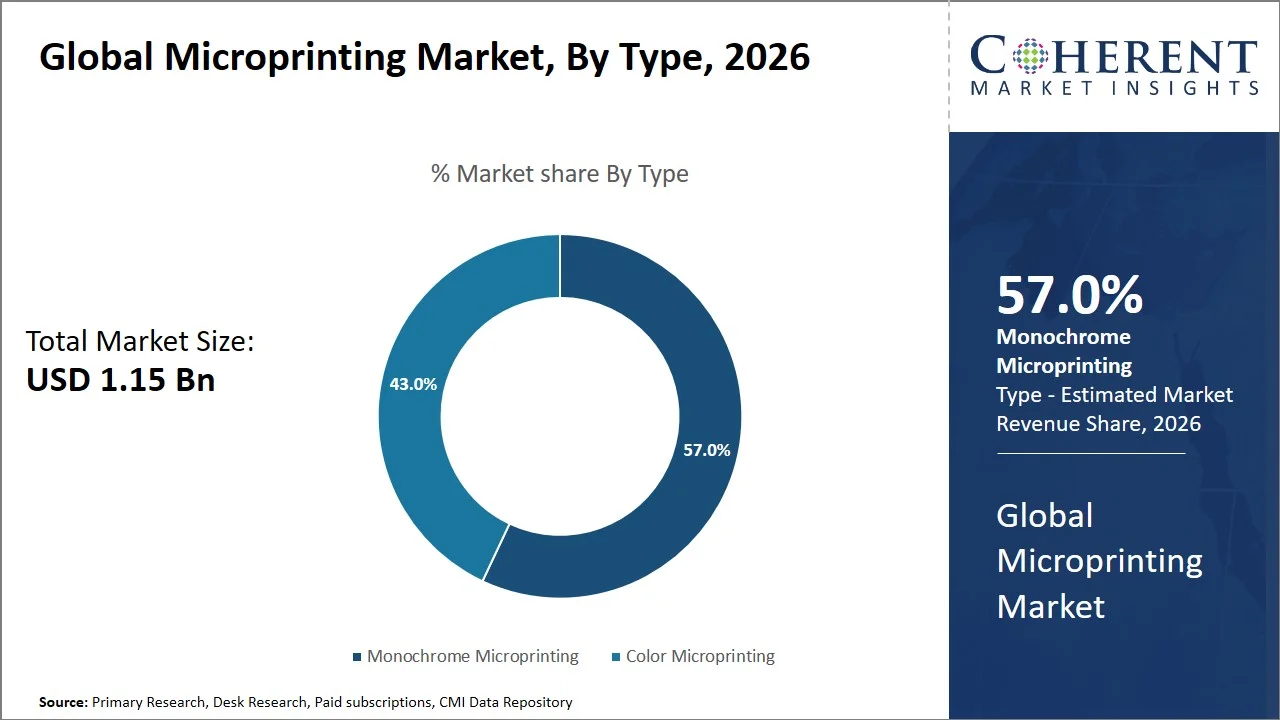
- The monochrome microprinting segment is expected to account for 57.0 % of the global microprinting market share in 2026. Growth in protective packaging and product authentication applications is driving the growth of the segment. On February 24, 2025, Systech announced the launch of UniSecure artAI, a transformative AI-powered authentication solution designed to safeguard brands, ensure packaging quality and protect patients. (Source: Systech)
- The single-sided printing segment is estimated to capture 52.0 % of the market share in 2026. Technological advancements in high-resolution digital printing systems is a major factor driving the growth of the segment. On June 19, 2025, Seiko Epson Corporation announced that it will exhibit Direct to Shape Printing System, an inkjet printing solution for printing directly on 3D objects, at Automatica, in Messe München, Germany. (Source: Epson)
- The micro-embossing inks is estimated to capture 31.0 % of the market share in 2026. Integration of microprinting with AI-enabled inspection and verification systems is driving the growth of the segment. On May 13, 2026, Cognex Corporation announced the general availability of OneVision, its collaborative AI vision development environment designed to simplify and scale AI-powered inspection across manufacturing operations. (Source: Cognex)
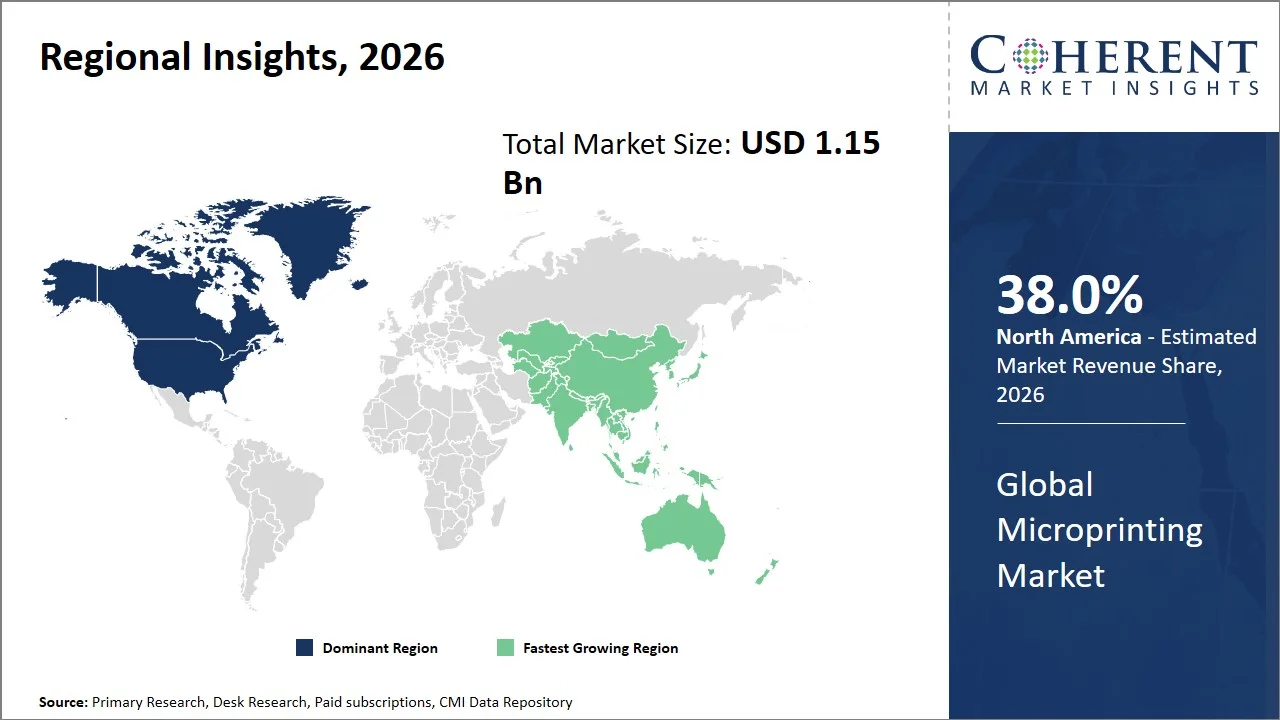
- North America is expected to dominate the microprinting market in 2026 with a market share of 38.0 %. Expansion of digital identity and e-government initiatives in North America is driving the growth of the regional market. On November 12, 2025, Apple announced the launch of Digital ID, a new way for users to create an ID in Apple Wallet using information from their U.S. passport, and present it with the security and privacy of iPhone or Apple Watch. (Source: Apple)
- Asia Pacific is expected to account for 32.0 % share in 2026 and is projected to record the fastest growth over the forecast period. Increasing security requirements in Asia Pacific is driving the growth of the regional market. On December 3, 2025, NEC Corporation developed a groundbreaking walk-through face and iris multimodal biometric authentication technology, enabling verification of individuals who are in motion, even in scenarios requiring strict identity verification. (Source: NEC)
- Integration with Multi-Layer Security Technologies: Microprinting is being integrated with other security features such as holograms, UV-reactive inks, RFID tags, QR codes, and digital watermarks to provide more advanced anti-counterfeiting systems. Organizations are using a tiered approach to security that makes it much tougher to duplicate documents and products and enhances authentication capabilities across banking, government and commercial systems.
- Growing Adoption in Smart Packaging and Product Authentication: Manufacturers are using microprinting in packaging designs to better protect brands and ensure product traceability. The technology in multifunctional printers is used in conjunction with serialization and track-and-trace systems in industries such as pharmaceuticals, cosmetics, food and drinks and luxury goods helping corporations fight counterfeiting and enhance supply chain transparency.
Segmental Insights
Why Does Monochrome Microprinting Dominate the Global Microprinting Market?
The monochrome microprinting segment is expected to account for 57.0% of the global microprinting market share in 2026. Monochrome microprinting is the leading segment in the global microprinting market owing to its high precision and readability in high security applications. The use of black-and-white or single-color microprinting text gives a higher contrast and more visible microscopic details, which facilitates verification under magnification and at the same time provides a high level of resistance to counterfeiting. Thus, monochrome microprinting is most commonly used on banknotes, passports, government papers, tax stamps, and secure certificates where correctness, reliability, and authentication effectiveness are important.
On April 24, 2025, Komori Corporation announced a major order for multiple banknote printing systems from the Bureau of Engraving and Printing, the U.S. Department of the Treasury bureau responsible for printing U.S. dollar banknotes. (Source: Komori)
- Current Industry Events of 2026
- Market Size Estimation
- Regional Breakdown
- Competitive Landscape
- Customer Intelligence
- Segmental Analysis
- Pricing Analysis
- Key Market Drivers, Challenges & Future Trends
- Customized Insights Section
Why is Single-Sided Printing the Most Preferred Print Type?
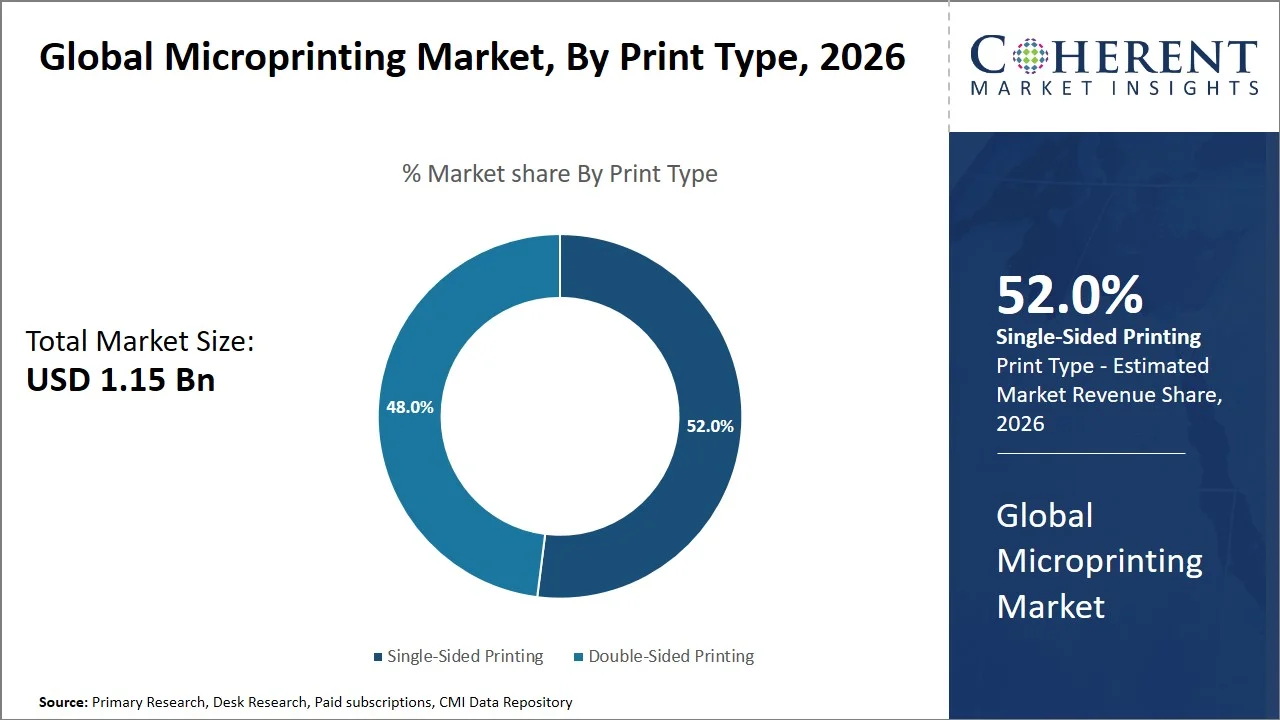
The single-sided printing segment is expected to account for 52.0% of the global microprinting market share in 2026. Single-sided printing is more cost-effective and easy to operate, which makes it the preferred choice in the worldwide microprinting industry. Microtext and security features printed on one side of a document or label leads to effective anti-counterfeiting protection, along with reduced complexity of production, minimal alignment issues and lower manufacturing costs. This is why single-sided microprinting is a popular choice for currency, ID documents, container labels, and security certifications.
On November 4, 2025, TOPPAN Security, a global leader in secure identity and payment solutions, unveiled CHROMA at the ICAO TRIP Symposium, the world’s first laser technology to deliver full-color, photo-realistic, personalization for polycarbonate identity documents. (Source: TOPPAN)
Micro-Embossing Inks Dominate the Global Microprinting Market
The micro-embossing inks segment is expected to account for 31.0% of the global microprinting market share in 2026. Micro-embossing inks dominate the worldwide microprinting market as they offer an additional physical security layer which is very difficult to reproduce. In addition to microprinted elements, these inks also create fine raised patterns and tactile qualities that improve document and product identification and greatly increase resistance to counterfeiting. They have established their market leadership position by their extensive use in banknotes, passports and security certificates and in high value branded products.
Moreover, the increasing need for document checks is driving the growth of the segment even more. On December 1, 2025, Authentix announced the production qualification and launch of PICO secure, a revolutionary new security product based on its award-winning Nano Optic technology. PICO secure is the first nano-optic, plasmonic optical variable device (OVD) for identity documents offering always-on-structural color and movement. (Source: Authentix)
Currents Events and their Impact
Current Events | Description and its Impact |
India - Rollout of E-Passports and Passport Seva Programme 2.0 |
|
India - Intensified Enforcement Against Fake Currency Printing Networks (2025) |
|
(Source: Ministry of External Affairs, Press Information Bureau)
Microprinting Market Dynamics
Market Drivers
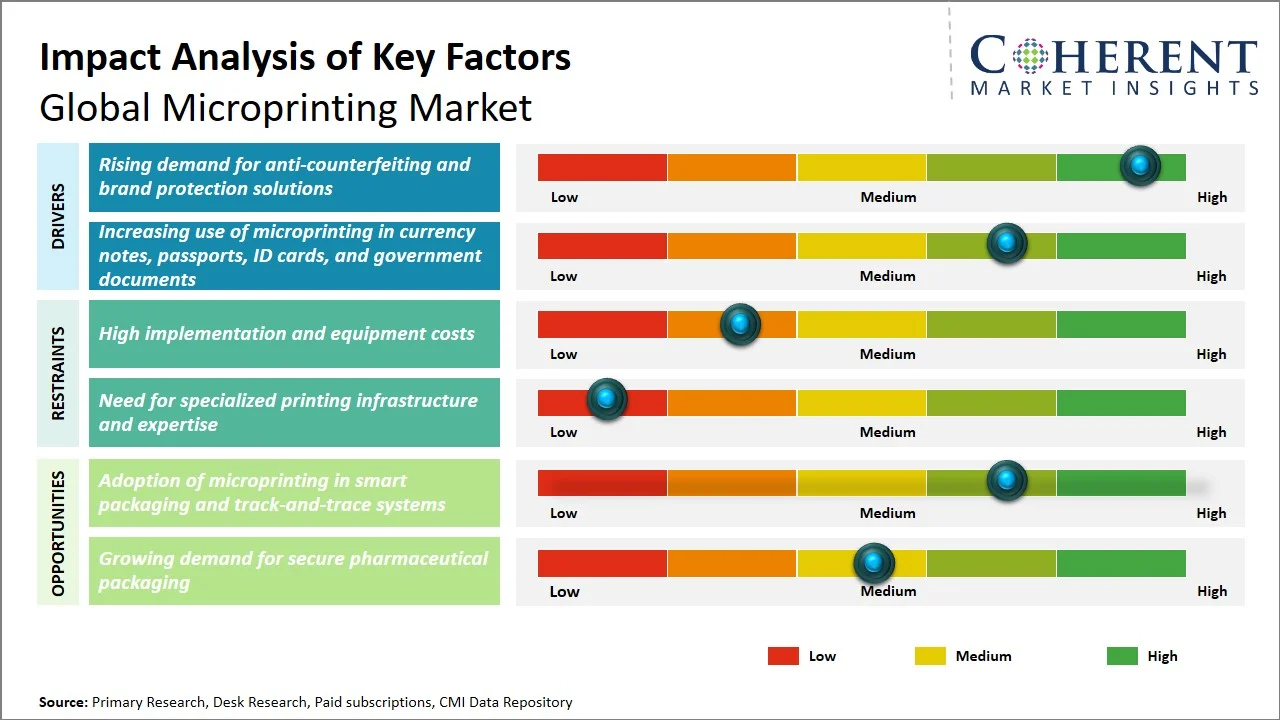
- Rising demand for anti-counterfeiting and brand protection solutions: Growing demand for anti-counterfeit and brand protection solutions is one of the key factors driving the growth of the global microprinting industry. As cases of counterfeit currencies, phony documents, fake drugs and copycat consumer items rise, governments and corporations are introducing sophisticated security measures to safeguard products, identities and financial assets. Microprinting is a very effective means of authentication, as it uses microscopic text and patterns which are exceedingly difficult to replicate precisely by normal means of printing. Fraud, intellectual property theft and lost revenue are forcing organizations to seek greater protections, driving wider usage of microprinting technology across banking, government, healthcare, packaging and luxury goods.
- On April 7, 2026, Authentic Vision announced its partnership with BILSTEIN, a leading brand in the automotive aftermarket, as part of the launch of its newly redesigned packaging and product protection strategy in 2026. With this update, BILSTEIN introduced a high-security label powered by Authentic Vision’s Holographic Fingerprint technology, enabling instant and reliable product verification for workshops, distributors, and end customers. (Source: Authentic Vision)
- Increasing use of microprinting in currency notes, passports, ID cards, and government documents: The increasing adoption of microprinting in currency notes, passports, ID cards and government documents is supporting the growth of the microprinting market. Governments and security agencies around the world are continually improving document security to resist counterfeiting, identity theft and document fraud. Microprinting is a very effective security feature. It consists of microscopic text and patterns that are hard to duplicate using normal printing equipment. As governments upgrade their financial systems, issue biometric passports and upgrade national identity programs, the need for sophisticated microprinting technologies continues to grow, helping to create stronger document integrity and public trust.
- On May 13, 2026, Bundesdruckerei GmbH presented its latest concept for the banknote of the future at the Banknote Conference, STELLA. STELLA focuses on maximum functionality whilst being reduced to credit card size. The prototype banknote from the EX NIHILO series was developed in collaboration with leading industry partners and has been nominated for the International Association of Currency Affairs (IACA) ‘Excellence in Currency Award 2026’ in the Best New House Note category. (Source: Bundesdruckerei)
Emerging Trends
- Advancements in High-Resolution Digital Printing Technologies: Ongoing upgrades to digital printing technology enable the creation of finer, more accurate microprinted features at higher speeds and reduced operating costs. Enhanced printing accuracy and automation are enabling microprinting to extend beyond the typical security document and currency printing applications to new industries and uses.
- Rising Utilization in Digital Identity and Secure Documentation Programs: Governments worldwide are investing more in digital identity programs and enhancing national ID systems, passports, and official certifications with cutting-edge security technology. Microprinting is emerging as a crucial element in these modernization efforts since it is an effective means of preventing document fraud and enabling safe verification processes in both physical and hybrid digital-physical identification systems.
Regional Insights
Why is North America a Strong Market for Microprinting?
North America is expected to account for a market share of 38.0% in 2026. The region is a prominent hub for microprinting adoption owing to the widespread usage of security printing in currencies, passports, driver’s licenses, tax stamps, and financial documents. The area hosts key providers of security printing and authentication equipment and agencies such as U.S. Advanced microprinted security features continue to be included into Federal Reserve Notes by the Bureau of Engraving and Printing. The pharmaceutical serialization regulations, as well as rising attempts to fight counterfeit consumer products, have also driven broader adoption of microprinting on labels, packaging and regulatory papers across the U.S. and Canada. On April 1, 2025, NovaVision, LLC announced the acquisition of Precision Converting Technologies. This acquisition expands NovaVision’s capabilities and strengthens its position as a premier provider of security and identification solutions. (Source: NovaVision)
Why Does the Asia Pacific Microprinting Market Exhibit High Growth?
Asia Pacific is projected to account for 32.0% of the global microprinting market and is expected to register the fastest growth. The Asia Pacific region is seeing fast growth in the use of microprinting, driven by large-scale government identity programs, currency modernization projects and growing worries about counterfeit consumer goods. Countries in the region are investing in secure passports, national ID cards, tax stamps and authentication technology to enhance document security. The region is also a key manufacturing base for medicines, electronics and consumer products, leading brand owners to use microprinting as part of wider anti-counterfeiting and supply chain security initiatives. On January 20, 2026, Komori was a Gold Sponsor at High Security Printing Asia, Kuala Lumpur, Malaysia and exhibited its state-of-the-art technology for banknote, passport and ID-document printing. The company cooperated with central banks and government printing agencies throughout Asia on next generation security printing initiatives, including high-precision microtext and anti-counterfeiting solutions. (Source: Komori)
Global Microprinting Market Outlook for Key Countries
Why is the U.S. Emerging as a Major Hub in the Microprinting Market?
The world’s most sophisticated microprinting sector is in the U.S. driven by strong demand for currency manufacture, government identification cards and secure financial instruments. Microprinted text is a key anti-counterfeiting element of modern U.S. banknotes, according to the U.S. Bureau of Engraving and Printing, and microprinting is also used by state governments in driver's licenses and identification cards that meet Real ID security standards. Large pharmaceutical producers and owners of luxury brands are also using microprinted authentication features on packaging to fight counterfeit items entering the domestic supply chains.
Is China the Next Growth Engine for the Microprinting Market?
In China, the microprinting market is mainly driven by the country’s attempts to combat counterfeit items and the need for enhanced security in official papers and financial instruments. The People’s Bank of China has microprinted renminbi banknotes in elaborate detail, and government agencies are in the process of upgrading resident identity cards and travel documents with additional security features. To meet more stringent intellectual property protection and anti-counterfeiting requirements, Chinese pharmaceutical businesses, electronics manufacturers and premium consumer brands are progressively incorporating microprinted authentication features into product packaging.
Germany Microprinting Market Analysis and Trends
Germany is one of the largest microprinting markets in Europe, owing to its well-developed security printing sector and strict criteria for document authentication. German passports, residency permits, vehicle registration certificates and other official documents are prepared to high security standards, with sophisticated microprinted features included into them. The country’s strong automotive, pharmaceutical and industrial manufacturing sectors also utilize microprinting on labels, certifications and traceability systems to protect brands, verify authenticity and adhere to European Union regulatory regulations.
India Microprinting Market Analysis and Trends
Microprinting in India is growing rapidly with the government increasing the use of microprinting in cash, passports, voter IDs and other important papers to improve security. Microprinted security elements have been used in Indian banknotes by the Reserve Bank of India and the demand for enhanced security printing solutions has increased with the roll out of biometric e-passports and upgrading of national identity infrastructure. In addition, the pharmaceutical, consumer goods, and agriculture industries are increasingly using microprinting on their packaging and labels to comply with traceability rules and to address the growing problem of counterfeit goods in their home and export markets.
Japan Microprinting Market Analysis and Trends
Japan has developed a firm foothold in the microprinting business due to its superior printing technologies and stringent security standards. Japanese yen banknotes use extremely advanced microprinted security features to discourage counterfeiting. Government-issued residency cards, passports and official certificates have precise microtext authentication capabilities. Home technology and electronics businesses also employ microprinting on product labels and components for tracking product origin, safeguarding intellectual property rights and supporting quality assurance programs in both home and export markets.
Global Microprinting Market - Passport Production Volumes with Microprinting Features
Region | 2024 (Million Units) | 2025 (Million Units) |
Asia Pacific | 45.2 | 49.4 |
Europe | 26.2 | 28.7 |
North America | 23.8 | 26.0 |
Latin America | 10.1 | 11.4 |
Middle East & Africa | 13.6 | 14.2 |
Global Microprinting Market - Banknotes Incorporating Microprinting
Country | Banknotes Incorporating Microprinting (Billion Notes) |
China | 12.8 |
India | 10.9 |
U.S. | 7.8 |
Indonesia | 4.9 |
Brazil | 4.3 |
Russia | 3.9 |
Japan | 3.4 |
Germany | 2.9 |
U.K. | 2.8 |
Mexico | 2.5 |
How is the Adoption of Microprinting in Smart Packaging and Track-and-Trace Systems Creating New Growth Opportunities in the Microprinting Market?
Increasing usage of microprinting in smart packaging and track & trace systems offers huge potential prospects for the microprinting market due to increased product authentication, supply chain visibility, and anti-counterfeiting protection. In addition to QR codes, RFID tags and serialization, manufacturers in the pharmaceutical, food and beverage, cosmetics, electronics and luxury goods sectors are progressively adding microprinted codes, text and security markers to packaging. These microprinted features give another layer of security which is difficult to duplicate, allowing organizations to authenticate products, track product movement in the supply chain and meet regulatory traceability requirements. The need for microprinting solutions in smart packaging and track and trace applications is predicted to expand significantly with the increasing worldwide concerns of counterfeiting of goods, diversion of products and transparency in the supply chain.
On September 17, 2025, Digimarc Corporation launched digitally watermarked security labels for 100% verifiable product authentication. These labels bring together the latest in Digimarc’s encrypted, covert, and highly copy-resistant watermarks and optimize them for different label material substrates. (Source: Digimarc)
Market Players, Key Development, and Competitive Intelligence
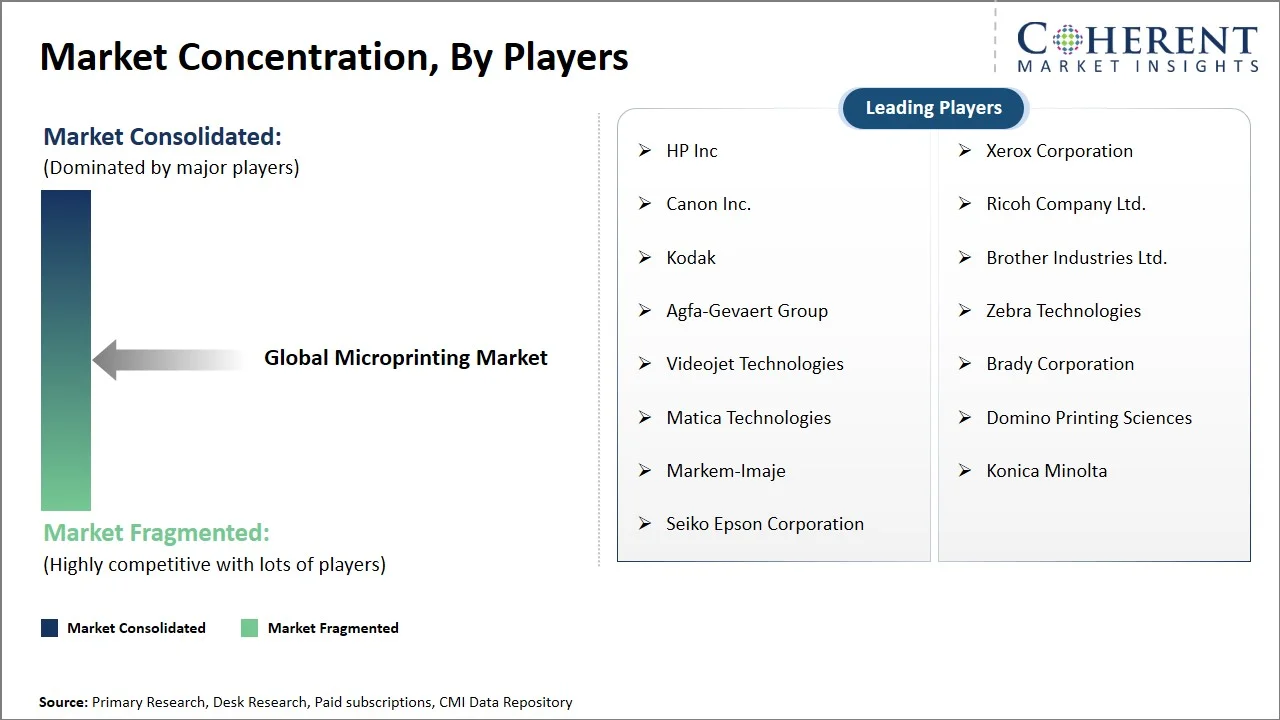
Key Developments
- On May 15, 2025, Crane Authentication unveiled the InsightPulse system. The InsightPulse system pairs patented, discreet digital marking technology with an intuitive smartphone app, delivering enhanced supply chain security and real-time insights into counterfeit activity across global markets.
- On April 4, 2025, TOPPAN Digital Inc developed Illumigram, a hologram that displays 3D text and images in response to strong light. Illumigram has previously only been available in a single color, but TOPPAN Digital has now developed a color version, enabling latent images using a special effect in multiple colors.
The global microprinting market is competitive and comprises established security printing companies, digital printing technology providers, and specialist authentication solution developers competing on the basis of technological innovation, product quality, and security feature enhancement. The company provides comprehensive anti-counterfeiting solutions that combine sophisticated microprinting capabilities with holograms, UV inks, digital watermarks, RFID technology, and serialization systems. Seeking strategic partnerships with government agencies, financial institutions and packaging manufacturers to improve market positions. Investing in high-resolution printing equipment and automated verification technologies to improve production efficiency and security performance.
Market Report Scope
Microprinting Market Report Coverage
| Report Coverage | Details | ||
|---|---|---|---|
| Base Year: | 2025 | Market Size in 2026: | USD 1.15 Bn |
| Historical Data for: | 2020 To 2024 | Forecast Period: | 2026 To 2033 |
| Forecast Period 2026 to 2033 CAGR: | 5.7% | 2033 Value Projection: | USD 1.70 Bn |
| Geographies covered: |
| ||
| Segments covered: |
| ||
| Companies covered: | HP Inc, Xerox Corporation, Canon Inc., Ricoh Company Ltd., Kodak, Brother Industries Ltd., Agfa-Gevaert Group, Zebra Technologies, Videojet Technologies, Brady Corporation, Matica Technologies, Domino Printing Sciences, Markem-Imaje, Konica Minolta, and Seiko Epson Corporation | ||
| Growth Drivers: |
| ||
| Restraints & Challenges: |
| ||
Analyst Opinion (Expert Opinion)
- Rising focus on document security, product authentication and anti-counterfeiting techniques across various industries is projected to have a favorable impact on the market. Strong demand is expected from government identity programs, currency modernization efforts and rising uses in areas such as smart packaging and pharmaceutical traceability. However, there are hurdles such as implementation costs and competition from alternative security technologies being witnessed. Continuous advances in printing precision, security inks, and integrated authentication systems are expected to drive sustainable growth.
- Increasing adoption of multi-layered security solutions and digitization of authentication processes are projected to shape the future of the microprinting industry. It is expected to see more use of microprinting in smart packaging, e-passports, secure identification documents, pharmaceutical serialization and high value product labeling. Innovations such as AI-based verification, machine-readable microtext and connected track-and-trace platforms are likely to improve the effectiveness of microprinting solutions while increasing investments in anti-counterfeiting infrastructure and document security programs are likely to offer long-term growth opportunities across both developed and emerging markets.
Speak to the analyst
Want personalized insights?
Take the findings above to one of our principal consultants, or have the report rebuilt around the segments, geographies and competitors you actually track.
Market Segmentation
- Type Insights (Revenue, USD Billion, 2021 - 2033)
- Monochrome Microprinting
- Color Microprinting
- Print Type Insights (Revenue, USD Billion, 2021 - 2033)
- Single-Sided Printing
- Double-Sided Printing
- Ink Type Insights (Revenue, USD Billion, 2021 - 2033)
- Micro-Embossing Inks
- Magnetic Inks
- UV Invisible Inks
- Infrared Ink Markings
- Special Security Inks
- By Application Insights (Revenue, USD Billion, 2021 - 2033)
- Currency Printing
- Bank Checks
- Government Documents
- Identification Cards
- Packaging Authentication
- Brand Protection
- Product Labels
- Regional Insights (Revenue, USD Billion, 2021 - 2033)
- North America
- U.S.
- Canada
- Latin America
- Brazil
- Argentina
- Mexico
- Rest of Latin America
- Europe
- Germany
- U.K.
- Spain
- France
- Italy
- Russia
- Rest of Europe
- Asia Pacific
- China
- India
- Japan
- Australia
- South Korea
- ASEAN
- Rest of Asia Pacific
- Middle East
- GCC Countries
- Israel
- Rest of Middle East
- Africa
- South Africa
- North Africa
- Central Africa
- North America
- Key Players Insights
- HP Inc
- Xerox Corporation
- Canon Inc.
- Ricoh Company Ltd.
- Kodak
- Brother Industries Ltd.
- Agfa-Gevaert Group
- Zebra Technologies
- Videojet Technologies
- Brady Corporation
- Matica Technologies
- Domino Printing Sciences
- Markem-Imaje
- Konica Minolta
- Seiko Epson Corporation
Sources
Primary Research Interviews
- Chief Executive Officers (CEOs) of Security Printing Companies
- Chief Technology Officers (CTOs) and AI Product Heads
- Vice Presidents of Printing Equipment Manufacturers
- Directors of Central Banks & Currency Printing Authorities
Magazines
- HSP Magazine (High Security Printing)
- Authentication & Brand News
- Packaging Europe
- Labels & Labeling
- PrintWeek
Journals
- Journal of Printing Science and Technology
- Journal of Imaging Science and Technology
- Packaging Technology and Science
- Forensic Science International
- IEEE Access
Associations
- International Association of Currency Affairs (IACA)
- International Hologram Manufacturers Association (IHMA)
- International Organization for Standardization (ISO)
Public Domain Sources
- U.S. Bureau of Engraving and Printing
- Federal Reserve System
- European Central Bank
Proprietary Elements
- CMI Data Analytics Tool
- Proprietary CMI Existing Repository of information for last 10 years
Get access to 250+ pages report
Every segment, forecast, competitor profile and data table behind the analysis above — available for instant download.
- ESOMAR Member
- ISO 9001:2015 Certified
- D-U-N-S Registered
- GDPR & CCPA Compliant
Missing comfort of reading report in your local language? Find your preferred language:
Transform your Strategy with Exclusive Trending Reports
Frequently Asked Questions
The global microprinting market is expected to stand at USD 1.15 Bn in 2026 and is expected to reach USD 1.70 Bn by 2033.
The CAGR of the global microprinting market is projected to be 5.7% from 2026 to 2033.
Rising demand for anti-counterfeiting and brand protection solutions and increasing use of microprinting in currency notes, passports, ID cards, and government documents are the major factors driving the growth of the global microprinting market.
High implementation and equipment costs and need for specialized printing infrastructure and expertise are the major factors hampering the growth of the global microprinting market.
In terms of type, the monochrome microprinting segment is estimated to dominate the market revenue share in 2026.
Yes, microprinting is increasingly used on packaging to support brand protection and product authentication initiatives.
Governments invest in microprinting to improve the security of currency, identity documents, certificates, and official records.