

Middle East and Saudi Arabia Neurosurgery Devices Market Size and Forecast – 2026 To 2033\
The Middle East and Saudi Arabia neurosurgery devices market is expected to grow from USD 937.4 Mn in 2026 to USD 1,577.8 Mn by 2033, registering a compound annual growth rate (CAGR) of 7.7% from 2026 to 2033. The market for neurosurgery devices in the Middle East and Saudi Arabia is poised for significant expansion, fueled by the Saudi Arabia's healthcare transformation under Vision 2030 and increasing investments in advanced healthcare infrastructure.
In 2024, the Saudi government allocated USD 57.1 Billion (SAR 214 billion) to the healthcare sector, representing nearly 17% of the national budget, while the Kingdom plans to invest USD 13.8 Billion in medical facilities by 2030. These investments are strengthening specialized neurological care, expanding hospital capabilities, and accelerating the adoption of advanced neurosurgery devices across the Middle East and Saudi Arabia.
(Source: International Trade Administration)
Key Takeaways of the Middle East and Saudi Arabia Neurosurgery Devices Market
- Deep brain stimulator (DBS) system is projected to hold 42.5 % of the Middle East and Saudi Arabia neurosurgery devices market share in 2026, making it the dominant product type segment, due to the growing adoption of implantable neuromodulation technologies for treating movement disorders. For instance, the Movement Disorders Chapter of the Pan Arab Union of Neurological Societies (PAUNS) regularly conducts scientific meetings and educational programs on advanced Deep Brain Stimulation (DBS) therapies, promoting the adoption of modern DBS systems across neurology and neurosurgery centers in the Middle East.
- Deep brain stimulation (DBS) is projected to hold 41.8 % of the Middle East and Saudi Arabia neurosurgery devices market share in 2026, making it the dominant surgery type segment, owing to the growing adoption of functional neurosurgical procedures for medically refractory movement disorders. For instance, the Saudi Health Council, through its National Center for Evidence-Based Medicine, recommends Deep Brain Stimulation (DBS) for eligible patients with advanced Parkinson's disease in its national clinical practice guidelines, encouraging standardized adoption of DBS procedures across specialized neurosurgical centers in Saudi Arabia.
- Epilepsy is projected to hold 29.6 % of the Middle East and Saudi Arabia neurosurgery devices market share in 2026, making it the dominant application segment, due to the increasing need for surgical intervention among patients with drug-resistant epilepsy. For instance, the Saudi Health Council's national clinical practice guidelines recommend referring patients with drug-resistant epilepsy to specialized epilepsy surgery centers for comprehensive surgical evaluation, supporting the increasing utilization of advanced neurosurgical technologies, including neuronavigation systems and intraoperative neurophysiological monitoring.
- Expansion of Comprehensive Epilepsy Surgery Programs: The growing establishment of comprehensive epilepsy surgery programs across Saudi Arabia and the Middle East is driving the demand for advanced neurosurgery Increasing referrals of patients with drug-resistant epilepsy to specialized centers are accelerating the adoption of technologies such as neuronavigation systems, intraoperative neurophysiological monitoring, neuroendoscopes, and stereo electroencephalography (SEEG) systems. Government-backed clinical guidelines and investments in specialized neuroscience centers are further strengthening procedural volumes and device utilization.
- Integration of AI-Enabled and Robotic Neurosurgical Platforms: The integration of artificial intelligence (AI), robotic-assisted surgery, and advanced navigation technologies presents a significant growth opportunity for the market. Healthcare providers across Saudi Arabia and the UAE are increasingly investing in robotic neurosurgery, AI-assisted surgical planning, and intraoperative imaging to improve surgical precision and clinical outcomes. As tertiary hospitals continue to modernize under national healthcare transformation programs, the demand for next-generation neurosurgery devices is expected to expand substantially.
Segmental Insights
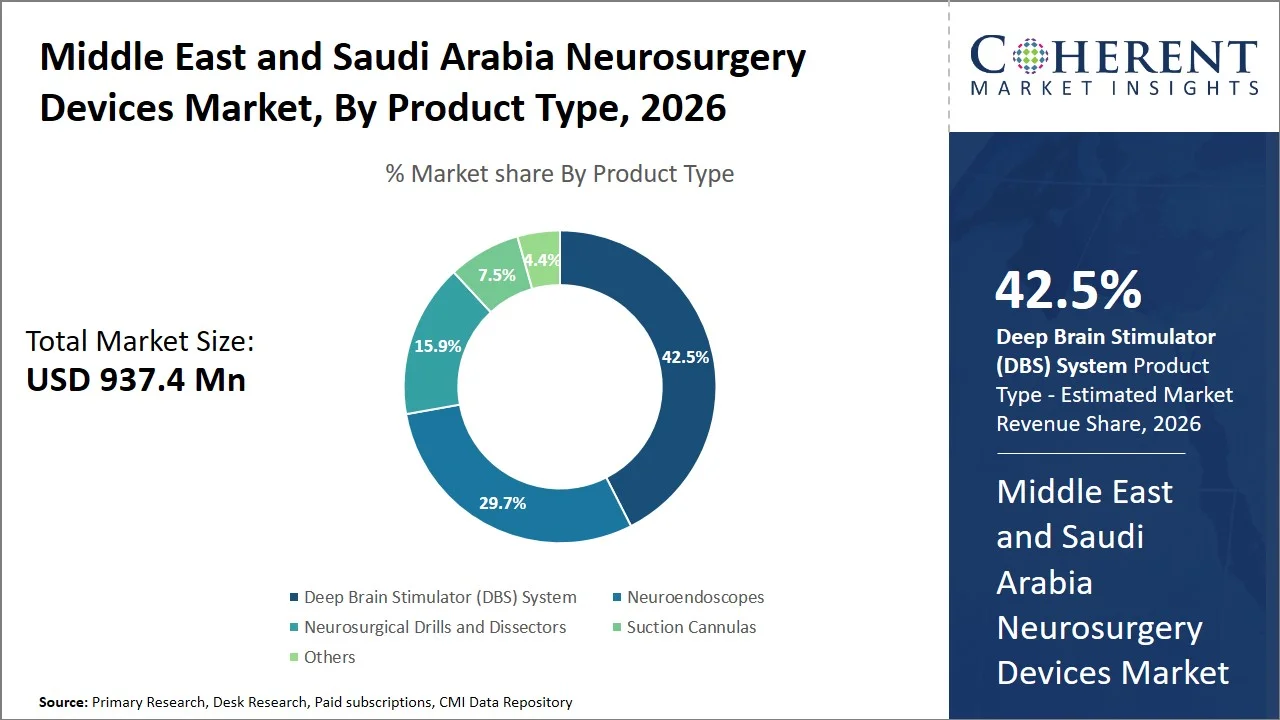
Why Does Deep Brain Stimulator (DBS) System Dominate the Middle East and Saudi Arabia Neurosurgery Devices Market?
Deep brain stimulator (DBS) system is projected to hold a market share of 42.5% in 2026, due to their demonstrated clinical results in the management of movement disorders like Parkinson's disease, essential tremor, and dystonia. Neuromodulation is evolving with technologies such as rechargeable implantable pulse generators, directional leads, and adaptive stimulation that improve clinical outcomes and enhance patient experience. For instance, on July 14, 2026, King Faisal Specialist Hospital & Research Centre (KFSHRC) announced the introduction of the first robotic-assisted Deep Brain Stimulation (DBS) surgery solution in the region. This solution allows the most accurate placement of electrodes for movement disorder patients and has been set up to improve speed, facilitate usage of cutting-edge DBS system and further elevate its status as a center of expertise for functional neurosurgery.
- Current Industry Events of 2026
- Market Size Estimation
- Regional Breakdown
- Competitive Landscape
- Customer Intelligence
- Segmental Analysis
- Pricing Analysis
- Key Market Drivers, Challenges & Future Trends
- Customized Insights Section
Why Does Deep brain stimulation (DBS) Represent the Largest Surgery Type Segment in the Middle East and Saudi Arabia Neurosurgery Devices Market?
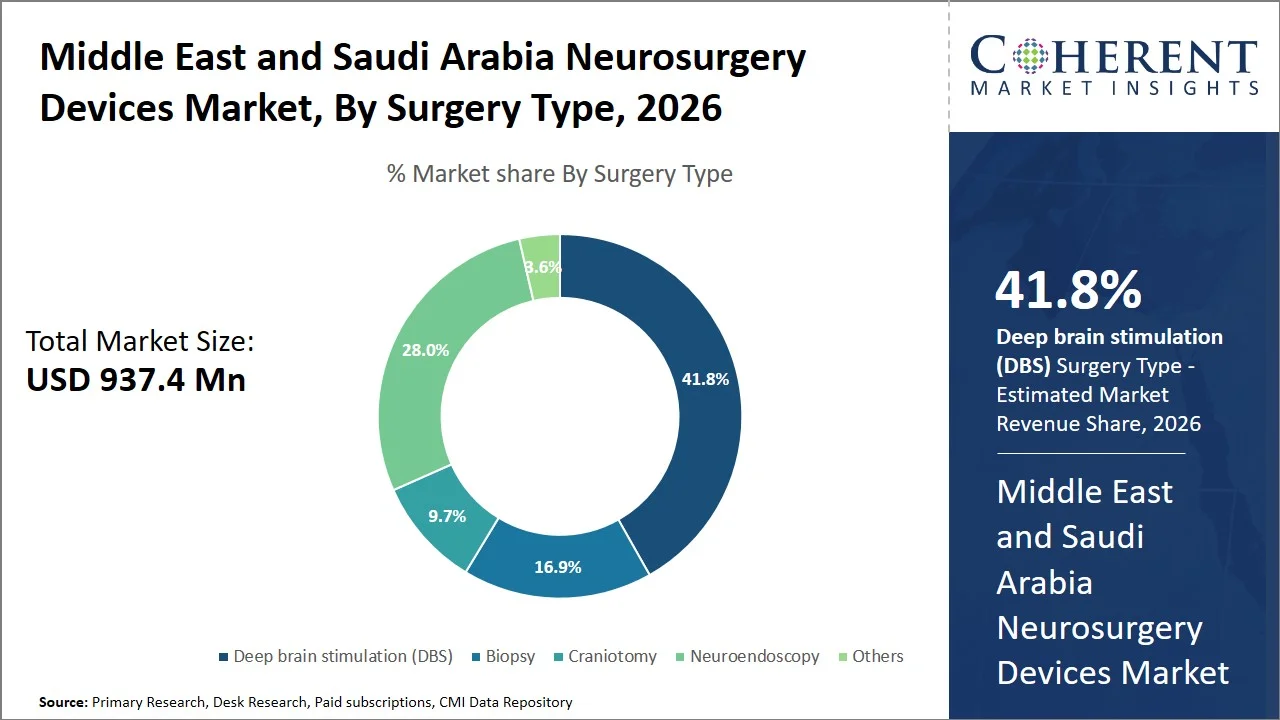
Deep brain stimulation (DBS) is projected to hold a market share of 41.8% in 2026, due to its proven efficiency in treating movement disorders and the increased application in functional neurosurgery procedures. It offers a minimally invasive and a focused therapy option, thereby yielding greater long-term control over the symptoms with faster recovery periods compared to traditional surgical methods. For instance, in April 2021, Cleveland Clinic Abu Dhabi successfully completed the first Deep Brain Stimulation (DBS) surgeries for Parkinson’s disease in the UAE, launching a multidisciplinary DBS program, highlighting the advancements of the region’s abilities in functional neurosurgery. The breakthrough has improved regional awareness and implementation of DBS procedures.
Epilepsy Segment Dominates the Middle East and Saudi Arabia Neurosurgery Devices Market
The epilepsy segment is projected to hold a market share of 29.6% in 2026, due to the rising incidences of drug-resistant epilepsy and the enhanced use of advanced surgical and neuromodulation treatments. Advancements in neuroimaging technology, stereo electroencephalography (SEEG), and targeted neurosurgical techniques facilitate the pinpointing of epileptic seizure origins and lead to better patient outcomes. For instance, in August 2025, King Faisal Specialist Hospital & Research Centre (KFSHRC) broadened its Epilepsy Center’s offerings and launched an expansion of its Stereo-Electroencephalography (Stereo-EEG) procedures. It is the biggest center in the Middle East for the diagnosis and treatment of epilepsy, having completed over 2,000 operations and treated over 4,000 patients. The move is expected to prompt rapid implementation of neurosurgical devices to address epilepsy cases across the region.
Currents Events and their Impact
Current Events | Description and its Impact |
Saudi Food and Drug Authority (SFDA) issued Guidance on Digital Health Products (MDS-G27) (August 2025) |
|
Saudi Food and Drug Authority (SFDA) signed a Memorandum of Understanding (MoU) with the Association for the Advancement of Medical Instrumentation (AAMI) (August 2025) |
|
Middle East and Saudi Arabia Neurosurgery Devices Market Dynamics
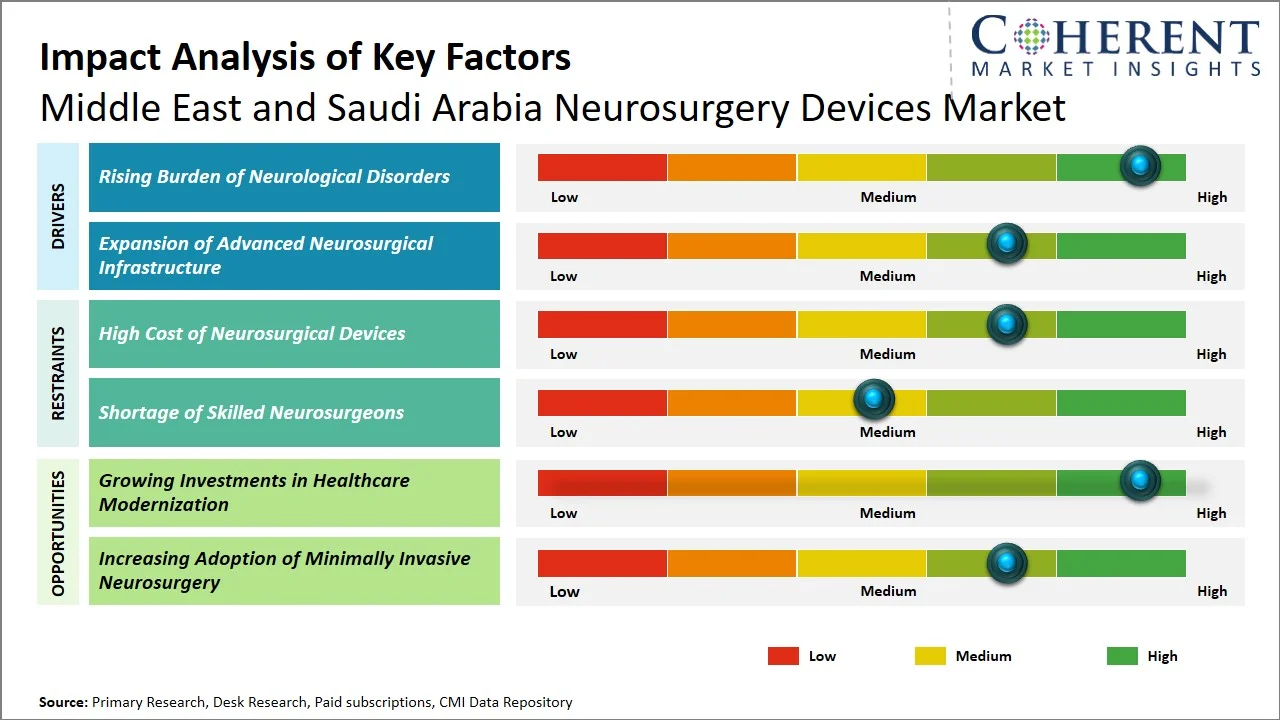
Market Drivers
- Rising Burden of Neurological Disorders: Growing prevalence of neurological disorders has boosted the demand for innovative neurosurgery devices in the Middle East and Saudi Arabia. Rising instances of stroke, epilepsy, brain tumors and other disorders has led to the adoption of more of neuronavigation systems, neuroendoscopes, neurostimulation devices, and intraoperative imaging devices. For instance, according to the Global Burden of Disease (GBD) 2019 study, the Middle East and North Africa (MENA) region had approximately 221.1 million prevalent cases of neurological diseases and 64.6 million incident cases of neurological diseases in 2019, stroke representing 45.2% of the DALYs of neurological disability, which highlights the increasing need of state of-the-art neurosurgery treatments.
- Expansion of Advanced Neurosurgical Infrastructure: The expansion of advanced neurosurgical infrastructure is accelerating the adoption of sophisticated neurosurgery devices across the Middle East and Saudi Arabia. Governments and healthcare providers are strengthening specialized neuroscience services by establishing dedicated brain and spine centers, upgrading operating rooms, and expanding access to image-guided neurosurgical procedures. For instance, in February 2025, Dubai Health inaugurated the Hamdan Bin Rashid Cancer Hospital, featuring advanced surgical infrastructure and specialized operating theatres designed to support complex oncological and neurological procedures, thereby increasing the demand for high-precision neurosurgery devices, including surgical microscopes, neuronavigation systems, and intraoperative imaging technologies.
Emerging Trends
- Growing Adoption of Intraoperative Imaging and Hybrid Neurosurgical Operating Rooms: Healthcare providers across Saudi Arabia and the Middle East are increasingly investing in hybrid operating rooms equipped with intraoperative MRI, CT, and advanced surgical microscopes to enhance precision during complex cranial and spinal procedures. This trend is improving surgical outcomes while driving the demand for image-guided neurosurgery devices and integrated operating room solutions.
- Expansion of Local Medical Device Manufacturing and Regulatory Localization: Saudi Arabia's healthcare localization initiatives under Vision 2030 are encouraging global medical device manufacturers to establish local manufacturing, assembly, and distribution partnerships. Supported by streamlined regulatory pathways and industrial incentives, this trend is expected to improve supply chain resilience, accelerate product availability, and expand access to advanced neurosurgery devices across the region.
Competitive Positioning of Key Countries in the Middle East and Saudi Arabia Neurosurgery Devices Market Based on Neurosurgical Infrastructure and Technology Adoption
Country | Specialized Neuroscience Centers | Adoption of Advanced Neurosurgery Technologies | Key Focus Areas | Competitive Position |
Saudi Arabia | High | Very High | DBS, Brain Tumor Surgery, Robotics | Leader |
UAE
| High | High | Image-Guided Neurosurgery, Neuro-oncology | Strong |
Qatar | Very High | Very High | Functional Neurosurgery, AI & Robotics | Innovation Leader |
Israel | Moderate | High | Skull Base & Pediatric Neurosurgery | Emerging |
Turkey | High | High | Spine & Cranial Neurosurgery, Medical Tourism | Strong Regional Hub |
How are growing investments in healthcare modernization creating new growth opportunities in the Middle East and Saudi Arabia neurosurgery devices market?
Rising investments in the modernization of healthcare infrastructure would provide robust opportunities for the growth in the Middle East and Saudi Arabia neurosurgery devices market. With various governments focused on broadening specialized health care infrastructure, remodeling secondary and tertiary care hospitals, and adopting innovative technologies in advanced surgery. Public-private sector investment along with public funding, and alliances are instrumental in promoting adoption of new technology equipment by several healthcare providers. For instance, during the Global Health Exhibition (GHE) 2025 held under the patronage of the Saudi Ministry of Health, more than USD 33 billion worth of healthcare agreements were revealed to accelerate Saudi Arabia’s Health Sector Transformation Programme, as part of the Kingdom’s Vision 2030. These investments will facilitate faster procurements and applications of sophisticated neurosurgery equipment like neuronavigation devices, neurosurgery microscopes, intraoperative neuro-imaging modalities and robotic-assisted surgical devices.
Market Players, Key Development, and Competitive Landscape
Key Developments
- In May 2026, neurocare group AG announced that its Transcranial Magnetic Stimulation (TMS) devices received Medical Device Marketing Authorization (MDMA) in Saudi Arabia. The approval enables the commercialization of the company's non-invasive brain stimulation systems in the country, expanding access to advanced neuromodulation therapies. The development is expected to strengthen the adoption of innovative neurostimulation technologies within Saudi Arabia's neuroscience and neurosurgery device market.
- In October 2025, King Faisal Specialist Hospital & Research Centre (KFSHRC), Saudi Arabia, performed the world's first robotic intracranial tumor resection, successfully removing a brain tumor using a robot-assisted system guided by advanced 3D optical imaging and navigation technologies. The milestone highlights Saudi Arabia's leadership in robotic neurosurgery and is expected to accelerate the adoption of advanced neurosurgical devices across the Middle East.
- In June 2025, the Saudi Food and Drug Authority (SFDA) granted marketing authorization for an advanced brain-stimulation medical device for the treatment of Parkinson's disease. The approval expands access to innovative neurostimulation therapies in Saudi Arabia and reflects the country's commitment to adopting advanced neurosurgical technologies. The development is expected to support the growth of the neurosurgery devices market, particularly in deep brain stimulation (DBS) systems.
Competitive Landscape
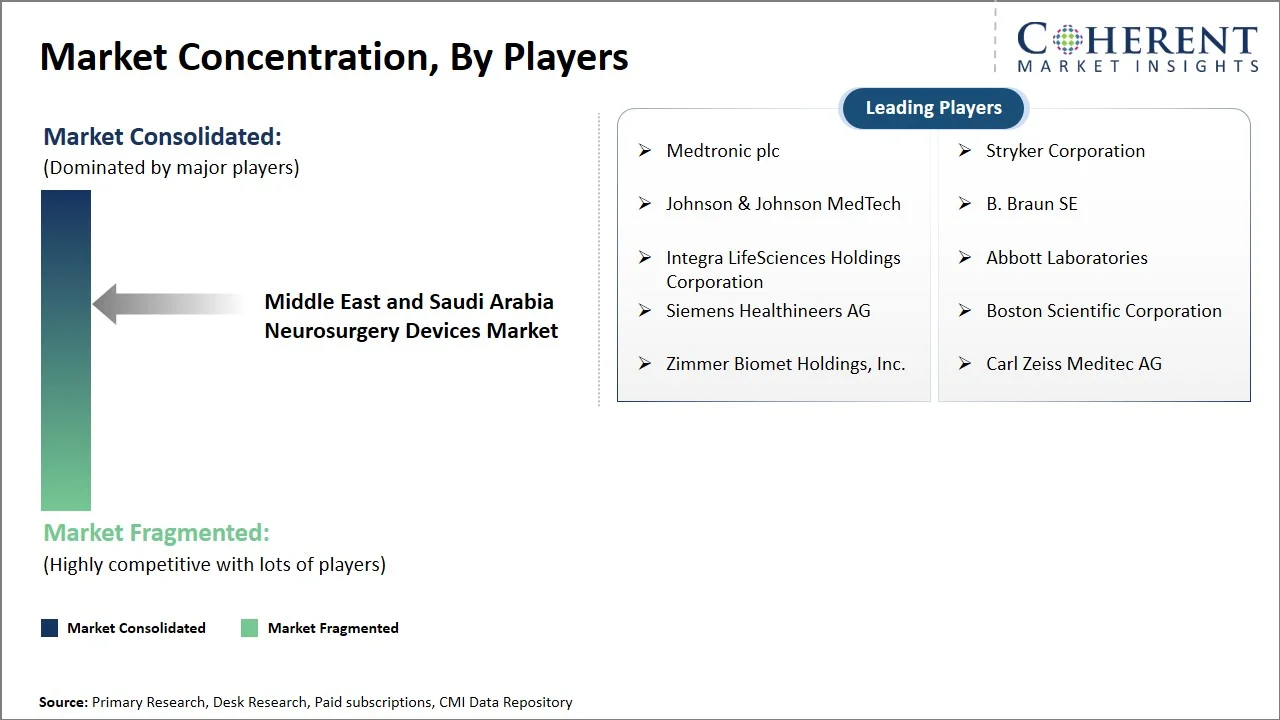
The Middle East and Saudi Arabia neurosurgery devices market is moderately consolidated, with competition driven by technological innovation, clinical performance, regulatory approvals, and strategic collaborations with leading hospitals and neuroscience centers. Market participants are strengthening their regional presence through the introduction of advanced neurostimulation, neuronavigation, neuroendoscopy, and robotic-assisted neurosurgical solutions, while expanding local distribution networks and surgeon training programs. Key focus areas include:
- Expansion of deep brain stimulation (DBS) systems and advanced neurostimulation technologies
- Development of AI-enabled neuronavigation, intraoperative imaging, and robotic-assisted neurosurgical platforms
- Strategic collaborations with tertiary hospitals, neuroscience centers, and healthcare providers
- Investment in surgeon training, clinical education, and minimally invasive neurosurgical techniques
- Focus on regulatory approvals, product commercialization, and localized distribution
Market Report Scope
Middle East and Saudi Arabia Neurosurgery Devices Market Report Coverage
| Report Coverage | Details | ||
|---|---|---|---|
| Base Year: | 2025 | Market Size in 2026: | USD 937.4 Mn |
| Historical Data for: | 2020 To 2024 | Forecast Period: | 2026 To 2033 |
| Forecast Period 2026 to 2033 CAGR: | 7.7% | 2033 Value Projection: | USD 1,577.8 Mn |
| Segments covered: |
| ||
| Companies covered: | Medtronic plc, Stryker Corporation, Johnson & Johnson MedTech, B. Braun SE, Integra LifeSciences Holdings Corporation, Abbott Laboratories, Siemens Healthineers AG, Boston Scientific Corporation, Zimmer Biomet Holdings, Inc., and Carl Zeiss Meditec AG | ||
| Growth Drivers: |
| ||
| Restraints & Challenges: |
| ||
Analyst Opinion (Expert Opinion)
- In the coming years, the Middle East and Saudi Arabia neurosurgery devices market is expected to witness sustained growth over the coming years, supported by healthcare modernization initiatives, increasing investments in specialized neuroscience infrastructure, and the rising burden of neurological disorders. The adoption of minimally invasive, image-guided, and robotic-assisted neurosurgical technologies is expected to reshape clinical practice, while government-led healthcare transformation programs will continue to strengthen access to advanced neurological care across the region.
- The maximum opportunities will probably exist within Deep Brain Stimulation (DBS) systems for the treatment of Parkinson's disease and other movement disorders in Saudi Arabia. Saudi Arabia's expanding network of tertiary care hospitals, increasing investments under Vision 2030, and growing adoption of functional neurosurgery position the country as the primary revenue-generating market. In parallel, neuronavigation systems and intraoperative imaging technologies are expected to witness strong demand as hospitals increasingly perform complex cranial and spinal procedures.
- In order to obtain a competitive advantage, market participants should prioritize strategic partnerships with leading neuroscience centers and tertiary hospitals, expand surgeon training and clinical education programs, and strengthen local distribution and after-sales service capabilities. Companies that introduce AI-enabled neuronavigation, robotic-assisted neurosurgical platforms, and next-generation neurostimulation technologies, while aligning with regional regulatory requirements and healthcare localization initiatives, are expected to be best positioned to capture long-term growth opportunities in the Middle East and Saudi Arabia neurosurgery devices market.
Speak to the analyst
Want personalized insights?
Take the findings above to one of our principal consultants, or have the report rebuilt around the segments, geographies and competitors you actually track.
Market Segmentation
- Product Type Insights (Revenue, USD Mn, 2021 - 2033)
- Deep Brain Stimulator (DBS) System
- Neuroendoscopes
- Neurosurgical Drills and Dissectors
- Suction Cannulas
- Others
- By Surgery Type (Revenue, USD Mn, 2021 - 2033)
- Deep brain stimulation (DBS)
- Biopsy
- Craniotomy
- Neuroendoscopy
- Others
- By Application (Revenue, USD Mn, 2021 - 2033)
- Epilepsy
- Neurovascular Disorders
- Brain Tumor
- Parkinson's disease
- Others
- By End User (Revenue, USD Mn, 2021 - 2033)
- Hospitals
- Specialty Clinics
- Ambulatory Surgical Centers
- Others
- Key Players Insights
- Medtronic plc
- Stryker Corporation
- Johnson & Johnson MedTech
- Braun SE
- Integra LifeSciences Holdings Corporation
- Abbott Laboratories
- Siemens Healthineers AG
- Boston Scientific Corporation
- Zimmer Biomet Holdings, Inc.
- Carl Zeiss Meditec AG
Sources
Primary Research Interviews
- Neurosurgeons specializing in cranial, spinal, functional, and pediatric neurosurgery
- Neurologists specializing in movement disorders and epilepsy surgery
- Heads of Neurosurgery Departments and Directors of Neuroscience Centers at tertiary hospitals
- Hospital procurement managers for neurosurgical equipment and medical devices
- Medical device distributors specializing in neurosurgery and neurointerventional products
- Clinical application specialists for neuronavigation, neuroendoscopy, surgical microscopes, and robotic-assisted neurosurgery
- Healthcare infrastructure and neuroscience technology consultants
- Officials from healthcare regulatory authorities and medical device registration agencies
Stakeholders
- Medical device manufacturers (neuronavigation systems, neuroendoscopes, neurostimulation devices, surgical microscopes, cranial fixation systems)
- Multispecialty and tertiary care hospitals
- Dedicated neuroscience and neurosurgery centers
- Specialty neurology and epilepsy treatment centers
- Brain and spine institutes
- Hospital purchasing organizations and group procurement entities
- Healthcare investors and private hospital operators
- End-use Sectors
- Tertiary care hospitals
- Dedicated neuroscience and neurosurgery centers
- Specialty neurology hospitals and clinics
- Academic medical centers and teaching hospitals
- Ambulatory surgery centers (ASCs)
- Government and military hospitals
- Regulatory & Health Bodies
- Saudi Food and Drug Authority (SFDA)
- Saudi Ministry of Health (MOH)
- Saudi Health Council (SHC)
- UAE Ministry of Health and Prevention (MoHAP)
- Department of Health – Abu Dhabi (DoH)
- Dubai Health Authority (DHA)
- Gulf Health Council (GHC)
Databases
- Saudi Ministry of Health Statistical Yearbook
- Saudi Food and Drug Authority (Medical Devices Database)
- World Health Organization (WHO) Global Health Observatory
- World Bank Open Data
- Global Burden of Disease (GBD) Study
- Institute for Health Metrics and Evaluation (IHME)
- Organisation for Economic Co-operation and Development (OECD) Health Statistics
Magazines
- Medical Device & Diagnostic Industry (MD+DI)
- Middle East Health Magazine
- Saudi Medical Journal Magazine
- Neuro Today
Journals
- Journal of Neurosurgery
- World Neurosurgery Journal
- Middle East Journal of Neuroscience
Newspapers
- Arab News (Health Section)
- Saudi Gazette (Medical & Healthcare)
- Gulf News (Healthcare)
- Al Arabiya Health
Associations
- Saudi Neurosurgery Society (SNS)
- Arab Medical Association
- Middle East Neurosurgery Association
- Medical Devices Manufacturers Association (MDMA)
Public Domain Sources
- Saudi Vision 2030 Health Sector Reports
- Saudi Food and Drug Authority (SFDA) Publications
- World Health Organization (WHO) Country Reports – Saudi Arabia
- Ministry of Health (MOH) Saudi Arabia Official Reports
Proprietary Elements
- CMI Data Analytics Tool, Proprietary CMI Existing Repository of information for last 10 years.
Get access to 250+ pages report
Every segment, forecast, competitor profile and data table behind the analysis above — available for instant download.
- ESOMAR Member
- ISO 9001:2015 Certified
- D-U-N-S Registered
- GDPR & CCPA Compliant
Missing comfort of reading report in your local language? Find your preferred language:
Transform your Strategy with Exclusive Trending Reports
Frequently Asked Questions
The Middle East and Saudi Arabia neurosurgery devices market is estimated to be valued at USD 937.4 Mn in 2026 and is expected to reach USD 1,577.8 Mn by 2033.
Deep brain stimulator (DBS) system dominates due to its proven clinical effectiveness in treating Parkinson's disease, essential tremor, and dystonia, coupled with the growing adoption of functional neurosurgery and expanding availability of specialized neuroscience centers.
Neurosurgery devices are specialized medical instruments and implantable systems used to diagnose, monitor, and surgically treat disorders affecting the brain, spine, peripheral nerves, and cerebrovascular system.
The CAGR of the Middle East and Saudi Arabia neurosurgery devices market is projected to be 7.7% from 2026 to 2033.
Neuronavigation is an image-guided surgical technology that provides real-time 3D anatomical guidance, enabling neurosurgeons to perform highly precise brain and spinal procedures.
Deep Brain Stimulation (DBS) is a functional neurosurgical procedure that implants electrodes in specific brain regions to deliver controlled electrical impulses for treating movement disorders and selected neurological conditions.
The market is expected to witness steady growth, driven by increasing investments in specialized neuroscience infrastructure, rising adoption of minimally invasive and robotic-assisted neurosurgical procedures, and growing demand for advanced technologies such as Deep Brain Stimulation (DBS), neuronavigation, and intraoperative imaging systems.