

Global Motor Oil Market Size and Forecast – 2026-2033
The Global Motor Oil Market is estimated to be valued at USD 43.90 Bn in 2026 and is expected to reach USD 61.36 Bn by 2033, exhibiting a compound annual growth rate (CAGR) of 4.9% from 2026 to 2033.
Key Takeaways of the Motor Oil Market
- The synthetic blend segment leads the market holding an estimated share of 44.6 % in 2026.
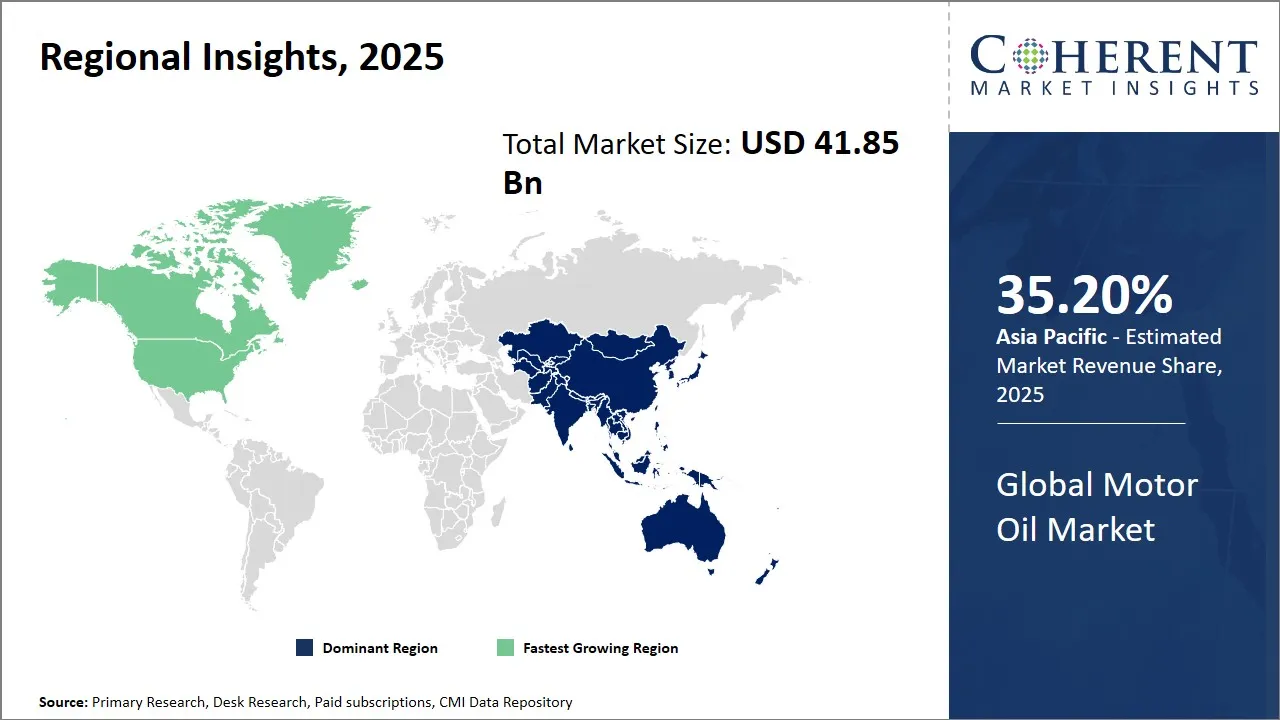
- Asia Pacific is estimated to lead the market with a share of 35.2 % in 2026.
- North America, holding a share of 24.4 % in 2026, is projected to be the fastest growing region.
Market Overview
The market is seeing a shift towards synthetic and high-performance motor oils because of consumer preference for improved engine efficiency and environmental sustainability. Additionally, advancements in automotive technologies, such as electric vehicles requiring specialized lubricants, are influencing product innovation. Growing environmental regulations are also pushing manufacturers to develop eco-friendly formulations.
Current Events and Its Impact
Current Events | Description and Impact |
Geopolitical and Trade Developments |
|
Economic and Infrastructure Trends |
|
Technological and Market Shifts |
|
Segmental Insights
- Current Industry Events of 2026
- Market Size Estimation
- Regional Breakdown
- Competitive Landscape
- Customer Intelligence
- Segmental Analysis
- Pricing Analysis
- Key Market Drivers, Challenges & Future Trends
- Customized Insights Section
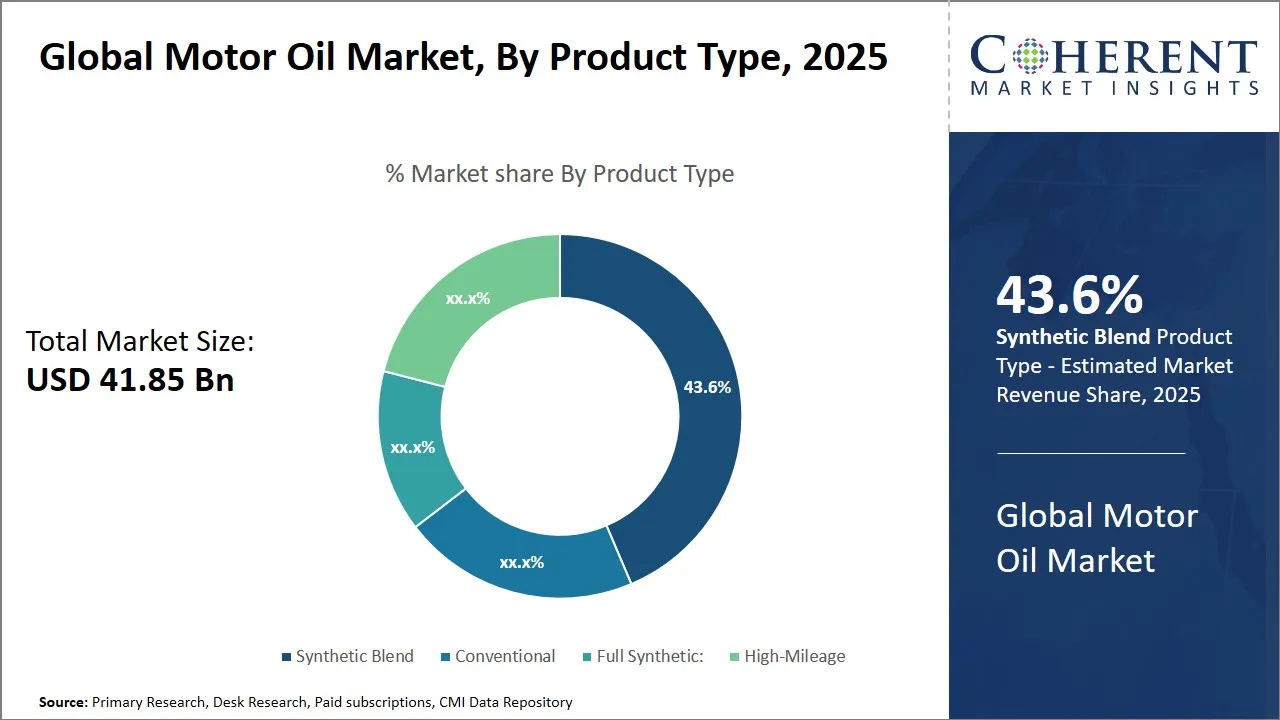
Global Motor Oil Market Insights, by Product Type - Synthetic blend contributes the highest share of the market owing to its optimal balance of performance and cost-efficiency
The synthetic blend segment is expected to dominate the global motor oil market, holding a share of 44.6% in 2026 primarily because it successfully bridges the gap between conventional oils and full synthetics, offering a blend that combines the best properties of both. One of the foremost drivers behind the growth of synthetic blend motor oils is their ability to deliver superior engine cleanliness and wear protection compared to conventional oils. These benefits result from the partial presence of synthetic base stocks that enhance thermal stability and resistance to oxidation, thereby ensuring prolonged engine life and consistent performance under varied operating conditions.
Furthermore, synthetic blends offer excellent resistance to viscosity breakdown, which is vital for protecting engine components during high-temperature operations. This characteristic extends the interval between oil changes, reducing maintenance costs and downtime for vehicle owners and fleet operators, which is highly attractive in both consumer and commercial sectors. Another significant factor is the rising awareness among vehicle owners about engine health and the long-term savings achievable through the use of higher-quality motor oils.
Consumer trends towards sustainability and fuel efficiency also bolster the synthetic blend segment.
Price Analysis of the Motor Oil Market
Region | Avg Retail Price | Historical CPI-Adjusted Price |
North America (USA) | USD 22.12/qt (≈USD 5.80 /L) – Mobil 0W‑20 full synthetic | ~USD 150.68 (2025 CPI-adjusted from USD 20 in 1977) |
Global Average | — | Same CPI benchmark (USD 150.68/qt ≈ USD 5.80/L) |
Wholesale Prices (Base Oils) | Group II & III base oils: volatile; correlated to crude and feedstock | — |
Regional Insights
Asia Pacific Motor Oil Market Analysis and Trends
The Asia Pacific region, holding a share of 35.2% in 2026, is expected to dominate the market, driven by its extensive automotive industry, rising vehicle production, and increasing consumer demand for premium lubricants. Countries such as China, India, and Japan host a dense ecosystem of Original Equipment Manufacturers (OEMs) and aftermarket suppliers, fostering robust demand for motor oils catering to diverse vehicle types. Government initiatives encouraging industrial modernization and environmental regulations have pushed manufacturers to innovate and adopt synthetic and semi-synthetic oils, supporting the region’s stronghold.
Additionally, the rapid expansion of e-commerce platforms and improved distribution networks enhances market penetration. Leading companies like Sinopec (China), Indian Oil Corporation (India), and Idemitsu Kosan (Japan) play pivotal roles by offering a broad range of products tailored to regional needs while expanding their technological capabilities and sustainability efforts.
North America Motor Oil Market Analysis and Trends
North America, holding a share of 24.4% in 2026, is expected to maintain a strong growth trajectory in the motor oil market, driven by a combination of high vehicle ownership rates, the expansion of quick-lube service chains, and increasing consumer preference for synthetic and high-performance oils. The region benefits from a well-established automotive aftermarket and stringent environmental regulations, which are encouraging the adoption of low-viscosity and fuel-efficient lubricant formulations. Technological innovation in engine designs—especially in hybrid and turbocharged engines—further accelerates the demand for advanced motor oils with extended drain intervals.
Moreover, the digitalization of fleet management and predictive maintenance practices is reshaping lubricant consumption patterns. Major players, such as Valvoline, ExxonMobil, and Chevron, are continuously innovating product lines, investing in sustainable packaging, and strengthening OEM partnerships to retain market leadership across the U.S., Canada, and Mexico.
Global Motor Oil Market Outlook for Key Countries
China Motor Oil Market Analysis and Trends
China’s motor oil market is characterized by strong demand from both passenger and commercial vehicles accompanied by growing awareness regarding engine maintenance and fuel efficiency. The country’s accelerating automotive manufacturing industry stimulates the need for technologically advanced lubricants. Sinopec and PetroChina remain dominant players, leveraging vast refining capacities and research centers. Additionally, government policies aimed at pollution control and stricter emission norms have led to increased adoption of synthetic motor oils, further stimulating market sophistication and innovation.
India Motor Oil Market Analysis and Trends
India motor oil market is propelled by rising vehicle ownership, especially two-wheelers and passenger cars, and increasing aftermarket demand. The government’s thrust towards improved fuel quality and initiatives like Bharat Stage VI emission standards are crucial in redefining lubricant formulations. Indian Oil Corporation and Bharat Petroleum Corporation Limited maintain strong distribution networks and focus on value-added products to cater to a price-sensitive yet quality-conscious consumer base. The country’s growing retail e-commerce penetration also facilitates better product accessibility across urban and semi-urban regions.
U.S. Motor Oil Market Analysis and Trends
The U.S. continues to lead with a mature automotive sector, high vehicle mileage, and stringent environmental regulations influencing product innovation. The country benefits from highly established OEM partnerships and aftermarket channels dominated by players such as ExxonMobil, Chevron, and Valvoline. These companies invest extensively in R&D, offering synthetic and high-performance motor oils optimized for varied fuel types including gasoline and diesel. The regulatory environment supports sustainable and advanced formulations, reinforcing the U.S. as a hub of technological advancement in motor oils.
Germany Motor Oil Market Analysis and Trends
Germany reflects the strength of its automotive industry and export-oriented economy. It leads in premium product offerings, catering to luxury and high-performance vehicles. Local companies, such as Liqui Moly and Fuchs Petrolub, are renowned for innovation and high-quality standards. Government policies emphasizing fuel economy and reduced carbon emissions drive the adoption of synthetic and environmentally friendly lubricants. The robust aftermarket sector and strong presence of OEMs coupled with Germany’s role as a European trade hub enhance market dynamics and competitiveness.
Saudi Arabia Motor Oil Market Analysis and Trends
Saudi Arabia represents a rapidly growing motor oil market in the Middle East, underpinned by expanding vehicle fleets and industrialization. The government’s vision for economic diversification includes improved transportation infrastructure and localization of lubricant production. Saudi Aramco Lubricants, a dominant entity, plays a critical role by integrating upstream crude supply with downstream blending and distribution, ensuring cost efficiencies. Additionally, the market is witnessing increasing demand for specialty lubricants suited to extreme temperature conditions, which are vital for both passenger vehicles and heavy-duty applications in the region.
Market Players, Key Development, and Competitive Intelligence
Key Developments
- In May 2025, BP plc BP, the U.K.-based energy major, officially launched the sale of its Castrol lubricants business, marking a significant move in the British energy giant’s plan to raise USD 20 billion by 2027 through asset sales. The divestment aims to streamline BP’s portfolio and strengthen its financial footing amid strategic recalibration.
- In July 2024, TotalEnergies announced the acquisition of Tecoil, a Finland-based company specialized in the production of Re-Refined Base Oils (RRBOs), which has the most efficient used oil regeneration process on the market today
- In April 2024, Shell Lubricants and Ducati announced that they will co-design high-performance motorcycle engine oils for a further three years, with Shell also continuing to supply the oils to Ducati’s global dealer network, as part of an extension of a collaboration established in 2020. Shell will supply the co-branded Shell Advance Ducati engine oil and Ducati Corse Performance Oil powered by Shell Advance, with the latter launched in 2023.
- In January 2024, Shell U.K. Limited completed the acquisition of MIDEL and MIVOLT, from U.S.-based M&I Materials Ltd. The acquisition of MIDEL enabled Shell to complement its differentiated position in Transformer Oils used for power distribution, offshore wind parks, utility companies and traction power systems.
Top Strategies Followed by Motor Oil Market Players
- Established market leaders consistently invest heavily in research and development (R&D) to innovate high-performance products that meet evolving automotive standards and consumer demands.
- Shell has invested significantly in R&D centers like the Shell Technology Centre in Bangalore and Hamburg, focusing on low-viscosity synthetic oils, bio-based lubricants, and lubricants for EVs and hybrids.
- Mid-level players in the motor oil market adopt a more cost-conscious strategy, targeting price-sensitive consumers who seek a balance between performance and affordability.
- Gulf Oil offers Gulf XHD Supreme+, a semi-synthetic oil targeting India’s large budget-conscious consumer base, offering extended drain intervals at lower prices.
- Small-scale players in the global motor oil market typically differentiate themselves by targeting niche segments and emphasizing specialized features or innovative formulations that larger competitors may overlook.
- Amsoil focuses on high-performance synthetic oils for motorsports, off-road vehicles, and power sports, including customized solutions for ATVs, snowmobiles, and marine engines.
Market Report Scope
Motor Oil Market Report Coverage
| Report Coverage | Details | ||
|---|---|---|---|
| Base Year: | 2025 | Market Size in 2026: | USD 43.90 Bn |
| Historical Data for: | 2020 To 2024 | Forecast Period: | 2026 To 2033 |
| Forecast Period 2026 to 2033 CAGR: | 4.9% | 2033 Value Projection: | USD 61.36 Bn |
| Geographies covered: |
| ||
| Segments covered: |
| ||
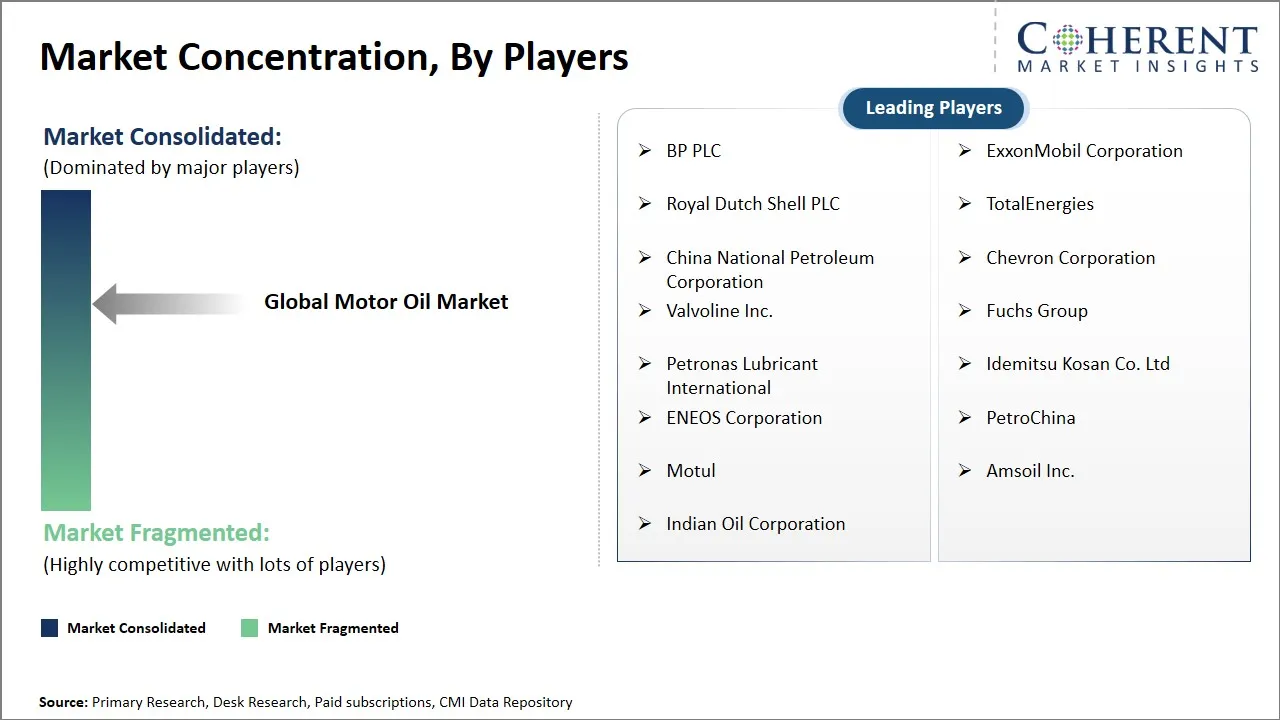
| Companies covered: | BP PLC, ExxonMobil Corporation, Royal Dutch Shell PLC, TotalEnergies, China National Petroleum Corporation, Chevron Corporation, Valvoline Inc., Fuchs Group, Petronas Lubricant International, Idemitsu Kosan Co. Ltd, ENEOS Corporation, PetroChina, Motul, Amsoil Inc., and Indian Oil Corporation | ||
| Growth Drivers: |
| ||
| Restraints & Challenges: |
| ||
Market Dynamics
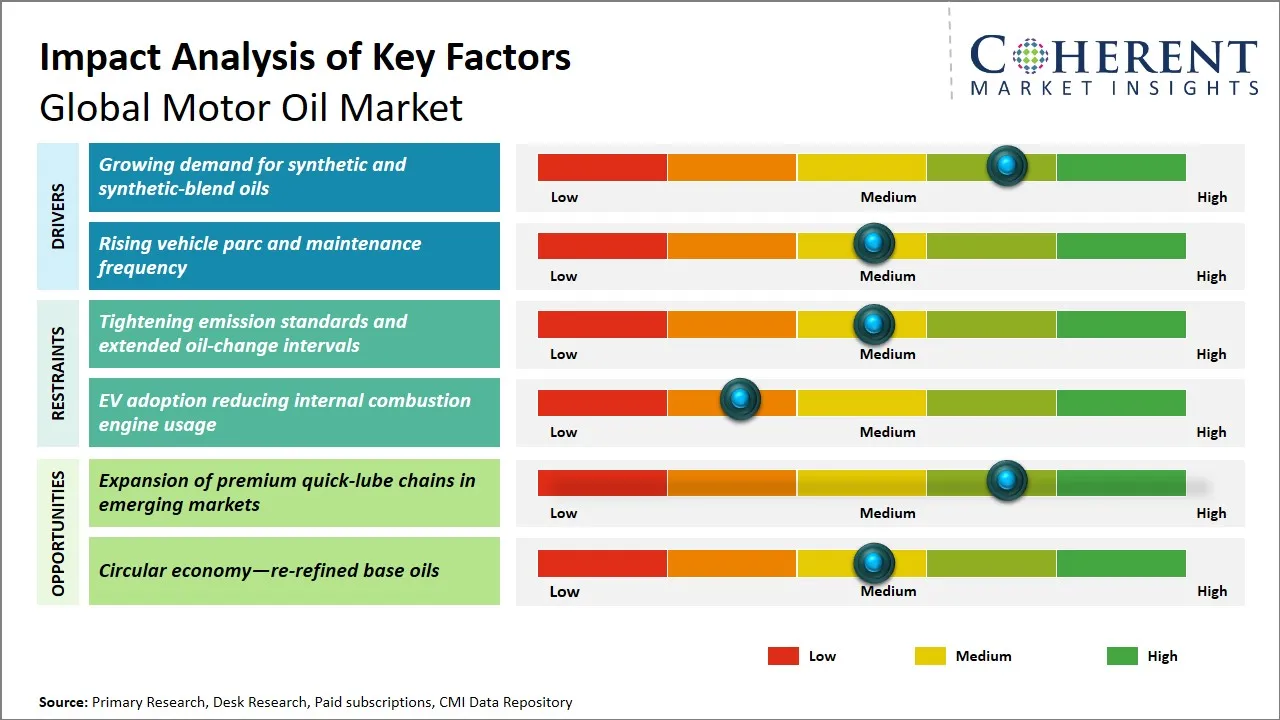
Global Motor Oil Market Driver – Growing Demand for Synthetic and Synthetic-blend Oils
The automotive industry is witnessing a significant shift towards the use of synthetic and synthetic-blend motor oils, driven largely by their superior performance characteristics compared to conventional mineral oils. These advanced lubricants offer enhanced engine protection, improved fuel efficiency, and better thermal stability under extreme operating conditions, which appeals to both manufacturers and consumers aiming to extend engine life and reduce maintenance costs. In 2024, Castrol India launched a synthetic-blend engine oil specifically tailored for SUVs, tapping into the rising consumer shift from conventional to synthetic and semi-synthetic lubricants.
Additionally, as stringent environmental regulations push for lower emissions, synthetic oils contribute by optimizing engine performance and reducing harmful exhaust gases. The increasing production of high-performance and luxury vehicles, which often come pre-filled with synthetic oils, further propels demand in this segment.
Global Motor Oil Market Opportunity – Expansion of Premium Quick-Lube Chains in Emerging Markets
The global motor oil market stands to benefit significantly from the rapid expansion of premium quick-lube chains in emerging markets, driven by rising disposable incomes, increasing vehicle ownership, and growing consumer preference for convenience and quality service. Emerging economies in Asia, Latin America, and Africa are witnessing a surge in personal and commercial vehicle sales, leading to greater demand for timely and reliable vehicle maintenance services.
Premium quick-lube chains, which offer fast, standardized, and high-quality oil change services, are perfectly positioned to capitalize on this trend by providing enhanced customer experiences compared to traditional service centers. These chains leverage advanced formulations of motor oils catering to the latest engine technologies, attracting tech-savvy and quality-conscious consumers. In 2023–2024, Valvoline Global aggressively expanded its Valvoline Express Care quick-lube outlets in India and Mexico, partnering with local entrepreneurs and fleet operators.
Analyst Opinion (Expert Opinion)
- As OEMs shift toward hybrid and start-stop systems, there's rising demand for ultra-low-viscosity, high-thermal-stability oils that minimize wear during frequent ignition cycles—prompting lubricant makers to develop tailored formulations for HEVs and PHEVs.
- Telematics-enabled commercial fleets are adopting condition-based oil monitoring, replacing time-based oil changes. This transition is fueling the demand for sensor-compatible and longer-drain interval lubricants, especially in logistics and ride-hailing sectors.
- While EVs don’t use motor oil, they require specialized e-transmission and thermal management fluids. Major players are leveraging their R&D in synthetics to expand into this adjacent space—transforming EV fluid solutions into the “new motor oil.”
Speak to the analyst
Want personalized insights?
Take the findings above to one of our principal consultants, or have the report rebuilt around the segments, geographies and competitors you actually track.
Market Segmentation
- Product Type Insights (Revenue, USD Bn, 2021 - 2033)
- Synthetic Blend
- Conventional
- Full Synthetic:
- High-Mileage
- Regional Insights (Revenue, USD Bn, 2021 - 2033)
- North America
- U.S.
- Canada
- Latin America
- Brazil
- Argentina
- Mexico
- Rest of Latin America
- Europe
- Germany
- U.K.
- Spain
- France
- Italy
- Russia
- Rest of Europe
- Asia Pacific
- China
- India
- Japan
- Australia
- South Korea
- ASEAN
- Rest of Asia Pacific
- Middle East
- GCC Countries
- Israel
- Rest of Middle East
- Africa
- South Africa
- North Africa
- Central Africa
- North America
- Key Players Insights
- BP PLC
- ExxonMobil Corporation
- Royal Dutch Shell PLC
- TotalEnergies
- China National Petroleum Corporation
- Chevron Corporation
- Valvoline Inc.
- Fuchs Group
- Petronas Lubricant International
- Idemitsu Kosan Co. Ltd
- ENEOS Corporation
- PetroChina
- Motul
- Amsoil Inc.
- Indian Oil Corporation
Sources
Primary Research Interviews
Stakeholders
- Automotive OEMs and Tier-1 Suppliers (e.g., Maintenance Managers, Powertrain Engineers)
- Motor Oil Manufacturers and Blenders (e.g., Castrol, Valvoline, Gulf Oil)
- Base Oil Producers and Additive Suppliers (e.g., Lubrizol, Chevron Oronite)
- Quick Lube Franchise Operators and Independent Workshop Owners
- Automotive Retail Chain Managers and Distributors
- Sustainability Officers from Fleet Management Companies
- Industry Consultants specializing in Lubricant Technology and Emissions Compliance
Databases
- North American Vehicle Fluid Consumption Survey (NAVFCS)
- Asia Lubricant Demand Tracker (ALDT), 2024 Edition
- Global Automotive Aftermarket Trends Database (GAATD)
- Institute for Petrochemical Economics (IPE) Data Vault
Magazines
- Lubricant World
- Automotive Aftermarket Review
- LubeTech Asia
- Fleet Maintenance Digest
- Performance Oils & Additives Weekly (POAW)
Journals
- Journal of Advanced Lubrication Science and Technology
- International Journal of Engine Oils and Fuels
- Journal of Mobility Fluids and Sustainable Lubrication
- Tribology Research and Innovation Journal
Newspapers
- The Engine Times (North America)
- Auto & Parts Daily (India)
- The Lubricants Business Report
- Oil Market Observer Weekly
Associations
- Global Lubricants Council (GLC)
- Automotive Lubricants Manufacturers Association (ALMA)
- North American Lubricants & Fluids Alliance (NALFA)
- Pacific Rim Engine Oil Consortium (PREOC)
- Society of Tribologists and Lubrication Engineers (STLE)
Public Domain Sources
- U.S. Energy Information Administration (EIA)
- International Energy Agency (IEA)
- United Nations Environment Programme (UNEP)
- World Bank Mobility Insights Portal
- ResearchGate – Publicly available studies on motor oil degradation and emissions
Proprietary Elements
- CMI Data Analytics Tool, Proprietary CMI Existing Repository of Information for Last 8 Years
Get access to 250+ pages report
Every segment, forecast, competitor profile and data table behind the analysis above — available for instant download.
- ESOMAR Member
- ISO 9001:2015 Certified
- D-U-N-S Registered
- GDPR & CCPA Compliant
Missing comfort of reading report in your local language? Find your preferred language:
Transform your Strategy with Exclusive Trending Reports
Frequently Asked Questions
The global motor oil market is estimated to be valued at USD 43.90 billion in 2026 and is expected to reach USD 61.36 billion by 2033.
The CAGR of the global motor oil market is projected to be 4.9% from 2026 to 2033.
Growing demand for synthetic and synthetic-blend oils and rising vehicle parc and maintenance frequency are the major factors driving the growth of the global motor oil market.
Tightening emission standards and extended oil‑change intervals and EV adoption reducing internal combustion engine usage are the major factors hampering the growth of the global motor oil market.
In terms of product type, synthetic blend is estimated to dominate the market revenue share in 2026.
Yes, motor oil can affect fuel efficiency—low-viscosity synthetic oils reduce internal engine friction, helping engines run smoother and more efficiently, especially in modern vehicles.
Motor oil brands are marketed through performance claims (e.g., extends engine life, improves mileage), OEM endorsements, motorsports sponsorships, and quick-lube service partnerships to build brand trust and visibility.