

Global Motorcycle Lighting Market Size and Forecast – 2026-2033
The global motorcycle lighting market is estimated to be valued at USD 17.27 Bn in 2026 and is expected to reach USD 30.58 Bn by 2033, exhibiting a compound annual growth rate (CAGR) of 8.5% from 2026 to 2033.
Key Takeaways of the Global Motorcycle Lighting Market
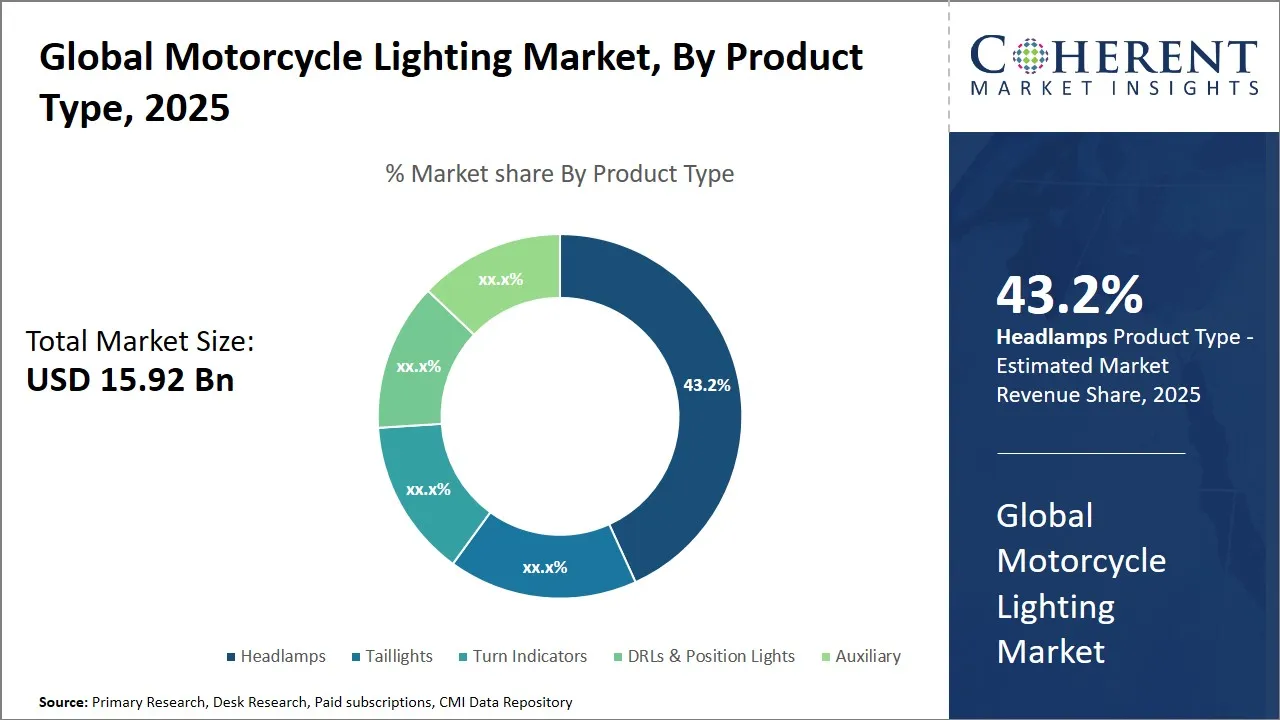
- The headlamps segment leads the market holding an estimated share of 44.2% in 2026.
- The LED segment is expected to capture 47.5 % share in 2026.
- Asia Pacific is estimated to lead the market with a share of 47.4 % in 2026.
- Latin America, holding an estimated share of 9.2 % in 2026, is projected to be the fastest growing region.
Market Overview
A key trend shaping the motorcycle lighting market is the rapid adoption of LED and smart lighting systems, driven by technological advancements and stricter safety regulations. Consumers are increasingly prioritizing enhanced visibility and aesthetic appeal, encouraging manufacturers to integrate adaptive and customizable lighting features. Additionally, rising environmental concerns are prompting a shift toward energy-efficient lighting solutions, further propelling innovation and the market expansion over the forecast period.
Current Events and Its Impact
Current Events | Description and its Impact |
Geopolitical and Trade Developments |
|
Economic and Infrastructure Trends |
|
Segmental Insights
- Current Industry Events of 2026
- Market Size Estimation
- Regional Breakdown
- Competitive Landscape
- Customer Intelligence
- Segmental Analysis
- Pricing Analysis
- Key Market Drivers, Challenges & Future Trends
- Customized Insights Section
Global Motocycle Lighting Market Insights, by Product Type – Headlamps Lead Owing to their Critical Role in Ensuring Rider Safety and Technological Advancements
The headlamps segment is projected to account for 44.2% share in 2026. Headlamps are the primary lighting component that directly affect a rider’s ability to navigate roads under low-light and adverse weather conditions. As such, they are subject to rigorous standards and constant innovation, driving their growth within the motorcycle lighting market. Governments and transport authorities across various regions are implementing stricter norms around motorcycle visibility and road safety, prompting manufacturers to equip motorcycles with more efficient and reliable headlamp systems.
Moreover, advancements in lighting technology have significantly impacted headlamp adoption. The shift from traditional halogen bulbs to more sophisticated LED headlamps has not only improved illumination capabilities but has also enhanced energy efficiency and lifespan. LED headlamps produce a brighter and more focused beam that enhances visibility without causing glare to oncoming traffic, making rides safer. Additionally, LED systems are more compact and offer greater design flexibility for manufacturers, allowing for aesthetically appealing yet functional headlamps in motorcycles.
Consumer preferences also contribute substantially to the dominance of headlamps in this segment. As motorcycles become more than just a mode of transport, riders increasingly seek customization and improved performance features, including superior lighting components. Stylish, high-performance headlamps appeal to motorcycle enthusiasts who aim to enhance both the look and functionality of their bikes.
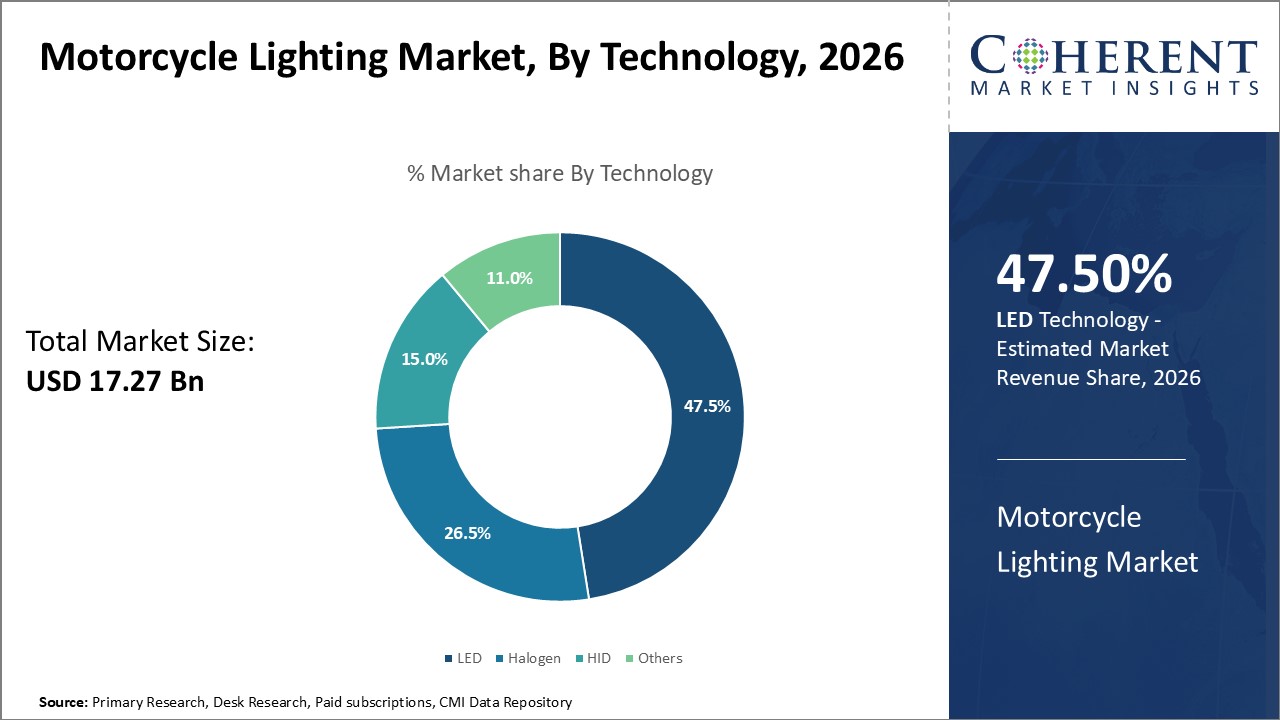
Global Motocycle Lighting Market Insights, by Technology – LED Segment Dominates Due to its Superior Efficiency, Longevity, and Design Versatility
The LED segment is expected to capture 47.5% share in 2026. LEDs offer a variety of advantages over traditional lighting technologies, such as halogen and HID, making them the preferred choice for motorcycle manufacturers and consumers alike. LEDs consume significantly less power than halogen or HID lamps, which is particularly advantageous for motorcycles given their limited battery capacity. Reduced power consumption translates into less strain on the motorcycle’s electrical system and enhanced fuel efficiency, an attribute highly valued by riders seeking cost-effective and environment-friendly solutions.
LED lighting has a longer operational life, drastically reducing the frequency of replacements. A longer lifespan also aligns with increasing consumer expectations for durable components that require minimal upkeep. Additionally, the compact nature of LED technology allows for innovative and flexible design opportunities. Motorcycle manufacturers utilize this advantage to develop lighting systems that are not only functional but also visually appealing, enhancing the bike's aesthetic appeal. LEDs can be configured in various shapes and sizes to create distinct lighting signatures, which has become a popular trend among premium motorcycle brands aiming to differentiate their models through unique lighting designs.
In 2023, Harley-Davidson introduced LED Daymaker Adaptive Headlamps across select touring and cruiser models. These headlamps not only deliver superior brightness and energy efficiency but also feature cornering illumination that automatically adjusts light distribution based on lean angle. Safety enhancements also bolster the adoption of LED lighting. The instant illumination capability of LEDs improves reaction times in critical situations, which is vital for signaling and visibility. The bright, focused light output offers better road illumination compared to halogen lights, thereby allowing riders to spot obstacles and hazards more effectively at night or in poor weather conditions.
Impact of AI on the Global Motorcycle Lighting Market
Artificial Intelligence (AI) is transforming the motorcycle lighting market by enabling smart, adaptive, and safety-driven solutions. AI algorithms integrated with sensors can dynamically adjust headlamp intensity and beam angle in real time, improving visibility during cornering, sudden braking, or varying weather conditions. This not only enhances rider safety but also meets increasingly strict regulatory requirements on road illumination standards. Additionally, AI supports predictive maintenance in lighting systems, allowing manufacturers and fleet operators to anticipate failures before they occur, reducing downtime and improving reliability.
A real-world instance of AI adoption is JW Speaker’s Adaptive 2 Series motorcycle headlights, which use sensor data and AI-based algorithms to automatically modify the light beam according to the motorcycle’s lean angle. This innovation improves visibility for riders during turns, a scenario where traditional fixed headlights fall short.
Regional Insights
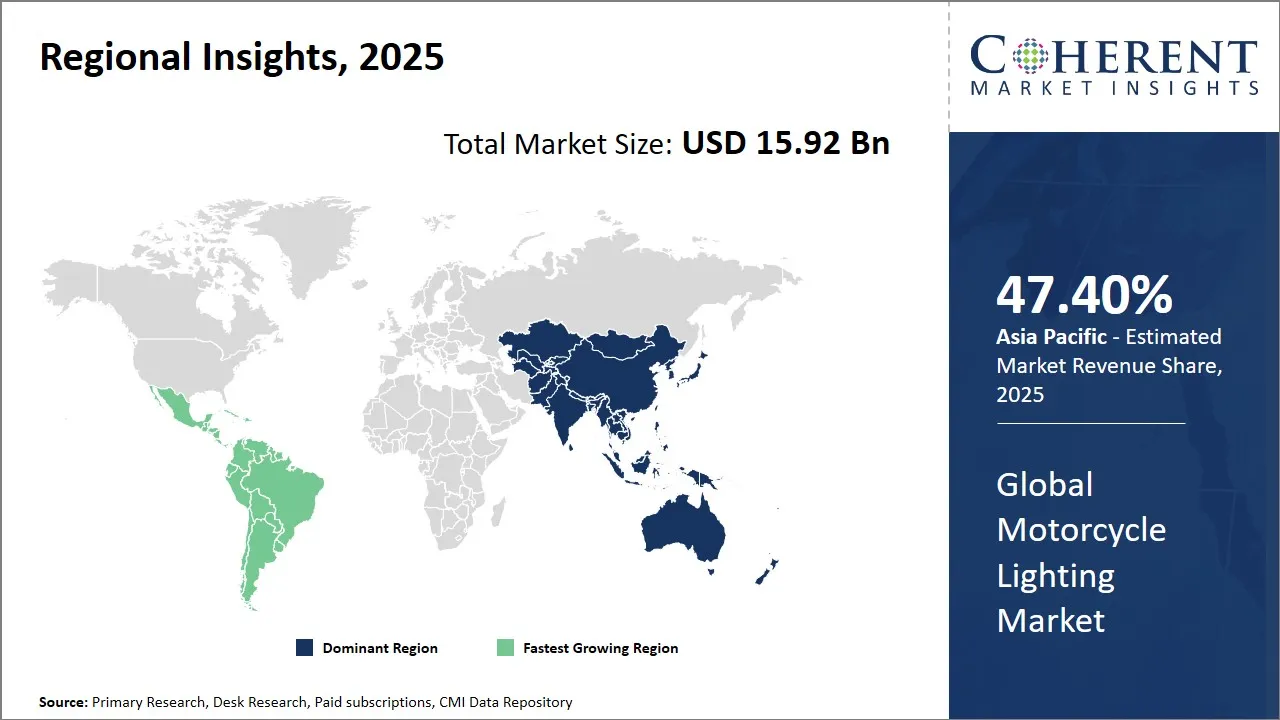
Asia Pacific Motorcycle Lighting Market Analysis and Trends
The Asia Pacific region holding an estimated share of 47.4% in 2026, dominates the global motorcycle lighting market, driven by the sheer volume of motorcycle production and usage across countries like India, China, Japan, and Southeast Asian nations. This region hosts a dense motorcycle ecosystem due to high urban population density, affordable transportation needs, and growing middle-class demand.
Government policies promoting road safety and emission reductions have led to stricter regulations on automotive lighting standards, encouraging the adoption of advanced LED and adaptive lighting technologies. Additionally, the strong presence of leading two-wheeler manufacturers such as Hero MotoCorp, Honda, Yamaha, and Suzuki fosters local R&D and supply chain development for lighting components.
Latin America Motorcycle Lighting Market Analysis and Trends
Latin America, holding an estimated share of 9.2% in 2026, is the fastest-growing region in the motorcycle lighting market, driven by increasing adoption of motorcycles and scooters for urban mobility and delivery services. Countries such as Brazil, Mexico, and Colombia have witnessed rapid growth in two-wheeler sales, creating strong demand for reliable and durable lighting solutions. The rising popularity of aftermarket customization and the gradual shift toward energy-efficient LED and adaptive lighting technologies are further boosting the market.
Government initiatives to improve road safety and regulations promoting the use of high-visibility lighting systems are encouraging the adoption of modern motorcycle lighting. Local and regional suppliers, along with global players like Varroc, Fiem Industries, and Koito, are expanding their presence, enhancing product availability and catering to diverse consumer preferences.
Global Motorcycle Lighting Market Outlook for Key Countries
India Motorcycle Lighting Market Analysis and Trends
India is characterized by a large volume of demand generated from commuter motorcycles, driven by increasing urbanization and affordable two-wheeler ownership. Indian government initiatives focusing on improved road safety and energy efficiency push manufacturers to adopt LED lighting and other advanced technologies. Hero MotoCorp and Bajaj Auto play central roles in the ecosystem, collaborating with lighting specialists to localize production and reduce costs. The market is also witnessing growth in aftermarket accessories, with companies such as Lumax Industries innovating in lighting solutions tailored for local conditions.
China Motorcycle Lighting Market Analysis and Trends
China continues to lead as a manufacturing powerhouse, producing a wide range of motorcycles that cater to both domestic and international markets. Strong government emphasis on sustainable transportation promotes the integration of intelligent lighting systems to meet rigorous safety and environmental standards. Major players like Zongshen and Loncin are active in R&D and manufacturing of cutting-edge lighting components, often partnering with global firms for technological advancements. The country’s export-oriented trade environment also allows Chinese manufacturers to influence global lighting trends through competitive pricing and technological adaptations.
U.S. Motorcycle Lighting Market Analysis and Trends
The U.S. stands out for its premium motorcycle segment, where consumer preference trends lean towards customization and upgraded lighting technology including adaptive headlights and DRLs (Daytime Running Lights). The regulatory landscape led by the National Highway Traffic Safety Administration (NHTSA) encourages implementation of high-performance lighting to improve rider safety. Industry giants such as Harley-Davidson and aftermarket specialists like Kuryakyn and JW Speaker contribute significantly to the innovation and supply of advanced motorcycle lighting systems. Additionally, growing e-motorcycle adoption in the U.S. market stimulates demand for energy-efficient, long-lasting lighting technologies.
Japan Motorcycle Lighting Market Analysis and Trends
Japan motorcycle lighting market benefits from advanced manufacturing capabilities and high emphasis on innovation and quality. Strict government safety regulations mandate enhanced lighting features, pushing local manufacturers like Honda, Yamaha, and Suzuki to integrate sophisticated LED and projector lighting systems in their product lines. Japan's established component suppliers and close integration with Original Equipment Manufacturers (OEMs) create a cohesive ecosystem that supports technological progress and market stability. The country’s focus on exports also drives the continuous evolution of lighting solutions tailored for global customers.
Brazil Motorcycle Lighting Market Analysis and Trends
Brazil motorcycle lighting market growth is influenced by rising motorcycle usage primarily for both personal mobility and commercial purposes. Government standards for road safety are evolving, which encourages adoption of improved lighting technologies to reduce accidents. Local players such as DTM Lighting and Philips Brazil collaborate to innovate lighting solutions suited to diverse road conditions and climatic challenges. Moreover, expanding dealership networks and rising aftermarket preferences contribute to the broader adoption of modern lighting technologies, enhancing product penetration across the country.
Market Players, Key Development, and Competitive Intelligence
Key Developments
- In February 2025, Stanley Electric Co., Ltd. announced that it has become an official sponsor of "Honda HRC Castrol", a motorcycle racing team fielded by Honda Racing Corporation (HRC), for the 2025 season.
- In March 2024, ams OSRAM launched the NIGHT BREAKER LED GEN 2 H7, providing for the first time an H7 retrofit lamp for low and high beam on motorcycles.
- In September 2024, KOITO MANUFACTURING CO., LTD. announced plans to increase production capacity in Mexico and Brazil in response to the medium- to long-term growth of the automotive industry and to the increase in new orders in the Americas.
- In February 2024, the international automotive supplier, FORVIA HELLA, together with the Austrian motorcycle manufacturer, KTM, developed a holistic concept for a motorcycle headlamp. This will go into series production with the 990 Duke and 1390 Super Duke R models.
Top Strategies Followed by the Motorcycle Lighting Market Players
- Established industry leaders dominate the market through robust investments in research and development, continuously innovating to deliver high-performance, energy-efficient, and aesthetically advanced lighting products.
- FORVIA HELLA secured a contract with KTM (2024) to supply advanced LED headlamps with adaptive functionality and animated DRLs, showcasing how R&D-led innovation drives OEM partnerships and reinforces market leadership.
- Mid-level players in the motorcycle lighting market adopt a more cost-conscious approach, focusing on delivering balanced products that merge quality with affordability.
- Fiem Industries expanded its LED product line and secured contracts with leading motorcycle OEMs such as Hero MotoCorp, offering cost-efficient lighting modules tailored to high-volume commuter motorcycles.
- Small-scale players in the global motorcycle lighting market carve out niche opportunities by concentrating on specialized features and innovative designs that differentiate them from more prominent competitors.
- JW Speaker offers its Adaptive 2 Series LED headlights, designed specifically for premium motorcycles and the aftermarket, offering advanced cornering illumination not commonly available from mainstream suppliers.
Market Report Scope
Automotive Suspension Market Report Coverage
| Report Coverage | Details | ||
|---|---|---|---|
| Base Year: | 2025 | Market Size in 2026: | USD 17.27 Bn |
| Historical Data for: | 2020 To 2024 | Forecast Period: | 2026 To 2033 |
| Forecast Period 2026 to 2033 CAGR: | 8.5% | 2033 Value Projection: | USD 30.58 Bn |
| Geographies covered: |
| ||
| Segments covered: |
| ||
| Companies covered: | FORVIA HELLA, ams OSRAM, Stanley Electric Co., Ltd., Varroc Lighting Systems, Koito Manufacturing Co., Ltd., Lumax Industries, Fiem Industries, Minda Corporation, JW Speaker, Philips Automotive Lighting, Cobo, Rinder, Unitech, Lazer Lamps, and Bruno | ||
| Growth Drivers: |
| ||
| Restraints & Challenges: |
| ||
Market Dynamics
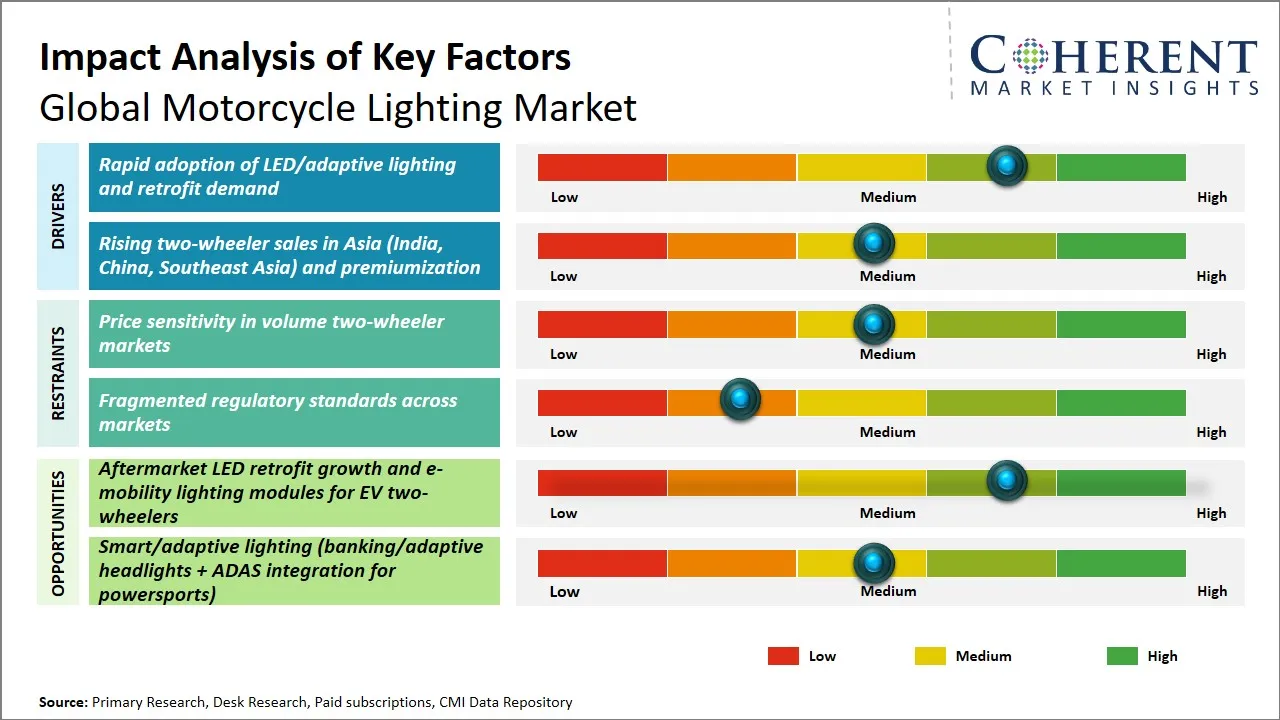
Global Motorcycle Lighting Market Driver – Rapid Adoption of LED/Adaptive Lighting and Retrofit Demand
The motorcycle lighting market is witnessing significant momentum due to the rapid adoption of LED and adaptive lighting technologies, which offer enhanced visibility, energy efficiency, and durability compared to traditional lighting systems. LED lights provide brighter illumination with lower power consumption, making them highly favorable for motorcycles that require optimal lighting without compromising battery life. Furthermore, adaptive lighting systems that adjust beam patterns based on riding conditions and road curvature are gaining traction, improving safety by delivering tailored light distribution and reducing glare for oncoming traffic.
In 2024, ams OSRAM launched its NIGHT BREAKER LED GEN 2 H7 retrofit lamps approved for motorcycle use. This product allowed riders to replace halogen bulbs with legal, high-performance LED solutions, directly addressing the growing retrofit demand and accelerating LED penetration in existing fleets. This technological shift is also fueling retrofit demand, as many motorcycle owners seek to upgrade older models with modern, high-performance lighting solutions to enhance both aesthetics and functionality. The increasing preference for customized and safer riding experiences is encouraging manufacturers and aftermarket suppliers to innovate, thereby propelling adoption rates.
Global Motorcycle Lighting Market Opportunity – Aftermarket LED Retrofit Growth and E-Mobility Lighting Modules for EV Two-Wheelers
As consumers increasingly prioritize enhanced safety, energy efficiency, and aesthetic appeal, LED retrofit kits have gained tremendous traction. These aftermarket solutions offer riders a cost-effective way to upgrade their existing motorcycle lighting systems with brighter, longer-lasting, and more energy-efficient LEDs compared to traditional halogen or incandescent bulbs. The retrofit trend is further bolstered by growing awareness about road safety and stringent vehicle lighting regulations in key markets.
Manufacturers are innovating lightweight, low-energy consumption lighting systems integrated with advanced technologies such as adaptive lighting and connectivity features to align with modern EV specifications. Fiem Industries in India expanded its supply of LED lighting systems for electric two-wheelers, securing orders from emerging EV brands such as Okinawa and Ampere. Additionally, government incentives and urban centers promoting electric mobility are accelerating the penetration of EV two-wheelers, thereby amplifying the need for specialized e-mobility lighting solutions.
Analyst Opinion (Expert Opinion)
- Integration of AI and sensor fusion is pushing motorcycle lighting toward adaptive headlamps that adjust beam angle and intensity based on lean angle, speed, and ambient conditions. This enhances safety and aligns with stricter global road safety norms.
- The shift toward IoT-enabled and V2X-integrated lighting is expected to accelerate, where lights not only improve visibility but also communicate with other vehicles and infrastructure, paving the way for connected mobility ecosystems.
- With the rapid adoption of electric motorcycles and scooters, OEMs are focusing on lightweight, low-power LED and laser-based modules that extend battery range while offering advanced styling flexibility, making EV-specific lighting a high-growth niche.
Speak to the analyst
Want personalized insights?
Take the findings above to one of our principal consultants, or have the report rebuilt around the segments, geographies and competitors you actually track.
Market Segmentation
- Product Type Insights (Revenue, USD Bn, 2021 - 2033)
- Headlamps
- Taillights
- Turn Indicators
- DRLs & Position Lights
- Auxiliary
- Technology Insights (Revenue, USD Bn, 2021 - 2033)
- LED
- Halogen
- HID
- Others
- Regional Insights (Revenue, USD Bn, 2021 - 2033)
- North America
- U.S.
- Canada
- Latin America
- Brazil
- Argentina
- Mexico
- Rest of Latin America
- Europe
- Germany
- U.K.
- Spain
- France
- Italy
- Russia
- Rest of Europe
- Asia Pacific
- China
- India
- Japan
- Australia
- South Korea
- ASEAN
- Rest of Asia Pacific
- Middle East
- GCC Countries
- Israel
- Rest of Middle East
- Africa
- South Africa
- North Africa
- Central Africa
- North America
- Key Players Insights
- FORVIA HELLA
- ams OSRAM
- Stanley Electric Co., Ltd.
- Varroc Lighting Systems
- Koito Manufacturing Co., Ltd.
- Lumax Industries
- Fiem Industries
- Minda Corporation
- JW Speaker
- Philips Automotive Lighting
- Cobo
- Rinder
- Unitech
- Lazer Lamps
- Bruno
Sources
Primary Research Interviews
Stakeholders
- Motorcycle OEMs and Two-Wheeler Manufacturers (e.g., Honda, Yamaha, Bajaj, Hero MotoCorp)
- Motorcycle Lighting System Suppliers (e.g., Koito, Varroc, Fiem Industries, Hella)
- Aftermarket Distributors and Retailers specializing in lighting solutions
- Electric Two-Wheeler Manufacturers and Startups (e.g., Ola Electric, Ather, Gogoro)
- Dealership Networks and Service Centers
- Automotive Lighting Engineers and Product Development Managers
- Regulatory & Safety Authorities focusing on vehicle lighting compliance
Databases
- EUROSTAT
- U.S. Department of Transportation (DOT) Vehicle Data
- Society of Indian Automobile Manufacturers (SIAM) Statistics
- International Motorcycle Manufacturers Association (IMMA)
- Organization for Economic Co-operation and Development (OECD)
Magazines
- Motorcycle News (MCN)
- Cycle World
- Rider Magazine
- Motorcyclist Online
- Powersports Business
Journals
- SAE International Journal of Transportation Safety
- Journal of Intelligent Transportation Systems
- IEEE Transactions on Vehicular Technology
- International Journal of Automotive Technology
- Transportation Research Part C: Emerging Technologies
Newspapers
- The Economic Times (India)
- Nikkei Asia (Japan)
- The Guardian (U.K.)
- The Wall Street Journal (U.S.)
- Financial Express (India)
Associations
- Automotive Component Manufacturers Association of India (ACMA)
- Japan Automobile Manufacturers Association (JAMA)
- Motorcycle Industry Association (MCIA, UK)
- Society of Automotive Engineers (SAE)
- European Association of Motorcycle Manufacturers (ACEM)
Public Domain Sources
- U.S. National Highway Traffic Safety Administration (NHTSA)
- EUROSTAT
- World Bank
- United Nations Economic Commission for Europe (UNECE)
- ResearchGate
Proprietary Elements
- CMI Data Analytics Tool
- Proprietary CMI Existing Repository of information for last 8 years
Get access to 250+ pages report
Every segment, forecast, competitor profile and data table behind the analysis above — available for instant download.
- ESOMAR Member
- ISO 9001:2015 Certified
- D-U-N-S Registered
- GDPR & CCPA Compliant
Missing comfort of reading report in your local language? Find your preferred language:
Transform your Strategy with Exclusive Trending Reports
Frequently Asked Questions
The global motorcycle lighting market is estimated to be valued at USD 17.27 billion in 2026 and is expected to reach USD 30.58 billion by 2033.
The CAGR of the global motorcycle lighting market is projected to be 8.5% from 2026 to 2033.
Rapid adoption of LED/adaptive lighting and retrofit demand and rising two-wheeler sales in Asia (India, China, Southeast Asia) and premiumization are the major factors driving the growth of the global motorcycle lighting market.
Price sensitivity in volume two-wheeler markets and fragmented regulatory standards across markets are the major factors hampering the growth of the global motorcycle lighting market.
In terms of product type, the headlamps segment is estimated to dominate the market revenue share in 2026.
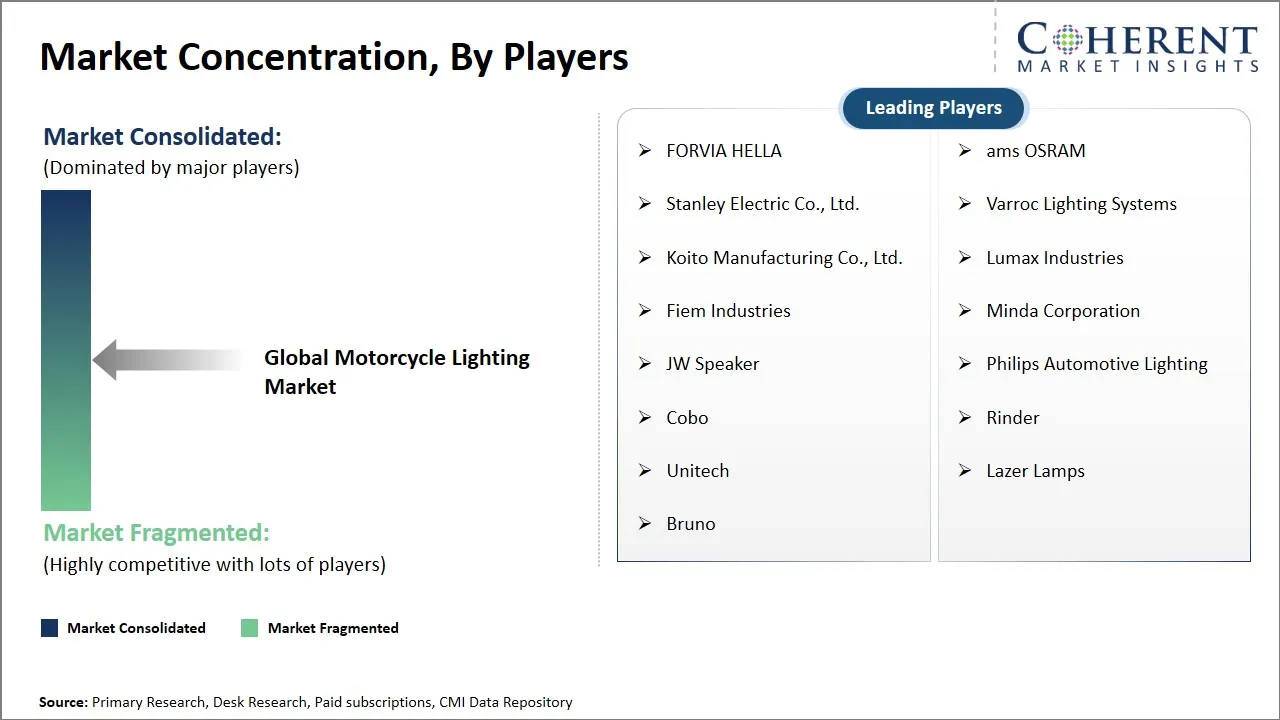
The market shows moderate consolidation (3/5), with many regional and aftermarket players.
AI-driven adaptive lights, connected/V2X systems, and energy-efficient EV modules are reshaping competition.