

Global Network Cables Market Size and Forecast: 2026-2033
Coherent Market Insights estimates that the global network cables market is expected to reach USD 1.25 Bn in 2026 and will expand to USD 1.70 Bn by 2033, registering a CAGR of 3.5% between 2026 and 2033.
Key Takeaways of the Network Cables Market
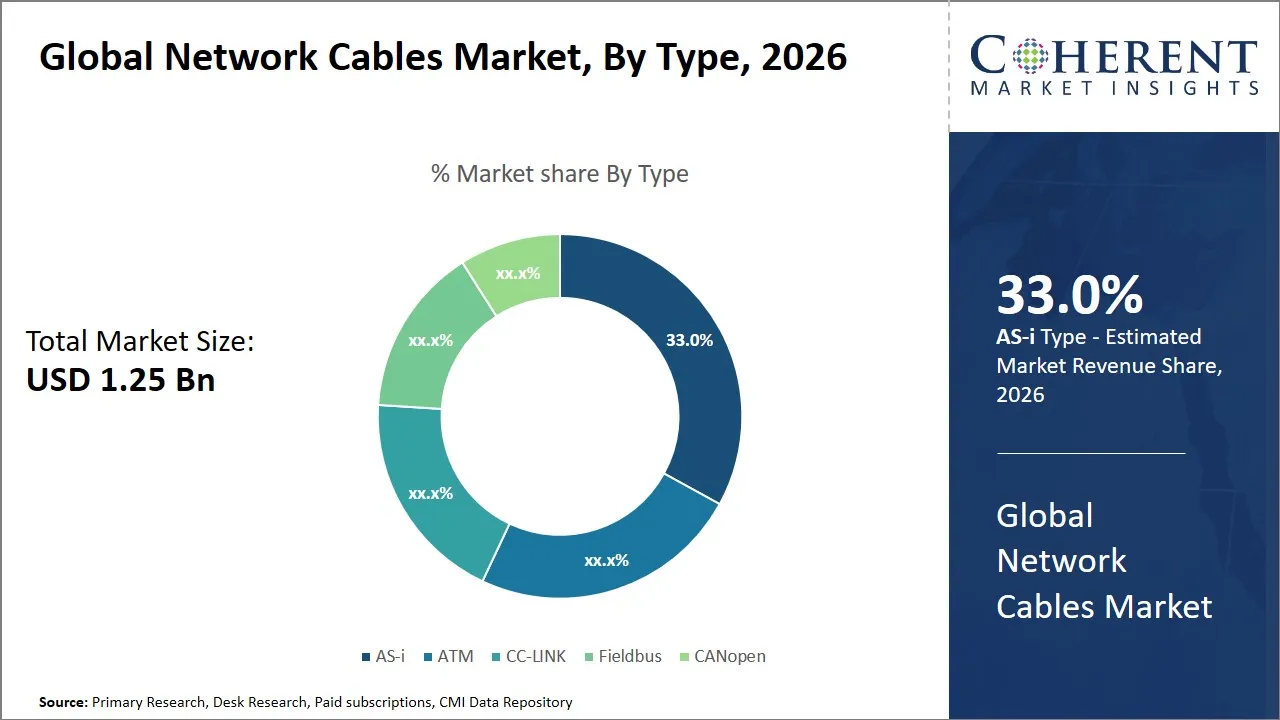
- The AS-i segment is expected to account for 33% of the network cables market share in 2026.
- The residential segment is projected to capture 51% of the market share in 2026.
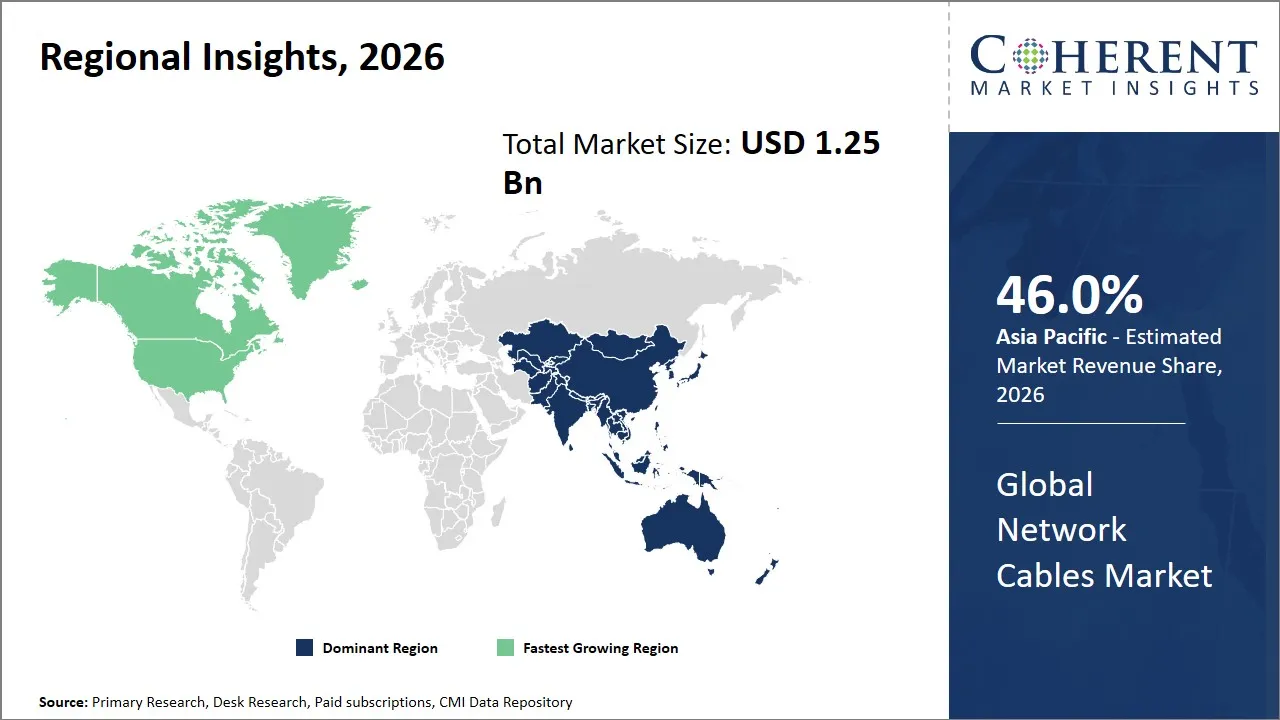
- Asia Pacific is projected to dominate the network cables market in 2026 with a 46%
- North America is expected to hold 31% share in 2026 and is expected to record the fastest growth over the forecast period.
Currents Events and Its Impact
Current Events | Description and its Impact |
Corning and Meta Business Collaboration |
|
Segmental Insights
- Current Industry Events of 2026
- Market Size Estimation
- Regional Breakdown
- Competitive Landscape
- Customer Intelligence
- Segmental Analysis
- Pricing Analysis
- Key Market Drivers, Challenges & Future Trends
- Customized Insights Section
Why Does the AS-i Segment Dominate the Global Network Cables Market in 2026?
The AS-i segment is expected to account for 33.0% of the global network cables market share in 2026. Growth stems mainly from importance in industrial automation, given rising need for straightforward, dependable connections. Though often chosen, these cables allow simple, economic links between sensors and actuators within automated setups, supporting smooth data flow and command handling. Behind expansion lies greater use of intelligent production methods tied to Industry 4.0, as firms aim to improve performance through linked systems that monitor processes instantly.
Residential Segment Dominates the Global Network Cables Market
The residential segment is expected to account for 51.0% of the global network cables market share in 2026. Driven mainly by wider use of smart home devices, global household uptake of IoT shapes current trends. With homes turning into linked digital spaces, need grows for stable cabling able to handle heavy data tasks. Cables hidden from sight make streaming, remote systems, monitoring tools, rapid browsing possible. As routines depend increasingly on invisible links within walls, expectations grow without announcement. What was previously ignored has become essential to household operations each day.
For instance, on October 28, 2024, AT&T announced a multi-year purchase agreement with Corning Incorporated to provide next-generation fiber, cable, and connectivity solutions to support the expansion of AT&T’s fiber network and help bring high-speed internet to more Americans.
(Source: corning.com)
Global Network Cables Market - Fiber Optic vs Copper Economics & Adoption Rates
Metric | Fiber Optic Cables | Copper Cables |
Typical Material Cost per Meter | ~USD 0.60–0.70 for multimode/single-mode fiber | ~USD 0.30 per meter for Cat6a copper |
Installed Cost for 100 m, 10 Gbps Link | ~USD 500 total installed | ~USD 350 total installed |
Typical Speed Capability | 10 Gbps to 400 Gbps+ | Up to ~40 Gbps (Cat8) over short runs |
Transmission Distance without Boosters | Up to ~100 km (long haul) | Effective ~100 m (needs repeaters beyond) |
Data Center Adoption Share | ~59% of cabling market in data centers | ~41% (remainder) |
Structured Cabling Market Adoption | ~65% share fiber in new installs, increasing | ~35% share copper, declining in new installs |
Energy Consumption (per 100 m) | ~1 W (lower) | ~3.5 W (higher) |
Regional Insights
Asia Pacific Network Cables Market Analysis and Trends
The Asia Pacific region is projected to lead the market with a 46% share in 2026. Expansion comes from broad industrial capabilities, alongside links to source providers and device makers, also supported by massive construction efforts. Across Asia Pacific, technological progress drives the demand for advanced cable networks. Japan sets pace with automated infrastructure projects. South Korea follows through integrated urban connectivity plans. India expands access under national digitization efforts. China advances manufacturing capabilities via long-term industrial strategies. Modern factories require reliable data transmission solutions. Transport improvements enable faster distribution of materials. Lower operational costs attract international firms. Nexans adapts facilities to regional requirements. Furukawa Electric increases local output steadily.
Prysmian Group integrates supply chains gradually. Industrial shifts occur without centralized coordination. Expansion continues regardless of policy differences. With trade pacts in place along with policies favoring exports, the area strengthens its role, key in making and using data cables. Even as changes occur globally, steady infrastructure continues influencing where investments flow. While transformations unfold beyond borders, reliability beneath stays pivotal.
For instance, on January 13, 2026, NTT DATA, Sumitomo Corporation, and JA Mitsui Leasing, Ltd. announced the joint establishment of a new company, Intra-Asia Marine Networks Co., Ltd. (I-AM NW), to construct and operate a large-scale submarine communication cable, Intra-Asia Marine Cable (I-AM Cable), connecting Japan, Malaysia and Singapore, with additional connectivity to Korea, the Philippines and Taiwan.
(Source: nttdata.com)
North America Network Cables Market Analysis and Trends
North America is expected to account for a market share of 31% in 2026 and register the fastest growth rate over the forecast period. Demand growth fuels changes in the North American market for network cables, shaped by rising needs for digital frameworks, heavy-data uses, not just business-level connections. Advanced fiber installations now take precedence over older models, a pattern confirmed through recent moves toward organized cabling layouts as essential supports for upcoming network designs. One long-term deal linking Meta and Corning on optical cable delivery illustrates how massive-scale computation demands influence tangible networking components. Industry leaders pour funds into wider production capabilities alongside novel offerings like factory-finished fiber units along with improved Category-classified copper lines, aiming at faster rollouts within corporate hubs and centralized processing sites. Expanding 5G coverage, increasing reliance on remote data storage, government-backed internet expansion plans collectively strengthen importance of reliable, high-speed wiring throughout both private sector operations and telecommunications domains.
Global Network Cables Market Outlook for Key Countries
Why is China Emerging as a Major Hub in the Network Cables Market?
Backed by extensive manufacturing dominance, China holds a central role in the network cables sector. A well-developed chain for assembling electronic components strengthens this standing. Speeding up, 5G network growth marks visible progress in cities. Notable players like YOFC and Hengtong Optic-Electric supply high-performance cables. Their reach extends beyond domestic needs into global markets. Sustained investment by state authorities fuels digital infrastructure development. Despite operating overseas, firms such as Prysmian and Nexans take part in shared projects locally. Because they are present physically, adjustments to goods can meet specific needs. Policies that assist likewise promote creativity, at the same time smoothing routes for global trade.
Is U.S. the Next Growth Engine for the Network Cables Market?
Progress in network wiring holds strong focus in U.S., driven forward via upgrades in data hubs, internet-based services, along with smart industrial operations. Major companies such as CommScope, Belden, and also Corning guide development using high-speed optical cables together with efficient wired solutions. Through initiatives similar to the National Broadband Plan, national support strengthens connectivity infrastructure, enabling growth to emerge gradually. When signals move faster, design precision matters more than before. Domestic manufacturing sees preference; however, select imported goods address specialized demands. Distinction among providers emerges via unique features rather than price alone, with attention shifting toward environmental care and alignment with tough legal benchmarks.
Germany Network Cables Market Analysis and Trends
Driven by heavy industry, Germany's cable sector sees steady demand from automakers, factories, and power providers needing durable, high-speed connections. Despite widespread competition, Prysmian Group and Nexans hold steady influence by supplying specialized solutions developed via concentrated study. Precision-defined systems take priority over standard models, fitting seamlessly into digitized manufacturing settings. Government-backed initiatives promoting intelligent production drive integration of updated cabling architectures within industrial sites. From central locations, movement of goods across borders becomes smoother than relying only on domestic networks. Because rules now focus on cutting power loss, modern facilities slowly take over from outdated ones. Market stability stems partly from consistent investment in grid upgrades and automated processes alike. Suppliers adapt quickly because access to neighboring economies allows flexible response patterns
India Network Cables Market Analysis and Trends
India's network cable sector advances in step with broader digital goals, driven by initiatives like Digital India that shape long-term planning. Across different areas, smart urban development’s rise gradually, pushing system modernization forward. Investment from non-public sources enters telecommunications frameworks, reinforcing ongoing growth patterns. Despite global players maintaining a presence locally, enterprises like Finolex Cables and Polycab India stay engaged. When regulations favor home-based production, conditions shift accordingly for modern cabling solutions. Because support channels prioritize homegrown results, digital changes spread more easily. Demand rises steadily - not only from technology districts but also densely populated areas and industrial zones. Expansion does not depend solely on internal needs; trade adjustments support broader integration. A focus on independent electronics production alters sourcing patterns gradually. Market dynamics evolve under these combined pressures, reshaping supply structures over time.
South Africa Network Cables Market Analysis and Trends
A leading position belongs to South Africa within the Middle East and Africa network cables landscape. Driven by rising mobile usage alongside expanding internet connectivity, its telecom industry requires continuous updates to physical networks. Presence has been secured locally by firms such as Leviton and Belden, delivering solutions adapted to African conditions - cables built to endure extreme climates are among them. Support emerges from state-backed initiatives focused on wider broadband coverage and intelligent urban systems. Access expands through South Africa's function as a commercial hub linking nearby developing economies. Growth follows for suppliers, fueled both by local modernization and cross-border distribution channels.
Market Players, Key Development, and Competitive Intelligence
Key Developments
- On October 11, 2025, Prysmian introduced the BendBrightXS 160µm single-mode optical fiber, the world’s first of its kind. This breakthrough enables cables to be much smaller and pack more fibers together, which is essential for modern digital networks.
- On August 4, 2025, CommScope, a global leader in network connectivity, announced it has entered into a definitive agreement to sell its Connectivity and Cable Solutions (CCS) segment to Amphenol Corporation.
- On May 28, 2025, Belden Inc., a leading global provider of complete connection solutions, announced the launch of its 10GXM13 Category 6A Cable. Building on Belden’s leadership in the smart infrastructure space, this 0.230” (5.84 mm) cable sets new standards for small-diameter Category 6A cables.
Top Strategies Followed by Global Network Cables Market Players
Player Type | Strategic Focus | Example |
Established Market Leaders | Product Launch | On September 1, 2025, HUBER+SUHNER introduced a Fiber Optic Offshore Splice Box positioned as IP67, modular, high-density, plug-and-play; references WDM integration and future scalability. |
Mid-Level Players | Siemon Product Launch | On June 19, 2025, The Siemon Company announced the launch of Smart Building COMPLETE, a unified connectivity and cabling solution engineered to power and connect the critical technologies shaping modern workplaces. |
Small-Scale Players | Business Acquisition | On April 2, 2025, Legrand Group announced the acquisition of Computer Room Solutions (CRS) in datacenters in Australia. Legrand is pursuing its active bolt-on acquisition strategy with today’s announcement of Computer Room Solutions (CRS). |
Market Report Scope
Network Cables Market Report Coverage
| Report Coverage | Details | ||
|---|---|---|---|
| Base Year: | 2025 | Market Size in 2026: | USD 1.25 Bn |
| Historical Data for: | 2020 To 2024 | Forecast Period: | 2026 To 2033 |
| Forecast Period 2026 to 2033 CAGR: | 3.5% | 2033 Value Projection: | USD 1.70 Bn |
| Geographies covered: |
| ||
| Segments covered: |
| ||
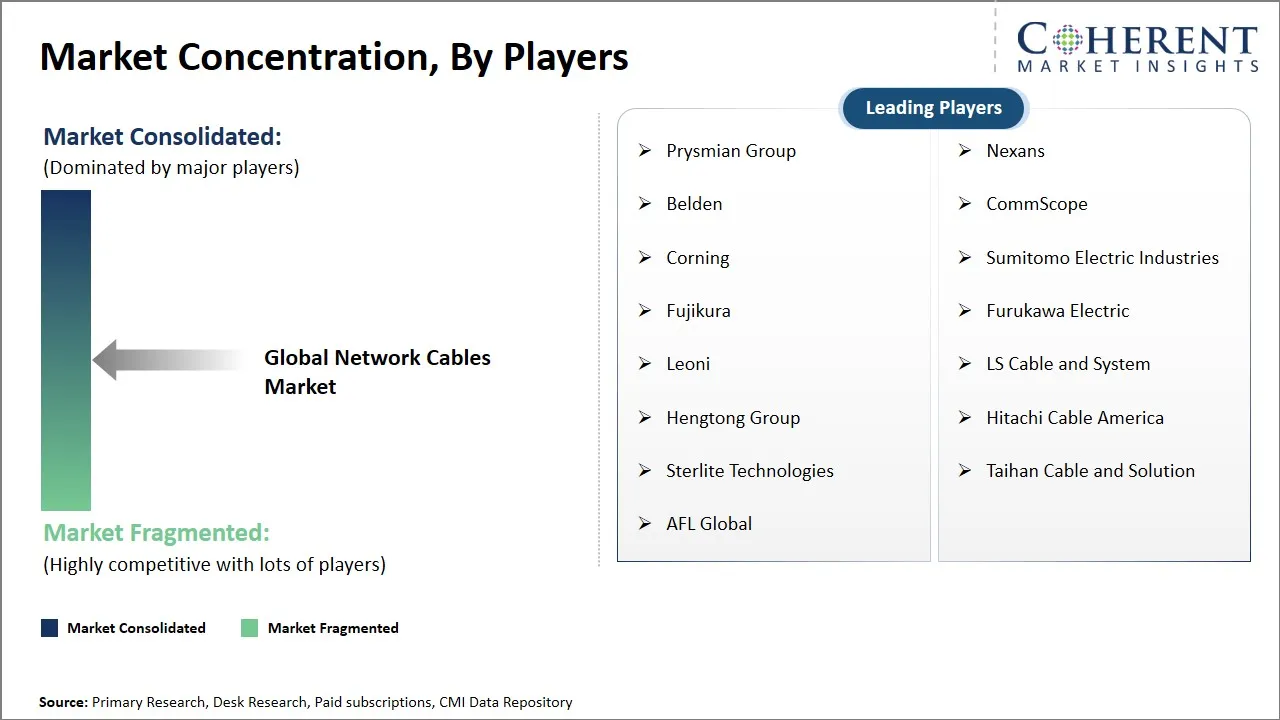
| Companies covered: | Prysmian Group, Nexans, Belden, CommScope, Corning, Sumitomo Electric Industries, Fujikura, Furukawa Electric, Leoni, LS Cable and System, Hengtong Group, Hitachi Cable America, Sterlite Technologies, Taihan Cable and Solution, and AFL Global | ||
| Growth Drivers: |
| ||
| Restraints & Challenges: |
| ||
Global Network Cables Market Dynamics
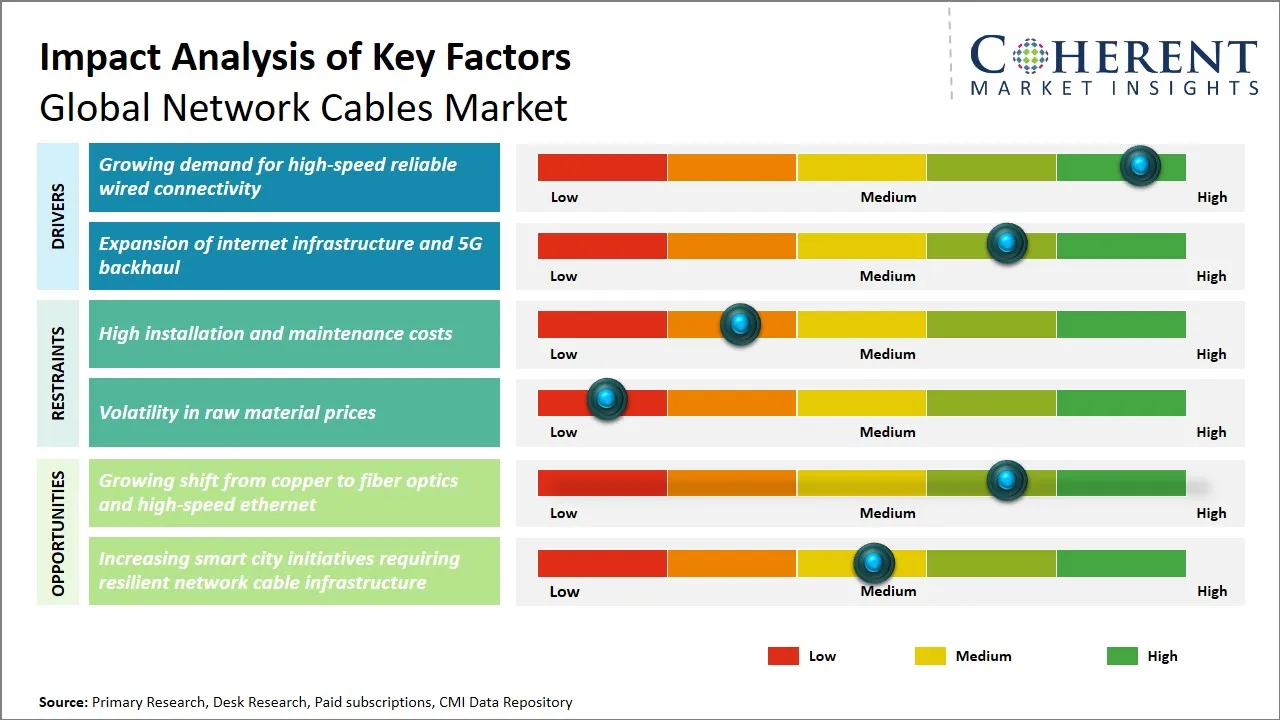
Global Network Cables Market Driver - Growing Demand for High ‑ Speed Reliable Wired Connectivity
The escalating need for high-speed and reliable wired connectivity is a pivotal factor driving the global network cables market. With change moving quickly through fields like technology, communications, and business systems, steady high-speed internet becomes a top focus for many groups running heavy data tasks. Where signals travel through air, wire and cables provide tighter protection, quicker response times, shorter delays, along with reliable capacity, needed elements when handling cloud platforms, large server rooms, real-time meetings by camera.
For instance, on June 20, 2025, CommScope announced the launch of the FiberREACH solution and the launch of CableGuide 360 platform. Both fall within CommScope’s SYSTIMAX 2.0 portfolio, the FiberREACH solution is designed to help enterprise network providers quickly and reliably extend power and connectivity to support more devices and applications at the edge.
(Source: commscope.com)
Global Network Cables Market Opportunity - Growing Shift from Copper to Fiber Optics and High ‑ Speed Ethernet
Among key developments in the worldwide network cable infrastructure sector, movement toward optical fiber and advanced ethernet switches and router systems stands out prominently. Where speed and data scale define operations, telecoms, server centers, and enterprise systems set early usage patterns. Even if legacy copper persists, its constraints become harder to overlook amid rising loads. Over distance, light-based channels deliver signals with far less weakening, enabling reach that skips frequent amplification. In environments sensitive to interference, immunity to electromagnetic disruption adds notable benefit.
On February 6, 2025, Corning published an industry strategic paper, highlighting fiber optic’s advantages as copper networks age and become obsolete, and positioning fiber as the future backbone for connectivity infrastructure. The release emphasizes optical fiber performance benefits over aging copper infrastructure.
(Source: corning.com)
Analyst Opinion (Expert Opinion)
- Emerging patterns in digital architecture shape the worldwide market for network cables, steering it toward faster, more capable systems. Fueled by escalating demands, expansion becomes evident where vast server networks meet cloud operations, advanced cellular systems, and updated business technologies. Although legacy copper lines persist, optical cables advance, offering higher throughput alongside scalability. Design changes within physical frameworks underpin much of this transition.
- Even as hyperscaler-funded undersea cables and advanced network builds highlight strong appetite for tangible connection systems, rising deployment expenses, limited workforce availability, combined with growing reliance on wireless alternatives, act as balancing elements affecting expansion speed across certain areas. With these dynamics in play, emerging advances - like fibers resistant to bending loss, mixed-media cable designs, along with more efficient setup methods - are viewed by experts as strategic moves allowing companies to stay aligned with upcoming demand despite persistent field obstacles.
Speak to the analyst
Want personalized insights?
Take the findings above to one of our principal consultants, or have the report rebuilt around the segments, geographies and competitors you actually track.
Market Segmentation
- Type Insights (Revenue, USD Bn, 2026 - 2033)
- AS-i
- ATM
- CC-LINK
- Fieldbus
- CANopen
- Application Insights (Revenue, USD Bn, 2026 - 2033)
- Residential
- Commercial
- Regional Insights (Revenue, USD Bn, 2026 - 2033)
- North America
- U.S.
- Canada
- Latin America
- Brazil
- Argentina
- Mexico
- Rest of Latin America
- Europe
- Germany
- U.K.
- Spain
- France
- Italy
- Russia
- Rest of Europe
- Asia Pacific
- China
- India
- Japan
- Australia
- South Korea
- ASEAN
- Rest of Asia Pacific
- Middle East
- GCC Countries
- Israel
- Rest of Middle East
- Africa
- South Africa
- North Africa
- Central Africa
- North America
- Key Players Insights
- Prysmian Group
- Nexans
- Belden
- CommScope
- Corning
- Sumitomo Electric Industries
- Fujikura
- Furukawa Electric
- Leoni
- LS Cable and System
- Hengtong Group
- Hitachi Cable America
- Sterlite Technologies
- Taihan Cable and Solution
- AFL Global
Sources
Primary Research Interviews
- Network Cable Manufacturers
- Telecommunications Equipment Suppliers
- Data Center Operators
- IT Infrastructure Managers
Databases
- Global Trade Atlas
Magazines
- Network World Magazine
- Data Center Knowledge
- Cabling Installation & Maintenance
- Communications Technology Magazine
Journals
- IEEE Communications Magazine
- Journal of Network and Computer Applications
- Telecommunications Policy Journal
Newspapers
- Financial Times
- The Wall Street Journal
- Business Wire
- Reuters Technology News
Associations
- Telecommunications Industry Association (TIA)
- Fiber Optic Association (FOA)
- Building Industry Consulting Service International (BICSI)
- Ethernet Alliance
Public Domain Sources
- Federal Communications Commission (FCC) Reports
- International Telecommunication Union (ITU) Statistics
- World Bank ICT Statistics
- OECD Digital Economy Reports
Proprietary Elements
- CMI Data Analytics Tool
- Proprietary CMI Existing Repository of information for last 8 years
Get access to 250+ pages report
Every segment, forecast, competitor profile and data table behind the analysis above — available for instant download.
- ESOMAR Member
- ISO 9001:2015 Certified
- D-U-N-S Registered
- GDPR & CCPA Compliant
Missing comfort of reading report in your local language? Find your preferred language:
Transform your Strategy with Exclusive Trending Reports
Frequently Asked Questions
The global network cables market is expected to stand at USD 1.25 Bn in 2026 and is expected to reach USD 1.70 Bn by 2033
The CAGR of global network cables market is projected to be 3.5% from 2026 to 2033.
Growing demand for high‑speed reliable wired connectivity and expansion of internet infrastructure and 5G backhaul are the major factors driving the growth of the global network cables market.
High installation and maintenance costs and volatility in raw material prices are the major factors hampering the growth of the global network cables market.
In terms of type, AS-i is estimated to dominate the market revenue share in 2026.
Prysmian Group, Nexans, Belden, CommScope, Corning, Sumitomo Electric Industries, Fujikura, Furukawa Electric, Leoni, LS Cable and System, Hengtong Group, Hitachi Cable America, Sterlite Technologies, Taihan Cable and Solution, and AFL Global are the major players.
Asia Pacific is expected to lead the global network cables market in 2026.