

Wire And Cables Market Size and Forecast – 2026 to 2033
The wire and cables market is estimated to be valued at USD 251.14 Bn in 2026 and is expected to reach USD 367.76 Bn by 2033, growing at a compound annual growth rate (CAGR) of 5.6% from 2026 to 2033.
Key Takeaways
- Based on Installation Type, Underground Installation segment is projected to account for 59.6% shares of the global market in 2026, owing to extensive infrastructure activities.
- Based on Voltage, the Low Voltage segment is expected to capture 39.20% share of the market in 2026, due to affordability factor and wide application in end use industries.
- Based on Industry Verticals, the Energy and Power industry is projected to command 42.77% share of the market in 2026, due to its role in delivering electricity consistently.
- Based on Region, Asia Pacific is set to dominate the global wires & cables market with a 27.3 % share in 2026.
Market Overview
The market is expected to witness positive growth over the forecast period owing to increasing investments in telecommunication and power transmission infrastructure projects across both developed and developing countries.
Moreover, rapid urbanization and industrialization along with reviving construction activities will boost the consumption of wires and cables. Furthermore, rising demand for reliable and durable wires and cables from end-use industries, such as IT & telecom, construction, energy, and automotive, will drive the wires and cables market growth during the next few years.
Current Events and Its Impact
Current Event | Description and its Impact |
Global Energy Transition and Renewable Infrastructure Development |
|
Electric Vehicle Revolution and Charging Infrastructure Boom |
|
Export Import Analysis of Cables
Between June 2024 and May 2025, India exported 196,048 cable shipments, showing a 25% growth over the previous year. These exports involved 7,087 Indian exporters and 15,078 international buyers. In May 2025 alone, India shipped 18,250 cable consignments, reflecting no change year-on-year or from April 2025.
The United States, France, and Germany are the main destinations for India's cable exports.
Globally, the top cable exporters are
- China – 3,021,726 shipments
- Mexico – 2,512,909 shipments
- Vietnam – 2,082,434 shipments
China leads in global cable exports.
- Current Industry Events of 2026
- Market Size Estimation
- Regional Breakdown
- Competitive Landscape
- Customer Intelligence
- Segmental Analysis
- Pricing Analysis
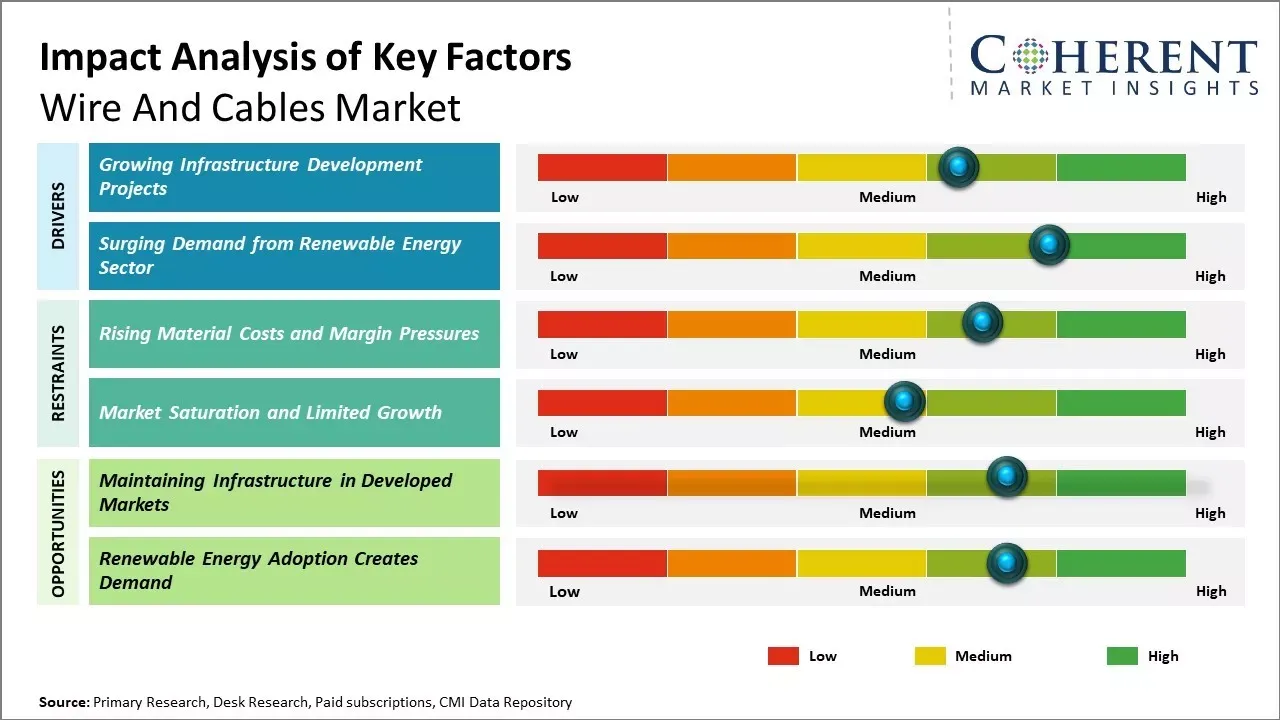
- Key Market Drivers, Challenges & Future Trends
- Customized Insights Section
Wires and Cables Market Growth Drivers
Growing Infrastructure Development Projects
The global infrastructure sector has witnessed significant growth over the past few years and this growth is expected to continue moving forward. Governments around the world are sharply focusing on the development of smart cities and upgrading of the transportation and utility infrastructure.
Major economies are making enormous investments in construction of new roads, bridges, rail networks, airports, seaports, power generation, and distribution facilities. In September 2025, the newly formed Office of Louisiana Highway Construction announced a bold plan to repair 62 small rural bridges across the state by the end of next year. This widespread infrastructure construction activity is directly driving the demand for wire and cables. Various types of cables including power cables, control cables, instrumentation cables, fiber optic cables and others are essential components used in different infrastructure projects. As modern infrastructure increasingly incorporates digital and smart technologies, the role and importance of cables become even more pronounced.
Surging Demand from Renewable Energy Sector
The renewable energy sector has emerged as a major driver of global economic growth in recent times owing to sustainability concerns. Strong policy support for clean technologies along with plunging prices of solar panels and wind turbines has made renewable power commercially viable.
According to estimates, the global renewable energy capacity is projected to almost double by 2030. This clean energy expansion predominantly relies on technologies such as solar PV, wind, hydro among others. All these renewable power solutions have one thing common - extensive use of cables for smooth generation, transmission and distribution of electricity.
Right from inter-array cables used within solar parks and wind farms to long transmission cables required to wheel power from remote projects to cities - cables lie at the heart of renewable infrastructure. Furthermore, construction of offshore wind projects necessitates special types of cables that can withstand harsh marine conditions. The bright outlook for renewable sources of energy guarantees rising demand trajectories for different varieties of polymer and metallic wires & cables in the upcoming years.
According to the International Energy Agency (IEA), renewable electricity generation capacity worldwide is expanding rapidly, with the potential to triple by 2030. In 2023, the capacity for renewable energy increased by 50%, reached nearly 510 gigawatts (GW). Solar photovoltaic (PV) accounted for three-quarters of this growth globally.
China saw the largest increase, installing as much solar PV in 2023 as the entire world did in 2022, and its wind power capacity rose by 66%. Europe, the United States, and Brazil also experienced record-high growth in renewable energy capacity.
Segmental Insights
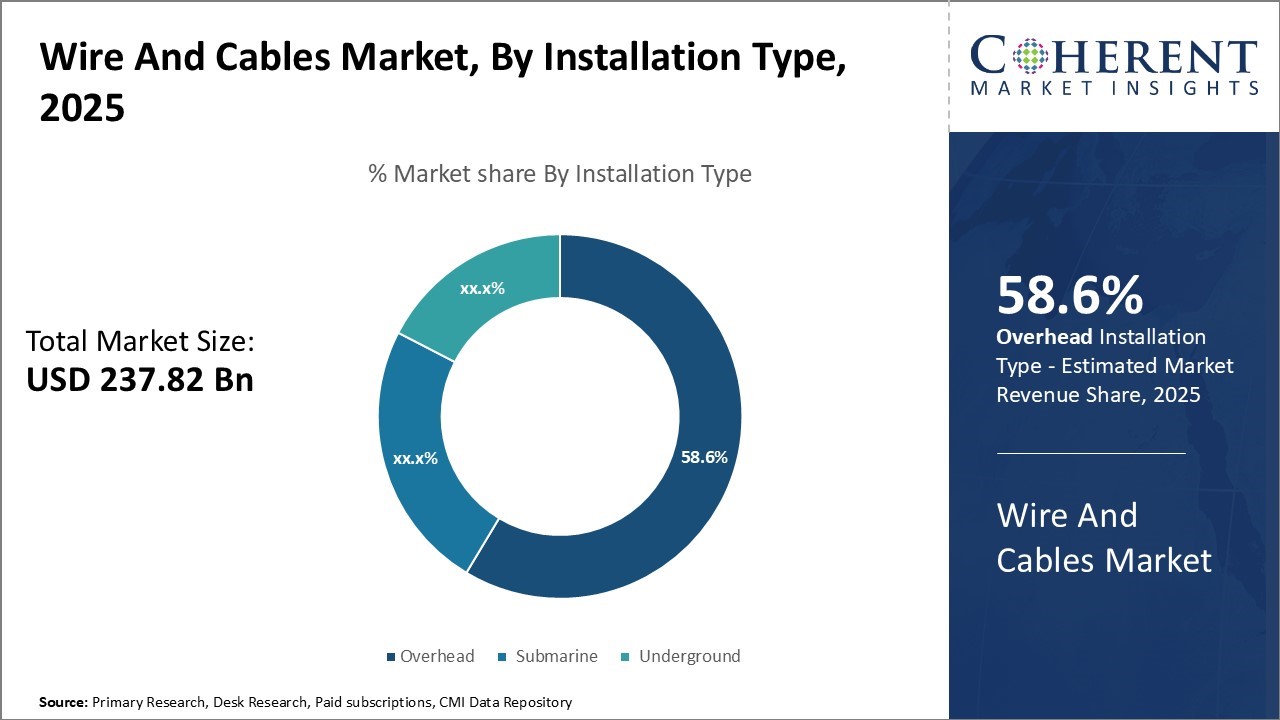
Wire and Cables Market Insights, By Installation Type - Infrastructure Development Fuels the Growth of Underground Installation
The underground installation segment is expected to hold the largest share of 59.6% in 2026, owing to extensive infrastructure development activities worldwide. Laying cables underground provides several advantages compared to overhead installation, making it a preferred choice for new construction projects.
Governments across regions are focusing on modernizing and expanding transportation and utility infrastructure. Mega projects for developing rail networks, Metro lines, water distribution systems and power grids involve vast underground cabling work.
Countries want to minimize visual pollution and prevent cable faults during extreme weather, thus pushing more investment into undergrounding. Cable trenches are dug during construction of roads, bridges and buildings to lay wires that will supply power and telecom services on completion.
Urbanization is another driver as densely populated cities lack space for aerial networks. Underground cables help avoid clutter and safety issues from falling wires. Many cities have underway projects to shift existing overhead wires below the ground.
Developing telecom infrastructure also relies heavily on underground ducts for laying optic fiber networks that support high-speed internet rollout. 5G network expansion will further boost demand as it requires fiber to be placed in close proximity of mobile towers and consumer premises.
For instance, in July 2025, Delhi government has replaced overheated electric wires with underground cabling is expanding to more areas in Delhi.
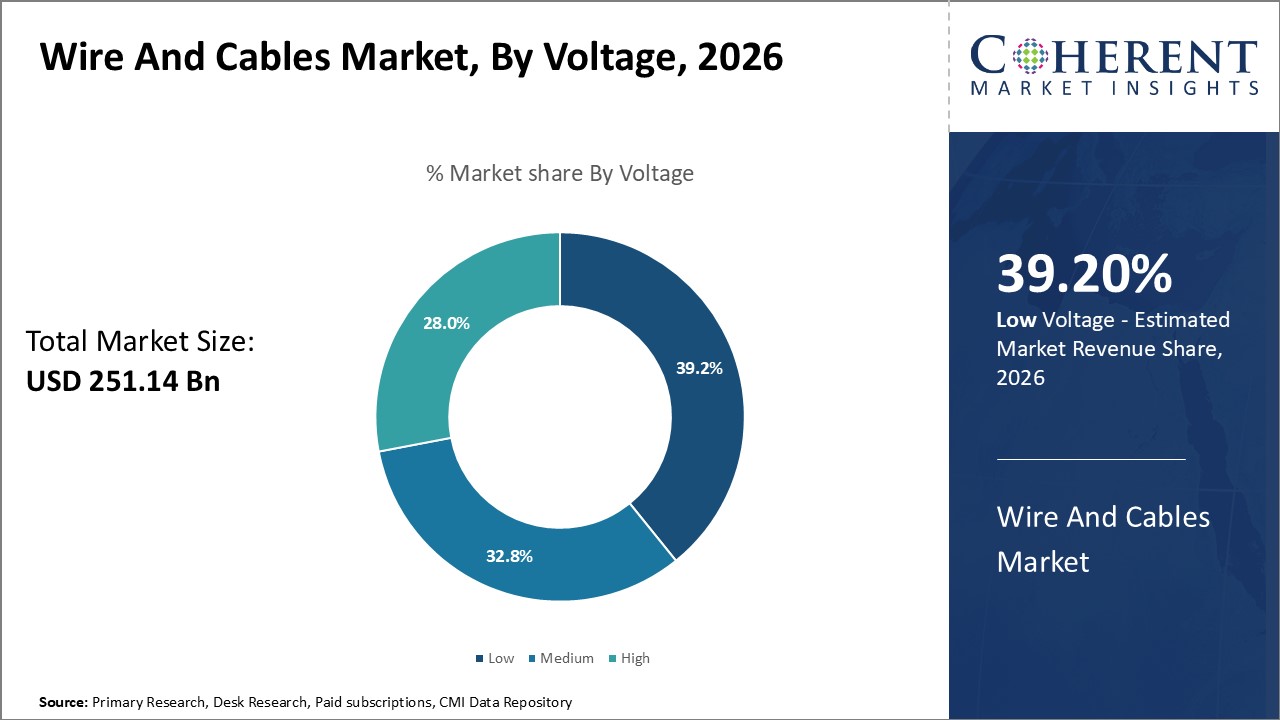
Wire and Cables Market Insights, By Voltage - Affordability Extends Reach of Low Voltage Cables
The low voltage segment is expected to dominate the market and have a market share of 39.20% in 2026, due to the affordability factor encouraging wider application across end-use industries. Cables rated below 1,000 volts are cost effective and suitable for the distribution of power within premises and industrial facilities having localized electricity requirements.
Devices and equipment operating on low voltage like lighting, small motors, and household appliances are common in residential and commercial buildings. Wires used here experience less power loss during transmission over short distances as against high voltage transmission lines spanning long distances. Expanding construction results in growing need of internal wiring.
Emerging economies exhibit strong potential as electrification and industrialization lift demand. Low capital required for setting up basic infrastructure helps start-ups and SMEs easily obtain electricity connection without burden of high investment. This stimulates businesses and pushes economic activity supporting cable usage. The growing manufacturing sector installs plenty of low voltage cables for machinery and production lines.
For instance, in October 2024, NKT, inaugurated the test system of the world’s longest superconducting power cable system, SuperLink, in Munich, Germany.
Wire and Cables Market Insights, By Industry Vertical - Reliable Power Supply is Critical for Energy Sector Cables
The energy and power industry is expected to dominate and is hold the largest share of 42.77% in 2026, due to the critical role of delivering electricity consistently. Uninterrupted power transmission is lifeline for energy generation, distribution and consumption activities. Vast network of cables is used in power plants for connecting generators to switchgear and control equipment.
Growing renewable energy capacity from solar and wind farms expands projects installing transmission infrastructure to feed clean power into national grids. Rising electrified transportation and emissions norms drive investments in upgrading conventional autos and setting up EV charging stations needing cabling work.
Smart grid technologies support modernization of aged distribution infrastructure. Advanced utility cables allow two-way communication between control centers and millions of smart meters/sensors installed at consumer premises. This enables utilities to monitor outages, analyze consumption patterns and restore supply faster leveraging digital solutions.
Dependence on power leaves little room for disruptions in oil/gas sector involving offshore/onshore drilling rigs and refineries. Robust cabling proves important for pipeline monitoring through SCADA systems. Data centers globally critical for digital economy also have high uptime requirements met through reliable cabling maintenance.
For instance, in February 2025, the Aditya Birla Group's board approved a proposal to expand its presence in the construction value chain through its Building Products Division.
Regional Insights
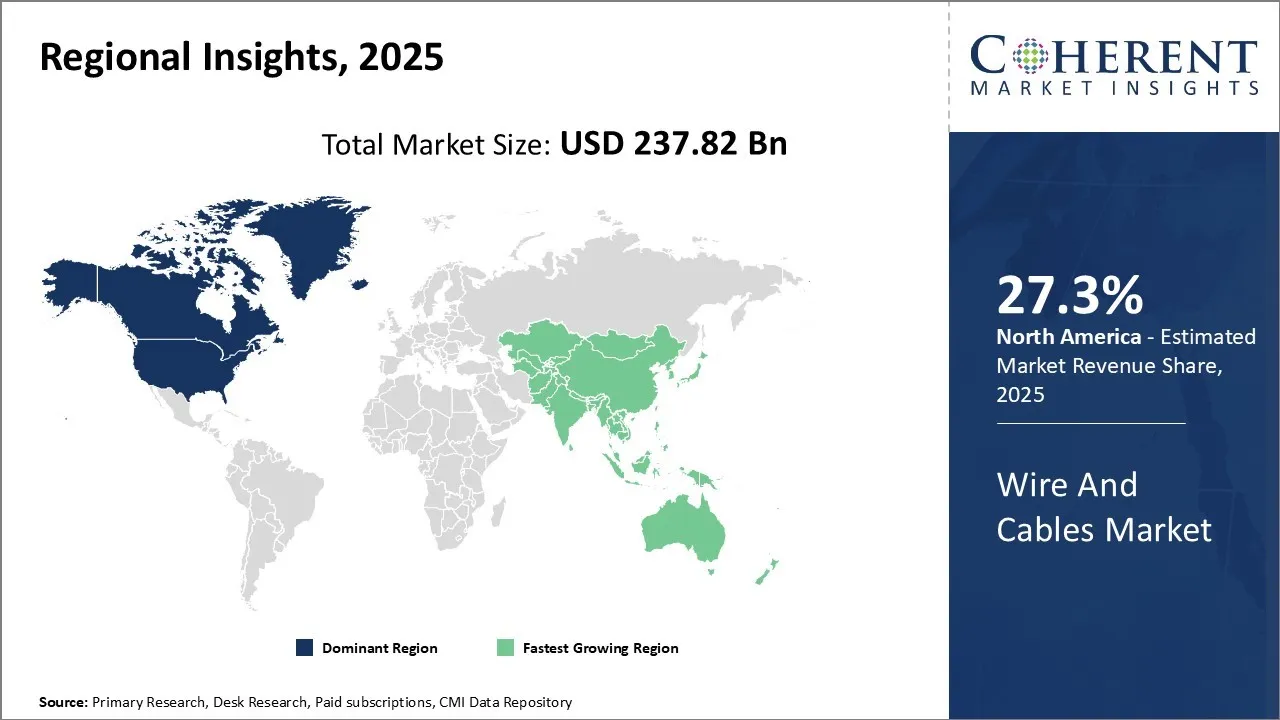
North America Wires and Cables Market Analysis & Trends
North America has dominated the global wire and cables market for many years and is expected to remain the largest regional market with share of 27.3% in 2026. The well-established manufacturing industry base across the U.S. and Canada has ensured the steady demand for wire and cables from sectors such as automotive, construction, industrial machinery and electronics.
In addition, the region's focus on upgrading and expansion of transmission line infrastructure to improve power distribution networks has supported the market growth. Major wire and cable producers have an extensive presence in the region through their manufacturing facilities and supply networks.
This allows them to efficiently serve the demands of customers and capitalize on opportunities. The pricing environment remains competitive due to the presence of many global and domestic players operating in the region.
For instance, in November 2024, ABB and Niedax Corporation introduced Abnex Inc, to expand cable management solutions in North America to enhance its product offering and efficiency.
Asia Pacific Wire and Cables Market Analysis & Trends
The Asia Pacific region stands out as the fastest-growing area, boasting a remarkable Compound Annual Growth Rate (CAGR) of 8.62%. This growth trajectory is driven by various factors contributing to the region's dynamic landscape. Asia Pacific is witnessing rapid industrialization, urbanization, and infrastructural development, particularly in emerging economies such as China, India, and Southeast Asian countries.
The expansion of construction, manufacturing, and automotive sectors in these regions demands extensive wire and cable installations for power transmission, telecommunications, and data networking. Additionally, ongoing initiatives for electrification, renewable energy integration, and smart grid implementations further propel the demand for wires and cables in the region. Moreover, the flourishing telecommunications industry and increasing internet penetration fuel the requirement for high-speed data transmission cables.
Government investments in infrastructure projects, coupled with advancements in technology and manufacturing processes, drive innovation and product development in the wire and cable sector. As a result, Asia Pacific emerges as a key player in the global wire and cables market, poised for sustained growth and contributing significantly to the region's economic development.
For instance, in August 2026, Asia Pacific Wire and Cable Corporation Limited announced that the company has filed a registration statement on Form-1 with the SEC for the rights offering to holders of its common shares.
Market Outlook Country-Wise
The U.S. Wire and Cables Market Trends
The U.S. wire and cables market is expected to surge, owing to growing investments in renewable energy expansion and rising commercial and manufacturing development activities across the states. Additionally, expanding infrastructure in power transmission & distribution, electricity generation, and construction sector will drive the demand for wires and cables in U.S.
For instance, in March 2023, LS Cable & System accepted a contract of USD 85 million for the supply of submarine cable to Taiwan Power Corporation, which has an offshore wind farm to build in Taiwan.
China Wire and Cables Market Trends
Asia Pacific wires and cable market is dominated by China, owing to its robust and extensive manufacturing capacity for wires and cables. China is considered as the home to various large and well-established cable manufactures, both state owned and private enterprises. Both of these manufacturers produce a wide range of cables for various applications ranging from power transmission to telecommunications.
For instance, China’s ZTT Submarine Cable & System has begun construction of an advanced cable laying vessel (CLV). This new system will service offshore wind, island interconnections and regional grid expansion projects in Asia Pacific (APAC).
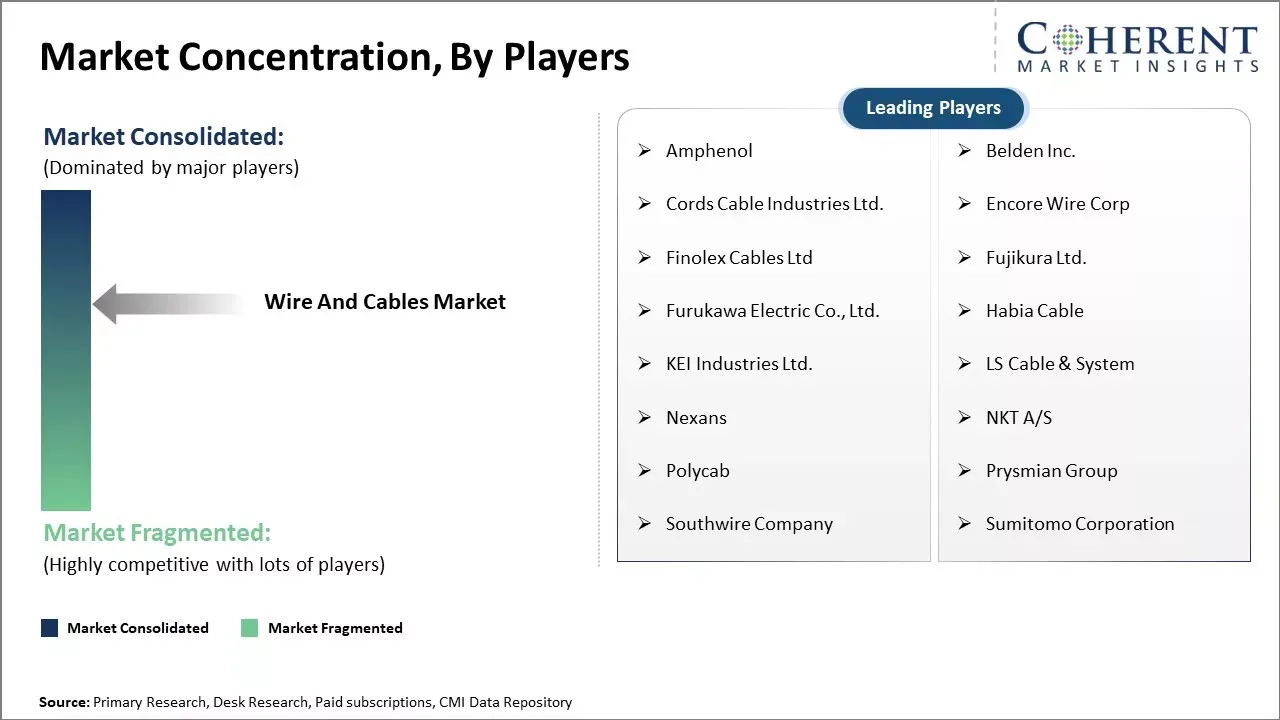
Market Concentration and Competitive Landscape
Analyst Opinion (Expert Opinion)
- The global wire and cables market remains positive over the long term, driven primarily by ongoing investments in infrastructure development and power transmission networks around the world. Growth in renewable energy generation capacity is also supporting demand for specialized cables.
- North America is likely remaining the dominant regional market, owing to the massive infrastructure development ambitions of government in the region. Asia Pacific is considered as the fastest growing region as Projects under China’s belt and road initiatives as well as India’s smart cities mission will require large quantities of cables.
Speak to the analyst
Want personalized insights?
Take the findings above to one of our principal consultants, or have the report rebuilt around the segments, geographies and competitors you actually track.
Wire And Cables Market News
- In June 2025, Lucker Electric Technologies Private Limited announced the investment of INR 150 crore in its Coimbatore facility to produce wires and cables.
- In August 2025,
- In March 2025, Adani Enterprise Limited announced the launch of its new joint venture company named Praneetha Ecocables Limited, by its subsidiary, Kutch Copper Limited.
Market Report Scope
Wire And Cables Market Report Coverage
| Report Coverage | Details | ||
|---|---|---|---|
| Base Year: | 2025 | Market Size in 2026: | USD 251.14 Bn |
| Historical Data for: | 2020 To 2024 | Forecast Period: | 2026 To 2033 |
| Forecast Period 2026 to 2033 CAGR: | 5.6% | 2033 Value Projection: | USD 367.76 Bn |
| Geographies covered: |
| ||
| Segments covered: |
| ||
| Companies covered: | Amphenol, Belden Inc., Cords Cable Industries Ltd., Encore Wire Corp, Finolex Cables Ltd, Fujikura Ltd., Furukawa Electric Co., Ltd., Habia Cable, KEI Industries Ltd., LS Cable & System, Nexans, NKT A/S, Polycab, Prysmian Group, Southwire Company, and Sumitomo Corporation | ||
| Growth Drivers: |
| ||
| Restraints & Challenges: |
| ||
Market Opportunity - Maintaining Infrastructure in Developed Markets
Replacement demand from aging infrastructure is creating consistent growth potential in developed markets. Rapid urbanization and industrialization in developing economies are driving massive investments in electric grid upgrades, telecom networks, and rail projects, requiring huge quantities of wires and cables. The rising focus on renewable energy also opens up opportunities as these projects depend on extensive transmission line constructions.
Market Segmentation
- Installation Type Insights (Revenue, USD Bn, 2021 - 2033)
- Overhead
- Submarine
- Underground
- Voltage Insights (Revenue, USD Bn, 2021 - 2033)
- High
- Medium
- Low
- Industry Vertical Insights (Revenue, USD Bn, 2021 - 2033)
- Energy and Power
- Aerospace and Defense
- IT and Telecommunication
- Industrial
- Oil and Gas
- Others
- Regional Insights (Revenue, USD Bn, 2021 - 2033)
- North America
- U.S.
- Canada
- Latin America
- Brazil
- Argentina
- Mexico
- Rest of Latin America
- Europe
- Germany
- U.K.
- Spain
- France
- Italy
- Russia
- Rest of Europe
- Asia Pacific
- China
- India
- Japan
- Australia
- South Korea
- ASEAN
- Rest of Asia Pacific
- Middle East & Africa
- South Africa
- GCC Countries
- Israel
- Rest of Middle East & Africa
- Key Players Insights
- Amphenol
- Belden Inc.
- Cords Cable Industries Ltd.
- Encore Wire Corp
- Finolex Cables Ltd
- Fujikura Ltd.
- Furukawa Electric Co., Ltd.
- Habia Cable
- KEI Industries Ltd.
- LS Cable & System
- Nexans
- NKT A/S
- Polycab
- Prysmian Group
- Southwire Company
- Sumitomo Corporation
Sources
Primary Research Interviews
- Cable manufacturers and suppliers executives
- Electrical contractors and installers
- Raw material suppliers (copper, aluminum, polymer)
- Construction industry professionals
- Others
Databases
- Global Trade Atlas
- Bloomberg Terminal
- Others
Magazines
- Wire & Cable ASIA
- International Wire & Machinery
- Electrical Construction & Maintenance Magazine
- Cable & Wire Magazine
- Others
Journals
- IEEE Transactions on Power Delivery
- Electric Power Systems Research Journal
- Materials & Design Journal
- Others
Newspapers
- Financial Times
- The Wall Street Journal
- Reuters Business News
- Bloomberg News
- Others
Associations
- International Wire & Cable Symposium (IWCS)
- Copper Development Association (CDA)
- Wire & Cable Industry Association
- National Electrical Manufacturers Association (NEMA)
- Others
Public Domain Sources
- International Energy Agency (IEA) reports
- World Bank infrastructure data
- Government statistical offices
- International Copper Association publications
- Others
Proprietary Elements
- CMI Data Analytics Tool
- Proprietary CMI Existing Repository of information for last 8 years
*Definition: The wire and cables market comprises companies that manufacture and distribute different types of wires and cables used for power transmission and telecommunication globally. Products offered include power cables, fiber optic cables, copper telecom cables, and specialty cables. Key end-use industries serviced are energy, construction, telecom, automotive, and electronics. Major players in this market supply wires and cables that meet various international quality standards and regulatory compliance. Innovation in materials and advanced manufacturing capabilities help address the growing demand for reliable and efficient transmission networks.
Get access to 250+ pages report
Every segment, forecast, competitor profile and data table behind the analysis above — available for instant download.
- ESOMAR Member
- ISO 9001:2015 Certified
- D-U-N-S Registered
- GDPR & CCPA Compliant
Missing comfort of reading report in your local language? Find your preferred language:
Transform your Strategy with Exclusive Trending Reports
Frequently Asked Questions
The Wire And Cables Market is estimated to be valued at USD 251.14 Bn in 2026, and is expected to reach USD 367.76 Bn by 2033.
The CAGR of the Wire And Cables Market is projected to be 5.6% from 2026 to 2033.
Growing infrastructure development projects and surging demand from renewable energy sector are the major factors driving the growth of the wire and cables market.
Rising material costs and margin pressures and market saturation and limited growth are the major factors hampering the growth of the wire and cables market.
In terms of installation type, underground is estimated to dominate the market revenue share in 2026.
Amphenol , Belden Inc. , Cords Cable Industries Ltd. , Encore Wire Corp , Finolex Cables Ltd , Fujikura Ltd. , Furukawa Electric Co., Ltd. , Habia Cable , KEI Industries Ltd. , LS Cable & System , Nexans , NKT A/S , Polycab , Prysmian Group , Southwire Company , and Sumitomo Corporation are the major players.
North America is expected to lead the wire and cables market in 2026.