

North America Central Fill Pharmacy Automation Market Size and Forecast – 2026 To 2033
The North America central fill pharmacy automation market is estimated to be valued at USD 427.0 Mn in 2026 and is expected to reach USD 822.8 Mn by 2033, exhibiting a compound annual growth rate (CAGR) of 11.4% from 2026 to 2033. This significant growth reflects increasing automation adoption across pharmacies to enhance operational efficiency, reduce medication errors, and manage growing prescription volumes efficiently.
Key Takeaways of the North America Central Fill Pharmacy Automation Market
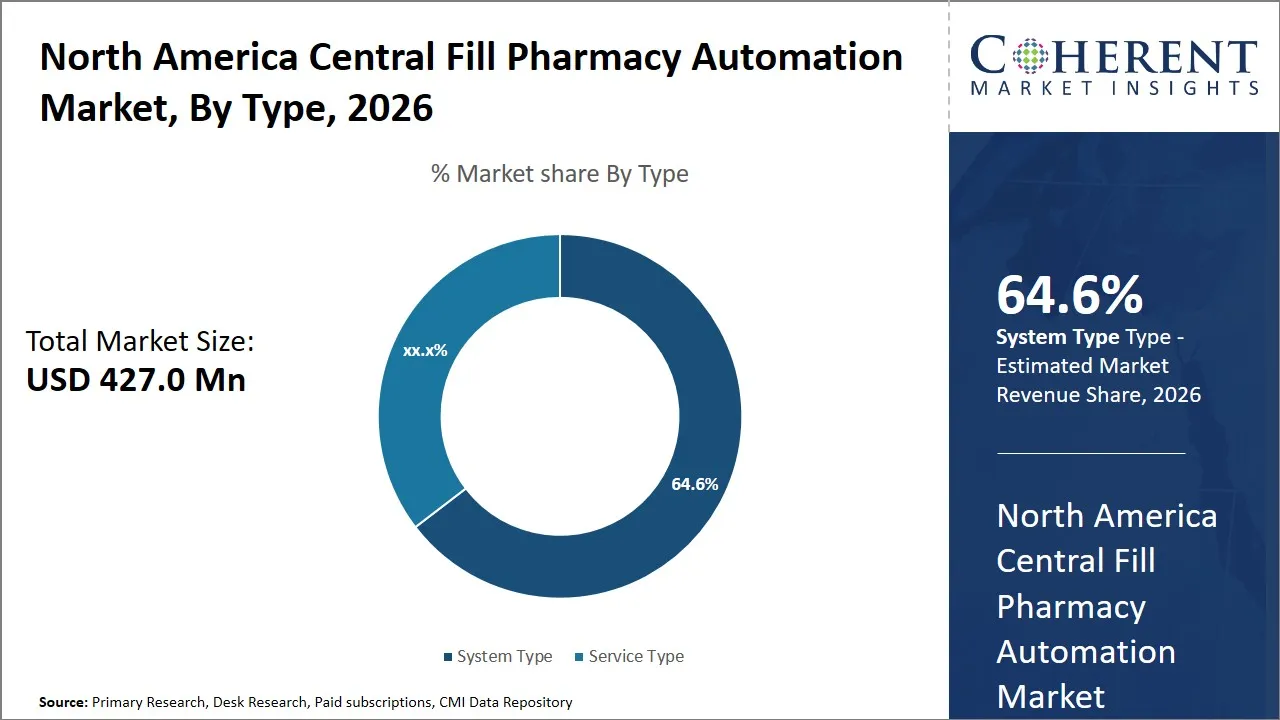
- System type segment is expected to lead the North America central fill pharmacy automation market, capturing 64.6% share in 2026.
- Hospital pharmacies segment is estimated to represent 55.5% of the North America central fill pharmacy automation market share in 2026.
Market Overview
- The North America central fill pharmacy automation market is being driven by high prescription volumes and the increasing prevalence of chronic diseases, which are creating a strong demand for centralized automated pharmacy fulfillment.
- Automation systems that combine robotics with pharmacy management software are improving throughput, accuracy, and significantly reducing medication errors.
- The growing adoption of mail-order and e-pharmacy services has positioned central fill facilities as critical nodes in the prescription distribution network.
- Advanced healthcare IT infrastructure in the region supports seamless integration of automation with electronic health records and existing pharmacy management systems.
Currents Events and their Impact
Current Events | Description and its Impact |
Adoption of AI‑Enhanced Automation in Central Fill Facilities |
|
Regulatory Emphasis on Medication Safety Standards |
|
Segmental Insights
- Current Industry Events of 2026
- Market Size Estimation
- Regional Breakdown
- Competitive Landscape
- Customer Intelligence
- Segmental Analysis
- Pricing Analysis
- Key Market Drivers, Challenges & Future Trends
- Customized Insights Section
Why Does the System Type Dominate the North America Central Fill Pharmacy Automation Market in 2026?
The system type segment is expected to hold the largest market share of 64.6% in 2026, largely attributed to the growing demand for efficient and error-free medication dispensing processes. A sub category of the segment is automatic medication dispensing systems which are important in improving the pharmacy workflow by reducing the number of human interventions involved decreasing human error and improving patient safety. The systems guarantee correct dosage, punctual delivery of medication and improved inventory monitoring, which are essential in large volume central fill pharmacies that handle complicated prescriptions.
Moreover, the automation systems of workflows have become very popular because of their capability of integrating various pharmacy functions to one comprehensive system. This integration maximizes operations involved in processing orders, labeling, compounding and packaging, which consequently improve the throughput and processing time. This growth is also underpinned by the growing use of automated packaging and labeling systems which save labor and allow regulatory compliance by use of standardized packages.
For instance, in July 2025, Capsa Healthcare introduced its Consolidated Services Pharmacy Platform (CSPP), an integrated central fill automation and distribution management system that unifies high‑volume prescription processing, specialty workflows, and inventory optimization into a single scalable solution for health systems seeking streamlined pharmacy operations.
(Source- Capsa Healthcare)
Why Does the Hospital Pharmacies Segment Dominate the North America Central Fill Pharmacy Automation Market in 2026?
The hospital pharmacies segment is expected to hold 55.5% of the market share in 2026, due to several compelling factors related to their operational demands and patient care requirements. Hospitals have a tremendous number of prescriptions to make each day and these prescriptions are very diverse in terms of types, dosage, and routes of administration. Such complexity requires the use of sophisticated automation systems that are able to handle high volume and yet deliver very stringent standards of precision and safety.
One of the main factors that are contributing is that hospital pharmacy operations are critical. The acute and chronic conditions and their specific medications that hospitals have to work with include intravenous treatments, narcotics, and compounded sterile preparations. Hospital pharmacy automation ensures that safety measures are strictly followed, the occurrence of medication errors is minimized, and dispensing of the critical drugs is done with greater accuracy and speed. Workflow optimization integrated into automated systems is important in the management of these complexities because it provides an opportunity to track, document and meet regulatory requirements, including those imposed by U.S. FDA and The Joint Commission.
For instance, in August 2024, Omnicell launched its Central Med Automation Service, a scalable solution for hospital and health system pharmacies that integrates robotics, software, and smart devices to streamline ordering, dispensing, verification, and inventory management, reinforcing hospital pharmacies’ dominance in North America central fill pharmacy automation market.
(Source- Omnicell)
DSCSA Compliance and Its Impact on North America Central Fill Pharmacy Automation Market
- The Drug Supply Chain Security Act (DSCSA) is a law that imposes strict criteria on tracing of prescription drugs, serialization and verification of drugs and electronic reporting throughout the U.S. supply chain. In the case of North America central fill pharmacies, it refers to the fact that all the incoming and outgoing medications should be identified by a distinct identifier and be electronically checked. Automated dispensing, labeling, and packaging systems should record the data that is serialized on each unit, facilitate the saleable return checks and have audit-readable records at least six years. It is important to integrate it with pharmacy management, EHR, and supply chain software to promote compliance and real-time reporting to the trading partners.
- An automation platform should also contain an alert and quarantine mechanism to deal with the suspicious or bad products within 24 hours to maintain the safety of patients and regulatory compliance. These features have been integrated into central fill systems by vendors such as Omnicell, Capsa Healthcare, and Parata, enabling a seamless workflow, with complete DSCSA compliance and reducing the occurrence of manual error and increasing the operational efficiency of pharmacies without affecting high volume of centralized fill operations.
Market Players, Key Developments, and Competitive Intelligence
Key Developments
- In July 2025, Swisslog Healthcare launched PillPick Octave, its newest automated unit‑dose packaging, storage and dispensing system designed to increase picking, packaging and dispensing efficiency while enhancing medication safety. The system features expanded storage capacity, improved reporting and dashboard functionality, and advanced vision systems to reduce errors — all key capabilities for high‑volume centralized pharmacy environments.
- In May 2025, Omnicell, Inc. announced a new suite of RFID‑enabled and intelligent workflow products designed to enhance inventory visibility, streamline medication management workflows, and improve operational efficiency across healthcare settings including perioperative environments and outpatient clinics.
- In January 2025, Capsa Healthcare, a provider of advanced healthcare and pharmacy automation solutions, announced that it had been selected as the design and implementation partner for a major central fill pharmacy automation project at Harris Health System in Houston. The multi‑phase project is intended to significantly increase the capacity and throughput of Harris Health’s central fill operations by deploying automated prescription processing technology.
E-Prescribing Adoption and Technology Penetration in North America Central Fill Pharmacy Operations
- E-prescribing adoption in the U.S has increased at a remarkable rate within the past ten years due to federal incentives, regulatory requirements as well as the drive to adopt safer and more efficient prescribing processes. Adoption rates are not uniform with the highest adoption being done by many states such as Massachusetts, New York, and Minnesota of up to 85.90% of the prescriptions sent electronically and some states that have fewer populations or less developed healthcare IT infrastructure have lower rates of up to 50.60%. Increased adoption is associated with fewer medication errors, quicker prescription fillings, and more effective integration with central fill pharmacy automation platforms to allow the smooth flow of work and enhance patient safety.
- One of the most important enablers of e-prescribing is technology penetration, such as access to broadband, adoption of the cloud, integration with electronic health records (EHRs) and pharmacy management systems. Health systems and states that have well-developed IT infrastructure can put to use real-time data transfer, automated checks, and interoperability among prescribers, pharmacy, and central fill facilities. This does not only speed up the prescription processing but also enables analytics-based inventory management and predictive workflow automation which strengthens the efficiency and scalability of central fill pharmacy operations in North America.
Top Strategies Followed by North America Central Fill Pharmacy Automation Market Players
Player Type | Strategic Focus | Examples |
Established Market Leaders | Established companies lead the market by investing heavily in R&D to develop high-performance, reliable, and scalable automation systems for central pharmacies. They form strategic partnerships with OEMs, healthcare providers, and technology firms to enhance offerings and strengthen market positions. Additionally, these players expand globally through broader distribution and entry into emerging markets. | Omnicell has strengthened its North American central fill pharmacy automation leadership through strategic partnerships and advanced robotics solutions. Its high-throughput, accurate, and scalable systems integrate with pharmacy software and electronic health records, improving efficiency and reducing errors, enabling the company to meet complex operational demands and maintain a competitive edge. |
Mid-Level Players | Mid-level players focus on cost-effective automation solutions that balance affordability with reliable performance, targeting price-sensitive pharmacies and healthcare institutions. They often partner with technology providers and manufacturers to access advanced features, streamline production, and achieve economies of scale, while using targeted marketing to highlight practical benefits. | TCGRx offers scalable central fill automation systems designed for smaller pharmacy networks and regional healthcare providers. Their solutions include automated dispensing, packaging, and labeling systems that maintain efficiency and accuracy while keeping investment and operational costs manageable, allowing mid-sized pharmacies to adopt advanced automation without the high expenditure associated with top-tier providers. |
Small-Scale Players | Small-scale players focus on niche automation solutions with specialized features, using AI, robotics, and data analytics to differentiate themselves from larger competitors. They often form local partnerships with startups, manufacturers, and regional distributors to build brand recognition and adapt to regional regulations. | ScriptPro offers compact, AI-enabled central fill systems for regional pharmacies, integrating dispensing, packaging, and verification to improve accuracy and efficiency. Their scalable solutions allow smaller networks to adopt advanced automation without large investments, helping them compete effectively. |
Market Report Scope
North America Central Fill Pharmacy Automation Market Report Coverage
| Report Coverage | Details | ||
|---|---|---|---|
| Base Year: | 2025 | Market Size in 2026: | USD 427.0 Mn |
| Historical Data for: | 2020 To 2024 | Forecast Period: | 2026 To 2033 |
| Forecast Period 2026 to 2033 CAGR: | 11.4% | 2033 Value Projection: | USD 822.8 Mn |
| Segments covered: |
| ||
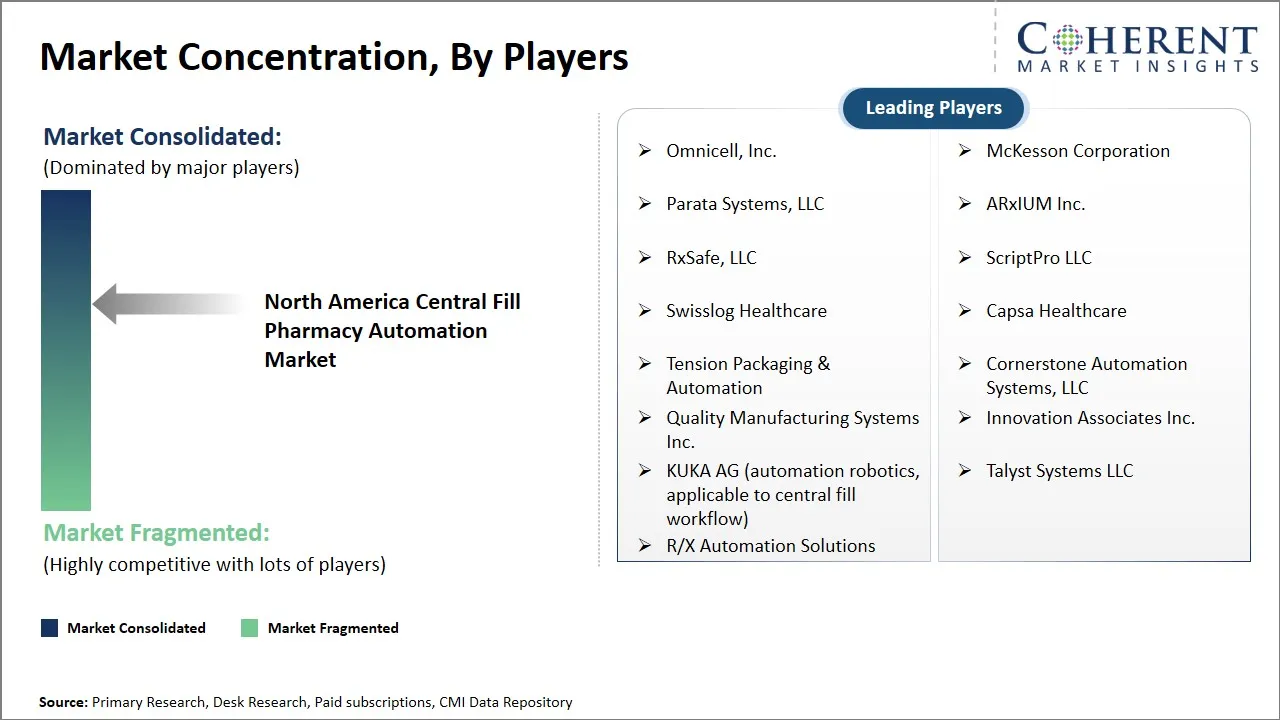
| Companies covered: | Omnicell, Inc., McKesson Corporation, Parata Systems, LLC, ARxIUM Inc., RxSafe, LLC, ScriptPro LLC, Swisslog Healthcare, Capsa Healthcare, Tension Packaging & Automation, Cornerstone Automation Systems, LLC, Quality Manufacturing Systems Inc., Innovation Associates Inc., KUKA AG (automation robotics, applicable to central fill workflow), Talyst Systems LLC, and R/X Automation Solutions | ||
| Growth Drivers: |
| ||
| Restraints & Challenges: |
| ||
North America Central Fill Pharmacy Automation Market Dynamics
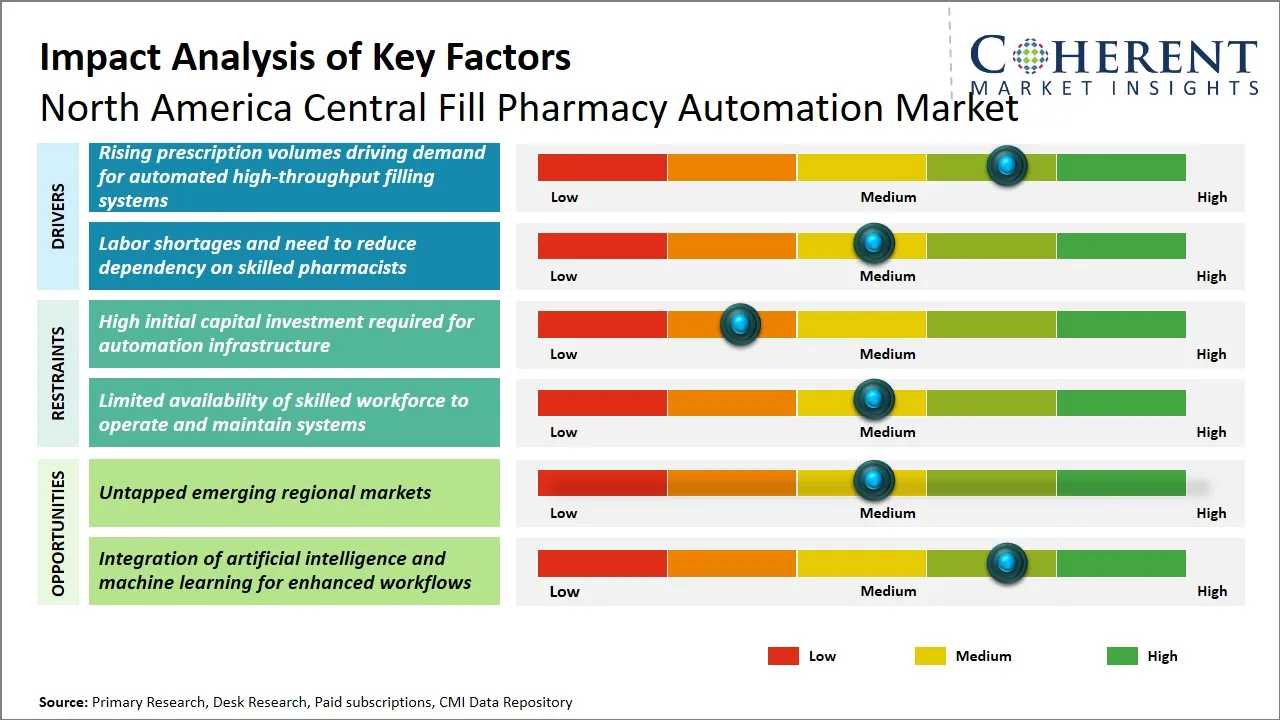
North America Central Fill Pharmacy Automation Market Driver - Rising Prescription Volumes Driving Demand for Automated High-Throughput Filling Systems
The growing prescription order volume in North America has turned into a major impetus in the implementation of automated high-throughput filling systems in the central fill pharmacies. With the growth of access to healthcare and the rising numbers of chronic diseases, there is a massive growth in the number of prescription orders that must be fulfilled quickly and accurately by the pharmacies. The growing demand is becoming too high to handle using manual filling procedures that are gradually becoming inadequate in controlling the workflow to reduce workload congestion and increase the risks of dispensing errors. Pharmacies can use automated systems with advanced robotics and integrated software solutions to improve and process a larger load of prescription works faster and with more accuracy, minimizing human error and enhancing overall operational efficiency.
For instance, on January 15, 2026, Morrison announced the launch of Fillex, a national automated pharmacy fulfillment platform designed to support e‑commerce prescription delivery and scalable centralized fulfillment services for retail pharmacies, grocery chains, e‑commerce providers, and health systems dealing with rising online order volumes.
(Source- Morrison)
North America Central Fill Pharmacy Automation Market Opportunity - Untapped Emerging Regional Markets
The North America central fill pharmacy automation market has been showing great prospects of growth with the new regional markets especially in rural and suburban regions yet to explore the automation adoption market. Although significant adoption of central fill automation systems in metropolitan centers due to the high prescription rates and the presence of well-established healthcare facilities have taken place, smaller areas are still dominated by manual or semi-automated practices. These underserved markets are a profit potential of market development because healthcare providers are becoming more focused on the efficiency and minimizing errors in the face of the rising number of patients.
Moreover, the accessibility of healthcare and the facilitation of pharmaceutical activities in the less urbanized areas through governmental efforts make the deployment of automation possible. The increased level of demand of home healthcare and specialty pharmacy services in these new areas contributes to the necessity of scalable and automated central fill systems to be able to fill more complex prescriptions faster and more accurately.
For instance, in February 2025, Hanmi Pharmaceuticals launched Countmate, a fully automated vial dispensing machine specifically tailored to meet the preferences and needs of the U.S. and Canadian markets. This product rollout reflects targeted innovation aimed at increasing adoption of automated prescription processing in regional and underserved North American pharmacy networks, helping pharmacies outside major metropolitan centers improve efficiency and throughput.
(Source- Hanmi Pharmaceuticals)
Analyst Opinion (Expert Opinion)
- North America central fill pharmacy automation market is expected to expand at a fast rate owing to the increasing volume of prescription, labor scarcity, and the necessity to minimize medication errors. Pharmacy management software integrated into the control system of the integrated robots assists centralized facilities to fill, label, and package faster so the pharmacist can concentrate on clinical care. Focus on safety and advanced healthcare IT infrastructure is also a driver of adoption, and increases in mail-order and e-pharmacy channels provide additional demand on high-volume, centralized operations.
- There are prospects in small-scale chain modular automation and workflow optimization by AI. In practical implementations, there are better throughput and less labor requirement but there are still challenges in integration with existing systems as well as capital expenditure. The main ones such as ASHP annual meetings and HIMSS conferences have encouraged sharing of knowledge, policy discourse, and the demonstration of technology, and have facilitated the development of best practices and expedited the uptake of automation solutions in the industry.
Speak to the analyst
Want personalized insights?
Take the findings above to one of our principal consultants, or have the report rebuilt around the segments, geographies and competitors you actually track.
Market Segmentation
- Type Insights (Revenue, USD Mn, 2021 - 2033)
- System Type
- Automated Medication Dispensing System
- Integrated Workflow Automation Systems
- Automated Packaging and Labelling Systems
- Automation Medication Compounding Systems
- Automated Storage and Retrieval Systems
- Others (fully-automatic vial-filling machine, etc.) Systems
- Service Type
- Workflow and Process Optimization
- Other Services (e.g., Inventory Management, etc.)
- System Type
- Application Insights (Revenue, USD Mn, 2021 - 2033)
- Hospital Pharmacies
- Retail Pharmacies
- Key Players Insights
- Omnicell, Inc.
- McKesson Corporation
- Parata Systems, LLC
- ARxIUM Inc.
- RxSafe, LLC
- ScriptPro LLC
- Swisslog Healthcare
- Capsa Healthcare
- Tension Packaging & Automation
- Cornerstone Automation Systems, LLC
- Quality Manufacturing Systems Inc.
- Innovation Associates Inc.
- KUKA AG (automation robotics, applicable to central fill workflow)
- Talyst Systems LLC
- R/X Automation Solutions
Sources
Primary Research Interviews
Industry Stakeholders
- Pharmacists and pharmacy operations managers interviewed for market insights
- Automation engineers and healthcare IT specialists consulted in pharmacy workflow research
End Users List
- Hospital pharmacy directors participating in automation efficiency assessments
- Central fill pharmacy facility managers providing operational feedback
Government and International Databases
- ClinicalTrials.gov clinical research registry for automation system evaluations
- HealthData.gov U.S. health data repository including pharmacy operations metrics
- FDA National Drug Code Directory for regulatory listings relevant to pharmacy automation
- Centers for Medicare & Medicaid Services (CMS) public health expenditure and utilization datasets
- U.S. Bureau of Labor Statistics occupational data on pharmacy automation impacts
Trade Publications
- Pharmacy Times articles on automation and workflow innovations
- Drug Store News coverage of pharmacy technology trends
- Healthcare Technology News on automation adoption in healthcare settings
- MedTech Insight reports on robotics and pharmacy automation systems
- Pharmacy Purchasing & Products automation features and case studies
- Drug Topics centralized fulfillment and automation strategy content
Academic Journals
- American Journal of Health‑System Pharmacy peer‑reviewed articles on pharmacy technology
- Journal of the American Pharmacists Association published research on automation impacts
- Journal of Pharmacy Technology automation performance studies
- International Journal of Pharmacy Practice research on automation outcomes
- Journal of Medical Systems studies on integrated pharmacy system automation
- BMC Health Services Research pharmacy workflow and automation analyses
Reputable Newspapers
- The Wall Street Journal healthcare technology and pharmacy delivery trend reporting
- The New York Times health section automation in medicine and pharmacy
- The Washington Post health technology features relating to pharmacy systems
- USA Today coverage of pharmacy automation and patient safety topics
- The Guardian health technology and AI in pharmacy workflows
- Financial Times reporting on healthcare innovation including automation
Industry Associations
- American Society of Health‑System Pharmacists (ASHP) guidelines and automation policy
- Pharmacy Quality Alliance (PQA) performance metrics and automation outcomes
- National Community Pharmacists Association (NCPA) automation practice insights
- Healthcare Information and Management Systems Society (HIMSS) digital health automation standards
- American Pharmacists Association (APhA) automation research contributions
- International Pharmaceutical Federation (FIP) pharmacy automation working group
Public Domain Resources
- FDA public regulatory databases on pharmacy technologies
- U.S. government health data repositories (Centers for Disease Control and Prevention (CDC) and the Centers for Medicare & Medicaid Services (CMS))
- OpenAccess journal repositories like PMC (PubMed Central)
- NIH National Library of Medicine research publications
- Government health policy documents on pharmacy automation adoption
- U.S. Patent and Trademark Office automation technology filings
Proprietary Elements
- CMI Data Analytics Tool: Proprietary analytics tool to analyze real-time market trends, consumer behavior, and technology adoption in market
- Proprietary CMI Existing Repository of Information for Last 10 Years
Get access to 250+ pages report
Every segment, forecast, competitor profile and data table behind the analysis above — available for instant download.
- ESOMAR Member
- ISO 9001:2015 Certified
- D-U-N-S Registered
- GDPR & CCPA Compliant
Missing comfort of reading report in your local language? Find your preferred language:
Transform your Strategy with Exclusive Trending Reports
Frequently Asked Questions
The North America central fill pharmacy automation market is estimated to be valued at USD 427.0 million in 2026 and is expected to reach USD 822.8 million by 2033.
The CAGR of North America central fill pharmacy automation market is projected to be 11.4% from 2026 to 2033.
Rising prescription volumes driving demand for automated high‑throughput filling systems and labor shortages and need to reduce dependency on skilled pharmacists are the major factors driving the growth of the North America central fill pharmacy automation market.
High initial capital investment required for automation infrastructure and limited availability of skilled workforce to operate and maintain systems are the major factors hampering the growth of the North America central fill pharmacy automation market.
Central fill pharmacy automation refers to automated systems and robotics used in centralized pharmacy facilities to process high volumes of prescriptions efficiently, reduce medication errors, improve throughput and lower operational costs for hospital, retail and mail order pharmacies. Adoption is driven by high prescription volumes and demand for pharmacy efficiency in North America.
Automation technologies include automated medication dispensing systems, integrated workflow systems, automated packaging and labeling systems, automated storage and retrieval systems, and software for inventory/order management that together streamline prescription processing and ensure accuracy.
In terms of type, system type is estimated to dominate the market revenue share in 2026.