

Nutraceutical Contract Manufacturing Services Market Size and Share Analysis- 2026 To 2033
The Global Nutraceutical Contract Manufacturing Services Market is expected to reach USD 460.7 Bn by 2033, from USD 205.9 Bn in 2026, expanding at a CAGR of 11.5%. The sector is gaining momentum through nutraceutical brands increasingly outsourcing formulation development, ingredient sourcing, manufacturing, packaging, quality testing, and regulatory support. This surge is further supporting the emergence of specialized contract manufacturing organizations (CMOs) and contract development and manufacturing organizations (CDMOs) within the broader nutraceuticals industry.
In perspective of consumer demand, the growing popularity of functional foods, nutritional supplements, sports nutrition products, and convenient wellness formats is encouraging brand owners to work with manufacturing partners that can support faster commercialization and flexible production volumes. As evidence, a study published by the National Library of Medicine (NLM) in September 2026 recorded an estimated additional willingness to pay of USD 67.06 and USD 62.95 per month among consumers in Thailand for cardiovascular nutraceuticals, backed by high-quality scientific evidence and healthcare professional recommendations, respectively.
Competition is also shifting beyond basic production capacity toward formulation expertise, ingredient traceability, product differentiation, and reliable manufacturing across multiple dosage forms. As a result, the global nutraceutical contract manufacturing services market is evolving into an increasingly specialized industry where product innovation and manufacturing capabilities play important roles in customer acquisition and long-term partnerships.
Key Takeaways of the Global Nutraceutical Contract Manufacturing Services Market
- By product, functional food & beverages are poised to account for 64.5% of global market revenue in 2026. Its leadership originates from the increasing demand for fortified beverages, protein-enriched products, functional snacks, and other nutrition-oriented food categories. As per NLM estimations, the global trade value of functional food products crossed USD 228 Bn in 2025, following an 8% CAGR from 2022.
- By dosage form, tablets, within the dietary supplement contract manufacturing category, are expected to lead with a 25.0% share in 2026. Established production processes, high-volume manufacturing capabilities, and cost efficiency support their proprietary position in this sector. This way of administration is also identified as the most common form by a 2026 NLM article, where 71.9% of 600 adult dietary supplement users reported using tablets, notably greater than 48.8% using powders and 18.2% using liquids.
- By service model, turnkey contract development & manufacturing services are estimated to represent 48.0% of market revenue in 2026. This is because brand owners preferring partners capable of managing product development through finished-product delivery. Exemplifying this customer behavior, in June 2025, Cosmos Health entered the U.S. nutraceutical manufacturing industry via a strategic agreement with a New Jersey-based developer and manufacturer of clinically studied nutraceutical ingredients, DolCas Biotech, for production at GMP-certified facilities.
- North America is predicted to hold the largest revenue share of 34.0% in the global nutraceutical contract manufacturing services market in 2026, owing to its favorable outsourcing ecosystem, experienced manufacturing entities, and demand from established and emerging supplement brands. Indicating a developed regional raw material supply chain, in 2025, cultivated production represented 76% of total reported botanical tonnage, as per a 2024-2025 survey covering responses on 126 botanical commodities from 113 plant species in America.
- Asia Pacific is anticipated to register the fastest growth during the forecast period, with expanding manufacturing infrastructure, competitive production capabilities, and growing regional nutraceutical businesses supporting its market outlook. For instance, the industry value of health supplements in South Korea is estimated to surpass USD 20 Bn by the end of 2030. The country comprised more than 37,000 registered health supplement products by mid-2024 and 5,000 new products introduced annually, according to the U.S. International Trade Administration (ITA).
Segmental Insights
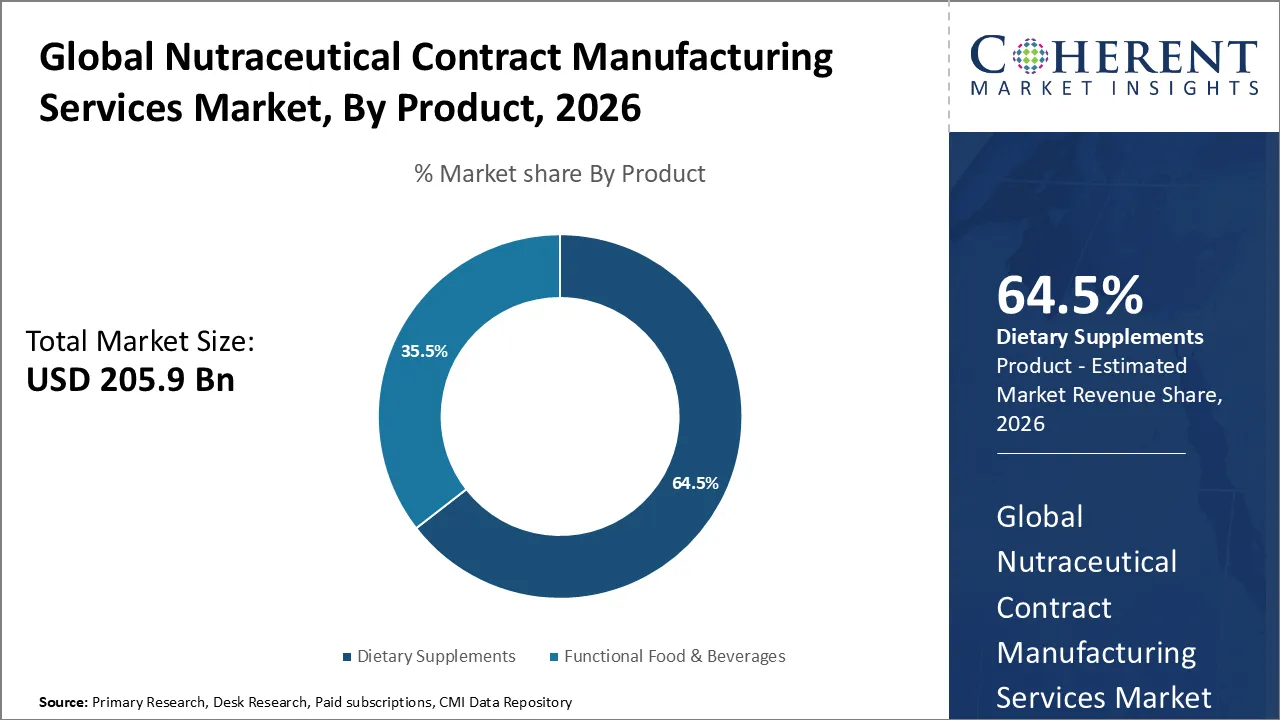
Why Are Functional Food & Beverage Manufacturing Services Leading the Global Nutraceutical Contract Manufacturing Services Market?
The functional food and beverages segment is estimated to capture 64.5% of the global nutraceutical contract manufacturing services market in 2026. Demand for contractual production services in this category is being induced by the rapid integration of functional ingredients into everyday food and beverage products. This shift in dietary selection therefore allows consumers to incorporate nutritional products into their daily food consumption habits.
In 2025, approximately three-quarters of global consumers were aware of functional foods and beverages, which is slightly more than half intended to increase their consumption, based on HealthFocus International's 2024 Global Trend Study. This indicates a substantial potential customer base for brands developing functional nutrition products.
Tracking this possibility, food and beverage brands are engaging in specialized contracts large-scale manufacturing of products, such as protein-enriched beverages, fortified snacks, functional confectionery, and nutritional powders. Specifically, those containing prebiotics, probiotics, or botanical ingredients, as these formulations often require customized ingredient processing, flavor optimization, stability management, and packaging capabilities.
Contract manufacturing companies are responding by developing flexible production lines capable of handling a wider variety of food matrices and ingredients, creating opportunities for contract manufacturers operating across the global functional food industry. For instance, in June 2026, Makers Nutrition announced the expansion of its manufacturing capabilities into chocolate-based supplements.
- Current Industry Events of 2026
- Market Size Estimation
- Regional Breakdown
- Competitive Landscape
- Customer Intelligence
- Segmental Analysis
- Pricing Analysis
- Key Market Drivers, Challenges & Future Trends
- Customized Insights Section
Why Do Tablets Continue to Hold a Leading Position in Dietary Supplement Contract Manufacturing?
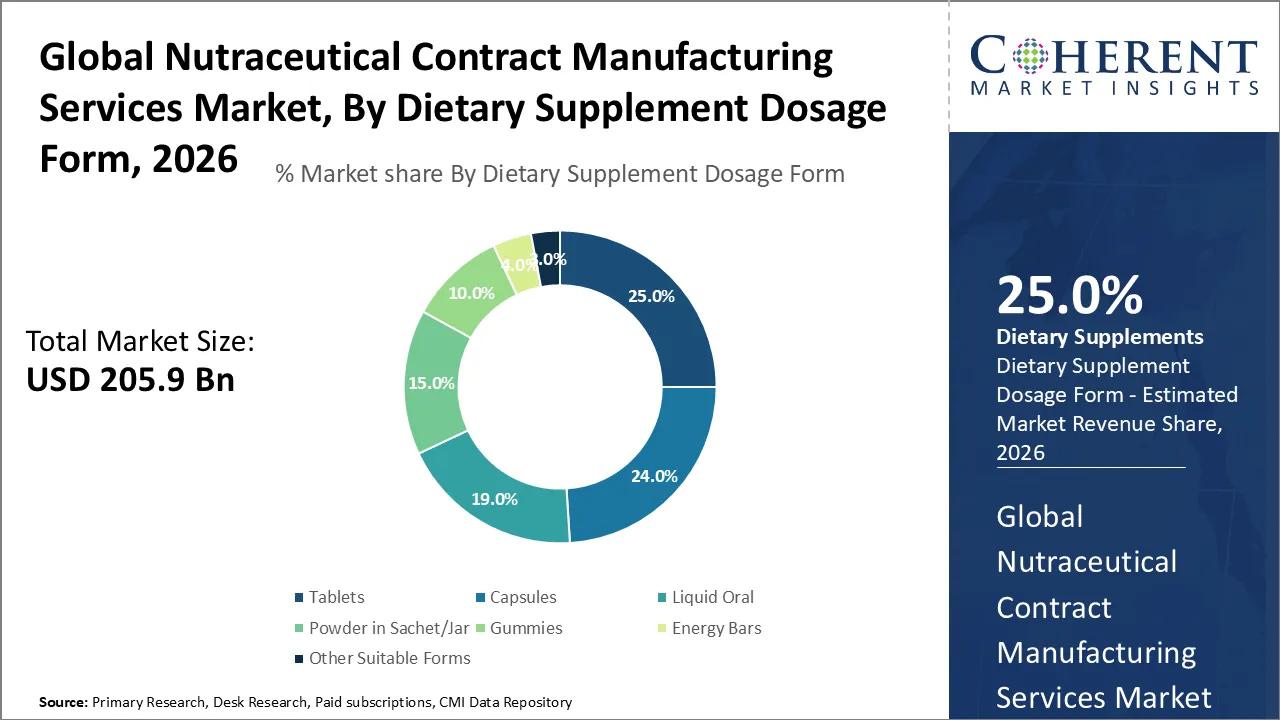
Tablets are estimated to contribute to 25.0% of dietary supplement contract manufacturing revenue by dosage form in 2026. Their efficient manufacturing infrastructure, suitability for high-volume production, and flexibility in combining multiple ingredients contribute to continued demand. These advantages can be portrayed by a 2025 life cycle assessment study on pharmaceutical tablets manufacturing, marking 96.6% and 99.6% of average yield in tablet compression and coating across 2,609 and 2,559 batches, respectively.
However, this market is becoming more diverse as consumers seek supplements that are easier to consume and better suited to individual preferences. This is encouraging manufacturers to invest in gummies, liquids, powders, and vegetarian softgels alongside conventional solid-dose products. Contract manufacturers can also participate in this shit by offering different tablet types, including conventional compressed tablets, chewable tablets, and effervescent formulations.
How Are Turnkey Manufacturing Partnerships Reshaping the Global Nutraceutical Contract Manufacturing Services Market?
Turnkey contract development and manufacturing services are estimated to acquire 48.0% of global market revenue in 2026 on account of its integrated solutions, covering formulation, sourcing, manufacturing, filling, packaging, testing, and associated product-development support. Subsequently, turnkey services are gaining traction among nutraceutical brands by providing them access to production expertise, without making investment in building their own facilities or, committing to additional fixed manufacturing assets, for portfolio expansion.
Such an opportunity for turnkey service providers can further be testified by the dietary supplement industry of the U.S. containing more than 100,000 products, as recorded by the National Institutes of Health (NIH)’s 2025-2029 Office of Dietary Supplements Strategic Plan. This diversity in pipeline confirms that, for contract manufacturers, offering an integrated service model can support longer customer relationships and create opportunities to participate earlier in product development.
Utilizing this scope, in November 2026, Biofarma Group completed the acquisition of a 70% controlling stake in a Poland-based dietary supplement CDMO, EuroPharma Alliance. The transaction was made to expand the company's manufacturing presence in Central & Eastern Europe and strengthen its ability to provide integrated development and production services.
Current Events and Their Impact on the Nutraceutical Contract Manufacturing Services Market
Current Event | Description and its Impact |
U.S. FDA Updates New Dietary Ingredient Guidance – October 2026 |
|
India Strengthens Food Processing Manufacturing through Government Schemes – February 2026 |
|
Nutraceutical Contract Manufacturing Services Market Dynamics
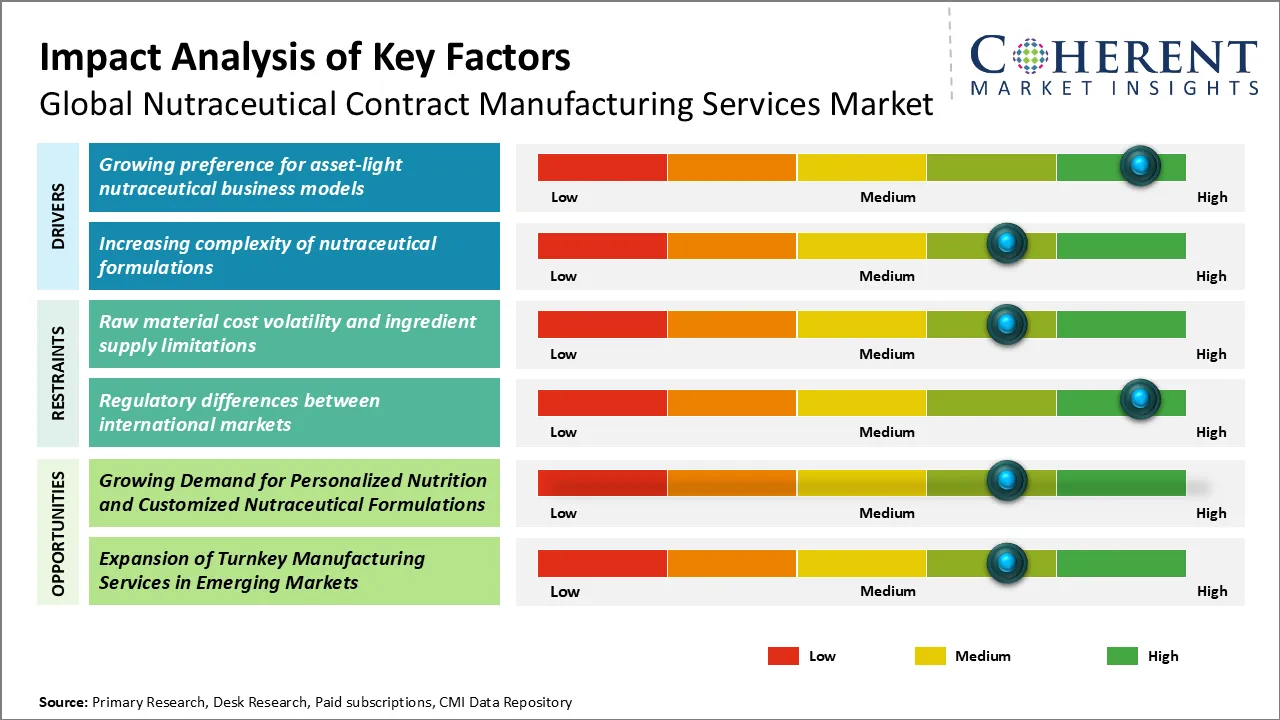
Market Drivers
- Growing preference for asset-light nutraceutical business models: Contract manufacturing enables brands to impose greater focus on customer acquisition, distribution, brand development, and product positioning, with the production operations being handled by the appointed partners. This model is particularly attractive to businesses seeking to introduce several nutritional products without establishing independent manufacturing lines for every dosage form. As a result, several nutraceutical brand owners are now evaluating outsourced manufacturing services to eliminate the need to invest in new facilities, machinery, technical personnel, and regulatory infrastructure.
- A research, published by the Association for Packaging and Processing Technologies (PMMI) in October 2024, found that 59% of brand owners used contract manufacturers to access machinery or packaging formats unavailable internally, with 48% and 43% relying on contract service providers for testing new products or packaging formats and supplementing internal production capacity & managing demand surges.
- Increasing complexity of nutraceutical formulations: The use of sensitive probiotics, concentrated botanicals, omega fatty acids, specialty proteins, and multi-ingredient formulations requires greater manufacturing expertise. This is because certain ingredients present challenges involving moisture sensitivity, stability, taste masking, compatibility, and shelf-life management. These technical requirements are creating opportunities for specialized nutraceutical CDMOs offering product-specific manufacturing environments, analytical testing, and formulation development capabilities.
- A 2026 NLM article confirmed a retention of 64.37% probiotics’ viability out of a novel pH-sensitive core-shell delivery system after 33 days at 4°C. Whereas unencapsulated probiotics declined to 3.55% viability after just 18 days under the same storage temperature. This underlines the need for encapsulation in optimizing stability of probiotic formulations under in vitro digestion conditions and during storage.
Nutraceutical Contract Manufacturing Services Market Trends
- Expansion of specialized probiotic manufacturing capabilities: Contract manufacturers are investing in controlled processing environments and improved handling systems for live microbial ingredients. For instance, in February 2026, Vitaquest International LLC opened a specialized Probiotics Manufacturing Suite in Parsippany, New Jersey, incorporating two dedicated blending rooms, four encapsulation rooms, and advanced environmental controls. The expansion doubled probiotic manufacturing capacity.
- Increasing manufacturing automation and digital quality management: Automated ingredient dispensing, production monitoring, inventory tracking, and batch documentation are becoming important competitive capabilities. To attain such commercial advantage, in September 2026, CSL USA expanded its manufacturing footprint in Franksville, Wisconsin, exceeding 80,000 square feet, by adding new fully automated encapsulation and bottle packaging capabilities.
- Growth in customized sports and lifestyle nutrition manufacturing: Manufacturers are expanding their capabilities in protein powders, pre-workout blends, hydration products, recovery formulations, and ready-to-mix nutrition products to grasp manufacturing opportunities from the ongoing product diversification trend in the global sports nutrition industry. Exemplifying such efforts, in May 2024, Prinova Group expanded its contract manufacturing capabilities for sports nutrition by introducing its new U.K.-based facility, Aylesford, at the PLMA World of Private Label International Trade Show.
Regional Insights
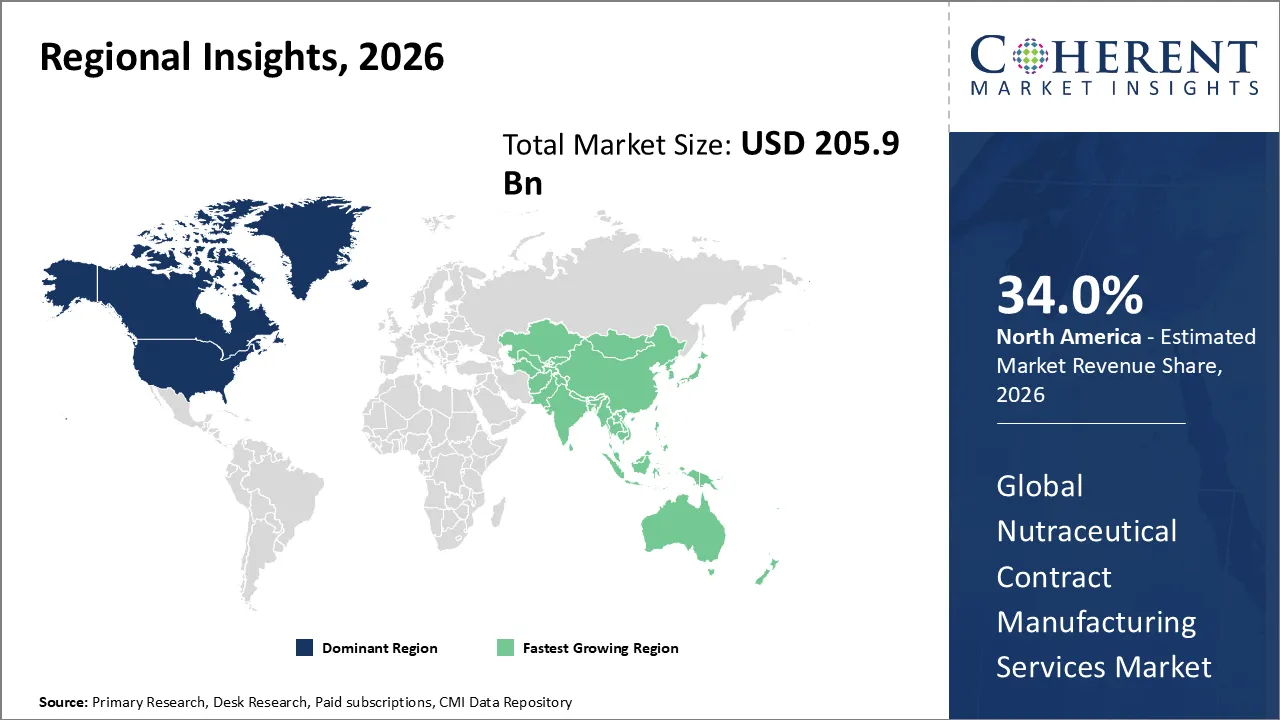
North America is estimated to account for 34.0% of global nutraceutical contract manufacturing services market revenue in 2026
The region comprises a consolidated leadership in this sector, owing to its established dietary supplement consumer base, a developed network of contract manufacturers, and a substantial base of nutraceutical brands operating across multiple retail and online channels. Evidencing such a flourishing business environment of this landscape, in 2024, herbal dietary supplement sales in the U.S. crossed USD 13 billion, reflecting a 5.4% year-on-year growth from 2023, as unveiled by the American Botanical Council.
These figures justify North America being an important manufacturing and commercialization hub for specialized nutritional products, with domestic manufacturers competing on technical capabilities, quality documentation, and flexibility. The same also makes the regional territory an attractive marketplace for future foreign investors, where Applied Nutrition participated by investing USD 16 million to acquire a US-based sports nutrition manufacturer, Nutrablend Group, in June 2026.
Asia Pacific is poised to register the fastest regional growth during 2026-2033
The region's market outlook is shaped by an expanding network of nutraceutical manufacturers in China, India, Japan, South Korea, and Southeast Asia, who are strengthening their portfolio by investing in specialized production systems, formulation development, ingredient processing, and export-oriented quality standards. For instance, in June 2026, DXN Holdings Bhd. broke ground on a RM 140 million nutraceutical manufacturing complex in Kedah. The project includes seven production blocks, ten warehouse facilities, and a dedicated R&D center.
The growth of domestic nutraceutical brands is also creating opportunities for APAC’s contract manufacturers, as investment in localized production may help participants reduce regional lead times and respond more effectively to market-specific requirements. To capitalize on this aspect, in May 2025, Cosmax NBT relocated its dietary supplement manufacturing operations from Texas to Korea to strengthen supply chain efficiency, elevate product quality, and better serve its global customers.
Global Nutraceutical Contract Manufacturing Services Market Outlook for Key Countries
The U.S. Strengthening Its Position in Specialized Nutraceutical Contract Manufacturing
The U.S. nutraceutical contract manufacturing services market benefits from its established manufacturing infrastructure and strong participation from specialized companies offering formulation development, ingredient sourcing, production, and packaging solutions. Such commercial-level engagement can be exemplified by Vitaquest International inaugurating an expanded probiotic manufacturing suite in February 2026, which marked a 100% increase in its probiotic manufacturing capacity.
The U.S. market also empowered by a mature consumer base, where more almost 80% of adults were taking supplements for their health. Individually, 67%, 31%, 25%, 19%, and 35% of total respondents were consuming vitamins/minerals, protein supplements, omega oil, herbals, and other types, respectively, based on a July 2026 survey of 3,554 adults. These figures indicate the potential of strategic partnerships between nutraceutical brands and contract manufacturers in fueling regional growth in this sector.
China is Expanding Its Role in the Global Nutraceutical Contract Manufacturing Services Market through Domestic Production Capabilities
China is also gaining momentum in the regional nutraceutical contract manufacturing services market through robust localization efforts in manufacturing specialized nutritional products to increase participation in international supply chains. These favorable advantages are prominently noticeable in the country’s online nutraceutical industry generating an impressive value of USD 17 billion in 2025, followed by a 14% year-on-year jump, as per the Health Products Association Global's 2026 industry analysis.
Manufacturers in China are now strengthening their capabilities across gummies, softgels, capsules, nutritional powders, and functional beverages to meet increasingly diverse product requirements to serve a diverse and international consumer base. Testifying to these activities, in June 2026, SIRIO Pharma introduced its pharmacopoeia-grade, Therapeutic Goods Administration (TGA)-compliant Gummies range at Complementary Medicines Australia (CMA) Innovation Day in Sydney. The pipeline expansion was made possible through the company’s specialized manufacturing lines at its Ma'anshan facility in China.
Germany is Becoming a Center for Advanced Nutraceutical Manufacturing Technologies
Germany is augmenting the nutraceutical contract manufacturing services market with its deepened expertise in pharmaceutical manufacturing, advanced processing equipment, and technical product development. All these capabilities are built over the years to satisfy the substantial consumer base residing across the country. Presenting a testimony for the same, a nationally structured survey on 1,071 participants was conducted in September 2024, which corresponded to an uptake rate of 77% for dietary supplements, according to 2025 NLM publication.
In terms of current trends, demand for effervescent formulations, botanical supplements, vitamin products, and convenient nutritional delivery formats are gaining momentum, which supports investments in processing and packaging equipment. One of such moves was detected in Aenova Group engaging a capital allocation of nearly EUR 20 million in reinforcing manufacturing and packaging infrastructure at its Bad Aibling facility in Germany in March 2025, extending its annual effervescent production capabilities to more than 420 million tablets.
How Is India's Contract Manufacturing Ecosystem Creating Opportunities for Nutraceutical Brands?
India's nutraceutical contract manufacturing services market is developing rapidly, as domestic manufacturers expand their capabilities and customer relations overseas. Exemplifying this progressive tendency, in August 2025, Sampre Nutritions Limited entered into a three-year manufacturing agreement with Nigeria-based Tolaram Wellness for the production, marketing, distribution, and sales of Tolaram’s nutraceutical and food products. This partnership led to an annual business generation of Rs. 10 crores over a 3 years tenure.
Indian contract manufacturers are now extensively providing integrated services, encompassing ingredient sourcing, formulation development, manufacturing, and packaging. This shift in service model is enabling domestic and international brands to access efficient, export-oriented production. The positive growth trajectory of these application industries can be exemplified by the country marking over USD 56 million worth of outbound trade worldwide for protein concentrates and textured protein substrates in 2024, as recorded by the World Integrated Trade Solution (WITS).
Japan is Focusing on Advanced Formulation and Precision Nutraceutical Manufacturing
The nutraceutical contract manufacturing services market is gaining traction within Japan on account of the country’s expertise in precision manufacturing, capsule technology, functional ingredients, and differentiated nutritional product development. Displaying such partial interest, in January 2024, Sunsho Pharmaceutical, a Japanese capsule CDMO, completed the acquisition a contract manufacturer of health food products, Kamata Co., Ltd., specializing in soft capsules.
These events confirm that Japanese CDMOs are more inclined towards supporting brands requiring specialized dosage forms, including soft capsules, liquid-filled formats, and products designed for controlled ingredient delivery. It is because their experience in technical formulation and quality management aligns better with the development of products where ingredient stability and consistency are especially important.
How Is Demand for Personalized and Innovative Nutritional Products Creating New Opportunities in the Global Nutraceutical Contract Manufacturing Services Market?
It is evident that personalized nutrition concepts require brands to accommodate product variations based on dietary preferences, lifestyle characteristics, and ingredient requirements. Subsequently, increasing demand for specialized nutritional products is fostering wider pathways of revenue generation for nutraceutical contract manufacturing companies, who are capable of offering smaller production runs, multiple ingredient combinations, and customized packaging.
Displaying the shifting consumer preference for individualized nutritional solutions, in October 2024, the Council for Responsible Nutrition (CRN) released the findings out of its consumer survey conducted upon 3,194 adult dietary supplement users across the U.S., where 69% of the total assessed population were found considering personalized regimens important when selecting products.
Another emerging opportunity involves the development of convenient nutritional delivery formats, as brands are expanding into gummies, stick packs, liquid concentrates, and other formats designed to improve convenience. This trend is specifically beneficial for manufacturers growing expertise in higher ingredient loading, taste masking, and plant-based gelling systems.
Market Players, Key Development, and Competitive Intelligence
Key Developments
- In October 2026, Riverside Company announced an investment in a U.S.-based nutraceutical CDMO, CSB Nutrition, as an addition to its Western Botanicals platform. The investment strengthened the group's supplement formulation, capsule and powder manufacturing, packaging, and product development capabilities.
- In July 2026, Wellma announced a strategic partnership with Virun NutraBiosciences, a specialist in advanced lipid carrier technologies. The partnership expanded Wellma's nutraceutical CDMO capabilities in micellar, liposomal, and cubosomal delivery systems while establishing its first manufacturing presence in the U.S. and Ireland.
- In March 2026, Icelandirect announced the acquisition of SOMA LABS, a New Jersey-based dietary supplement contract manufacturer. The acquisition expanded Icelandirect's manufacturing portfolio to include powders, capsules, tablets, and chewables, complementing its existing lipid and softgel manufacturing capabilities.
Competitive Landscape
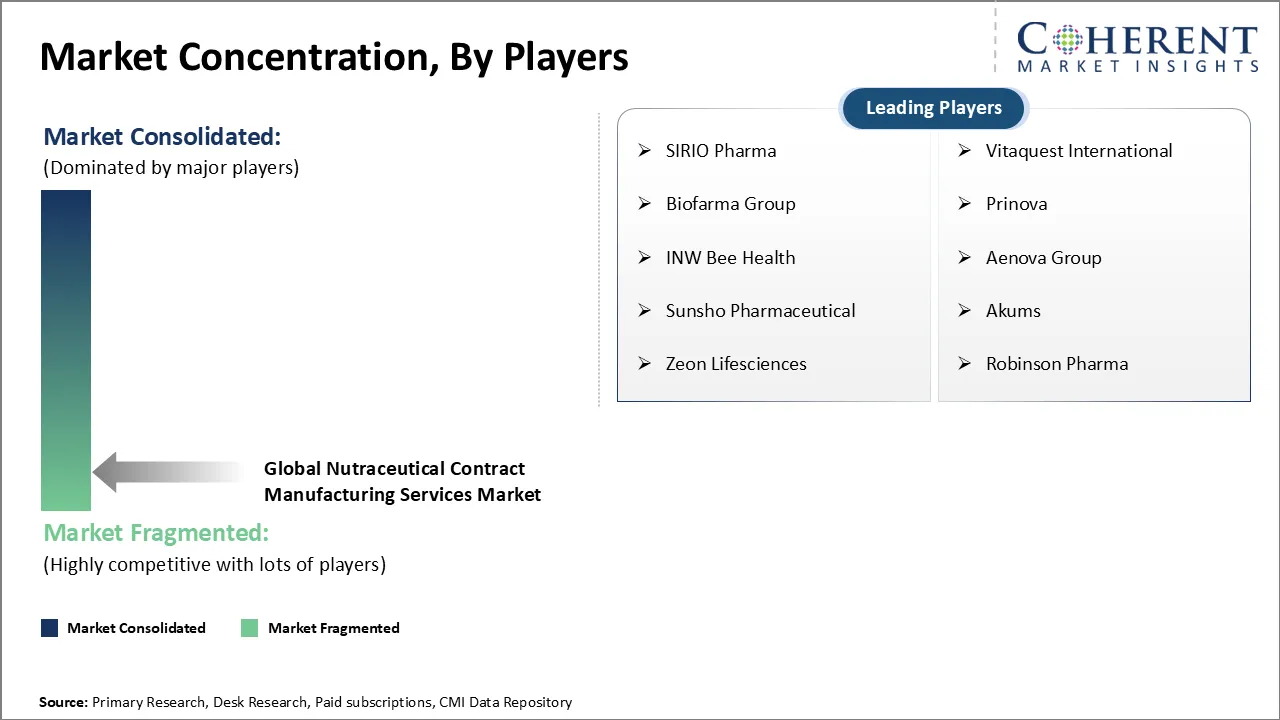
The global nutraceutical contract manufacturing services market is high fragmented due to heavy participation from specialized CDMOs, ingredient-focused manufacturing companies, private-label supplement producers, and integrated food and nutrition manufacturers. Amid such a competitive atmosphere, companies are consolidating their leadership through developing exclusive abilities in offering differentiated formulation solutions, dependable ingredient sourcing, flexible production volumes, multiple dosage forms, and product-specific quality systems.
Following this trail of portfolio expansion, in April 2025, TopGum Industries acquired a Canadian contract manufacturer, Island Abbey Nutritionals, specializing in supplement gummies and lozenges by signing a USD 12 million Letter of Intent (LoI). The acquisition added a 65,000-square-foot manufacturing facility equipped with starchless depositing, center-fill technologies, and automated packaging systems, strengthening the comapany's North American production capabilities.
In emerging marketplace, such as India, Thailand, Indonesia, and South Korea, domestic companies are heavily participating in outsourced manufacturing across nutritional and related product categories. These characteristics keeps the landscape highly populated with manufacturers seeking differentiation through technological capabilities, specialized formulation expertise, geographic expansion, and long-term customer partnerships.
Top Manufacturers and Notable Products/Solutions in the Nutraceutical Contract Manufacturing Services Market
Company | Notable Services / Capabilities |
SIRIO Pharma | Gummies, softgels, capsules, tablets, functional formulations |
Vitaquest International | Customized dietary supplements, probiotics, formulation development |
Biofarma Group | Integrated nutraceutical development, manufacturing, and packaging |
Prinova / Armada Nutrition | Ready-to-mix powders, capsules, sports nutrition manufacturing |
INW Bee Health | Vitamins, minerals, softgels, tablets, capsules, liquids |
Aenova Group | Effervescent products, solid dosage forms, packaging |
Sunsho Pharmaceutical | Capsule technologies, health food contract development |
Akums Drugs & Pharmaceuticals | Nutraceutical and related contract manufacturing services |
Zeon Lifesciences | Private-label nutraceuticals, sports nutrition, formulation services |
Robinson Pharma | Softgels, tablets, capsules, and supplement contract manufacturing |
Market Report Scope
Nutraceutical Contract Manufacturing Services Market Report Coverage
Report Coverage | Details | ||
Base Year: | 2025 | Market Size in 2026: | USD 205.9 Bn |
Historical Data for: | 2020 to 2024 | Forecast Period: | 2026 to 2033 |
CAGR: | 11.5% | 2033 Value Projection: | USD 460.7 Bn |
Geographies covered: |
| ||
Segments covered: |
| ||
Companies covered: | SIRIO Pharma, Vitaquest International, Biofarma Group, Prinova, INW Bee Health, Aenova Group, Sunsho Pharmaceutical, Akums, Zeon Lifesciences, and Robinson Pharma | ||
Growth Drivers: |
| ||
Restraints & Challenges: |
| ||
Analyst Opinion (Expert Opinion)
- The global nutraceutical contract manufacturing services market is evolving from a production-focused industry toward a more technically differentiated outsourcing ecosystem. Thus, manufacturers are increasingly expected to provide services beyond basic production, including formulation expertise, stability assessment, customized packaging, and manufacturing process optimization. This creates opportunities for companies that can combine product development with scalable manufacturing infrastructure.
- The market's next stage of expansion is likely to be influenced by specialized nutrition categories and advanced product formats. This will allow manufacturers having capabilities in complex functional ingredients, high-potency formulations, and alternative delivery systems to be better positioned and to attract long-term customer relationships. In this aspect, Asia Pacific is expected to be the most suitable landscape of new investment opportunities, while North America is likely to remain an important center for specialized contract manufacturing services.
- Competitive differentiation will further depend on technical reliability, manufacturing flexibility, product quality, and responsiveness to customer requirements. As a result, companies showing interest in developing stronger formulation capabilities, more consistent production systems, and highly transparent supply chains may be better positioned to serve both established nutrition brands and emerging market participants.
Speak to the analyst
Want personalized insights?
Take the findings above to one of our principal consultants, or have the report rebuilt around the segments, geographies and competitors you actually track.
Market Segmentation
- By Product (Revenue, USD Bn, 2021-2033)
- Dietary Supplements
- Functional Food & Beverages
- By Dietary Supplement Dosage Form (Revenue, USD Bn, 2021-2033)
- Tablets
- Capsules
- Liquid Oral
- Powder in Sachet/Jar
- Gummies
- Energy Bars
- Other Suitable Forms
- By Dietary Supplement Type (Revenue, USD Bn, 2021-2033)
- Proteins & Amino Acid Supplements
- Weight Management & Meal Replacer Supplements
- Multivitamin
- Multi-Mineral & Antioxidant Supplements
- Other Supplements
- Service Model (Revenue, USD Bn, 2021-2033)
- Turnkey Contract Development & Manufacturing
- Contract Manufacturing-Only Services
- Standalone Formulation Development & Other Services
- By Region (Revenue, USD Bn, 2021-2033)
- North America
- U.S.
- Canada
- Latin America
- Brazil
- Mexico
- Argentina
- Rest of Latin America
- Europe
- Germany
- U.K.
- France
- Italy
- Spain
- Russia
- Rest of Europe
- Asia Pacific
- China
- India
- Japan
- Australia
- South Korea
- ASEAN
- Rest of Asia Pacific
- Middle East
- GCC
- Israel
- Rest of Middle East
- Africa
- South Africa
- Central Africa
- North Africa
- North America
- Key Players
- Emulate, Inc.
- MIMETAS B.V.
- Valo Health, Nortis, Inc.
- AxoSim
- BICO - THE BIO CONVERGENCE COMPANY
- CN Bio Innovations Ltd
- The Charles Stark Draper Laboratory, Inc.
- SynVivo, Inc.
- AlveoliX AG.
Sources
Primary Research Interviews
- Nutraceutical contract manufacturing organizations (CMOs) and CDMO executives
- Dietary supplement and functional food manufacturers
- Nutraceutical formulation development and R&D specialists
- Nutritional ingredient suppliers and procurement managers
- Quality assurance, regulatory affairs, and compliance professionals
- Private-label nutraceutical brands and outsourcing managers
- Supplement packaging and manufacturing technology providers
Databases
- U.S. National Library of Medicine (NLM) – PubMed
- National Institutes of Health (NIH) – Office of Dietary Supplements
- U.S. Food and Drug Administration (FDA)
- U.S. International Trade Administration (ITA)
- World Integrated Trade Solution (WITS)
- Ministry of Food Processing Industries (MoFPI), India
- U.K. Food Standards Agency (FSA)
Industry Associations and Research Organizations
- Council for Responsible Nutrition (CRN)
- American Botanical Council (ABC)
- Health Products Association Global (HPAG)
- Association for Packaging and Processing Technologies (PMMI)
- India Brand Equity Foundation (IBEF)
- Pew Research Center
- HealthFocus International
Academic and Scientific Publications
- Peer-reviewed studies on dietary supplement consumption and consumer preferences
- Research publications on probiotic encapsulation and ingredient stability
- Life cycle assessment studies on tablet manufacturing efficiency
- Scientific studies on nutraceutical formulations and consumer willingness to pay
Public Domain Sources
- Nutraceutical contract manufacturing company websites and annual reports
- Corporate press releases covering mergers, acquisitions, partnerships, and investments
- Manufacturing capacity expansion and technology development announcements
- Government policies, food safety regulations, and nutraceutical manufacturing guidelines
- International trade statistics and food-processing industry publications
- Dietary supplement consumer surveys and industry research reports
- Publicly available nutraceutical manufacturing and outsourcing market studies
Proprietary Elements
- CMI Data Analytics Tool
- Proprietary CMI Existing Repository of Information for the Last 10 Years
Get access to 250+ pages report
Every segment, forecast, competitor profile and data table behind the analysis above — available for instant download.
- ESOMAR Member
- ISO 9001:2015 Certified
- D-U-N-S Registered
- GDPR & CCPA Compliant
Frequently Asked Questions
The market is estimated at USD 205.9 Bn in 2026, based on the selected published market benchmark.
The global nutraceutical contract manufacturing services market is forecast to reach approximately USD 460.7 Bn by 2033.
The market is expected to register a CAGR of approximately 11.5% during 2026–2033.
Functional food and beverage contract manufacturing is estimated to lead the market, accounting for 64.5% of revenue in the 2026 modeled allocation.
North America is estimated to lead with approximately 34.0% share in 2026.
Asia Pacific is expected to record the fastest growth during the forecast period.
Increasing outsourcing of nutraceutical production, demand for specialized formulations, expanding private-label businesses, and investments in advanced manufacturing capabilities are supporting the market.