

Oatmeal Market Size and Share Analysis- 2026 To 2033
The Oatmeal Market size is anticipated to grow at a CAGR of 5.9%, with USD 6.77 Bn in 2026, and is expected to reach USD 10.14 Bn by 2033. The key factors are mainly related to growing preference of consumers for healthy and nutritious breakfast products, growing awareness about health benefits of whole-grains, increasing demand for high fiber and plant-based food products, and increasing consumption of convenient and ready to eat breakfast cereals. In the 2025 Consumer Insights Survey by the Oldways Whole Grains Council, 46% of U.S. consumers surveyed said oats were among their favorite whole grains.
Key Takeaways
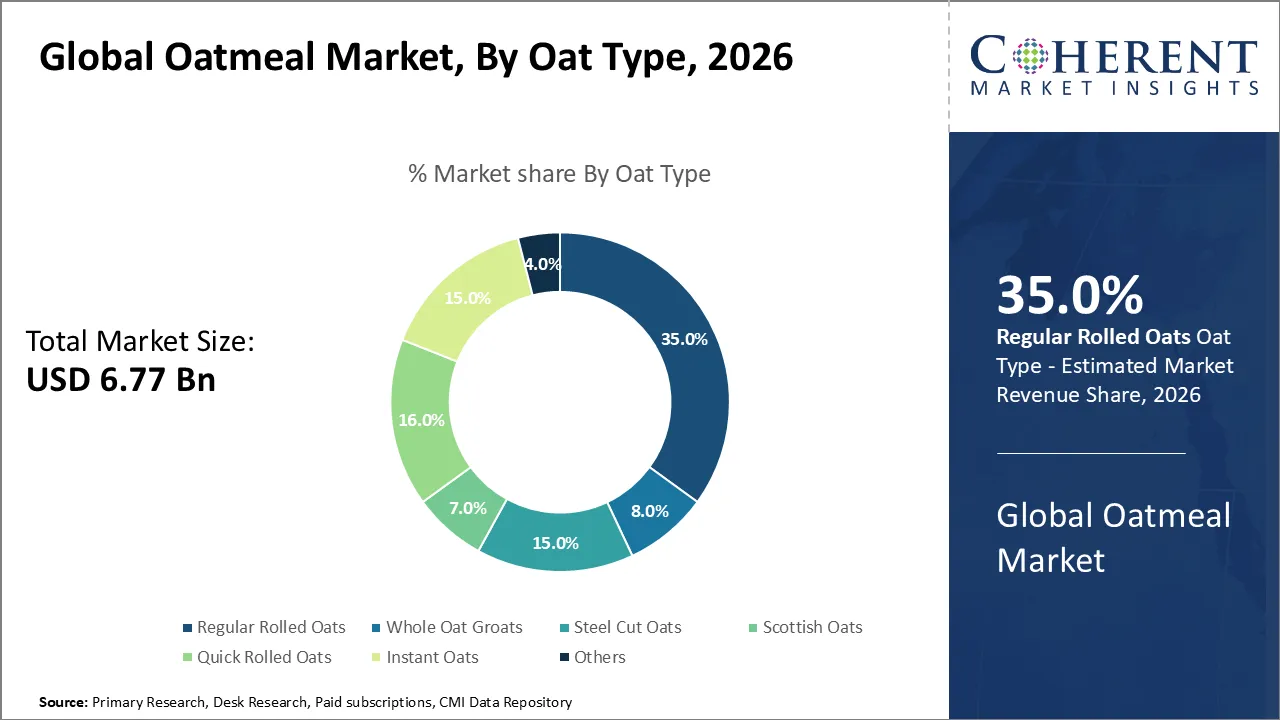
- The regular rolled oats is projected to account for the largest share of the oatmeal market with 35.0% in 2026. Increasing use of the segment in homemade granola, bakery products and oat-based meals will boost the market growth. The segment growth is attributed to its versatility in breakfast preparations, low prices and widespread availability. According to the USDA’s Foreign Agricultural Service, world oat production is expected to reach 26.23 million metric tons in 2025/26, up about 16% from 22.53 million metric tons in 2024/25, implying better availability of raw materials for oatmeal makers.
- The Supermarket segment is projected to lead the market with 38.0% in 2026. The segment is expanding because of diverse product range, competitive pricing, private label oatmeal products, promotional discounts and strong grocery retail networks. Grocery store food sales reached USD 617 Bn (inflation adjusted) in 2025, highlighting the scale of traditional grocery retail channels (USDA Economic Research Service, August 2026).
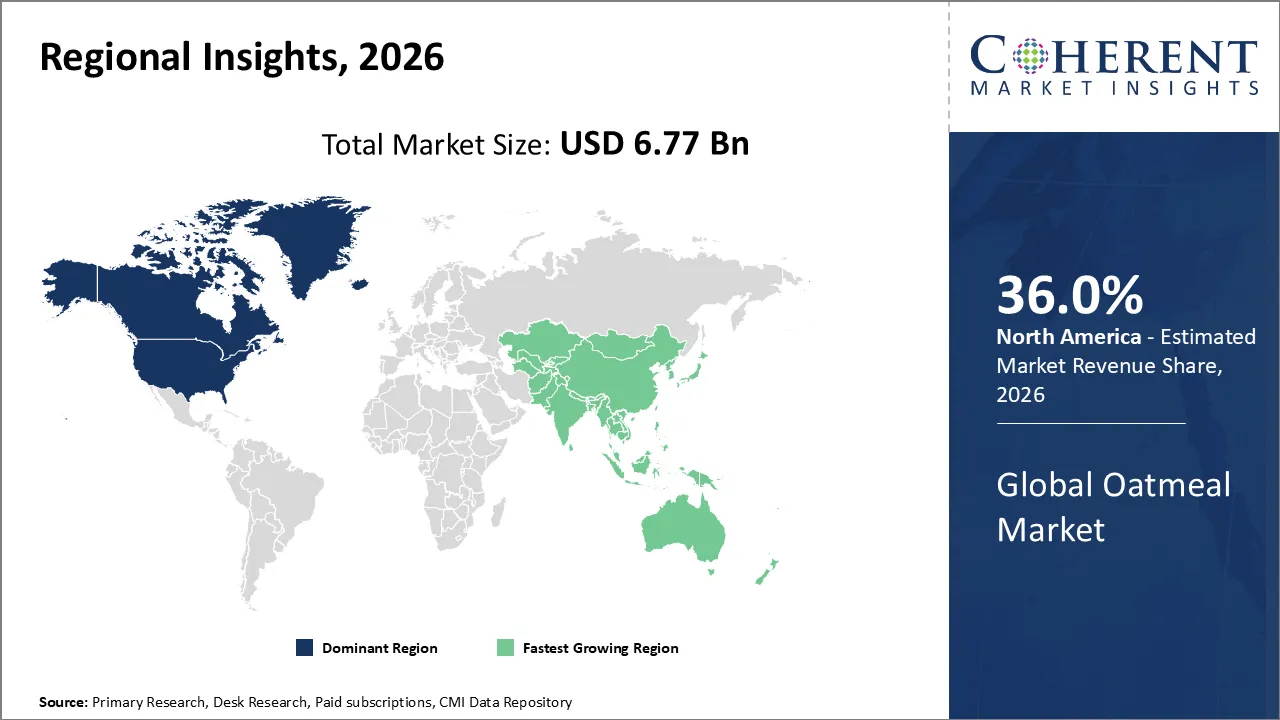
- North America is projected to account for a significant market share of 36.0% by the year 2026. The existing breakfast cereal consumption base, high brand penetration, demand for convenient oatmeal products and increased usage of oats as an ingredient in packaged food are driving growth in the region. The USDA National Agricultural Statistics Service estimates the production of oats in the U.S. at 69.6 million bushels in 2025, increasing by 2% over 2024, as of September 2025. This indicates continued domestic oat production and availability of raw material.
Market Drivers
Rising Health Consciousness and Growing Preference for High-Fiber Foods are Driving the Oatmeal Market
The rising consumer awareness of heart health, digestive health and the nutritional benefits of whole grains is fueling steady growth in the global oatmeal market. The consumption of oatmeal is increasing in consumers’ daily diets due to its beta-glucan soluble fiber content that may reduce blood cholesterol levels as part of an appropriate diet. Moreover, the increasing preference for minimally processed, nutrient-dense breakfast foods is further fueling the popularity of traditional and rolled oats.
According to the U.S. Food and Drug Administration (FDA) says eating 3 or more grams a day of soluble beta-glucan fiber from whole oats or barley is linked with a lower risk of heart disease when eaten as part of a diet low in saturated fat and cholesterol. The FDA also requires that qualifying rolled oats must contain at least 4% beta-glucan soluble fiber on a dry-weight basis, providing a scientifically supported nutritional basis for eating oatmeal.
In May 2026, PepsiCo India rolled out a major brand refresh for Quaker, emphasizing the nutritional benefits of oats. Company research shows that 46% of Indian consumers consider high protein content an important food purchasing factor, while 32% of consumers look for high fiber content. This trend underscores the growing commercial significance of nutritional positioning and backs the proliferation of oatmeal products for health-conscious consumers.
Increasing Demand for Convenient Breakfast Solutions and Product Innovation Accelerates Oatmeal Market Growth
Another major factor driving the growth of the global oatmeal market is the increasing trend of demand for convenient, ready-to-prepare and on-the-go breakfast products. Increasing urbanization, busy work schedules and changing breakfast eating habits are pushing manufacturers to develop instant oatmeal, flavored oats, protein-enriched varieties and novel oat-based formats. These trends are pushing oatmeal consumption past its traditional hot breakfast status.
According to PepsiCo’s July 2026 announcement said searches for cold-prepared oat recipes on TikTok increased 49% year-over-year, as overnight oats and easy-to-make foods gain popularity. The trend is driving manufacturers to develop products that offer the best of both worlds — whole-grain nutrition benefits and faster prep time.
In July 2026 Quaker introduced its Oat Shake & Go product in the U.S. The product is a ready-to-mix, oat-based beverage delivering 16 grams of whole grains, 15 grams of protein and 3 grams of fiber per serving, and can be prepared in less than a minute. The launch reflects how manufacturers are expanding their oat-based breakfast offerings to meet consumer demand for convenience and create new consumption occasions.
Current Events and Their Impact on the Oatmeal Market
Current Event | Description and its Impact |
U.S. FDA Updates “Healthy” Food Labeling Regulations, Strengthening Whole-Grain Product Standards (2025–2026) |
|
U.S. FDA Advances Front-of-Package Nutrition Labeling Requirements for Packaged Breakfast Foods (2025–2026) |
|
- Current Industry Events of 2026
- Market Size Estimation
- Regional Breakdown
- Competitive Landscape
- Customer Intelligence
- Segmental Analysis
- Pricing Analysis
- Key Market Drivers, Challenges & Future Trends
- Customized Insights Section
Segmental Insights
Why are Regular Rolled Oats Acquiring the Largest Market Share?
On the basis of oat type, the regular rolled oats segment is estimated to account for the largest Oatmeal Market share of 35.0% in 2026. The segment’s growth is attributed to its affordability, versatility in breakfast and bakery applications, balanced cooking time, and growing demand for minimally processed whole-grain foods. Regular rolled oats are commonly used in traditional oatmeal, granola, overnight oats and other convenient breakfast preparations.
According to the Oldways Whole Grains Council’s 2025 Consumer Insights Survey, 48% of U.S. consumers eat whole grains at breakfast most or all of the time, and among Gen Z and Millennials, that number rises to 56%. This suggests a strong demand for whole grain foods at breakfast, including rolled oats.
In May 2026, the U.S. Department of Agriculture (USDA) released updated specifications for processed cereal commodities, adding quick-cook rolled oats to the federal food procurement specifications. This supports their ongoing use in institutional food programs, and emphasizes the importance of standardized oat products in the food supply chain.
Why Does the Supermarket Segment Hold the Largest Market Share?
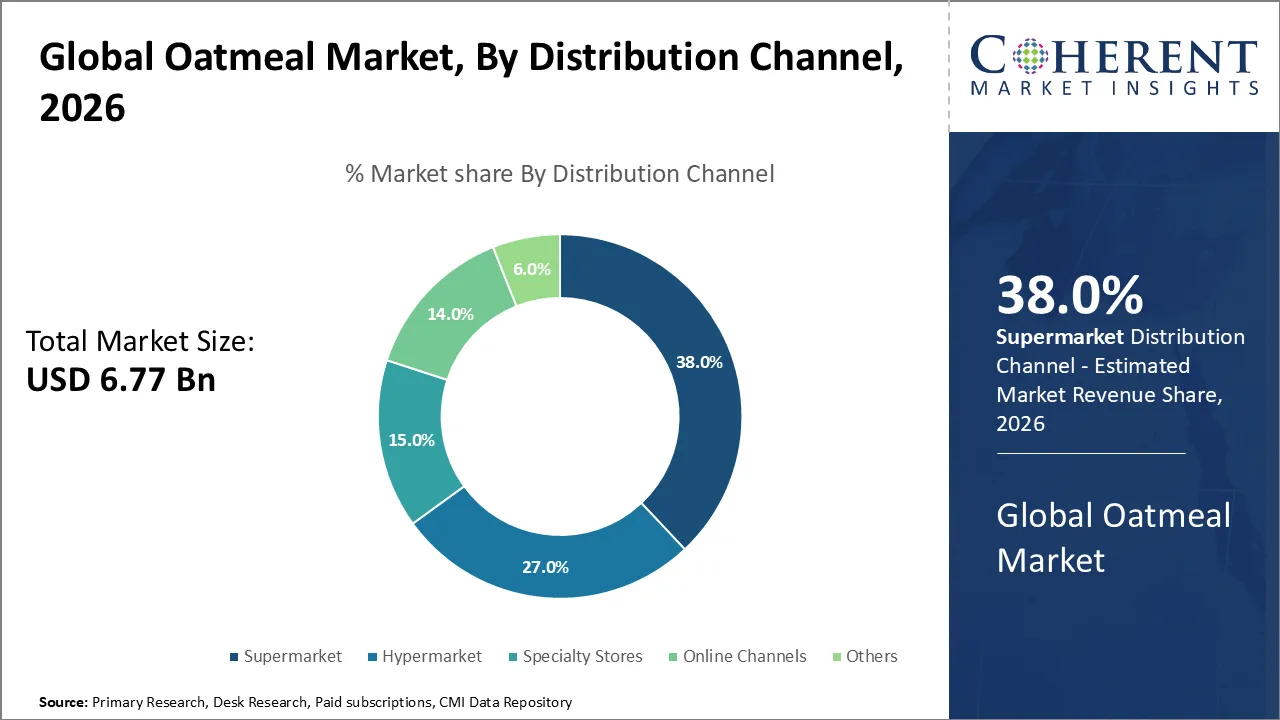
On the basis of distribution channel, the supermarket segment is expected to lead the Oatmeal Market with a prominent 38.0% share in 2026. The segment’s growth is owing to extensive availability of branded and private-label oatmeal products, competitive pricing, promotional discounts, convenient bulk purchasing, and established retail distribution networks. Supermarkets also provide consumers with access to regular rolled oats, instant oatmeal, flavored varieties, and organic oatmeal under one roof.
According to the USDA Economic Research Service, in 2025, grocery stores continued to be the largest food retail outlet category, accounting for 56.2% of U.S. food-at-home spending. This implies that traditional grocery channels are still relevant for purchases of packaged food, even oatmeal.
In July 2026, PepsiCo’s Quaker brand introduced Oat Shake & Go, a convenient oat-based breakfast beverage, in Strawberry & Banana and Cinnamon Vanilla flavors. Each serving has 16 grams of whole grain, 15 grams of protein and 3 grams of fiber.
Oatmeal Market Trends
- The growing demand for high-protein and functional oatmeal products is motivating the manufacturers to launch protein-enriched instant oatmeal types that provide the benefits of whole-grain nutrition along with functional benefits. In July 2026 Quaker (PepsiCo) introduced High Protein Instant Oatmeal in Blueberries & Cream and Banana Chocolate flavors, delivering 22 grams protein per serving, catering to growing consumer demand for protein-rich breakfast options.
- The rising demand for clean label ingredients and new oatmeal flavors is pushing manufacturers to update their product portfolio with convenient formulations and unique taste profiles. Bob’s Red Mill has launched Chocolate Chip Instant Oatmeal Packets and Chocolate Hazelnut Overnight Protein Oats at the Natural Products Expo West 2026 in February 2026, showcasing continued innovation in flavored and protein-fortified oatmeal.
- Consumers are looking for recognizable nutritional claims and independently verified product information, and whole-grain certification and transparent nutritional labeling are playing an increasingly important role in purchasing decisions for oatmeal products. According to the 2025 Consumer Insights Survey by the Oldways Whole Grains Council, 81% of U.S. shoppers surveyed said that the Whole Grain Stamp makes them more likely to buy a product, up from 78% in 2021.
Regional Insights
North America Dominates Owing to Established Oatmeal Consumption and Strong Oat Processing Infrastructure
North America is expected to dominate the Oatmeal Market with a share of 36.0% in 2026. The region’s growth is driven by established oatmeal consumption patterns, high demand for convenient whole-grain breakfast products, extensive supermarket distribution, and presence of leading manufacturers such as Quaker (PepsiCo), General Mills and Bob’s Red Mill. Moreover, increasing consumer preference for protein-based, organic and ready-to-prep oatmeal products is also fueling regional demand.
According to Agriculture and Agri-Food Canada (August 2026), over the first 11 months of the 2025–2026 crop year, the United States was the destination of almost 80% of Canada’s raw oat grain exports, and around 95% of Canadian oat-product exports. This reflects the very integrated oat supply chain in North America and its importance to the oatmeal processing and packaged breakfast food manufacturing sectors.
In February 2026, Ferrero North America introduced Famous Amos Oatmeal Chocolate Chip Cookies, which have real oat flakes and chocolate chips. The company said it would be initially available in select U.S. stores, followed by a nationwide retail rollout starting spring 2026.
Asia Pacific Oatmeal Market Trends
The Asia Pacific is anticipated to be the fastest-growing region of the Oatmeal Market during 2026 – 2033, owing to the increasing urbanization, changing breakfast consumption patterns, increasing health consciousness, and growing adoption of convenient whole-grain foods. New avenues for oatmeal manufacturers are being opened up by countries like China, India, Japan, Indonesia and Malaysia, through the growth of modern retail networks, product localization and rising demand for convenient breakfast options.
According to World Bank World Integrated Trade Solution (WITS) based on UN Comtrade data, Australia exported rolled or flaked oats worth some USD 60.47 million in 2025, including to Japan (USD 11.95 million), Malaysia (USD 11.39 million) and the Philippines (USD 11.03 million). The figures demonstrate the established regional trade flows and the commercial importance of processed oat products in Asian markets.
In May 2026, PepsiCo India announced a major refresh of its Quaker brand, based on the benefits of protein and fiber to increase consumer awareness of the nutrition from oats. The push included better nutritional information and consumer outreach, similar to the increasing interest among manufacturers to increase oatmeal uptake in developing Asian markets.
Strong Consumer Demand for Whole-Grain Breakfast Foods and Established Oat Supply Chains are Driving the U.S. Oatmeal Market
The U.S. Oatmeal Market is growing at a steady rate due to increasing consumer preference for healthy breakfast items, growing demand for whole grain foods and rising availability of instant as well as traditional oatmeal. There is established food processing infrastructure, strong supermarket distribution systems and a growing take-up of convenient, fibre-rich breakfast options in the country.
According to the USDA Economic Research Service (March 2026) forecasts U.S. oat supplies at 170 million bushels for the 2025/26 marketing year, with imports of about 72 million bushels. Over the 2015/16–2024/25 marketing years, Canada, on average, accounted for 97% of U.S. oat imports, indicating the significance of cross-border sourcing to the country’s oat processing and breakfast cereal industries.
China Oatmeal Market Trends
China is expected to witness healthy growth in the Oatmeal Market during the forecast period due to changing breakfast consumption habits, increasing health consciousness, growing demand for convenient packaged foods and increasing availability of imported oat-based products. The rising modern grocery retail networks and the increasing demand for whole-grain breakfast items are presenting opportunities for domestic and international oatmeal manufacturers.
According to the World Bank’s World Integrated Trade Solution (WITS, China imported about 718,156 metric tons of oats in 2025, valued at USD 223.91 million. The country's substantial oat imports highlight the importance of international raw-material sourcing and the commercial opportunities available to oat processors and packaged oatmeal manufacturers.
Who are the Major Companies in Oatmeal Industry
Some of the major key players in Oatmeal Market are Nature’s Path Foods Inc., General Mills Inc., Kellogg NA Co., The Quaker Oats Company, Bagrry’s India Ltd., La Crosse Milling Company, Avena Foods Limited, Cargill Incorporated, and World Finer Foods Inc.
Key News
- In March 2026, Nature's Path Organic Foods announced a modernized company logo and redesigned product packaging to improve retail visibility and help consumers identify its organic breakfast products more easily. The company stated that the update preserves its organic ingredients and sustainability commitments.
- In February 2026, General Mills introduces new breakfast products such as Nature Valley Cinnamon Roll Protein Granola and Cheerios Granola in Apple Cinnamon, Chocolate and Honey Nut flavors. The Apple Cinnamon Cheerios Granola variety was announced as a Walmart-exclusive offering.
Market Report Scope
Oatmeal Market Report Coverage
Report Coverage | Details | ||
Base Year: | 2025 | Market Size in 2026: | USD 6.77 Bn |
Historical Data for: | 2020 to 2024 | Forecast Period: | 2026 to 2033 |
CAGR: | 5.9% | 2033 Value Projection: | USD 10.14 Bn |
Geographies covered: |
| ||
Segments covered: |
| ||
Companies covered: | Nature’s Path Foods Inc., General Mills Inc., Kellogg NA Co., The Quaker Oats Company, Bagrry’s India Ltd., La Crosse Milling Company, Avena Foods Limited, Cargill Incorporated, and World Finer Foods Inc. | ||
Growth Drivers: |
| ||
Restraints & Challenges: |
| ||
Analyst Opinion
- The global oatmeal market is expected to witness steady growth, supported by expanding oat-processing capabilities, improving agricultural productivity, and increasing demand for value-added oat products. Canada produced 3.92 million metric tons of oats in 2025-2026, with food and industrial oat use estimated at 90,000 metric tons. This underscores the significance of current oat production and processing infrastructure to oatmeal manufacturing and supply chains.
- Risks associated with agricultural production and changes in raw material supply will impact oatmeal manufacturers' profitability and competitive positioning. According to Statistics Canada, 2.5 million acres of oats were seeded in 2026, a 15.1% decrease from the previous year. This decline indicates possible supply-side pressures and highlights the necessity for oatmeal producers to have long-term sourcing agreements, inventory control, and diverse procurement strategies.
- The oatmeal manufacturers are expected to have more focus on product differentiation, quality assurance and efficient sourcing strategies for sustainable expansion. The average price of oats for the 2026–2027 crop year was forecast at USD 315 per metric ton, up from about USD 307 per metric ton in 2025–2026, reflecting expected tightening in North American supplies of oats (Agriculture and Agri-Food Canada, August 2026). This development is expected to encourage manufacturers to optimize procurement costs, improve processing efficiency, and strengthen premium product positioning to protect profit margins.
Speak to the analyst
Want personalized insights?
Take the findings above to one of our principal consultants, or have the report rebuilt around the segments, geographies and competitors you actually track.
Market Segmentation
- By Oat Type (Revenue, USD Bn, 2021-2033)
- Whole Oat Groats
- Steel Cut Oats
- Scottish Oats
- Regular Rolled Oats
- Quick Rolled Oats
- Instant Oats
- Others
- By Distribution Channel (Revenue, USD Bn, 2021-2033)
- Supermarket
- Hypermarket
- Specialty Stores
- Online Channels
- Others
- By Region (Revenue, USD Bn, 2021-2033)
- North America
- U.S.
- Canada
- Latin America
- Brazil
- Mexico
- Argentina
- Rest of Latin America
- Europe
- Germany
- U.K.
- France
- Italy
- Spain
- Russia
- Rest of Europe
- Asia Pacific
- China
- India
- Japan
- Australia
- South Korea
- ASEAN
- Rest of Asia Pacific
- Middle East
- GCC
- Israel
- Rest of Middle East
- Africa
- South Africa
- Central Africa
- North Africa
- North America
Sources
Primary Research Interviews
- Oatmeal and breakfast cereal manufacturers
- Oat farmers and agricultural commodity suppliers
- Oat milling and food processing industry experts
- R&D heads from oatmeal manufacturing companies
- Supermarket, hypermarket, and specialty food retail procurement managers
- Food and beverage distributors and supply chain experts
- Key opinion leaders (KOLs) in whole-grain nutrition and cereal processing
Databases
- United States Department of Agriculture (USDA)
- Food and Agriculture Organization of the United Nations (FAOSTAT)
- World Bank
- UN Comtrade Database
- USDA Economic Research Service (ERS)
- Statistics Canada
- Eurostat – Agriculture and Food Industry Statistics
Magazines
- Food Business News
- Food Processing Magazine
- FoodNavigator
- Milling and Grain
- Baking & Snack
- Food & Beverage Magazine
Journals
- Journal of Cereal Science
- Cereal Chemistry
- Foods
- Food Chemistry
- Journal of Food Science
- International Journal of Food Science & Technology
Newspapers
- The New York Times
- The Guardian
- The Wall Street Journal
- Financial Times
- The Economic Times
Associations
- Oldways Whole Grains Council
- North American Millers' Association (NAMA)
- Prairie Oat Growers Association (POGA)
- International Association for Cereal Science and Technology (ICC)
- Cereals & Grains Association
- Grain Growers of Canada
Public Domain Sources
- Company Annual Reports and Investor Presentations
- Government Agricultural Production and Commodity Trade Reports
- USDA Oat Production, Consumption, and Supply Chain Statistics
- FDA Food Labeling, Nutrition, and Health Claim Regulations
- FAO and UN Comtrade Agricultural Trade Statistics
- Publicly Available Oatmeal Product Launches and Manufacturer Press Releases
- Scientific Publications on Oat Nutrition and Cereal Processing
Proprietary Elements
- CMI Data Analytics Tool
- Proprietary CMI Existing Repository of Information for the Last 10 Years
Get access to 250+ pages report
Every segment, forecast, competitor profile and data table behind the analysis above — available for instant download.
- ESOMAR Member
- ISO 9001:2015 Certified
- D-U-N-S Registered
- GDPR & CCPA Compliant
Missing comfort of reading report in your local language? Find your preferred language:
Transform your Strategy with Exclusive Trending Reports
Frequently Asked Questions
The Oatmeal Market is expected to reach USD 10.14 Bn by 2033, increasing from USD 6.77 Bn in 2026.
Major players operating in the global Oatmeal Market include Nature’s Path Foods Inc., General Mills Inc., Kellogg NA Co., The Quaker Oats Company, World Finer Foods Inc., Bagrry’s India Ltd., La Crosse Milling Company, Avena Foods Limited, and Cargill Incorporated.
Fluctuations in raw oat prices, high processing and packaging costs, supply chain disruptions, and increasing competition from alternative breakfast cereals are the key factors hampering market growth.
Increasing consumer preference for nutritious breakfast options, rising demand for high-fiber and whole-grain foods, growing health consciousness, and expanding consumption of convenient and ready-to-eat oatmeal products are driving market growth.
The Oatmeal Market is anticipated to grow at a CAGR of approximately 5.9% between 2026 and 2033.
Among regions, North America is expected to account for the largest market share of 36.0% in 2026, supported by established oatmeal consumption patterns, strong supermarket distribution networks, and the presence of leading oatmeal manufacturers.
Oatmeal is a food product made from processed oat grains, commonly available in rolled, steel-cut, quick-cooking, and instant varieties. It is widely consumed as a breakfast food owing to its fiber content, nutritional benefits, and convenient preparation.