

Global Frozen Fruit Market Size and Share Analysis – Growth Trends and Forecasts (2026-2033)
The frozen fruit market is estimated to be valued at USD 5.62 Bn in 2026 and is expected to reach USD 8.97 Bn by 2033, exhibiting compound annual growth rate (CAGR) of 6.9% from 2026 to 2033. The market growth is attributed to factors such as the availability of different fruit varieties, longer shelf life as compared to fresh fruits, and hectic lifestyle of consumers that demand convenient food options.
Key Takeaways
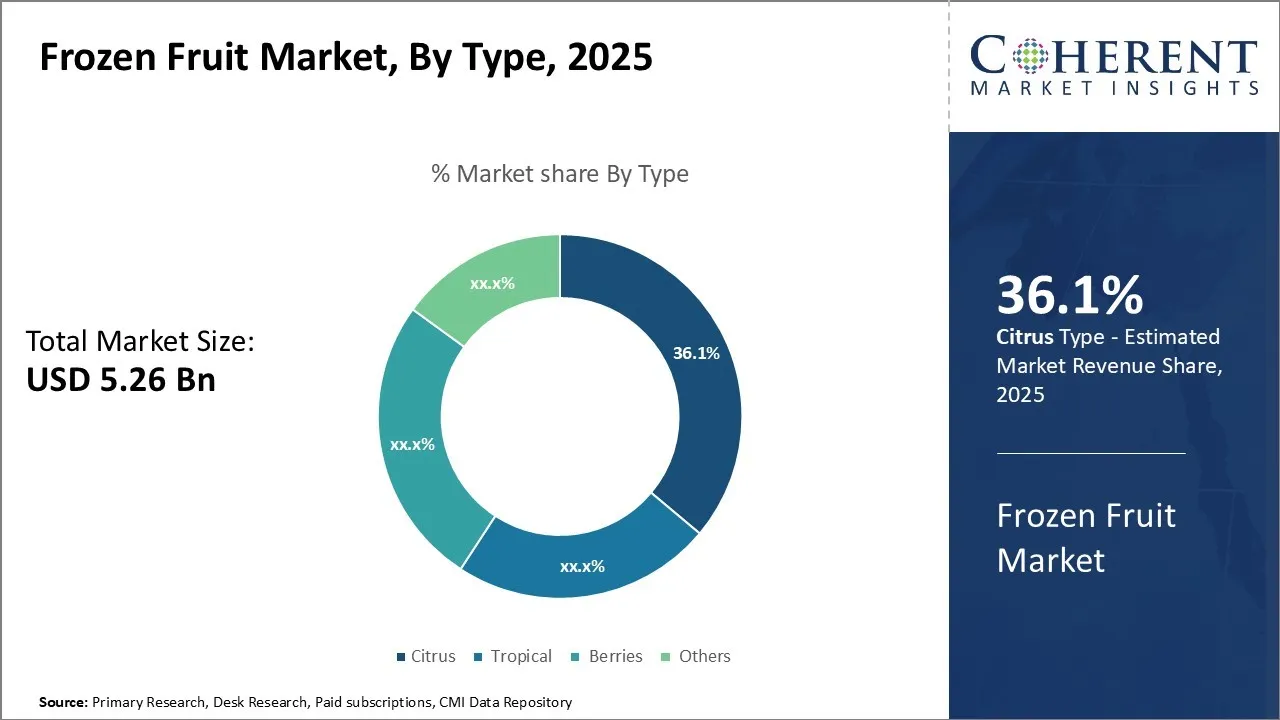
- In terms of Type, Citrus Segment is projected to have the highest market value share of 37.1% of frozen fruit in 2026. This is because of their immense demand and wide usage.
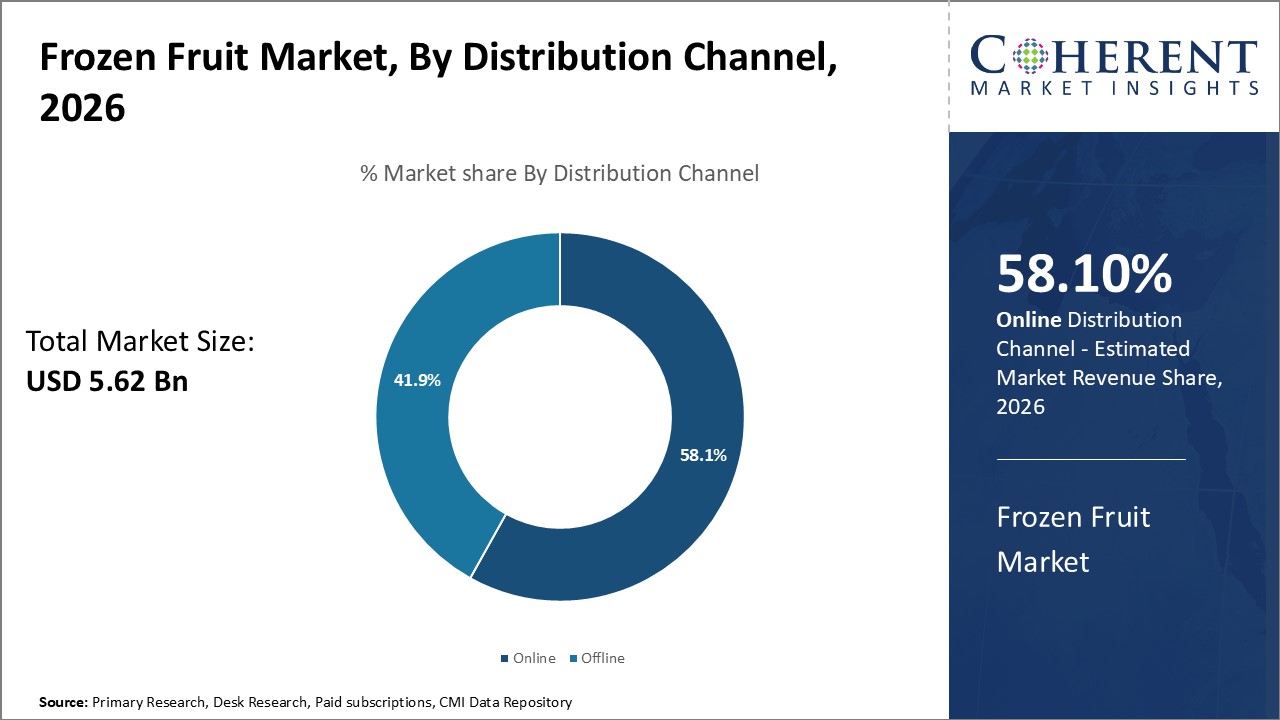
- In terms Distribution Channel, Online Segment is estimated to contribute the highest market share of 58.1% of the frozen fruit market in 2026. This is due to increased consumer preference for convenient, home-delivered, and wide-ranging frozen fruit options.
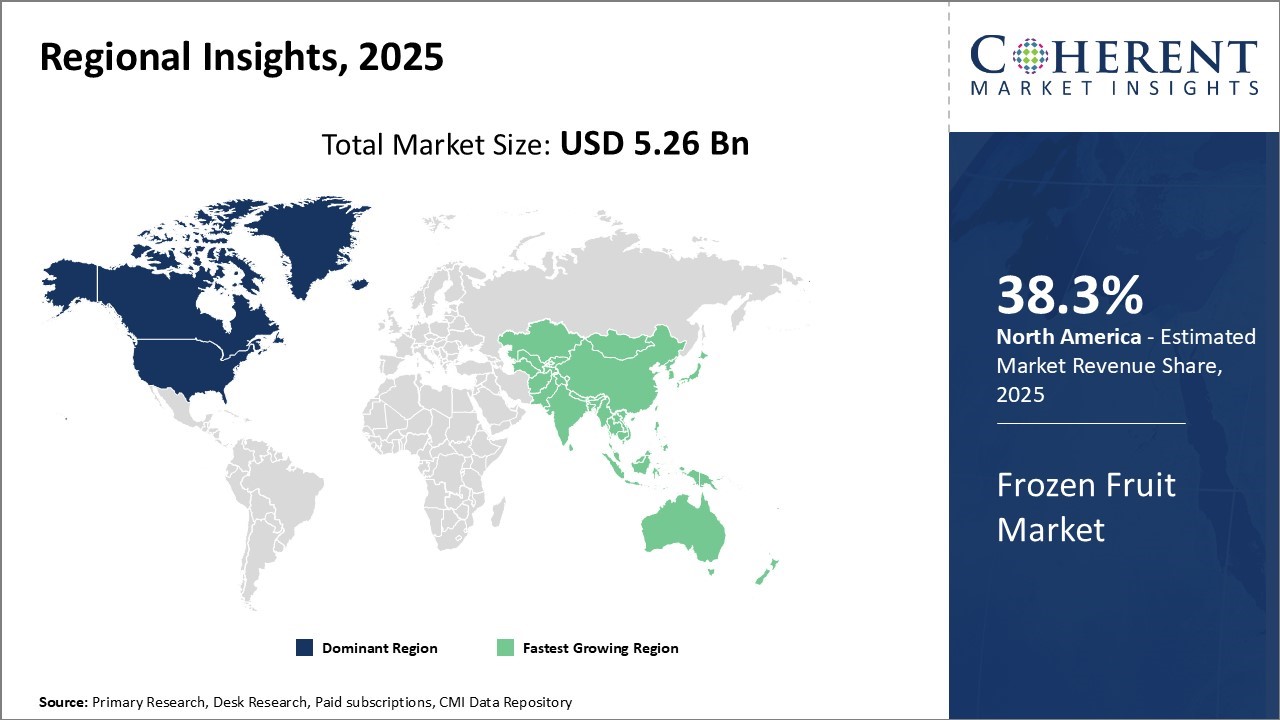
- North America is expected to account for the greatest revenue share, with 38.3% in 2026. This is attributed to strong fruits production and solid market channels.
Market Overview
The frozen fruit sector has been witnessing consistent growth over the last few years owing to rising health awareness, need for convenience food, and growing popularity of plant-based and clean-label diets. The market is expected to experience growth at a remarkable rate in the forecast period, led by growing applications in smoothies, functional drinks, dairy substitutes, and ready-to-eat foods. The longer storage life and retention of nutrients in frozen fruits over their fresh counterparts render them ever more appealing to consumers and food manufacturers alike.
Current Events and Its Impact on Frozen Fruit Market
Current Events | Description and its impact |
Transition to New IQF & Flavor-Preserving Technologies |
|
AI-Powered Cold-Chain & Predictive Supply Systems |
|
Pricing Analysis
The worldwide market of frozen fruits is characterized by price stabilization over the recent years, even though history has seen it volatile. In 2024, world production of frozen fruit amounted to about 12 million tonnes and earned value of around 27.3 billion USD at export prices, down slightly (~–1.3%) from the level of 2022, which was 27.7 billion USD.
Export prices were around 2,535 USD/tonne, decreasing approximately 2.1%, whereas average import prices were about 2,497 USD/tonne, decreasing about 2.4% year-on-year.
Price differs considerably by type and country of origin. Berries (raspberries, blackberries, currants) are the most expensive at about 2,800–2,900 USD/tonne, while frozen strawberries are one of the lowest-priced at about 1,700–1,720 USD/tonne.
Drivers of pricing here are raw material cost fluctuations (weather, yields, tariffs), cold‐chain transport energy and logistics, and geopolitical disturbances such as war or inflation in producer nations like Russia and Ukraine. Consumers are still very sensitive to price; most markets are unwilling to pay premiums for frozen fruit over fresh options unless value is seen in convenience or health aspects.
- Current Industry Events of 2026
- Market Size Estimation
- Regional Breakdown
- Competitive Landscape
- Customer Intelligence
- Segmental Analysis
- Pricing Analysis
- Key Market Drivers, Challenges & Future Trends
- Customized Insights Section
Demand for natural and organic ingredients
Consumer interest in natural, clean-label, and organic frozen fruit is growing globally as health-oriented consumers increasingly demand minimally processed products free of artificial food additives, preservatives, and sweeteners.
The organic segment is already dominant—commanding an estimated 46% of revenue share in 2022—thanks to positioning against claims of purity, nutritional goodness, and sustainability. Health-conscious consumers, especially Millennials and Gen Z, value products that are seen as safer and more natural.
Organic frozen fruit is sold as "chemical-free, nutrient-dense alternatives" that support clean-eating and plant-based lifestyle trends. Companies are responding by highlighting organic certification, non-GMO status, and transparency in sourcing to bolster credibility with discerning consumers.
Concurrently, clean-label innovations continue to increase in popularity—firms are launching blends with superfruits or novel combinations, without additives, due to consumer demand for functional and premium frozen fruit. Retailers like Whole Foods and online plant-based food retailers have launched separate lines of organic frozen fruit (e.g., organic blueberries, mixed berries), driving typical growth within the category.
Geographically, adoption is highest in North America and Europe, where shoppers are both most mindful of organic certification and most likely to pay a premium price—usually 10–50% more—for perceived health and environmental gain (organic food premiums in general vary widely).
Consequently, the market for frozen fruit keeps growing—predicted to approach nearly USD 11.2 billion by 2032—thanks to organic and clean-label options spearheading value-added, profitable growth. Natural and organic frozen fruit demand is moving from niche to mainstream, influencing innovation, premiumization, and long‑term market opportunity in the worldwide frozen fruit market.
Role of technologies like AI on the Market
Artificial intelligence (AI) is transforming the worldwide frozen fruit industry with significant improvements in supply chain optimization, quality assurance, and forecasting demand. On the production side, AI-based visual inspection systems utilize computer vision and machine learning to automate the detection of flaws, ripeness, or deterioration of the fruit—reducing waste and increasing better quality product during the freezing and processing processes. This enables automated quality control versus manual inspections, enhancing consistency and safety.
In logistics, AI revolutionizes cold-chain handling by monitoring sensor readings (e.g. temperature, humidity) to provide ideal storage and transportation conditions. It real-time foretells and marks risks such as deviations in temperature, minimizing spoilage during transport and warehousing for frozen fruit products.
Route optimization with AI also improves delivery efficiency—orchestrating truck dispatch, eliminating cold-chain downtime, and reducing emissions through optimization in real-time. Demand forecasting is one of AI’s most transformative roles: machine learning models now analyze historical sales, weather patterns, promotional schedules, and even social media sentiment to predict seasonal spikes and adjust inventory proactively.
This granularity helps manufacturers and retailers reduce overstock and stockouts while aligning production to actual demand patterns. More advanced "demand sensing" systems combine multiple real-time data signals—leading to finer responsiveness in volatile markets.
Market Driver - Increasing demand for convenience food products
With changing busy lifestyles and rising dual income households, convenience has become one of the top priorities for consumers. People are constantly looking for food products that can save their time and effort in the kitchen. Frozen fruits are perfectly positioned to capitalize on this demand as they can be stored and used as per convenience without much effort.
In April 2025, FNB News reported that frozen fruits are increasingly dominating supermarket freezers. Driven by fast-paced urban lifestyles, consumers are choosing frozen fruits as nutrient-rich, ready-to-use options that eliminate washing, peeling, and chopping. This shift caters especially to busy professionals, students, and families seeking convenient, health-forward nutrition.
Market Opportunity: Increasing demand for organic and natural products
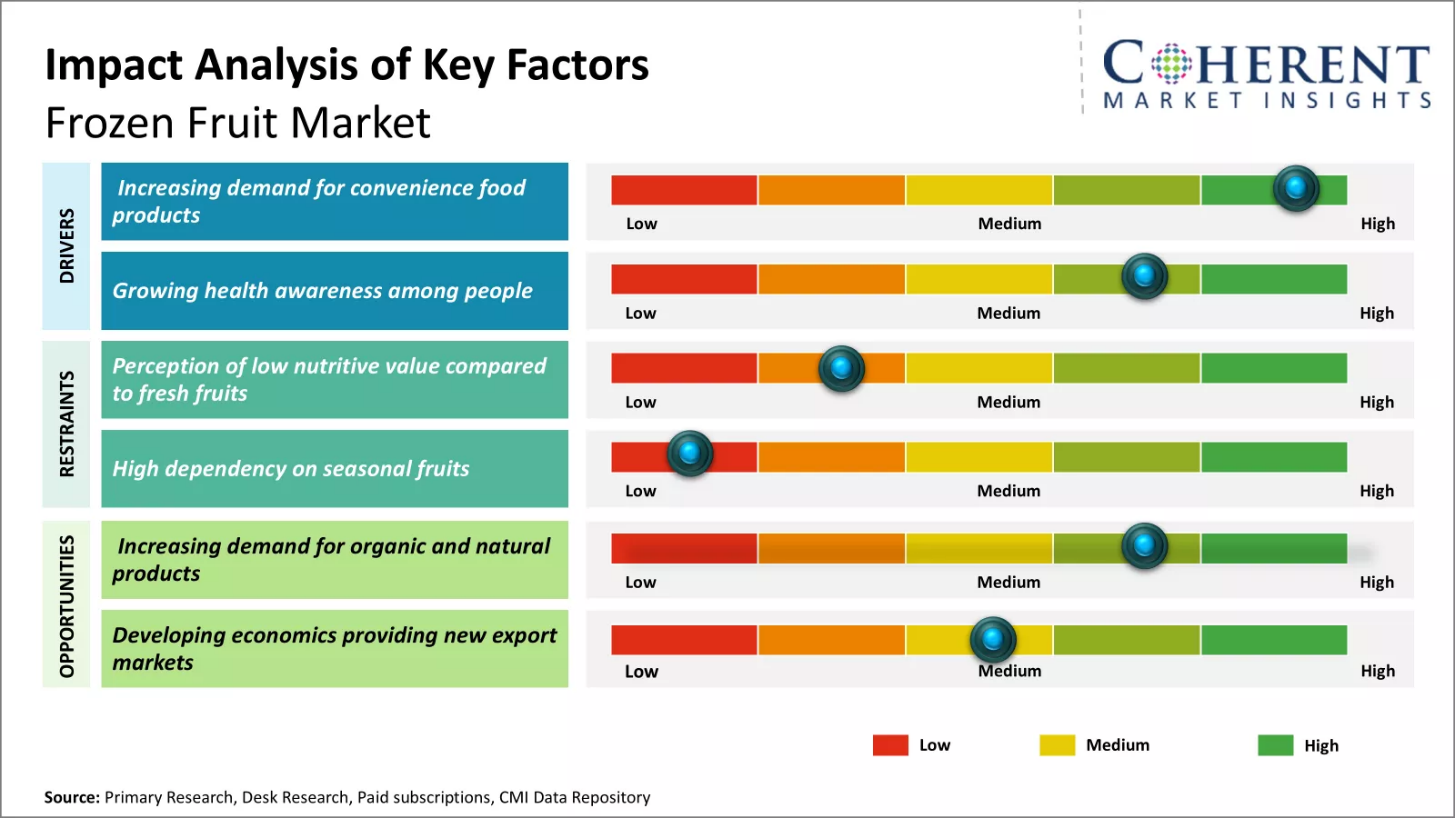
One major opportunity for the frozen fruit market is the increasing demand for organic and natural food products globally. Consumers are becoming more health conscious and looking to limit consumption of foods with artificial preservatives, colors, flavors or genetically modified ingredients. Frozen fruits, which involve minimal processing and do not require the use of preservatives for longer shelf life, are well positioned to tap into this demand.
Frozen fruit producers can promote their products as a clean label and all-natural option. The market has also seen impressive growth of organic frozen fruits in recent years to meet the needs of health-focused consumers who prefer fruits grown without synthetic pesticides and fertilizers. This growing preference for organic and natural products is expected to drive significant growth for the frozen fruits market going forward.
Segmental Insights
Frozen Fruit Market Insights, By Type
In terms of type, citrus segment is estimated to contribute the highest market share of 37.1% of the frozen fruit market in 2026, due to their high demand and versatile uses. Oranges, lemons, limes and grapefruits are some of the popular citrus fruits frozen for consumption. Citrus fruits have a bright, tangy flavor that lifts the taste of both sweet and savory dishes. They are a rich source of vitamin C and contribute a refreshing flavor to smoothies, juices, desserts and more.
Frozen Fruit Market Insights, By Distribution Channel
In terms distribution channel, online segment is estimated to contribute the highest market share of 58.1% of the frozen fruit market in 2026. Customers now expect a digital shopping experience on par with what they find in physical stores. This has propelled retailers and Consumer packaged goods (CPG) brands to establish robust online presences for frozen fruit products. Improvements in cold chain logistics by e-commerce giants ensure safe, reliable delivery of perishables directly to customers' doorsteps.
Global Frozen Fruit Market – Regional Insights
Dominating Region: North America
North America is expected to account for the greatest revenue share, with 38.3% in 2026. North America’s dominance in the frozen fruit market can be attributed to robust fruits production and strong market channels across countries like the U.S. Government initiatives to promote consumption of frozen produce have also contributed to market growth. Major players in the region such as Dole Food Company, Simplot and General Mills have reinforced their market presence through innovative product offerings and strategic acquisitions over the years.
Fastest-Growing Region: Asia Pacific
The Asia Pacific exhibits the fastest growth driven by rising health consciousness and increasing per capita income in populous nations like India and China. Changing lifestyles and rising preference for convenience foods have boosted demand for frozen fruits. Large fruit production bases and improving cold chain infrastructure are helping drive market penetration. Key regional players including Del Monte and Huber's Fruit Plus have intensified their focus on the Asia Pacific market.
Frozen Fruit Market Dominating Countries
United States Frozen Fruit Market Analysis and Trend
The U.S. market is characterized by high fruit sourcing capabilities and strong distribution networks of leading brands dominating retail shelves. Companies including Dole Food Company continue to leverage their scale to deliver innovative new products.
China Frozen Fruit Market Analysis and Trend
China's market growth is supported by government measures to modernize agriculture and food processing sectors. Regional players such as Yantai North Andre Juice are expanding operations to meet rising urban demand for frozen fruits.
India Frozen Fruit Market Analysis and Trend
India market continues to lead South Asia with its vast production base and emerging middle class. Companies like Del Monte focus on private label offerings and partnership with e-tailers to boost outreach.
Brazil Frozen Fruit Market Analysis and Trend
Although Brazil faces export challenges, companies like Simplot are expanding in Latin America through tailored product ranges designed for the regional palate. Brazil's market retains opportunities in processed fruits and mixed blends.
Market Concentration and Competitive Landscape
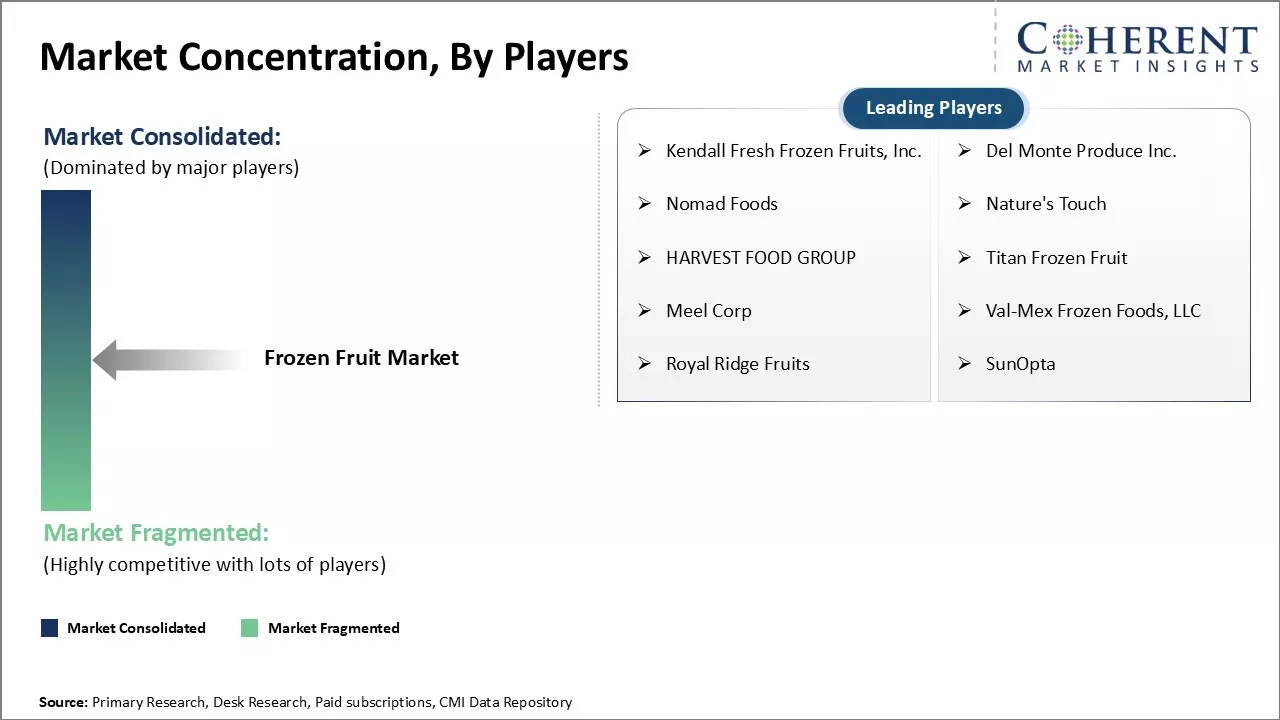
Top Strategies Followed by Frozen Fruit Market Players
- Established players heavily invest in research and development to drive product innovation. Companies like Dole Food and Berry Gardens pour resources into developing new frozen fruit varieties, customized blends, and high-performance packaging solutions. They leverage extensive R&D to deliver diverse, value-added products catering to evolving consumer tastes.
- Leading players also pursue strategic partnerships for market dominance. Dole partners with foodservice giants to expand distribution into commercial channels like restaurants and cafeterias.
- International companies expand global footprints through multi-national acquisitions. Fairtrade grows its presence in Europe by acquiring compatriot frozen fruit suppliers.
- Mid-tier players differentiate through affordable products. Companies like Andros and Pictsweet utilize economical production techniques and competitive pricing to grab the value-conscious consumer segment. They launch reasonably-priced frozen fruit snacks and blends targeting budget-minded households.
Emerging Startups in the Frozen Fruit Market
Several startups contribute innovative technologies. Companies like Ripple Foods and Future Farm are developing smart ripening units powered by IoT sensors and AI algorithms. These high-tech solutions promise precise ripening control for extended freshness and minimized food waste throughout the cold chain. Their advances could help optimize the industry's supply processes.
Sustainability-driven startups also impact the market. Apeel Sciences utilizes plant-based coatings to lengthen produce shelf life without artificial preservatives. This natural technology aids in reducing greenhouse gas emissions from food loss. Other firms work on growing fruits locally using hydroponics or vertical farming methods with less land and water usage. Their eco-friendly solutions lower the industry's environmental impact over time.
Market Report Scope
Frozen Fruit Market Report Coverage
| Report Coverage | Details | ||
|---|---|---|---|
| Base Year: | 2025 | Market Size in 2026: | USD 5.62 Bn |
| Historical Data for: | 2020 To 2024 | Forecast Period: | 2026 To 2033 |
| Forecast Period 2026 to 2033 CAGR: | 6.9% | 2033 Value Projection: | USD 8.97 Bn |
| Geographies covered: |
| ||
| Segments covered: |
| ||
| Companies covered: | Kendall Fresh Frozen Fruits, Inc., Del Monte Produce Inc., Nomad Foods, Nature's Touch, HARVEST FOOD GROUP, Titan Frozen Fruit, Meel Corp, Val-Mex Frozen Foods, LLC, Royal Ridge Fruits, and SunOpta | ||
| Growth Drivers: |
| ||
| Restraints & Challenges: |
| ||
Recent Development
- In March 2024, BigBasket partnered with celebrity chef Sanjeev Kapoor to bring in a frozen food brand, Precia. The partnership merges Kapoor's culinary skills with BigBasket's delivery network to introduce a series of frozen vegetables, snacks, and sweets by applying Individual Quick Freezing (IQF) technology to lock in flavor and nutritional content. The brand expects to reach online sales of INR 100 crore by 2026 through convenience and quality for the modern consumer.
- In June 2024, Del Monte Inc. introduced frozen British strawberries, only found in Iceland stores nationwide in the UK. The expansion is a major step for Del Monte in its pursuit of offering the highest quality, locally sourced food items, responding to increasing consumer demand for traceable and sustainable food choices.
Key Takeaways from Analyst
- The global frozen fruit market is expected to witness steady growth over the forecast period, driven by rising health consciousness among consumers. As consumers become more health-cautious, demand for frozen fruits is rising as they are considered a healthy alternative to fresh fruits.
- Additional drivers include a growing working population, changing lifestyles, and increasing demand for convenience food products. Moreover, the rising popularity of frozen fruit keto-friendly snacks is further boosting market growth, particularly among consumers following low-carb and health-focused diets.
- The North America region dominates the global frozen fruit market and is expected to continue its lead over the forecast period. Growing population, increasing health awareness, rising disposable incomes are driving demand in the region.
- Asia Pacific is expected to grow at a significant rate in the frozen fruit industry, backed by high demand for convenience foods and the presence of major players. Furthermore, the expanding food processing industry is increasing the application of frozen fruits in various food products such as jams, yogurt, smoothies, and bakery goods, which is fueling market growth.
- Additionally, the rising popularity of high-fiber frozen fruit market options—such as berries, mangoes, and pears—is attracting health-conscious consumers, further driving demand in the region.
Market Segmentation
- Type Insights (Revenue, USD, 2021 - 2033)
- Citrus
- Tropical
- Berries
- Others
- Application Insights (Revenue, USD, 2021 - 2033)
- Online
- Offline
- Regional Insights (Revenue, USD, 2021 - 2033)
- North America
- U.S.
- Canada
- Latin America
- Brazil
- Argentina
- Mexico
- Rest of Latin America
- Europe
- Germany
- U.K.
- Spain
- France
- Italy
- Russia
- Rest of Europe
- Asia Pacific
- China
- India
- Japan
- Australia
- South Korea
- ASEAN
- Rest of Asia Pacific
- Middle East
- GCC Countries
- Israel
- Rest of Middle East
- Africa
- South Africa
- North Africa
- Central Africa
- Key Players Insights
- Kendall Fresh Frozen Fruits, Inc.
- Del Monte Produce Inc.
- Nomad Foods
- Nature's Touch
- HARVEST FOOD GROUP
- Titan Frozen Fruit
- Meel Corp
- Val-Mex Frozen Foods, LLC
- Royal Ridge Fruits
- SunOpta
Sources
Primary Research Interviews
- Frozen fruit manufacturers and processors
- E commerce platform managers and executives
- Supply chain and logistics providers
- Retail buyers and procurement managers
- Others
Databases
- Euromonitor International
- IBISWorld Industry Reports
- Nielsen Consumer Panel Data
- Others
Magazines
- Frozen Food Age
- Food Business Magazine
- Progressive Grocer
- Refrigerated & Frozen Foods
- Others
Journals
- International Journal of Food Science & Technology
- Food Quality and Preference
- Journal of Food Engineering
- Others
Newspapers
- Food Business Daily
- The Grocer
- Supermarket News
- Food Navigator
- Grocery Dive
- Others
Associations
- American Frozen Food Institute (AFFI)
- International Association of Refrigerated Warehouses (IARW)
- Frozen Food Europe (FFE)
- National Frozen & Refrigerated Foods Association (NFRA)
- Others
Public Domain Sources
- U.S. Department of Agriculture (USDA) reports
- Food and Agriculture Organization (FAO) statistics
- International Trade Centre (ITC) data
- National statistical offices publications
- Others
Proprietary Elements
- CMI Data Analytics Tool
- Proprietary CMI Existing Repository of information for last 8 years
Get access to 250+ pages report
Every segment, forecast, competitor profile and data table behind the analysis above — available for instant download.
- ESOMAR Member
- ISO 9001:2015 Certified
- D-U-N-S Registered
- GDPR & CCPA Compliant
Missing comfort of reading report in your local language? Find your preferred language:
Transform your Strategy with Exclusive Trending Reports
Frequently Asked Questions
The Frozen Fruit Market size is estimated to be valued at USD 5.62 Bn in 2026, and is expected to reach USD 8.97 Bn by 2033.
The CAGR of the global Market is projected to be 6.9% from 2026 to 2033.
Increasing demand for convenience food products and growing health awareness among people are the major factors driving the growth of frozen fruit industry.
Economic factors like inflation and disposable income affect the frozen fruit market by influencing consumer purchasing power, where higher inflation may lead to reduced spending on premium frozen fruits, while stable or rising incomes support consistent demand.
Key demographics for frozen fruit consumers include health-conscious millennials, working professionals, and urban families seeking convenient, nutritious food options.
Rising consumer awareness of healthy eating significantly boosts frozen fruit sales, as buyers increasingly choose nutrient-rich, preservative-free products for smoothies, snacks, and meal prep.
Perception of low nutritive value compared to fresh fruits and high dependency on seasonal fruits are the major factors hampering the growth of global market.