

Granola Market Size and Share Analysis – Growth Trends and Forecasts (2026–2033)
The Granola Market size is anticipated to grow at a CAGR of 6.6%, with a market valuation of USD 19.29 Bn in 2026, and is expected to reach USD 30.10 Bn by 2033. Increasing inclination of consumers toward healthy & convenient breakfast options, growing demand for high fiber & protein rich food, rising consciousness about nutritional wellness and increasing adoption of organic, gluten-free and plant-based granola products are the major growth drivers. In the 2025 IFIC survey, 32% of U.S. consumers influenced by convenience said ease of preparation had a great impact on their purchases, while 29% cited convenience of consumption.
Key Takeaways
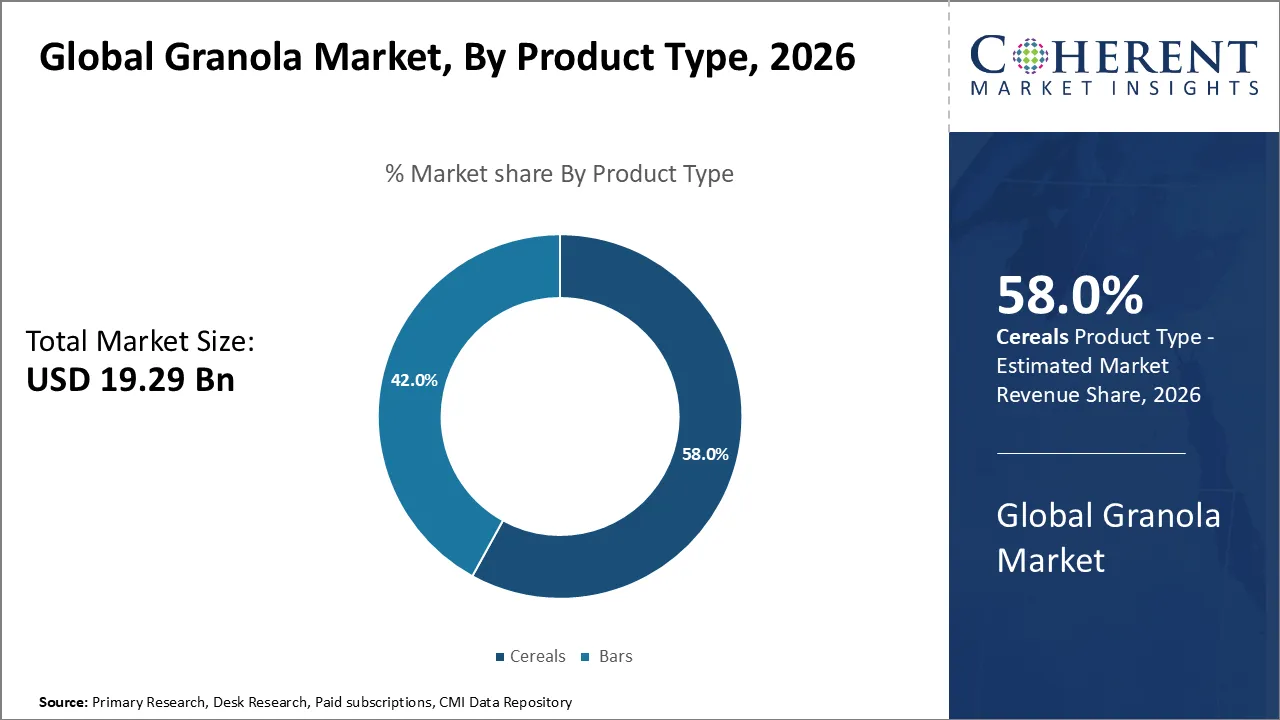
- The cereals segment is expected to retain its leadership in the granola market with a 58.0% share in 2026. The segment’s growth is attributed to the growing consumption of whole-grain breakfast products, increasing demand for fiber-rich foods and rising preference for convenient and nutritious breakfast options. According to Oldways Whole Grains Council’s 2025 Consumer Insights Survey, 72% of U.S. consumers said they want to eat more whole grains and 57% said they picked whole grain products at least half the time.
- The oats segment is expected to dominate the market with an estimated share of 64.0% in 2026. High dietary fiber content of oats, its wide application in granola formulations and rising demand for whole grain foods are also expected to drive the segment. In several European countries, oatmeal is one of the most consumed whole-grain breakfast cereals. The annual per capita consumption of oatmeal is estimated to be 30-34 kg in Finland.
- The supermarkets segment is projected to lead the market with a share of about 38.0% in 2026. The segment’s growth is due to wide product availability, competitive pricing, private label offerings and increasing shelf space for organic and health-oriented breakfast products. According to the Organic Trade Association report, the U.S. organic food sales in 2025 reached USD 70.1 Bn, with a 6.9% increase year-on-year. This growth is an indication of the strong consumer demand for organic food products through retail channels.
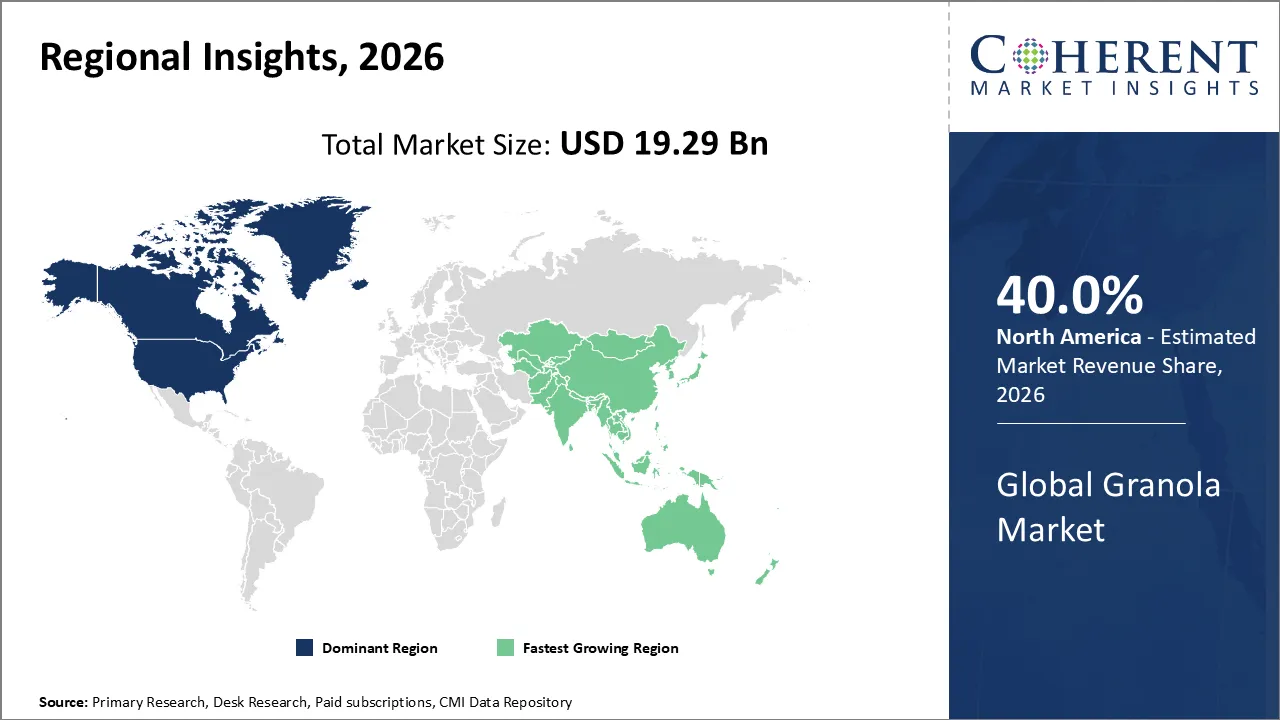
- North America is projected to dominate the market with a share of around 40.0% in 2026. The region’s growth can be credited to high consumption of ready-to-eat breakfast cereals, established packaged food distribution channels, rising demand for high-protein and fiber-rich granola products, and continuous innovations in convenient breakfast and snack formats. According to Circana data in Snack Food & Wholesale Bakery’s June 2026 State of the Industry report, sales of U.S. shelf-stable cereals were USD 12.8 Bn over the 52 weeks ended March 22, 2026.
Market Drivers
Rising Demand for High-Protein and Fiber-Rich Foods is Driving the Granola Market in the U.S.
Increasing consumer demand for nutritional wellness, growing preference for protein rich breakfast products and increasing adoption of whole grain and high fiber foods are driving the U.S. granola market. Increasing consumer demand for healthier and convenient breakfast alternatives is encouraging manufacturers to launch more and more granola products that incorporate oats, nuts, seeds and other protein sources.
According to the International Food Information Council (IFIC) 2025 Food & Health Survey found that 70% of U.S. consumers were trying to eat more protein, with 64% trying to get more fiber. The increasing emphasis on nutritional intake is opening up opportunities for high-protein granola, oat-based cereals and fiber-enriched snack products.
According to the Oldways Whole Grains Council’s October 2025 Consumer Insights Survey, 77% of U.S. consumers wanted to see information about whole-grain content on food packaging. This rising need for ingredient transparency is encouraging manufacturers to innovate whole grain granola formulations with transparent nutritional benefits thus boosting the growth of the market.
Growing Preference for Convenient Breakfast and On-the-Go Snacking is Accelerating Granola Market Growth
The increasing demand for convenience and ready-to-eat foods is emerging as a major driver of the granola market. Changing lifestyle, busy work schedules and increasing consumer preference for portable meal alternatives are fostering consumption of granola bars, packaged granola cereals and single serving snack products. In response, manufacturers are increasing the availability of portion-controlled packaging, offering innovative flavors and creating granola products that can be eaten for breakfast or between meals.
According to the 2026 State of Snacking report from Mondelēz International in partnership with Mintel and Black Swan Data revealed that 66% of U.S. consumers surveyed snacked daily and 41% of U.S. snack consumers consume snacks in place of regular meals.
Current Events and Their Impact on the Granola Market
Current Event | Description and its Impact |
U.S. FDA Strengthens Healthy Food Labeling Standards for Packaged Breakfast Products (2025–2026) |
|
European Union Implements New Packaging and Packaging Waste Regulation (August 2026) |
|
- Current Industry Events of 2026
- Market Size Estimation
- Regional Breakdown
- Competitive Landscape
- Customer Intelligence
- Segmental Analysis
- Pricing Analysis
- Key Market Drivers, Challenges & Future Trends
- Customized Insights Section
Segmental Insights
Why is the Cereals Segment Acquiring the Largest Market Share?
By product type, cereals segment is anticipated to lead the Granola Market with the highest share of 58.0% in 2026. Increasing consumption of ready-to-eat breakfast cereals, increasing demand for whole grain and fiber-rich foods, and increasing availability of nutritious granola formulations are driving the growth of the segment. Manufacturers are broadening their range of low-sugar, fortified and high-protein cereals in line with changing consumer dietary preferences.
According to the European Breakfast Cereal Association (CEEREAL), Europe’s breakfast cereal makers fortified 60% of the cereals they sold in Europe in 2025 and June 2026, or about 9.2 billion servings. This shows the industry’s focus on nutritional enhancement and product innovation.
In February 2026 General Mills announced new granola and cereal products, including Cheerios Granola (Apple Cinnamon, Chocolate and Honey Nut) and Nature Valley Cinnamon Roll Protein Granola.
Why is the Oats Segment Dominating the Granola Market?
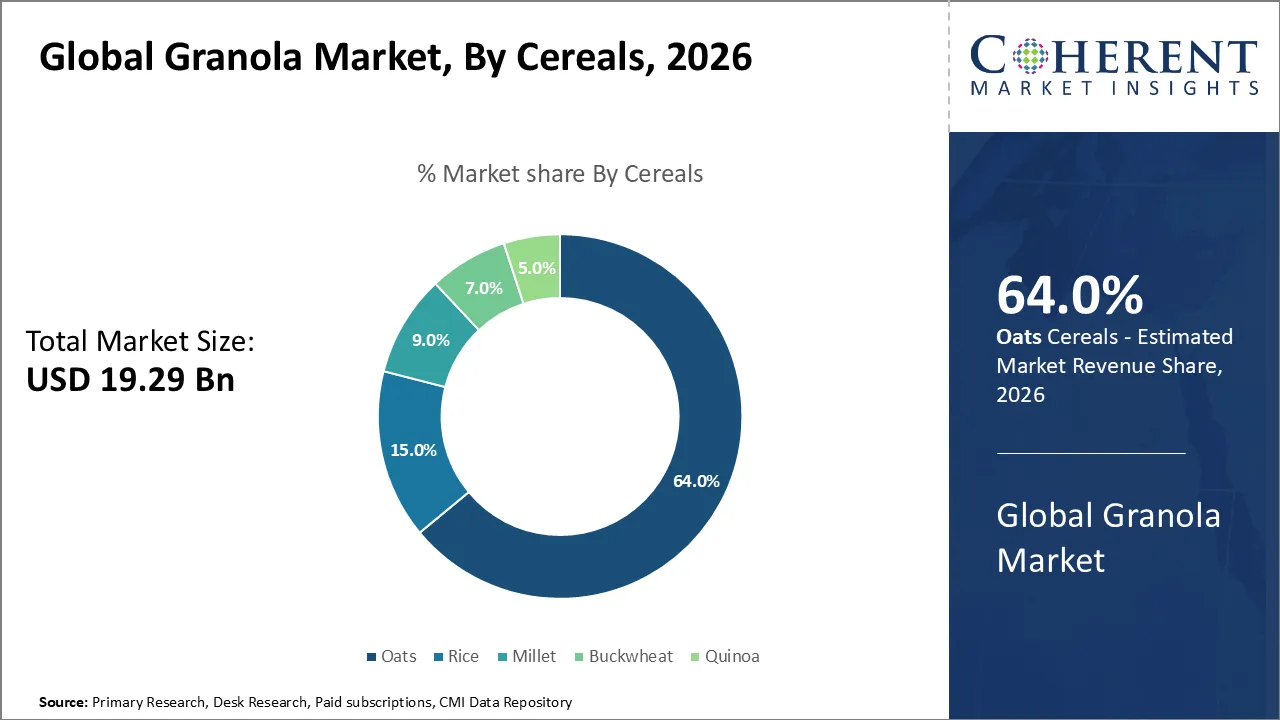
The oat segment is expected to account for the largest share of the market in 2026, with a share of 64.0%, due to the cereal ingredients. The segment attributes its growth to the popularity of rolled oats in granola making, the increasing demand for naturally fiber-rich ingredients, and the adaptability of oats to organic, gluten-free and protein-fortified granola products. Oats are a popular base ingredient in many granola products, providing texture and binding properties.
According to Statistics Canada’s December 2025 report stated that Canada’s oat production rose 16.7% to approximately 3.9 million tons in 2025, a result of a 5.6% expansion in harvested area and a 10.6% rise in yields. This demonstrates the big production capacity of a major oat producing country.
According to Agriculture and Agri-Food Canada’s September 2026 outlook, the United States was also the largest destination for oat product exports from Canada, accounting for a significant share of the 0.9 million tons exported in the 2025–2026 crop year. This underscores the significance of current North American oat processing and trade networks for producers of breakfast products based on oats.
Why are Supermarkets Holding the Largest Market Share?
Based on distribution channel, the supermarkets segment is expected to dominate the granola market with an estimated share of 38.0% in 2026. The segment’s dominance can be attributed to the broad product assortments, extensive retail networks, competitive pricing, private-label granola offerings, and convenient access to packaged breakfast products. Supermarkets enable consumers to compare brands, nutritional formulations, packaging sizes and prices, which improves their position in the distribution of granola.
According to FMI, the Food Industry Association on 2026 U.S. Grocery Shopper Trends, shows that 77% of American consumers shopped for groceries in supermarkets and 54% said they always shop in-store at their primary grocery retailer. This is the reason for the continuing importance of physical supermarkets in buying packaged foods.
In May 2026, Michele's Granola announced nationwide expansion of its granola portfolio through Target stores across the U.S. The launch included Original, Almond Butter and Salted Maple Pecan Granola at USD 7.99 per 12-ounce bag, and Banana Bread and Cinnamon Roll flavors at USD 5.49 per 11-ounce bag.
Granola Market Trends
- Growing consumer demand for high-protein granola bars made with natural, minimally processed ingredients is pushing manufacturers to add nuts, seeds, oats and ancient grains to their formulations. Clean-label nutrition products are in demand, and Purely Elizabeth launched Protein Ancient Grain Granola in May 2026 with 10 grams of protein per serving from whole foods (not protein powders or isolates).
- Innovation in premium granola products is being fueled by the increasing demand for indulgent flavors and healthier nutritional profiles. In May 2026, Love Crunch introduced flavors of Dubai Style Chocolate and Dark Chocolate & Blueberry Cream granola, pointing to a growing trend in dessert-inspired flavors in organic and gluten-free breakfast foods.
- Increasing consumption of granola bars as a convenient snack on the go, is driving the innovation of products in portable food formats. U.S. sales of granola bars in the 52 weeks ended March 22, 2026, came to USD 1.8 billion, up 1.4% from the same period a year earlier, data released by Circana in June 2026 showed. The larger snack bars, granola bars & clusters segment was worth USD10.9 billion, indicating that demand for easy snacking formats remains strong.
Regional Insights
North America Dominates Owing to Strong Demand for Convenient and Nutritious Breakfast Products
North America is anticipated to hold the largest share in the Granola Market in 2026 at roughly 40.0%. The region’s dominance is backed by the well-established consumption of ready-to-eat breakfast cereals, the increasing demand for protein-rich and clean-label granola products, the robust presence of leading manufacturers, and the extensive distribution networks through supermarkets and convenience stores.
In May 2026, Purely Elizabeth reported that its business had more than doubled in size over the preceding two years and was on track to exceed USD 300 million in annual sales in 2026. The company also cited a U.S. granola category exceeding USD 1.3 billion, highlighting the commercial scale of premium granola products in the region.
Additionally, Keychain’s granola industry analysis, published in September 2026 and based on its tracked market dataset, found U.S. granola unit sales grew 7% and revenue grew 9% from 2025 to 2026. These trends point to the continued demand for granola products and growing opportunities for premiumization, product innovation and retail expansion across North America.
Asia Pacific Granola Market Trends
The Asia Pacific region is anticipated to be the fastest-growing region in the Granola Market during the forecast period of 2026–2033. The growth in the region is attributed to the growing urbanization, growing middle class, growing demand for convenient Western-style breakfast products, and rapid development of organized retail and e-commerce channels. Granola cereals, functional breakfast products and portable snack formats are key markets in China, India, Japan and South Korea.
In May 2026, Calbee announced plans to begin local original equipment manufacturer (OEM) production of its Frugra granola brand in China. The move highlights growing interest from manufacturers in local manufacturing, supply chain development and better access to granola products in Asian markets, supporting future regional market growth.
Growing Demand for Functional and Convenient Breakfast Products is Driving the Granola Market in the United States
The U.S. granola market is fueled by growing consumer demand for nutrition wellness, growing preference for protein rich breakfast products and growing adoption of whole grain and high fiber foods. As consumers have turned to healthier, more convenient breakfast options, manufacturers have rolled out ever-growing numbers of granola products featuring oats, nuts, seeds and other protein sources.
According to data published in June 2026 by Circana, Quaker Oats sold $336.1 million in U.S. granola bars in the 52 weeks ending March 22, 2026, up 49.2% year-over-year. It highlights the strong demand for some of the granola brands that are popular and the opportunities for manufacturers to expand their breakfast and snacking portfolios.
According to Circana’s May 2026 New Product Pacesetters report, the top new consumer packaged goods products brought in a combined USD 6.2 billion in first-year retail sales in 2025. This wider packaged-food innovation trend shows the commercial significance of launches and differentiation, providing opportunities for granola makers to launch functional, premium and convenient products.
China Granola Market Trends
China is expected to witness continued development in the Granola Market during the forecast period. Growing awareness of nutritional wellness, increasing urban consumption of packaged breakfast foods, increasing interest in convenient cereal products and innovation in fortified granola formulations support market opportunities. But the ongoing competition from traditional Chinese breakfast foods and hot cereals remains a significant influence shaping.
In February 2026, Dezhou Grain Food Technology Co., Ltd. launched its WuGu Oat Nut Rounds in China including, strawberry, dark chocolate and kale flavors. The products incorporate rolled oats, pumpkin seeds, milk powder, and prebiotic fructooligosaccharides.
Who are the Major Companies in Granola Industry
Some of the major key players in Granola Market are Sunnycrunch, Kellogg Corners, General Mills, Nature Valley, Kraft Foods Inc., ConAgra Foods, Nestlé, Slim-Fast Food Co., and Clif Bar & Co.
Key News
- In July 2026, Nestle expanded its Fitness Granola portfolio in Spain with the introduction of Fitness Granola Crunchy, combining oats and cornflakes. The new product is rich in fiber, provides calcium and iron, contains whole-grain flour, and is formulated without palm oil.
- In October 2026, WK Kellogg Co announced its participation in the Food & Nutrition Conference & Expo (FNCE) 2026, showcasing its Bear Naked Vanilla Almond Crisp Granola, among other nutrition-focused cereals. The granola combines whole-grain oats, sliced almonds, and vanilla in a gluten-free formulation.
Market Report Scope
Granola Market Report Coverage
Report Coverage | Details | ||
Base Year: | 2025 | Market Size in 2026: | USD 19.29 Bn |
Historical Data for: | 2020 to 2024 | Forecast Period: | 2026 to 2033 |
CAGR: | 6.6% | 2033 Value Projection: | USD 30.10 Bn |
Geographies covered: |
| ||
Segments covered: |
| ||
Companies covered: | Sunnycrunch, Kellogg Corners, General Mills, Nature Valley, Kraft Foods Inc., ConAgra Foods, Nestlé, Slim-Fast Food Co., and Clif Bar & Co. | ||
Growth Drivers: |
| ||
Restraints & Challenges: |
| ||
Analyst Opinion
- The Granola Market is expected to benefit from increasing digital grocery penetration and evolving retail purchasing patterns, as manufacturers expand their presence across e-commerce platforms and omnichannel distribution networks. According to Brick Meets Click’s October 2026 research, U.S. online grocery sales grew 20.7% year over year in the third quarter of 2026. Nearly 64% of U.S. households bought groceries online in September 2026.
- The availability of oats and the stability of its price are becoming important factors that affect the cost and profitability of the granola manufacturing. According to Agriculture and Agri-Food Canada’s September 2026 outlook, Canadian oat production is expected to decline to approximately 3.03 million tons in 2026–2027 from 3.92 million tons in 2025–2026, while the Chicago Board of Trade oat price is expected to rise to USD 330 per ton, up more than USD 20 per ton year over year. The developments emphasize the value of raw material sourcing, supplier diversification and procurement planning to granola producers looking to keep prices competitive.
- Growing emphasis on nutritional transparency and labeling of packaged foods is likely to drive reformulation and product differentiation in the Granola Market. The U.S. FDAs proposed front-of-package nutrition labeling initiative is on its 2026 regulatory agenda at the final-rule stage with a regulatory timetable of December 2026. The proposal would introduce prominent nutritional information on packaged foods to help consumers assess product characteristics.
Speak to the analyst
Want personalized insights?
Take the findings above to one of our principal consultants, or have the report rebuilt around the segments, geographies and competitors you actually track.
Market Segmentation
- By Product Type (Revenue, USD Bn, 2021-2033)
- Cereals
- Bars
- By Cereals (Revenue, USD Bn, 2021-2033)
- Oats
- Rice
- Millet
- Buckwheat
- Quinoa
- By Distribution Channel (Revenue, USD Bn, 2021-2033)
- Online
- Supermarkets
- Hypermarkets
- Specialty Stores
- Convenience Stores
- By Region (Revenue, USD Bn, 2021-2033)
- North America
- U.S.
- Canada
- Latin America
- Brazil
- Mexico
- Argentina
- Rest of Latin America
- Europe
- Germany
- U.K.
- France
- Italy
- Spain
- Russia
- Rest of Europe
- Asia Pacific
- China
- India
- Japan
- Australia
- South Korea
- ASEAN
- Rest of Asia Pacific
- Middle East
- GCC
- Israel
- Rest of Middle East
- Africa
- South Africa
- Central Africa
- North Africa
- North America
Sources
Primary Research Interviews
- Granola and breakfast cereal manufacturers
- Granola bars and healthy snack product manufacturers
- Food scientists and cereal formulation specialists
- R&D and product development heads from packaged food companies
- Oats, grains, nuts, and dried fruit suppliers
- Supermarket, hypermarket, and specialty food retail procurement managers
- Food industry distributors and supply chain experts
- Nutritionists, dietitians, and food industry key opinion leaders (KOLs)
Databases
- United States Department of Agriculture (USDA)
- USDA Economic Research Service (ERS)
- USDA Foreign Agricultural Service (FAS)
- Food and Agriculture Organization of the United Nations (FAO)
- FAOSTAT
- United Nations Comtrade Database
- World Bank
- Organisation for Economic Co-operation and Development (OECD)
- U.S. Census Bureau
- Eurostat
- Statistics Canada
- Agricultural and Agri-Food Canada
Magazines
- Food Business News
- FoodNavigator-USA
- FoodNavigator-Asia
- Food Processing Magazine
- Snack Food & Wholesale Bakery
- Prepared Foods
- Baking Business
- Food Ingredients First
Journals
- Journal of Food Science
- Food Chemistry
- Foods
- LWT – Food Science and Technology
- Journal of Cereal Science
- Cereal Chemistry
- International Journal of Food Science & Technology
- Nutrients
Newspapers
- The New York Times
- The Wall Street Journal
- Financial Times
- The Guardian
- The Economic Times
- Reuters
- The Hindu BusinessLine
Associations
- European Breakfast Cereal Association (CEEREAL)
- Whole Grains Council (Oldways)
- International Food Information Council (IFIC)
- Food Industry Association (FMI)
- Organic Trade Association (OTA)
- FoodDrinkEurope
- SNAC International
- Institute of Food Technologists (IFT)
- International Association for Cereal Science and Technology (ICC)
- Cereals & Grains Association
- Plant Based Foods Association (PBFA)
Public Domain Sources
- Company Annual Reports and Investor Presentations
- Company Product Launch Announcements and Press Releases
- Government Food and Agricultural Statistics
- USDA Crop Production and Grain Supply Reports
- U.S. Food and Drug Administration (FDA) Food Labeling and Regulatory Publications
- European Food Safety Authority (EFSA) Publications
- European Commission Food Safety and Packaging Regulations
- Publicly Available Consumer Food and Nutrition Surveys
- University Food Science and Nutrition Research Publications
- Food Industry Trade Publications and Retail Sales Announcements
- Publicly Available Import and Export Trade Statistics
- Granola Product Specifications and Nutritional Labeling Information
Proprietary Elements
- CMI Data Analytics Tool
- Proprietary CMI Existing Repository of Information for the Last 10 Years
Get access to 250+ pages report
Every segment, forecast, competitor profile and data table behind the analysis above — available for instant download.
- ESOMAR Member
- ISO 9001:2015 Certified
- D-U-N-S Registered
- GDPR & CCPA Compliant
Missing comfort of reading report in your local language? Find your preferred language:
Transform your Strategy with Exclusive Trending Reports
Frequently Asked Questions
The Granola Market is expected to reach USD 30.10 Bn by 2033, compared to USD 19.29 Bn in 2026.
Major players operating in the global Granola Market include Sunnycrunch, Kellogg Corners, General Mills, Nature Valley, Kraft Foods Inc., ConAgra Foods, Nestlé, Slim-Fast Food Co., and Clif Bar & Co.
The high cost of premium and organic granola products, fluctuating raw material prices, and increasing competition from alternative healthy breakfast and snack products are the key factors hampering market growth.
The increasing demand for healthy and nutritious breakfast cereals, rising consumption of convenient ready-to-eat foods, growing preference for high-protein and fiber-rich products, and expanding availability of organic and gluten-free granola are driving market growth.
The Granola Market is anticipated to grow at a CAGR of approximately 6.6% between 2026 and 2033.
Among regions, North America is expected to account for the largest market share of approximately 40.0% in 2026, supported by strong demand for convenient breakfast products, established retail networks, and increasing consumption of nutritious snack foods.
Granola is a ready-to-eat food product typically made from rolled oats, nuts, seeds, and sweeteners such as honey or syrup. It is commonly consumed as a breakfast cereal, snack, or topping for yogurt and other foods.