

Global Online Gaming Market Size and Forecast – 2026 To 2033
The global online gaming market is expected to grow from USD 157 Bn in 2026 to USD 337 Bn by 2033, registering a compound annual growth rate (CAGR) of 11% from 2026 to 2033. The global online gaming market is driven by the increasing adoption of esports and competitive gaming. On November 3, 2025, KRAFTON India unveiled the 2026 Esports Roadmap, a complete competitive ladder from grassroot events to professional championships for Battlegrounds Mobile India with expanded tournament infrastructure and talent development activities.
Key Takeaways of the Global Online Gaming Market
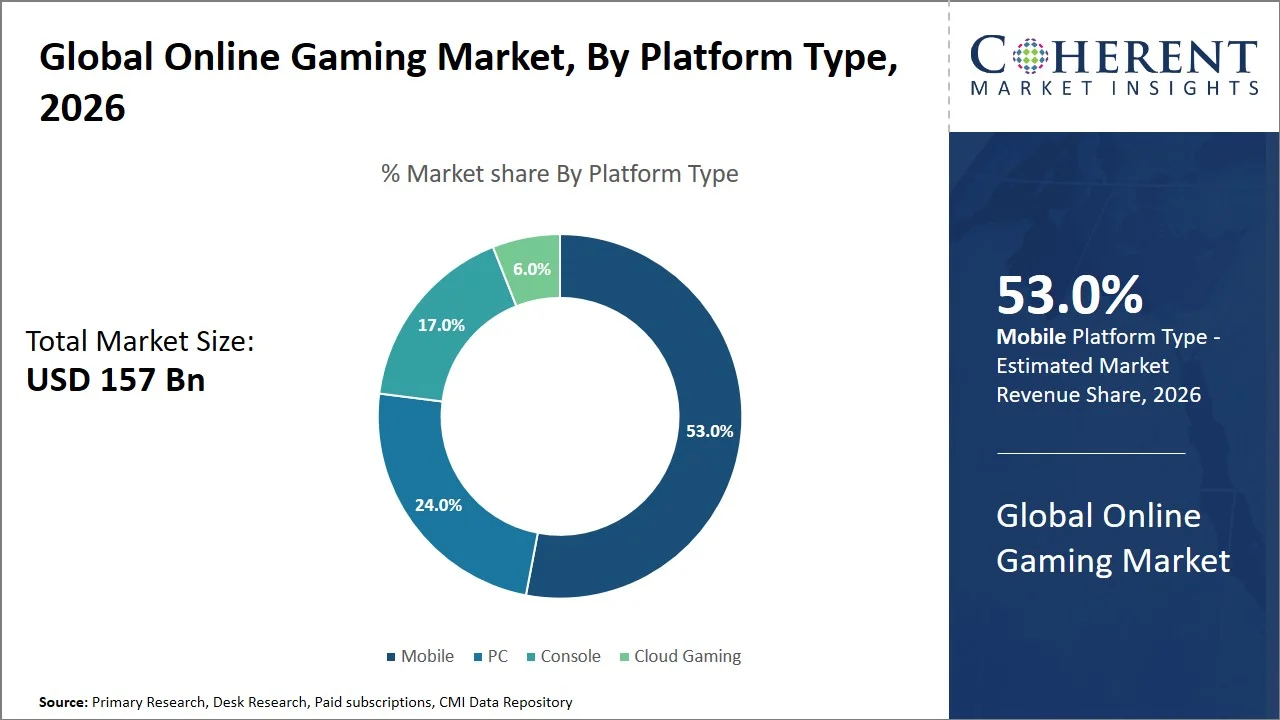
- The mobile segment is expected to account for 53.0 % of the global online gaming market share in 2026. Integration of AI for personalized gaming experiences is driving the growth of the segment. On August 5, 2025, Google DeepMind announced Project Genie, an AI platform that allows developers and creators to create playable, interactive gaming worlds using generative AI, accelerating personalized game creation and adaptive gameplay experiences.
- The action segment is estimated to capture 25.0 % of the market share in 2026. Growth of cross platform multiplayer gaming is a major factor driving the growth of the segment. On July 18, 2025, Sloclap announced that its multiplayer football videogame Rematch will include cross play support, letting PlayStation 5, Xbox Series X/S, and PC gamers to play against each other after launch, greatly extending the game’s online player base and esports potential.
- The casual gamers segment is estimated to capture 48.0 % of the market share in 2026. Higher spending on in game purchases and digital content is driving the growth of the segment. On June 5, 2025, Nintendo Switch 2 was released by Nintendo. Nintendo also increased its digital game sales, downloadable content, and Nintendo Switch Online membership services.
- Asia Pacific is expected to dominate the online gaming market in 2026 with a market share of 39.0 %. Growing subscription-based gaming services across Asia Pacific is primarily driving the growth of the regional market. On May 21, 2025, Microsoft partnered with Antstream Arcade to launch Retro Classics for Xbox Game Pass members, adding more than 80 Activision and Blizzard classic games to the subscription service, with availability extending across key Asia Pacific markets including Japan, South Korea, Australia, Singapore, and later India.
- North America is expected to account for 30.0 % of the market share in 2026 and is projected to record the fastest growth over the forecast period. AI driven game development and player engagement in North America is driving the growth of the regional market. On January 8, 2024, NVIDIA introduced production microservices for the NVIDIA Avatar Cloud Engine (ACE) that allow developers of games, tools and middleware to integrate state-of-the-art generative AI models into the digital avatars in their games and applications.
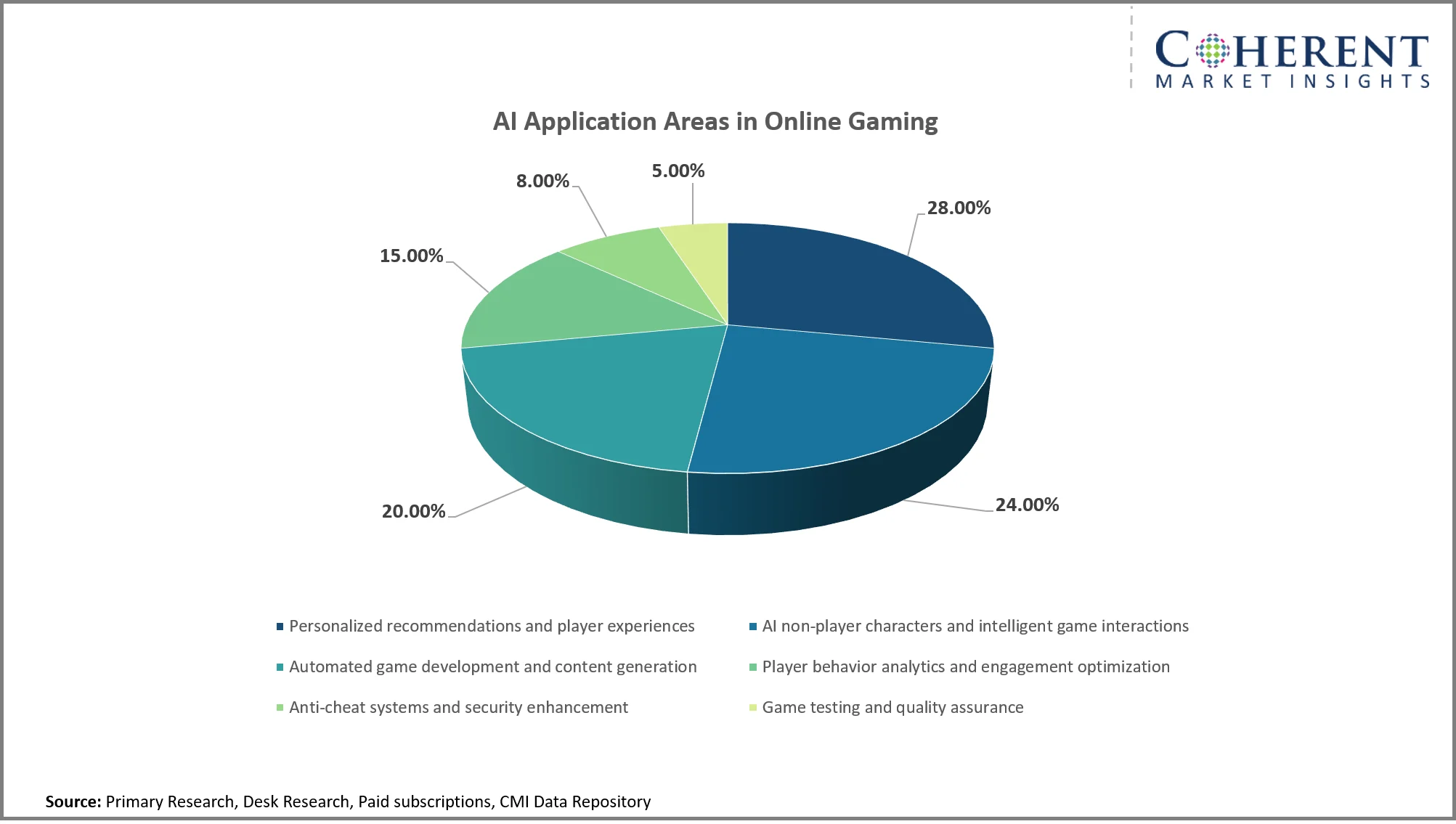
- AI Driven Game Development and Personalized Player Experiences: Artificial intelligence is being increasingly integrated into game development to automate content creation, improve non player character behavior, personalize gameplay based on player preferences, optimize matchmaking systems, and strengthen anti cheating mechanisms, resulting in higher player engagement and retention.
- Rapid Expansion of Cloud Gaming and Cross Platform Ecosystems: Cloud gaming services are expanding to enable high quality gaming without the need for expensive hardware. Cross platform compatibility allows players across mobile, PC, console and smart TV devices to play in the same cloud gaming ecosystem, expanding user accessibility and monetization opportunities.
Segmental Insights
Why Does Mobile Dominate the Global Online Gaming Market?
The mobile segment is expected to account for 53.0% of the global online gaming market share in 2026. Smartphones are now equipped with powerful processors and cheap mobile internet access, greatly increasing the availability of online gaming in both developed and developing countries. Thanks to the constant progress in mobile hardware, app store ecosystems and free to play business models players are able to enjoy high quality multiplayer games at any time without the need for specialist gaming devices. Mobile gaming is the most accessible and most extensively used platform in the world today. On July 16, 2026, KRAFTON India released BGMI 5th Anniversary Update 4.5 with collaborations with Naruto, Spider-Man and Ferrari, and improved gameplay for a broader variety of Android smartphones, thus further growing the popularity of mobile gaming in India.
- Current Industry Events of 2026
- Market Size Estimation
- Regional Breakdown
- Competitive Landscape
- Customer Intelligence
- Segmental Analysis
- Pricing Analysis
- Key Market Drivers, Challenges & Future Trends
- Customized Insights Section
Why is Action the Most Popular Game Type?
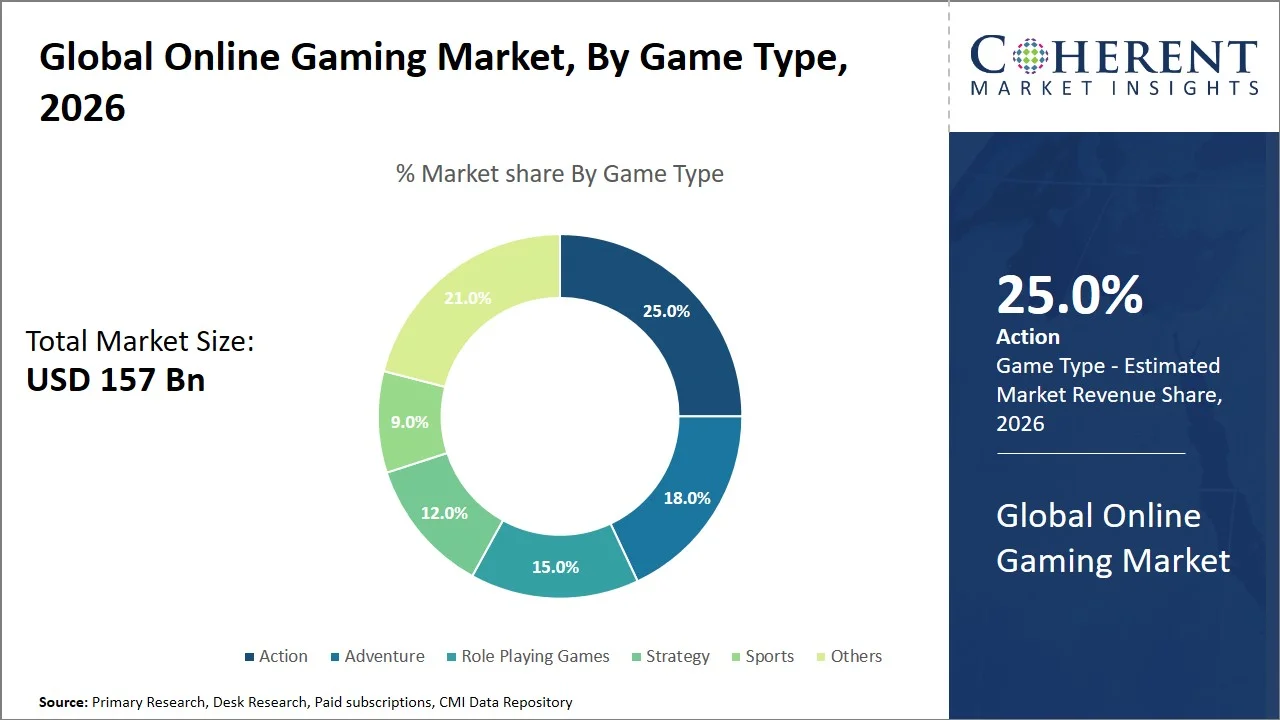
The action segment is expected to account for 25.0% of the global online gaming market share in 2026. Action games are popular because they are fast-paced and exciting, keeping players continually immersed through real-time challenges, battle features, speedy decision-making and lucrative advancement systems. The high level of excitement, together with multiplayer, esports, and frequent content releases, further enhance player retention and long-term demand across mobile, PC and console platforms for a broad audience. On February 28, 2025, Capcom released Monster Hunter Wilds, including seamless online co-op hunting, dynamic combat systems, and cross platform multiplayer. The game swiftly grew to be one of the company’s fastest growing action game releases.
Casual Gamers Segment Dominates the Global Online Gaming Market
The casual gamers segment is expected to account for 48.0% of the global online gaming market share in 2026. The prevalence of casual gamers can be explained by the existence of games that are basic, easy to understand, demand little time and no particular gaming skills. Mobile devices, free-to-play business models, and short play sessions have allowed millions of people of all ages to engage in online gaming as part of their daily routines, and the player base has expanded dramatically with participation remaining steady in worldwide markets. On February 6, 2025, Candy Crush Solitaire was released globally by King, expanding the Candy Crush franchise into the casual solitaire genre, featuring short play sessions and free-to-play features to cater to a wider audience of casual gamers.
Currents Events and their Impact
Current Events | Description and its Impact |
European Union Digital Services Act |
|
United Kingdom Online Safety Act |
|
Global Online Gaming Market - Esports Tournament Prize Pool Trends
Esports tournament prize pools continued to grow in 2025. The investment was not evenly distributed but concentrated on countries having publisher-sponsored and government-sponsored events. Saudi Arabia secured its place with the Esports World Cup, China kept the big prize pools with Tencent’s local leagues and the U.S. stayed a hotbed for varied publisher-led competitions. By 2026 publishers were increasingly interested in investing in the ecosystem outside of regional prize funds, assuring long-term sustainable league development as well as significant international events. Key points include:
- Esports World Cup in Saudi Arabia to feature competitions across 24 game titles, cementing the Kingdom as the leading destination for major esports tournaments
- China strengthens publisher-backed esports with bigger prize pools from Tencent's King Pro League Grand Finals and other domestic leagues
- The United States is an important esports market with major publisher backed tournaments across Counter-Strike 2, Valorant, Call of Duty and Rocket League
- Riot Games has changed the esports ecosystem for League of Legends, moving money from several regional league prize pools to long-term team sustainability and ecosystem development
- KRAFTON has increased the PUBG Global Championship prize pool through crowd funding efforts and more publisher money
- Saudi Arabia continues to pour significant investments into the Esports World Cup, increasing prize money for various international esports titles
- Publisher-sponsored Battlegrounds Mobile India tournaments are driving the expansion of India’s esports prize pools domestically, reflecting increasing investment in competitive mobile gaming.
Global Online Gaming Market Dynamics
Market Drivers
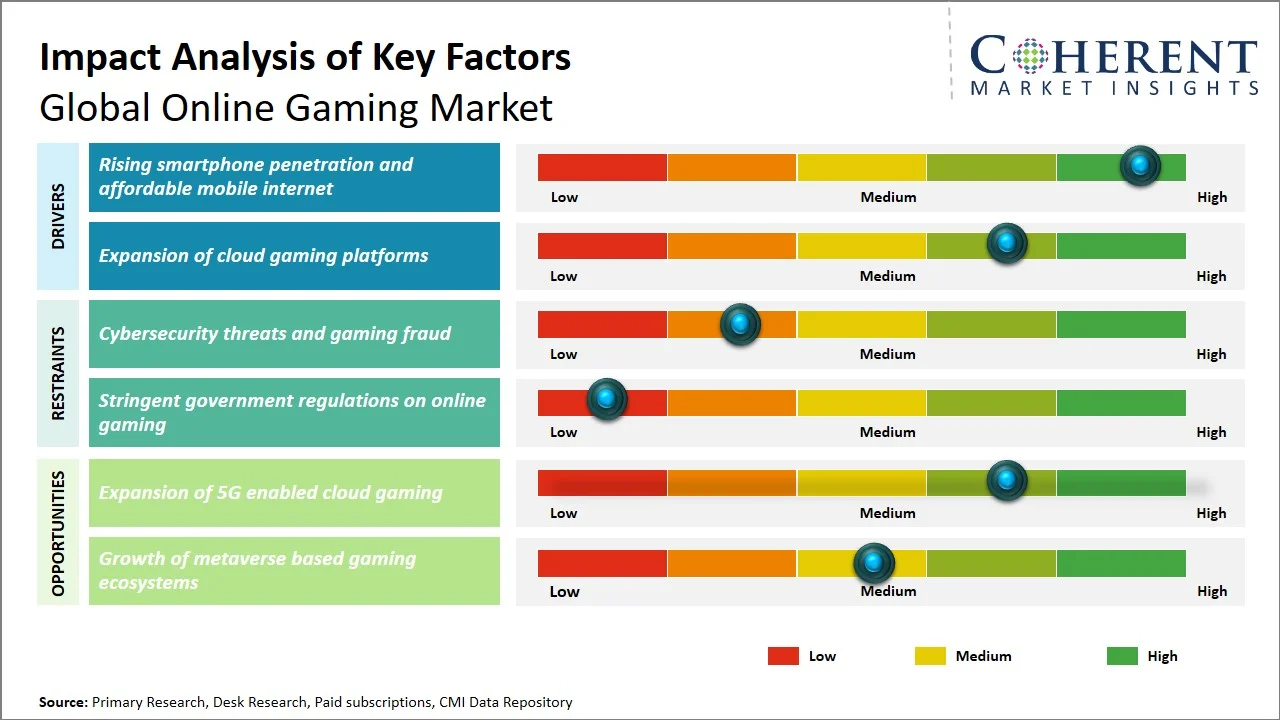
- Rising smartphone penetration and affordable mobile internet: The exponential expansion of smartphone penetration and availability of affordable high speed mobile internet has significantly increased the global online gaming audience. Better performance of mobile processors, display technology and battery life have enabled users to play graphics-heavy multiplayer games on portable devices, while competitive mobile data plans and expanding 4G and 5G coverage have made online gaming more accessible in developed and emerging economies. On August 19, 2025, Reliance Jio revealed that it is aggressively building out its 5G network in India on Standalone (SA) 5G architecture. Jio has successfully transferred millions of consumers to its 5G network, triggering a rapid expansion in the country’s 5G subscriber base.
- Expansion of cloud gaming platforms: The advent of cloud gaming platforms has enabled users to stream high quality games straight from remote servers without requiring costly gaming hardware or large local storage space. Major technology companies are investing in cloud infrastructure, edge computing, and low latency streaming technologies that are enhancing gameplay performance, increasing cross-device compatibility, and supporting the growth of subscription-based gaming services, which in turn is making premium gaming experiences more accessible globally. On March 21, 2025, Microsoft updated Xbox Cloud Gaming to allow users to stream more of their own Xbox titles on supported devices, reducing the need for console hardware and encouraging cloud gaming usage.
Emerging Trends
- Growth of User Generated Content and Creator Economy: Gaming platforms are increasingly supporting user created content, custom game creation, virtual assets, and creator monetization programs, allowing players to become content creators and creating long term community engagement across online gaming ecosystems.
- Increasing Adoption of Immersive Technologies and Live Digital Experiences: Virtual reality, augmented reality, mixed reality, real time live events, virtual concerts and interactive in game social experiences are transforming video games into digital entertainment platforms, driving longer play sessions and opening up new sources of income through virtual goods and premium experiences.
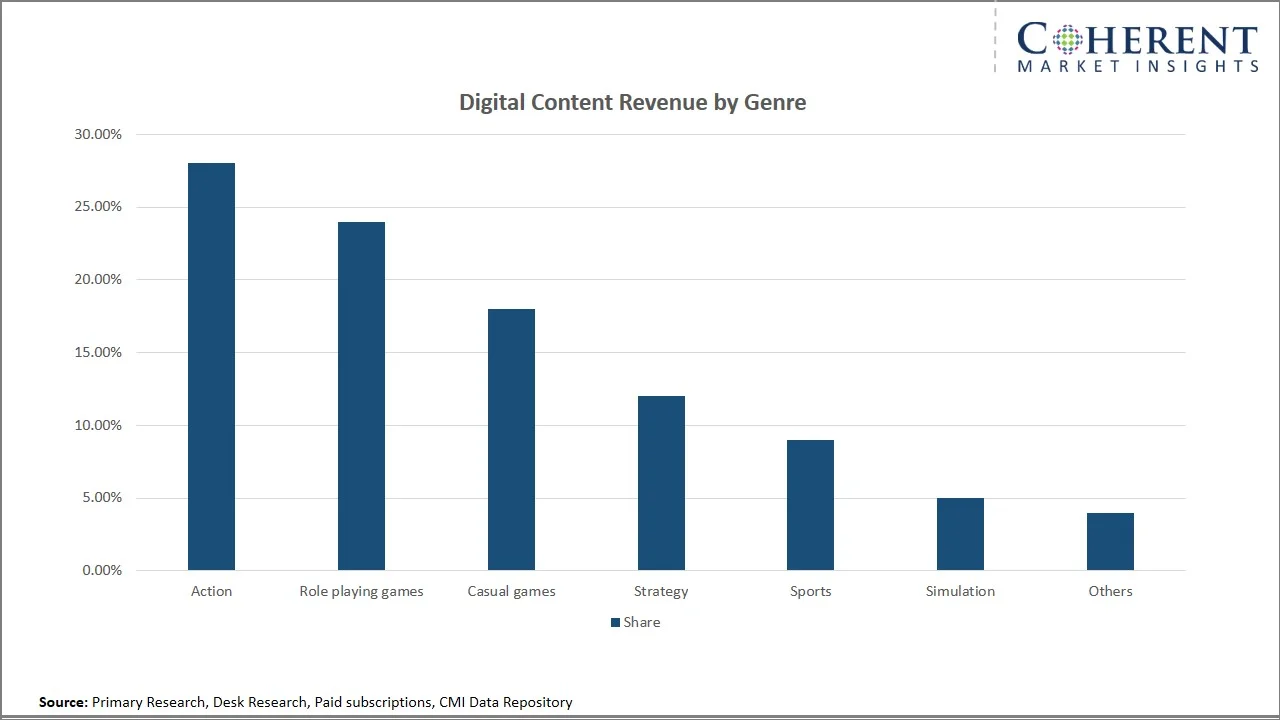
Global Online Gaming Market - Digital Content Revenue by Genre (2025-2026)
Global Online Gaming Market - AI Application Areas in Online Gaming
Regional Insights
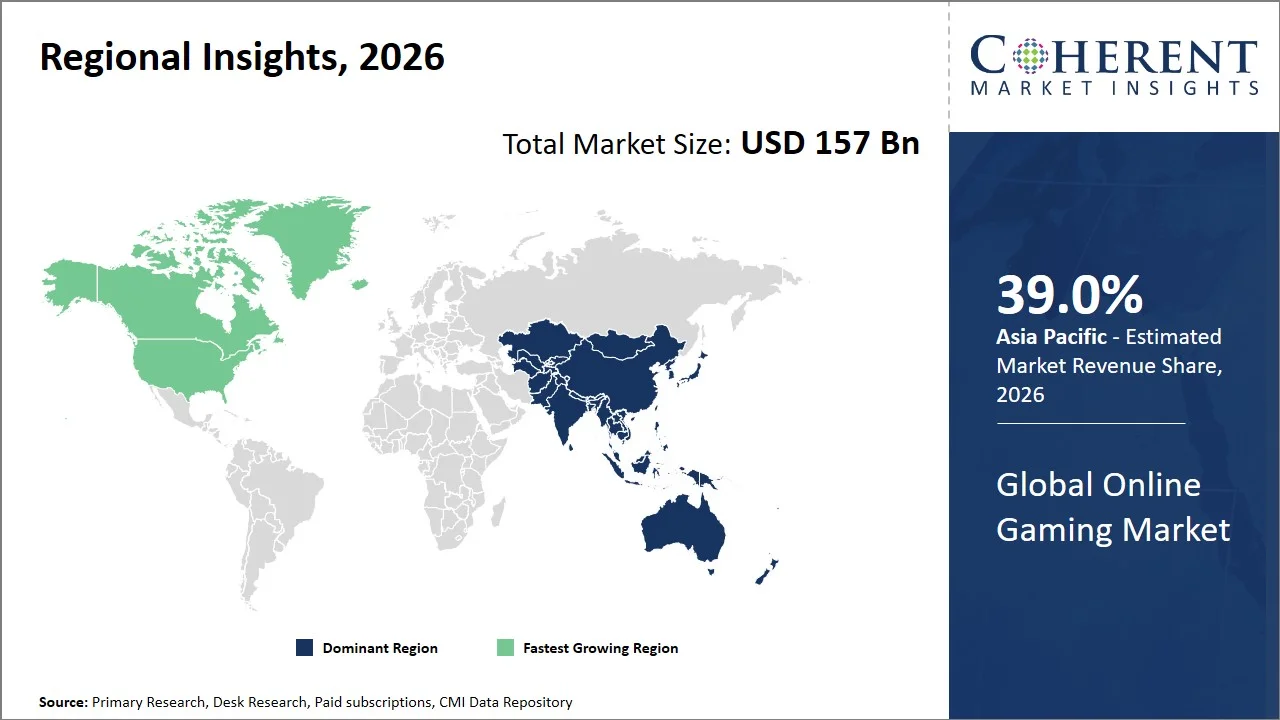
Why is Asia Pacific a Strong Market for Online Gaming?
Asia Pacific is expected to account for a market share of 39.0% in 2026. Asia Pacific continues to be the largest online gaming region, with strong ecosystems in China, Japan, South Korea, India and Southeast Asia. Tencent continues to broaden the international reach of Honor of Kings and PUBG Mobile. NetEase has bolstered its portfolio with titles such as Naraka: Bladepoint Mobile and international publishing collaborations. Krafton keeps investing in Battlegrounds Mobile India and PUBG Mobile esports while Garena is still a big player with Free Fire in Southeast Asia. Japan remains dominant in the mobile role playing game space with businesses such as Nintendo, Bandai Namco Entertainment and Square Enix, while South Korea is leading in esports, cloud gaming and live service games with Nexon, NCSoft and Smilegate.
Why Does the North America Online Gaming Market Exhibit High Growth?
North America is projected to account for 30.0% of the global online gaming market and is expected to register the fastest growth. North America is a key market for premium online titles, cloud gaming and live service games. Microsoft continues to build out Xbox Cloud Gaming and Game Pass with more day one releases, while Sony Interactive Entertainment continues to bolster PlayStation Network with multiplayer services and exclusive online titles like Helldivers 2. Roblox Corporation remains one of the largest user generated gaming platforms in the region and Epic Games continues to grow Fortnite with creator driven experiences, virtual concerts and Unreal Editor for Fortnite. EA is seeing good activity across EA Sports FC, Apex Legends and Madden NFL. Take Two Interactive continues to invest in GTA Online and prepare for future online content.
Global Online Gaming Market Outlook for Key Countries
Why is China Emerging as a Major Hub in the Online Gaming Market?
China is the world's largest online gaming ecosystem, with Tencent and NetEase leading the way. Tencent increases investment in artificial intelligence for game creation and engagement, while growing Honor of Kings, Peacekeeper Elite and League of Legends. NetEase has also improved its worldwide publishing strategy, in addition to its successful domestic releases and joint ventures with global studios. Chinese regulators have continued to approve new game licenses, allowing big companies to speed the release of content while staying inside the bounds of adolescent gaming rules and real-name verification requirements.
Is the U.S. the Next Growth Engine for the Online Gaming Market?
Leading developers, cloud infrastructure providers and digital distribution platforms continue to position the U.S. as the leader in online game innovation. Xbox Cloud Gaming gets wider device support, while Epic Games continues to turn Fortnite into a digital entertainment platform with creator economies and sponsored collaborations. Roblox has enhanced educational and commercial virtual experiences through its immersive platform, and Electronic Arts continues to enhance live service features across EA Sports FC and Apex Legends. Amazon Web Services and Google Cloud continue to provide publishers with infrastructure for multiplayer gaming with scalable cloud hosting and low latency networking services.
South Korea Online Gaming Market Analysis and Trends
With its excellent internet infrastructure, highly competitive esports and globally recognized game developers, South Korea remains a leader in the global online gaming business. Krafton has grown the PUBG franchise with consistent new releases and global esports events, while Nexon has bolstered its online lineup with games like The First Descendant and Dungeon & Fighter. NCSoft continues to invest in massively multiplayer online titles and AI-based game services, while Smilegate maintains strong global participation through Lost Ark and CrossFire. It’s also a major hub for professional e-sports competitions, gaming cafés and innovation in gaming technologies.
Japan Online Gaming Market Analysis and Trends
Japan’s position in the online gaming industry is strong due to a mix of console, mobile and online multiplayer gaming. Nintendo is also seeing continued growth in online interaction via Nintendo Switch Online and multiplayer titles like Mario Kart 8 Deluxe and Splatoon 3. Japan's dominance in globally popular online gaming content was highlighted by Bandai Namco Entertainment strengthening its live service gaming offerings through its Dragon Ball and Tekken franchises, Square Enix continuing to support online role playing games like Final Fantasy XIV, and Capcom expanding its digital multiplayer capabilities across the Monster Hunter franchise.
India Online Gaming Market Analysis and Trends
India has emerged as one of the fastest growing online gaming marketplaces led by high penetration of smartphones, cheap mobile data and locally generated gaming content. Krafton is also pumping money into the game with esports events, creator programs and fresh content releases, and Garena has brought Free Fire back through localized operations. Nazara Technologies has expanded by making smart acquisitions and investments in the esports, mobile gaming and gamified learning space, while Reliance Jio continues to bolster its cloud gaming and digital entertainment services. The country is increasingly showing signs that it is capable of creating innovative games and competing in the eSports space with domestic studios like SuperGaming making a mark on the world stage with games like Indus Battle Royale.
Global Online Gaming Market - Average Revenue Per Paying User By Region
Region/Country | Average Revenue Per Paying User (USD/year) |
North America | USD 95 |
Japan | USD 88 |
South Korea | USD 82 |
Western Europe | USD 76 |
China | USD 72 |
Australia | USD 70 |
Southeast Asia | USD 38 |
Latin America | USD 32 |
India | USD 18 |
Middle East & Africa | USD 25 |
Global Online Gaming Market - Digital Game Download Volume By Region (2025-2026)
Country/Region | Digital Game Download Volume (Billion Downloads) |
Asia Pacific | 32.5 |
North America | 8.2 |
Europe | 7.6 |
Latin America | 6.8 |
Middle East & Africa | 4.5 |
China | 15.8 |
India | 5.9 |
Japan | 3.2 |
South Korea | 2.8 |
Southeast Asia | 7.4 |
How is the Expansion of 5G Enabled Cloud Gaming Creating New Growth Opportunities in the Online Gaming Market?
Growth potential is emerging from 5G-enabled cloud gaming, which allows users to stream high-quality games with low latency and without the need for expensive gaming hardware. Faster network speeds, better bandwidth and lower latency are making possible smooth multiplayer experiences across smartphones, tablets, smart televisions and low-specification PCs, driving wider adoption of subscription-based gaming services. Technology companies and game publishers are investing in cloud data centers and edge computing infrastructure to enable more responsive games, while telecommunications carriers are cooperating with gaming platforms to integrate cloud gaming services with 5G plans. These advances are broadening the addressable consumer base, increasing recurring revenue potential, as well as allowing publishers to roll out graphically sophisticated games across numerous devices through a single cloud based ecosystem. On July 15, 2026, NVIDIA revealed that it is bringing GeForce NOW to India, which will enable AAA games to be played through 5G networks without the need for high-end gaming gear, owing to RTX 4080 cloud servers.
Market Players, Key Development, and Competitive Landscape
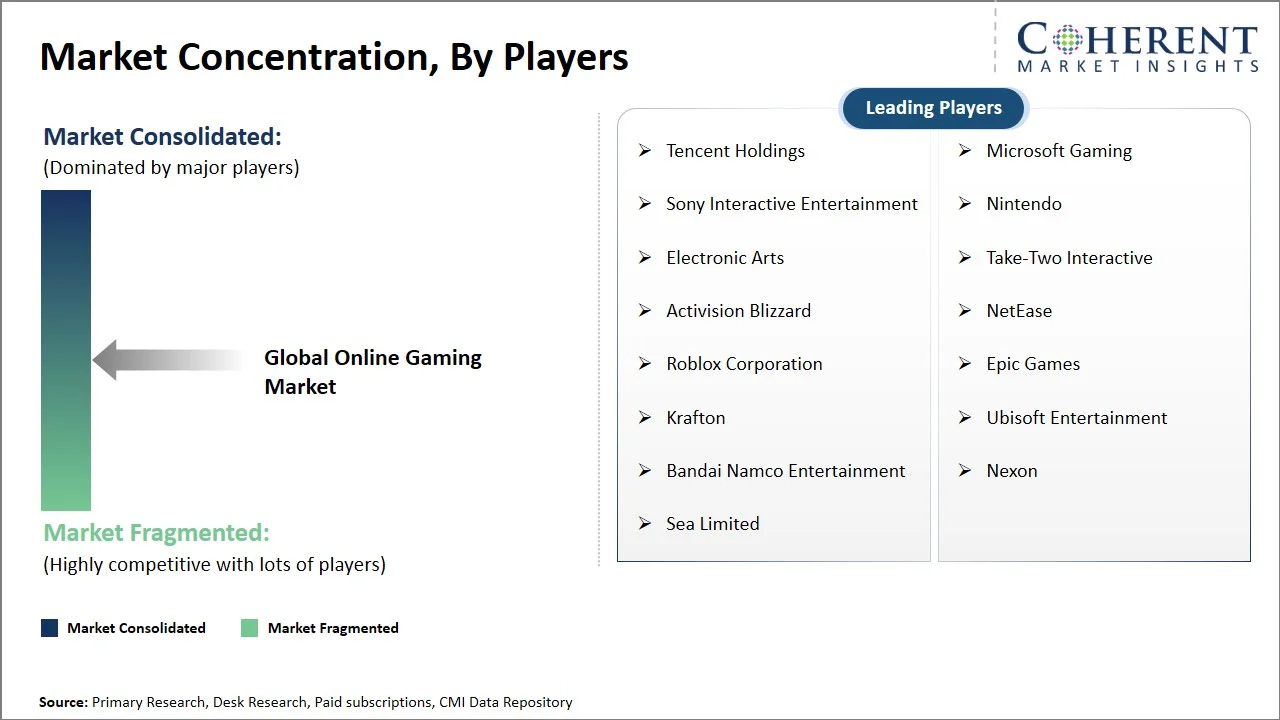
Key Developments
- On April 21, 2026, NAVER Corp, alongside KRAFTON and Mirae Asset, hosted a roundtable in New Delhi, India, to mark the launch of the Unicorn Growth Fund (UGF), an investment vehicle valued at up to USD 675 Million.
- On March 27, 2024, NetEase Games and Marvel Games announced their latest collaboration, Marvel Rivals, a cooperative, Super Hero Team-Based PVP Shooter that lets players assemble an ever-evolving all-star squad of Super Heroes and Super Villains while battling with unique super powers across a dynamic lineup of destructible maps from across the Marvel Multiverse.
Competitive Landscape
Tencent is still a market leader due to a diverse portfolio includes Honor of Kings, PUBG Mobile, League of Legends and major investments in worldwide studios like Riot Games, Supercell and Epic Games. Microsoft is also bolstering its competitive position by merging Xbox Game Pass with Xbox Cloud Gaming and growing its first-party content following the Activision Blizzard acquisition, incorporating properties like Call of Duty, Diablo, and Overwatch into its ecosystem. Sony Interactive Entertainment is pushing live service gaming through PlayStation Network and multiplayer games such as Helldivers 2, while Epic Games is evolving Fortnite into a creative economy platform with Unreal Editor for Fortnite and branded virtual experiences. Roblox Corporation is defined by user created content and developer monetization, and NetEase is accelerating worldwide expansion with agreements with Marvel Games, Blizzard Entertainment and Bungie.
Market Report Scope
Online Gaming Market Report Coverage
| Report Coverage | Details | ||
|---|---|---|---|
| Base Year: | 2025 | Market Size in 2026: | USD 157 Bn |
| Historical Data for: | 2020 To 2024 | Forecast Period: | 2026 To 2033 |
| Forecast Period 2026 to 2033 CAGR: | 11% | 2033 Value Projection: | USD 337 Bn |
| Geographies covered: |
| ||
| Segments covered: |
| ||
| Companies covered: | Tencent Holdings, Microsoft Gaming, Sony Interactive Entertainment, Nintendo, Electronic Arts, Take-Two Interactive, Activision Blizzard, NetEase, Roblox Corporation, Epic Games, Krafton, Ubisoft Entertainment, Bandai Namco Entertainment, Nexon, and Sea Limited | ||
| Growth Drivers: |
| ||
| Restraints & Challenges: |
| ||
Analyst Opinion (Expert Opinion)
- The online gaming market is shifting towards ecosystem rivalry, rather than competition between individual games. There’s more strategic value in proprietary game engines, creator platforms, cloud infrastructure, live service operations and IP ownership than there is in one-off game sales. User created content ecosystems like as Roblox and Fortnite Creative have been witnessed to redefine player engagement, while recurrent monetization through subscriptions, battle passes and digital content has been established as the key long term income model. The primary differentiators impacting competitive posture among leading publishers have been identified as cross platform compatibility, artificial intelligence assisted game development and continuous content delivery.
- The online gaming business is predicted to develop into persistent digital gaming ecosystems, where gameplay, social interaction, digital commerce and creator generated experiences work together within unified platforms. AI will automate more of game production, create dynamic content and personalize to players, shortening development cycles and enabling ongoing content updates. Cloud native game development, multi-platform progression and real time game streaming will be standard features across premium and free to play titles. The top games on the internet are likely to become platforms for extended duration digital engagement, rather than isolated gaming products with more integration of virtual concerts, interactive entertainment, esports and creator marketplaces.
Speak to the analyst
Want personalized insights?
Take the findings above to one of our principal consultants, or have the report rebuilt around the segments, geographies and competitors you actually track.
Market Segmentation
- Platform Type Insights (Revenue, USD Billion, 2021 - 2033)
- Mobile
- PC
- Console
- Cloud Gaming
- Game Type Insights (Revenue, USD Billion, 2021 - 2033)
- Action
- Adventure
- Role Playing Games
- Strategy
- Sports
- Others
- End User Insights (Revenue, USD Billion, 2021 - 2033)
- Casual Gamers
- Professional Gamers
- Esports Players
- Regional Insights (Revenue, USD Billion, 2021 - 2033)
- North America
- U.S.
- Canada
- Latin America
- Brazil
- Argentina
- Mexico
- Rest of Latin America
- Europe
- Germany
- U.K.
- Spain
- France
- Italy
- Russia
- Rest of Europe
- Asia Pacific
- China
- India
- Japan
- Australia
- South Korea
- ASEAN
- Rest of Asia Pacific
- Middle East
- GCC Countries
- Israel
- Rest of Middle East
- Africa
- South Africa
- North Africa
- Central Africa
- North America
- Key Players Insights
- Tencent Holdings
- Microsoft Gaming
- Sony Interactive Entertainment
- Nintendo
- Electronic Arts
- Take-Two Interactive
- Activision Blizzard
- NetEase
- Roblox Corporation
- Epic Games
- Krafton
- Ubisoft Entertainment
- Bandai Namco Entertainment
- Nexon
- Sea Limited
Sources
Primary Research Interviews
- Online Gaming Platform Developers & Publishers
- Game Streaming Service Providers
- Esports Tournament Organizers & Associations
- Mobile & Console Gaming Hardware Manufacturers
Magazines
- Game Developer Magazine
- PC Gamer
- Edge Magazine
- Wireframe Magazine
Journals
- Journal of Gaming & Virtual Worlds
- Computers in Human Behavior
- Journal of Computer-Mediated Communication
Associations
- Entertainment Software Association (ESA)
- Interactive Software Federation of Europe (ISFE)
- Global Esports Federation (GEF)
- Association for UK Interactive Entertainment (Ukie)
Public Domain Sources
- U.S. Federal Trade Commission (FTC) – Gaming Industry Reports
- European Commission – Digital Economy & Society Reports
- World Intellectual Property Organization (WIPO) – Gaming IP Data
- United Nations Conference on Trade and Development (UNCTAD) – Digital Economy Reports
Proprietary Elements
- CMI Data Analytics Tool
- Proprietary CMI Existing Repository of Information for the Last 10 Years
Get access to 250+ pages report
Every segment, forecast, competitor profile and data table behind the analysis above — available for instant download.
- ESOMAR Member
- ISO 9001:2015 Certified
- D-U-N-S Registered
- GDPR & CCPA Compliant
Missing comfort of reading report in your local language? Find your preferred language:
Transform your Strategy with Exclusive Trending Reports
Frequently Asked Questions
The global online gaming market is expected to stand at USD 157 Bn in 2026 and is expected to reach USD 337 Bn by 2033.
The CAGR of the global online gaming market is projected to be 11% from 2026 to 2033.
Rising smartphone penetration and affordable mobile internet and expansion of cloud gaming platforms are the major factors driving the growth of the global online gaming market.
Cybersecurity threats and gaming fraud and stringent government regulations on online gaming are the major factors hampering the growth of the global online gaming market.
In terms of platform type, the mobile segment is estimated to dominate the market revenue share in 2026.
Esports increase player engagement, attract sponsorships, and expand audience reach through competitive tournaments.
Artificial intelligence improves matchmaking, personalizes gameplay, enhances security, and supports game development.