

Terrestrial Trunked Radio Market Size and Forecast – 2026-2033
The global terrestrial trunked radio market size is estimated to be valued at USD 7.27 Bn in 2026 and is expected to reach USD 13.90 Bn by 2033, grow at a compound annual growth rate (CAGR) of 9.7% from 2026 to 2033.
Key Takeaways
- Based on Technology, the Digital segment is expected to account 35.0% share in the market in 2205, owing to its ability for better functions.
- Based on Application, the Transportation is expected to contribute the highest share of the market in 2026, owing to the reliable communication in transportation.
- Based on Component, the Infrastructure segment is expected to hold the highest share in the market, owing to its ability to handle large number of users.
- Based on Frequency, 700 MHz & above segment is projected to account for highest share in the market in 2026, driven by its superior capabilities in long-range communication.
- Based on Region, North America is leading the market with 37% in 2026, owing to the high adoption in military and public safety agencies.
Market Overview
Terrestrial trunked radio (TETRA) is a professional mobile radio and two-way transceiver specification designed for use by government agencies, emergency services (police forces, fire departments, ambulances) for public safety networks, rail transportation staff for train radios, transport services, and the military. TETRA provides secure, high-availability communications that allow users to communicate directly without relying on an operator or fixed infrastructure. Key drivers include increasing demand for seamless critical communication operations and growing adoption in the military and defense sectors.
Current Events and their Impacts on the Terrestrial Trunked Radio Market
Current Events | Description and its Impact |
Technological Advancements and Security Challenges |
|
Economic and Defense Sector Trends |
|
Role of Artificial Intelligence (AI) in the Terrestrial Trunked Radio Market
The integration of artificial intelligence into terrestrial trunked radio system has the ability to optimize various aspects including the resource allocation, network management, and even enhancing the user experience. Along with that, the AI algorithm facilitates in analyze network traffic, predict usage patterns, and dynamically adjust channel assignments, bandwidth allocation, and power levels to ensure optimal performance. Additionally, Ai has the potential to automate tasks like network maintenance, improve security, and even personalize user interfaces for voice commands.
In April 2023, Hytera Communications expanded its TETRA radio lineup with the PT590, a mission-critical portable radio offering enhanced coverage, superior audio quality, and advanced safety features. It includes AI noise cancellation that adapts to various noise types and echo reduction algorithms that prevent howling echoes even when radios are within 30cm of each other, ensuring frontline workers stay responsive and productive.
- Current Industry Events of 2026
- Market Size Estimation
- Regional Breakdown
- Competitive Landscape
- Customer Intelligence
- Segmental Analysis
- Pricing Analysis
- Key Market Drivers, Challenges & Future Trends
- Customized Insights Section
Segmental Analysis
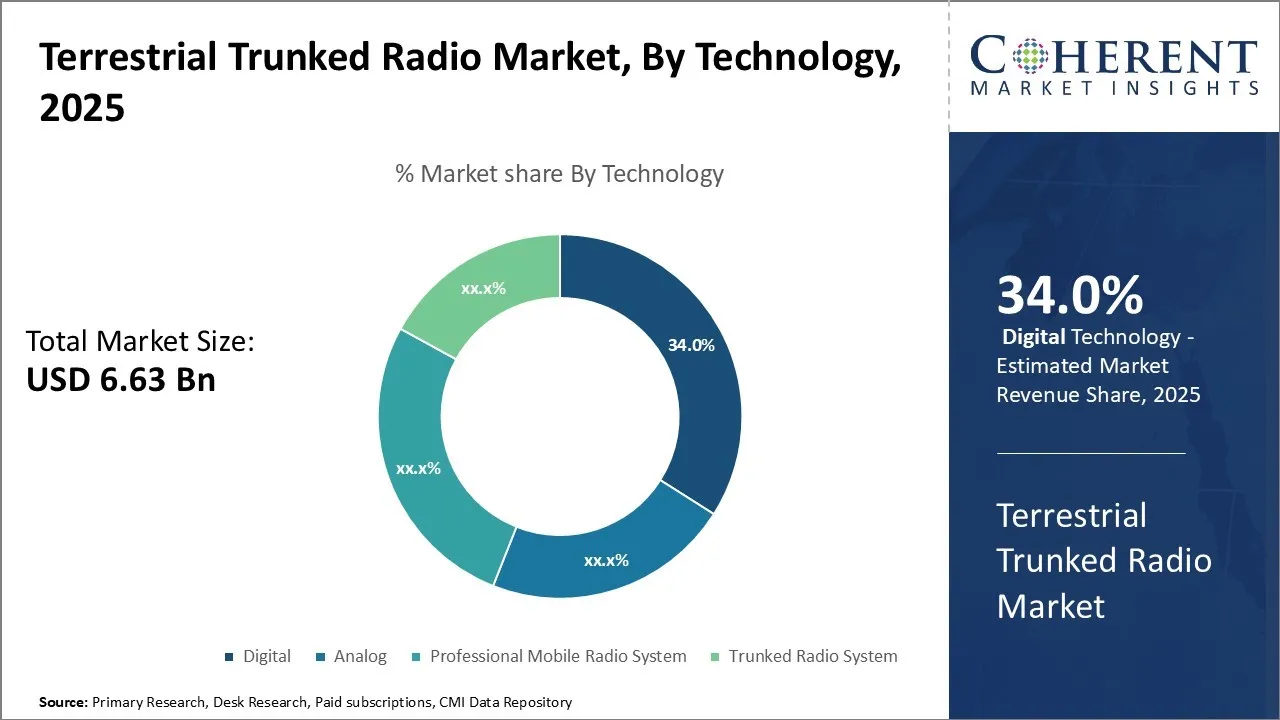
Terrestrial Trunked Radio Market Insights, By Technology
Digital Drives the Dominant Terrestrial Trunked Radio Market Share Owing to its Better Functions
In term of technology, the digital segment is leading the market with 35% share in the market in 2026, owing to its ability to offer better functions which includes, enhance voice quality, increased security, and improved spectrum efficiency. Along with this, digital technology enables data transmission and direct mode operation, making terrestrial trunked radio suitable for mission-critical application. The digital terrestrial trunked radio is widely used by public safety agencies, utilities and other industries requiring reliable and secure-two-way communication.
For instance, in May 2025, Axell Wireless launched the BSR438, a digital band selective TETRA (terrestrial trunked Radio) repeater. This product is designed to support public-safety network and professional mobile-radio system for high-security application such as metro underground network or oil and gas industries. The BSR438 has the frequency capability from 380 MHz to 470 MHz in bands of up to 20MHz in bandwidth.
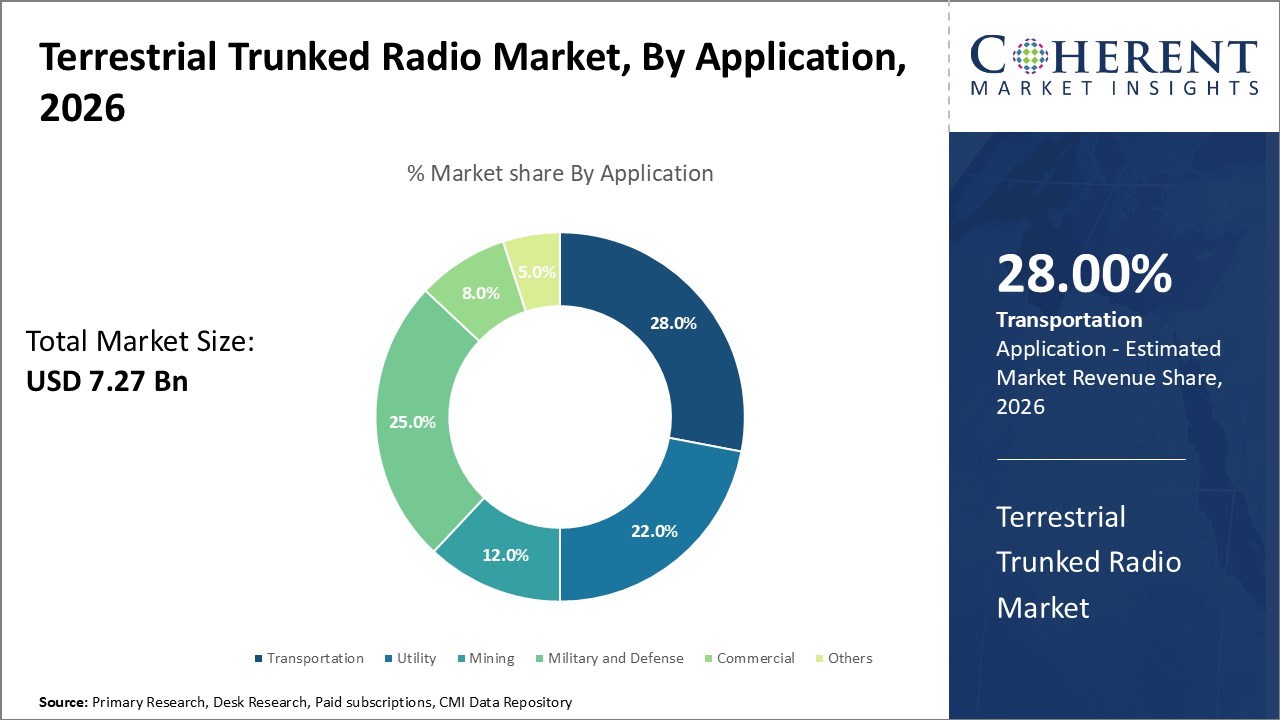
Terrestrial Trunked Radio Market Insights, By Application
Transportation Segment Acquires the Largest Share Owing to its reliable Communication in Transportation
In terms of application, the transportation segment is expected to contribute the highest share of the market in 2026. The transportations segment is emerging through the increasing need for secure and reliable communication systems in transportation infrastructure such as railways, airports, and public transit systems. Additionally, a strong intelligence transportation system enhances passenger safety and operational efficiency which further expands the market.
For Instance, in September 2024, the RATP, the Parisian public transport operator was awarded a contract to Eviden, an Atos Group company, to equip its MP14 and upcoming MF19 metro trains, as well as TW20 tramways with embedded TETRA radio communication system. The agreement consists of 132 radio units and 800 additional units over the next eight years. This collaboration aims to modernize RATP's communication infrastructure, enhancing real-time connectivity between centralized control stations and rolling stock.
Terrestrial Trunked Radio Market Insights, By Component, Infrastructure- Large number of Users
In terms of component, the infrastructure segment is expected to dominate the market with largest share in 2026 due to its ability to handle large number of users, along with that it can connect to external networks, and ensure high quality voice and data transmission. Infrastructure in terrestrial trunked radio systems is crucial as it provides framework for reliable, secure and efficient communication. Infrastructure facilitates interoperability between different devices and systems, allowing for seamless communication across different networks. It also allows for scalability, enabling the system to grow from small networks to regional or national networks.
In May 2025, the Danish and German emergency services incorporated a new communication gateway in border region to talk directly to each other through their TETRA radio, both during the emergency call and coordinated efforts. This connection removes a crucial barrier to effective cooperation across the border.
Terrestrial Trunked Radio Market Insights, By Frequency
700 MHz & Above Acquires the Largest Share On Account of Superior Capabilities
In terms of frequency, the 700MHz & above segment is expected to contribute the highest share of the market in 2026, owing to its superior capabilities in long-range communication. The 700 MHz & above frequency has the ability to enhance signal penetration and reliability which are essential for mission-critical application. 700 MHZ & above offers better signal propagation, allowing for more extensive coverage areas and improved indoor penetration. It is ideally used in urban environments and large infrastructure facilities. Governments and regulatory bodies are allocating more spectrum in the 700 MHz & above range for public safety communications, recognizing the need for reliable and interoperable communication systems.
For instance, in May 2025, Vietnamese telecom giant Viettel has secured the B2–B2′ block of the 700 MHz spectrum for VND1.95 trillion (USD 75.2 million) after multiple failed auctions. This 15-year license enables Viettel to enhance its 4G and 5G services, aiming for 99% national population coverage by 2030.
Regional Insights
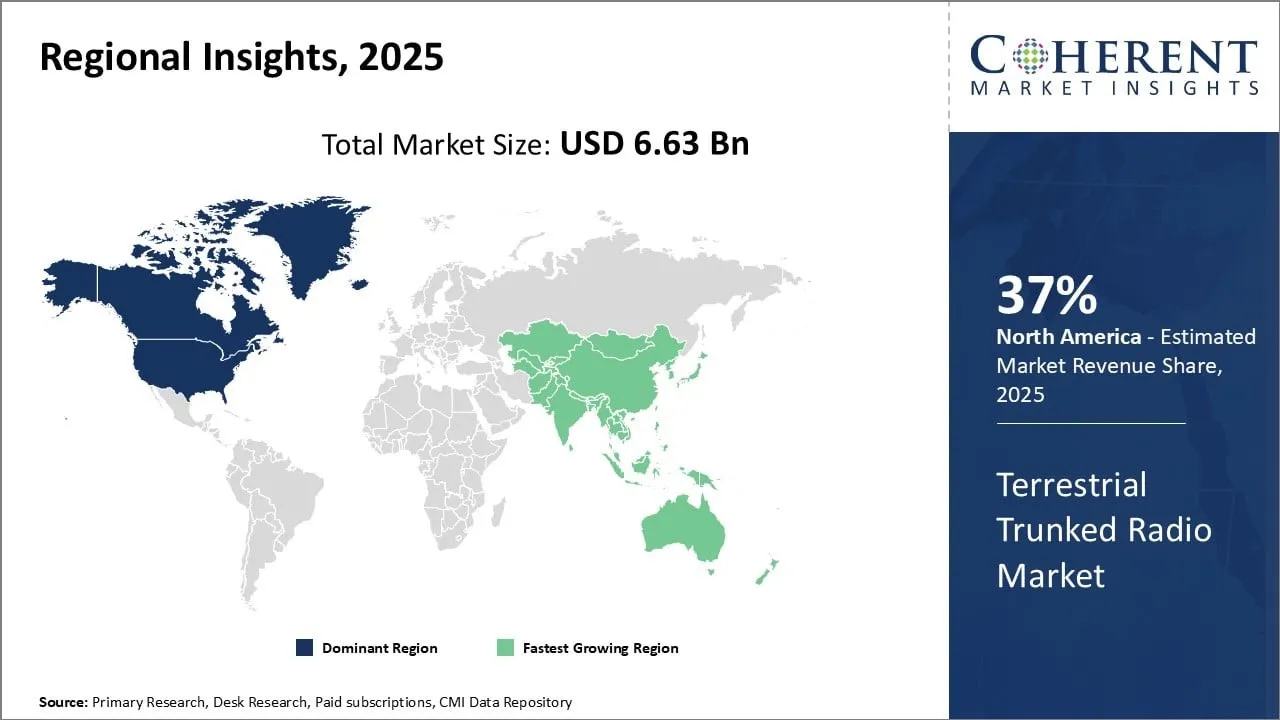
North America Terrestrial Trunked Radio Market Analysis and Trends
North America is expected to be the largest market for terrestrial trunked radio during the forecast period, accounting for over 37% of the market share in 2026. The growth of the market in North America is attributed to high adoption in military and public safety agencies. North America has a increasing demand for secure and reliable commination solutions within various industries which is another factor driving the market. In the North American region, the adoption of TETRA by military is commonly observed by the Department of Defense and U.S. military, including the Army, Navy, and Air Force, as well as public safety organizations like police and fire departments. According to the national telecommunication and Information Administration, the military services use the 138-144 MHz band to support air-to-ground, air-to-air, and air-ground-air (AGA) tactical communications; air traffic control operations; LMR nets for sustaining base and installation infrastructure support; and for tactical training and test range support.
For instance, in January 2026, The U.S. Army has awarded L3Harris Technologies full-rate Manpack and Leader radio production orders under the Handheld, Manpack & Small Form Fit (HMS) program totaling nearly USD 300 million.
Europe Terrestrial Trunked Radio Market Analysis and Trends
Europe market is expected to be the second-largest market for terrestrial trunked radio, accounting for over 32.1% of the market share in 2026. The growth of the market in is attributed to stringent safety regulations for critical communications. The market is Europe is also driven by the strong government mandates for mission-critical communication system. The EU Critical Communication System (EUCCS) plays a critical role in enhancing the resilience of public communication infrastructure and stimulating Europe's crisis response capabilities. By 2030, this initiative hopes to create an EU-wide, secure, and interoperable public security communication network.
For instance, in March 2026, Vodafone introduced Europe with most modern, mission-critical mobile communications service that prioritizes the emergency services, and other first responders. Mission Critical (MCx) to provide essential voice, data and video connectivity to first responders, public safety services, and transportation sectors.
Asia Pacific Terrestrial Trunked Radio Market Analysis and Trends
Asia Pacific market is expected to be the fastest-growing market for terrestrial trunked radio, with a CAGR of over 22.3% during the forecast period. The growth of the market in Asia Pacific is attributed to increasing demand from transportation and utility sectors. Countries with large-scale public safety initiatives (such as India, China, Australia, South Korea) and extensive transport infrastructure continue to drive demand. The region is observed to have rapid growth in critical communications, propelled by urbanization, smart city investments, and increased public safety needs.
For instance, in February 2026, Australian telecommunications company Telstra joined the TCCA (The Critical Communications Association), strengthening its role in global critical communications. This partnership supports vital services across Australia and beyond, contributing to the advancement of mission-critical communication technologies and standards.
Terrestrial Trunked Radio Market Outlook Country-wise
The United States Terrestrial Trunked Radio Market Trends
The United States terrestrial trunked radio market is primarily driven by Project 23 (P25) standards, designed for the public safety agencies. In the U.S. TETRA is widely used by the public safety sector, commercial and industrial domains. The United States has a growing emphasis on integrating LMR systems with LTE and 5G networks to support data-intensive applications, leading to hybrid communication solutions. With over 15 major US cities encompassing 5G networks and around 289 million connections of 5G in 2024. This further drives the Terrestrial Trunked Radio Market demand.
Germany Terrestrial Trunked Radio Market Trends
Germany holds the largest terrestrial trunked radio market in Europe with nationwide BOSNet for emergency services and upgraded underway for future LTE integrations. TETRA is extensively used in railways, airports, and urban transit systems to coordinate operations and enhance safety.
Market Report Scope
Terrestrial Trunked Radio Market Report Coverage
| Report Coverage | Details | ||
|---|---|---|---|
| Base Year: | 2025 | Market Size in 2026: | USD 7.27 Bn |
| Historical Data for: | 2020 To 2024 | Forecast Period: | 2026 To 2033 |
| Forecast Period 2026 to 2033 CAGR: | 9.7% | 2033 Value Projection: | USD 13.90 Bn |
| Geographies covered: |
| ||
| Segments covered: |
| ||
| Companies covered: | Motorola Solutions, JVCKENWOOD, Hytera Communications, Sepura, Simoco Wireless Solutions, Tait Communications, Codan Radio Communications, Cisco Systems, Harris Corporation, PowerTrunk | ||
| Growth Drivers: |
| ||
| Restraints & Challenges: |
| ||
Terrestrial Trunked Radio Market Trends
- Adoption of IoT and Big Data Solutions: Integration of sensors, IoT (Internet of Things) connectivity, and big data analytics is enabling intelligence enhancements across TETRA networks. Capturing health, location, and situational data from network infrastructure and connected devices facilitates predictive maintenance, automation and data-driven decision making. AI-enabled analytics help derive actionable insights from the massive amount of data. Such smart networks deliver greater value and help justify investments for public safety organizations. IoT Analytics expected the number of IoT devices to grow 13% to 18.8 billion by the end of 2024.
- Development of Multi-technology Devices: Vendors are introducing multi-technology devices capable of supporting multiple network technologies such as TETRA, LTE, and WiFi within a single portable device. This allows users to take advantage of both broadband high-speed data and the reliability of TETRA networks. Dynamic switching between networks ensures access to critical voice services in all situations. Demand for such hybrid devices is expected to rise with mission-critical users looking to enhance capabilities. This is further propelling the terrestrial trunked radio market growth.
Terrestrial Trunked Radio Market Drivers
- Enhanced Capabilities for Critical Communications: Critical communication capabilities are being enhanced with the integration of TETRA networks and next-generation Long-Term Evolution (LTE) networks. This allows high-speed data and multicast services to be delivered alongside secure and reliable voice services on a single platform. The hybrid networks support new applications such as video streaming, database lookups, and dispatch consoles to improve situational awareness and incident management. Agencies are adopting TETRA technologies due to their ability to provide resilient, always-available communications. For instance, in June 2022, Sepura, a radio manufacturer, introduced its inaugural TETRA radio, designed to function in the very high frequency (VHF) range.
- High Adoption in Public Safety and Transportation Sectors: TETRA networks play a vital role in ensuring connectivity for first responders and public safety organizations. Rapidly evolving smart city infrastructure is also contributing to increased adoption in the transportation sector. Rail networks, airports, and seaports are deploying TETRA systems to enable communications across geographically dispersed locations and enhance safety and security through group communication and status messaging features. The critical nature of operations in these sectors will continue to drive investments in technologically advanced TETRA systems.
Terrestrial Trunked Radio Market Opportunities
- Development of 5G-Ready TETRA systems: Migration to 5G-Ready TETRA systems will enable delivery of high-bandwidth applications such as real-time video and imaging. This will expand the capabilities of traditional narrowband networks while retaining critical voice services. Several advancements are underway to develop multi-mode TETRA radios capable of 5G service coverage leveraging edge computing and network slicing techniques. This convergence will support next-generation use cases across public safety and enterprise markets. In May 2022, NTT created a unified push-to-talk (PTT) application designed for airport personnel, allowing seamless switching between private 5G and terrestrial trunked radio (TETRA) communications.
- Growing Adoption in Emerging Economies: Emerging economies are undertaking large-scale critical communication transformation projects, which provide significant opportunities for TETRA vendors. Investments in technologies such as TETRA for modernizing public safety and defense networks have gained momentum. Expanding urban metro rail networks in these regions has also fueled adoption in the transportation vertical. Tailored solutions catering to limited financial resources can boost penetration in cost-sensitive markets.
Recent Developments
- In May 2025, Savox Communications unveiled its new tactical communication platform, the Savox Tactical Radio Platform (TRP), designed for demanding defense and security operations. The TRP enables seamless integration between various communication devices, enhancing interoperability, security, and real-time situational awareness. The TRP aims to meet the evolving needs of military and tactical teams operating in dynamic and high-risk environments worldwide.
- In May 2025, Hytera celebrated a major milestone in Africa’s critical communications landscape with a successful summit in South Africa. The event showcased Hytera’s latest innovations in professional communication, including broadband and narrowband integration, command and dispatch systems, and emergency response solutions. The company’s strategic investments aim to support sectors like public safety, utilities, and transportation with reliable, next-generation technologies tailored to local needs.
- In May 2024, Motorola Solutions announced new broadband features for its TETRA radio portfolio, designed to improve connectivity, safety, and efficiency for mission-critical users. The innovations include seamless integration between narrowband TETRA and LTE networks, enabling secure push-to-talk, video sharing, and data access. The aim is to support operational resilience amid growing demand for faster, data-rich communication in critical missions.
- In May 2023, Sepura is a leading provider of critical communications solutions, specializing in the design, development, and manufacturing of radio communication devices and systems for public safety, industrial, and commercial applications introduced a simplified TETRA handheld device.
Analyst Opinion (Expert Opinion)
- The terrestrial trunked radio market is a mission-critical enabler of hybrid communication infrastructure. While broadband technologies like LTE and 5G have dominated headlines, they have yet to match TETRA's deterministic reliability and end-to-end encryption essential for public safety and utility applications. In fact, during Hurricane Ian (2022), several U.S. counties reported complete LTE outages, whereas TETRA networks maintained over 96% uptime, proving its value under extreme conditions.
- The ongoing shift towards frequency bands above 700 MHz is not incidental, it's strategic. Higher bands provide superior propagation in dense urban zones and improved building penetration. The recent allocation of 700 MHz spectrum to first responders in Canada and the U.S. underscores this transition. For instance, the FirstNet initiative in the U.S. has actively incorporated TETRA nodes into its broader LTE network for fallback redundancy, signaling an industry preference for hybrid architectures.
- Furthermore, TETRA’s dominance is evident in critical infrastructure. Over 85% of oil and gas refineries in the Gulf Coast still rely on TETRA for site-wide communication. Even in transport, the London Underground and New York’s MTA have resisted full LTE migration, citing latency, jitter, and security vulnerabilities in broadband systems compared to TETRA’s Time Division Multiple Access (TDMA)-based approach.
- While broadband players market scalability and speed, they overlook the low-latency, call-setup times of under 300ms that TETRA routinely delivers, unmatched in high-risk environments where every second counts.
- The market’s real pivot isn’t away from TETRA, it’s toward integration. Stakeholders who treat TETRA as a legacy system are missing the strategic advantage of layered communication networks. In today’s risk-averse geopolitical climate, governments and enterprises are doubling down on resilience and TETRA remains the backbone.
Speak to the analyst
Want personalized insights?
Take the findings above to one of our principal consultants, or have the report rebuilt around the segments, geographies and competitors you actually track.
Market Segmentation
- Terrestrial Trunked Radio Market, By Technology (Revenue, USD Bn, 2021 - 2033)
- Digital
- Analog
- Professional Mobile Radio System
- Trunked Radio System
- Terrestrial Trunked Radio Market, By Application (Revenue, USD Bn, 2021 - 2033)
- Transportation
- Utility
- Mining
- Military and Defense
- Commercial
- Others
- Terrestrial Trunked Radio Market, By Component (Revenue, USD Bn, 2021 - 2033)
- Infrastructure
- Terminals
- Software
- Terrestrial Trunked Radio Market, By Frequency (Revenue, USD Bn, 2021 - 2033)
- 25-174 MHz (VHF)
- 200-512 MHz (UHF)
- 700 MHz & above
Regional Insights (Revenue, USD Bn, 2021 - 2033)
- North America
- U.S.
- Canada
- Latin America
- Brazil
- Argentina
- Mexico
- Rest of Latin America
- Europe
- Germany
- U.K.
- Spain
- France
- Italy
- Russia
- Rest of Europe
- Asia Pacific
- China
- India
- Japan
- Australia
- South Korea
- ASEAN
- Rest of Asia Pacific
- Middle East
- GCC Countries
- Israel
- Rest of Middle East
- Africa
- South Africa
- North Africa
- Central Africa
- North America
- Top companies in Terrestrial Trunked Radio Market
- Motorola Solutions
- JVCKENWOOD
- Hytera Communications
- Sepura
- Simoco Wireless Solutions
- Tait Communications
- Codan Radio Communications
- Cisco Systems
- Harris Corporation
- PowerTrunk
Sources
Primary Research Interviews from the following stakeholders:
Stakeholders:
- Interviews with public safety communications officers, telecom infrastructure planners, emergency response coordinators, network operations heads, transportation communication leads, and IT procurement officials across global regions.
Databases:
- International Telecommunication Union (ITU) Statistics
- UN Comtrade Database
- Bureau of Economic Analysis (U.S.)
- Eurostat
- International Civil Aviation Organization (ICAO) Data
- India Ministry of Home Affairs – Police Modernisation Data
- Korea Communications Commission (KCC) Statistics
- Japan Ministry of Internal Affairs and Communications (MIC) Telecom Data
- Directorate General of Commercial Intelligence and Statistics (DGCIS), India
Magazines:
- Critical Communications Today
- TETRA Today
- Land Mobile
- MissionCritical Communications
- Communications International
- RadioResource International
- APCO International Magazine
- Transportation Communications Newsletter
Journals:
- IEEE Transactions on Wireless Communications
- IEEE Transactions on Vehicular Technology
- International Journal of Communication Systems
- Journal of Network and Computer Applications
- Telecommunication Systems (Springer)
- International Journal of Critical Infrastructure Protection
- Wireless Networks (Springer)
Newspapers:
- The Economic Times – Telecom & Infrastructure
- The Wall Street Journal – Infrastructure & Technology
- The Hindu Business Line – Communications and Public Services
- Financial Times – Telecom & Security
- Nikkei Asia – Communications Equipment and Government Infrastructure
- South China Morning Post – Telecom & Public Safety
Associations:
- TETRA and Critical Communications Association (TCCA)
- International Telecommunication Union (ITU)
- International Association of Chiefs of Police (IACP) – Communications Committee
- International Union of Railways (UIC)
- International Association of Fire Chiefs (IAFC) – Technology Council
- Transportation Research Board (TRB) – Communications and Operations
- Smart Cities Council – Communications Infrastructure Group
Public Domain Sources:
- U.S. Department of Homeland Security (DHS) – SAFECOM Program
- Ministry of Home Affairs (Government of India) – Police Telecommunication Reports
- European Union Agency for Cybersecurity (ENISA) – Critical Communication Infrastructure
- NITI Aayog – Urban Infrastructure and Telecom Integration Reports
- National Communications Authority (various countries)
- Ministry of Communications and Information Technology (MCIT), Egypt
- Federal Communications Commission (FCC) – Public Safety and Homeland Security Bureau
- Indian Telecommunication Engineering Centre (TEC) Reports
- U.S. Government Accountability Office (GAO) – Emergency Communications Assessments
Proprietary Elements:
- CMI Data Analytics Tool, and Proprietary CMI Existing Repository of information for last 8 years
*Definition: Terrestrial trunked Radio (TETRA) refers to a professional mobile radio standard developed specifically for mission critical communications usage by government organizations. It provides secure, encrypted and reliable wireless communication services to teams working in challenging environments through the use of radio systems.
Get access to 250+ pages report
Every segment, forecast, competitor profile and data table behind the analysis above — available for instant download.
- ESOMAR Member
- ISO 9001:2015 Certified
- D-U-N-S Registered
- GDPR & CCPA Compliant
Missing comfort of reading report in your local language? Find your preferred language:
Transform your Strategy with Exclusive Trending Reports
Frequently Asked Questions
The Terrestrial Trunked Radio Market is estimated to be valued at USD 7.27 Bn in 2026, and is expected to reach USD 13.90 Bn by 2033.
The key factors hampering growth of the terrestrial trunked radio market High costs involved, spectrum bandwidth limitations, interoperability issues, security and privacy concerns.
The major factors driving the terrestrial trunked radio market growth Increasing demand for seamless communication, growing adoption in military and defense sector, rising focus on critical communication operations, advancements in LTE technology.
The leading component segment in the terrestrial trunked radio market is infrastructure.
Motorola Solutions, JVCKENWOOD, Hytera Communications, Sepura, Simoco Wireless Solutions, Tait Communications, Codan Radio Communications, Cisco Systems, Harris Corporation, PowerTrunk.
North America is expected to lead the terrestrial trunked radio market.
The CAGR of the Terrestrial Trunked Radio Market is projected to be 9.7% from 2026 to 2033.