

Global Pharmaceutical Grade Magnesium Hydroxide Market Size and Forecast – 2026 To 2033
The global pharmaceutical grade magnesium hydroxide market is expected to grow from USD 785.3 Mn in 2026 to USD 1,155.8 Mn by 2033, registering a compound annual growth rate (CAGR) of 5.7% from 2026 to 2033. The market for pharmaceutical grade magnesium hydroxide is poised for significant expansion, fueled by the rising prevalence of gastrointestinal disorders, which is increasing the demand for magnesium hydroxide-based antacids and laxatives globally.
According to the Global Burden of Disease (GBD) 2021, digestive diseases accounted for 3.30 million deaths and 116.73 million disability-adjusted life years (DALYs) globally in 2021, highlighting the substantial healthcare burden associated with digestive disorders.
(Source: National Library of Medicine)
Key Takeaways of the Global Pharmaceutical Grade Magnesium Hydroxide Market
- >99% is projected to hold 61.8 % of the global pharmaceutical grade magnesium hydroxide market share in 2026, making it the dominant purity segment across North America due to stringent pharmaceutical quality standards. For instance, the U.S. Pharmacopeia (USP–NF) Monograph No. 46830 for Magnesium Hydroxide establishes official specifications for identity, assay, impurities, and quality required for pharmaceutical-grade magnesium hydroxide used in medicinal products, reinforcing the demand for high-purity (>99%) grades.
- Pharmaceutical companies are projected to hold 46.0 % of the global pharmaceutical grade magnesium hydroxide market share in 2026, making it the dominant end user segment across Europe owing to stringent pharmaceutical quality regulations. For instance, the European Pharmacopoeia (Ph. Eur.) Monograph 00128: Magnesium Hydroxide, published by the European Directorate for the Quality of Medicines & HealthCare (EDQM), specifies mandatory quality and purity requirements for pharmaceutical-grade magnesium hydroxide used in medicinal products marketed across Europe, supporting sustained demand from pharmaceutical manufacturers.
- Europe maintains its dominance with an expected share of 30.5 % in 2026, bolstered by its mature pharmaceutical manufacturing industry and stringent excipient quality requirements. For instance, the European Federation of Pharmaceutical Industries and Associations (EFPIA) reported that Europe invested approximately USD 62.8 billion (€55 billion) in pharmaceutical research and development in 2023, reflecting the region's strong pharmaceutical production ecosystem and sustained demand for high-quality pharmaceutical ingredients and excipients, including pharmaceutical grade magnesium hydroxide.
- Asia Pacific is expected to exhibit the fastest growth with an estimated contribution of 27.7 % share in 2026, driven by expanding pharmaceutical manufacturing across emerging economies. For instance, according to the India Brand Equity Foundation (IBEF), India supplies around 20% of the world's generic medicines by volume and exports pharmaceutical products to more than 200 countries, creating sustained demand for pharmaceutical-grade excipients and raw materials, including magnesium hydroxide.
- Increasing Adoption of Co-processed Pharmaceutical Excipients: The growing use of co-processed excipients in oral solid dosage formulations is driving the demand for pharmaceutical grade magnesium hydroxide owing to its excellent acid-neutralizing, flow, and compressibility properties. Pharmaceutical manufacturers are increasingly utilizing high-purity magnesium hydroxide in advanced tablet formulations to improve manufacturing efficiency, dosage uniformity, and product stability, supporting its adoption in next-generation oral drug delivery systems.
- Rising Adoption of Fast Melt and Orally Disintegrating Tablet (ODT) Formulations: The growing preference for fast melt tablets (FMTs) and orally disintegrating tablets (ODTs) is creating new opportunities for pharmaceutical grade magnesium hydroxide manufacturers. These patient-friendly dosage forms offer improved convenience, faster onset of action, and better compliance, particularly among pediatric, geriatric, and dysphagic patients. The increasing development of fast-dissolving antacid and gastrointestinal formulations is expected to drive the demand for high-purity pharmaceutical grade magnesium hydroxide.
Segmental Insights
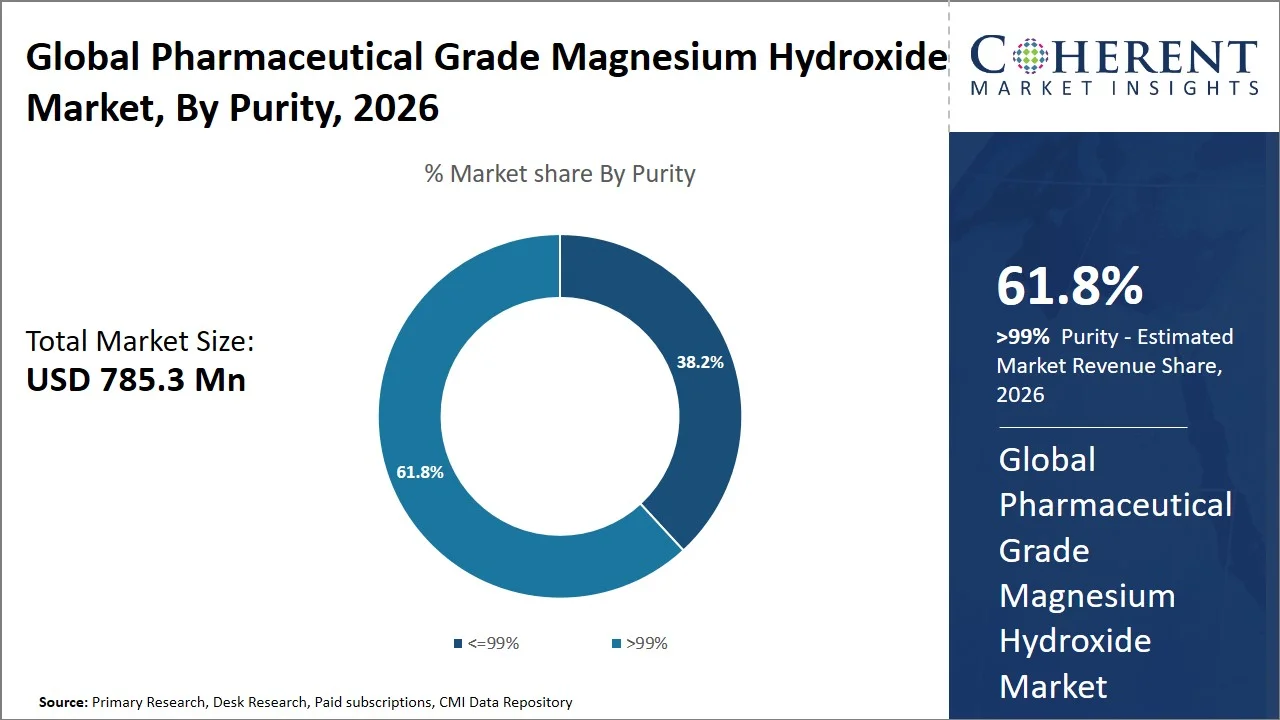
Why Does the >99% Segment Dominate the Global Pharmaceutical Grade Magnesium Hydroxide Market?
>99% is projected to hold a market share of 61.8% in 2026, due to better chemical stability, lowest impurity levels, and compatibility with pharmaceutical regulatory requirements. High purity grades are suitable for the formulation of antacids, laxatives, and various oral dosage forms that are designed with strict quality assurance standards. For instance, according to the U.S. Food and Drug Administration (FDA) guidance on ICH Q3D(R2): Elemental Impurities reinforces control over the potential elemental impurities within the pharmaceutical products and reinforces the preference for high-purity pharmaceutical raw materials, including magnesium hydroxide, in pharmaceutical drug manufacturing.
- Current Industry Events of 2026
- Market Size Estimation
- Regional Breakdown
- Competitive Landscape
- Customer Intelligence
- Segmental Analysis
- Pricing Analysis
- Key Market Drivers, Challenges & Future Trends
- Customized Insights Section
Why Do Pharmaceutical Companies Represent the Largest End User Segment in the Pharmaceutical Grade Magnesium Hydroxide Market?
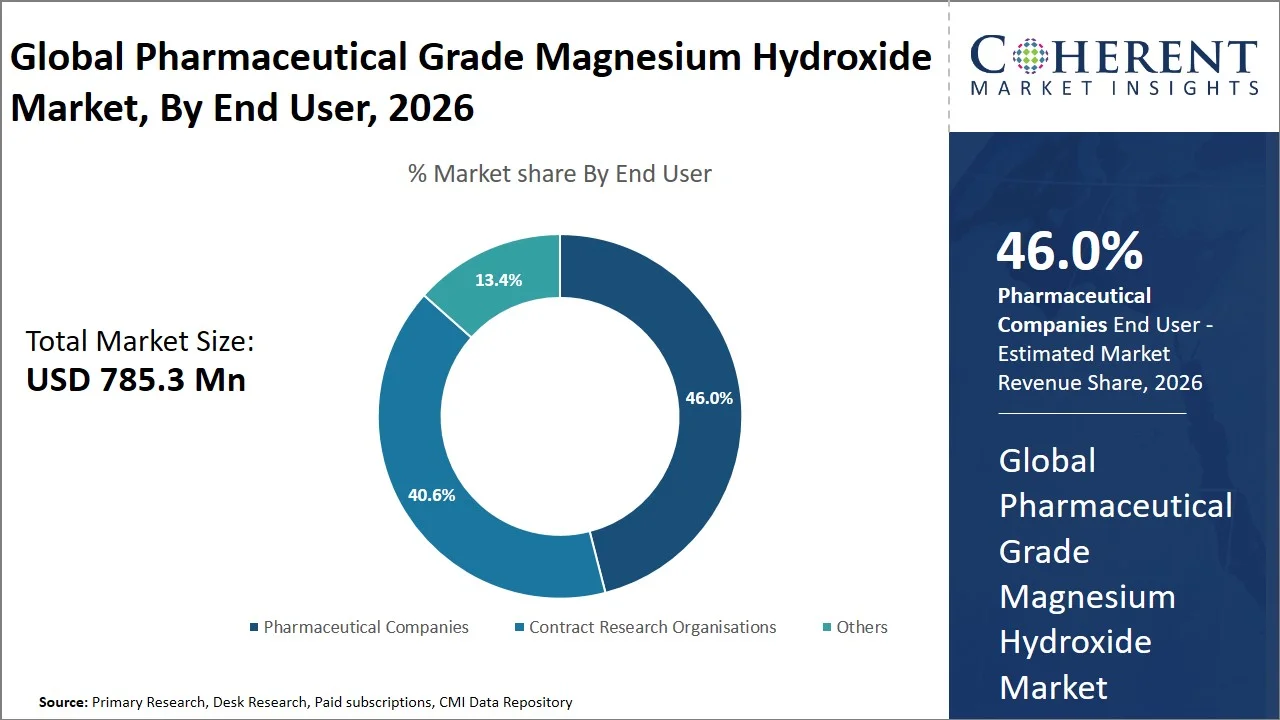
Pharmaceutical companies are projected to hold a market share of 46.0% in 2026, as magnesium hydroxide is widely used as an active pharmaceutical ingredient (API) in antacids and laxatives and also plays an important role in oral formulations for the pharmaceutical sector. Due to their huge production volumes, stringent quality standards, and compliance with the pharmacopeial regulations, pharmaceutical companies are consistent in their demand for pharmaceutical grade magnesium hydroxide high purity products. For instance, the U.S. Food and Drug Administration’s (FDA) OTC Monograph M001: Antacid Products for Over-the-Counter Human Use designates magnesium hydroxide as an allowed active antacid ingredient in OTC human drugs. This designation validates the wide usage of magnesium hydroxide by many pharmaceutical product manufacturers.
Current Events and their Impact
Current Events | Description and its Impact |
European Commission Publishes Revision 5 of the Excipients Labelling Guideline (December 2025) |
|
United States Pharmacopeia (USP) Opens Public Comment for USP–NF 2026 Proposed Revisions (September 2025) |
|
Global Pharmaceutical Grade Magnesium Hydroxide Market Dynamics
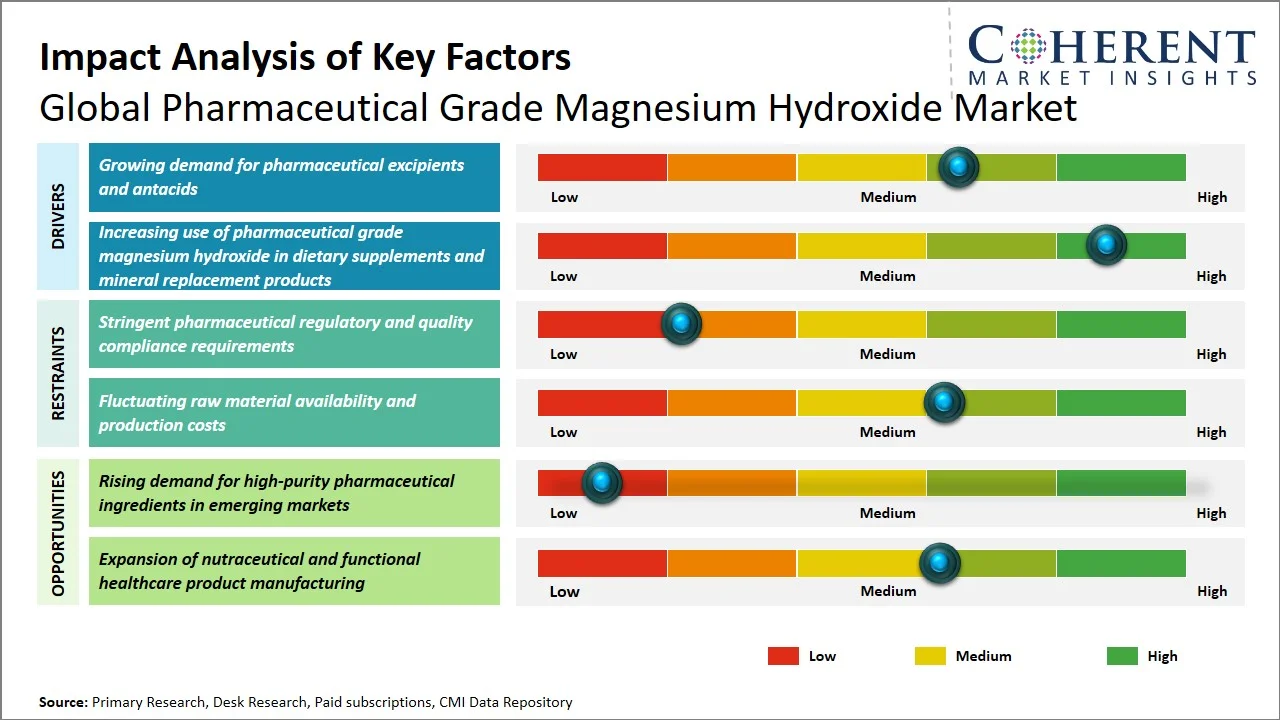
Market Drivers
- Growing demand for pharmaceutical excipients and antacids: The growing demand for high-quality pharmaceutical excipients and antacid formulations is driving the adoption of pharmaceutical grade magnesium hydroxide owing to its excellent acid-neutralizing properties, high purity, and compatibility with oral drug formulations. Its widespread use in over-the-counter (OTC) antacids and laxatives continues to support market growth. For instance, in May 2024, the European Medicines Agency (EMA) published a list of nationally authorized medicinal products containing a combination of calcium carbonate, famotidine, and magnesium hydroxide, reflecting the continued regulatory acceptance and clinical use of magnesium hydroxide-based gastrointestinal therapies across Europe.
- Increasing use of pharmaceutical grade magnesium hydroxide in dietary supplements and mineral replacement products: The growing consumption of dietary supplements and mineral replacement products is increasing the demand for pharmaceutical grade magnesium hydroxide as a high-purity source of magnesium. Rising consumer awareness of magnesium's role in supporting bone, muscle, nerve, and cardiovascular health is encouraging manufacturers to expand magnesium-based nutritional formulations across global markets. For instance, in October 2025, the Council for Responsible Nutrition (CRN) reported that 75% of U.S. adults use dietary supplements, with minerals remaining among the most widely consumed supplement categories, reflecting sustained demand for pharmaceutical-grade mineral ingredients used in supplement manufacturing.
Emerging Trends
- Increasing Adoption of Continuous Pharmaceutical Manufacturing: Pharmaceutical manufacturers are increasingly adopting continuous manufacturing technologies to improve production efficiency, product consistency, and regulatory compliance. This trend is driving the demand for high-purity raw materials such as pharmaceutical grade magnesium hydroxide that offer consistent physicochemical properties and batch-to-batch uniformity.
- Growing Emphasis on Sustainable and Traceable Pharmaceutical Raw Materials: Pharmaceutical companies are placing greater emphasis on sustainable sourcing and end-to-end traceability of excipients and active pharmaceutical ingredients to meet evolving ESG goals and regulatory expectations. As a result, manufacturers of pharmaceutical grade magnesium hydroxide are investing in cleaner production processes, supply chain transparency, and enhanced quality assurance to strengthen their position in regulated markets.
Regional Insights
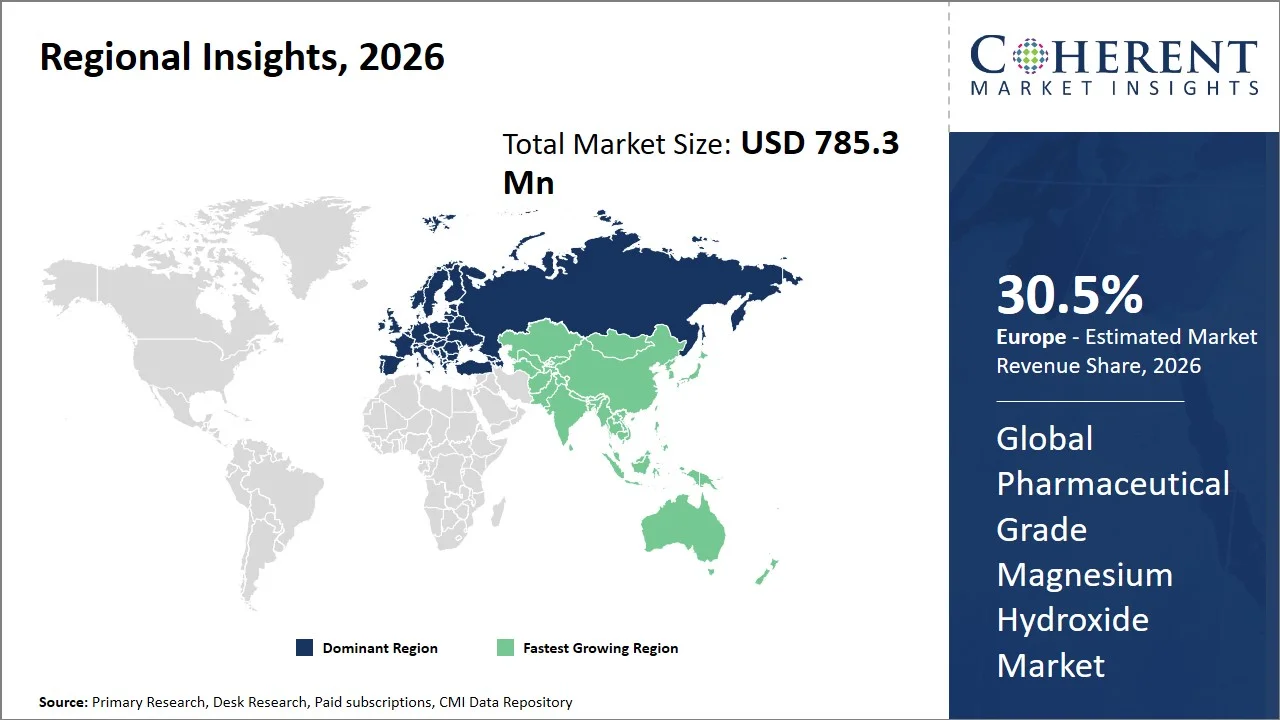
Why is Europe a Strong Market for Pharmaceutical Grade Magnesium Hydroxide?
Europe leads the global pharmaceutical grade magnesium hydroxide market, accounting for an estimated 30.5% share in 2026, due to a well-developed pharmaceutical manufacturing ecosystem, state-of-the-art production capabilities, and high market demand for active pharmaceutical ingredients (APIs) and excipients of premium purity. The region’s rigorous government regulations focused on quality and manufacturing compliances standards helps maintain the product quality that maintains market leadership of the region. For instance, the European Commission's EudraLex Volume 4 - Good Manufacturing Practice (GMP) Guidelines outlines overall quality requirements for the manufacture of medicinal products and active substances, ensuring consistent production quality across the European Union. Moreover, the region’s stable healthcare infrastructure and increased spending on pharmaceutical R&D coupled with rising trends in demand for oral formulations, antacids and dietary supplements for pharmaceutical applications are propelling the demand for pharmaceutical grade magnesium hydroxide in the region.
Why Does the Asia Pacific Pharmaceutical Grade Magnesium Hydroxide Market Exhibit High Growth?
The Asia Pacific pharmaceutical grade magnesium hydroxide market is expected to exhibit the fastest growth, accounting for an estimated 27.7% share of the global market in 2026. This growth is driven by expanding pharmaceutical manufacturing capabilities across the region, rising healthcare expenditure, and increasing demand for high-purity active pharmaceutical ingredients (APIs) and excipients. Government regulations that promote indigenous pharmaceutical production and self-sufficiency are expected to boost the market’s growth in Asia Pacific.
For instance, with an objective to reduce the dependence on imports and boost the domestic pharmaceutical supply chain, the Government of India announced Production Linked Incentive (PLI) Scheme for the domestic manufacturing of the critical Key Starting Materials (KSMs), Drug Intermediates (DIs), and Active Pharmaceutical Ingredients (APIs). (Source: Department of Pharmaceuticals) Furthermore, improvement in quality standards, cost-effective manufacturing, growth in export opportunities, and sustained investments in the healthcare sector in Asia Pacific region support a healthy long-term outlook for the market.
Global Pharmaceutical Grade Magnesium Hydroxide Market Outlook for Key Countries
Why is the U.S. Leading Innovation and Adoption in the Pharmaceutical Grade Magnesium Hydroxide Market?
The U.S. dominates the pharmaceutical grade magnesium hydroxide market due to its sophisticated pharmaceutical manufacturing ecosystem and the surging demand for highly pure pharmaceutical ingredients. The presence of an over-the-counter (OTC) gastrointestinal products industry with numerous magnesium hydroxide-based antacids and laxatives helps the market grow steadily. Furthermore, leading pharma companies (such as Pfizer Inc., Johnson & Johnson, Merck & Co., Inc), excipient manufacturers (such as IFF Pharma Solutions, Ashland Inc., DuPont Pharma Solutions, and Colorcon Inc) and contract development & manufacturing organizations (CDMOs) (such as Catalent, Thermo Fisher Scientific (Patheon), PCI Pharma Services, and Cambrex Corporation) enable faster product innovation and market penetration.
Is Japan a Favorable Market for Pharmaceutical Grade Magnesium Hydroxide Market?
Japan is one of the most promising markets for the pharmaceutical grade magnesium hydroxide market due to its robust pharma manufacturing base and strong emphasis on the use of pharmacopeial-grade excipients and high-purity active pharmaceutical ingredients (APIs). The country has consistent requirement of oral gastrointestinal formulations, dietary supplements, and drug precision manufacturing. Advanced formulation development skills and strong quality protocols reinforce the adoption of high-purity, pharmaceutical-grade magnesium hydroxide.
Is China Emerging as a Key Growth Hub for the Pharmaceutical Grade Magnesium Hydroxide Market?
China is positioned as a key growth hub in the global pharmaceutical grade magnesium hydroxide market spurred by the robust growth in the pharmaceutical production of high purity active pharmaceutical ingredients (APIs) and pharmaceutical excipients in the region. Also, the increasing demand for oral solid dosage formulations, gastrointestinal agents, and supplements are likely to drive the market growth. Investments in capacity expansions for pharmaceutical production along with focus on quality manufacturing further support the adoption of pharmaceutical grade magnesium hydroxide.
Why Does Germany Top the European Pharmaceutical Grade Magnesium Hydroxide Market?
Germany leads the European pharmaceutical grade magnesium hydroxide market owing to its well-established pharmaceutical manufacturing facilities and significant requirement of pharmacopeial grade raw materials for APIs and excipients. As a significant player in the oral solid dosage product development and the highest share of value for high value pharmaceutical products exports, there is stable consumption of pure raw ingredients in Germany. Furthermore, the country's advanced pharmaceutical formulation capabilities, stringent regulatory standards, and well-established supply chain for high-quality pharmaceutical production further strengthen its market leadership.
Is the Pharmaceutical Grade Magnesium Hydroxide Market Developing in the U.K.?
The U.K. is a high-potential market for pharmaceutical grade magnesium hydroxide driven by the growing pharmaceutical sector in the country and surging need for superior-grade pharmaceutical raw materials which include active pharmaceutical ingredients (APIs) and excipients. The demand for magnesium hydroxide in pharmaceutical applications has been fueled by the increasing production of oral solid dose forms, dietary supplements, and treatments for gastrointestinal conditions. Furthermore, sustained investment in research, drug development, manufacturing and quality control further contribute to market growth.
Product Innovation Landscape in the Global Pharmaceutical Grade Magnesium Hydroxide Market
Innovation Area | Recent Product Innovation | Key Benefit | Market Impact |
High-purity manufacturing | Advanced purification technologies to reduce trace metal impurities | Improved pharmacopeial compliance | Expands adoption in regulated pharmaceutical markets |
Particle engineering | Controlled particle size and morphology | Better flowability and compressibility | Supports tablet and capsule manufacturing |
Low-contaminant production | Enhanced impurity control and analytical testing | Greater product consistency | Strengthens manufacturer qualification by pharma companies |
Sustainable manufacturing | Energy-efficient production and waste minimization | Lower environmental footprint | Improves ESG (Environmental, Social, and Governance) compliance and supply chain competitiveness |
How is the rising demand for high-purity pharmaceutical ingredients in emerging markets creating new growth opportunities in the pharmaceutical grade magnesium hydroxide market?
Pharmaceutical manufacturing in emerging regions is presenting enormous growth opportunities for pharmaceutical-grade magnesium hydroxide as manufacturing companies are shifting their attention to pure grade excipients and active ingredients, so that products meet global regulatory guidelines. The rising investment in the generic drug manufacturing sector and export-driven operations will also boost the demand for pharmacopeial-grade raw materials. For instance, in June 2025, the World Health Organization’s Local Production and Assistance Unit pre-qualified two African pharmaceutical manufacturing facilities, thereby reinforcing pharmaceutical local production capacity within the region and increased the need of global standard compatible active pharmaceutical ingredients (APIs) and excipients.
Market Players, Key Development, and Competitive Landscape
Key Developments
- In October 2024, Akums Drugs & Pharmaceuticals Ltd. launched a dual-action heartburn relief chewable tablet combining Famotidine, Calcium Carbonate, and Magnesium Hydroxide for the Indian market. The product is designed to provide immediate acid neutralization along with sustained acid suppression, strengthening the company's gastrointestinal therapeutic portfolio and supporting demand for pharmaceutical-grade magnesium hydroxide.
- In June 2024, M. Huber Corporation, through its subsidiary, Huber Engineered Materials, completed the acquisition of Active Minerals International (AMI). The acquisition expands Huber's specialty minerals portfolio and strengthens its capabilities in supplying high-purity mineral ingredients for regulated industries, including pharmaceutical applications. This strategic move enhances the company's position in the pharmaceutical grade magnesium hydroxide market.
Competitive Landscape
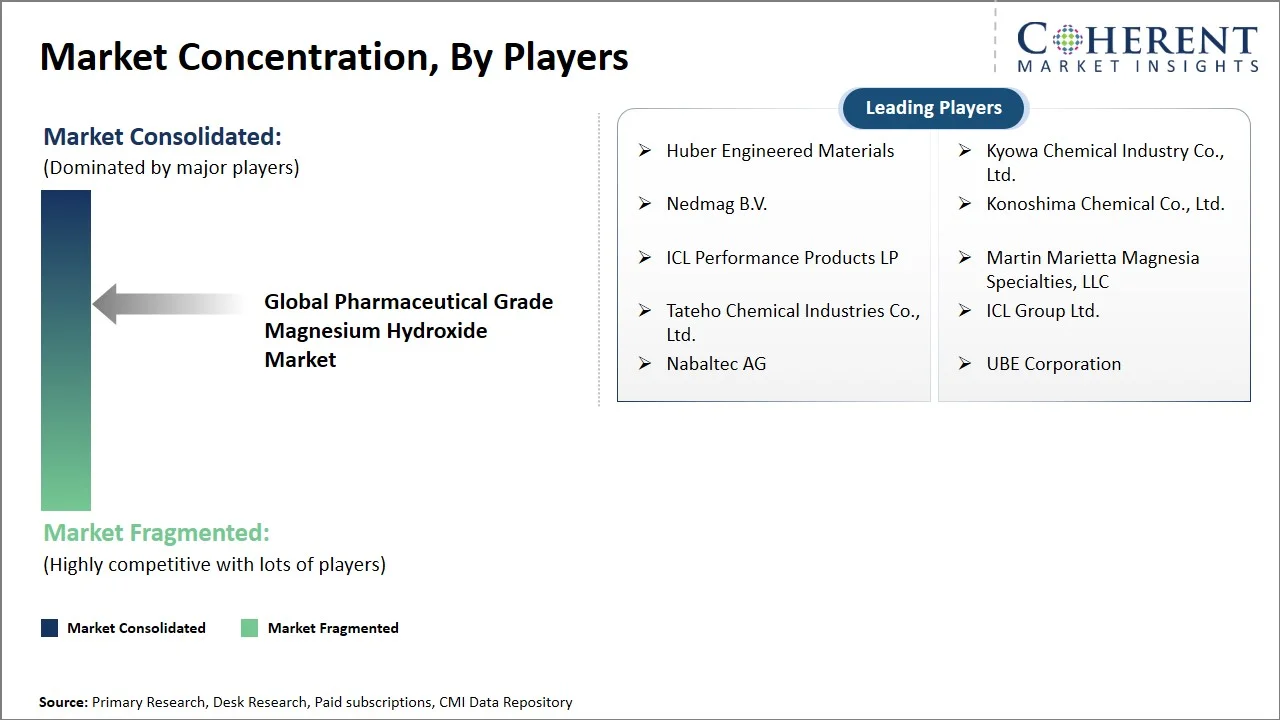
The global pharmaceutical grade magnesium hydroxide market is moderately consolidated, with competition centered on product purity, pharmacopeial compliance, manufacturing capabilities, and supply reliability. Leading manufacturers are investing in advanced purification technologies, process optimization, and quality assurance systems to meet stringent United States Pharmacopeia (USP), European Pharmacopoeia (EP), and Japanese Pharmacopoeia (JP) standards while strengthening their presence in regulated pharmaceutical markets. Strategic capacity expansions and long-term partnerships with pharmaceutical manufacturers further intensify market competition. Key focus areas include:
- Development of high-purity, low-impurity pharmaceutical grade magnesium hydroxide compliant with USP, EP, and JP pharmacopeial standards.
- Investment in advanced purification, particle size control, and analytical testing technologies to ensure consistent product quality.
- Expansion of manufacturing capacity and strategic supply agreements with pharmaceutical and nutraceutical companies to strengthen global market presence.
- Geographic expansion into high-growth Asia Pacific and Latin American markets through local manufacturing, distribution partnerships, and regulatory approvals.
Market Report Scope
Pharmaceutical Grade Magnesium Hydroxide Market Report Coverage
| Report Coverage | Details | ||
|---|---|---|---|
| Base Year: | 2025 | Market Size in 2026: | USD 785.3 Mn |
| Historical Data for: | 2020 To 2024 | Forecast Period: | 2026 To 2033 |
| Forecast Period 2026 to 2033 CAGR: | 5.7% | 2033 Value Projection: | USD 1,155.8 Mn |
| Geographies covered: |
| ||
| Segments covered: |
| ||
| Companies covered: | Huber Engineered Materials, Kyowa Chemical Industry Co., Ltd., Nedmag B.V., Konoshima Chemical Co., Ltd., ICL Performance Products LP, Martin Marietta Magnesia Specialties, LLC, Tateho Chemical Industries Co., Ltd., ICL Group Ltd., Nabaltec AG, and UBE Corporation | ||
| Growth Drivers: |
| ||
| Restraints & Challenges: |
| ||
Analyst Opinion (Expert Opinion)
- In the coming years, the market for pharmaceutical grade magnesium hydroxide will be shaped by the increasing demand for high-purity pharmaceutical excipients and active pharmaceutical ingredients (APIs), supported by stricter pharmacopeial standards and expanding pharmaceutical manufacturing worldwide. Growing adoption in oral solid dosage forms, gastrointestinal therapeutics, and nutraceutical formulations is expected to sustain long-term market growth.
- The maximum opportunities will probably exist within oral antacid and gastrointestinal formulations across India, driven by the country's expanding generic pharmaceutical manufacturing sector, increasing production of over-the-counter (OTC) medicines, and growing exports to regulated markets requiring pharmacopeial-grade raw materials.
- In order to obtain a competitive advantage, market participants should focus on developing high-purity, low-impurity pharmaceutical grade magnesium hydroxide that complies with the United States Pharmacopeia (USP), European Pharmacopoeia (EP), and Japanese Pharmacopoeia (JP) standards. Investments in advanced purification technologies, robust analytical testing, sustainable manufacturing processes, and long-term partnerships with pharmaceutical manufacturers will further strengthen market positioning.
Speak to the analyst
Want personalized insights?
Take the findings above to one of our principal consultants, or have the report rebuilt around the segments, geographies and competitors you actually track.
Market Segmentation
- Purity Insights (Revenue, USD Mn, 2021 - 2033)
- <=99%
- >99%
- End User Insights (Revenue, USD Mn, 2021 - 2033)
- Pharmaceutical Companies
- Contract Research Organizations
- Others
- Regional Insights (Revenue, USD Mn, 2021 - 2033)
- North America
- U.S.
- Canada
- Latin America
- Brazil
- Argentina
- Mexico
- Rest of Latin America
- Europe
- Germany
- U.K.
- Spain
- France
- Italy
- Russia
- Rest of Europe
- Asia Pacific
- China
- India
- Japan
- Australia
- South Korea
- ASEAN
- Rest of Asia Pacific
- Middle East
- GCC Countries
- Israel
- Rest of Middle East
- Africa
- South Africa
- North Africa
- Central Africa
- North America
- Key Players Insights
- Huber Engineered Materials
- Kyowa Chemical Industry Co., Ltd.
- Nedmag B.V.
- Konoshima Chemical Co., Ltd.
- ICL Performance Products LP
- Martin Marietta Magnesia Specialties, LLC
- Tateho Chemical Industries Co., Ltd.
- ICL Group Ltd.
- Nabaltec AG
- UBE Corporation
Sources
Primary Research Interviews
- Pharmaceutical grade magnesium hydroxide manufacturers and specialty mineral producers
- Pharmaceutical formulation scientists and excipient development specialists
- Regulatory affairs and quality assurance professionals from pharmaceutical companies
- Oral solid dosage formulation experts and pharmaceutical R&D managers
- Procurement and strategic sourcing managers from pharmaceutical manufacturers
- Contract Development and Manufacturing Organization (CDMO) executives
- Technical experts from pharmaceutical excipient suppliers
Stakeholders
- Pharmaceutical grade magnesium hydroxide manufacturers
- Pharmaceutical excipient manufacturers and distributors
- Active Pharmaceutical Ingredient (API) manufacturers
- Contract Development and Manufacturing Organizations (CDMOs)
- Ingredient distributors and specialty chemical suppliers
- End-use Sectors
- Pharmaceutical companies
- Generic drug manufacturers
- Over-the-counter (OTC) medicine manufacturers
- Nutraceutical and dietary supplement manufacturers
- Contract pharmaceutical manufacturers (CMOs/CDMOs)
- Regulatory & Health Bodies
- U.S. Food and Drug Administration (FDA)
- European Medicines Agency (EMA)
- European Directorate for the Quality of Medicines & HealthCare (EDQM)
- Pharmaceuticals and Medical Devices Agency (PMDA), Japan
- Central Drugs Standard Control Organization (CDSCO), India
- World Health Organization (WHO) Prequalification Programme
Databases
- United States Pharmacopeia–National Formulary (USP–NF)
- European Pharmacopoeia (Ph. Eur.)
- Japanese Pharmacopoeia (JP)
- U.S. Food and Drug Administration (FDA) Drugs Database
- European Medicines Agency (EMA) Medicines Database
- World Health Organization (WHO) Global Health Observatory (GHO)
- OECD Health Statistics
Magazines
- Pharmaceutical Technology Magazine
- Drug Development & Delivery Magazine
- Chemical & Engineering News (C&EN)
- Manufacturing Chemist Magazine
Journals
- International Journal of Pharmaceutics
- Journal of Pharmaceutical Sciences
- European Journal of Pharmaceutics and Biopharmaceutics
Associations
- International Pharmaceutical Excipients Council (IPEC)
- Pharmaceutical Research and Manufacturers of America (PhRMA)
- European Federation of Pharmaceutical Industries and Associations (EFPIA)
- American Chemical Society (ACS)
Public Domain Sources
- U.S. Food and Drug Administration (FDA) – Inactive Ingredient Database
- European Medicines Agency (EMA) Publications
- United States Pharmacopeia (USP)
- World Health Organization (WHO) – Pharmaceutical Standards
Proprietary Elements
- CMI Data Analytics Tool, Proprietary CMI Existing Repository of information for last 10 years.
Get access to 250+ pages report
Every segment, forecast, competitor profile and data table behind the analysis above — available for instant download.
- ESOMAR Member
- ISO 9001:2015 Certified
- D-U-N-S Registered
- GDPR & CCPA Compliant
Missing comfort of reading report in your local language? Find your preferred language:
Transform your Strategy with Exclusive Trending Reports
Frequently Asked Questions
The global pharmaceutical grade magnesium hydroxide market is estimated to be valued at USD 785.3 Mn in 2026 and is expected to reach USD 1,155.8 Mn by 2033.
>99% dominates due to its high chemical purity, pharmacopeial compliance, and suitability for regulated pharmaceutical formulations requiring consistent quality and safety.
Pharmaceutical grade magnesium hydroxide is a highly purified form of magnesium hydroxide that complies with pharmacopeial standards for use as an active pharmaceutical ingredient (API) and excipient in medicinal products.
The CAGR of the global pharmaceutical grade magnesium hydroxide market is projected to be 5.7% from 2026 to 2033.
Growing demand for pharmaceutical excipients and antacids, and increasing use of pharmaceutical grade magnesium hydroxide in dietary supplements and mineral replacement products are the major factors driving the growth of the global pharmaceutical grade magnesium hydroxide market.
Stringent pharmaceutical regulatory and quality compliance requirements, and fluctuating raw material availability and production costs are the major factors hampering the growth of the global pharmaceutical grade magnesium hydroxide market.
Uniform particle size improves flowability, compressibility, dissolution characteristics, and formulation consistency during pharmaceutical manufacturing.