

Hunter Syndrome Treatment Market Size and Forecast — 2026-2033
The Global Hunter Syndrome Treatment Market size is estimated to be valued at USD 1.37 billion in 2026 and is expected to reach USD 2.35 billion by 2033, exhibiting a compound annual growth rate (CAGR) of 8.0% from 2026 to 2033.
Overview
Hunter syndrome treatments include enzyme replacement therapies (ERTs), gene therapies, substrate reduction agents, and supportive care medications designed to manage the symptoms of mucopolysaccharidosis II (MPS II). The mainstay products are recombinant iduronate-2-sulfatase enzymes, such as idursulfase and its variants, administered intravenously to restore deficient enzyme activity. Recent product innovations are focusing on intrathecal and blood–brain barrier-penetrant formulations to address neurological symptoms that conventional ERTs cannot treat effectively.
Pipeline therapies also include adeno-associated virus (AAV) vector-based gene therapy candidates targeting long-term enzyme production. Supportive products, such as anti-inflammatory and respiratory care drugs, complement primary treatment regimens, while companion diagnostic tools are being developed to identify genetic mutations early and enable timely therapeutic intervention.
Key Takeaways
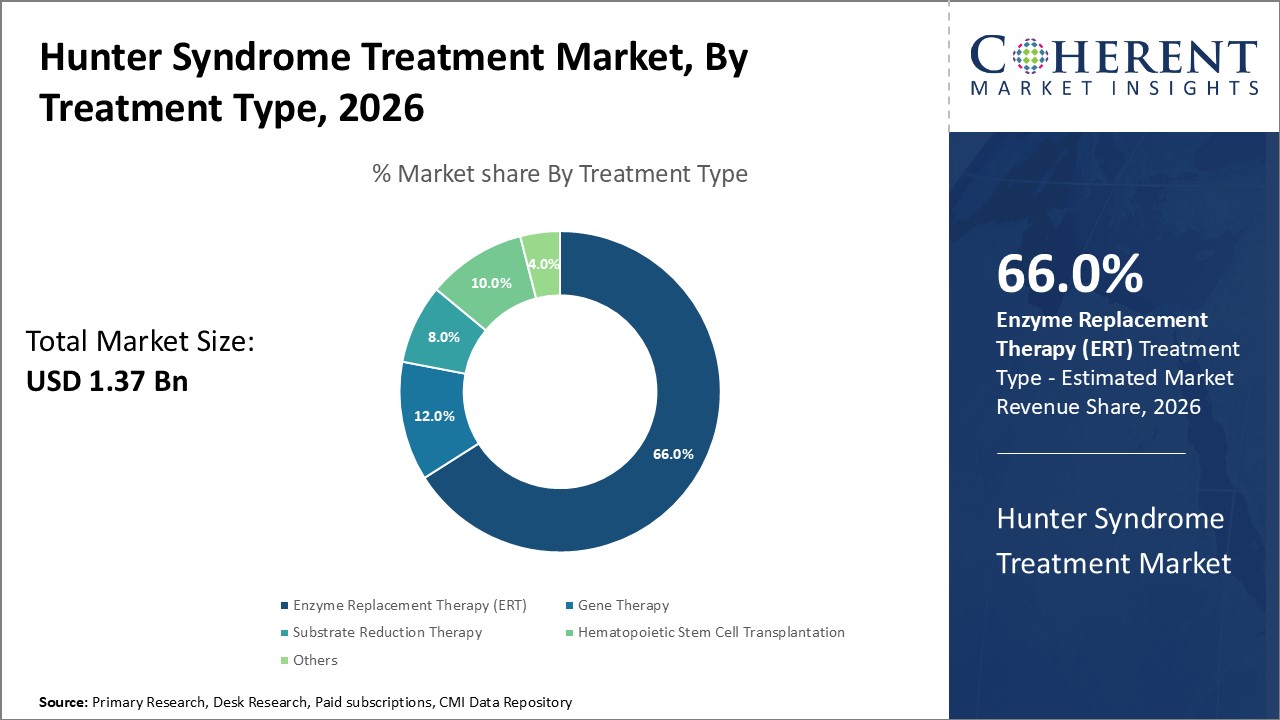
The Enzyme Replacement Therapy segment leads, accounting for a robust 66% market share driven by ongoing product pipeline expansions and efficacy profiles.
Pediatric patients dominate age-wise segmentation, highlighting critical neonatal screening initiatives. Hospital pharmacies remain the predominant distribution channel, reflecting institutional reliance for complex treatments.
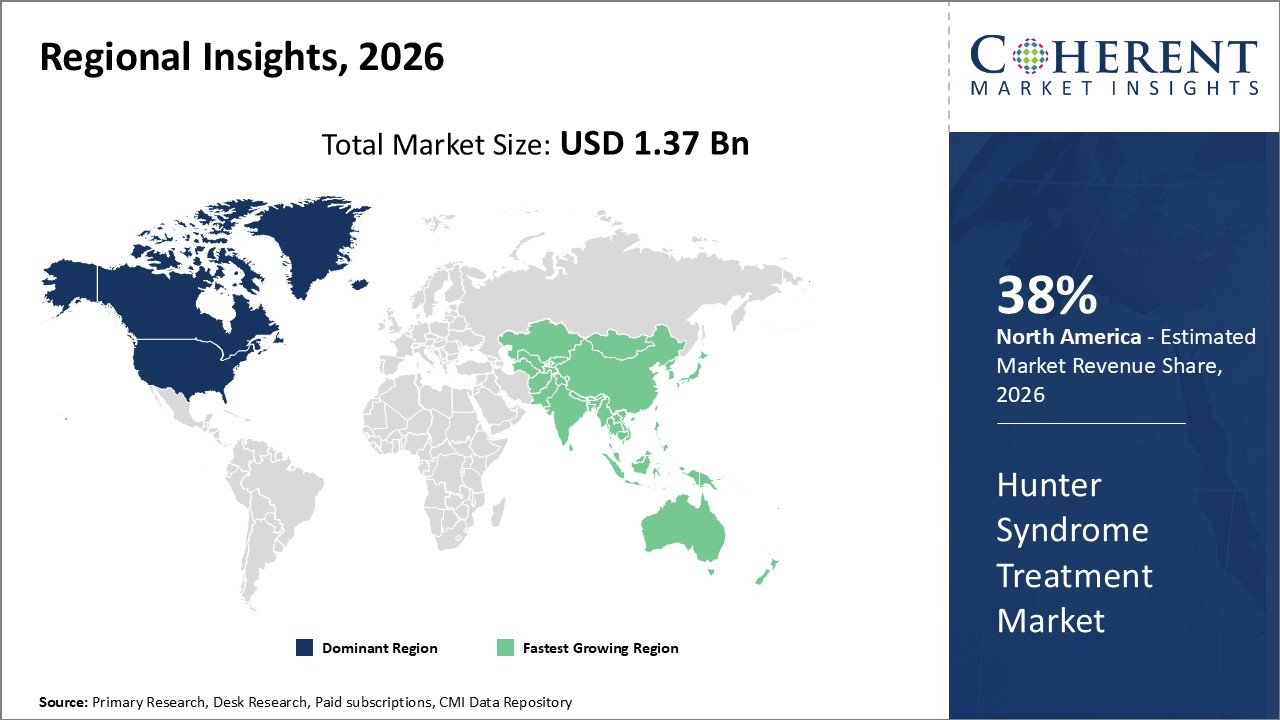
Regionally, North America holds the commanding industry share with 38% owing to a well-established healthcare infrastructure and extensive research funding.
Meanwhile, Asia Pacific emerges as the fastest-growing region due to increasing awareness programs and government incentives facilitating market penetration, reflected by a CAGR of approximately 9.1%.
Hunter Syndrome Treatment Market Segmentation Analysis
Hunter Syndrome Treatment Market Insights, By Treatment Type
Enzyme Replacement Therapy (ERT) remains the cornerstone due to its established efficacy and widespread clinical acceptance, accounting for approximately 66% of market share. The segment benefits from continuous product innovation and biomanufacturing scale-up, enabling enhanced patient access globally. Gene Therapy is the fastest growing treatment subsegment, propelled by breakthroughs in viral vector delivery systems and promising clinical results demonstrating long-term benefits in 2025-2026 trials.
Hunter Syndrome Treatment Market Insights, By Patient Age Group
The pediatric segment leads due to the critical need for early interventions and newborn screening programs, which facilitate timely enzyme replacement initiation. This age category drives considerable demand and revenue owing to the progressive nature of Hunter syndrome and higher clinical trial activity targeting this group. The adult segment is the fastest growing, reflecting advancements in therapies prolonging patient lifespan and enabling longer-term management.
Hunter Syndrome Treatment Market Insights, By Distribution Channel
Hospital Pharmacies hold dominance as they serve as primary distribution points, ensuring the complex administration and monitoring of therapies, especially enzyme replacement therapies requiring specialist oversight. Specialty Clinics are emerging rapidly as the fastest-growing subsegment, driven by centers of excellence for rare diseases that offer specialized administration and follow-up care. Retail Pharmacies maintain a steady presence, often serving patient convenience needs for ancillary medications.
Hunter Syndrome Treatment Market Trends
Recent market trends in Hunter Syndrome Treatment pivot around the advent of gene therapy, which demonstrated promising clinical data in 2025, including durable efficacy in pediatric and adolescent patients.
Integration of real-world evidence and patient-reported outcomes is increasingly shaping market growth strategies, enabling payers and providers to better assess treatment value.
Telehealth expansion has further enhanced accessibility and monitoring, especially in underserved markets.
Hunter Syndrome Treatment Market Insights, By Geography
North America Hunter Syndrome Treatment Market Analysis and Trends
In North America, the dominance in the Hunter Syndrome Treatment market stems from the presence of advanced biopharmaceutical companies, robust regulatory frameworks, and comprehensive newborn screening programs. The U.S. accounts for over 30% of the market share, supported by fast-track FDA approvals and high R&D investments.
Asia Pacific Hunter Syndrome Treatment Market Analysis and Trends
Meanwhile, Asia Pacific exhibits the fastest growth with a CAGR of approximately 9.1%, driven by government initiatives for rare disease registries, increasing healthcare expenditure, and rising awareness campaigns in countries like China and India.
Hunter Syndrome Treatment Market Outlook for Key Countries
USA Hunter Syndrome Treatment Market Analysis and Trends
The U.S. maintains leadership due to advanced clinical trial activity and significant investment by market companies such as BioMarin and Takeda. The introduction of gene therapies that received FDA breakthrough designation in 2025 has expanded treatment options, enhancing market revenue. High per capita healthcare spending and comprehensive insurance coverage further foster market share growth here.
China Hunter Syndrome Treatment Market Analysis and Trends
China’s market is rapidly evolving with expanded regulatory support for orphan drugs and increased patient access programs, fostering growth. Companies such as Ultragenyx and Shire have initiated local partnerships to optimize distribution. Government-driven research funding in rare diseases complements rising diagnosis rates, contributing significantly to business growth and market forecast optimism.
Analyst Opinion
Increasing production capacities for recombinant enzymes have streamlined supply chains, enabling manufacturers to meet rising global demand. For instance, data from 2025 shows a 16% increase in enzyme production capabilities by leading biopharmaceutical entities, reflecting expanded industrial output to address unmet needs.
Pricing dynamics remain a critical demand-side indicator, with efforts towards cost optimization—such as biosimilar development—affecting affordability in markets like Europe. In 2026, targeted pricing strategies lowered treatment costs by up to 10% in select healthcare systems, stimulating treatment adoption.
The expansion of treatment across various age groups, notably pediatric to adult transitions, enhances market size. Recent clinical outcomes published in 2025 reveal improved therapeutic adherence, with 21% more adult Hunter syndrome patients receiving enzyme replacement therapies compared to previous years.
Export flows from North America to emerging regions have witnessed growth, showing a 12% rise in 2026, driven by technology transfer agreements and regional manufacturing partnerships, enhancing global market revenue and share.
- Current Industry Events of 2026
- Market Size Estimation
- Regional Breakdown
- Competitive Landscape
- Customer Intelligence
- Segmental Analysis
- Pricing Analysis
- Key Market Drivers, Challenges & Future Trends
- Customized Insights Section
Market Scope
| Report Coverage | Details | ||
|---|---|---|---|
| Base Year: | 2025 | Market Size in 2026: | USD 1.37 billion |
| Historical Data for: | 2020 To 2024 | Forecast Period: | 2026 To 2033 |
| Forecast Period 2026 to 2033 CAGR: | 8.0% | 2033 Value Projection: | USD 2.35 billion |
| Geographies covered: |
| ||
| Segments covered: |
| ||
| Companies covered: | BioMarin Pharmaceutical Inc., Takeda Pharmaceutical Company Limited, Sanofi Genzyme, Ultragenyx Pharmaceutical Inc., Ascendis Pharma, Sangamo Therapeutics, Audentes Therapeutics, Amicus Therapeutics, Orchard Therapeutics, PTC Therapeutics. | ||
| Growth Drivers: |
| ||
Hunter Syndrome Treatment Market Growth Factors
The escalating prevalence and improved diagnostic capabilities underpin the growth trajectory in the Hunter Syndrome Treatment market. Increased newborn screening programs, especially in North America and Europe, have facilitated early disease identification, boosting market penetration. Advancements in gene therapy and enzyme replacement options continuously expand therapeutic effectiveness, enabling wider clinical acceptance. Additionally, consistent investment in R&D and policy support for orphan drug development has driven faster regulatory approvals, thereby reducing time to market for novel treatments.
Hunter Syndrome Treatment Market Development
In January 2021, GC Pharma and Clinigen K.K. received marketing approval in Japan for Hunterase ICV Injection (idursulfase-beta administered intracerebroventricularly), marking the world’s first approval of an ICV enzyme-replacement therapy for Hunter syndrome (mucopolysaccharidosis type II). The approval enables delivery of the therapy directly into the cerebral ventricles, targeting central nervous system symptoms previously unmet by intravenous ERT.
In September 2020, CANbridge Pharmaceuticals received approval from China’s National Medical Products Administration (NMPA) for Hunterase (idursulfase-beta injection) for the long-term treatment of Hunter syndrome, becoming the first enzyme-replacement therapy (ERT) in China for this condition.
Key Players
Leading companies of the market include:
BioMarin Pharmaceutical Inc.
Takeda Pharmaceutical Company Limited
Sanofi Genzyme
Ultragenyx Pharmaceutical Inc.
Ascendis Pharma
Sangamo Therapeutics
Audentes Therapeutics
Amicus Therapeutics
Orchard Therapeutics
PTC Therapeutics
Several leading companies have adopted targeted growth strategies, such as strategic collaborations and licensing agreements, to accelerate drug development pipelines. For example, Takeda secured partnership deals in 2025 focusing on expanding gene therapy platforms—resulting in a 25% increase in R&D output. BioMarin’s recent acquisitions of smaller biotech firms equipped it with next-gen enzyme replacement capabilities, which led to a 30% surge in market revenue by late 2026.
Hunter Syndrome Treatment Market Future Outlook
The Hunter Syndrome Treatment Market is expected to witness gradual but sustainable growth, driven by advancements in gene therapy, next-generation ERTs with improved blood-brain barrier penetration, and expanding access in emerging markets. Major biopharmaceutical players are focusing on innovative delivery systems and long-term gene correction strategies to address neurological symptoms. Regulatory incentives for rare diseases and the rising trend of newborn screening are anticipated to strengthen early intervention rates. While high therapy costs and reimbursement hurdles will remain challenges, the increasing availability of curative and disease-modifying treatments is projected to enhance the overall therapeutic landscape by the early 2030s.
Hunter Syndrome Treatment Market Historical Analysis
The Hunter Syndrome Treatment Market has evolved gradually over the past two decades, driven by increasing disease awareness, improvements in diagnostic capabilities, and the introduction of enzyme replacement therapies (ERTs). Historically, treatment options were limited primarily to supportive and palliative care due to the rarity and complexity of the disease. However, the launch of idursulfase (Elaprase) marked a major milestone, setting the stage for a new era of targeted therapies for mucopolysaccharidosis type II (MPS II). Throughout the 2010s and early 2020s, market expansion was supported by orphan drug incentives, research collaborations, and improved patient registries that enhanced early diagnosis. Despite this progress, high treatment costs, infusion-related burden, and limited efficacy in central nervous system manifestations continued to present barriers to broad adoption and optimal patient outcomes.
Sources
Primary Research Interviews:
Pediatric Geneticists
Metabolic Disorder Specialists
Rare Disease Clinicians
Hospital Pharmacists
Biotech R&D Heads
Databases:
Orphanet
ClinicalTrials.gov
GlobalData Rare Disease Reports
FDA Orphan Drug Database
Magazines:
Genetic Engineering & Biotechnology News
Rare Disease Report
BioCentury
PharmaVOICE
Journals:
Genetics in Medicine
Molecular Genetics and Metabolism
Orphanet Journal of Rare Diseases
The Lancet Child & Adolescent Health
Newspapers:
The New York Times (Health)
The Guardian (Science)
The Hindu (Health)
Financial Times (Pharma)
Associations:
National Organization for Rare Disorders (NORD)
European Medicines Agency (EMA)
American College of Medical Genetics (ACMG)
International Society for Rare Diseases
Get access to 250+ pages report
Every segment, forecast, competitor profile and data table behind the analysis above — available for instant download.
- ESOMAR Member
- ISO 9001:2015 Certified
- D-U-N-S Registered
- GDPR & CCPA Compliant
Missing comfort of reading report in your local language? Find your preferred language:
Transform your Strategy with Exclusive Trending Reports
Frequently Asked Questions
The market is led by companies such as BioMarin Pharmaceutical Inc., Takeda Pharmaceutical Company Limited, Sanofi Genzyme, and Ultragenyx Pharmaceutical Inc., which continually innovate in the enzyme replacement and gene therapy sectors.
The market size is forecasted to grow from USD 1.37 billion in 2026 to USD 2.35 billion by 2033, reflecting a CAGR of 8.0%, driven by innovative therapy adoption and expanded patient coverage.
The pediatric patient segment exhibits the largest growth potential due to increased newborn screening and early intervention programs facilitating prompt treatment initiation.
Emerging gene-editing therapies, integration of telemedicine for treatment monitoring, and regulatory facilitation of orphan drugs are expected to fuel rapid market growth and transformation.
Competition is intense with focus on proprietary enzyme therapies and gene therapies; challenges include high treatment costs, market access barriers, and limited patient populations.
Strategic collaborations, licensing deals, portfolio diversification, and patient assistance programs are widely adopted to accelerate drug availability and maximize reach.