

Pharmaceutical Testing Services Market Size and Trends- (2026-2033)
The Pharmaceutical Testing Services Market is estimated to be valued at USD 20 Bn in 2026 and is expected to reach USD 37.0 Bn by 2033, growing at a compound annual growth rate (CAGR) of 9.2% from 2026 to 2033.
Key Takeaways
- Based on Product Type, the Finished Products segment is expected to lead the market with 47% share in 2026, due to regulatory batch release and quality compliance.
- Based on Service Type, the Bio-analytical Testing segment is expected to hold 29.3 % share of the market in 2026, driven by increasing Investment in new drug research.
- Based on End User, the Biopharmaceutical and Pharmaceutical Companies segment is projected to account for 63.6 % share in 2026, leveraging outsourced testing to reduce operational complexity.
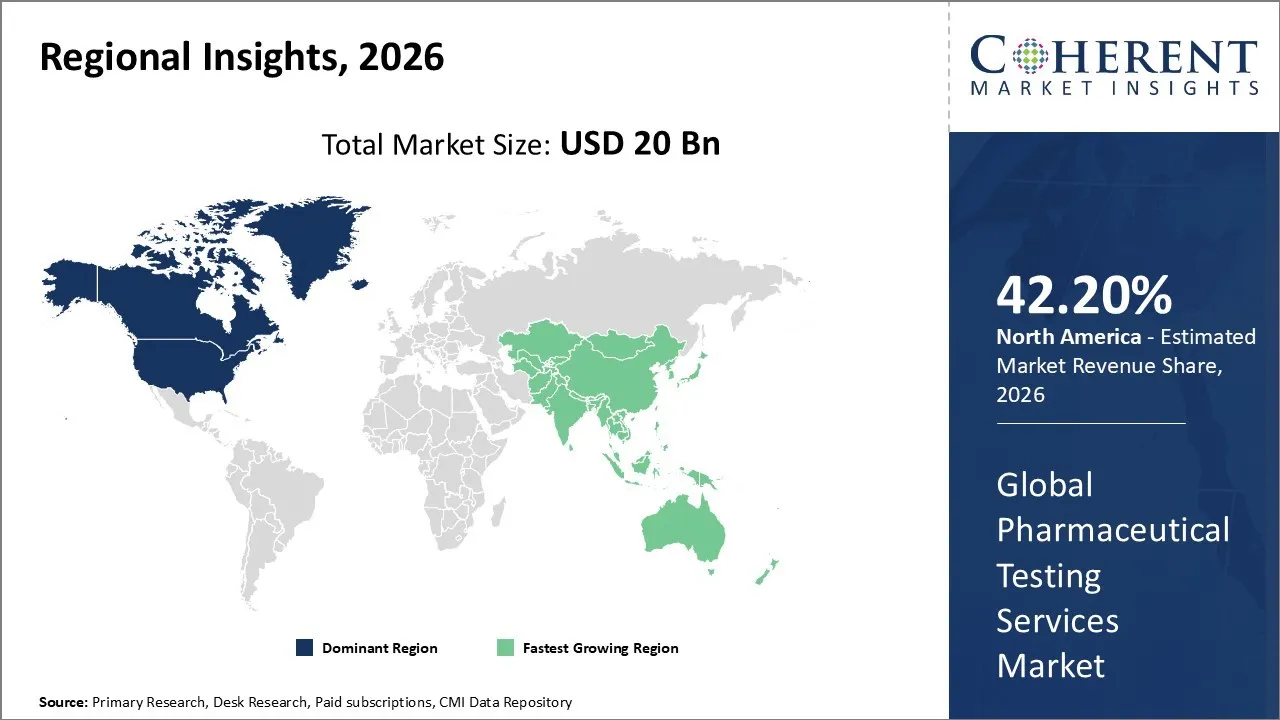
- Based on Region, North America is set to lead the market with 42.2 % share in 2026. While, Asia Pacific is anticipated to be the fastest growing region.
Market Overview
This sector encompasses testing services provided to pharmaceutical and biopharmaceutical companies throughout drug development and manufacturing. The growing complexity of drug molecules and increasing regulatory scrutiny are driving the market value for pharmaceutical testing services.
The Pharmaceutical Testing Services Market is trending towards the greater outsourcing and specialization of testing capabilities. Pharmaceutical companies are embracing contract testing laboratories and CROs that provide comprehensive analytical services integrated with regulatory expertise for enhanced compliance. Specialized testing for biologics and biosimilars is also growing in popularity over traditional small molecule testing. This is because they provide improved quality assurance, advanced characterization, and deeper insights into drug safety and efficiency profiles. This outsourcing shift will continue propelling market volumes higher over the forecast period.
Current Events and Its Impacts on the Pharmaceutical Testing Services Market
Current Event | Description and the Impact |
Technological Advancements in Testing Methodologies |
|
Regional Public Health Crises and Emerging Disease Outbreaks
|
|
Environmental and Sustainability Regulations Impacting Laboratory Operations
|
|
Role Of Artificial Intelligence (AI) In Pharmaceutical Testing Services Market
Artificial intelligence (AI) is reshaping the pharmaceutical testing services market in a major way. drug discovery and development are being done at a much faster pace and with greater efficiency due to AI algorithms. These algorithms analyze a large amount of data to find potential drug candidates, forecast their effectiveness and toxicity, and even figure out the best clinical trial designs, thus cutting both time and money to market. AI is also at the forefront in handling and making sense complicate biological data, which in turn helps in the personalized medicine approaches. AI-driven automation in lab operations, eliminates human error and also greatly enhances the speed of the testing processes. AI is the main factor behind the market's expansion, as it is giving rise to more accurate, efficient, and cost saving testing services.
For instance, the McKinsey Global Institute (MGI) anticipated that AI could add USD 60 to USD 110 billion to the economy each year for the pharmaceutical and medical product industries. This advantage is because AI can speed up the process of finding compounds that could be used to make new drugs, speed up their development and approval, and make them easier to market.
- Current Industry Events of 2026
- Market Size Estimation
- Regional Breakdown
- Competitive Landscape
- Customer Intelligence
- Segmental Analysis
- Pricing Analysis
- Key Market Drivers, Challenges & Future Trends
- Customized Insights Section
Segmental Insights
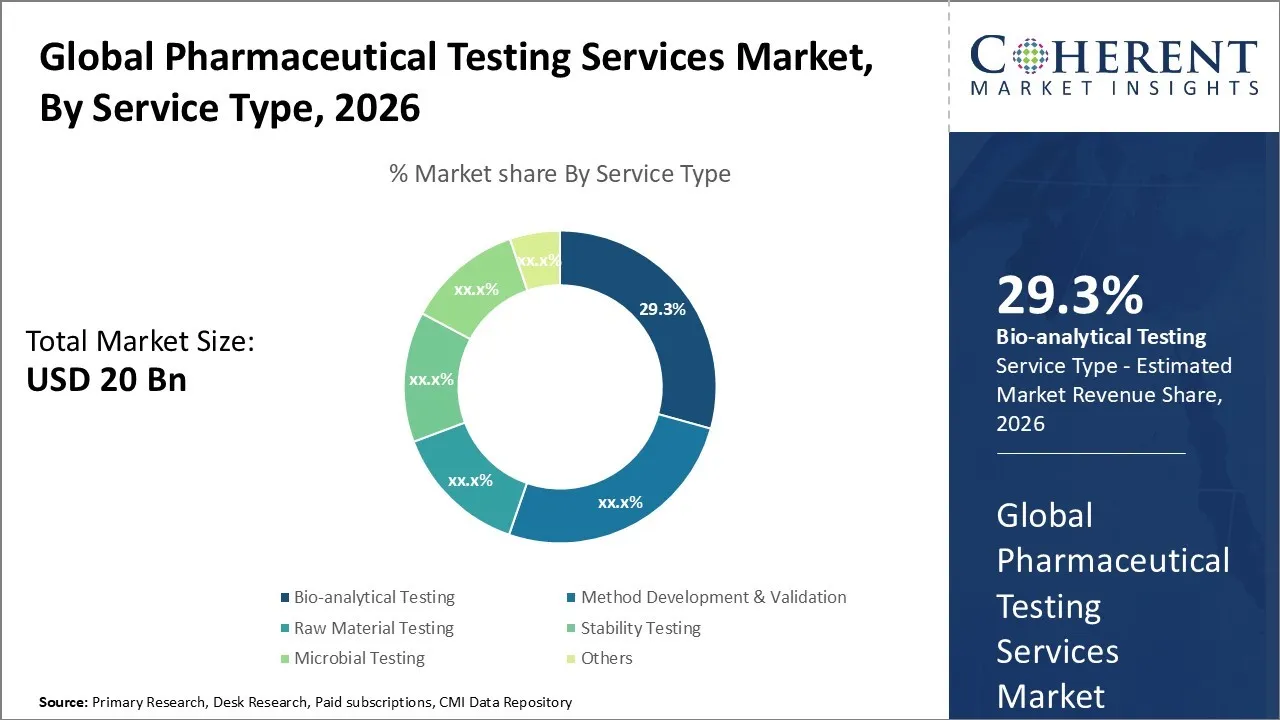
Pharmaceutical Testing Services Market Insights, By Service Type - Increasing Investment in New Drug Research Boosts Bio-analytical Testing Usage
In terms of service type, the bio-analytical testing segment contributes the highest share of 29.3% in 2026 of the market. The segment is growing because of increasing investment in new drug research, particularly for biological medicines that require detailed analysis of how drugs behave in the body. The strict rules from agencies like the FDA require extensive testing before drugs can be approved, thus propelling demand for these services.
For instance, in December 2022, Alliance Pharma, a world leader in the pharmaceutical and biopharmaceutical business that offers bioanalytical, DMPK, and CMC testing services, launched its new 20,000-square-foot bioanalytical laboratory, Alliance Pharma Pty, Ltd., in Brisbane, Australia. The company revealed plans earlier this summer to build a new facility in Australia, which will have a big lab to offer much-needed small and large molecule bioanalytical services to a region with few options for bioanalytical support.
Pharmaceutical Testing Services Market Insights, By Product Type - Regulatory Batch Release and Quality Compliance Drives Preference for Finished Products
In terms of product type, the finished products segment contributes the highest share of 47% in 2026 of the market owing to stringent regulatory batch release requirements and quality compliance protocols. Before being sold, finished products must undergo extensive testing and certification. This process establishes quality assurance frameworks that prioritize ready-to-market formulations. Such regulatory oversight ensures that finished goods comply with GMP standards prior to their sale.
Pharmaceutical Testing Services Market Insights, By End User- Biopharmaceutical and Pharmaceutical Companies Lead as They Utilize Outsourced Testing to Simplify Their Operations
In terms of end user, the biopharmaceutical and pharmaceutical companies contribute the highest share of 63.6% in 2026 of the market owing to stringent regulatory requirement and complex drug development pipelines. These companies outsource testing to specialized laboratories to ensure product safety, efficacy and compliance with FDA and other regulatory standards.
For instance, in November 2025, Servier India, a wholly owned subsidiary of Servier Group, introduced a biomarker testing program for two specific types of cancer. This was developed in collaboration with the genomic laboratories MedGenome and Strand Life Sciences based in India.
Regional Insights
North America Pharmaceutical Testing Services Market Analysis & Trends
North America has remained the dominant region with 42.20% in 2026 of the global Pharmaceutical Testing Services Market over the past decade. The growth is attributable to the rising drug complexity, strict FDA regulations, increased outsourcing to CROs, and high R&D spending, particularly for new therapies and biosimilars. The region's strong infrastructure, along with its use of cutting-edge technology and a growing number of clinical trials, is also driving up the need for specialized analytical services. Two advanced analytical methods, mass spectrometry and chromatography, are essential for accurately describing biologics, biosimilars, and combination drugs.
For instance, in January 2024,Kindeva Drug Delivery, a provider of drug-device combination products, extended its analytical services capabilities by introducing a new global business unit. This unit provides integrated and independent analytical support to the pharmaceutical, biopharmaceutical, and medical device industry.
Asia Pacific Pharmaceutical Testing Services Market Analysis & Trends
The Asia Pacific region has become the fastest growing market owing to increasing investment in research activities and a heightened demand for advanced testing of both biologics and generics. The pharmaceutical industry is growing quickly in cities like China, India, and Japan, which is driving up the need for testing new drugs for discovery and production. Greater investments in drug discovery, particularly in advanced therapies like biologics, require more sophisticated testing methods. The stricter quality and safety standards are fostering the need for extensive analytical assessments. Many global firms prefer to outsource testing to this region owing to its competitive costs and skilled workforces. Technologies like AI, automation, and digital platforms are improving the testing efficiency and accuracy. The rise in generics and biologics is resulting in high demand for specialized testing. The supportive government policies like "Make in India" are fostering domestic laboratory growth in the region.
For instance, in October 2024, Agilus Diagnostics unveiled its new Pharmacogenomics Testing Services. This service provides individuals and healthcare professionals with valuable information about how unique genetic profiles influence the effectiveness and safety of medications. This facilitates the development of a more personalized treatment plan.
Pharmaceutical Testing Services Market Outlook Country-Wise
The U.S. Pharmaceutical Testing Services Market Trends
The U.S. market growth is owing to strict FDA regulations, rising outsourcing to CROs, increased R&D for complex biologics, and demand for cutting edge technologies for quality and safety. Other factors like increased drug approvals, personalized medicine trends, greater complexity in drug development, and focus on data integrity, is also boosting the demand for specialized bioanalytical and stability testing services.
For instance, in May 2025, Minaris Regenerative Medicine was merged with the U.S. and U.K. operations of WuXi Advanced Therapies by the by New York based investment company, Altaris to form Minaris Advanced Therapies™. As a CDMO and testing expert in cell therapies globally the company headquartered in Pennsylvania provides the latest technology platforms, cell therapy and viral vector manufacturing, as well as comprehensive testing services.
China Pharmaceutical Testing Services Market Trends
China's market is growing owing to the rising R&D, increased clinical trials, and supportive government policies simplifying regulations. This makes China a global hub for drug development and attracting outsourcing from international firms, alongside a focus on novel therapies like gene editing.
For instance, in November 2023, Asahi Kasei and Asahi Kasei Medical will open the Asahi Kasei Bioprocess Technical Center (CBTC) in Suzhou, Jiangsu, China. The bioprocess division of Asahi Kasei Medical, which includes products for biotherapeutics, biosafety testing services, and a biopharmaceutical CDMO, is one of the Asahi Kasei Group's "10 Growth Gears" (GG10) businesses that will help the company grow in the future.
Market Report Scope
Pharmaceutical Testing Services Market Report Coverage
| Report Coverage | Details | ||
|---|---|---|---|
| Base Year: | 2025 | Market Size in 2026: | USD 20 Bn |
| Historical Data for: | 2020 To 2024 | Forecast Period: | 2026 To 2033 |
| Forecast Period 2026 to 2033 CAGR: | 9.2% | 2033 Value Projection: | USD 37.0 Bn |
| Geographies covered: |
| ||
| Segments covered: |
| ||
| Companies covered: | Merck KGaA, Boston Analytical, West Pharmaceutical Services Inc., Exova Group PLC., Source BioScience , Pace Analytical Services, Inc., W.uXi AppTec, Toxikon, Eurofins Scientific, and West Pharmaceutical Services Inc. | ||
| Growth Drivers: |
| ||
| Restraints & Challenges: |
| ||
Pharmaceutical Testing Services Market Drivers
Rising R&D in complex biologics and biosimilars
Today, the pharmaceutical industry is making substantial investments in the development of biologics and biosimilars. These complex molecules require extensive testing protocols during their entire lifecycle. Biologic drugs now account for a substantial share of new drug approvals, with manufacturers allocating heavily in research initiatives. Biologics, unlike traditional small-molecule drugs, require specialized analytical methods to guarantee consistency and safety throughout production batches.
For instance, in October 2025, the U.S. Food and Drug Administration (FDA) said it would take big steps to speed up and lower the cost of making biosimilar medicines. These are lower-cost generic versions of biologic drugs that treat serious and chronic diseases. This brave move by the FDA speeds up the development of biosimilars, increases competition in the market, and gives patients more choices.
Pharmaceutical Testing Services Market Opportunities
Demand for specialized CROs with advanced tech
A growing number of pharmaceutical companies are working with specialized CROs that utilize cutting-edge technology. This trend is creating numerous growth prospects in the testing services sector. These specialized CROs are skilled in areas like biomarker analysis, companion diagnostics, and complex biologics testing which are essential for modern drug development. The cutting-edge technology platforms like high throughput screening, mass spectrometry, and real world data analytics allow specialized CROs to provide faster and more accurate results. Their investment in cutting-edge infrastructure allows pharmaceutical firms to access sophisticated testing capabilities without major capital expenditure. Precision medicine and complex therapies, such as cell and gene therapies, are gaining popularity. These therapies require specialized testing that is not available at standard laboratories. This trend is particularly strong in oncology, rare diseases, and biosimilars development.
For instance, in October 2025, MilliporeSigma, Merck KGaA's life science business in the U.S. and Canada, teamed up with Promega Corporation, a global leader in life science solutions and services from Madison, Wisconsin, to work together on new technologies that will help with drug screening and discovery.
Analyst Opinion (Expert Opinion)
- The pharmaceutical testing services market is supported by strong, measurable demand across analytical, bioanalytical, microbiological, and stability testing domains. Industry data indicate that North America accounts for a significant proportion of global testing activity, driven by strict regulatory compliance requirements, high drug development intensity, and a dense presence of contract research organizations and specialized laboratories. Analytical testing remains the most utilized service category, representing a substantial share of total testing volumes due to routine requirements for impurity profiling, method validation, and quality control across development and commercial manufacturing stages.
- Small-molecule drugs continue to generate the highest testing demand, reflecting their extensive presence in global pharmaceutical pipelines and generic drug production. At the same time, testing volumes for biologics and biosimilars are increasing steadily, supported by the rising number of monoclonal antibodies, cell therapies, and recombinant products under development. Clinical-phase testing shows particularly high service utilization, as regulatory submissions require comprehensive pharmacokinetic, bioequivalence, and safety data packages.
- Outsourcing trends remain pronounced, with pharmaceutical and biotechnology companies increasingly relying on external testing providers to manage costs, access advanced instrumentation, and accelerate development timelines. Data also indicate growing adoption of digital laboratory systems, including laboratory information management systems and automated analytical platforms, which have improved throughput, traceability, and data integrity. Expansion of pharmaceutical manufacturing and clinical research infrastructure in Asia Pacific further supports sustained growth in testing volumes, reinforcing the market’s long-term demand fundamentals.
Speak to the analyst
Want personalized insights?
Take the findings above to one of our principal consultants, or have the report rebuilt around the segments, geographies and competitors you actually track.
Pharmaceutical Testing Services Industry News
- In December 2025, EDX Medical is pleased to announce the launch of a new, highly accurate testing service, introduced BC95, a precise new diagnostic service for the early-early bowel cancer detection. Featuring robust clinical backing, this UK available test boosts sensitivity and accuracy while evaluating patients hereditary genetic risks.
- In March 2025, the renowned worldwide expert in applied safety science, UL Solutions Inc. opened its Songshan Lake IoT Lab based in Dongguan, China. The initiative highlights the organizations commitment to supporting the manufacturer in addressing the issues facing the evaluation or certification of networked products and wireless technologies.
- In October 2024, LGM Pharma revealed the expansion of its pharmaceutical Analytical Testing Services (ATS) by adding endotoxin and rapid sterility testing capabilities. These additional services, now offered at LGM Pharma’s Irvine, CA facility, provide substantial advantages to drug developers, including faster turnaround times, improved quality control, and reduced costs.
- In September 2023, Element Materials Technology introduced a consolidated offering for pharmaceutical services combining resources from their recent acquisitions of Nanosyn and JMI labs into its established Life Sciences division. The new company will now operate as a single global testing, inspection, and certification company offering clients more than 1,400 scientists and chemists working in laboratories around the world.
Market Segmentation
- Product Type Insights (Revenue, USD Bn, 2020 - 2033)
- Active Pharmaceutical Ingredients
- Raw Materials
- Finished Products
- Service Type Insights (Revenue, USD Bn, 2020 - 2033)
- Bio-analytical Testing
- Method Development & Validation
- Raw Material Testing
- Stability Testing
- Microbial Testing
- Others
- End User Insights (Revenue, USD Bn, 2020 - 2033)
- Biotechnology Industries
- Biopharmaceutical and Pharmaceutical Companies
- Others
- Regional Insights (Revenue, USD Bn, 2020 - 2033)
- North America
- U.S.
- Canada
- Latin America
- Brazil
- Argentina
- Mexico
- Rest of Latin America
- Europe
- Germany
- U.K.
- France
- Italy
- Russia
- Rest of Europe
- Asia Pacific
- China
- India
- Japan
- Australia
- South Korea
- ASEAN
- Rest of Asia Pacific
- Middle East & Africa
- GCC Countries
- South Africa
- Rest of Middle East & Africa
- North America
- Key Players Insights
- Merck KGaA
- Boston Analytical
- West Pharmaceutical Services Inc.
- Exova Group PLC.
- Source BioScience
- Pace Analytical Services, Inc.
- uXi AppTec
- Toxikon
- Eurofins Scientific
- West Pharmaceutical Services Inc.
Sources
Primary Research Interviews
- Pharmaceutical Testing Service Providers
- Contract Research Organizations (CROs)
- Quality Control & Quality Assurance Heads (Pharma & Biotech)
- Regulatory Affairs Professionals
- Analytical Laboratory Managers
- Bioanalytical & Microbiology Testing Experts
- Others
Databases
- Bloomberg Terminal
- Thomson Reuters Eikon
- S&P Global Market Intelligence
- IQVIA
- GlobalData Healthcare
- Statista
- Others
Magazines
- Pharmaceutical Technology
- Contract Pharma
- BioPharm International
- Drug Development & Delivery
- Outsourced Pharma
- Others
Journals
- Journal of Pharmaceutical Sciences
- International Journal of Pharmaceutics
- Pharmaceutical Research
- Journal of Chromatography A
- Journal of Analytical Chemistry
- Others
Newspapers
- Financial Times
- The Wall Street Journal
- Reuters
- Bloomberg News
- The Economic Times
- Others
Associations
- International Pharmaceutical Federation (FIP)
- American Association of Pharmaceutical Scientists (AAPS)
- Parenteral Drug Association (PDA)
- Drug Information Association (DIA)
- International Council for Harmonisation (ICH)
- Others
Public Domain Sources
- U.S. Food and Drug Administration (FDA)
- European Medicines Agency (EMA)
- World Health Organization (WHO)
- National Institutes of Health (NIH)
- World Bank Open Data
- Others
Proprietary Elements
- CMI Data Analytics Tool
- Proprietary CMI Existing Repository of Information for the Last 8 Years
*Definition: The Pharmaceutical Testing Services Market facilitates quality assurance and regulatory compliance throughout the drug development lifecycle. It provides analytical testing solutions that allow pharmaceutical and biopharmaceutical companies to evaluate drug safety, efficacy, and quality in a reliable, accurate, and efficient way. Companies can use this market to conduct stability testing, validate manufacturing services, perform bioanalytical studies, ensure regulatory compliance, and verify product quality across global manufacturing sites. Testing services include analytical chemistry, microbiology testing, method development and validation, and emerging specialized services for complex biologics.
Get access to 250+ pages report
Every segment, forecast, competitor profile and data table behind the analysis above — available for instant download.
- ESOMAR Member
- ISO 9001:2015 Certified
- D-U-N-S Registered
- GDPR & CCPA Compliant
Missing comfort of reading report in your local language? Find your preferred language:
Transform your Strategy with Exclusive Trending Reports
Frequently Asked Questions
The Pharmaceutical Testing Services Market is estimated to be valued at USD 20 Bn in 2026, and is expected to reach USD 37.0 Bn by 2033.
The CAGR of the Pharmaceutical Testing Services Market is projected to be 9.2% from 2026 to 2033.
Rise of real-time payments and growing adoption of virtual payment methods are the major factors driving the growth of the Pharmaceutical Testing Services Market.
Enhancing B2B payments transaction infrastructure and limited appeal among older kids who want pedal bikes are the major factors hampering the growth of the Pharmaceutical Testing Services Market.
In terms of product type, the finished products is estimated to dominate the market revenue share in 2026.
Merck KGaA, Boston Analytical, West Pharmaceutical Services Inc., Exova Group PLC., Source BioScience , Pace Analytical Services, Inc., W.uXi AppTec, Toxikon, Eurofins Scientific, and West Pharmaceutical Services Inc. are the major players.
North America is expected to lead the Pharmaceutical Testing Services Market in 2026.