

Nasopharyngeal Carcinoma Treatment Market Share Analysis- 2026 To 2033
The Nasopharyngeal Carcinoma Treatment Market size is anticipated to grow at a CAGR of 7.2%, with USD 1.35 Bn in 2026 and is expected to reach USD 2.20 Bn in 2033. The key factors are characterized mainly by the increasing incidence of nasopharyngeal carcinoma, rising use of targeted treatments and immunotherapies, increasing adoption of combination treatment regimens, and continuous development in radiation therapy and precision oncology. In April 2025, the U.S. FDA approved penpulimab-kcqx in combination with cisplatin or carboplatin and gemcitabine for the first-line treatment of adults with recurrent or metastatic non-keratinizing nasopharyngeal carcinoma.
Key Takeaways
- The Taxotere (Docetaxel) segment is likely to dominate the market with 36.4% in 2026. The segment’s growth is owing to the established role of docetaxel in systemic chemotherapy regimens for nasopharyngeal carcinoma and its use in combination with other anticancer agents. According to the National Cancer Institute (NCI), docetaxel is among the chemotherapy drugs used for nasopharyngeal cancer, along with cisplatin, carboplatin, fluorouracil, and gemcitabine, while combination regimens are commonly used across advanced disease settings.
- The Hospital Pharmacies segment is set to lead with 57.4% in 2026. The segment’s growth is owing to the hospital-based administration of intravenous chemotherapy and immunotherapy, requirement for oncology supervision, and concentration of complex treatment in specialized cancer centers. In the supporting clinical study, 291 patients were enrolled, and the drug is administered intravenously by a healthcare professional, supporting the importance of institutional treatment settings.
- North America is expected to acquire the prominent share of 34.6% in 2026. The region’s growth is owing to the availability of advanced oncology infrastructure, adoption of immunotherapies, presence of major pharmaceutical developers, and continued regulatory approvals for novel treatment options. In April 2025, the U.S. FDA approved penpulimab-kcqx for recurrent or metastatic non-keratinizing nasopharyngeal carcinoma, adding another PD-1–directed treatment option to the U.S. treatment landscape.
Market Drivers
High Disease Burden and Advanced-Stage Diagnosis are Driving Treatment Demand
The Nasopharyngeal Carcinoma Treatment Market is being supported by the continued global burden of the disease and the substantial proportion of patients requiring intensive multimodal treatment. The treatment requirement is particularly significant because many patients present with disease that requires systemic therapy in addition to radiotherapy.
A 2025 JAMA Phase III study states, “More than 70% of newly diagnosed nasopharyngeal carcinoma are locoregionally advanced, for which cisplatin-based chemoradiotherapy has traditionally been an important treatment approach.
Expansion of PD-1 Immunotherapy is Transforming the Nasopharyngeal Carcinoma Treatment Landscape
The introduction of immune checkpoint inhibitors is expanding the therapeutic options available for patients with recurrent and metastatic nasopharyngeal carcinoma. In April 2025, the U.S. Food and Drug Administration (FDA) approved penpulimab-kcqx in combination with cisplatin or carboplatin and gemcitabine for the first-line treatment of adults with recurrent or metastatic non-keratinizing nasopharyngeal carcinoma.
In January 2026, JAMA Oncology published the 5-year results of the Phase III CAPTAIN-1st trial involving 263 patients with recurrent or metastatic nasopharyngeal carcinoma. Patients receiving camrelizumab plus chemotherapy achieved a median overall survival of 34.5 months, compared with 26.6 months with chemotherapy alone.
Current Events and Their Impact on the Nasopharyngeal Carcinoma Treatment Market
Current Event | Description and its Impact |
U.S. FDA Approves Penpulimab-kcqx for Nasopharyngeal Carcinoma (2025) |
|
China Expands Cancer Screening and Early-Diagnosis Policies, Including Nasopharyngeal Cancer Screening (2025–2026) |
|
- Current Industry Events of 2026
- Market Size Estimation
- Regional Breakdown
- Competitive Landscape
- Customer Intelligence
- Segmental Analysis
- Pricing Analysis
- Key Market Drivers, Challenges & Future Trends
- Customized Insights Section
Segmental Insights
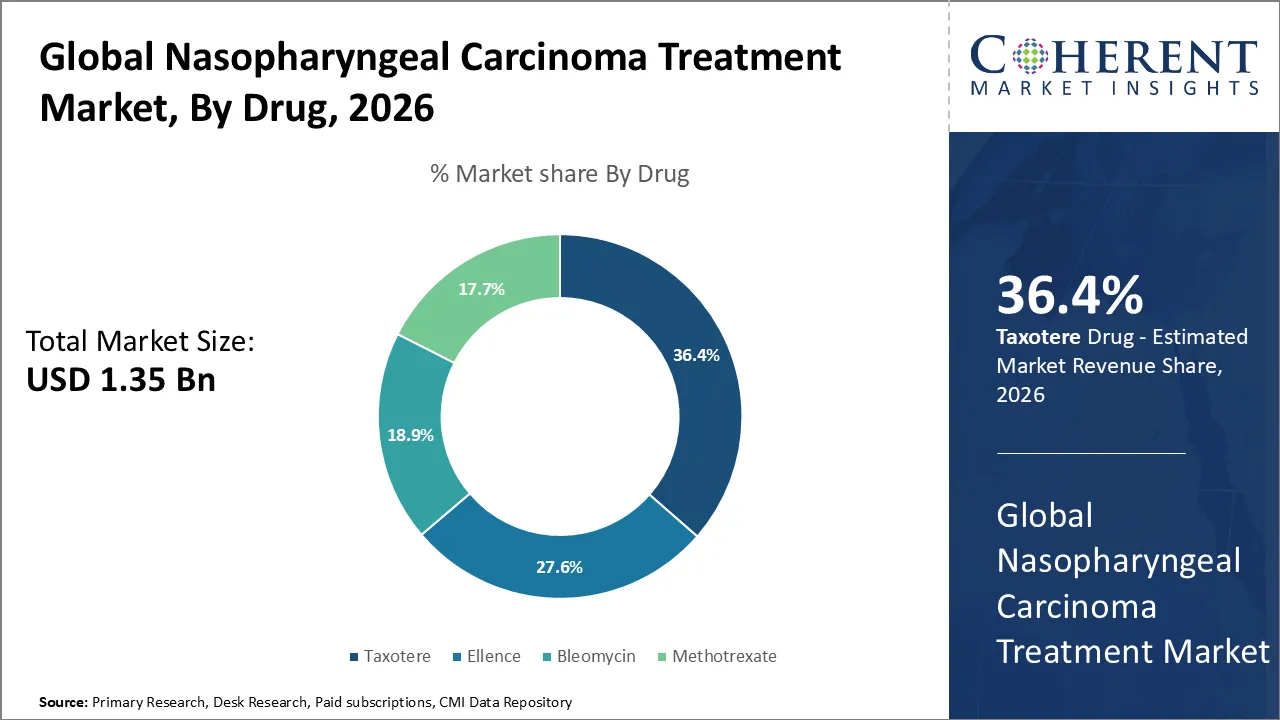
Why is Taxotere (Docetaxel) Acquiring the Largest Share?
On the basis of drug, the Taxotere (Docetaxel) segment is projected to account for the largest Nasopharyngeal Carcinoma Treatment Market share of 36.4% in 2026. The segment’s growth is owing to the established use of docetaxel-containing induction chemotherapy regimens in locoregionally advanced nasopharyngeal carcinoma and its continued evaluation in combination with cisplatin and chemoradiotherapy.
A 2025 Phase III multicenter randomized trial published in BMJ evaluated 186 patients with untreated stage N2–3 nasopharyngeal carcinoma. Patients who received four cycles of docetaxel plus cisplatin before concurrent chemoradiotherapy had a 5-year distant metastasis-free survival rate of 91.3%, compared with 78.2% with concurrent chemoradiotherapy alone. The same study reported 5-year overall survival of 90.3% versus 82.6%, respectively.
In March 2026, Sapu Nano announced that its Sapu006 candidate, an advanced injectable formulation of docetaxel based on its Deciparticle nanomedicine platform, was entering Phase I clinical development.
Why do Hospital Pharmacies Hold the Largest Market Share?
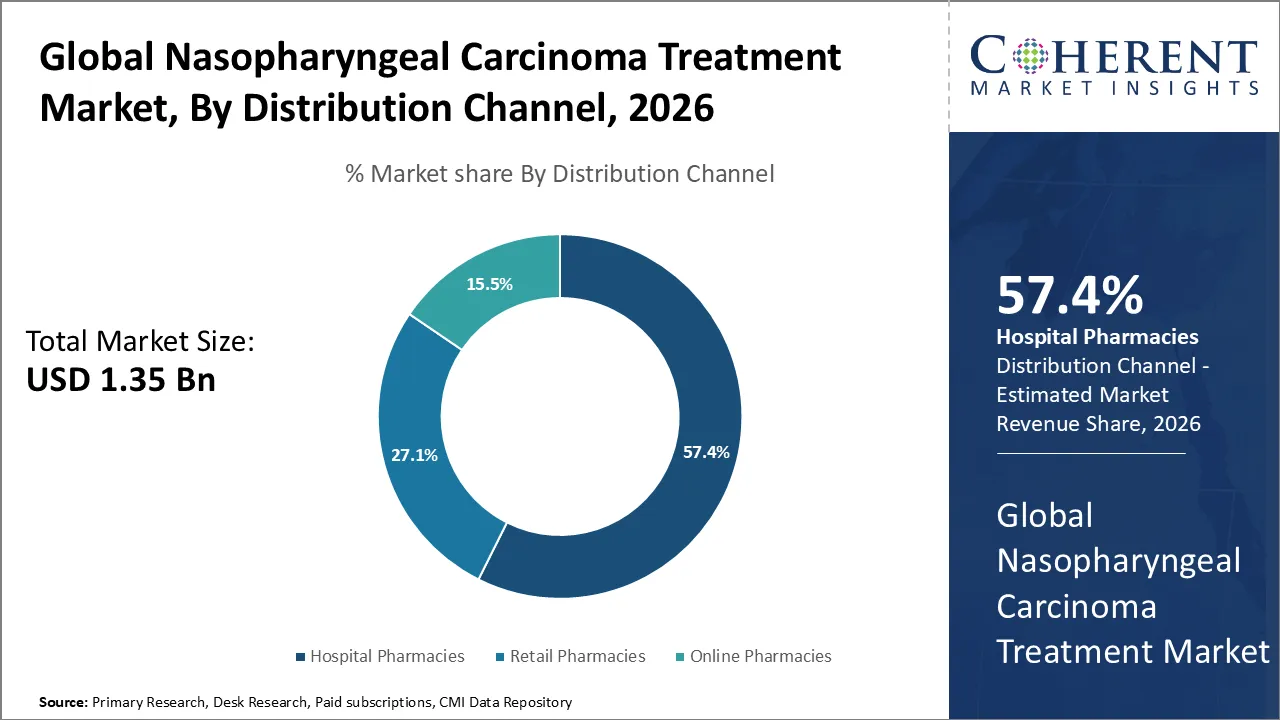
On the basis of distribution channel, the Hospital Pharmacies segment is projected to lead the Nasopharyngeal Carcinoma Treatment Market with a share of 57.4% in 2026. The segment’s growth is owing to the hospital-centered delivery of chemotherapy, immunotherapy, chemoradiation, and supportive oncology treatment, particularly among patients with stage II–IV or recurrent disease.
A teaching-hospital study involving 222 nasopharyngeal carcinoma patients found that 89.6% presented with advanced-stage disease, while 76.1% received induction chemotherapy followed by concurrent chemoradiation.
In September 2026, Allina Health Cancer Institute expanded its oncology services to Edina, Minnesota, with the opening of a new cancer-care location featuring 10 infusion chairs, 10 examination rooms and an on-site pharmacy to aid in the coordinated delivery of oncology treatment.
Nasopharyngeal Carcinoma Treatment Market Trends
- Increasing use of PD-1 immune checkpoint inhibitors in combination with chemotherapy is changing the first-line treatment landscape for recurrent or metastatic nasopharyngeal carcinoma. A 2026 JAMA Oncology analysis of the Phase III CAPTAIN-1st trial of 263 patients demonstrated a 5-year overall survival rate of 37.8% with camrelizumab plus chemotherapy versus 24.2% with chemotherapy alone, supporting the move toward chemoimmunotherapy in advanced disease.
- Growing use of Epstein-Barr virus DNA as a treatment-monitoring and prognostic biomarker is improving precision-based patient management. The same 2026 CAPTAIN-1st analysis also showed that rapid clearance of plasma Epstein-Barr virus DNA was associated with better long-term survival, demonstrating the growing role for biomarker-guided monitoring during systemic therapy.
- Adaptive radiotherapy and treatment-plan reassessment are increasingly being used to improve radiation delivery in patients with changing anatomy during therapy. A 2025 study suggested re-evaluating radiotherapy plans around fractions 15–20 and highlighted clinical factors, including bulky lymph nodes greater than 15 mm, large tumor volumes, and high parotid radiation exposure, as potential criteria for identifying patients who may benefit from adaptive radiotherapy.
Regional Insights
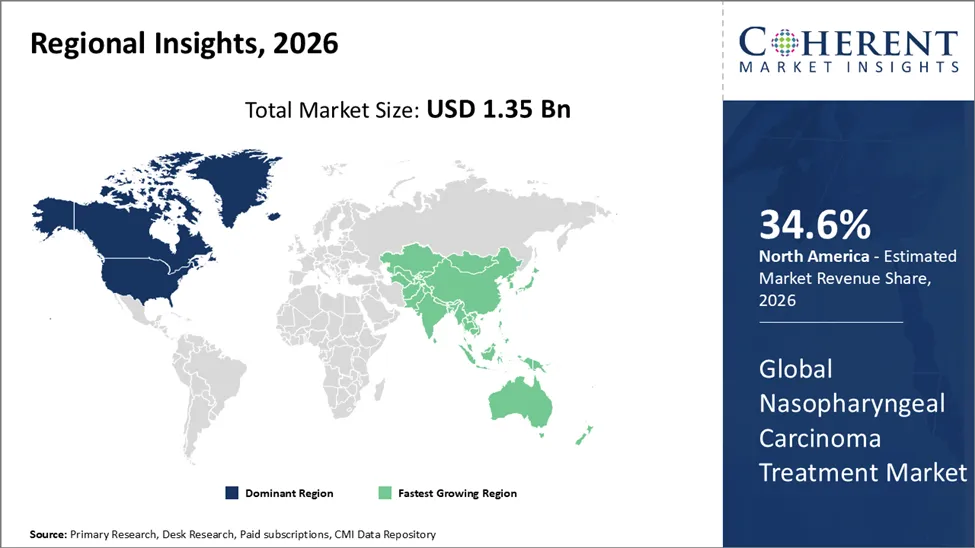
North America Dominates Owing to Advanced Oncology Infrastructure and Rapid Adoption of Novel Therapies
North America is expected to account for a substantial 34.6% share of the Nasopharyngeal Carcinoma Treatment Market in 2026. The region’s growth is supported by a developed cancer-care infrastructure, strong access to immunotherapy and combination regimens, a developed clinical-trial ecosystem and relatively rapid regulatory uptake of new oncology therapies.
The U.S. treatment landscape includes FDA approval of toripalimab-tpzi for nasopharyngeal carcinoma, which demonstrated a median progression-free survival of 11.7 months versus 8.0 months with chemotherapy alone in the pivotal JUPITER-02 trial. The availability of multiple approved PD-1-based regimens expands treatment choice and supports greater use of advanced systemic therapies across North American cancer centers.
In August 2026, Coherus Oncology reported that LOQTORZI (toripalimab-tpzi) generated USD 13.6 million in U.S. net revenue during the second quarter of 2026, representing a 37% increase from USD 10.0 million in Q2 2025 and a 15% increase from Q1 2026.
Asia Pacific Nasopharyngeal Carcinoma Treatment Market Trends
Asia Pacific is expected to be the fastest-growing regional market over the forecast period, supported by the exceptionally high regional disease burden, expansion of oncology infrastructure, increasing access to immunotherapy, and continued clinical research activity in China and other endemic Asian markets.
According to the latest IARC GLOBOCAN 2024 database released in 2026, approximately 119,750 new nasopharyngeal cancer cases were estimated globally in 2024. Earlier IARC regional data show that Asia accounted for 100,298 cases, or 83.3% of global nasopharyngeal cancer incidence, and 83.5% of global five-year prevalent cases.
In June 2026, Sichuan Biokin Pharmaceutical and SystImmune announced that China’s National Medical Products Administration approved iza-bren (izalontamab brengitecan; BL-B01D1) for patients with recurrent or metastatic nasopharyngeal carcinoma whose disease progressed after prior platinum-based chemotherapy and PD-1/PD-L1 inhibitor treatment.
Growing Adoption of Disease-Specific Immunotherapy is Strengthening the Nasopharyngeal Carcinoma Treatment Market in the United States
The U.S. Nasopharyngeal Carcinoma Treatment Market is being supported by the increasing commercial uptake of disease-specific immunotherapy, broader use of PD-1 inhibitors, and continued expansion of specialist oncology treatment pathways.
Coherus estimates an approximately USD 250 million addressable U.S. market for recurrent or metastatic nasopharyngeal carcinoma and stated that LOQTORZI remains the only FDA-approved and commercially available therapy in the U.S. specifically for recurrent, locally advanced, or metastatic nasopharyngeal carcinoma.
China Nasopharyngeal Carcinoma Treatment Market Trends
China is expected to witness strong growth in the Nasopharyngeal Carcinoma Treatment Market owing to its large underlying patient population, domestic development of oncology biologics, increasing commercialization of immunotherapies, and rapid introduction of next-generation targeted treatments.
China is also witnessing strong commercial growth of domestically developed immunotherapy. Junshi Biosciences reported approximately RMB 1.299 billion in domestic sales revenue from toripalimab during the first half of 2026, representing growth of approximately 36% compared with the corresponding 2025 period. The company’s total first-half 2026 revenue reached approximately RMB 1.696 billion, up 45% year over year.
In March 2026, China’s NMPA also accepted the marketing applications for a subcutaneous formulation of toripalimab across 12 tumor indications.
Who are the Major Companies in Nasopharyngeal Carcinoma Treatment Industry
Some of the major key players in Nasopharyngeal Carcinoma Treatment Market are Pfizer Inc., Sanofi, Merck & Co., Inc., Eli Lilly and Company, Teva Pharmaceutical Industries Ltd., Fresenius SE & Co. KGaA.
Key News
- In February 2026, Merck & Co., Inc. published a new KEYNOTE-122 biomarker analysis in recurrent or metastatic nasopharyngeal carcinoma. The analysis included 228 treated patients, of whom 215 (94.3%) had evaluable baseline plasma Epstein-Barr virus DNA data.
- In August 2026, the European Medicines Agency updated the regulatory assessment history for Docetaxel Kabi, marketed by Fresenius Kabi Deutschland GmbH. Docetaxel Kabi remains an authorized generic docetaxel product in Europe, supporting continued institutional availability of taxane-based chemotherapy used across head and neck cancer treatment settings.
Market Report Scope
Nasopharyngeal Carcinoma Treatment Market Report Coverage
Report Coverage | Details | ||
Base Year: | 2025 | Market Size in 2026: | USD 1.35 Bn |
Historical Data for: | 2020 to 2024 | Forecast Period: | 2026 to 2033 |
CAGR: | 7.2% | 2033 Value Projection: | USD 2.20 Bn |
Geographies covered: |
| ||
Segments covered: |
| ||
Companies covered: | Pfizer Inc., Sanofi, Merck & Co., Inc., Eli Lilly and Company, Teva Pharmaceutical Industries Ltd., Fresenius SE & Co. KGaA. | ||
Growth Drivers: |
| ||
Restraints & Challenges: |
| ||
Analyst Opinion
- The Nasopharyngeal Carcinoma Treatment Market is increasingly shifting toward immunotherapy-led systemic treatment, particularly for recurrent or metastatic disease. In 2025, a multidisciplinary consensus on the use of immune checkpoint inhibitors in nasopharyngeal carcinoma, including patient selection, combination regimens, adverse-event management, and multidisciplinary treatment planning, was published in ESMO Open.
- Biomarker-guided treatment and precision stratification are becoming important in treatment planning. A 2025 ASCO Educational Book review highlighted plasma Epstein-Barr virus DNA as a key biomarker being evaluated for treatment stratification and personalization, with trials ongoing for bispecific antibodies, antibody-drug conjugates, and new immunotherapy combinations.
- The market is also being shaped by continued refinement of radiotherapy and multimodal treatment standards. The 2025 SEOM-TTCC clinical guideline reaffirmed radiotherapy as the cornerstone of treatment for non-metastatic disease and highlighted the survival benefit of combining radiotherapy with chemotherapy, while metastatic disease continues to rely heavily on platinum/gemcitabine-based systemic therapy.
Speak to the analyst
Want personalized insights?
Take the findings above to one of our principal consultants, or have the report rebuilt around the segments, geographies and competitors you actually track.
Market Segmentation
- By Drug (Revenue, USD Bn, 2021-2033)
- Ellence
- Taxotere
- Bleomycin
- Methotrexate
- By Distribution Channel (Revenue, USD Bn, 2021-2033)
- Hospital Pharmacies
- Retail Pharmacies
- Online Pharmacies
- By Region (Revenue, USD Bn, 2021-2033)
- North America
- U.S.
- Canada
- Latin America
- Brazil
- Mexico
- Argentina
- Rest of Latin America
- Europe
- Germany
- U.K.
- France
- Italy
- Spain
- Russia
- Rest of Europe
- Asia Pacific
- China
- India
- Japan
- Australia
- South Korea
- ASEAN
- Rest of Asia Pacific
- Middle East
- GCC
- Israel
- Rest of Middle East
- Africa
- South Africa
- Central Africa
- North Africa
- North America
Sources
Primary Research Interviews
- Medical oncologists specializing in head and neck cancers
- Radiation oncologists treating nasopharyngeal carcinoma
- Hospital pharmacists and oncology pharmacy managers
- Clinical researchers involved in nasopharyngeal carcinoma trials
- Pharmaceutical company medical affairs and oncology teams
- Cancer center procurement and formulary decision-makers
- Key opinion leaders (KOLs) in head and neck oncology
Databases
- International Agency for Research on Cancer (IARC) – Global Cancer Observatory
- World Health Organization (WHO)
- U.S. Food and Drug Administration (FDA)
- European Medicines Agency (EMA)
- National Cancer Institute (NCI)
- ClinicalTrials.gov
- PubMed / MEDLINE
Magazines
- The ASCO Post
- Oncology Times
- Cancer Network
- HemOnc Today
- OncLive
Journals
- Journal of Clinical Oncology
- JAMA Oncology
- The Lancet Oncology
- ESMO Open
- Cancer Medicine
- International Journal of Radiation Oncology, Biology, Physics
Newspapers
- The New York Times
- The Guardian
- The Wall Street Journal
- Financial Times
- Reuters
Associations
- American Society of Clinical Oncology (ASCO)
- European Society for Medical Oncology (ESMO)
- American Society for Radiation Oncology (ASTRO)
- European Society for Radiotherapy and Oncology (ESTRO)
- International Association for the Study of Lung Cancer and Head & Neck Oncology Groups
- National Comprehensive Cancer Network (NCCN)
Public Domain Sources
- Company Annual Reports and Investor Presentations
- Regulatory Approval and Drug Label Databases
- Government Cancer Statistics and Epidemiology Publications
- Clinical Trial Registries and Peer-Reviewed Clinical Study Publications
- Hospital and Cancer Center Treatment Guidelines
- Pharmaceutical Pipeline and Product Development Disclosures
Proprietary Elements
- CMI Data Analytics Tool
- Proprietary CMI Existing Repository of Information for the Last 10 Years
Get access to 250+ pages report
Every segment, forecast, competitor profile and data table behind the analysis above — available for instant download.
- ESOMAR Member
- ISO 9001:2015 Certified
- D-U-N-S Registered
- GDPR & CCPA Compliant
Missing comfort of reading report in your local language? Find your preferred language:
Transform your Strategy with Exclusive Trending Reports
Frequently Asked Questions
The Nasopharyngeal Carcinoma Treatment Market is expected to reach USD 2.20 Bn in 2033.
Major players operating in the global Nasopharyngeal Carcinoma Treatment Market include Pfizer Inc., Sanofi, Merck & Co., Inc., Eli Lilly and Company, Teva Pharmaceutical Industries Ltd., and Fresenius SE & Co. KGaA.
The high cost of advanced cancer treatment, limited access to novel therapies in developing markets, treatment-related toxicities, and limited availability of specialized oncology infrastructure are some of the key factors hampering market growth.
The increasing adoption of immunotherapy and targeted treatment approaches, rising diagnosis of nasopharyngeal carcinoma, growing use of combination treatment regimens, and advancements in radiation therapy and precision oncology are driving growth of the market.
The Nasopharyngeal Carcinoma Treatment Market is anticipated to grow at a CAGR of 7.2% between 2026 and 2033.
Among regions, North America is expected to account for a prominent market share in 2026. The linked Coherent Market Insights report also identifies North America as the dominant regional market, supported by research and development activities and the presence of major pharmaceutical companies.
Asia Pacific is expected to witness the fastest growth over the forecast period, supported by the high incidence of nasopharyngeal carcinoma in Southern China and Southeast Asia, expanding oncology infrastructure, and increasing availability of advanced systemic therapies.