

Global Physical Access Control Market Size and Forecast – 2026-2033
The Global Physical Access Control Market is estimated to be valued at USD 11.80 Bn in 2026 and is expected to reach USD 21.17 Bn by 2033, exhibiting a compound annual growth rate (CAGR) of 8.7% from 2026 to 2033.
Key Takeaways of the Physical Access Control Market
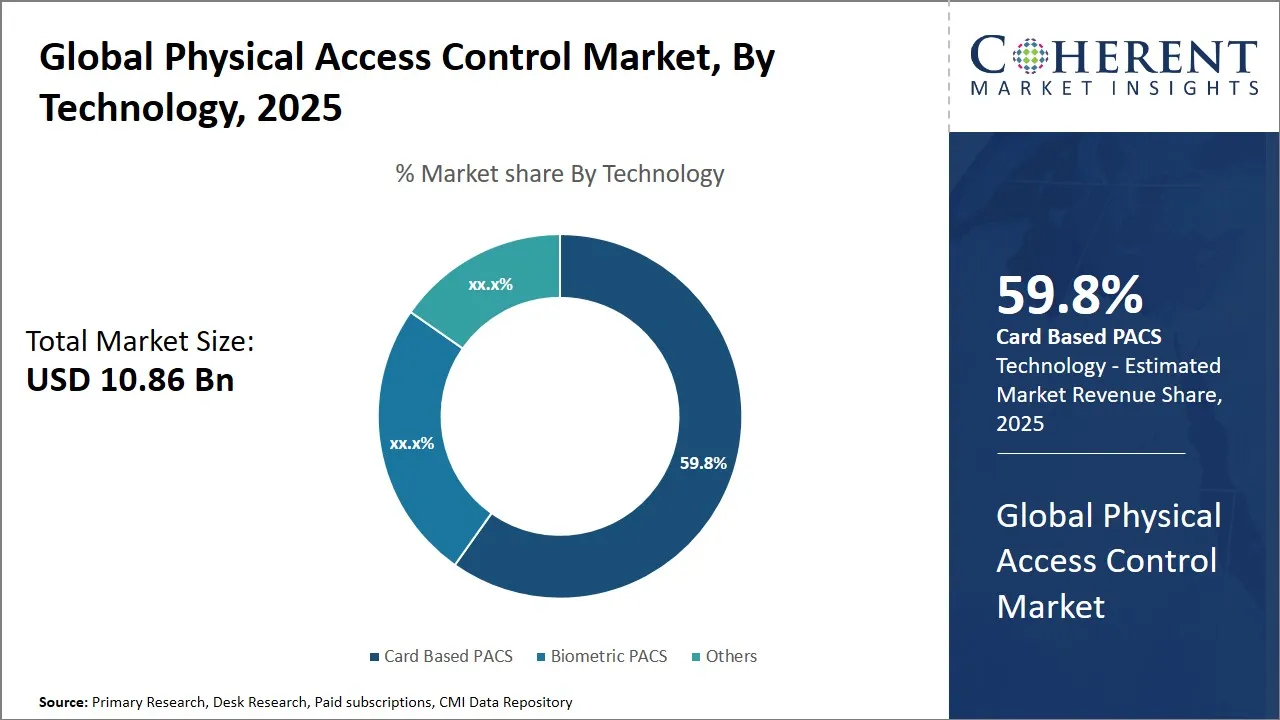
- The Card Based PACS segment leads the market, holding an estimated share of 60.8% in 2026.
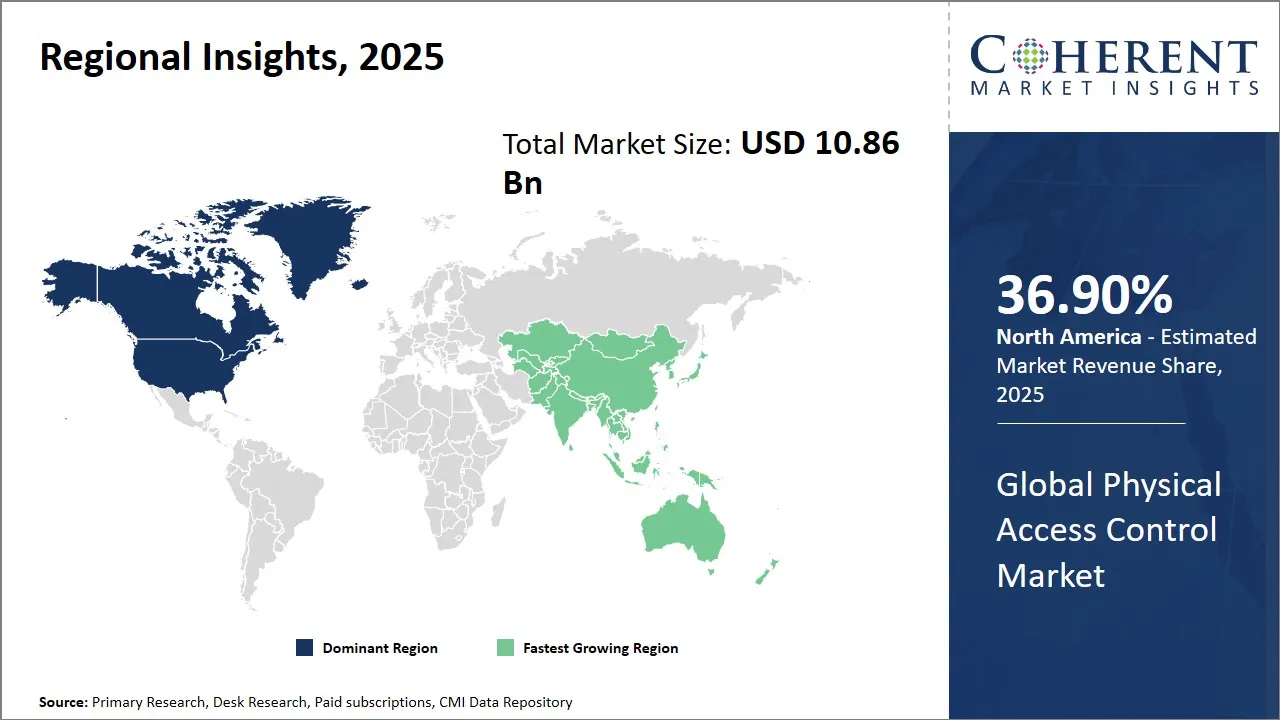
- North America is estimated to lead the market with a share of 36. 9% in 2026.
- Asia Pacific, holding a share of 24. 3% in 2026, is projected to be the fastest growing region.
Market Overview
The market trend is strongly influenced by the integration of IoT and AI technologies into access control systems, enhancing automation, real-time monitoring, and analytics capabilities. Also, the market is seeing growing adoption of cloud-based and mobile access solutions, offering scalable and flexible security management. Growing awareness about cybersecurity and regulatory compliance also adds to the adoption of advanced physical access control systems, fostering innovation and significant investments within the industry.
Current Events and Its Impact
Current Events | Description and Impact |
Geopolitical and Trade Developments |
|
Economic and Infrastructure Trends |
|
Segmental Insights
- Current Industry Events of 2026
- Market Size Estimation
- Regional Breakdown
- Competitive Landscape
- Customer Intelligence
- Segmental Analysis
- Pricing Analysis
- Key Market Drivers, Challenges & Future Trends
- Customized Insights Section
Global Physical Access Control Market Insights, by Technology – Card Based PACS Contributes the Highest Share Owing to Its Cost-Effectiveness and Widespread Adoption
Card Based PACS is expected to contribute the highest share of 60.8% in the global physical access control market in 2026. Card-based solutions are cost-effective, making them a preferred choice for small organizations. Card Based PACS give a straightforward and scalable method of access management. The use of proximity cards, magnetic stripe cards, or smart cards makes possible quick and efficient distribution and revocation of access rights. Also, their ease of integration with existing security infrastructures and compatibility with different locking mechanisms add to their adoption. User familiarity and minimal learning curve also plays a role. Employees and visitors find card access systems intuitive, enabling smoother operational flow without the need for extensive training or technical support.
Impact of AI on the Physical Access Control Market
Artificial Intelligence (AI) is reshaping the physical access control market by making possible smarter, more adaptive security systems. Traditional card-based and keypad access controls are being replaced by AI-powered facial recognition, behavioral analytics, and predictive threat detection. These systems can analyze vast amounts of real-time data to identify irregular patterns, detect unauthorized attempts, and even adjust access levels based on contextual cues (like time, location, or personnel behavior). AI also enhances identity verification accuracy by reducing false positives and improving authentication in low-light or high-traffic environments, which is especially crucial in sectors like airports, government facilities, and data centers.
A notable example is the deployment of Hikvision's DeepinMind NVR and AI-powered facial recognition terminals across various high-security facilities in Southeast Asia. These systems use deep learning to enhance facial matching and crowd control, providing rapid access decisions while reducing the need for manual monitoring.
Regional Insights
North America Physical Access Control Market Analysis and Trends
North America, holding an estimated share of 36.9% in 2026, dominates the global physical access control market, driven primarily by a mature technological ecosystem, extensive presence of major manufacturers, and significant government investments in security infrastructure. The United States, being a key contributor, emphasizes stringent regulatory requirements and cybersecurity integration in physical access control solutions. The large base of enterprise and government customers coupled with heightened awareness of security threats further supports market leadership here. In May 2026, Verkada launched its dual-head camera with enhanced access control integration, allowing facility managers to monitor entry points and respond to incidents instantly.
Additionally, North America benefits from robust trade relations and supply chain resilience, enabling quick adoption of advanced access technologies such as biometric systems and cloud-based control platforms. Notable companies headquartered in this region include Honeywell International Inc., Johnson Controls International plc, and Allegion plc, all of which contribute through continuous innovation and expansive service networks.
Asia Pacific Physical Access Control Market Analysis and Trends
Asia Pacific region, holding an estimated share of 24.3% in 2026, exhibits the fastest growth in the physical access control market, due to rapid urbanization, infrastructural expansion, and increasing adoption of smart city initiatives. Government policies across countries like China, India, and Southeast Asian nations are encouraging investment in advanced security systems to enhance public safety and regulatory compliance. NEC’s NeoFace Watch, integrated with a powerful AI facial recognition engine, has been widely deployed across airports, smart cities, and corporate campuses in the Asia Pacific region. The system offers real-time face matching with high accuracy, even in crowded and dynamic environments. The burgeoning industrial sector, growing real estate developments, and increasing digital transformation in enterprises fuel demand for integrated access control solutions.
Moreover, the region’s manufacturing capabilities and cost-competitive environment support local production and innovation. Key players active in Asia Pacific include Hikvision Digital Technology Co., Ltd., Dahua Technology, and ZKTeco, which focus on offering affordable yet advanced biometric and IP-based access solutions.
Physical Access Control Market Outlook for Key Countries
U.S. Physical Access Control Market Analysis and Trends
The U.S. remains a critical driver of innovation and deployment in physical access control technologies, largely due to strong demands from federal agencies, corporations, and educational institutions. American companies like Honeywell and Johnson Controls lead with cutting-edge integration of AI, IoT, and cloud management platforms that enhance security and operational efficiency. Supportive regulatory frameworks around data privacy and facility security contribute to robust adoption rates. Additionally, extensive public-private partnerships and security modernization programs foster continuous advancements, positioning the U.S. as a global technology hub for physical access control.
U.K. Physical Access Control Market Analysis and Trends
The U.K. maintains a dynamic market characterized by advanced technological adoption and strong regulatory frameworks focusing on data security and physical protection. Companies like ASSA ABLOY and Gallagher Security provide comprehensive access solutions integrating biometric and mobile credentials for corporate offices, healthcare, and transportation hubs. Post-Brexit trade dynamics encourage localized manufacturing and innovation while maintaining compatibility with EU security standards. Governmental emphasis on counter-terrorism and critical infrastructure protection sustains demand for high-assurance access control systems.
China Physical Access Control Market Analysis and Trends
China physical access control market sees growth because of the large-scale infrastructural developments and smart city projects incorporating advanced access control systems for public transportation, government complexes, and commercial properties. Domestic giants such as Hikvision and Dahua Technology dominate product supply and innovation by integrating facial recognition and AI-driven analytics into access management. Government initiatives encouraging digitalization and security surveillance intensify the adoption of integrated.
Germany Physical Access Control Market Analysis and Trends
Germany physical access control market is marked by a strong industrial base and adherence to rigorous European security standards. The presence of leading companies like BOSCH Security Systems and Software AG adds to the development in sectors such as automotive, manufacturing, and public infrastructure. Germany emphasizes innovation in cyber-physical security and data protection compliant with GDPR, prompting vendors to focus on encrypted and multi-factor authentication solutions.
India Physical Access Control Market Analysis and Trends
India is seeing fast expansion in the physical access control market because of its infrastructural growth and urban residential projects. Increasing awareness about safety in commercial buildings and public institutions is creating new opportunities. Local companies, alongside multinational firms such as Johnson Controls and Honeywell, are investing in partnerships and distribution to reach tier-2 and tier-3 cities.
Market Players, Key Development, and Competitive Intelligence
Key Developments
- In April 2025, Mobile Communications America, Inc. (MCA), a security integration and critical communications provider focused on solutions that enhance workplace safety, security, and efficiency, today announced the acquisition of Presidio, Inc.'s Physical Security Integration business ("PhySec"). This strategic acquisition underscores MCA's commitment to providing innovative, customizable security solutions to its clients.
- In January 2025, ASSA ABLOY signed an agreement to acquire 3millID Corporation and Third Millennium Systems Ltd., companies within readers and credentials for physical access control based in the U.S. and UK.
- In July 2024, the global video technology company, Milestone Systems, announced its merger with cloud-based video surveillance solutions provider, Arcules, to combine their strengths in video management software, analytics and cloud-based solutions.
- In June 2024, Honeywell announced the completion of its acquisition of Carrier Global Corporation's Global Access Solutions business for USD 4.95 billion. The deal positions Honeywell as a provider of security solutions for the digital age with opportunities for accelerated innovation in the fast-growing, cloud-based services and solutions space.
Top Strategies Followed by Physical Access Control Market Players
- Established market leaders prioritize innovation and global outreach, heavily investing in research and development (R&D) to design and launch high-performance, reliable, and scalable access control solutions.
- HID Global (a subsidiary of ASSA ABLOY) offers its HID Origo Mobile Access Platform, developed through sustained R&D investment. The platform enables secure mobile credentials and cloud-based identity management.
- Mid-level companies in the physical access control market strategically position themselves by delivering cost-effective solutions that strike a balance between quality and affordability.
- Matrix Comsec’s COSEC ARGO series is a budget-friendly biometric access control solution designed for SMEs and public institutions. It delivers core functionality like fingerprint and face recognition at competitive pricing.
- Small-scale players in the global physical access control market differentiate themselves by focusing on niche opportunities and innovation-driven offerings. These firms often specialize in products that incorporate unique or cutting-edge features such as biometric modalities tailored to specific verticals, mobile credentialing technologies, or highly customizable software interfaces.
- ZKTeco has focused on multi-modal biometric solutions (e.g., palm vein and face recognition for high-security labs and hospitals).
Market Report Scope
Physical Access Control Market Report Coverage
| Report Coverage | Details | ||
|---|---|---|---|
| Base Year: | 2025 | Market Size in 2026: | USD 11.80 Bn |
| Historical Data for: | 2020 To 2024 | Forecast Period: | 2026 To 2033 |
| Forecast Period 2026 to 2033 CAGR: | 8.7% | 2033 Value Projection: | USD 21.17 Bn |
| Geographies covered: |
| ||
| Segments covered: |
| ||
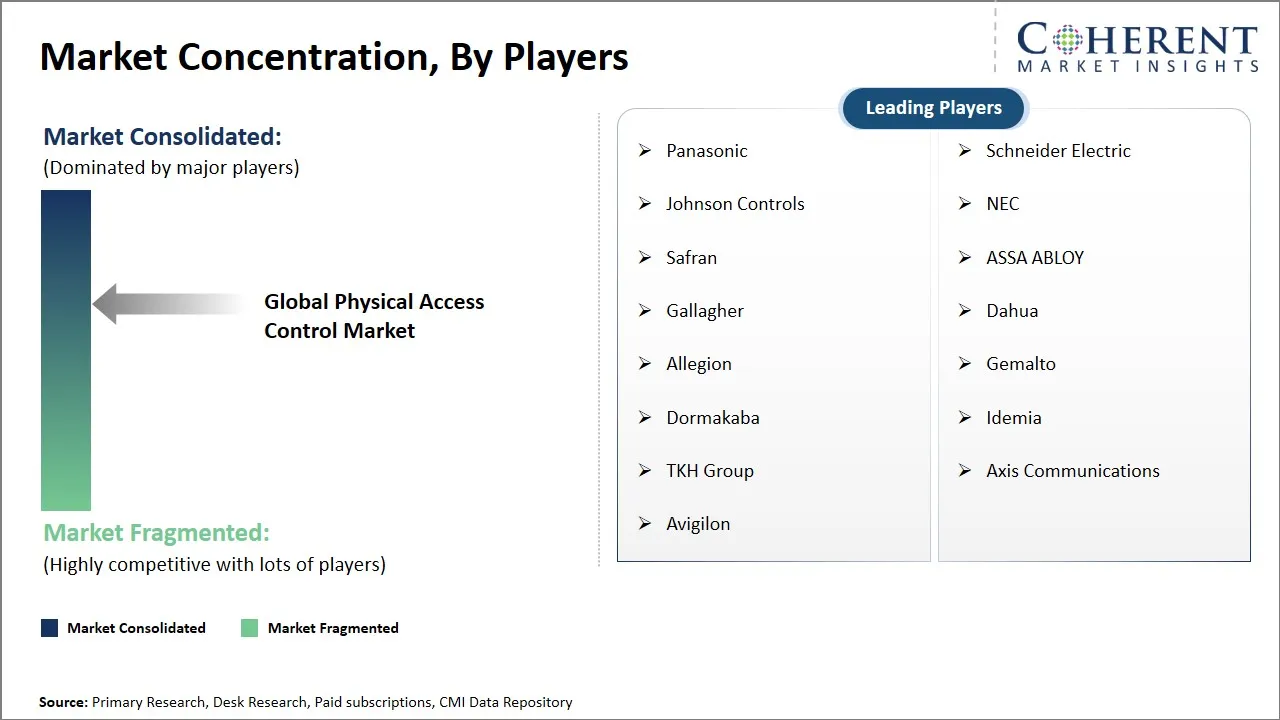
| Companies covered: | Panasonic, Schneider Electric, Johnson Controls, NEC, Safran, ASSA ABLOY, Gallagher, Dahua, Allegion, Gemalto, Dormakaba, Idemia, TKH Group, Axis Communications, and Avigilon | ||
| Growth Drivers: |
| ||
| Restraints & Challenges: |
| ||
Market Dynamics
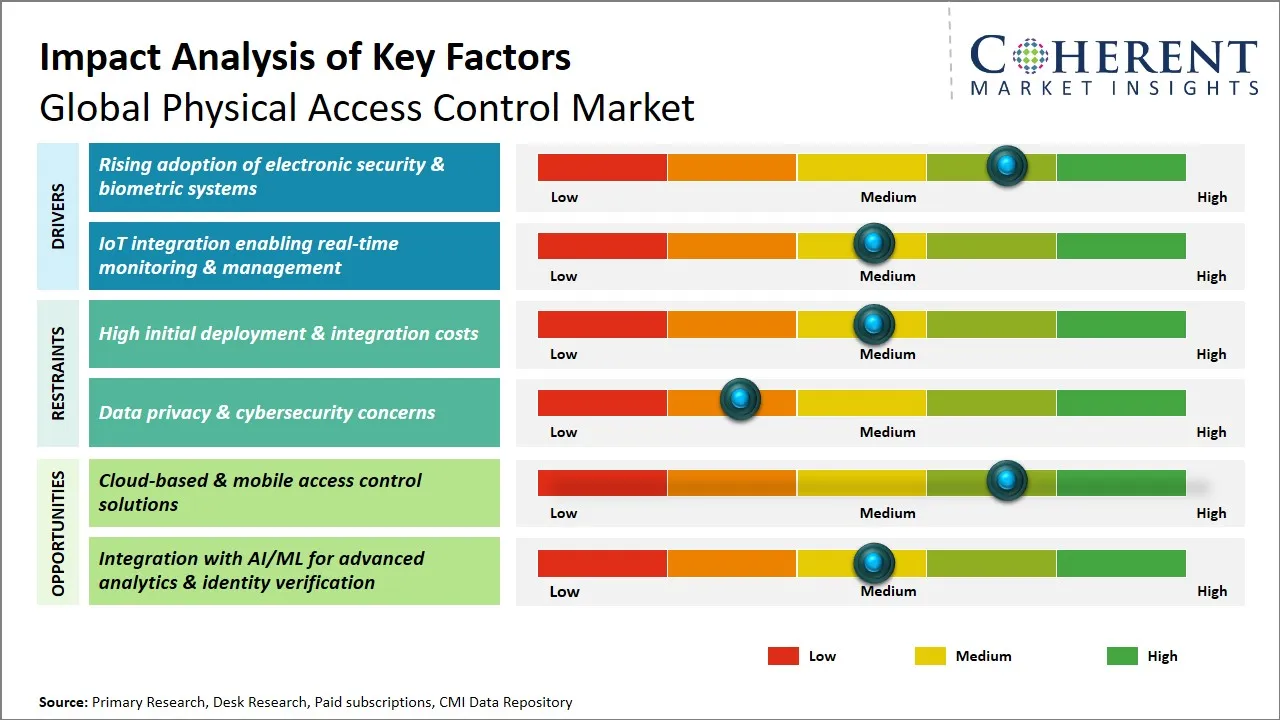
Global Physical Access Control Market Driver – Rising Adoption of Electronic Security & Biometric Systems
Organizations in many different sectors are working on improved security measures to safeguard critical assets and sensitive information, moving away from traditional mechanical locks to more advanced electronic solutions. Biometric technologies, such as fingerprint recognition, facial recognition, iris scanning, and voice identification, offer higher accuracy and reduced risk of unauthorized access compared to conventional methods. In June 2023, Indira Gandhi International Airport (Delhi, India) implemented DigiYatra, a biometric-based boarding system that uses facial recognition for contactless entry, security clearance, and boarding.
Also, integrating electronic and biometric access controls with IoT-enabled devices and smart building infrastructures makes centralized and real-time monitoring possible, adding to operational efficiency and response capabilities.
Global Physical Access Control Market Opportunity – Cloud-Based and Mobile Access Control Solutions
Organizations in different sectors are shifting from traditional, hardware-centric access control systems to more flexible, scalable, and cost-effective cloud-enabled platforms. Cloud-based access control makes possible centralized management of security credentials and real-time monitoring from any location with internet connectivity, reducing the need for extensive on-site infrastructure and lowering maintenance costs. This aligns with the growing demand for integrated security solutions that can easily connect with other enterprise systems, such as visitor management, video surveillance, and identity management, enhancing overall operational efficiency.
Brivo, a cloud-based access control provider, partnered with RealPage to integrate its cloud and mobile access platform into residential property management systems across the U.S.
Also, the popularity of smartphones and mobile devices is facilitating the adoption of mobile access credentials, which replace physical cards and keys with secure, app-based solutions. Mobile access control not only offers convenience but also improves security through features like biometric authentication, multi-factor verification, and dynamic credential issuance.
Analyst Opinion (Expert Opinion)
- The global demand for physical access control systems is being shaped by evolving industry-specific needs and macro-environmental shifts. In the commercial sector, especially in North America and Western Europe, post-pandemic return-to-office mandates and the acceptance of hybrid work models are adding to the adoption of smart, touchless access solutions. These systems improve security and also support ESG-aligned building upgrades by adding occupancy analytics, air quality sensors, and employee wellness platforms.
- Meanwhile, in the public sector, heightened geopolitical tensions and regulatory pressure are pushing investments in high-security access systems. Governments in Asia Pacific and the Middle East are increasingly using biometric authentication and AI-powered surveillance infrastructure as part of smart city developments and national security programs.
- In healthcare and education, institutions, such as hospitals and universities, are adopting access control technologies that balance security with privacy compliance under frameworks like HIPAA and FERPA. Demand is rising for zone-based access control, emergency lockdown features, and real-time credentialing. These technologies are especially critical in high-traffic urban environments, where controlling movement and ensuring the safety of staff, patients, and students is paramount.
Speak to the analyst
Want personalized insights?
Take the findings above to one of our principal consultants, or have the report rebuilt around the segments, geographies and competitors you actually track.
Market Segmentation
- Technology Insights (Revenue, USD Bn, 2021 - 2033)
- Card Based PACS
- Biometric PACS
- Others
- Regional Insights (Revenue, USD Bn, 2021 - 2033)
- North America
- U.S.
- Canada
- Latin America
- Brazil
- Argentina
- Mexico
- Rest of Latin America
- Europe
- Germany
- U.K.
- Spain
- France
- Italy
- Russia
- Rest of Europe
- Asia Pacific
- China
- India
- Japan
- Australia
- South Korea
- ASEAN
- Rest of Asia Pacific
- Middle East
- GCC Countries
- Israel
- Rest of Middle East
- Africa
- South Africa
- North Africa
- Central Africa
- North America
- Key Players Insights
- Panasonic
- Schneider Electric
- Johnson Controls
- NEC
- Safran
- ASSA ABLOY
- Gallagher
- Dahua
- Allegion
- Gemalto
- Dormakaba
- Idemia
- TKH Group
- Axis Communications
- Avigilon
Sources
Primary Research Interviews
Stakeholders
- Security System Integrators and Installation Contractors (e.g., Project Leads, Technical Managers)
- Access Control Device Manufacturers and OEM Suppliers (e.g., card readers, biometric terminals)
- Facility Managers of Corporate Offices, Airports, and Hospitals
- Real Estate Developers and Commercial Property Managers
- IT and Physical Security Consultants
- Cybersecurity Compliance Auditors (for access control data integrity)
Databases
- Security Infrastructure Database (SID)
- U.S. General Services Administration Procurement Records
- Global Building Technologies Repository
- Asia Urban Infrastructure Initiative (AUII)
Magazines
- Secure Access Today
- Smart Infrastructure Review
- Facility & Building Security Digest
- Connected Property Technology (CPT) Magazine
Journals
- Journal of Intelligent Security Systems
- Built Environment Technology & Access Control (BETAC)
- Security Integration & Automation Journal
- Urban Security Engineering Review
Newspapers
- The Security Post (US)
- AccessTech Times (Singapore)
- Global Infrastructure Daily
- The Business Standard (India)
Associations
- International Association of Security Technology Providers (IASTP)
- Building Intelligence Access Forum (BIAF)
- American Society for Industrial Security (ASIS)
- Asia-Pacific Smart Security Alliance (APSSA)
- European Access Control Federation (EACF)
Public Domain Sources
- U.S. Census Bureau
- EUROSTAT
- United Nations Economic Commission for Europe (UNECE)
- World Bank
- ResearchGate
Proprietary Elements
- CMI Data Analytics Tool, Proprietary CMI Existing Repository of Information (covering data from the last 8 years)
Get access to 250+ pages report
Every segment, forecast, competitor profile and data table behind the analysis above — available for instant download.
- ESOMAR Member
- ISO 9001:2015 Certified
- D-U-N-S Registered
- GDPR & CCPA Compliant
Missing comfort of reading report in your local language? Find your preferred language:
Transform your Strategy with Exclusive Trending Reports
Frequently Asked Questions
The global physical access control market is estimated to be valued at USD 11.80 billion in 2026 and is expected to reach USD 21.17 billion by 2033.
The CAGR of global physical access control market is projected to be 8.7% from 2026 to 2033.
Rising adoption of electronic security & biometric systems and IoT integration enabling real-time monitoring & management are the major factors driving the growth of the global physical access control market.
High initial deployment & integration costs and data privacy & cybersecurity concerns are the major factors hampering the growth of the global physical access control market.
In terms of Technology, Card Based PACS are estimated to dominate the market revenue share in 2026.
Biometric access control uses unique physiological traits—such as fingerprints, facial recognition, or iris scans—to verify an individual’s identity. Once matched with stored data, access is granted or denied in real time.
RFID systems use encoded cards or tags to grant access and are faster and contactless, but less secure than biometrics, which offer higher accuracy and reduced risk of credential theft or sharing.