

Global Pipeline Monitoring System Market Size and Forecast – 2026 To 2033
The global pipeline monitoring system market is expected to grow from USD 18.45 Bn in 2026 to USD 33.90 Bn by 2033, registering a compound annual growth rate (CAGR) of 9% from 2026 to 2033. The global pipeline monitoring system market is driven by the introduction of stringent environmental safety regulations across energy industries.
For instance, on January 17, 2025, the U.S. Department of Transportation’s Pipeline and Hazardous Materials Safety Administration (PHMSA) transmitted a final rule to the Federal Register to enhance the safety of natural gas pipelines through updated leak detection and repair requirements. The rule is expected to deliver up to USD 1.5 billion in annual net benefits to the public and eliminate up to 500,000 metric tons of methane emissions from approximately 2.8 million miles of gas transmission, distribution, and gathering pipeline facilities, 398 underground natural gas storage facilities (UNGSF), and 173 liquefied natural gas (LNG) facilities across the U.S.
Key Takeaways of the Global Pipeline Monitoring System Market
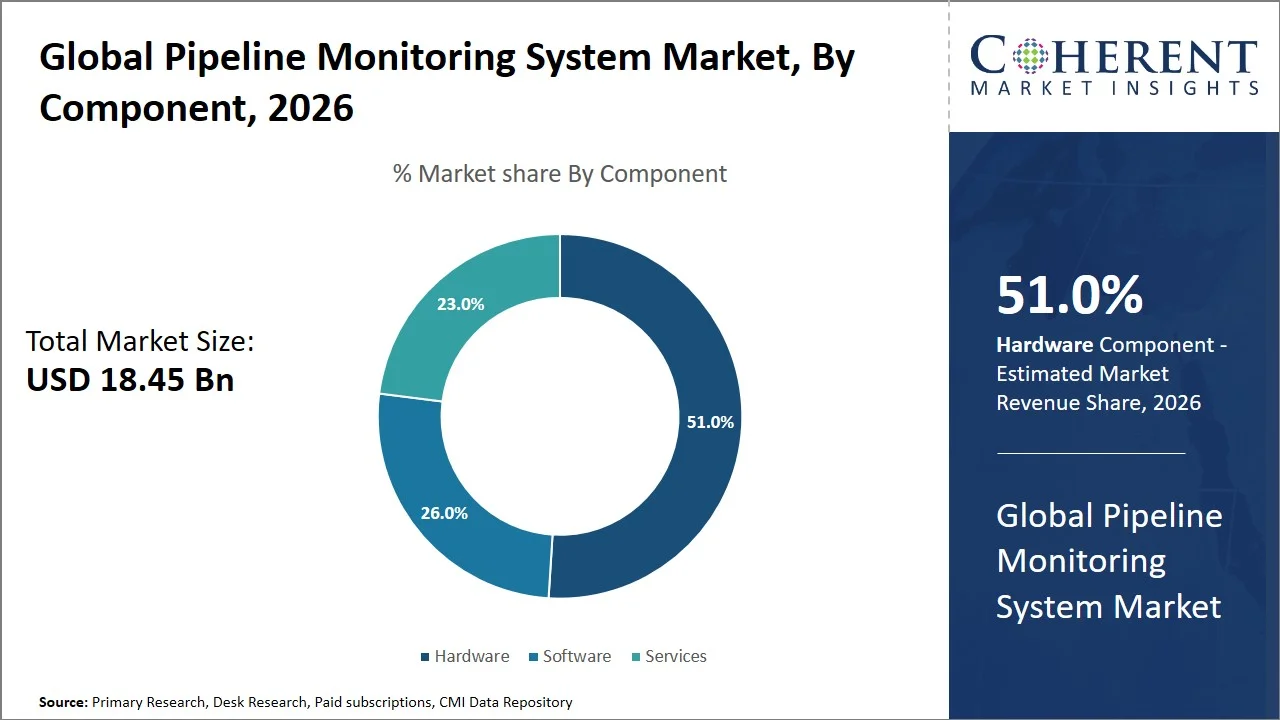
- The hardware segment is expected to account for 51.0 % of the global pipeline monitoring system market share in 2026. The growing need to reduce pipeline failures and product losses is driving the growth of the segment. On April 8, 2025, South Bow Corporation shut down the Keystone Pipeline after a rupture near North Dakota, U.S., released an estimated 147,000 gallons of crude oil, prompting the operator to strengthen integrity inspections and accelerate failure analysis before restarting the system.
- The oil pipelines segment is estimated to capture 39.0 % of the market share in 2026. The expansion of cross border crude oil and natural gas transmission networks is majorly driving the growth of the segment. On December 11, 2025, GASCADE Gastransport GmbH began converting approximately 400 km of its natural gas transmission network in Germany into hydrogen transmission service.
- The fiber optic monitoring segment is estimated to capture 28.0 % of the market share in 2026. Rising investments in smart water distribution infrastructure is driving the growth of the segment. On December 29, 2025, San Antonio Water System (SAWS) completed its ConnectH2O modernization program by deploying more than 604,000 electronic smart water meters across its service area.
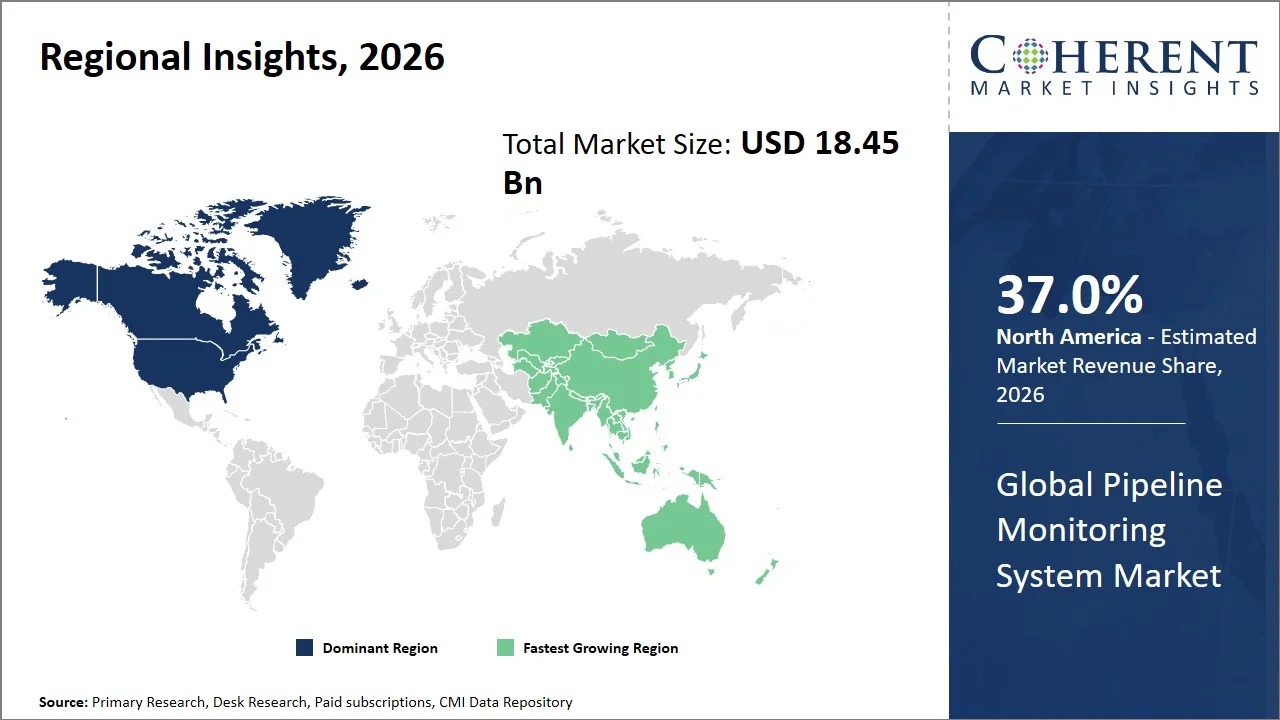
- North America is expected to dominate the pipeline monitoring system market in 2026 with a market share of 37.0 %. Growth of cloud-based predictive pipeline monitoring platforms in North America is driving the growth of the regional market. On March 16, 2026, PTC announced the completion of the previously announced sale of the company’s Kepware industrial connectivity and ThingWorx Internet of Things (IoT) businesses to TPG.
- Asia Pacific is expected to account for 28.0 % of the market share in 2026 and is projected to record the fastest growth over the forecast period. Development of digital twin solutions for pipeline asset management in Asia Pacific is driving the growth of the regional market. On October 30, 2025, AVEVA unveiled its CONNECT industrial intelligence platform at ADIPEC 2025, expanding AI-enabled digital twin capabilities that integrate engineering, operations, and asset performance into a unified cloud environment for energy infrastructure.
- Growing Deployment of Distributed Fiber Optic Sensing Technologies: Pipeline operators are increasingly using distributed acoustic sensing (DAS) and distributed temperature sensing (DTS) systems along new and existing pipelines to enable continuous, real-time monitoring of leaks, ground movement, unauthorized digging and structural stress over hundreds of kilometers with minimal field equipment.
- Integration of Artificial Intelligence with Predictive Asset Integrity Management: Pipeline monitoring platforms are moving beyond simply providing alarms and are beginning to incorporate artificial intelligence and machine learning algorithms that use historical operating data, pressure variations, vibration signatures and inspection records to forecast failures, determine maintenance priorities and reduce unplanned downtime.
Segmental Insights
Why Does Hardware Dominate the Global Pipeline Monitoring System Market?
The hardware segment is expected to account for 51.0% of the global pipeline monitoring system market share in 2026. Hardware accounts for the largest share of the global pipeline monitoring system market because every monitoring deployment depends on a physical network of sensing and communication devices installed along the pipeline. The continuous data acquisition infrastructure includes fiber optic cables, pressure and flow sensors, acoustic detectors, ultrasonic instruments, remote terminal units and communication gateways and allows operators to identify leaks, corrosion, pressure anomalies and third-party interference in real time. Since these field devices represent the essential infrastructure required before software analytics and monitoring services can function, investments in hardware remain the highest across new pipeline construction as well as modernization projects. On April 15, 2025, Project Canary was granted the U.S. Environmental Protection Agency (EPA) approval for its Canary X continuous methane monitoring hardware as an Alternative Test Method (MATM-010) for regulatory leak detection throughout natural gas and pipeline infrastructure, permitting operators to use fixed laser-based sensing equipment.
- Current Industry Events of 2026
- Market Size Estimation
- Regional Breakdown
- Competitive Landscape
- Customer Intelligence
- Segmental Analysis
- Pricing Analysis
- Key Market Drivers, Challenges & Future Trends
- Customized Insights Section
Why are Oil Pipelines the Most Widespread Pipeline Type?
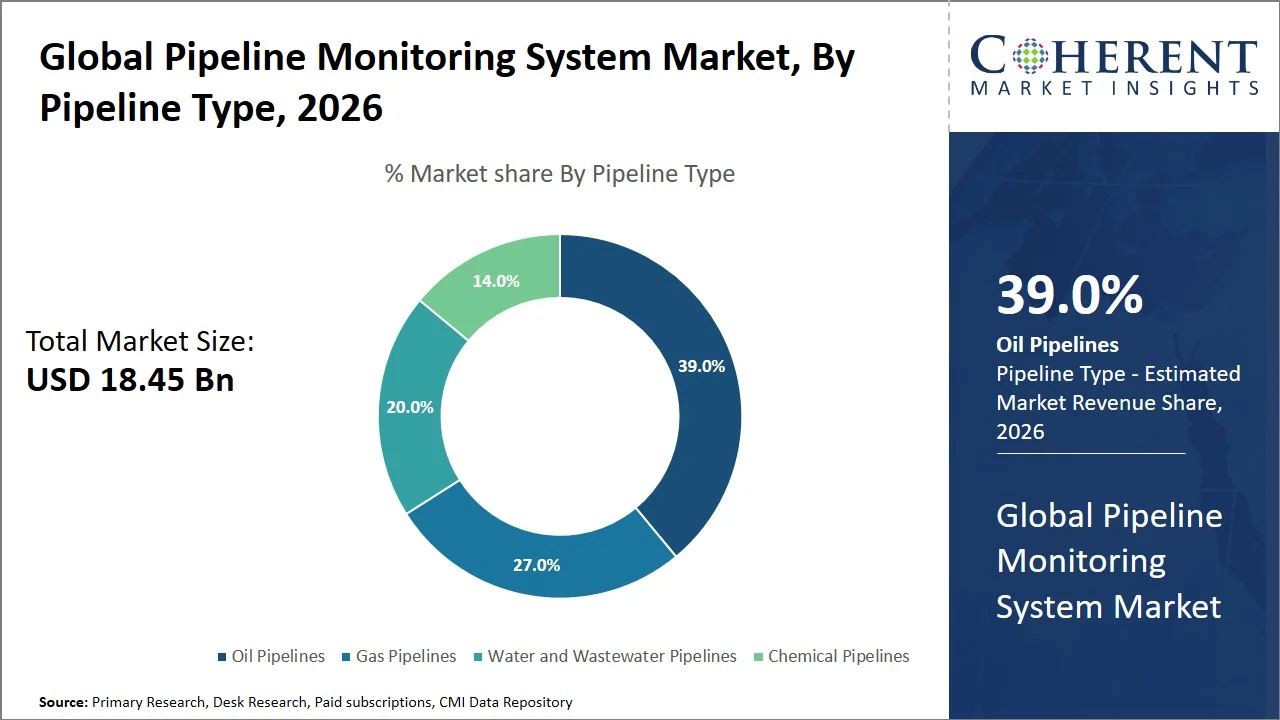
The oil pipelines segment is expected to account for 39.0% of the global pipeline monitoring system market share in 2026. Oil pipelines are still the most common form of pipeline as the transport of crude oil requires high-capacity, continuous and cost-effective infrastructure to carry enormous volumes over long distances from production areas to refineries, export terminals and storage facilities. Pipelines have lower operating costs, higher reliability and smaller weather-related disruptions than alternative transportation modes such as rail or road tankers, making them the preferred means of transport for major oil-producing and oil-consuming regions. Investments in more sophisticated monitoring systems for operational safety and asset integrity are being driven by the continued reliance on pipeline networks. On January 15, 2026, TotalEnergies, CNOOC, Uganda National Oil Company (UNOC), and Tanzania Petroleum Development Corporation (TPDC) announced that the East African Crude Oil Pipeline (EACOP) had reached approximately 79% completion.
Fiber Optic Monitoring Dominates the Global Pipeline Monitoring System Market
The fiber optic monitoring segment is expected to account for 28.0% of the global pipeline monitoring system market share in 2026. Fiber optic monitoring is commonly used because it allows continuous, real-time monitoring across great distances of pipelines with a single sensing wire that may detect leaks, temperature changes, vibrations, ground movement and unlawful digging. Unlike traditional point sensors that only detect certain places, distributed fiber optic sensing offers full coverage, high sensitivity and low maintenance so operators may detect possible threats early and respond quickly. The capacity to function reliably in hostile settings and assist predictive asset integrity management has made it the technology of choice for pipeline infrastructure. On July 14, 2026, at the Potsdam Conference for National Cybersecurity, AP Sensing demonstrated how Distributed Fiber Optic Sensor (DFOS) detects unauthorized access and fire events in real time during a simulated sabotage scenario.
Current Events and their Impact
Current Events | Description and its Impact |
U.S. - PHMSA Gas Pipeline Leak Detection and Repair Rule |
|
European Union - Methane Regulation (Regulation (EU) 2024/1787) |
|
Canada – Canadian Energy Regulator Onshore Pipeline Regulations Amendments |
|
Global Pipeline Monitoring System Market Dynamics
Market Drivers
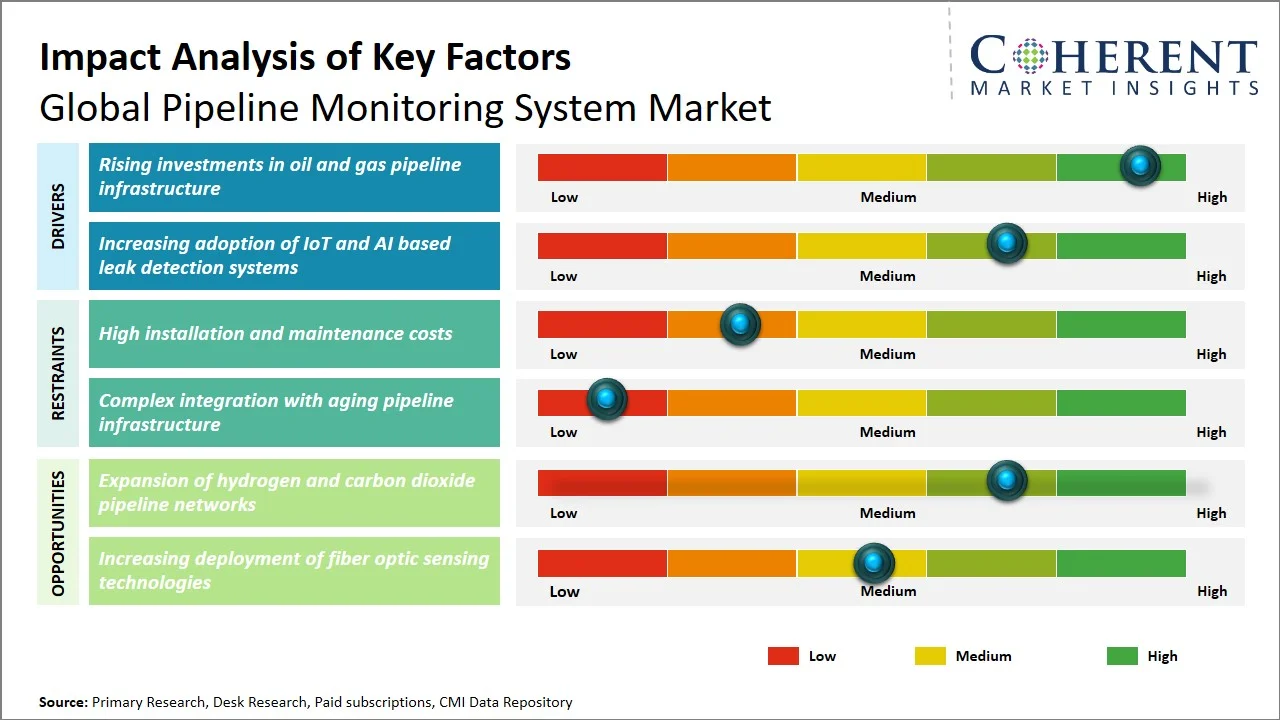
- Rising investments in oil and gas pipeline infrastructure: Increasing investment in crude oil, natural gas, and refined product pipeline infrastructure is fueling growing demand for sophisticated pipeline monitoring systems. Governments and energy firms are investing in extending transmission networks, upgrading aging pipelines and building cross-border pipeline projects to ensure energy security and meet increased demand for fuel. Monitoring of pipelines is an integral feature of contemporary pipeline asset management, with continuous monitoring technologies that can identify leaks, corrosion, pressure changes and third party interference in real time being vital for such large-scale investments. On November 24, 2024, ONEOK, Inc. and EnLink Midstream, LLC announced that they have executed a definitive merger agreement under which ONEOK will acquire all of the outstanding publicly held common units of EnLink for USD 4.3 billion in ONEOK common stock.
- Increasing adoption of IoT and AI based leak detection systems: The growing use of Internet of Things (IoT) devices and artificial intelligence technologies are redefining pipeline monitoring by providing real-time, data-driven leak detection and predictive maintenance. Smart sensors distributed along pipeline networks continuously acquire operational data and AI algorithms analyze pressure, flow, vibration and auditory patterns to find anomalies before they turn into significant breakdowns. This combination enhances detection accuracy, eliminates false alarms, shortens response time and helps operators optimize maintenance schedules while improving pipeline safety and operating efficiency. On April 22, 2025, Project Canary and QLM announced a strategic partnership to enhance methane monitoring capabilities for utility and local gas distribution companies. This collaboration integrates QLM's innovative quantum lidar methane camera with Project Canary's advanced emissions analytics platform.
Emerging Trends
- Expansion of Satellite and Remote Sensing for Long-Distance Pipeline Surveillance: Energy companies are increasingly using satellite imagery, synthetic aperture radar, unmanned aerial vehicles and geospatial analytics in conjunction with conventional SCADA systems to monitor remote pipeline corridors, detect land movement, identify third-party interference, and improve surveillance in difficult-to-access regions.
- Increasing Adoption of Cloud-Based Digital Twin Platforms for Pipeline Operations: Pipeline operators are increasingly leveraging cloud-enabled digital twin solutions that integrate sensor data, GIS mapping, inspection records, and hydraulic models into one operational platform to allow real-time visualization, simulation of operating conditions, risk assessment, and rapid decision-making for large pipeline networks.
Regional Insights
Why is North America a Strong Market for Pipeline Monitoring Systems?
North America is expected to account for a market share of 37.0% in 2026. North America holds the highest share in the pipeline monitoring system market due to the huge network of crude oil, natural gas, refined product and hazardous liquid pipelines coupled with stringent integrity management regulations. The U.S. and Canada have more than 3.11 million miles of pipelines, including transmission and distribution systems.
There has been widespread deployment of fiber optic distributed acoustic sensing (DAS), SCADA modernization, aerial surveillance, AI-driven leak detection and digital twin technologies in the region. Major operators including Enbridge, TC Energy, Kinder Morgan, Williams, Energy Transfer, Pembina Pipeline and Colonial Pipeline have developed predictive monitoring capabilities across interstate and cross-border pipeline assets. The Trans Mountain Expansion Project in Canada, finished in 2024, installed roughly 980 km of pipeline with the newest leak detection and integrity monitoring equipment.
Why Does the Asia Pacific Pipeline Monitoring System Market Exhibit High Growth?
Asia Pacific is projected to account for 28.0% of the global pipeline monitoring system market and expected to register the fastest growth. Governments in the Asia Pacific region continue to construct long distance transmission infrastructure for oil, natural gas and water, focusing on operational safety, making it the fastest growing regional market. China, India, Australia, Japan and Southeast Asian nations are aggressively investing in digital pipeline management backed by AI, IOT, satellite monitoring and fiber optic sensing. China is expanding China Oil & Gas Pipeline Network (PipeChina) while India is aggressively growing its national gas grid through projects undertaken by GAIL, Indian Oil Corporation, Bharat Petroleum and Hindustan Petroleum. Australia is deploying enhanced monitoring systems to LNG export pipes serving LNG facilities in Western Australia and Queensland. In Japan and Australia, growing investments in hydrogen pipeline demonstration projects are also generating the demand for next-generation monitoring platforms to identify hydrogen leakage and material degradation.
Global Pipeline Monitoring System Market Outlook for Key Countries
Why is the U.S. Emerging as a Major Hub in the Pipeline Monitoring System Market?
The U.S. is still the largest market, given its extensive interstate transmission infrastructure and strong government safety standards overseen by the Pipeline and Hazardous Materials Safety Administration (PHMSA). The country has roughly 3.3 million miles (5.3 million km) of gas distribution, gas transmission, hazardous liquid, collection and other regulated pipelines. Companies like as Kinder Morgan, Enterprise Products Partners, Energy Transfer, Williams, ONEOK, Plains All American Pipeline, Colonial Pipeline and TC Energy US are adopting AI-enabled leak detection, fiber optic sensing, drone inspections and predictive integrity management solutions. New monitoring investments are being focused on the Permian Basin, Marcellus Shale and Gulf Coast as pipeline capacity is increasing to meet higher hydrocarbon production and LNG exports.
Is China the Next Growth Engine for the Pipeline Monitoring System Market?
PipeChina has been in the forefront of the continuous development of national oil and natural gas infrastructure, making China one of the largest markets in the world for pipeline monitoring. The country runs a transmission network of over 118,060 miles for crude oil, refined goods and natural gas. Large scale strategic projects such as the China-Russia East Natural Gas Pipeline, the West-East Gas Pipeline system and large LNG receiving terminal connections need constant real-time monitoring of pressure, corrosion, leakage, third-party intervention, and so on. Chinese IT companies are combining fiber optic sensing, Beidou satellite positioning, AI analytics and unmanned aerial vehicle inspections into pipeline integrity programs, especially in distant western provinces and hilly terrain.
Russia Pipeline Monitoring System Market Analysis and Trends
Russia is a strategically important market because of one of the world’s largest long-distance oil and natural gas transmission systems that link Siberian production fields with domestic consumers and export markets. Companies such as Gazprom, Transneft and Rosneft continue to use state-of-the-art telemetry, fiber optic communication networks, intelligent pigging, satellite monitoring and automated leak detection along major routes such as the Power of Siberia, Eastern Siberia–Pacific Ocean (ESPO) oil pipeline and vast trunk pipeline systems. Given the harsh Arctic climate, permafrost conditions and thousands of km of distant infrastructure, continual monitoring is a must for pipeline integrity and minimizing operational risks in the country.
Canada Pipeline Monitoring System Market Analysis and Trends
Canada has one of the most sophisticated pipeline monitoring environments in the world, given the large amount of export infrastructure for crude oil and natural gas, spanning from Alberta to the Pacific Coast, to the U.S. and Eastern Canada. Major operators such as Enbridge, TC Energy, Pembina Pipeline Corporation and Keyera use fiber optic sensing, aerial light detection and ranging surveys, satellite monitoring, intelligent inline inspection tools and predictive analytics on thousands of kilometers of transmission pipelines. The enlarged pipeline path of the Trans Mountain Expansion Project came into service in 2024 and involved even more stringent monitoring standards, such as the use of advanced leak detection, continuous pressure monitoring and automated control systems. Canada’s regulatory emphasis on integrity management and environmental protection continues to drive investment in advanced pipeline monitoring equipment.
Saudi Arabia Pipeline Monitoring System Market Analysis and Trends
Saudi Arabia is an important market given the size of its crude oil, refined products and natural gas transmission network, which is mainly operated by Saudi Aramco. Critical infrastructure such as the East–West Crude Oil Pipeline (Petroline), gas gathering systems, export pipelines for the Red Sea and Arabian Gulf, depend on sophisticated SCADA, fiber optic sensing, intelligent leak detection and cybersecurity-enabled monitoring platforms. As part of its digital transformation drive, Saudi Aramco is integrating digital asset management, predictive maintenance with AI, and industrial IoT technologies to improve the reliability of operations on pipelines that serve key processing hubs such as Abqaiq, Ras Tanura and Yanbu.
Global Pipeline Monitoring System Market - Fiber Optic Sensing Adoption Rate (2025)
Country | Estimated Fiber Optic Sensing Adoption Rate in Pipeline Monitoring (%) |
U.S. | 72% |
Canada | 69% |
China | 66% |
Norway | 64% |
Saudi Arabia | 62% |
Germany | 60% |
Australia | 58% |
U.K. | 56% |
Japan | 53% |
India | 49% |
How is the Expansion of Hydrogen and Carbon Dioxide Pipeline Networks Creating New Growth Opportunities in the Pipeline Monitoring System Market?
The development of dedicated hydrogen and carbon dioxide pipeline networks is opening up growth avenues for pipeline monitoring system suppliers as these transported media pose integrity concerns that cannot be handled by oil and gas monitoring alone. Hydrogen’s small molecular size means pipelines need to be constantly monitored for hydrogen embrittlement, microcrack formation, rapid pressure fluctuations and leakage. Operators are turning to high-sensitivity fiber optic sensing, ultrasonic monitoring and AI-based anomaly detection.
Carbon dioxide pipelines used for carbon capture, utilization, and storage (CCUS) demand real-time monitoring of dense-phase pressure, temperature, corrosion caused by impurities such as water and sulfur compounds, and fracture propagation to maintain safe operation over long distances. Large infrastructure developments such as the Northern Lights CO₂ transport network in Norway, the Summit Carbon Solutions pipeline project in the United States, the Heartland Greenway CO₂ network, and the European Hydrogen Backbone initiative are accelerating demand for next-generation monitoring platforms that integrate distributed acoustic sensing, digital twins, predictive integrity analytics, and continuous leak detection specifically engineered for hydrogen and carbon dioxide transportation.
On March 10, 2026, Snam presented its 2026-2030 strategic plan, under which it plans to invest USD 16.01 billion, focusing on projects related to gas transport, the upgrading of storage sites, the expansion of the Panigaglia regasification terminal and consolidation of OLT, the launch of the Ravenna CCS project, as well as biomethane projects and hydrogen projects development.
Market Players, Key Development, and Competitive Landscape
Key Developments
- On April 29, 2026, Atmos International launched Atmos Insight, a new monitoring platform designed to give water utilities continuous visibility of pipeline conditions and support earlier leak detection. Developed initially for the water industry, Atmos Insight addresses the growing need for more detailed, continuous monitoring across water networks.
- On February 26, 2026, Yokogawa Electric Corporation announced the release of the OpreX Pressure Transmitter EJX S Series as the successor to its core EJX A lineup of plant field instruments. Building on the proven silicon resonant sensor technology that Yokogawa has been refining for the past 30 plus years, the EJX S Series offers enhancements in accuracy, long-term stability, and durability that ensure stable plant operations and improve maintenance efficiency.
Competitive Landscape
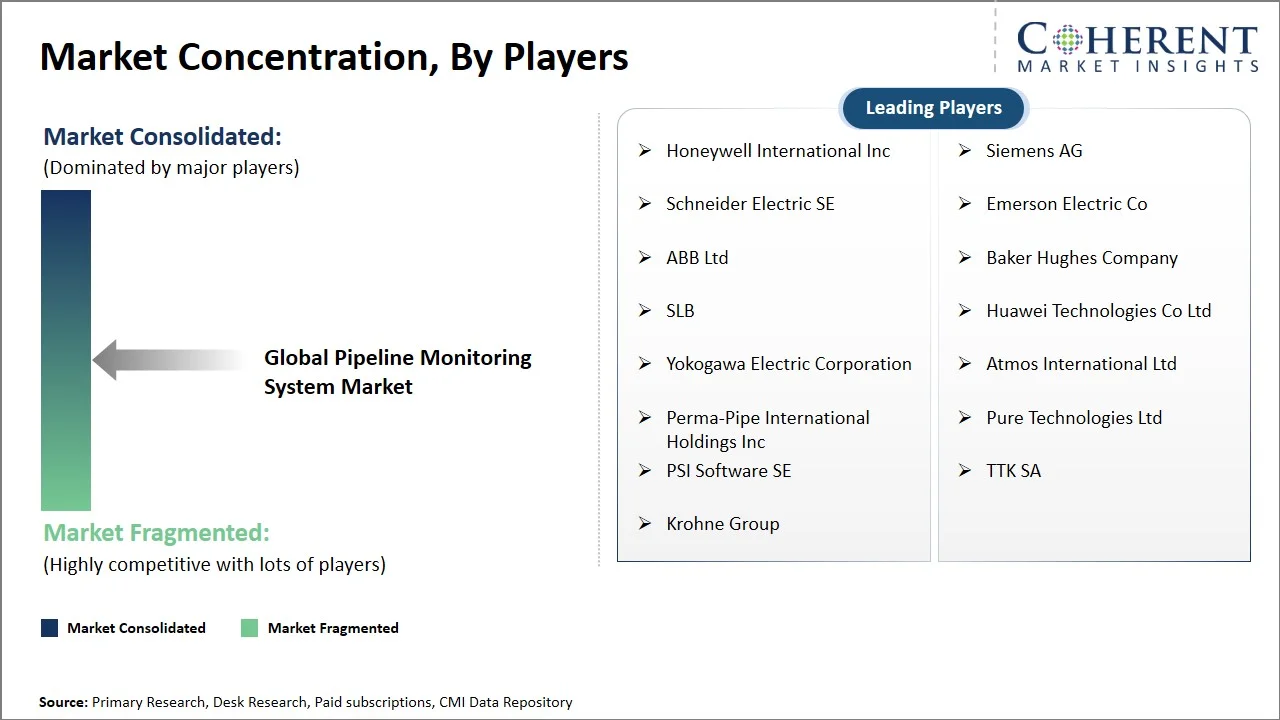
Competition in the global pipeline monitoring system market is centered on integrated sensing platforms rather than standalone leak detection equipment. Honeywell is consolidating its position with integrated SCADA, cybersecurity and asset performance management into unified pipeline operating platforms. Emerson is extending AI-enabled predictive diagnostics through its Plantweb architecture for transmission assets. Atmos International specializes in computational pipeline monitoring and statistical leak detection and has its solutions deployed on oil, gas, water and aviation fuel pipelines in over 60 countries. Siemens is working on digital twin-enabled pipeline operation by combining industrial automation and edge analytics, while ABB is merging distributed control systems with condition monitoring and remote asset management for cross-country pipelines.
Yokogawa Electric is concentrating on integrated operating centers that combine pipeline telemetry with process automation, and SLB and Baker Hughes are leveraging their pipeline integrity and inspection portfolios by merging intelligent pigging data with continuous monitoring platforms. Huawei has been offering industrial optical communication and AI-powered edge computing for long-distance pipeline surveillance in Asia and the Middle East, and KROHNE is reinforcing its position with high-accuracy flow measurement technologies combined with pipeline monitoring software.
Market Report Scope
Report Coverage
| Report Coverage | Details | ||
|---|---|---|---|
| Base Year: | 2025 | Market Size in 2026: | USD 18.45 Bn |
| Historical Data for: | 2020 To 2024 | Forecast Period: | 2026 To 2033 |
| Forecast Period 2026 to 2033 CAGR: | 9% | 2033 Value Projection: | USD 33.90 Bn |
| Geographies covered: |
| ||
| Segments covered: |
| ||
| Companies covered: | Honeywell International Inc, Siemens AG, Schneider Electric SE, Emerson Electric Co, ABB Ltd, Baker Hughes Company, SLB, Huawei Technologies Co Ltd, Yokogawa Electric Corporation, Atmos International Ltd, Perma-Pipe International Holdings Inc, Pure Technologies Ltd, PSI Software SE, TTK SA, and Krohne Group | ||
| Growth Drivers: |
| ||
| Restraints & Challenges: |
| ||
Analyst Opinion (Expert Opinion)
- The pipeline monitoring system market is not being influenced by advancements in leak detection gear alone. The market is increasingly being defined by the confluence of operational technology, geospatial intelligence, and industrial artificial intelligence. Competitive differentiation will come from the capacity to combine distributed fiber optic sensing, intelligent pig inspection data, satellite imaging, drone surveillance and SCADA telemetry on a common real-time analytics platform.
- In response to expanding regulatory demands and the need to fortify critical infrastructure against cyber threats, pipeline operators are increasing investments in cybersecurity-certified monitoring infrastructures. Demand is likely to move towards software-defined monitoring tools that learn from operational behavior in real time, rather than static alarm thresholds, particularly for hydrogen, carbon dioxide and multi-product pipeline networks.
- Continuous sensing, edge computing, and AI-assisted decision making will enable autonomous pipeline operations and is projected to be a key direction for future monitoring system deployments. The integration of hydraulic simulation, corrosion growth models and live sensor data into a single field operational environment is expected to make digital twin technology a typical feature of future transmission pipes.
- Distributed acoustic sensing is expected to develop from leak detection to geohazard monitoring, excavation risk identification and structure health evaluation in the long-distance pipeline corridors. High frequency real-time diagnostics will be required for adaptive monitoring platforms capable of managing multiple transported media through emerging hydrogen transport corridors, carbon dioxide sequestration networks, offshore carbon capture infrastructure, and cross-border energy pipelines.
Speak to the analyst
Want personalized insights?
Take the findings above to one of our principal consultants, or have the report rebuilt around the segments, geographies and competitors you actually track.
Market Segmentation
- Component Insights (Revenue, USD Billion, 2021 - 2033)
- Hardware
- Software
- Services
- Pipeline Type Insights (Revenue, USD Billion, 2021 - 2033)
- Oil Pipelines
- Gas Pipelines
- Water and Wastewater Pipelines
- Chemical Pipelines
- Technology Insights (Revenue, USD Billion, 2021 - 2033)
- Fiber Optic Monitoring
- Acoustic Monitoring
- Magnetic Flux Leakage
- Ultrasonic Testing
- Smart Pigging
- Satellite Monitoring
- SCADA Based Monitoring
- End User Insights (Revenue, USD Billion, 2021 - 2033)
- Oil and Gas
- Water Utilities
- Chemical Industry
- Energy and Power
- Mining
- Regional Insights (Revenue, USD Billion, 2021 - 2033)
- North America
- U.S.
- Canada
- Latin America
- Brazil
- Argentina
- Mexico
- Rest of Latin America
- Europe
- Germany
- U.K.
- Spain
- France
- Italy
- Russia
- Rest of Europe
- Asia Pacific
- China
- India
- Japan
- Australia
- South Korea
- ASEAN
- Rest of Asia Pacific
- Middle East
- GCC Countries
- Israel
- Rest of Middle East
- Africa
- South Africa
- North Africa
- Central Africa
- North America
- Key Players Insights
- Honeywell International Inc
- Siemens AG
- Schneider Electric SE
- Emerson Electric Co
- ABB Ltd
- Baker Hughes Company
- SLB
- Huawei Technologies Co Ltd
- Yokogawa Electric Corporation
- Atmos International Ltd
- Perma-Pipe International Holdings Inc
- Pure Technologies Ltd
- PSI Software SE
- TTK SA
- Krohne Group
Sources
Primary Research Interviews
- Pipeline Operators & Transmission Companies
- Oil & Gas Equipment Manufacturers
- Pipeline Safety & Integrity Engineers
- Government & Regulatory Authority Representatives
Magazines
- Pipeline & Gas Journal
- Oil & Gas Journal (OGJ)
- Pipeline Technology Journal
- Hart Energy Magazine
Journals
- Journal of Pipeline Systems Engineering and Practice (ASCE)
- International Journal of Pressure Vessels and Piping
- Journal of Natural Gas Science and Engineering
Associations
- American Petroleum Institute (API)
- Pipeline Research Council International (PRCI)
- International Pipeline & Offshore Contractors Association (IPLOCA)
- Association of Oil Pipe Lines (AOPL)
Public Domain Sources
- U.S. Department of Transportation – Pipeline and Hazardous Materials Safety Administration (PHMSA)
- U.S. Energy Information Administration (EIA) – Pipeline Infrastructure Reports
- European Commission – Energy Infrastructure Policy Documents
- International Energy Agency (IEA) – Pipeline & Infrastructure Reports
Proprietary Elements
- CMI Data Analytics Tool
- Proprietary CMI Existing Repository of Information for Last 10 Years
Get access to 250+ pages report
Every segment, forecast, competitor profile and data table behind the analysis above — available for instant download.
- ESOMAR Member
- ISO 9001:2015 Certified
- D-U-N-S Registered
- GDPR & CCPA Compliant
Missing comfort of reading report in your local language? Find your preferred language:
Transform your Strategy with Exclusive Trending Reports
Frequently Asked Questions
The global pipeline monitoring system market is expected to stand at USD 18.45 Bn in 2026 and is expected to reach USD 33.90 Bn by 2033.
The CAGR of the global pipeline monitoring system market is projected to be 9% from 2026 to 2033.
Rising investments in oil and gas pipeline infrastructure and increasing adoption of IoT and AI based leak detection systems are the major factors driving the growth of the global pipeline monitoring system market.
High installation and maintenance costs and complex integration with aging pipeline infrastructure are the major factors hampering the growth of the global pipeline monitoring system market.
In terms of component, the hardware segment is estimated to dominate the market revenue share in 2026.
Artificial intelligence analyzes operational data to identify abnormal patterns and predict failures before they occur.
Distributed acoustic sensing uses fiber optic cables to detect vibrations caused by leaks, excavation, or mechanical disturbances.