

Global Plate Heat Exchanger Market Size and Forecast – 2026 To 2033
The global plate heat exchanger market is expected to grow from USD 6.70 Bn in 2026 to USD 11 Bn by 2033, registering a compound annual growth rate (CAGR) of 7.5% from 2026 to 2033. The global plate heat exchanger market is driven by steady growth of water and wastewater treatment facilities across the world. On September 11, 2025, the cities of Mexico City and Monterrey announced a collaboration with Xylem Inc and Amazon to deploy Xylem Vue, an advanced software platform that applies data and analytics to detect leaks, cut water losses and improve residents’ water supply. (Source: Xylem)
Key Takeaways of the Global Plate Heat Exchanger Market
- The gasketed plate heat exchangers segment is expected to account for 55.0 % of the global plate heat exchanger market share in 2026. Increasing demand for heat recovery systems is primarily driving the segmental growth. On June 2, 2026, KRN Heat Exchanger & Refrigeration raised around USD 3.65 billion through a Qualified Institutional Placement (QIP) to strengthen manufacturing capacity and expand heat exchanger production, including heat recovery applications. (Source: Economic Times)
- The HVAC and refrigeration segment is estimated to capture 27.0 % of the market share in 2026. The growing integration of smart and digitalized heat exchanger monitoring solutions is a major factor driving the growth of the segment. On January 15, 2026, Kelvion launched K Focus Carbon Capture & Storage (CCS), an online platform designed to guide operators in selecting the right thermal solutions for efficient and sustainable carbon capture processes. (Source: Kelvion)
- Asia Pacific is expected to dominate the plate heat exchanger market in 2026 with a market share of 31.0 %. Growth of pharmaceutical and biotechnology manufacturing in the region is a key reason driving the growth of the plate heat exchanger market in Asia Pacific. On February 23, 2026, AbbVie announced a USD 380 million expansion of its manufacturing capacity in 2026, reinforcing biologics and advanced drug production networks that heavily rely on Asia Pacific supply ecosystems, including India and Singapore-linked API and biologics suppliers. (Source: AbbVie)
- North America is expected to account for 25.0 % share in 2026 and is projected to record the fastest growth over the forecast period. Growing need of data center cooling in North America is driving the growth of the regional market. On June 3, 2025, Ecolab Inc., a global sustainability leader offering water, hygiene and infection prevention solutions and services, announced the launch of a transformative technology to drive high-performance data center cooling. (Source: Ecolab)
- Growing Adoption in Industrial Heat Pumps and Energy Transition Projects: The adoption of plate heat exchangers is on the rise in industrial heat pumps, district heating networks, carbon capture systems, and renewable energy They are preferred by industries, who want to cut carbon emissions and make better use of energy for their high heat transfer efficiency, small size and capacity to work in severe situations.
- Technological Advancements in High-Pressure and Corrosion-Resistant Designs: Manufacturers are creating next generation plate heat exchangers for higher pressure, temperature and corrosive media applications. Plate heat exchangers are also witnessing innovations such as semi-welded, completely welded and laser welded plate heat exchangers, new plate materials and gasket technologies that improve the durability and boost the operational efficiency of the products.
Segmental Insights
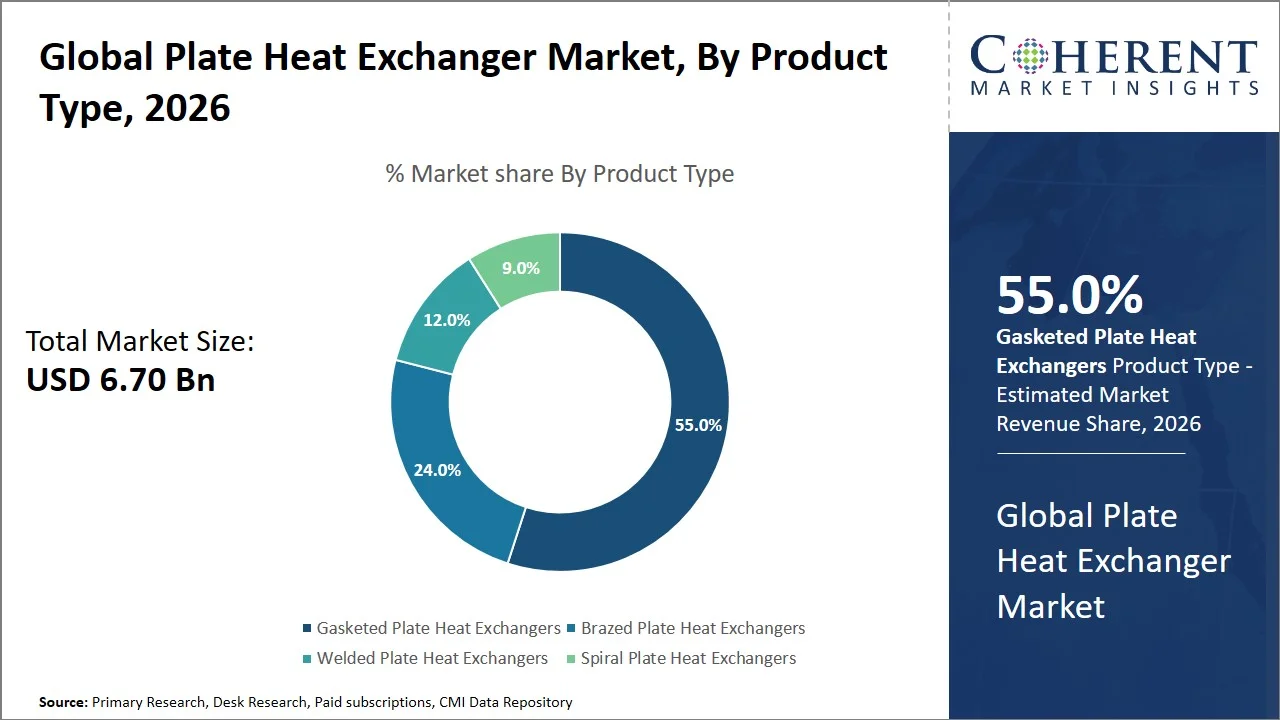
Why Do Gasketed Plate Heat Exchangers Dominate the Global Plate Heat Exchanger Market?
The gasketed plate heat exchangers segment is expected to account for 55.0% of the global plate heat exchanger market share in 2026. The availability of unequaled operational flexibility with easy maintenance has made gasketed plate heat exchangers dominate the global industry. Plates may be readily added, removed or cleaned without the need for specialized tools due to their modular design, making them extremely ideal for industries with frequent process modifications or severe hygiene requirements such as HVAC, food & beverage and pharmaceuticals. This simplicity of servicing minimizes downtime and lifecycle costs, making them more desirable than welded or brazed options for a substantial percentage of industrial applications. On November 5, 2025, Tranter announced that it has been awarded a contract to supply gasketed plate & frame heat exchangers for the Net Zero Teesside Power project (NZT Power). NZT Power is poised to be the world's first gas-fired power plant with carbon capture technology. (Source: Tranter)
- Current Industry Events of 2026
- Market Size Estimation
- Regional Breakdown
- Competitive Landscape
- Customer Intelligence
- Segmental Analysis
- Pricing Analysis
- Key Market Drivers, Challenges & Future Trends
- Customized Insights Section
Why is HVAC and Refrigeration the Most Widespread Application?
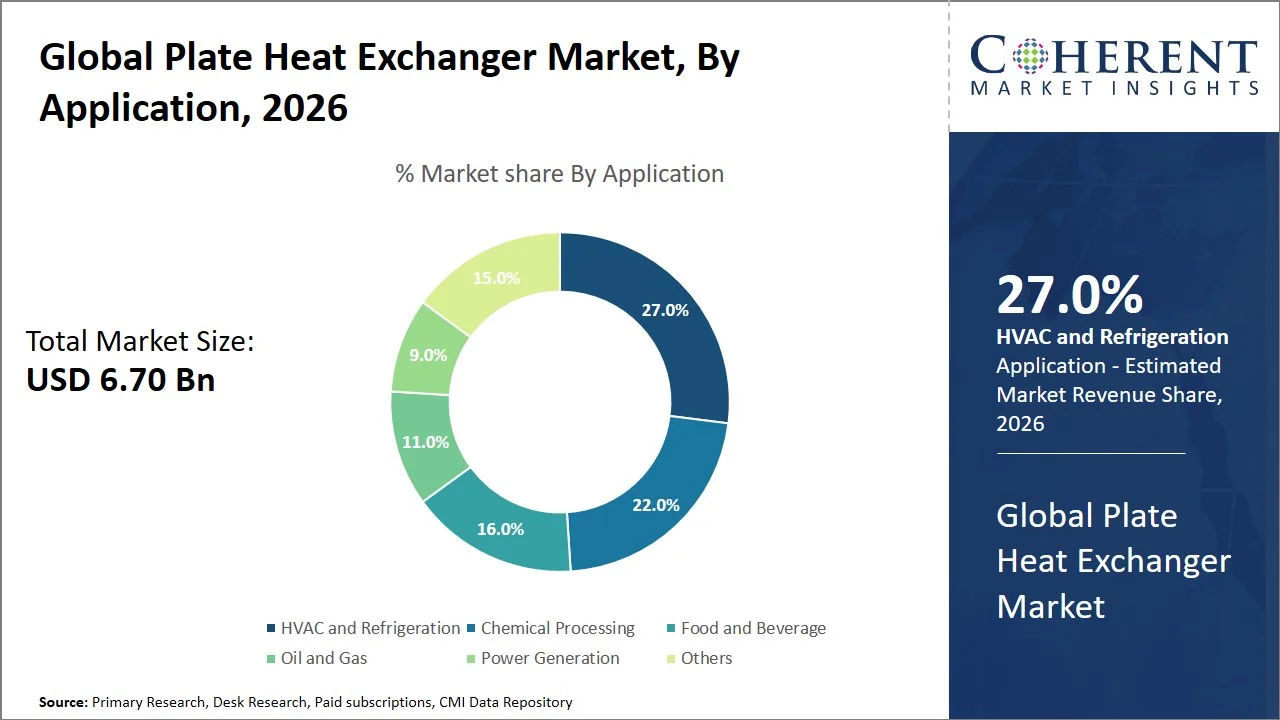
The HVAC and refrigeration segment is expected to account for 27.0% of the global plate heat exchanger market share in 2026. The application landscape is dominated by HVAC and refrigeration, because they need continuous and large scale heat transfer, with energy efficiency and compactness of the system being a priority. Plate heat exchangers are very efficient in these systems as they have a high heat transfer efficiency and can work under varied load circumstances with low energy consumption as compared to conventional systems. It offers them the best solution for residential, commercial buildings, supermarkets and cold storage facilities where the need for stable temperature control at low running costs is vital. For example, Kelvion expanded its supply of plate heat exchangers for liquid-cooled data center HVAC systems, supporting hyperscale facilities in Europe and North America. The systems are designed to improve heat rejection efficiency and reduce energy consumption in AI-driven cooling environments, where constant thermal load management is required. (Source: Kelvion)
Currents Events and their Impact
Current Events | Description and its Impact |
European Union - Ecodesign Directive (ErP) and Energy Efficiency Directive |
|
China - 14th Five-Year Plan for Energy Conservation and Emission Reduction (2021–2025) |
|
(Source: European Commission, Climate Change Laws)
Plate Heat Exchanger Market Dynamics
Market Drivers
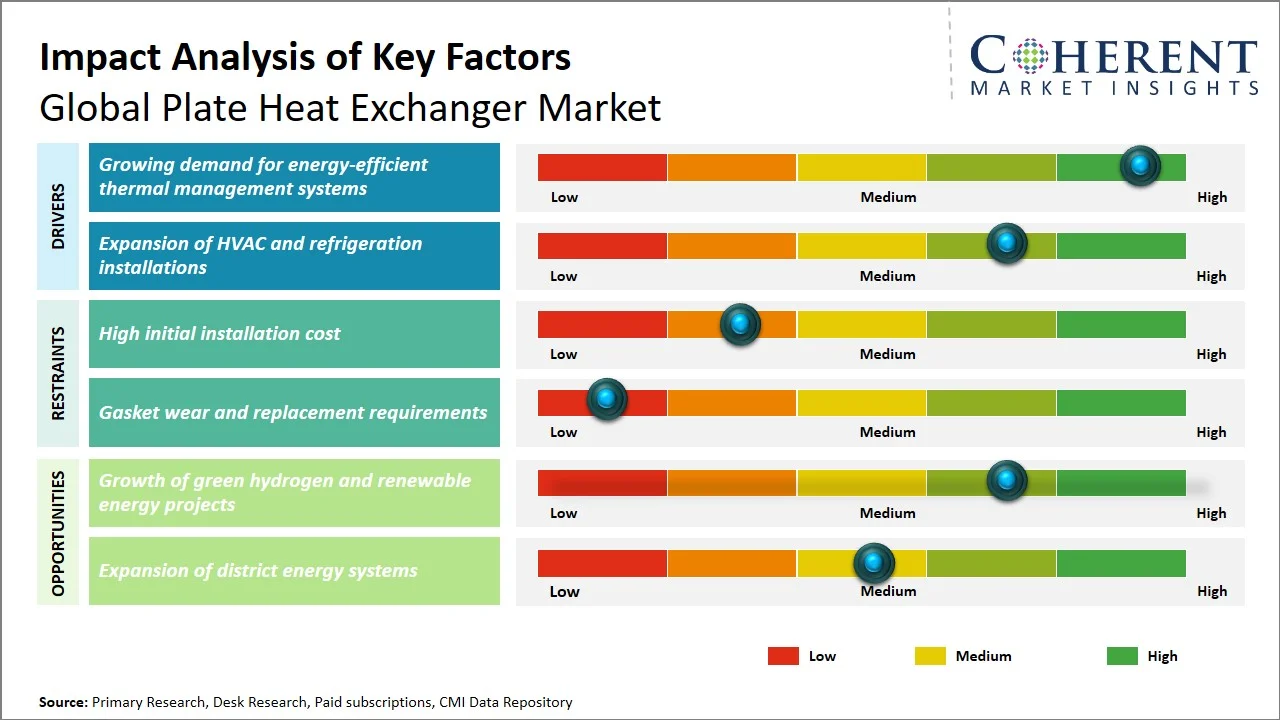
- Growing demand for energy-efficient thermal management systems: A major element driving adoption of plate heat exchangers across sectors is the increasing demand for energy-efficient thermal management systems. Efficient heat transfer technologies have become vital in the HVAC, power generation and process industries as firms focus on decreasing energy consumption, lowering operational costs and meeting tight environmental laws. Plate heat exchangers are increasingly popular because they offer great thermal efficiency, a compact design and they can efficiently recover and reuse heat, contributing to the achievement of sustainability goals in general. On April 21, 2026, Johnson Controls was named to the Fortune “Change the World 2025” list for its advanced data center thermal management systems. The company’s YORK YVAM chiller was highlighted for reducing power consumption by 40% and eliminating on-site water use, reflecting rising demand for highly energy-efficient cooling solutions. (Source: Johnson Controls)
- Expansion of HVAC & refrigeration installations: The expansion of HVAC and refrigeration installations is a major factor driving the growth of the plate heat exchanger market around the globe. The rapid urbanization, the rising development of commercial buildings and the growing demand for cold chain logistics in food and pharmaceuticals are pushing the large-scale deployment of HVAC systems. They are frequently employed in these systems because of their high efficiency, small size, and the ability to precisely control the temperature. It is a key component of modern cooling and refrigeration infrastructure. On March 27, 2026, Danfoss announced a USD 15 billion investment in India (2026–2030) to expand manufacturing capacity and localization for HVAC, refrigeration, and cooling technologies. The expansion directly supports rising installation of energy-efficient HVAC systems in data centers, cold chain logistics, and district cooling projects. (Source: Times of India)
Emerging Trends
- Rising Demand from Data Centers and Advanced Cooling Applications: The growth of cloud computing, artificial intelligence (AI), and hyperscale data centers is driving the need for effective thermal management systems. Plate heat exchangers have extensive use in liquid cooling and heat recovery systems because of their enhanced performance and compact structure. As demand for cooling in high density computer settings grows, manufacturers are ramping up their production capabilities and creating specialized heat exchanger models.
- Integration of Digital Monitoring and Predictive Maintenance Solutions: Digitalization is emerging as a key trend in the plate heat exchanger market as companies are adopting smart monitoring systems, sensors, and predictive maintenance technologies to their equipment. Real-time performance monitoring and AI-based analytics enable operators to detect fouling, improve heat transfer efficiency, decrease downtime and lower maintenance costs. This move to intelligent heat management technologies is boosting asset reliability and enabling wider adoption of Industry 4.0 practices across industrial facilities.
Regional Insights
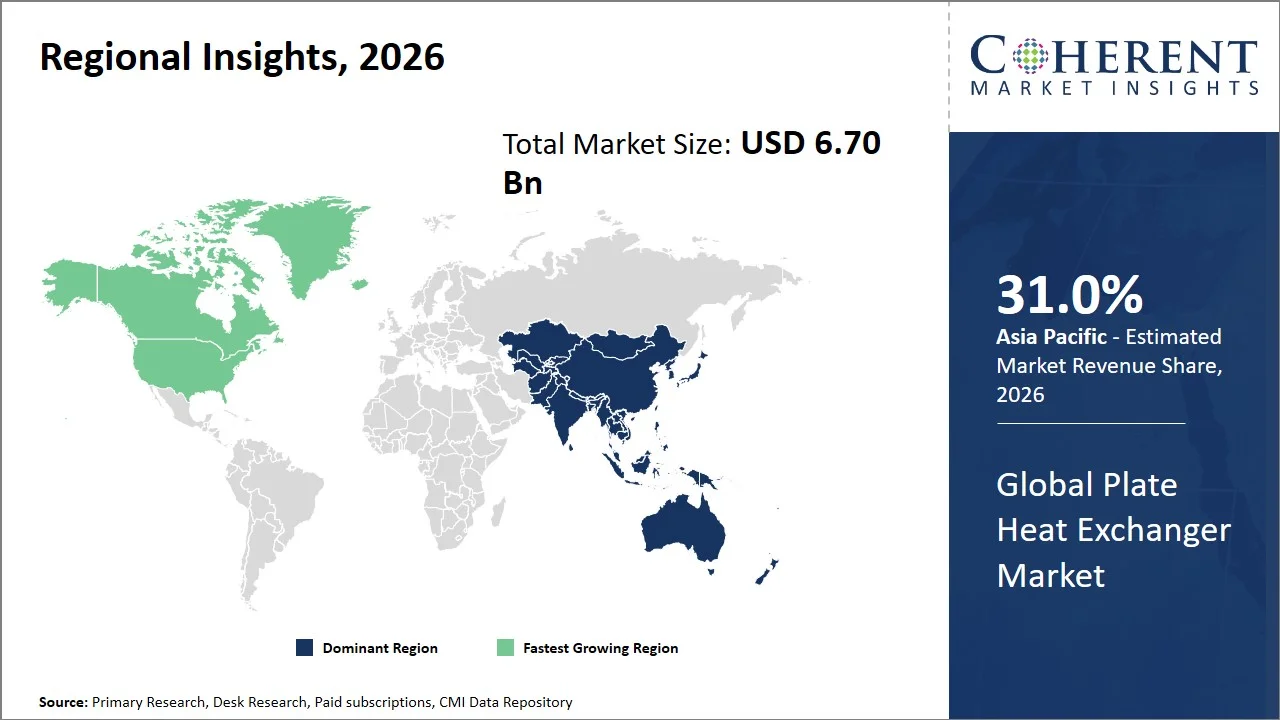
Why is Asia Pacific a Strong Market for Plate Heat Exchangers?
Asia Pacific is expected to account for a market share of 31.0% in 2026. Demand for plate heat exchangers in Asia Pacific is being driven strongly by large-scale industrial expansion in industries such as petrochemicals, shipbuilding and district cooling. For example, district cooling systems at Marina Bay and Jurong Island in Singapore use plate heat exchangers extensively for centralized thermal management, and South Korea’s LNG terminals and semiconductor fabs utilize high-efficiency units for process cooling. The region witnesses considerable adoption in food processing clusters in Thailand and Vietnam where export-oriented cold chain infrastructure requires compact and hygienic heat transfer systems.
Moreover the growth of the pharmaceutical manufacturing sector in Asia Pacific is an added advantage for the regional market. On February 17, 2026, at BioAsia 2026, the government of Telangana reported USD 730 billion in life sciences investments, with Hyderabad emerging as a major hub for bulk drugs, biologics, and advanced therapeutics manufacturing in India. The region is actively transitioning from traditional pharmaceutical production to gene editing, mRNA, and AI-driven biotech manufacturing, attracting global pharma firms and CDMOs. (Source: Times of India)
Why Does the North America Plate Heat Exchanger Market Exhibit High Growth?
North America is projected to account for 25.0% of the global plate heat exchanger market and is expected to register the fastest growth. The demand from North America is linked to industrial decarbonization programs and data center cooling expansion, especially in the U.S. Gulf Coast and Virginia tech corridor. For example, Microsoft and Google hyperscale data centers are increasingly adopting liquid cooling systems in conjunction with plate heat exchangers to effectively control high heat loads. The Canadian oil sands enterprises in Alberta also employ sturdy plate heat exchanger systems for heat recovery in the bitumen processing and upgrading plants.
In addition, the growing requirements of data center cooling is also expected to boost the growth of the regional market. On March 3, 2026, Trane Technologies announced that it has completed the acquisition of LiquidStack, a global leader in liquid cooling technology for data centers, headquartered in Texas, U.S. The acquisition further strengthens Trane Technologies’ position as a full‑service provider of advanced, sustainable thermal management solutions for mission critical operations, and unlocks new opportunities to scale LiquidStack’s innovative technology globally. (Source: Trane Technologies)
Global Plate Heat Exchanger Market Outlook for Key Countries
Why is China Emerging as a Major Hub in the Plate Heat Exchanger Market?
Large-scale district heating networks and industrial modernization plans are the major factors that could affect the China plate heat exchanger market in the context of its “dual carbon” targets. In cities such as Beijing and Harbin, plate heat exchangers have been widely applied to centralized heating substations to enhance the efficiency of energy transfer during winter heating seasons. Welded and gasketed plate heat exchangers are also used in large scale refining and ammonia production plants in chemical clusters in provinces like Jiangsu and Shandong.
Is the U.S. the Next Growth Engine for the Plate Heat Exchanger Market?
The U.S. plate heat exchanger market is driven by stringent energy efficiency improvements in HVAC retrofits and high demand from the food processing industry. For instance, the milk pasteurization and chilling processes in Wisconsin and California dairy plants utilize plate heat exchangers because of their sanitary design and quick temperature reaction. ExxonMobil and Chevron facilities on the Gulf Coast also include sophisticated heat exchanger systems for heat recovery in refining and LNG processing processes.
Japan Plate Heat Exchanger Market Analysis and Trends
In Japan, demand is driven by an emphasis on compact, high-efficiency systems for limited industrial space and innovative production. Automotive manufacturers such as Toyota, for example, employ plate heat exchangers for paint shop temperature control and waste heat recovery systems to improve energy efficiency. Tokyo’s initiatives for urban district heating and cooling also use sophisticated plate heat exchangers to improve energy distribution in commercial areas with high population density.
India Plate Heat Exchanger Market Analysis and Trends
The India plate heat exchanger market is growing fast with massive investments in industrial corridors, metro rail HVAC systems and food processing facilities. For example, plate heat exchangers are used in station HVAC systems of Delhi Metro and Mumbai Metro for efficient temperature regulation in high passenger density areas. Dairy cooperatives such as Amul also employ plate heat exchangers widely in Gujarat and other states in milk chilling and pasteurization operations to ensure product quality and hygiene standards.
Global Plate Heat Exchanger Market - Industrial Waste Heat Recovery Project Pipeline
Country/Region | Company | Project / Initiative (2025–2026) |
Switzerland | Johnson Controls | Zurich district heating expansion using waste incineration recovery (2025) |
Germany | Johnson Controls + Nestle | Biessenhofen factory ammonia heat pump system (2025) |
U.S. | Skyven Technologies ecosystem (industrial decarbonization projects) | Deployment of heat recovery systems across food, paper, and chemical plants (2025–2026) |
Global (Data Centers) | SWEP | Large-scale deployment of BPHEs in data center cooling systems (ongoing 2025–2026) |
Europe (Industrial manufacturing) | Multiple OEMs (Alfa Laval, Kelvion, Danfoss ecosystem) | Industrial waste heat recovery upgrades in process industries (2025–2026) |
How is the Growth of Green Hydrogen and Renewable Energy Projects Creating New Growth Opportunities in the Plate Heat Exchanger Market?
Rapid rise of green hydrogen and renewable energy projects is creating new prospects for plate heat exchangers owing to their key role in effective heat transfer in energy intensive processes. In green hydrogen production, notably in electrolysis-based plants such as those being developed in Europe and India’s NTPC and Green Hydrogen Mission programs, plate heat exchangers are used to cool electrolyzers, control process temperatures, and improve system efficiency. Likewise, in renewable energy applications like concentrated solar power plants in Spain and geothermal facilities in Iceland, they assist in heat recovery and fluid temperature management, both of which are critical to maximizing energy conversion efficiency and ensuring operational stability. On February 25, 2025, Plug Power Inc confirmed that its new 15-ton-per-day (TPD) hydrogen plant in Louisiana, U.S., is on schedule as previously announced for operations in the first quarter, now entering the final commissioning phase. Operated by Hidrogenii, a 50/50 joint venture between Plug Power and Olin Corporation, the facility utilizes Olin’s by-product hydrogen from chlorine production. (Source: Plug Power)
Market Players, Key Development, and Competitive Intelligence
Key Developments
- On May 6, 2026, Alfa Laval announced the launch of TS45, the company’s largest semi-welded plate heat exchanger to date, engineered to secure competitiveness and resilience by meeting growing demands for high-capacity, high-pressure heat transfer across energy transition, industrial, and energy efficiency applications.
- On February 9, 2026, Danfoss announced that it has begun production of its brazed plate heat exchangers at its newly expanded factory in Monterrey, Mexico. This will enable the company to shorten supply chains in North America by reducing delivery times to its customers in the region.
Competitive Landscape
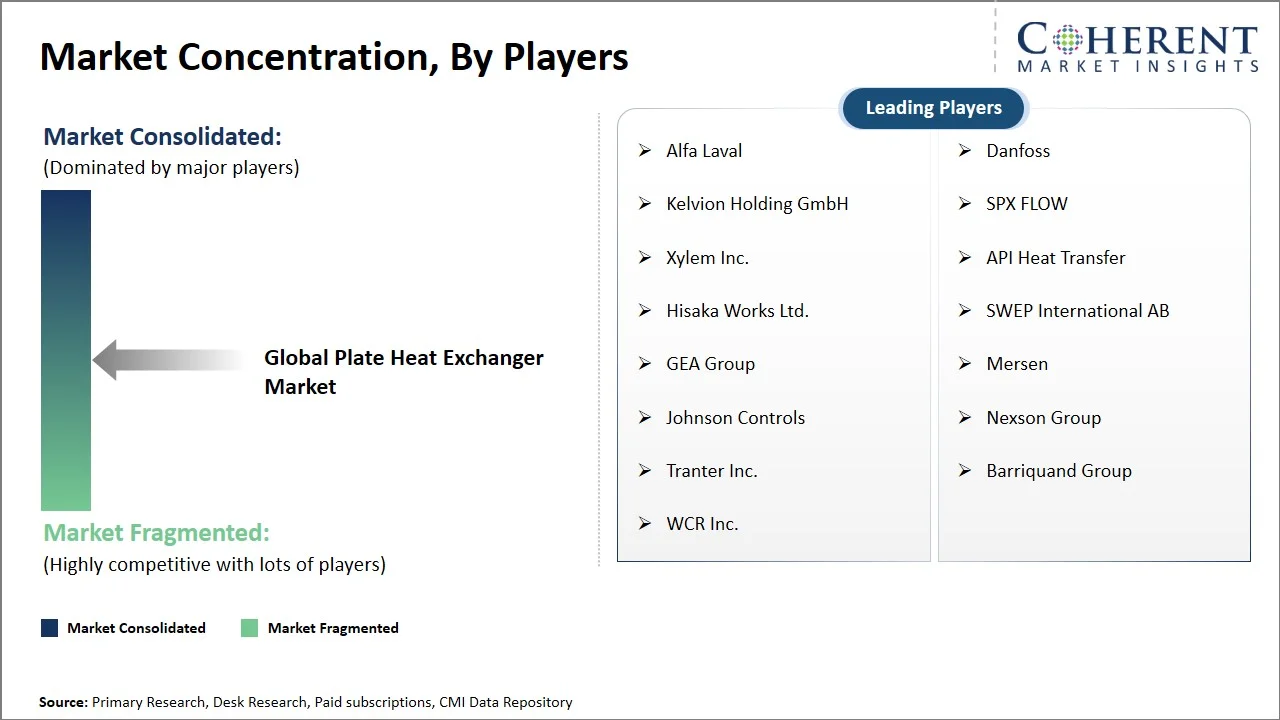
The global plate heat exchanger market is dominated by several well established international players along with other regional manufacturers competing on technology, pricing and service capabilities. Alfa Laval, Danfoss, Kelvion and SWEP are perceived to lead the market with continual product innovation, worldwide supply chain development and robust aftermarket services. The focus is growing on the development of high-efficiency, corrosion-resistant and digitally-enabled heat exchangers for HVAC, data centers and renewable energy industries. Moreover, mergers and acquisitions and capacity additions in emerging regions are escalating competition.
Market Report Scope
Plate Heat Exchanger Market Report Coverage
| Report Coverage | Details | ||
|---|---|---|---|
| Base Year: | 2025 | Market Size in 2026: | USD 6.70 Bn |
| Historical Data for: | 2020 To 2024 | Forecast Period: | 2026 To 2033 |
| Forecast Period 2026 to 2033 CAGR: | 7.5% | 2033 Value Projection: | USD 11 Bn |
| Geographies covered: |
| ||
| Segments covered: |
| ||
| Companies covered: | Alfa Laval, Danfoss, Kelvion Holding GmbH, SPX FLOW, Xylem Inc., API Heat Transfer, Hisaka Works Ltd., SWEP International AB, GEA Group, Mersen, Johnson Controls, Nexson Group, Tranter Inc., Barriquand Group, and WCR Inc. | ||
| Growth Drivers: |
| ||
| Restraints & Challenges: |
| ||
Analyst Opinion (Expert Opinion)
- Global decarbonization measures and the drive towards energy efficient industrial systems are widely reported to be actively supporting the plate heat exchanger industry. The growing deployment of heat recovery technology and increased investments in green infrastructure are regarded as the primary drivers for long-term market stability. However, difficulties associated with fouling, high starting prices and maintenance complexity are being addressed by technological developments and material breakthroughs , therefore enhancing overall market feasibility across varied applications.
- Growing applications of plate heat exchangers in hydrogen energy systems, advanced HVAC networks, and industrial waste heat recovery solutions are likely to propel the future growth of the plate heat exchanger market. Fast-growing industrialization and infrastructural development in emerging economies, particularly in Asia Pacific and the Middle East, are likely to see strong adoption. Besides, the application of smart monitoring systems, AI-based predictive maintenance, and next-generation compact designs are predicted to improve the operational efficiency, minimize downtime, and increase the utilization of the plate heat exchanger in traditional and new energy sectors.
Speak to the analyst
Want personalized insights?
Take the findings above to one of our principal consultants, or have the report rebuilt around the segments, geographies and competitors you actually track.
Market Segmentation
- Product Type Insights (Revenue, USD Billion, 2021 - 2033)
- Gasketed Plate Heat Exchangers
- Brazed Plate Heat Exchangers
- Welded Plate Heat Exchangers
- Spiral Plate Heat Exchangers
- Application Insights (Revenue USD Billion, 2021 - 2033)
- HVAC and Refrigeration
- Chemical Processing
- Food and Beverage
- Oil and Gas
- Power Generation
- Others
- Regional Insights (Revenue, USD Billion, 2021 - 2033)
- North America
- U.S.
- Canada
- Latin America
- Brazil
- Argentina
- Mexico
- Rest of Latin America
- Europe
- Germany
- U.K.
- Spain
- France
- Italy
- Russia
- Rest of Europe
- Asia Pacific
- China
- India
- Japan
- Australia
- South Korea
- ASEAN
- Rest of Asia Pacific
- Middle East
- GCC Countries
- Israel
- Rest of Middle East
- Africa
- South Africa
- North Africa
- Central Africa
- North America
- Key Players Insights
- Alfa Laval
- Danfoss
- Kelvion Holding GmbH
- SPX FLOW
- Xylem Inc.
- API Heat Transfer
- Hisaka Works Ltd.
- SWEP International AB
- GEA Group
- Mersen
- Johnson Controls
- Nexson Group
- Tranter Inc.
- Barriquand Group
- WCR Inc.
Sources
Primary Research Interviews
- Heat exchanger manufacturers and OEMs
- Industrial equipment distributors and suppliers
- HVAC system integrators and contractors
- Chemical and petrochemical plant operators
Magazines
- Heat Exchanger World Magazine
- Chemical Processing Magazine
- HVAC&R Research International Journal
- Industrial Heating Magazine
Journals
- International Journal of Heat and Mass Transfer
- Applied Thermal Engineering Journal
- Heat Transfer Engineering Journal
Associations
- Heat Exchange Institute (HEI)
- Tubular Exchanger Manufacturers Association (TEMA)
- American Society of Heating, Refrigerating and Air-Conditioning Engineers (ASHRAE)
- European Heat Pump Association (EHPA)
Public Domain Sources
- International Energy Agency (IEA) Reports
- U.S. Department of Energy Industrial Technologies Program
- European Commission Energy Efficiency Reports
- United Nations Industrial Development Organization (UNIDO)
Proprietary Elements
- CMI Data Analytics Tool
- Proprietary CMI Existing Repository of information for last 10 years
Get access to 250+ pages report
Every segment, forecast, competitor profile and data table behind the analysis above — available for instant download.
- ESOMAR Member
- ISO 9001:2015 Certified
- D-U-N-S Registered
- GDPR & CCPA Compliant
Missing comfort of reading report in your local language? Find your preferred language:
Transform your Strategy with Exclusive Trending Reports
Frequently Asked Questions
The global plate heat exchanger market is expected to stand at USD 6.70 Bn in 2026 and is expected to reach USD 11 Bn by 2033.
The CAGR of the global plate heat exchanger market is projected to be 7.5% from 2026 to 2033.
Growing demand for energy-efficient thermal management systems and expansion of HVAC and refrigeration installations are the major factors driving the growth of the global plate heat exchanger market.
High initial installation cost and gasket wear and replacement requirements are the major factors hampering the growth of the global plate heat exchanger market.
In terms of product type, the gasketed plate heat exchangers segment is estimated to dominate the market revenue share in 2026.
They recover and reuse heat from process fluids, reducing overall energy consumption.
Yes, especially welded and semi-welded types are designed for high-pressure industrial use.