

Global Power Over Ethernet Market Size & Forecast – 2026 To 2033
The global power over ethernet market is estimated to be valued at USD 1,521.8 Mn in 2026 and is expected to reach USD 3,536.1 Mn by 2033, exhibiting a compound annual growth rate (CAGR) of 12.80% from 2026 to 2033. Growth is supported by the increasing deployment of IP cameras, wireless access points, access-control systems, smart lighting, and connected building devices that require reliable power and data transmission through a single Ethernet cable.
Power over ethernet reduces separate electrical wiring, simplifies endpoint installation, and enables centralized power management across commercial, industrial, and public infrastructure. In January 2025, Lantronix launched a 28-port managed 2.5G PoE++ switch designed for wireless networks, smart buildings, and security and surveillance applications, demonstrating continued supplier investment in higher-power, multi-gigabit edge connectivity.
Key Takeaways of the Global Power Over Ethernet Market
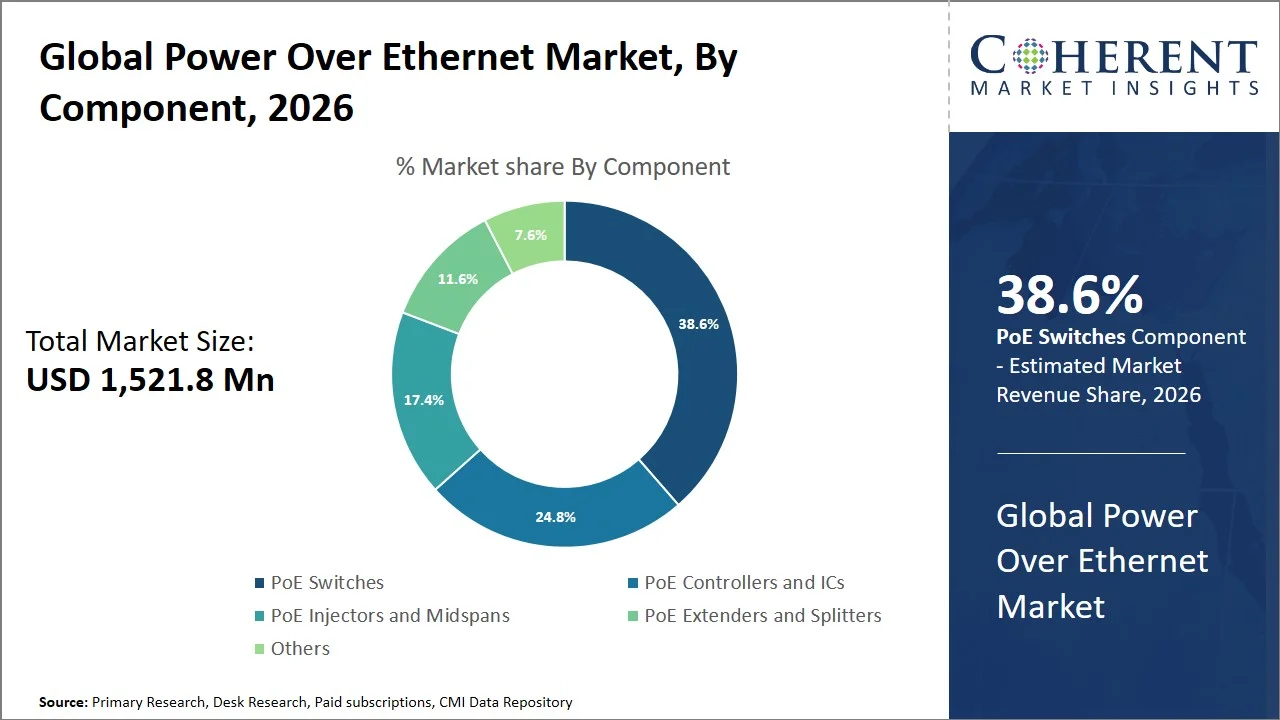
- The PoE switches segment is expected to hold 38.6 % of the market share in 2026, supported by centralized power delivery, lower cabling complexity, and scalable deployment of cameras, access points, and IoT endpoints. In July 2025, Arista introduced a 12-port, 60W-capable Power Over Ethernet switch for branch deployments.
- IEEE 802.3at is expected to represent 31.6 % of the market share in 2026, as its 30W-per-port capability provides a practical balance of power, compatibility, and infrastructure cost for access points, surveillance, access-control, and VoIP deployments. In May 2025, Zyxel launched XGS1935 Power Over Ethernet models supporting IEEE 802.3at, with 30W per port and a 375W power budget for SMB networks.
- IP cameras are expected to capture 31.8 % of the market share in 2026, as security networks increasingly combine high-resolution video, edge analytics, and remote monitoring over a single power-and-data connection. Power over ethernet reduces dependence on nearby electrical outlets and facilitates centralized backup power. In September 2025, Axis unveiled AI-powered P1475/85-LE and P1487/88-LE bullet cameras with DC and power over ethernet power redundancy.
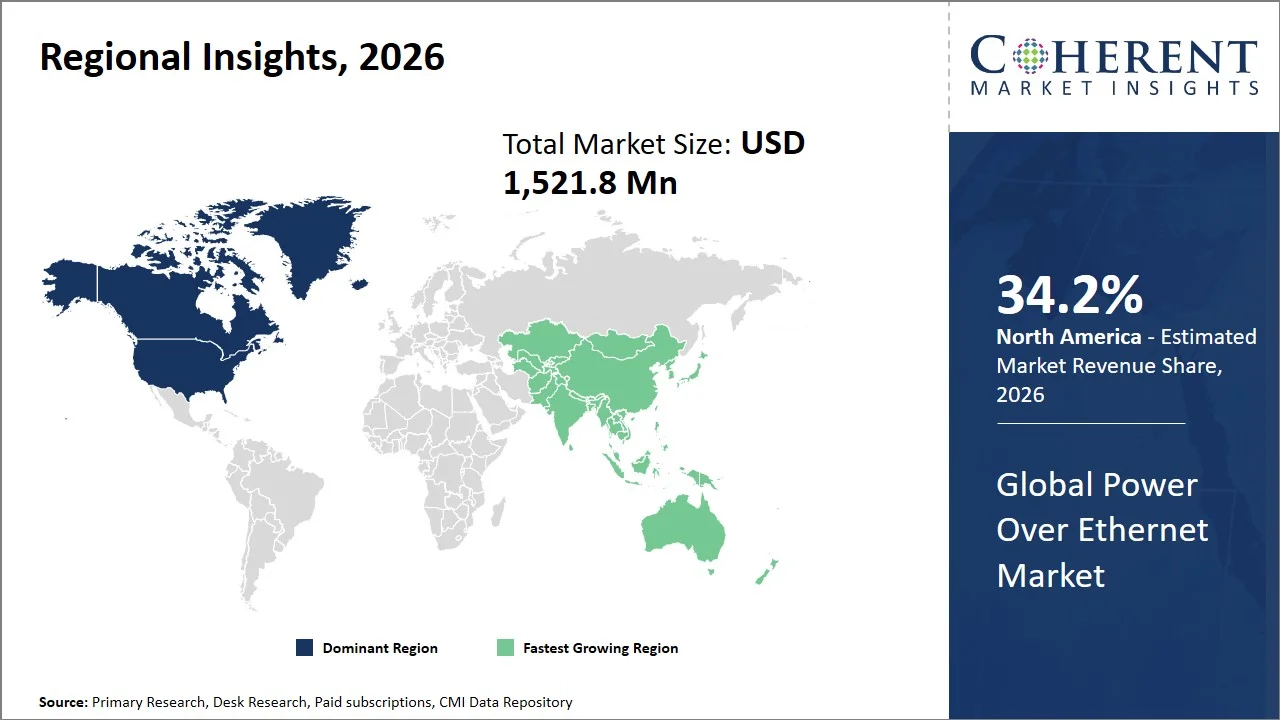
- North America is expected to account for 34.2 % of the market share in 2026, supported by early enterprise-network upgrades, mature IP-surveillance adoption, smart-building investment, and strong availability of managed networking solutions. In June 2025, Cisco launched its C9350 and C9610 Smart Switches for campus networks; the C9350 portfolio includes a 48-port model delivering up to 90W UPOWER OVER ETHERNET+ per port.
- Asia Pacific is expected to hold 31.1 % of the market share in 2026 and record the fastest expansion, supported by digital infrastructure development, local equipment manufacturing, enterprise modernization, and large-scale surveillance deployment. In February 2025, D-Link India launched Made-in-India surveillance switches with built-in power supplies, 802.3af/at compatibility, and long-range power over ethernet transmission of up to 250 meters.
- Higher-Power Power Over Ethernet++ Architectures: Increasing power requirements from Wi-Fi 7 access points, PTZ cameras, digital signage, smart lighting, and edge devices are shifting network design toward IEEE 802.3bt Type 3 and Type 4. This transition expands single-cable deployment opportunities but increases the importance of power-budget planning, thermal management, cable quality, and resilient backup, favoring vendors offering intelligent allocation and multi-gigabit connectivity.
- Cloud-Managed Power Orchestration: Enterprises are increasingly treating power as an operational platform rather than basic power delivery. Cloud dashboards, automated device discovery, remote reboot, per-port scheduling, fault detection, and energy monitoring can reduce field-service requirements and improve uptime across distributed sites. This direction strengthens software and managed-service opportunities while making cybersecurity, API integration, policy automation, and lifecycle visibility more influential in purchasing decisions.
Segmental Insights
Why Does the PoE Switches Segment Dominate the Global Power Over Ethernet Market?
PoE switches are expected to account for 38.6% of the global power over ethernet market in 2026. Their leadership reflects their position as the control and power-distribution layer of enterprise edge networks, where buyers prefer one managed platform for port provisioning, device prioritization, fault isolation, and power-budget allocation. High port density allows organizations to bring numerous powered endpoints under a common policy, monitoring, and maintenance domain, while switching capabilities support VLAN segmentation, link aggregation, traffic prioritization, and resilient topology design. Adoption is particularly strong across corporate campuses, education facilities, broadcast environments, hospitality properties, and large commercial buildings requiring coordinated oversight of distributed devices. Suppliers are reinforcing this position through multi-gigabit interfaces, larger power reserves, modular power architectures, and software-based preconfiguration. In January 2026, NETGEAR introduced the M4350-16M4V with sixteen 2.5G Power Over Ethernet++ ports and up to 1,130W total power for professional AV and broadcast installations.
- Current Industry Events of 2026
- Market Size Estimation
- Regional Breakdown
- Competitive Landscape
- Customer Intelligence
- Segmental Analysis
- Pricing Analysis
- Key Market Drivers, Challenges & Future Trends
- Customized Insights Section
Why Does IEEE 802.3at Represent the Largest Standard in the Global Power Over Ethernet Market?
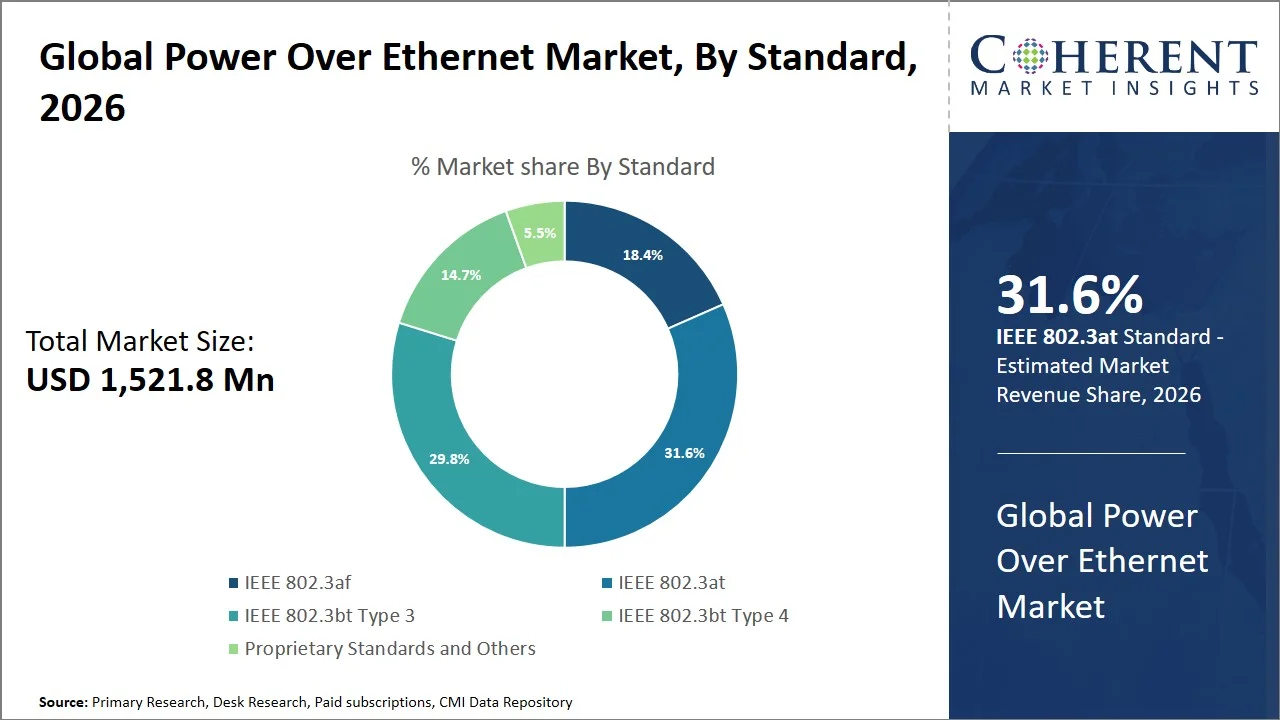
IEEE 802.3at is expected to represent 31.6% of the global power over ethernet market in 2026. The standard remains commercially important because it supports a broad installed base of moderate-power network devices while allowing enterprises to retain common Ethernet cabling and established switch architectures. Procurement teams favor IEEE 802.3at where endpoint requirements do not justify the higher equipment cost, power provisioning, and thermal planning associated with IEEE 802.3bt. Its mature interoperability also reduces integration risk across mixed-vendor networks and supports phased infrastructure upgrades rather than full replacement cycles. The standard is widely applied in branch offices, hotels, schools, retail sites, and healthcare facilities for wireless access points, fixed surveillance cameras, conferencing endpoints, and communication devices. In July 2025, EnGenius launched the ECS2530FP multi-gigabit switch with sixteen IEEE 802.3at Power Over Ethernet+ ports alongside eight IEEE 802.3bt ports, demonstrating continued supplier support for hybrid networks combining mainstream and high-power endpoints.
Why Do IP Cameras Dominate the Global Power Over Ethernet Market?
IP cameras are expected to hold 31.8% of the global power over ethernet market in 2026. The segment leads because surveillance systems typically require large numbers of geographically dispersed endpoints across entrances, perimeters, parking areas, production zones, warehouses, and public spaces. Standardized Ethernet-based deployment enables security integrators to replicate camera architectures across multiple sites, accelerate additions and replacements, and manage mixed indoor and outdoor installations through established network practices.
Centralized switching further enables administrators to segment video traffic, enforce device-access policies, coordinate firmware maintenance, and remotely recover individual endpoints. Demand is reinforced by the expansion of video security from passive recording toward operational monitoring, incident verification, and cloud-connected services across commercial, industrial, education, transportation, and government environments. In March 2025, i-PRO introduced a 28-model U-series portfolio, spanning 2MP, 5MP, and 4K dome, box, and bullet cameras, with entry-level edge analytics and direct-to-cloud support.
Global Power Over Ethernet Market Dynamics
Key Market Drivers
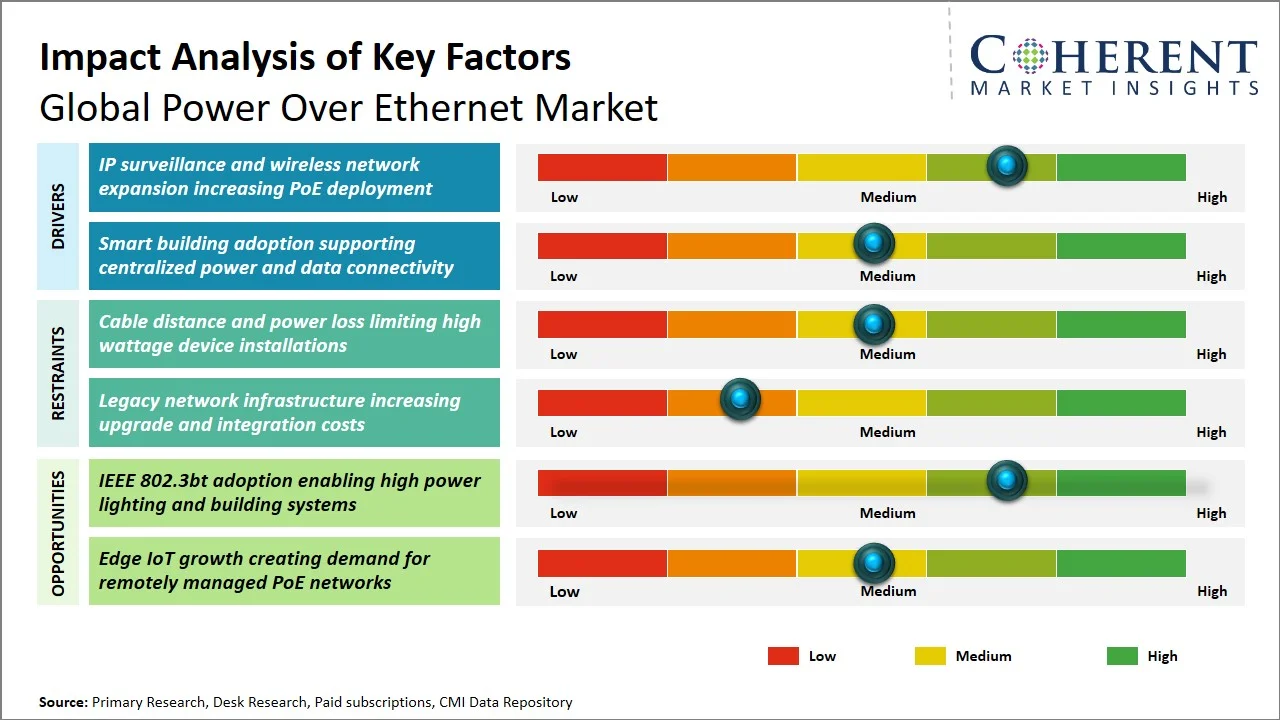
- IP Surveillance and Wi-Fi 7 Expansion Accelerate Edge-Power Investment: Enterprise security and wireless refresh cycles are increasingly being planned together because both IP cameras and high-density access points require dependable edge power, multi-gigabit backhaul, and centralized management. Power over ethernet enables integrators to position endpoints where surveillance coverage or radio performance is the strongest without installing separate AC circuits, while switch-level backup power improves service continuity. Demand is expanding across campuses, hospitals, warehouses, transport hubs, retail estates, and outdoor facilities where device counts are increasing and installation windows remain limited. The transition to Wi-Fi 7 also raises per-port power and bandwidth requirements, encouraging the replacement of legacy access switches with Power Over Ethernet+ or Power Over Ethernet++ platforms. In May 2025, Hewlett Packard Enterprise introduced Aruba Networking 720, 740, and 760 Series Wi-Fi 7 access points for campus, industrial, and indoor-outdoor environments, reinforcing the need for capable wired power infrastructure beneath next-generation wireless networks.
- Smart Buildings Shift Power Distribution Toward Converged IP Infrastructure: Smart-building programs are shifting lighting, occupancy sensing, access control, environmental monitoring, and selected building controls onto converged IP infrastructure. This architecture makes power over ethernet commercially attractive because facilities teams can add, relocate, monitor, and power distributed endpoints through structured cabling rather than separate electrical and communications systems. Centralized power supplies can also be supported by backup power, scheduling, and port-level controls, helping building owners improve resilience and reduce maintenance complexity. Demand is the strongest in offices, hotels, education campuses, healthcare facilities, and mixed-use properties where space utilization and energy management require granular device data. Supply-side innovation is consequently moving toward higher-power switches, low-voltage luminaires, intelligent drivers, and cabling designed for sustained current loads. In December 2025, Belden presented a network-inspired star-topology approach for centralized power delivery, positioning unified cabling and centrally managed power as a scalable model for increasingly connected buildings.
Emerging Market Trends
- Migration Toward Four-Pair High-Power Power over Ethernet Architectures: Power over Ethernet adoption is shifting toward four-pair, high-power architectures that support Wi-Fi 7 access points, PTZ cameras, digital signage, conferencing systems, intelligent lighting, and compact edge devices. This is increasing the demand for PoE++ switches with higher usable power density, improved thermal management, multi-gigabit connectivity, and real-time power monitoring. New-build campuses and major network upgrades are increasingly specifying power capacity and data bandwidth together. As device power requirements continue to rise, enterprises are prioritizing infrastructure that can scale without frequent hardware replacement. This trend is also encouraging manufacturers to innovate in energy efficiency and compact switch design to meet space and sustainability constraints.
- Software-Defined Power Orchestration at the Network Edge: Managed power over ethernet systems are increasingly using software to allocate power dynamically, schedule consumption, identify faults, and remotely restart connected devices. Cloud-based management and device-health monitoring are gaining importance across distributed offices, retail chains, campuses, and public infrastructure. Vendors are differentiating through power analytics, automated policies, remote administration, and integration with building-management and security platforms. The growing reliance on centralized control is enabling faster troubleshooting and reduced operational costs for IT teams. Additionally, advancements in AI-driven analytics are helping organizations predict power usage patterns and optimize network performance proactively.
Current Events and their Impact
Current Events | Description and its Impact |
U.S. Federal IoT Procurement Direction – June 2025 |
|
European Commission Cyber Resilience Act Guidance – March 2026 |
|
United Kingdom Connected-Product Security Regime – April 2024 onward |
|
Regional Insights
Why Does North America Dominate the Global Power Over Ethernet Market?
North America is expected to lead the global power over ethernet market with 34.2% of the market share in 2026. Regional leadership reflects the concentration of enterprise campuses, cloud-managed branch networks, commercial security installations, multi-dwelling properties, education facilities, and digitally managed public infrastructure. Buyers increasingly specify Power Over Ethernet alongside multi-gigabit switching because wireless access points, video devices, access-control systems, and building sensors must be deployed rapidly and managed centrally.
The region also benefits from established distributors, certified integrators, structured-cabling specialists, and technology vendors capable of supporting complex refresh projects. Replacement demand is shifting toward higher port power, stronger cybersecurity, remote diagnostics, and application-level visibility. In November 2025, CommScope introduced RUCKUS MDU 360 and new H670 and R575 Wi-Fi 7 access points for multi-dwelling environments, highlighting continued investment in managed, IoT-ready edge networks that require dependable Ethernet power and backhaul.
Why is Asia Pacific Emerging as the Fastest-Growing Region in the Global Power Over Ethernet Market?
Asia Pacific is expected to hold 31.1% of the market share in 2026 and emerge as the fastest-growing region. Expansion is supported by large greenfield commercial developments, smart-city programs, manufacturing digitization, expanding hospitality and education networks, and rapid modernization of enterprise wireless infrastructure. Unlike mature replacement-led markets, many Asia Pacific deployments involve first-time installation of dense camera, access-point, sensor, and access-control estates, creating opportunities across switches, injectors, controllers, and extenders.
Regional equipment production and broad price segmentation also make Power Over Ethernet accessible to small businesses as well as large campuses. Local suppliers are increasingly combining Wi-Fi 7, cloud management, and multi-gigabit interfaces in products designed for cost-sensitive, high-density environments. In June 2025, Ruijie Reyee announced global availability of its RG-RAP72 Wi-Fi 7 ceiling access point for small and medium-sized businesses; the device supports Power Over Ethernet or Power Over Ethernet+ power and a 2.5GbE connection, illustrating the region’s movement toward higher-performance powered-edge infrastructure.
Global Power Over Ethernet Market Outlook for Key Countries
Why is the U.S. a Key Market for the Global Power over Ethernet Market?
The U.S. power over ethernet market is growing due to continued investment in enterprise networks, school connectivity, commercial surveillance, healthcare IT, smart buildings, and logistics automation. Demand is also supported by the widespread adoption of cloud-managed switches, wireless access points, security cameras, and other centrally powered network devices.
Supporting institutional demand, the Federal Communications Commission stated in June 2026 that eligible E-Rate internal connections include wireless access points, routers, switches, managed internal broadband services, and related maintenance.
Why Does China Support Growth in the Global Power over Ethernet Market?
China supports power over ethernet market growth through large-scale deployment of smart factories, surveillance systems, transport infrastructure, connected commercial properties, and IoT devices. Its established electronics and networking-equipment manufacturing base also enables cost-efficient production of PoE switches, components, and powered devices.
Reflecting the country’s expanding digital infrastructure, the Chinese government reported 4.838 million 5G base stations and 2.888 billion mobile IoT terminal users in January 2026.
Why is Germany a Strategic Country in the Power over Ethernet Market?
Germany’s power over ethernet market is driven by industrial automation, smart manufacturing, logistics facilities, energy systems, and intelligent commercial buildings. Demand is particularly strong for reliable industrial PoE switches that provide secure management, redundant power, electromagnetic protection, and long operating lifecycles.
Demonstrating this industrial demand, Phoenix Contact introduced an upgraded Smart Ethernet Box in February 2026, featuring an outdoor PoE switch designed for secure installation and operation in demanding environments.
Why is India Important in the Global Power over Ethernet Market?
India’s power over ethernet market is expanding with the deployment of surveillance cameras, wireless access points, access-control systems, public-address equipment, and smart-city infrastructure. Growth is also supported by technology parks, hospitals, hotels, educational campuses, and small businesses seeking cost-efficient network installations with reduced electrical cabling.
Illustrating this opportunity, India’s Press Information Bureau reported in June 2025 that more than 84,000 CCTV cameras had been installed across 100 Smart Cities with operational Integrated Command and Control Centres.
Why is Japan an Important Growth Market for the Power over Ethernet Market?
Japan’s power over ethernet market is growing due to network upgrades across offices, hotels, hospitals, railway facilities, educational institutions, retail properties, and advanced manufacturing sites. High labor costs and limited installation space increased the demand for compact systems that deliver power and data through a single cable.
Supporting the shift toward higher-speed PoE networks, Allied Telesis published specifications in July 2025 for its TQ3403 wireless access point, which uses a 2.5G Ethernet PoE+ port for connectivity and power.
Technology Adoption Landscape in the Power Over Ethernet Market
Technology | Adoption Level | Key Application Area | Business Impact |
IEEE 802.3at Power Over Ethernet+ | High | Fixed IP cameras, VoIP phones, conventional wireless access points, access-control terminals | Offers mature interoperability and sufficient power for a broad installed base, supporting cost-effective upgrades without extensive redesign. |
IEEE 802.3bt Type 3 and Type 4 | Medium | Wi-Fi 7 access points, PTZ cameras, digital signage, lighting controllers, edge devices | Expands the range of devices powered through Ethernet but increases requirements for power-budget planning, cooling, and cable-quality assurance. |
Multi-Gigabit Ethernet with Power Over Ethernet | Medium | High-density wireless networks and AI-enabled video surveillance | Prevents access-layer bandwidth constraints and allows customers to upgrade endpoint performance without replacing established copper cabling unnecessarily. |
LLDP-Based Dynamic Power Management | Medium | Managed enterprise, campus, and industrial switching | Allocates power according to endpoint requirements, improves utilization of available switch budgets, and enables priority-based service continuity. |
Cloud-Managed Power Over Ethernet and Remote Port Control | High | Distributed offices, retail chains, schools, hospitality properties, and branch networks | Reduces site visits through remote diagnostics, power cycling, policy deployment, firmware management, and centralized fleet visibility. |
Single-Pair Ethernet with Power Delivery | Low | Industrial sensors, building controllers, environmental monitors, and field devices | Can reduce cabling volume and installation complexity for dense, lower-bandwidth device networks, although ecosystem maturity remains at an early stage. |
How are High-Power Power Over Ethernet and Single-Pair Ethernet Creating New Growth Opportunities in the Global Power Over Ethernet Market?
The strongest expansion opportunity lies in extending power over ethernet from traditional communications equipment into higher-power building, industrial, and edge-computing applications. IEEE 802.3bt enables suppliers to address devices that previously depended on separate electrical circuits, while multi-gigabit Ethernet supports the data intensity of Wi-Fi 7, intelligent video, and real-time analytics. In parallel, Single-Pair Ethernet with power delivery can simplify connectivity for lower-bandwidth sensors, controllers, and field devices distributed across factories and commercial buildings. Combining these architectures creates a tiered power-and-data environment: high-power four-pair power over ethernet for demanding endpoints and lightweight single-pair connectivity for dense sensor networks. Commercial success will depend on interoperable chipsets, efficient power conversion, thermal-safe cabling, ruggedized components, and management software providing visibility into power consumption and device status. Vendors that develop application-specific reference designs and collaborate with camera, lighting, automation, and wireless-equipment manufacturers can shorten customer deployment cycles, reduce integration risk, and capture greater value than suppliers competing solely on individual hardware components.
Market Players, Key Development, and Competitive Landscape
Key Developments
- In June 2026, Omnitron Systems introduced 24-port FlexSwitch Ethernet and Power Over Ethernet+ models with dual 10-Gigabit uplinks and the ability to deliver 30W across all 24 powered ports simultaneously. This is important for the Power Over Ethernet Market because it supports dense camera, wireless-access, and communication deployments without requiring operators to ration available switch power.
- In December 2025, ORing Industrial Networking launched the IGPS-9084GP-BT industrial Power Over Ethernet switch, supporting IEEE 802.3af, 802.3at, and 802.3bt with power delivery of up to 90W per port. This is important for the Power Over Ethernet Market because it extends high-power Ethernet connectivity into automation, surveillance, transport, and other operational environments requiring ruggedized equipment.
- In May 2025, MaxLinear announced that HiSource had selected its MxL86252S and MxL86282S Web-Smart 2.5G Ethernet switch systems-on-chip for next-generation Power Over Ethernet switches. The development is important because integrated multi-gigabit switching, processing, and management functions can help equipment suppliers reduce design complexity and introduce higher-performance Power Over Ethernet products for wireless, surveillance, and small-enterprise networks.
Competitive Landscape
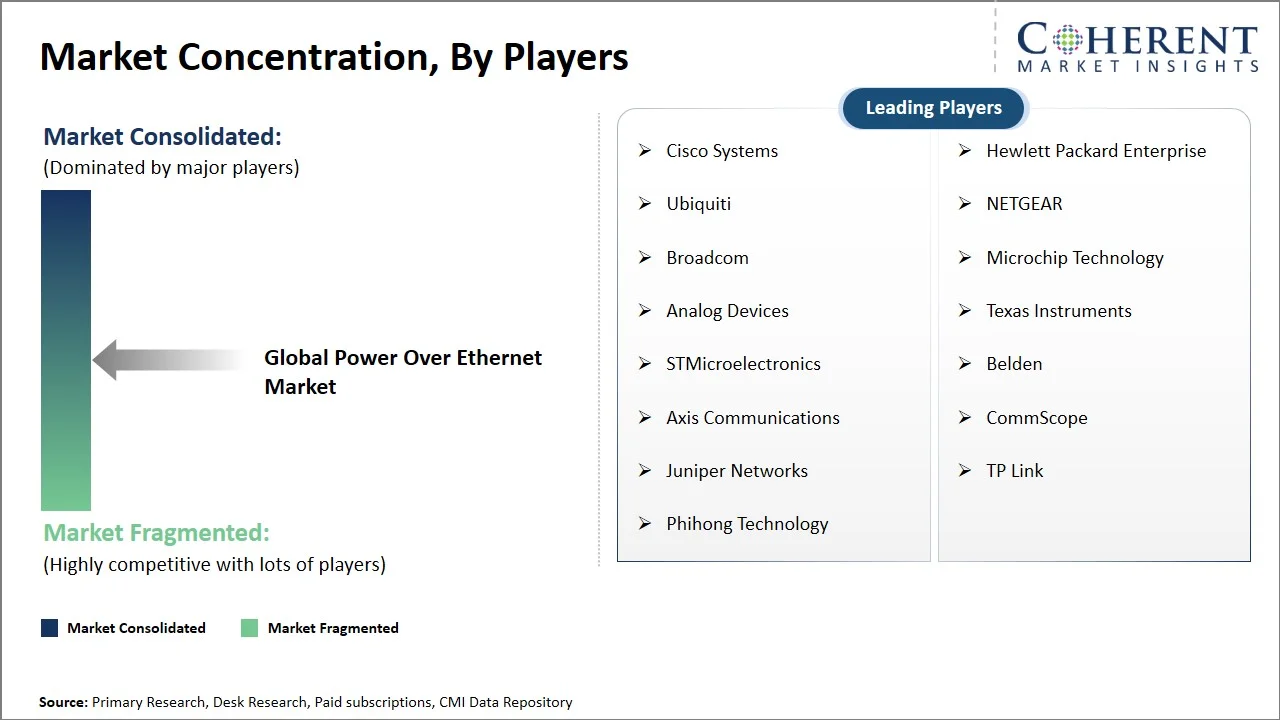
The global power over ethernet market comprises global networking-equipment companies, semiconductor and controller suppliers, industrial Ethernet specialists, injector and extender manufacturers, cabling providers, and cloud-management vendors. Competition is moderately fragmented across the value chain, although established networking brands retain advantages in enterprise accounts, channel coverage, installed-base compatibility, and software integration. Market positioning increasingly depends on delivering validated power, data, security, and management performance as an integrated system rather than competing only through maximum port wattage.
Key focus areas include
- Usable power capacity: Delivering stated per-port power while maintaining the total switch budget under high endpoint loads.
- Bandwidth-power integration: Combining multi-gigabit interfaces, high-power Power Over Ethernet, and resilient uplinks for wireless and video-intensive networks.
- Thermal and electrical performance: Managing heat, cable-bundle loading, surge conditions, and power-conversion efficiency.
- Management differentiation: Providing cloud visibility, remote port recovery, energy controls, analytics, APIs, and automated policies.
- Interoperability and security: Supporting recognized IEEE specifications, device classification, secure firmware, and documented update practices.
- Application durability: Offering industrial temperature ratings, redundant power inputs, ruggedized enclosures, and outdoor protection.
- Market reach: Building relationships with distributors, system integrators, electrical contractors, security installers, and managed-service providers.
- Supply and lifecycle reliability: Maintaining component availability, long-term technical support, firmware maintenance, and consistent product quality.
Market Report Scope
Power Over Ethernet Market Report Coverage
| Report Coverage | Details | ||
|---|---|---|---|
| Base Year: | 2025 | Market Size in 2026: | USD 1,521.8 Mn |
| Historical Data for: | 2020 To 2024 | Forecast Period: | 2026 To 2033 |
| Forecast Period 2026 to 2033 CAGR: | 12.80% | 2033 Value Projection: | USD 3,536.1 Mn |
| Geographies covered: |
| ||
| Segments covered: |
| ||
| Companies covered: | Cisco Systems, Hewlett Packard Enterprise, Ubiquiti, NETGEAR, Broadcom, Microchip Technology, Analog Devices, Texas Instruments, STMicroelectronics, Belden, Axis Communications, CommScope, Juniper Networks, TP Link, and Phihong Technology | ||
| Growth Drivers: |
| ||
| Restraints & Challenges: |
| ||
Analyst Opinion (Expert Opinion)
- The power over ethernet market will evolve from a connectivity feature into a distributed power architecture. Future procurement decisions will increasingly evaluate usable power density, network resilience, software control, cybersecurity, and lifecycle support together. Suppliers offering an integrated power-and-data platform will be better positioned than vendors competing primarily through headline wattage or port counts.
- The convergence of Power Over Ethernet++, multi-gigabit switching, Wi-Fi 7, intelligent video, and edge analytics will have a transformative effect on market development. Network upgrades will become application-led rather than hardware-led, encouraging closer collaboration among switch manufacturers, semiconductor companies, camera vendors, wireless-equipment suppliers, and building-automation specialists.
- Deployment barriers will shift toward infrastructure readiness and operational governance. Legacy cabling, cable-bundle heating, inadequate switch power reserves, cybersecurity exposure, and divided responsibility between IT and facilities teams can slow adoption. Market participants should prioritize certified interoperability, secure device management, modular power design, vertical-specific reference architectures, and strong system-integrator support to reduce customer risk and protect long-term margins.
- The most defensible competitive advantage will come from software and application expertise. Companies should build recurring value through energy visibility, remote diagnostics, automated endpoint recovery, cybersecurity updates, and performance analytics while tailoring solutions for surveillance, wireless networking, industrial automation, smart buildings, and public infrastructure.
Speak to the analyst
Want personalized insights?
Take the findings above to one of our principal consultants, or have the report rebuilt around the segments, geographies and competitors you actually track.
Market Segmentation
- Component Insights (Revenue, USD Mn, 2021 - 2033)
- PoE Switches
- PoE Controllers and ICs
- PoE Injectors and Midspans
- PoE Extenders and Splitters
- Others
- Standard Insights (Revenue, USD Mn, 2021 - 2033)
- IEEE 802.3af
- IEEE 802.3at
- IEEE 802.3bt Type 3
- IEEE 802.3bt Type 4
- Proprietary Standards and Others
- Application Insights (Revenue, USD Mn, 2021 - 2033)
- IP Cameras
- Wireless Access Points
- VoIP Phones
- Lighting and Building Automation
- Access Control and IoT Devices
- Others
- End User Insights (Revenue, USD Mn, 2021 - 2033)
- Commercial and Enterprise
- Industrial
- Government and Public Infrastructure
- Residential
- Others
- Regional Insights (Revenue, USD Mn, 2021 - 2033)
- North America
- U.S.
- Canada
- Latin America
- Brazil
- Argentina
- Mexico
- Rest of Latin America
- Europe
- Germany
- U.K.
- Spain
- France
- Italy
- Russia
- Rest of Europe
- Asia Pacific
- China
- India
- Japan
- Australia
- South Korea
- ASEAN
- Rest of Asia Pacific
- Middle East
- GCC Countries
- Israel
- Rest of Middle East
- Africa
- South Africa
- North Africa
- Central Africa
- North America
- Key Players Insights
- Cisco Systems
- Hewlett Packard Enterprise
- Ubiquiti
- NETGEAR
- Broadcom
- Microchip Technology
- Analog Devices
- Texas Instruments
- STMicroelectronics
- Belden
- Axis Communications
- CommScope
- Juniper Networks
- TP Link
- Phihong Technology
Source
Primary Research Interviews
- Manufacturers of PoE switches, controllers, ICs, injectors, midspans, extenders, splitters, and powered devices
- Suppliers of Ethernet PHYs, power-management chips, magnetics, connectors, structured cabling, and power supplies
- Manufacturers of IP cameras, wireless access points, VoIP phones, access-control, smart-lighting, and IoT devices
- Network architects, security integrators, building-automation specialists, contractors, distributors, and testing experts
Stakeholders
- Networking companies: Cisco Systems, Hewlett Packard Enterprise, Ubiquiti, NETGEAR, Juniper Networks, TP-Link, D-Link, Allied Telesis, and CommScope
- Semiconductor suppliers: Broadcom, Microchip Technology, Analog Devices, Texas Instruments, STMicroelectronics, NXP, and Marvell
- PoE infrastructure companies: Belden, Phihong Technology, Lantronix, Omnitron Systems, TRENDnet, and PLANET Technology
- End users: IP surveillance, wireless networking, smart buildings, industrial automation, access control, digital signage, and IoT companies
Databases
- UN Comtrade, ITC Trade Map, USITC DataWeb, Eurostat, and EU PRODCOM
- ITU ICT DataHub, World Bank, OECD, FCC, NTIA, China MIIT, India MeitY, Japan MIC, and METI
- NIST NVD, CISA databases, European Commission cybersecurity resources, and U.K. product-security databases
- Company annual reports, product catalogues, patents, investor presentations, and press releases
Industry Publications and Journals
- Cabling Installation & Maintenance, Lightwave, Network World, EE Times, Electronic Design, and SecurityInfoWatch
- IEEE Communications Magazine, IEEE Access, IEEE Internet of Things Journal, IEEE Sensors Journal, and Computer Networks
Associations and Standards Bodies
- IEEE 802.3 Ethernet Working Group
- Ethernet Alliance
- Telecommunications Industry Association
- BICSI
- Wi-Fi Alliance
- ONVIF
- BACnet International, KNX Association, IEC, ISO, UL, and NFPA
Public Domain Sources
- FCC, NTIA, U.S. DOE, NIST, CISA, and GSA
- European Commission, ENISA, Eurostat, and national telecom regulators
- India MeitY, Department of Telecommunications, TEC, and BIS
- China MIIT, Japan MIC and METI, and Korea Ministry of Science and ICT
Key Standards
- IEEE 802.3af, IEEE 802.3at, and IEEE 802.3bt
- ANSI/TIA-568 and TIA TSB-184
- ISO/IEC TR 29125
- IEC 62368-1
- NFPA 70
- UL limited-power cable requirements
- ONVIF interoperability profiles
Proprietary Elements
- CMI Data Analytics Tool, Proprietary CMI Existing Repository of information for last 10 years.
Get access to 250+ pages report
Every segment, forecast, competitor profile and data table behind the analysis above — available for instant download.
- ESOMAR Member
- ISO 9001:2015 Certified
- D-U-N-S Registered
- GDPR & CCPA Compliant
Missing comfort of reading report in your local language? Find your preferred language:
Transform your Strategy with Exclusive Trending Reports
Frequently Asked Questions
The CAGR of the global power over ethernet market is projected to be 12.80% from 2026 to 2033.
The global power over ethernet market is estimated to be valued at USD 1,521.8 million in 2026 and is expected to reach USD 3,536.1 million by 2033.
IP cameras lead the market due to their extensive deployment across commercial security, industrial monitoring, public infrastructure, and smart-city applications.
IEEE 802.3at is widely adopted because it offers suitable power capacity, broad device compatibility, and cost-effective deployment across enterprise networks.
Asia Pacific is expected to register the fastest growth, supported by smart-city development, enterprise network upgrades, manufacturing digitization, and expanding surveillance infrastructure.
IP surveillance and wireless network expansion increasing Power Over Ethernet deployment and smart building adoption supporting centralized power and data connectivity are the major factors driving the growth of the global power over ethernet market.
Cable distance and power loss limiting high wattage device installations and legacy network infrastructure increasing upgrade and integration costs are the major factors hampering the growth of the global power over ethernet market.