

Prefilled Safety Devices Market Size and Share Analysis- 2026 To 2033
The Prefilled Safety Devices Market size is anticipated to grow at a CAGR of 12.3%, with USD 11.2 Bn in 2026 and is expected to reach USD 25.24 Bn in 2033. The primary drivers are largely defined by the rising adoption of prefilled syringes and safety-engineered injection systems, increasing prevalence of chronic diseases requiring frequent injectable therapies, growing demand for self-administration of biologics and specialty drugs, and stringent regulations aimed at reducing needlestick injuries among healthcare professionals. CDC estimates that approximately 385,000 needlestick and other sharps-related injuries occur annually among hospital-based healthcare personnel in the U.S., supporting continued adoption of safety-engineered syringes and needle-protection mechanisms.
Key Takeaways
- The safety syringe segment is likely to dominate the market with 48.6% in 2026. The segment’s growth is owing to the increasing use of integrated needle-protection mechanisms, rising demand for safer injectable drug delivery, and stronger emphasis on reducing occupational exposure to bloodborne pathogens. According to the CDC/NIOSH, sharps injuries can expose healthcare workers to bloodborne pathogens such as hepatitis B, hepatitis C, and HIV, supporting continued adoption of safety-engineered injection devices.
- The passive safety mechanism segment is set to lead with 54.8% in 2026. The segment’s growth is owing to automatic activation of the safety feature after injection, reduced dependence on additional user steps, and growing preference for devices designed to minimize accidental needlestick exposure. In a 2026 U.S. FDA device review, a prefilled syringe needle guard was described as an anti-needlestick safety device that automatically activates once the pharmaceutical preparation has been delivered, with the guard covering the needle after it is removed from the skin.
- The hospital segment is expected to hold the largest share of 58.7% in 2026. The segment’s growth is owing to high injectable drug volumes, frequent use of flush syringes and parenteral therapies, and institutional requirements for safe and standardized injection practices. In August 2025, BD announced an investment of more than USD 35 million to expand prefilled flush syringe manufacturing in Nebraska, enabling production of hundreds of millions of additional units annually to meet demand from U.S. hospitals and health systems.
- North America is expected to acquire the prominent share of 39.4% in 2026. The region’s growth is owing to established pharmaceutical and medical-device manufacturing, strong adoption of biologics and GLP-1 therapies, safety-focused healthcare practices, and continued investment in domestic prefilled syringe capacity. In January 2026, BD announced a USD 110 million investment to expand U.S. production of prefillable syringes for biologic and GLP-1 drug delivery, including USD 100 million for BD Neopak glass prefillable syringe production in Nebraska.
Market Drivers
Rising Demand for Biologics and Self-Administration is Accelerating the Prefilled Safety Devices Market
The Prefilled Safety Devices Market is expanding owing to the rising use of biologic drugs, GLP-1 therapies, and other injectable treatments that increasingly require convenient and patient-friendly delivery systems. Prefilled syringes combined with passive needle-safety mechanisms help simplify administration while reducing preparation steps and improving protection after injection.
The shift toward home-based administration is also strengthening demand. In 2026, BD expanded its collaboration with Ypsomed to develop a 5.5 mL prefillable syringe compatible with the YpsoMate 5.5 autoinjector, targeting patients who need larger-volume self-injection of biologic therapies. This development is broadening the addressable opportunity for safety-enabled prefilled systems away from traditional low-volume injections.
Growing Focus on Needlestick Injury Prevention is Driving Adoption of Safety-Engineered Injection Devices
Needlestick and sharps injuries continue to be a significant occupational safety issue in hospitals, clinics and other healthcare settings. Healthcare institutions and manufacturers are therefore turning more often to retractable needles, automatic shields and passive safety mechanisms with prefilled syringes.
In January 2025 BD said new U.S. manufacturing lines would increase its capacity for safety-engineered injection devices by more than 40% and conventional syringe capacity by more than 50%. The expansion is expected to add hundreds of millions of units annually for uses including medication delivery, vaccination and hospital procedures.
Current Events and Their Impact on the Prefilled Safety Devices Market
Current Event | Description and its Impact |
OSHA Reinforces Safety-Engineered Sharps Requirements in U.S. Healthcare Settings (2026) |
|
FDA Strengthens Review of Needle-Safety Features in Prefilled Syringe Combination Products (2025–2026) |
|
- Current Industry Events of 2026
- Market Size Estimation
- Regional Breakdown
- Competitive Landscape
- Customer Intelligence
- Segmental Analysis
- Pricing Analysis
- Key Market Drivers, Challenges & Future Trends
- Customized Insights Section
Segmental Insights
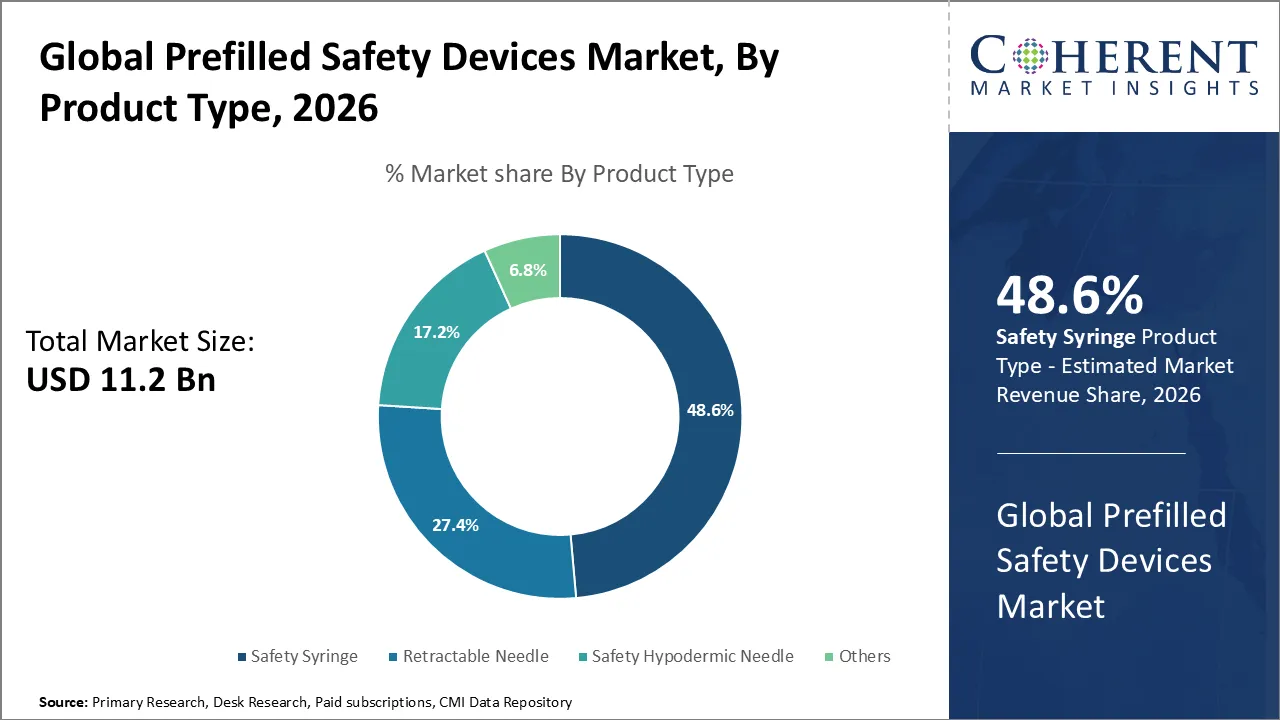
Why are Safety Syringes Acquiring the Largest Share?
On the basis of product type, the safety syringe segment is projected to account for the largest Prefilled Safety Devices Market share of 48.6% in 2026. The segment’s growth is owing to the increasing need to minimize occupational needlestick injuries, wider adoption of engineered sharps-injury protection, and growing use of safety-enabled injection systems across hospitals and other healthcare facilities.
According to the U.S. Occupational Safety and Health Administration (OSHA), studies have shown that as many as one-third of sharps injuries in hospital settings occur during sharps disposal, while nurses sustain the greatest number of needlestick injuries. OSHA consequently requires effective and clinically appropriate safety-engineered sharps to be evaluated and implemented where they can minimize employee exposure.
In October 2025, Owen Mumford expanded its 1 mL safety syringe platform with the launch of the EcoSafe system, combining its safety syringe with a reusable autoinjector. The company positioned the platform for patients requiring easier and safer self-administration, including people with limited dexterity or needle anxiety.
Why is the Passive Safety Mechanism Segment Acquiring the Largest Share?
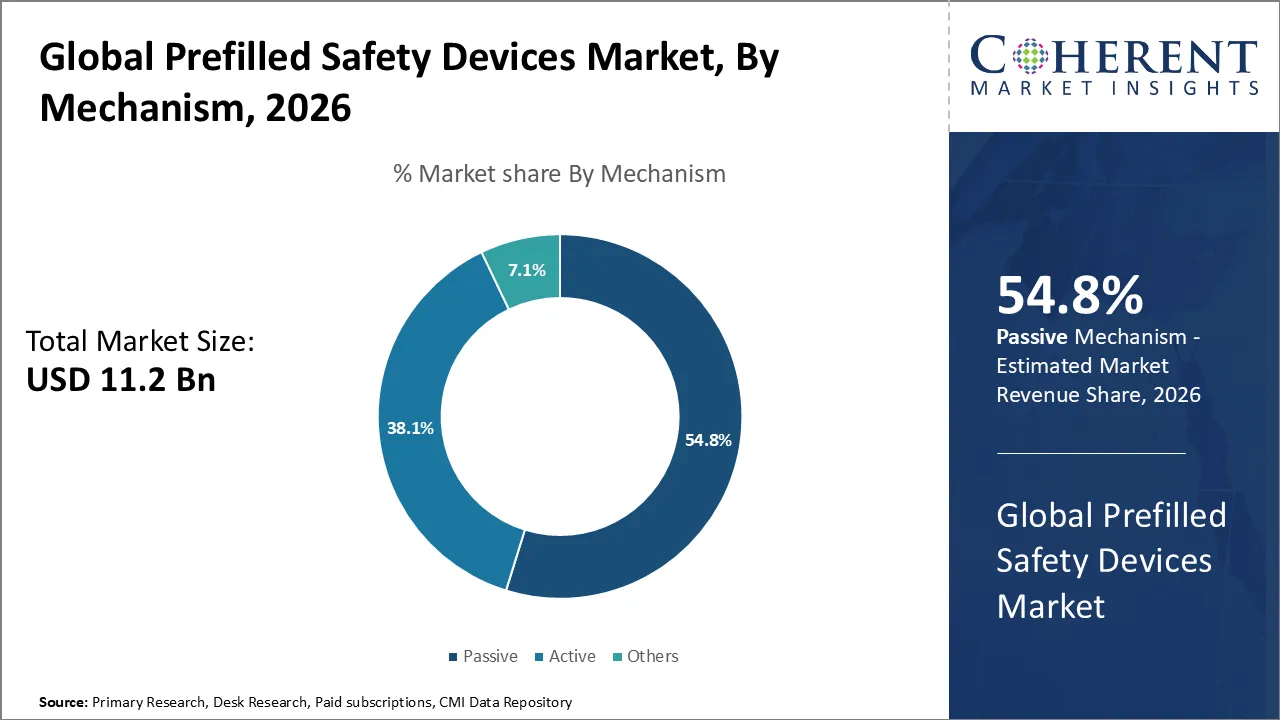
On the basis of mechanism, the passive safety mechanism segment is set to lead with 54.8% share in 2026. The segment’s growth is owing to automatic needle protection after injection, reduced dependence on healthcare-worker activation, lower risk of incorrect safety-device engagement, and suitability for integration with ready-to-use prefilled syringes.
BD’s UltraSafe Plus 2.25 mL Passive Needle Guard provides another indicator of commercial maturity. The system supports 1 mL and 2.25 mL prefilled syringe formats, can be used by patients, caregivers, and healthcare professionals, and is validated for manual delivery of formulations with viscosity of up to 30 cP in the 2.25 mL format.
In January 2026, Terumo launched its SurTract Safety Syringe in the U.S. with SafeR passive safety technology. The system uses a fully passive automatic retraction mechanism that withdraws the needle into the plunger immediately after use, while preserving standard clinical injection technique.
Why are Hospitals Acquiring the Largest Market Share?
On the basis of end user, the hospital segment is expected to hold the largest Prefilled Safety Devices Market share of 58.7% in 2026. The segment’s growth is owing to high volumes of injectable medications, catheter flushing procedures, inpatient drug administration, and stringent requirements for infection prevention and healthcare-worker safety.
BD also stated that its prefilled flush devices are used in nearly every hospital across the U.S. for catheter care and maintenance. Moreover, over the preceding three years, the company invested more than USD 80 million in expanding its U.S. prefilled flush syringe capacity, increasing production capacity by more than 750 million units.
Prefilled Safety Devices Market Trends
- The growing shift toward prefilled formats for established therapies and vaccines is expanding the use of ready-to-administer delivery systems. In July 2025, the U.S. FDA approved a pre-filled syringe presentation of GSK’s Shingrix vaccine, eliminating the need to reconstitute the vaccine before administration. The development reflects increasing pharmaceutical interest in simplifying preparation and reducing handling steps at the point of care.
- The rising adoption of self-administered prefilled biologics is strengthening demand for integrated safety and convenience features. In April 2025, the FDA approved a prefilled syringe version of argenx’s Vyvgart Hytrulo for at-home self-administration. Vyvgart generated approximately USD 2.2 billion in global sales in 2024, indicating the commercial scale of therapies transitioning toward patient-controlled prefilled delivery.
- The market is increasingly moving toward large-volume passive safety systems for biologics. In September 2026, SCHOTT Pharma and Nemera launched fully compatible passive safety system incorporating a 5.5 mL prefillable glass syringe. A U.S. human-factors study conducted in July 2026 with 30 participants achieved 100% successful injections and a mean injection time below 30 seconds.
Regional Insights
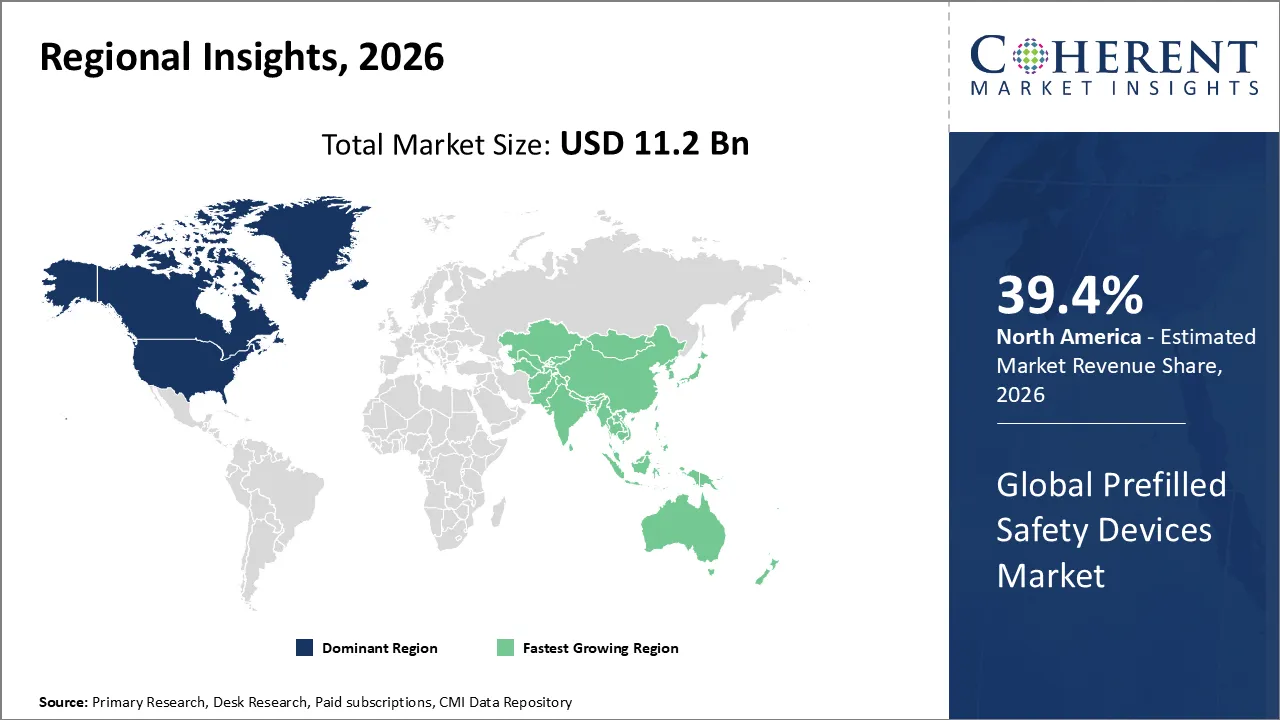
North America Dominates Owing to the Strong Regulatory Framework and High Adoption of Safety-Engineered Injection Devices
The North America region accounts for 39.4% of the Prefilled Safety Devices Market share in 2026. The region’s growth is owing to the high adoption of prefilled injectable therapies, established safety-device regulations, strong biologics and biosimilars pipeline, and continued introduction of safety-engineered syringes across hospital and homecare settings.
In July 2026, the U.S. FDA granted 510(k) clearance to embecta Medical’s Ultra-Fine SAFETY Insulin Syringe, classified as a piston syringe with an additional safety-related product code. The clearance demonstrates continued commercial introduction of safety-engineered syringe technologies in the U.S. market.
Stevanato Group reported in its 2026 Form 20-F that approximately 95% of the syringe market has already transitioned to ready-to-use prefillable syringes, illustrating the high maturity of prefilled formats compared with vials and cartridges.
Asia Pacific Prefilled Safety Devices Market Trends
Asia Pacific is expected to be the fastest-growing region in the Prefilled Safety Devices Market over the forecast period. The region’s growth is owing to expanding biologics manufacturing, increasing adoption of self-administered injectable therapies, greater availability of prefilled drug presentations, and investments in pharmaceutical fill-finish capacity across China, India, Japan, and other Asian markets.
In June 2026, Alkem Laboratories launched semaglutide in India in single-shot prefilled syringes after receiving approval from the Drugs Controller General of India (DCGI).
In July 2025, WuXi Biologics announced that its commercial prefilled syringe production line had successfully passed its first U.S. FDA Pre-License Inspection, as part of five manufacturing facility inspections. The company attained 100% success rate in passing its PLIs and further cemented China as a global manufacturing base for prefilled biologic products.
Strong Regulatory Support and Expanding Safety-Engineered Syringe Availability is Accelerating the Prefilled Safety Devices Market in the United States
The U.S. Prefilled Safety Devices Market is witnessing strong growth due to the existing regulatory framework for sharps-injury prevention, high penetration of injectable biologics and continuous introduction of safety-engineered syringes.
The wider injectable drug-delivery ecosystem is also supporting demand. Stevanato Group reported a 20% year-over-year increase in global demand for prefillable syringes in the first quarter of 2026, with biologics-related high-value solutions growing 15% year-over-year. The company is simultaneously ramping its Fishers, Indiana facility for syringe production and device contract manufacturing, highlighting rising U.S. demand for advanced prefilled drug-delivery systems.
China Prefilled Safety Devices Market Trends
China is expected to witness strong growth in the Prefilled Safety Devices Market over the forecast period. The growth is owing to the rapid expansion of biologics manufacturing, increasing domestic prefilled syringe capacity, and greater integration of safety and automated combination-device formats into injectable drug programs.
In May 2026, WuXi Biologics announced GMP release of its DP15 drug-product facility in Shanghai, its 18th operational drug-product facility globally. The facility supports several delivery formats including prefilled syringes, dual-chamber cartridges, and safety and automated combination products.
China also has substantial domestic prefilled-syringe manufacturing capacity. 3SBio reports annual production capacity of 333 million vials and prefilled syringes, supported by four manufacturing sites and four CDMO bases.
Who are the Major Companies in Prefilled Safety Devices Industry
Some of the major key players in Prefilled Safety Devices Market are Retractable Technologies, Inc., Becton, Dickinson and Company, B.Braun Melsungen AG, Axel Bio Corporation, DMC Medical Limited, Sol-Millennium, Medigard Limited, Smiths Medical Inc., Globe Medical Tech, Inc., and UltiMed, Inc.
Key News
- In March 2026, Retractable Technologies reported a 15.8% increase in 2025 revenue to approximately USD 38.3 million, compared with USD 33.0 million in 2024. Domestic revenue increased 9.7%, driven primarily by higher VanishPoint and EasyPoint sales, while international revenue increased 64.0%, mainly owing to stronger EasyPoint retractable needle sales.
- In September 2024, BD commercially released the BD Neopak XtraFlow Glass Prefillable Syringe, designed for higher-viscosity biologic formulations. The syringe incorporates an 8 mm needle and thinner-wall cannula to reduce injection force and injection time.
Market Report Scope
Prefilled Safety Devices Market Report Coverage
Report Coverage | Details | ||
Base Year: | 2025 | Market Size in 2026: | USD 11.2 Bn |
Historical Data for: | 2020 to 2024 | Forecast Period: | 2026 to 2033 |
CAGR: | 12.3% | 2033 Value Projection: | USD 25.24 Bn |
Geographies covered: |
| ||
Segments covered: |
| ||
Companies covered: | Retractable Technologies, Inc., Becton, Dickinson and Company, B.Braun Melsungen AG, Axel Bio Corporation, DMC Medical Limited, Sol-Millennium, Medigard Limited, Smiths Medical Inc., Globe Medical Tech, Inc., and UltiMed, Inc. | ||
Growth Drivers: |
| ||
Restraints & Challenges: |
| ||
Analyst Opinion
- The Prefilled Safety Devices Market is structurally supported by regulatory requirements for safer injection practices, particularly in hospitals and other high-use healthcare settings. In 2026, OSHA reiterated that when an effective and clinically appropriate safety-engineered sharp is available, employers must evaluate and implement it. OSHA further notes that as many as one in three hospital sharps injuries occur during disposal, highlighting the long-term need for syringes with built-in protective features.
- The market is also benefiting from the rapid expansion of biologic and GLP-1 injectable therapies, which is increasing demand for ready-to-use and prefillable delivery platforms. In January 2026, BD announced a USD 110 million U.S. investment, including USD 100 million to establish BD Neopak glass prefillable syringe production in Nebraska, specifically citing growing demand for biologic and GLP-1 drug delivery.
- Passive and integrated safety mechanisms are likely to remain an important area of product differentiation because they reduce dependence on manual post-injection actions. In February 2025, CDC/NIOSH highlighted retracting needles, sliding sheaths, and hinged needle shields as examples of safety-engineered sharps devices used to prevent occupational exposure to bloodborne pathogens.
Speak to the analyst
Want personalized insights?
Take the findings above to one of our principal consultants, or have the report rebuilt around the segments, geographies and competitors you actually track.
Market Segmentation
- By Product Type (Revenue, USD Bn, 2021-2033)
- Retractable Needle
- Safety Syringe
- Syringe with Protective Shield
- Syringe with Retractable Needle
- Manual
- Automated
- Safety Hypodermic Needle
- Others
- By Mechanism (Revenue, USD Bn, 2021-2033)
- Active
- Passive
- Others
- By End User (Revenue, USD Bn, 2021-2033)
- Hospitals
- Clinics
- Others
- By Region (Revenue, USD Bn, 2021-2033)
- North America
- U.S.
- Canada
- Latin America
- Brazil
- Mexico
- Argentina
- Rest of Latin America
- Europe
- Germany
- U.K.
- France
- Italy
- Spain
- Russia
- Rest of Europe
- Asia Pacific
- China
- India
- Japan
- Australia
- South Korea
- ASEAN
- Rest of Asia Pacific
- Middle East
- GCC
- Israel
- Rest of Middle East
- Africa
- South Africa
- Central Africa
- North Africa
- North America
Sources
Primary Research Interviews
- Prefilled syringe and safety device manufacturers
- Pharmaceutical and biologics manufacturers
- Drug-device combination product developers
- Hospital procurement and supply chain managers
- Injection safety and infection control professionals
- Contract development and manufacturing organizations (CDMOs)
- Key opinion leaders (KOLs) in injectable drug delivery and medical devices
Databases
- U.S. Food and Drug Administration (FDA) – 510(k), Drugs@FDA, and Purple Book
- European Medicines Agency (EMA)
- EUDAMED – European Database on Medical Devices
- Centers for Disease Control and Prevention (CDC)
- Occupational Safety and Health Administration (OSHA)
- World Health Organization (WHO)
- U.S. National Library of Medicine – AccessGUDID
- ClinicalTrials.gov
Magazines
- Drug Delivery & Development
- ONdrugDelivery
- Pharmaceutical Technology
- European Pharmaceutical Review
- Medical Device and Diagnostic Industry (MD+DI)
- Pharmaceutical Manufacturing
Journals
- International Journal of Pharmaceutics
- Journal of Pharmaceutical Sciences
- PDA Journal of Pharmaceutical Science and Technology
- Drug Development and Industrial Pharmacy
- Expert Opinion on Drug Delivery
- AAPS PharmSciTech
Newspapers
- Reuters
- Financial Times
- The Wall Street Journal
- The Economic Times
- Business Standard
Associations
- Parenteral Drug Association (PDA)
- International Organization for Standardization (ISO)
- Association for the Advancement of Medical Instrumentation (AAMI)
- Medical Device Manufacturers Association (MDMA)
- MedTech Europe
- International Safety Center
- Pharmaceutical and Healthcare Sciences Society (PHSS)
Public Domain Sources
- Company Annual Reports and Investor Presentations
- FDA 510(k), Drugs@FDA, and Purple Book Records
- EMA and European Commission Regulatory Publications
- CDC and OSHA Injection Safety and Sharps Injury Publications
- WHO Injection Safety and Healthcare Publications
- Company Product Catalogues, Press Releases, and Technical Documents
- Patent Databases such as WIPO, USPTO, EPO, and Google Patents
- Clinical Trial Registries and Peer-Reviewed Publications
- ISO Standards Related to Prefilled Syringes, Needle Protection, and Sharps Safety
Proprietary Elements
- CMI Data Analytics Tool
- Proprietary CMI Existing Repository of Information for the Last 10 Years
Get access to 250+ pages report
Every segment, forecast, competitor profile and data table behind the analysis above — available for instant download.
- ESOMAR Member
- ISO 9001:2015 Certified
- D-U-N-S Registered
- GDPR & CCPA Compliant
Missing comfort of reading report in your local language? Find your preferred language:
Transform your Strategy with Exclusive Trending Reports
Frequently Asked Questions
The Prefilled Safety Devices Market is expected to reach USD 25.24 Bn in 2033, from USD 11.2 Bn in 2026.
Major players operating in the global Prefilled Safety Devices Market include Retractable Technologies, Inc., Becton, Dickinson and Company, B. Braun Melsungen AG, Axel Bio Corporation, DMC Medical Limited, Sol-Millennium, Medigard Limited, Smiths Medical Inc., Globe Medical Tech, Inc., and UltiMed, Inc.
The high manufacturing and device integration costs and stringent regulatory and safety compliance requirements are the key factors hampering growth of the market.
The increasing adoption of safety-engineered syringes to reduce needlestick injuries and the rising use of prefilled syringes for biologics and injectable therapies are boosting demand for prefilled safety devices.
The Prefilled Safety Devices Market is anticipated to grow at a CAGR of 12.3% between 2026 and 2033.
Among regions, North America is expected to account for the largest market share of 39.4% in 2026, supported by strong adoption of prefilled injectable therapies, established safety-device regulations, and a well-developed biologics and biosimilars ecosystem.
Asia Pacific is expected to be the fastest-growing region over the forecast period, driven by expanding biologics manufacturing, increasing adoption of self-administered injectable therapies, and investments in pharmaceutical fill-finish capacity across China, India, Japan, and other Asian countries.