

Handheld Backscatter X-Ray Device Market Size and Share Analysis- Growth Trends and Forecasts (2026-2033)
The Handheld Backscatter X-Ray Device Market size is anticipated to grow at a CAGR of 7.2% with USD 167 Mn in 2026 and is expected to reach USD 271 Mn in 2033. The growth of the market is being driven by the increasing drug interdiction operations, rising customs and border inspection needs, portable security screening demand, and growing use of non-intrusive inspection tools in law enforcement. According to UNODC World Drug Report 2025, 316 million people used drugs in 2023, while cocaine production, seizures, and use reached new highs, strengthening demand for concealed-threat detection technologies.
Key Takeaways
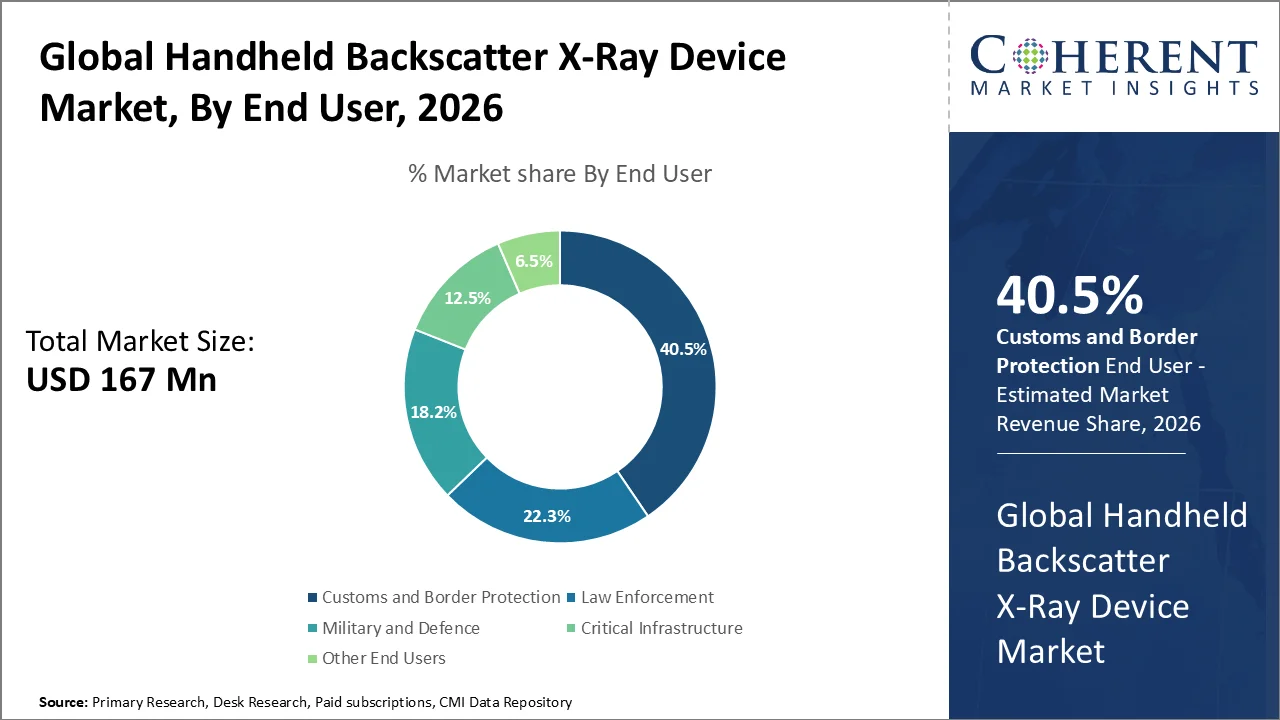
- The customs and border protection segment is expected to account for the largest share of 40.5% in 2026. The segment’s growth is owing to the rising use of handheld non-intrusive inspection systems for detecting narcotics, weapons, explosives, undeclared currency, and concealed contraband at airports, seaports, land borders, and checkpoints. CBP processes over 1.13 million passengers and pedestrians daily, supporting demand for faster portable screening tools.
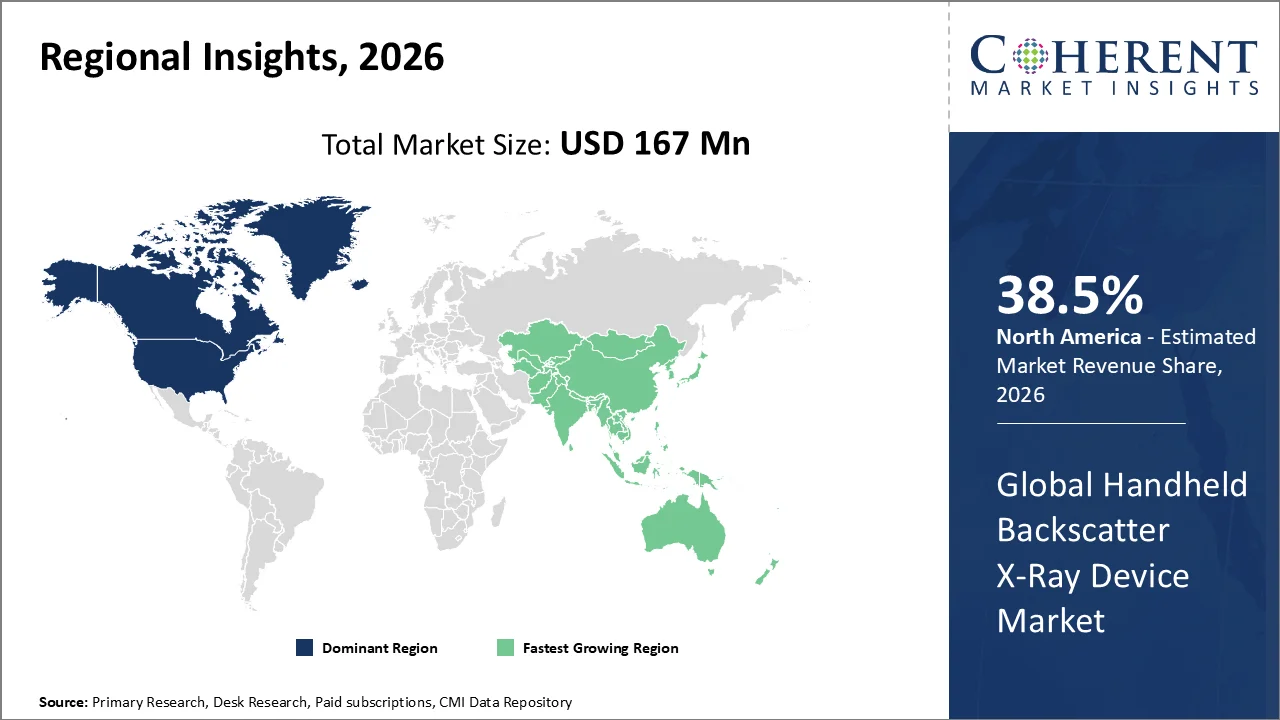
- North America is expected to acquire the dominant share of 38.5% in 2026. The region’s growth is owing to the owing to strong border-security spending, advanced law-enforcement procurement, and wider adoption of X-ray inspection technologies across U.S. and Canadian agencies. GAO noted that CBP uses X-ray-based non-intrusive inspection machines to detect illegal drugs and contraband at land ports of entry.
Segmental Insights
Why the Customs and Border Protection Segment Is Acquiring the Highest Share in the Handheld Backscatter X-Ray Device Market
By application, customs and border protection segment is projected to account for the largest Handheld Backscatter X-Ray Device Market share of 40.5% in 2026. The segment’s growth is owing to the high inspection volumes at land ports, seaports, airports, and cargo checkpoints.
GAO reported that CBP uses NII systems such as X-ray machines to inspect vehicles and travelers at land ports of entry, and Congress directed CBP to develop a plan to achieve 100% scanning of commercial and passenger vehicles and freight rail at land ports using large-scale NII by 2027. Handheld backscatter systems support this infrastructure by enabling secondary screening, tactical checks, and targeted inspection of vehicle compartments.
In June 2026, OSI Systems received a USD 19 million North American order to support the deployment of non-intrusive inspection systems at cargo and vehicle inspection checkpoints like civil works and systems integration. This highlights the continued investment in border-screening infrastructure, thereby supporting the demand within the customs and border protection end-user segment.
- Current Industry Events of 2026
- Market Size Estimation
- Regional Breakdown
- Competitive Landscape
- Customer Intelligence
- Segmental Analysis
- Pricing Analysis
- Key Market Drivers, Challenges & Future Trends
- Customized Insights Section
Rising Narcotics Interdiction is Transforming the Handheld Backscatter X-Ray Device Industry
The rising narcotics trafficking through vehicles, parcels, cargo containers, and concealed compartments is a major driver for handheld backscatter X-ray devices. These devices are valuable owing to their ability to support quick, one-sided inspection of hard-to-reach areas without dismantling vehicles or cargo.
According to the U.S. GAO, the non-intrusive inspection equipment contributed to at least 1,030 fentanyl-related seizures at ports of entry from FY2021 to FY2024, resulting in about 20,400 pounds of fentanyl, 290 pounds of fentanyl precursor chemicals, and 1,370 pieces of production equipment seized.
The GAO also reported that targeting activities contributed to at least 2,530 fentanyl-related seizures at ports of entry, resulting in about 11,300 pounds of fentanyl seized during the same period. This creates a strong operational case for portable backscatter systems which can complement fixed scanners, canine teams, as well as manual inspection.
Z Backscatter Imaging: A Key Advancement in Handheld Backscatter X-Ray Device Marketplace
Z Backscatter imaging is emerging as a key advancement in the Handheld Backscatter X-Ray Device Market. It allows for rapid and non-intrusive inspection of vehicle panels, cargo surfaces, baggage, walls, furniture, aircraft interiors, and concealed compartments without dismantling the target object.
The technology works by detecting reflected X-rays, rather than depending only on transmission through materials, which makes it highly useful for identifying organic materials like drugs, explosives, currency, and other concealed contraband. This capability supports customs, law enforcement, aviation security, as well as defense agencies in screening hard-to-reach or suspicious areas with improved operational efficiency.
Rapiscan states that its MINI Z handheld system supports inspection of vehicles, walls, furniture, packages, and other confined locations. Aligning with this demand, the procurement activity is increasing internationally. In February 2026, the U.S. Department of State issued a formal RFQ to acquire four handheld Z Backscatter screening systems for the international customs security operations.
Current Events and Their Impact
Current Event | Description and its Impact |
WCO Illicit Trade Report 2024 released in February 2026
|
|
GAO 2025–2026 findings on CBP non-intrusive inspection gaps
|
|
Handheld Backscatter X-Ray Device Market Trends
- Security agencies are moving beyond fixed scanners toward mobile and handheld systems that can be deployed during vehicle stops, tactical raids, special events, and emergency response.
- Border agencies are investing in non-intrusive inspection technologies to increase screening coverage without slowing legal trade and travel. GAO reported that CBP had 52 of 153 planned large-scale NII systems fully operational as of February 2025, thereby showing active investment in inspection infrastructure.
- Backscatter imaging is valued as it highlights organic threats like narcotics, explosives, and currency. The NUCTECH states that its BXM2000 portable scanner highlights organic materials that can be lost in X-ray transmission systems like explosives, coins, and drugs.
- Adoption is linked to compliance with radiation safety rules. FDA’s cabinet X-ray system requirements under 21 CFR 1020.40 include safety interlocks, key-actuated controls, and X-ray generation indicators. OSHA states that radiation protection programs are best practice for protecting workers from ionizing radiation.
- Companies are positioning handheld and portable inspection systems alongside vehicle scanners, cargo systems, trace detection, and software. Rapiscan reports more than 100,000 systems installed, 26 global service centers, and supply to 170+ countries, supporting lifecycle service and cross-selling opportunities.
Regional Insights
North America Handheld Backscatter X-Ray Device Market Leadership Driven by Border Security Procurement and Strong Technology Adoption
North America is set to account for the leading position in the Handheld Backscatter X-Ray Device Market. The region occupies a substantial 38.5% share in 2026. The growth is mainly driven by the U.S. customs modernization, law enforcement demand, homeland security spending, and domestic supplier presence. The region also benefits from firms like Rapiscan Systems and Viken Detection, which offer Z Backscatter and handheld X-ray imaging platforms.
In February 2025, Videray Technologies launched APX, a next-generation electronics platform standard across its handheld X-ray devices. It helps in enhancing imaging precision, speed, connectivity, as well as storage while maintaining compact, durable design. APX empowers professionals in safety, security, and NDT applications to perform inspections more efficiently and confidently.
Asia Pacific Handheld Backscatter X-Ray Device Market Trends
The Asia Pacific region is poised to be as the fastest-growing region through 2026-2033. The region’s growth is owing to the expanding airports, cross-border trade, urban security, and customs modernization across China, India, Japan, South Korea, Australia, and ASEAN. ACI World projected Asia-Pacific as a major contributor to global passenger traffic recovery, and global passenger traffic is forecast to reach 10.2 billion in 2026.
In December 2023, Micro-X launched the Argus X-ray Camera, featuring proprietary CNT and WASP backscatter technologies that allow for lightweight, high-definition imaging with reduced power consumption. The system allows stand-off threat detection, rapid deployment, and safer operations for counter-IED and high-risk search missions.
High Border Traffic and Contraband Interdiction Priorities Accelerates Handheld Backscatter X-Ray Device Adoption in United States
The United States Handheld Backscatter X-Ray Device Market has seen robust growth. The growth is owing to the high border traffic, fentanyl and narcotics interdiction priorities, and established procurement channels for inspection technologies.
CBP’s NII program and GAO’s findings on deployment gaps are expected to support continued spending on fixed, mobile, and handheld inspection systems. GAO reported that nine southwest border crossings omitted from deployment plans accounted for nearly 40% of passenger vehicle traffic at that border in FY2024.
In February 2024, Videray Technologies Inc. announced the launch of the PXT, the industry’s first handheld 140kV transmission X-ray generator. The PXT can penetrate up to 30 mm of steel. It delivers 100 μm resolution. This enhances security and NDT inspections.
China Handheld Backscatter X-Ray Device Market Trends
China Handheld Backscatter X-Ray Device Market is rapidly evolving with the expansion of domestic security inspection manufacturing, airport modernization, and public safety upgrades. The State Administration for Market Regulation has issued a national standard for micro-dose X-ray security inspection systems. It encompasses backscatter and low-dose X-ray devices which streamlines technical requirements and facilitates procurement across customs, ports, as well as transport hubs.
Concurrently, China’s General Administration of Customs (GACC) initiated spot checks on digital radiography and mobile X-ray units from June 1, 2026. This emphasizes safety, electromagnetic compatibility, and performance compliance. These regulatory measures reinforce quality control and encourage wider adoption of cutting edge inspection technologies nationwide.
Who are the Major Companies in Handheld Backscatter X-Ray Device Industry
Some of the major key players in Handheld Backscatter X-Ray Device industry are Nutech Company Limited, Viken Detection (formerly Heuresis Inc.), and Rapiscan Systems Inc. (a part of OSI Systems Inc.), among others.
Key News
- In May 2026, OSI Systems received a USD 15 million task order from the U.S. government customer to supply cargo and vehicle inspection systems like follow-on service and support. The award highlights continual confidence in OSI’s inspection technologies and their ability to deliver complex programs with full lifecycle maintenance and operational support.
- In July 2025, Inspectahire introduced the Videray PX1, a handheld backscatter X-ray imager offering enhanced power, a larger detector, and user-friendly design for efficient non-intrusive inspections. The PX1 provides deep surface penetration with a 140 keV source while minimizing user exposure and supporting the versatile inspection applications.
Market Report Scope
Handheld Backscatter X-Ray Device Market Report Coverage
| Report Coverage | Details | ||
|---|---|---|---|
| Base Year: | 2025 | Market Size in 2026: | USD 167 Mn |
| Historical Data for: | 2020 To 2024 | Forecast Period: | 2026 To 2033 |
| Forecast Period 2026 to 2033 CAGR: | 7.2% | 2033 Value Projection: | USD 271 Mn |
| Geographies covered: |
| ||
| Segments covered: |
| ||
| Companies covered: | Nutech Company Limited, Viken Detection (formerly Heuresis Inc.), and Rapiscan Systems Inc. (a part of OSI Systems Inc.), among others. | ||
| Growth Drivers: |
| ||
| Restraints & Challenges: |
| ||
Analyst Opinion
- Handheld backscatter X-ray device demand is driven by border security and contraband detection needs. CBP seized 1,598 pounds of drugs on a typical day in FY2025, including 33 pounds of fentanyl, showing why agencies need rapid field inspection tools.
- Customs and law enforcement remain core users because non-intrusive inspection helps detect threats without delaying cargo and vehicle movement. CBP uses X-ray-based NII systems at land ports to inspect vehicles and travelers for illegal drugs and contraband.
- Portable backscatter systems are gaining traction because they can scan vehicle panels, cargo, suspicious packages, and hidden compartments without opening the object. Newer devices such as Videray PX1 use a 140 keV source, larger detector, imaging filters, and low-exposure design, supporting adoption across customs, EOD, law enforcement, and critical infrastructure.
Speak to the analyst
Want personalized insights?
Take the findings above to one of our principal consultants, or have the report rebuilt around the segments, geographies and competitors you actually track.
Market Segmentation
- By End User (Revenue, USD Mn, 2021-2033)
- Customs and Border Protection
- Law Enforcement
- Critical Infrastructure
- Military and Defence
- Other End Users
- Global Handheld Backscatter X-Ray Device Market, By Region (Revenue, USD Mn, 2021-2033)
- North America
- U.S.
- Canada
- Latin America
- Brazil
- Mexico
- Argentina
- Rest of Latin America
- Europe
- Germany
- U.K.
- France
- Italy
- Spain
- Russia
- Rest of Europe
- Asia Pacific
- China
- India
- Japan
- Australia
- South Korea
- ASEAN
- Rest of Asia Pacific
- Middle East
- GCC
- Israel
- Rest of Middle East
- Africa
- South Africa
- Central Africa
- North Africa
- North America
- Key Players
- Nutech Company Limited
- Viken Detection (formerly Heuresis Inc.)
- Rapiscan Systems Inc. (a part of OSI Systems Inc.)
Sources
Primary Research Interviews
- Handheld Backscatter X-Ray Device Manufacturers
- Portable X-Ray Inspection System Suppliers
- Security Screening Equipment Integrators
- Customs & Border Inspection Officials
- Law Enforcement and Bomb Disposal Units
- Non-Destructive Testing (NDT) Engineers
- Radiation Safety Officers and Health Physicists
- Defense and Homeland Security Procurement Experts
- Industrial Inspection Service Providers
- Others
Databases
- Bloomberg Terminal
- Thomson Reuters Eikon
- Factiva
- Dun & Bradstreet Hoovers
- PitchBook
- ImportGenius / Panjiva Trade Data
- Others
Magazines
- Security Management Magazine
- Security Today
- Security Technology Executive
- Homeland Security Today
- NDT.net
- Quality Magazine
- Materials Evaluation Magazine
- Transport Security International
- Others
Journals
- Journal of Nondestructive Evaluation
- NDT & E International
- Insight – Non-Destructive Testing and Condition Monitoring
- Journal of X-Ray Science and Technology
- Radiation Protection Dosimetry
- Health Physics Journal
- IEEE Transactions on Nuclear Science
- Applied Radiation and Isotopes
- Others
Newspapers
- Reuters
- Bloomberg News
- Financial Times
- The Wall Street Journal
- Defense News
- The Washington Post
- The New York Times
- Others
Associations
- American Society for Nondestructive Testing (ASNT)
- Health Physics Society (HPS)
- International Radiation Protection Association (IRPA)
- International Atomic Energy Agency (IAEA)
- ASIS International
- Security Industry Association (SIA)
- ASTM International
- National Council on Radiation Protection and Measurements (NCRP)
- Others
Public Domain Sources
- U.S. Food and Drug Administration (FDA) – Radiation-Emitting Products
- U.S. Environmental Protection Agency (EPA) – Radiation Protection
- International Atomic Energy Agency (IAEA)
- U.S. Department of Homeland Security (DHS)
- U.S. Customs and Border Protection (CBP)
- Transportation Security Administration (TSA)
- European Commission – Radiation Protection
- National Institute of Standards and Technology (NIST)
- Occupational Safety and Health Administration (OSHA)
- Others
Proprietary Elements
CMI Data Analytics Tool, Proprietary CMI Existing Repository of Information for the Last 10 Years
Get access to 250+ pages report
Every segment, forecast, competitor profile and data table behind the analysis above — available for instant download.
- ESOMAR Member
- ISO 9001:2015 Certified
- D-U-N-S Registered
- GDPR & CCPA Compliant
Missing comfort of reading report in your local language? Find your preferred language:
Transform your Strategy with Exclusive Trending Reports
Frequently Asked Questions
The Handheld Backscatter X-Ray Device Market is expected to reach USD 271 million in 2033.
Major players operating in the global Handheld Backscatter X-Ray Device Market include Nutech Company Limited, Viken Detection (formerly Heuresis Inc.), and Rapiscan Systems Inc. (a part of OSI Systems Inc.), among others.
The exorbitant procurement and maintenance costs, strict regulatory limits on ionizing radiation, and public health/privacy concerns are the key factors hampering growth of the market.
The increasing need for rapid, non-intrusive threat detection at border checkpoints and transportation hubs, rising global smuggling of illicit drugs and weapons is boosting demand for Handheld Backscatter X-Ray Device.
The Handheld Backscatter X-Ray Device Market is anticipated to grow at a CAGR of 7.2% between 2026 and 2033.
The market outlook remains positive due to rising border security needs, contraband detection, defense modernization, critical infrastructure protection, and adoption of portable non-intrusive inspection systems.
The market encompasses handheld backscatter X-ray devices, imaging software, accessories, maintenance, and support services used for portable non-intrusive inspection applications globally.