

Vaccine Delivery Devices Market Size and Share Analysis- 2026 To 2033
The Vaccine Delivery Devices Market size is anticipated to grow at a CAGR of 7.6%, with a market value of USD 8.5 Bn in 2026, and is expected to reach approximately USD 14.2 Bn by 2033. The major factors are predominantly determined by the increasing number of global vaccination rates, the increased incidence of communicable diseases, growing need for effective and non-invasive methods of vaccines' delivery systems, and further expansion of immunization programs in both developed and developing countries. In 2024, about 115 million infants got at least one dose of DTP vaccine and 109 million infants completed all three doses, which indicates high repeated needs for vaccine delivery systems worldwide.
Key Takeaways
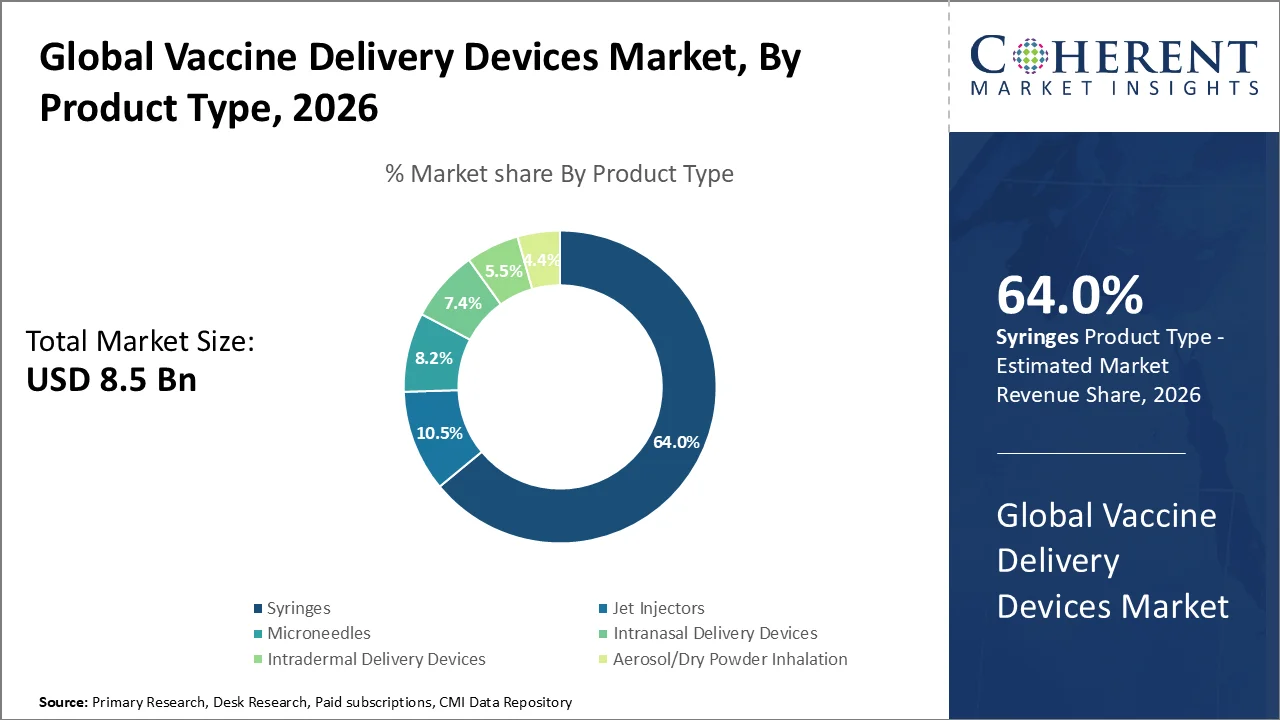
- The syringes segment is likely to dominate the market with approximately 64.0% in 2026. The segment’s dominance is owing to the extensive use of conventional, auto-disable, safety-engineered, and prefilled syringes across routine and mass immunization programs, their established healthcare infrastructure, low unit cost, and compatibility with a broad range of vaccines. UNICEF procures approximately 40% of the auto-disable syringes available in the global market and supplies an average of around 800 million AD syringes annually across more than 90 countries.
- The intramuscular segment is set to lead with approximately 53.0% in 2026. The segment’s growth is owing to the widespread use of intramuscular administration for routine vaccines, including influenza, hepatitis, HPV, pneumococcal, meningococcal, tetanus-containing and several combination vaccines, along with strong healthcare-provider familiarity and established needle-and-syringe administration protocols. According to WHO's latest immunization data, approximately 110 million infants, representing 85% of infants globally, received all three doses of DTP-containing vaccine in 2025, illustrating the large recurring administration volumes associated with routine injectable immunization programs.
- The hospitals segment is anticipated to dominate the end-user category with approximately 48.0% in 2026. The segment’s leadership is supported by centralized vaccine procurement, availability of trained healthcare professionals, established cold-chain and injection-safety infrastructure, and administration of pediatric, adult, geriatric and high-risk vaccination programs. The institutional vaccination opportunity is also broadening beyond childhood immunization; according to WHO, HPV vaccines were included in national immunization programmes in 162 countries in 2025, including 15 countries introducing the vaccine during the year, while global first-dose HPV coverage among girls reached 33%.
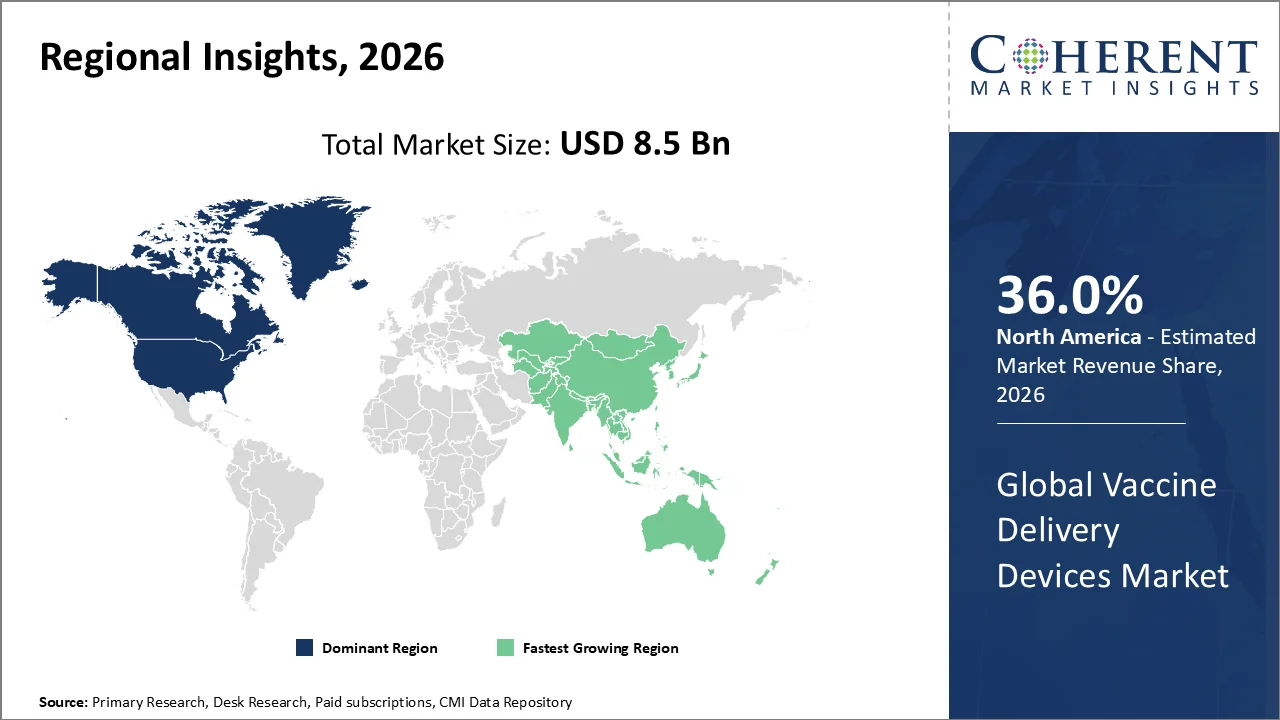
- North America is expected to dominate the global vaccine delivery devices market with approximately 36.0% share in 2026. The region’s leadership is supported by high routine vaccination volumes, well-established hospital and pharmacy-based immunization infrastructure, early adoption of advanced and alternative vaccine-delivery technologies, and a strong regulatory environment for novel administration systems. CDC reported that among U.S. adolescents aged 13–17 years, 91.3% had received at least one Tdap dose and 90.1% at least one MenACWY dose in 2024, both increasing from 2023.
Market Drivers
Expansion of Global Immunization Programs is Accelerating Demand for Vaccine Delivery Devices
The Global Vaccine Delivery Devices Market is gaining strong momentum from the continued expansion of national immunization schedules, introduction of new vaccines, and large-scale vaccination programs across low-, middle-, and high-income countries. Every expansion in injectable or device-administered vaccination increases recurring demand for syringes, needles, intradermal devices, jet injectors, and other vaccine delivery systems.
In July 2026, Gavi confirmed that its 2026–2030 strategy aims to reach an additional 500 million children and prevent approximately 8–9 million future deaths, while supporting a further 10% reduction in under-five mortality. This expansion represents a significant prospective administration volume for vaccine delivery technologies, particularly across emerging markets.
Rising Disease Outbreaks and Catch-Up Vaccination Campaigns are Increasing Device Utilization
Vaccine preventable diseases have been making a comeback, thereby increasing the need for vaccination delivery devices through emergency vaccinations, disease response campaigns, and catch-up campaigns. These campaigns usually involve a quick delivery of many devices to hospitals, clinics, vaccination facilities, and healthcare centers within the community.
The scale of vaccination in outbreaks is equally impressive. In 2025, UNICEF supplied about 860 million doses of vaccines for outbreak responses, whereas the Big Catch-Up campaign on a global level provided more than 94 million doses of previously unvaccinated vaccines. Further, UNICEF facilitated the measles vaccination of more than 191 million children, out of which almost 39.7 million were in humanitarian settings.
Current Events and Their Impact on the Vaccine Delivery Devices Market
Current Event | Description and its Impact |
WHO Digitizes Prequalification of Immunization Delivery Devices Through ePQS (2025–2026) |
|
UNICEF Establishes New 2026–2027 Safe Injection Equipment Procurement Framework |
|
- Current Industry Events of 2026
- Market Size Estimation
- Regional Breakdown
- Competitive Landscape
- Customer Intelligence
- Segmental Analysis
- Pricing Analysis
- Key Market Drivers, Challenges & Future Trends
- Customized Insights Section
Segmental Insights
Why are Syringes Acquiring the Largest Share?
On the basis of product type, the syringes segment is projected to account for the largest Vaccine Delivery Devices Market share of approximately 64.0% in 2026. The segment’s dominance is owing to the widespread use of conventional, auto-disable, reuse-prevention, safety-engineered, and prefilled syringes across routine immunization and emergency vaccination programs. Their low costs, manufacturing capacity, ability to accommodate a wide variety of vaccines, and capacity to support mass immunization programs keep them superior to alternative technologies.
According to WHO E008 Prequalification List dated 09/08/2026, there are 72 different types of AD syringes in fixed dose vaccinations. WHO has indicated that at present AD syringes remain the only kind of injectable devices that WHO fully supports for administering injectable vaccines.
In January 2026, BD announced a USD 110 million investment in its Columbus, Nebraska facility, including USD 100 million to establish BD Neopak™ Glass Prefillable Syringe manufacturing and another USD 10 million to expand cannula manufacturing capabilities.
Why is Intramuscular Administration Acquiring the Largest Share?
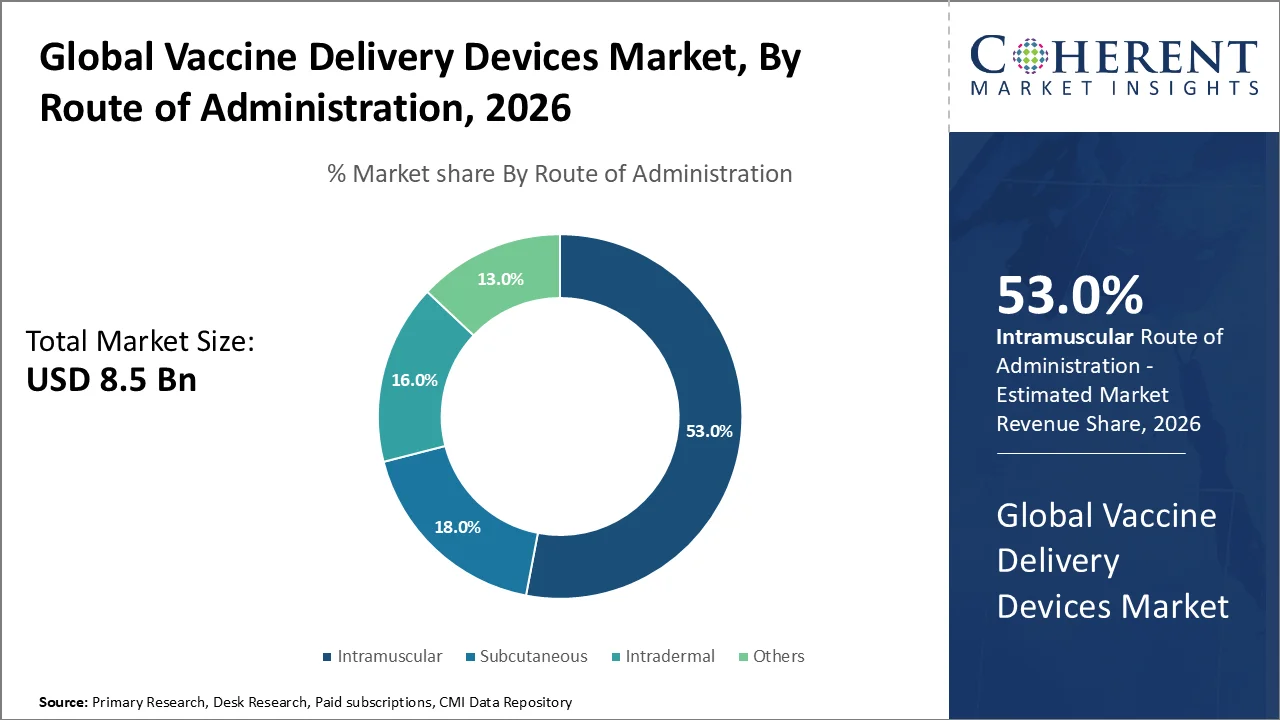
On the basis of route of administration, the intramuscular segment is forecasted to dominate the Vaccine Delivery Devices Market with nearly 53.0% market share in 2026 owing to the wide variety of vaccines already being used which are given through muscle tissue. Other factors responsible for the dominance include the standard administration methods, predictability of immune response, and the common practice among healthcare providers.
Moreover, the Adult Immunization Schedule 2025 by the CDC involves yearly vaccination against influenza, Td/Tdap boosters at an interval of 10 years, and two-dose recombinant zoster vaccine for adults who are eligible. Thus, the recurrent nature of the need for IM vaccines can be highlighted.
In January 2026, PharmaJet announced that its Stratis Intramuscular Needle-Free Injection System was being used to deliver Scancell’s iSCIB1+ DNA immunotherapy in the Phase II SCOPE study for advanced melanoma.
Why are Hospitals Acquiring the Largest End-User Share?
On the basis of end user, the hospitals segment is anticipated to account for the largest Vaccine Delivery Devices Market share of approximately 48.0% in 2026. The segment’s dominance is owing to the presence of trained healthcare professionals, established vaccine storage and cold-chain infrastructure, centralized device procurement, ability to manage high-risk patients and adverse reactions, and routine administration of vaccines across pediatric, adult, geriatric, occupational, and emergency-care populations.
The recent 2026 figures from the American Hospital Association demonstrate the magnitude of health care infrastructure. In America alone, there are 6,100 hospitals, 907,216 bed capacity hospitals, and around 35.66 million annual hospital admissions.
In March 2026, SPARSH Group of Hospitals announced the launch of a structured Life-Course Vaccination Program covering vaccination needs from childhood through adulthood and old age. The program is being rolled out through SPARSH's hospital network and integrates vaccination into broader preventive healthcare service.
Vaccine Delivery Devices Market Trends
- The increasing adoption of needle-free and intradermal vaccine delivery systems is shifting alternative delivery technologies from clinical evaluation toward large-scale immunization programs. In May 2026, PharmaJet announced that it’s WHO-prequalified Tropis needle-free intradermal system would be used to administer approximately 1.4 million fractional IPV doses in Nigeria. The company stated that supplies for more than 20 million Tropis pediatric injections had already been provided across Pakistan, Nigeria, Afghanistan, and Somalia.
- Microarray vaccine patches are progressing toward larger clinical programs and commercialization owing to their potential for needle-free administration, improved thermostability, and simplified distribution. In February 2026, Vaxxas was involved in an EU-funded project for next generation influenza vaccines in conjunction with the largest Phase I HD-MAP trial conducted on over 250 subjects. The HD-MAP technology has been tested on over 750 clinical trial subjects, whereas earlier data on influenza vaccines revealed stability up to 12 months at 40°C.
- The increasing preference for the use of prefilled vaccine delivery systems is prompting development in the production of scalable, one-dose delivery system manufacturing technology. In May 2025, Amneal Pharmaceuticals and ApiJect announced that they will be installing a dedicated manufacturing line for delivering ApiJect's Blow-Fill-Seal prefilled delivery systems, which can produce an estimated 250 million to 300 million units per year and even more than 400 million units.
Regional Insights
North America Dominates Owing to Advanced Vaccination Infrastructure and Early Adoption of Next-Generation Delivery Systems
The North America region is expected to account for approximately 36.0% of the global Vaccine Delivery Devices Market share in 2026. The region’s dominance is owing to its mature vaccination infrastructure, high utilization of routine and seasonal vaccines, strong presence of vaccine and medical-device manufacturers, established hospital and pharmacy vaccination networks, and early adoption of prefilled syringes, safety-engineered devices, needle-free injectors, and intranasal delivery technologies.
The scale of recurring vaccination in the U.S. continues to support device consumption. According to the CDC, approximately 135.6 million influenza vaccine doses had been distributed in the U.S. for the 2025–2026 season as of March 7, 2026. By May 2026, around 49.3% of children aged 6 months–17 years had received an influenza vaccine, while 46.5% of adults had been vaccinated by February 2026.
In April 2026, the U.S. FDA approved GSK's supplemental application for a new vial-plus-prefilled-syringe presentation of AREXVY, with the prefilled syringe containing the vaccine's adjuvant suspension component. Such regulatory approvals are strengthening commercialization opportunities for higher-value, ready-to-use vaccine delivery formats across the region.
Asia Pacific is Expected to be the Fastest-Growing Region
Asia Pacific is expected to record the fastest growth in the global Vaccine Delivery Devices Market, with an estimated CAGR of approximately 7.6% during 2026–2033. Growth is being supported by large population-based immunization programs, expansion of healthcare infrastructure, rising vaccine accessibility, growing local syringe and vaccine manufacturing capabilities, and increasing adoption of safety-engineered and alternative vaccine delivery systems across China, India, Southeast Asia, Japan, and other regional markets.
The scale of immunization activity across the region provides a substantial underlying demand base. According to WHO's July 2026 update, the South-East Asia Region maintained 94% DTP3 vaccination coverage in 2025, compared with the global average of 85%, while first-dose measles vaccine coverage increased to 96%.
In October 2025, PharmaJet announced that it’s WHO-prequalified Tropis intradermal needle-free injection system would be used exclusively to deliver fractional-dose inactivated polio vaccine to approximately 1.8 million children in Lahore, Pakistan.
Strong Immunization Infrastructure and Rapid Adoption of Alternative Delivery Technologies are Supporting the U.S. Vaccine Delivery Devices Market
The U.S. Vaccine Delivery Devices Market is witnessing sustained demand owing to its large routine and seasonal vaccination base, extensive physician/pharmacy vaccination infrastructure, strong presence of injectable-device manufacturers, and growing clinical adoption of prefilled syringes, intranasal systems, microneedle patches, and other needle-free technologies.
According to the CDC's final assessment report of January 2026 revealed that 43.8% of the United States population of individuals aged six months and above had taken a flu vaccination in the period 2024-2025. This was 50.2% for the group of children aged 6 months to 17 years, while adults showed 41.9%.
In June 2025, Atlanta-based Micron Biomedical and Emory University launched the first CDC-sponsored clinical trial of a vaccine delivered using patch/microarray technology. The Phase I study is recruiting 50 adults aged 18–45 years to evaluate an inactivated rotavirus vaccine delivered through Micron's dissolvable microarray platform.
China Vaccine Delivery Devices Market Trends
China is expected to witness strong growth in the Vaccine Delivery Devices Market owing to the expansion of national immunization programs, increasing government-funded vaccination, a large pediatric population, strengthening domestic biopharmaceutical manufacturing, and growing availability of advanced injectable and prefillable delivery systems.
Device and injectable manufacturing infrastructure is also expanding. In June 2026, West Pharmaceutical Services introduced its Synchrony Prefillable Syringe System to pharmaceutical and biotechnology developers in China at CPHI & PMEC China 2026. West's official portfolio includes 1 mL standard staked-needle and Luer-lock configurations specifically intended for vaccines, supporting the shift toward integrated and ready-to-administer delivery formats in the Chinese biopharmaceutical ecosystem.
Who are the Major Companies in Vaccine Delivery Devices Industry
Some of the major key players in Vaccine Delivery Devices Market are Panacea Pharmaceuticals, 3M, Biojet Medical Technologies Pharmajet, Valeritas, Vaxxas, Gerresheimer, Schott AG, Corium International, and Becton Dickinson & Company.
Key News
- In July 2026, SCHOTT Pharma and Nemera announced successful verification of Nemera's pen-injector platform with SCHOTT Pharma's 3 mL cartriQ ready-to-use glass cartridge system, confirming technical compatibility between the drug container and administration device.
- In June 2026, Panacea Biotec joined the DENSTAR project to advance development and licensure of its tetravalent live-attenuated dengue vaccine DengiAll in sub-Saharan Africa. The four-year program began June 1, 2026 and received an EDCTP contribution of about €11.09 million.
Market Report Scope
Vaccine Delivery Devices Market Report Coverage
| Report Coverage | Details | ||
|---|---|---|---|
| Base Year: | 2025 | Market Size in 2026: | USD 8.5 Bn |
| Historical Data for: | 2020 To 2024 | Forecast Period: | 2026 To 2033 |
| Forecast Period 2026 to 2033 CAGR: | 7.6% | 2033 Value Projection: | USD 14.2 Bn |
| Geographies covered: |
| ||
| Segments covered: |
| ||
| Companies covered: | Panacea Pharmaceuticals, 3M, Biojet Medical Technologies Pharmajet, Valeritas, Vaxxas, Gerresheimer, Schott AG, Corium International, and Becton Dickinson & Company. | ||
| Growth Drivers: |
| ||
| Restraints & Challenges: |
| ||
Analyst Opinion
- The Vaccine Delivery Devices Market is expected to retain a strong recurring-demand base from large institutional immunization programs, with syringes and other injectable devices remaining central to vaccine administration. UNICEF procured approximately USD 2.45 billion worth of vaccines, USD 163 million of medical supplies and equipment, and USD 144 million of cold-chain equipment in 2025, highlighting the scale of the global vaccination procurement ecosystem that supports continued demand for delivery devices.
- The expansion of newer vaccines into national immunization programs is leading to increased administration volume, especially in emerging economies. As of January 2026, 25 countries in Africa had adopted the malaria vaccine program through the help of Gavi, with over 39 million doses distributed. Adoption of malaria vaccines, HPV vaccines, pneumococcal vaccines, among others, will lead to greater use of syringes and other delivery platforms.
- The market is gradually moving from a predominantly needle-and-syringe model toward a more diversified delivery ecosystem. In May 2026, Gavi highlighted six emerging approaches capable of transforming vaccine administration, including microarray patches, nasal and inhaled vaccines, needle-free jet injectors, electrically enhanced delivery, and dry vaccine formats. These technologies could reduce dependence on trained vaccinators and cold-chain infrastructure while increasing accessibility in remote settings, creating long-term opportunities beyond conventional injection devices.
Speak to the analyst
Want personalized insights?
Take the findings above to one of our principal consultants, or have the report rebuilt around the segments, geographies and competitors you actually track.
Market Segmentation
- By Product Type (Revenue, USD Bn, 2021-2033)
- Syringes
- Jet Injectors
- Micro needles
- Aerosol/dry powder inhalation
- Intranasal delivery devices
- Intradermal delivery devices
- By Route of Administration (Revenue, USD Bn, 2021-2033)
- Intradermal
- Intramuscular
- Subcutaneous
- Others
- By End User (Revenue, USD Bn, 2021-2033)
- Hospitals
- Clinics
- Others
- By Region (Revenue, USD Bn, 2021-2033)
- North America
- U.S.
- Canada
- Latin America
- Brazil
- Mexico
- Argentina
- Rest of Latin America
- Europe
- Germany
- U.K.
- France
- Italy
- Spain
- Russia
- Rest of Europe
- Asia Pacific
- China
- India
- Japan
- Australia
- South Korea
- ASEAN
- Rest of Asia Pacific
- Middle East
- GCC
- Israel
- Rest of Middle East
- Africa
- South Africa
- Central Africa
- North Africa
- North America
Sources
Primary Research Interviews
- Vaccine delivery device manufacturers
- Syringe and prefilled syringe manufacturers
- Needle-free injector and microneedle technology developersVaccine manufacturers and biopharmaceutical companies
- R&D heads and drug-delivery technology specialists
- Hospital procurement and vaccination program managers
- Public health and immunization program officials
- Key opinion leaders (KOLs) in vaccines, immunology, and drug delivery
Databases
- World Health Organization (WHO) – Global Immunization Data
- UNICEF Data and Supply Division
- Gavi, the Vaccine Alliance
- U.S. Centers for Disease Control and Prevention (CDC)
- U.S. Food and Drug Administration (FDA)
- European Medicines Agency (EMA)
- World Bank
- United Nations Comtrade Database
- Organisation for Economic Co-operation and Development (OECD)
Magazines
- Pharmaceutical Technology
- Drug Delivery Business News
- Medical Device Network
- Contract Pharma
- Pharmaceutical Manufacturing
- European Pharmaceutical Review
- Drug Development & Delivery
Journals
- Vaccine
- Human Vaccines & Immunotherapeutics
- Advanced Drug Delivery Reviews
- Journal of Controlled Release
- International Journal of Pharmaceutics
- Expert Opinion on Drug Delivery
- Drug Delivery and Translational Research
Newspapers
- Reuters
- The Wall Street Journal
- Financial Times
- The New York Times
- The Guardian
- The Economic Times
Associations
- International Federation of Pharmaceutical Manufacturers & Associations (IFPMA)
- Developing Countries Vaccine Manufacturers Network (DCVMN)
- Vaccines Europe
- Parenteral Drug Association (PDA)
- International Society for Pharmaceutical Engineering (ISPE)
- Association for Professionals in Infection Control and Epidemiology (APIC)
- International Coalition of Medicines Regulatory Authorities (ICMRA)
Public Domain Sources
- WHO Immunization and Vaccine Delivery Publications
- UNICEF Vaccine and Safe Injection Equipment Procurement Reports
- Gavi Immunization Program and Vaccine Market Reports
- CDC Vaccination Coverage and Administration Guidelines
- FDA Device Approvals, 510(k) Clearances, and Combination Product Guidance
- EMA Regulatory Publications and Product Assessment Documents
- Company Annual Reports, Investor Presentations, and Press Releases
- Government Immunization Policies and National Vaccination Schedules
- ClinicalTrials.gov and WHO International Clinical Trials Registry Platform
- Patent Databases such as WIPO, USPTO, and Google Patents
- Public Procurement and Tender Documents for Syringes and Vaccine Delivery Equipment
Proprietary Elements
- CMI Data Analytics Tool
- Proprietary CMI Existing Repository of Information for the Last 10 Years
Get access to 250+ pages report
Every segment, forecast, competitor profile and data table behind the analysis above — available for instant download.
- ESOMAR Member
- ISO 9001:2015 Certified
- D-U-N-S Registered
- GDPR & CCPA Compliant
Missing comfort of reading report in your local language? Find your preferred language:
Transform your Strategy with Exclusive Trending Reports
Frequently Asked Questions
The Vaccine Delivery Devices Market is expected to reach approximately USD 14.2 Bn by 2033, compared with USD 8.5 Bn in 2026.
The Vaccine Delivery Devices Market is anticipated to grow at a CAGR of 7.6% between 2026 and 2033
Major players covered in the global Vaccine Delivery Devices Market include Panacea Pharmaceuticals, 3M, Biojet Medical Technologies Pharmajet, Valeritas, Vaxxas, Gerresheimer, Schott AG, Corium International, and Becton Dickinson & Company.
The market is primarily driven by increasing global vaccination and immunization coverage and rising demand for safer and more efficient vaccine administration devices. Expansion of immunization programs and growing adoption of advanced delivery technologies are also supporting market growth.
The major challenges include high development and manufacturing costs and stringent regulatory approval requirements for vaccine delivery systems.
The syringes segment is expected to dominate the market with approximately 64.0% share in 2026, supported by widespread use of conventional, auto-disable, safety-engineered, and prefilled syringes in routine and mass immunization programs.
The intramuscular segment is projected to lead with approximately 53.0% share in 2026, owing to its widespread use across influenza, hepatitis, HPV, pneumococcal, meningococcal, and other routine vaccines.