

Global PV Junction Box Market Size and Forecast – 2026 To 2033
The global PV junction box market is expected to grow from USD 1.85 Bn in 2026 to USD 3.30 Bn by 2033, registering a compound annual growth rate (CAGR) of 8% from 2026 to 2033. The global PV junction box market is driven by steady growth in distributed rooftop solar systems. As of June 4, 2026, India’s PM Surya Ghar Muft Bijli Yojana has propelled the growth of residential solar rooftops with the government targeting more than 7.5 million households by 2026 as adoption speeds across states like Uttar Pradesh and Haryana. (Source: Press Information Bureau)
Key Takeaways of the Global PV Junction Box Market
- The potting PV junction box segment is expected to account for 61.0 % of the global PV junction box market share in 2026. The increasing adoption of smart junction boxes with monitoring capabilities is driving the growth of the segment. For example, Emerson’s DeltaV CTO CHARM Smart Junction Boxes are an off-the-shelf option for speedier project execution and decreased installation costs. (Source: Emerson)
- The residential segment is estimated to capture 52.0 % of the market share in 2026. Rising domestic electricity demand worldwide is primarily driving the demand of the residential segment. In December 2025, the U.S. Energy Information Administration reported that total U.S. electricity consumption in 2025 was about 4.20 trillion kWh, the highest ever recorded. (Source: Energy Information Administration)
- Asia Pacific is expected to dominate the PV junction box market in 2026 with a market share of 43.0 %. Growing investments in grid modernization in Asia Pacific are majorly driving the growth of the regional market. On May 3, 2026, the Asian Development Bank (ADB) announced that it will invest USD 70 billion in new energy and digital infrastructure initiatives by 2035, aiming to connect power grids, expand cross-border electricity trade, and improve broadband access across Asia and the Pacific. (Source: Asian Development Bank)
- North America is expected to account for 22.0 % share in 2026 and is projected to record the fastest growth over the forecast period. Development of high-efficiency solar modules requiring advanced junction boxes, is driving the growth of the PV junction box market in North America. On February 17, 2026, Nextpower announced that it is entering into a multi-year supply agreement with Jinko Solar (U.S.) Industries Inc. Under the agreement, Nextpower plans to supply more than one gigawatt (GW) of steel frames, scalable to up to 3 GW over a three-year period, to support module manufacturing in Jinko Solar’s Jacksonville, Florida, U.S. facility. (Source: Nextpower)
- Shift toward higher-efficiency and higher-voltage systems: The growth of utility-scale solar projects is seeing PV modules move to 1,500V systems. This is leading to an increased demand for junction boxes with stronger thermal resistance, higher current carrying capability and superior insulation materials to safely and efficiently manage increasing electrical loads.
- Integration of smart and monitoring-enabled junction boxes: Integration of monitoring enabled bypass diodes (temperature, current, fault detection) is an increasing trend. Smart junction boxes and electrical enclosures are used to identify hotspots, reduce energy losses and improve predictive maintenance, which is particularly significant for large solar farms.
Segmental Insights
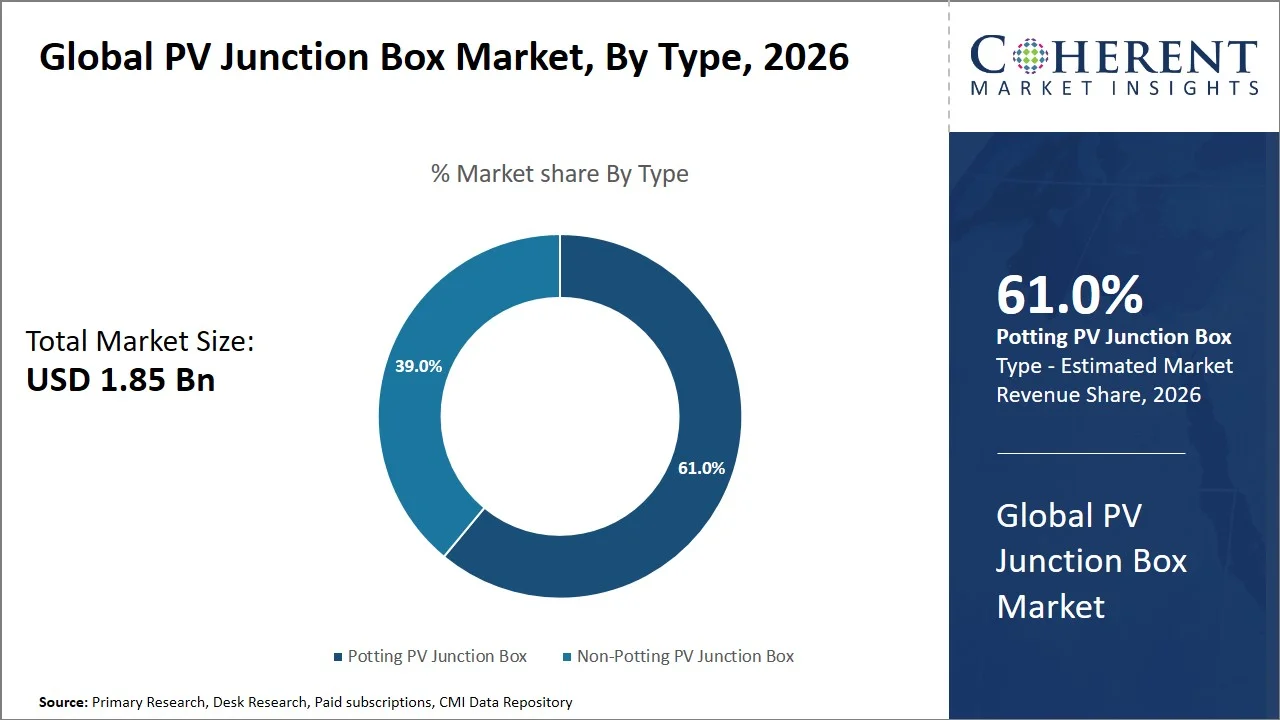
Why Does the Potting PV Junction Box Segment Dominate the Global PV Junction Box Market?
The potting PV junction box segment is expected to account for 61.0% of the global PV junction box market share in 2026. Potting PV junction boxes dominate the global PV junction box market due to their better protection against moisture, dust and environmental stress. The potting technique totally wraps the interior electrical components (e.g. bypass diodes, connectors) in a resin or silicone material which greatly increases insulation, heat stability and long term durability. This gives them particular advantages in outdoor solar applications where they are exposed to harsh conditions such as humidity, rain, UV radiation and temperature cycling and will reduce failure rates and improve module longevity.
On January 29, 2026, Staubli extended the application of its MC4-Evo2 connector systems to next-generation PV modules that call for enhanced ingress protection and long-term sealing performance. Increasingly these connectors are being integrated into potting-based junction box assemblies for utility-scale installations. (Source: Staubli)
- Current Industry Events of 2026
- Market Size Estimation
- Regional Breakdown
- Competitive Landscape
- Customer Intelligence
- Segmental Analysis
- Pricing Analysis
- Key Market Drivers, Challenges & Future Trends
- Customized Insights Section
Why is Residential the Most Widespread Application?
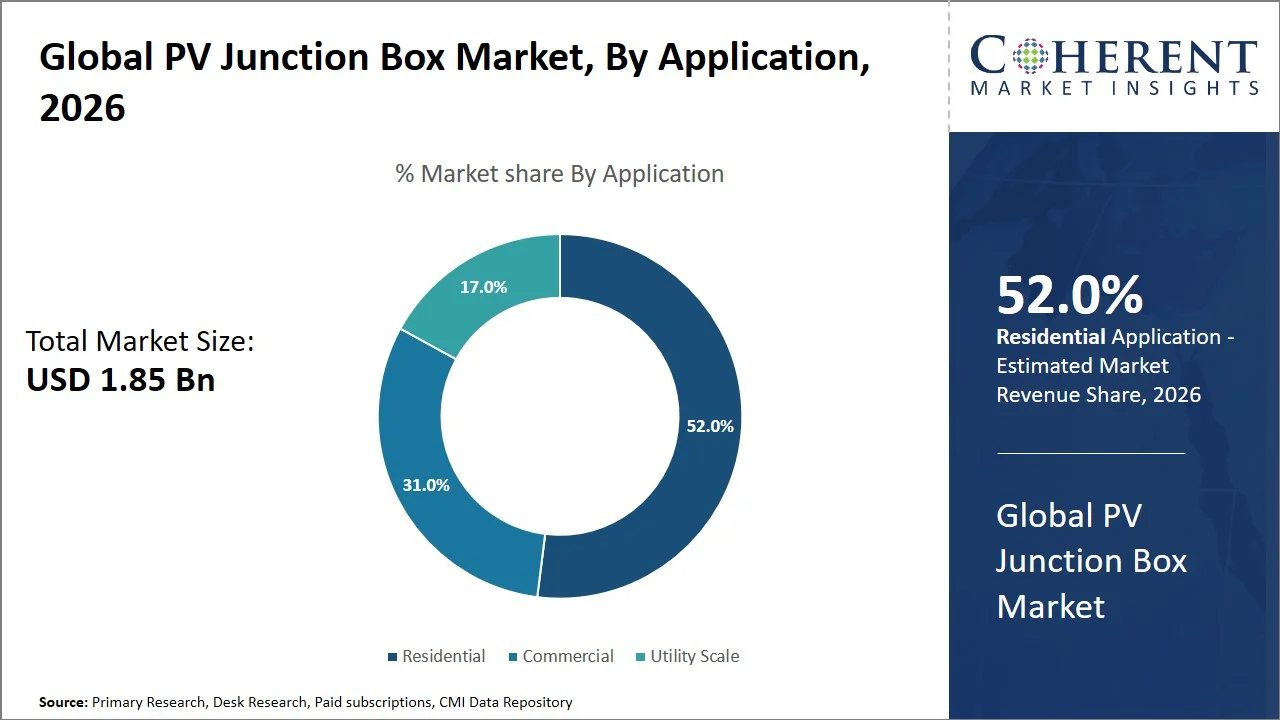
The residential segment is expected to account for 52.0% of the global PV junction box market share in 2026. High adoption rate due to the requirement for decentralized generation of electricity is one of the major reasons for the growth of the residential segment. Homeowners are installing rooftop PV systems more and more, to decrease their electricity bills and to free themselves from grid fluctuations and rising tariffs. Therefore, residential deployments are more frequent and widely spread than utility-scale or commercial projects. On May 28, 2026, India added 2.7 GW of rooftop solar capacity. The highest share of installations in the segment came from residential users. Net metering and reducing system costs are driving a fast expanding share of total solar additions in residential systems.
Currents Events and their Impact
Current Events | Description and its Impact |
U.S. Inflation Reduction Act (IRA) |
|
European Union Green Deal & REPowerEU Plan |
|
(Source: Department of Energy, European Commission)
PV Junction Box Market Dynamics
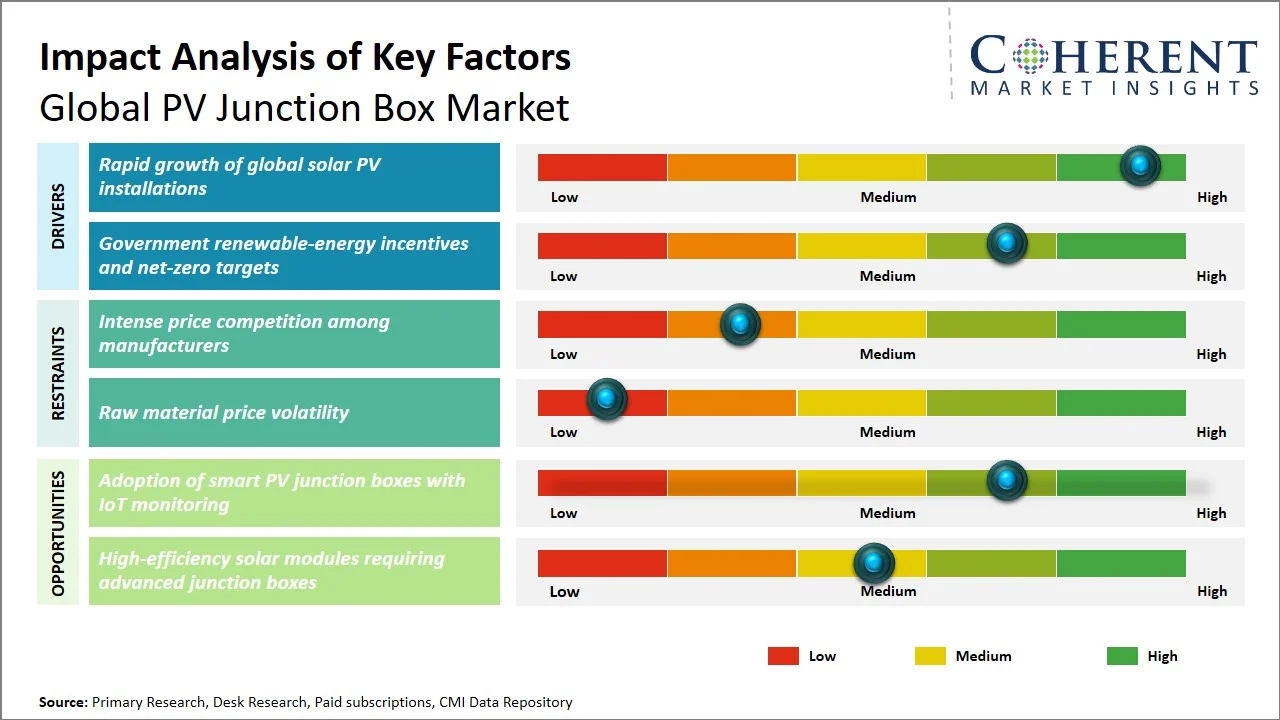
Market Drivers
Rapid growth of global solar PV installations
Worldwide solar PV installations are growing strongly, driven by increasing decarbonization targets, lowering solar module prices and strong government policy support in major economies. Countries are rapidly boosting their renewable energy capacity to phase out fossil fuels and improve energy security, resulting in the massive deployment of utility, commercial and residential solar projects globally. Technological improvements in high-efficiency modules such as bifacial, TOPCon and HJT panels are also enhancing energy yield and making solar electricity more economically feasible. As a result, the global installed solar PV capacity is increasing at a record speed, which is directly improving the demand of the entire solar value chain comprising modules, inverters, mounting systems and balance-of-system components.
As of May 19, 2026, the global solar PV capacity expanded by a record 510 GW from 2025, reaching more than 2,383 GW installed capacity worldwide, with China alone accounting for almost 314 GW. Record breaking global deployment levels were also confirmed with robust additions in the U.S., EU and India. (Source: Renewable Energy)
Government renewable-energy incentives and net-zero targets
Government renewable-energy incentives and net-zero targets are core to driving global solar PV adoption through strong policy-led demand and long-term investment certainty. Many nations are granting subsidies, tax credits, feed-in tariffs, production-linked incentives and renewable purchase requirements to make solar energy more financially appealing than conventional electricity sources. At the same time, the net-zero commitments from governments and companies are speeding up the transition to sustainable energy infrastructure, with concrete targets of capacity for 2030 and beyond. This mix of financial incentives and regulatory pressure is greatly decreasing project risk, boosting private sector involvement and driving the large scale spread of solar installations around the world.
On October 29, 2025, the U.K. government issued its Carbon Budget Delivery Plan (2025), which reinforced its legally binding net-zero 2050 target and initiatives to decarbonize power by 2030 and increase renewable deployment. The plan offers considerable incentives for heat pumps, EV infrastructure and the increase of renewable production. (Source: UK Government)
Emerging Trends
- Adoption of advanced materials for durability and weather resistance: Manufacturers are increasingly adopting halogen-free polymers, UV-resistant compounds, and anti-PID (Potential Induced Degradation) designs. This enhances long-term reliability in difficult settings like deserts, coastal areas and high humidity regions where solar installations are developing rapidly.
- Rising demand driven by bifacial and n-type solar modules: The transition to bifacial modules and next-generation cell technologies like as TOPCon and HJT is influencing junction box design. These modules produce higher rear-side currents, which require more effective bypass diode arrangements and enhanced thermal management in junction boxes.
Regional Insights
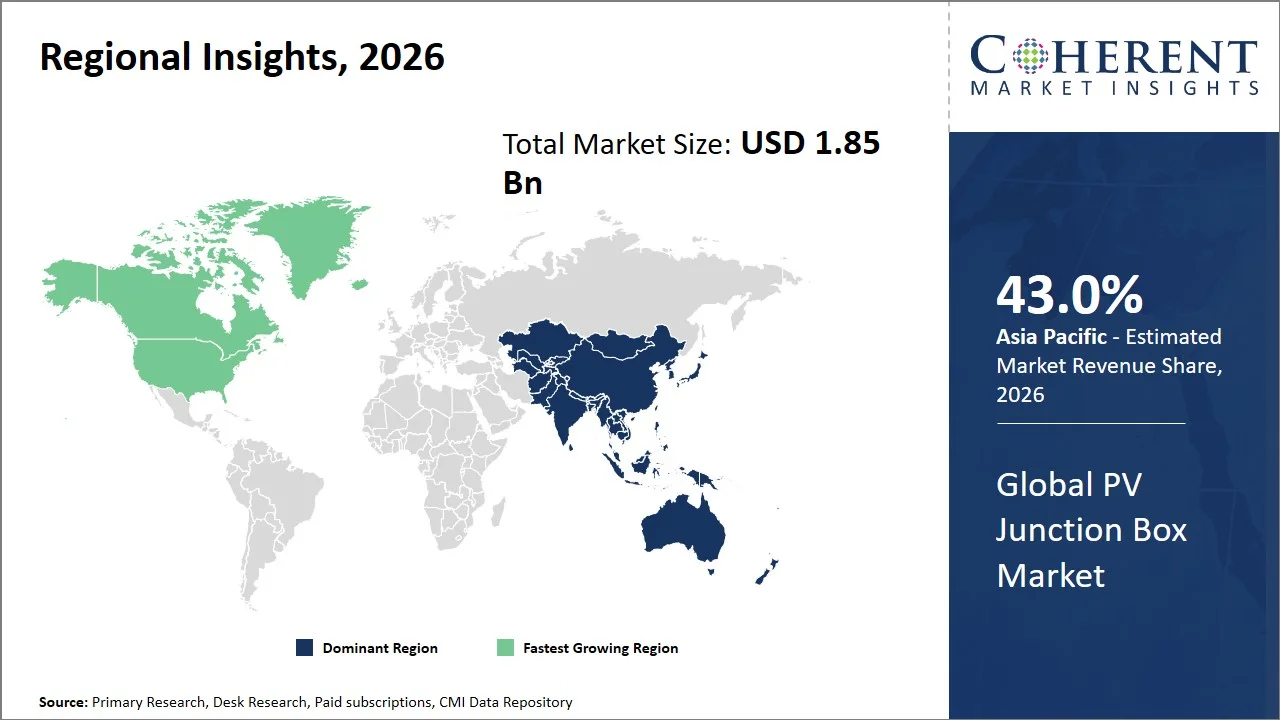
Why is Asia Pacific a Strong Market for PV Junction Boxes?
Asia Pacific is expected to account for a market share of 43.0% in 2026. The PV junction box market in Southeast Asia, particularly in Vietnam and Thailand, is driven by export-focused solar manufacturing centers that supply modules to the U.S. and the EU. Companies such as JinkoSolar and local EMS vendors embed large numbers of junction boxes into utility-scale modules. In Australia, the harsh desert irradiation conditions are creating demand for high temperature, UV resistant potting-type junction boxes at major solar farms such as the Sunraysia Solar Farm (Victoria). The region’s market is also driven by the increased adoption of rooftop solar in countries like the Philippines, where typhoon-resistant PV system components are valued for longevity. On November 8, 2025, Dhash Group launched India’s first 2,000V rated PV junction box developed for next generation ultra-high voltage solar systems. The product is targeted at utility scale solar facilities that need to reduce BOS losses and increase string efficiency. (Source: Dhash Group)
Why Does North America PV Junction Box Market Exhibit High Growth?
North America is projected to account for 22.0% of the global PV junction box market and is expected to register the fastest growth. Utility-scale solar projects such as the NextEra Energy solar farms in Texas and Florida are driving the North American PV junction box industry, as high-voltage 1,500V systems demand improved junction boxes with better thermal dissipation and safety certifications (UL standards). Domestic content restrictions mandated by the Inflation Reduction Act are prompting U.S. module assembly companies, particularly in areas like Georgia and Ohio, to progressively source junction boxes that are consistent with domestic rules. Demand is also coming from rooftop solar installers like Sunrun, which want compact, fire-resistant junction box designs for residential rooftops. First Solar continues to scale its U.S. manufacturing presence in 2025, with expanded production of Series 7 thin-film modules raising yearly output capacity to more over 14 GW across existing Ohio and new U.S. sites. This growth directly drives demand for high-reliability junction boxes for thin-film, high-current utility modules in desert and large-scale North American solar projects. (Source: First Solar)
Global PV Junction Box Market Outlook for Key Countries
Why is China Emerging as a Major Hub in the PV Junction Box Market?
China dominates the PV junction box industry, as it has a vast integrated solar manufacturing ecosystem, with companies like LONGi Green Energy and Trina Solar producing modules at gigawatt scale. The large manufacturing clusters in the Jiangsu and Zhejiang provinces are primarily reliant on high-efficiency potting junction boxes for automated production lines. Mega solar projects like Hainan offshore PV demonstration base and desert projects in Qinghai also contribute to the demand for heat-resistant, high-durability junction boxes for difficult working circumstances.
Is he U.S. the Next Growth Engine for the PV Junction Box Market?
In the U.S., the PV junction box demand is highly correlated with large-scale solar projects in areas like Texas, Nevada, and California, where companies such as First Solar deploy utility-grade modules that require sophisticated junction box layouts with improved bypass diode protection. IRA incentives are driving domestic manufacture and localizing junction box production to meet compliance and tariff needs. Demand for compact, fire-safe, and easy-installation junction box designs is being spurred by the expansion of residential solar, driven by firms such as Tesla (Solar Roof and rooftop PV systems).
Taiwan PV Junction Box Market Analysis and Trends
In Taiwan, the PV junction box market is mainly driven by a robust electronics manufacturing ecosystem and dedicated PV component suppliers serving worldwide module exporters. Companies like AUO (AU Optronics) are incorporating sophisticated thin film and high efficiency PV technologies that require precision manufactured junction boxes for small module layouts. The island also produces high-reliability specialty components for export-oriented solar panels exported to Europe and North America with a focus on quality consistency and anti-corrosion design owing to humid coastal circumstances.
India PV Junction Box Market Analysis and Trends
The India PV junction box market is growing fast owing to the presence of large scale solar parks such as Bhadla Solar Park (Rajasthan) and Pavagada Solar Park (Karnataka) that demand high durability junction boxes that can endure intense heat and dust conditions. Domestic manufacturing is gaining traction under the Production Linked Incentive (PLI) plan that incentivizes domestic producers to cut back on imports from China. Waaree Energies is scaling up its module production capacity, driving the demand for cost-effective potting based junction boxes for utility scale deployment and rooftop installations in industrial zones.
South Korea PV Junction Box Market Analysis and Trends
South Korea’s PV junction box market is driven by high-end module manufacturing and R&D-oriented firms like Hanwha Q CELLS. Those companies focus on high-efficiency mono-PERC and next-generation TOPCon modules that require improved electrical protection systems. The government is focusing on smart solar integration in urban infrastructure, with building-integrated photovoltaics (BIPV) in places like Seoul, which require compact and high-reliability junction box designs. Strong export emphasis to Europe and the U.S. also drives compliance with demanding international safety and performance standards.
How is the Adoption of Smart PV Junction Boxes with IoT Monitoring Creating New Growth Opportunities in the PV Junction Box Market?
Growing demand for smart PV junction boxes with IoT-enabled monitoring is opening up new growth opportunities for the PV junction box market by transforming them from passive electrical components to intelligent system-level assets. These intelligent junction boxes are equipped with sensors for temperature, current and fault detection, allowing real-time performance monitoring, predictive maintenance and early detection of issues like hot spots or bypass diode failures. This results in much less downtime and better energy yield . This is quite important with large solar farms because even little losses in efficiency can be a large loss in revenue . As solar installations become more complex and digitally managed, especially in utility-scale projects and smart grid ecosystems, the demand is increasing for connected junction boxes to support remote diagnostics and lifecycle optimization, creating higher-value product segments for manufacturers.
Global PV Junction Box Market - Junction Boxes per GW of Solar Installations
Parameter | Utility-Scale (500W–700W modules) | Commercial Rooftop (400W–550W modules) | Residential Rooftop (350W–450W modules) |
Typical module rating | 550 W avg | 450 W avg | 400 W avg |
Modules per MW | ~1,818 | ~2,222 | ~2,500 |
Modules per GW | ~1.82 million | ~2.22 million | ~2.50 million |
Typical adjustment factor (bifacial / split JBs) | +5% to +15% | +3% to +10% | +0% to +5% |
Global PV Junction Box Market - Junction Box Replacement Rate in Installed Solar Fleets
Fleet Category | Typical System Age | Annual Junction Box Failure / Replacement Rate | Cumulative Replacement Rate (20–25 years) |
Utility-scale solar farms | 0–10 years | 0.1% – 0.3% per year | 2% – 6% |
Utility-scale (aged fleet >10 years) | 10–25 years | 0.3% – 0.8% per year | 6% – 18% |
Commercial rooftop systems | 0–15 years | 0.2% – 0.6% per year | 5% – 12% |
Residential rooftop systems | 0–20 years | 0.3% – 0.9% per year | 7% – 15% |
Harsh environments | Any age | 0.5% – 1.5% per year | 10% – 25% |
Market Players, Key Development, and Competitive Intelligence
Key Developments
- On March 23, 2026, Renesas Electronics Corporation introduced the industry’s first bidirectional switch using depletion-mode (d-mode) GaN technology, capable of blocking both positive and negative currents in a single device with DC blocking.
- On March 11, 2025, Amphenol Industrial Operations introduced two cutting-edge products designed to revolutionize photovoltaic (PV) connectivity, the H4 PRO PV Connector and the Saguaro Junction Box. These advanced solutions enhance performance, durability, and ease of integration, ensuring high-efficiency solar interconnects that optimize energy transfer and reduce power loss across solar installations worldwide.
Competitive Landscape
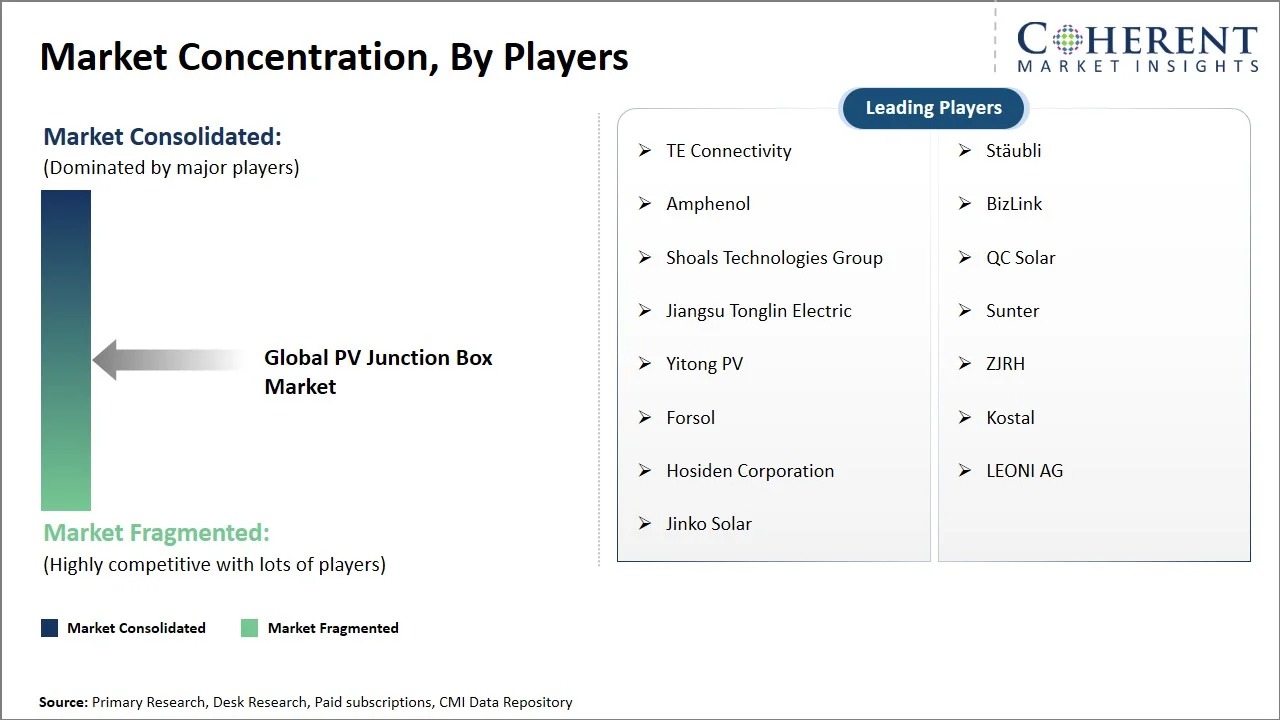
The PV junction box market is relatively consolidated, with a mix of large integrated solar manufacturers and niche component suppliers competing on cost, reliability, and technical innovation. The big scale module producers, Trina Solar, LONGi Green Energy and JinkoSolar also have a strong position in the large scale module manufacturing industry due to their vertical integration, which enables them to manage the sourcing of junction boxes. Independent providers are competing on improvements such as potting technology, greater current-carrying capacity designs and smart junction boxes with monitoring features. The competition is increasingly driven by the conformity to international safety standards, demand for high voltage 1,500V systems, and the requirement for better thermal and environmental endurance for utility-scale solar projects.
Market Report Scope
PV Junction Box Market Report Coverage
| Report Coverage | Details | ||
|---|---|---|---|
| Base Year: | 2025 | Market Size in 2026: | USD 1.85 Bn |
| Historical Data for: | 2020 To 2024 | Forecast Period: | 2026 To 2033 |
| Forecast Period 2026 to 2033 CAGR: | 8% | 2033 Value Projection: | USD 3.30 Bn |
| Geographies covered: |
| ||
| Segments covered: |
| ||
| Companies covered: | TE Connectivity, Stäubli, Amphenol, BizLink, Shoals Technologies Group, QC Solar, Jiangsu Tonglin Electric, Sunter, Yitong PV, ZJRH, Forsol, Kostal, Hosiden Corporation, LEONI AG, and Jinko Solar | ||
| Growth Drivers: |
| ||
| Restraints & Challenges: |
| ||
Analyst Opinion (Expert Opinion)
- The PV junction box market is growing steadily owing to high impact of rapidly growing utility-scale solar installations and increasing need for high-reliability balance-of-systems components. Demand for potting-type and smart junction boxes is driven by the increased durability requirements under harsh climatic conditions and greater system voltages. Large countries, such as the U.S. and India, are seeing a move to localized manufacturing, under government incentive schemes. In addition, the competitive pressure is increasing as manufacturers focus on pricing optimization and technology distinction.
- The PV junction box market is anticipated to keep growing as global solar PV capacity continues to develop and grid modernization gains traction. The increasing deployment of smart junction boxes with embedded sensors is projected to transform the product portfolio, allowing predictive maintenance and enhancing system efficiency for huge solar farms. An increasing number of utility-scale and bifacial PV installations is expected to increase the demand for high-voltage, thermally stable and weather-resistant configurations. Moreover, the localization of manufacturing and the integration of innovative materials are expected to enhance supply chain resilience and improve cost competitiveness in emerging solar markets.
Speak to the analyst
Want personalized insights?
Take the findings above to one of our principal consultants, or have the report rebuilt around the segments, geographies and competitors you actually track.
Market Segmentation
- Type Insights (Revenue, USD Billion, 2021 - 2033)
- Potting PV Junction Box
- Non-Potting PV Junction Box
- Application Insights (Revenue, USD Billion, 2021 - 2033)
- Residential
- Commercial
- Utility Scale
- Regional Insights (Revenue, USD Billion, 2021 - 2033)
- North America
- U.S.
- Canada
- Latin America
- Brazil
- Argentina
- Mexico
- Rest of Latin America
- Europe
- Germany
- U.K.
- Spain
- France
- Italy
- Russia
- Rest of Europe
- Asia Pacific
- China
- India
- Japan
- Australia
- South Korea
- ASEAN
- Rest of Asia Pacific
- Middle East
- GCC Countries
- Israel
- Rest of Middle East
- Africa
- South Africa
- North Africa
- Central Africa
- North America
- Key Players Insights
- TE Connectivity
- Stäubli
- Amphenol
- BizLink
- Shoals Technologies Group
- QC Solar
- Jiangsu Tonglin Electric
- Sunter
- Yitong PV
- ZJRH
- Forsol
- Kostal
- Hosiden Corporation
- LEONI AG
- Jinko Solar
Sources
Primary Research interviews
- PV Junction Box Manufacturers
- Solar Panel Manufacturers
- Solar Installation Companies
- Electrical Component Distributors
Magazines
- Solar Power World
- PV Magazine
- Renewable Energy World
- Solar Industry Magazine
Journals
- Solar Energy Materials and Solar Cells
- IEEE Journal of Photovoltaics
- Progress in Photovoltaics: Research and Applications
Associations
- Solar Power Europe (SPE)
- Solar Energy Industries Association (SEIA)
- International Renewable Energy Agency (IRENA)
- Global Solar Council (GSC)
Public Domain sources
- International Trade Administration (ITA)
- World Bank Open Data
- United Nations Statistics Division
- European Commission Energy Database
Proprietary Elements
- CMI Data Analytics Tool
- Proprietary CMI Existing Repository of information for last 10 years
Get access to 250+ pages report
Every segment, forecast, competitor profile and data table behind the analysis above — available for instant download.
- ESOMAR Member
- ISO 9001:2015 Certified
- D-U-N-S Registered
- GDPR & CCPA Compliant
Missing comfort of reading report in your local language? Find your preferred language:
Transform your Strategy with Exclusive Trending Reports
Frequently Asked Questions
The global PV junction box market is expected to stand at USD 1.85 Bn in 2026 and is expected to reach USD 3.30 Bn by 2033.
The CAGR of the global PV junction box market is projected to be 8% from 2026 to 2033.
In terms of type, the potting PV junction box segment is estimated to dominate the market revenue share in 2026.
A smart PV junction box includes sensors for monitoring temperature, current, and system performance in real time.
They enable predictive maintenance by detecting faults early and reducing system downtime.
Rapid growth of global solar PV installations and government renewable-energy incentives and net-zero targets are the major factors driving the growth of the global PV junction box market.
Intense price competition among manufacturers and raw material price volatility are the major factors hampering the growth of the global PV junction box market.