

PVC Packaging Materials Market Size and Share Analysis – 2026 To 2033
The PVC Packaging Materials Market size is anticipated to grow at a CAGR of 4.8%, with USD 23.95 Bn in 2026, and is expected to reach USD 33.25 Bn in 2033. The primary drivers are largely defined by the rising demand for cost-effective and durable packaging materials, increasing consumption of pharmaceutical blister packaging, expanding use of PVC films and sheets in food and consumer goods packaging, and growing demand for transparent, lightweight, and moisture-resistant packaging solutions. According to the European Commission’s Joint Research Centre (JRC), in July 2026, approximately 5.9 million tonnes of plastic packaging were placed on the market across 19 EU Member States in 2025, equivalent to around 14 kg per capita.
Key Takeaways
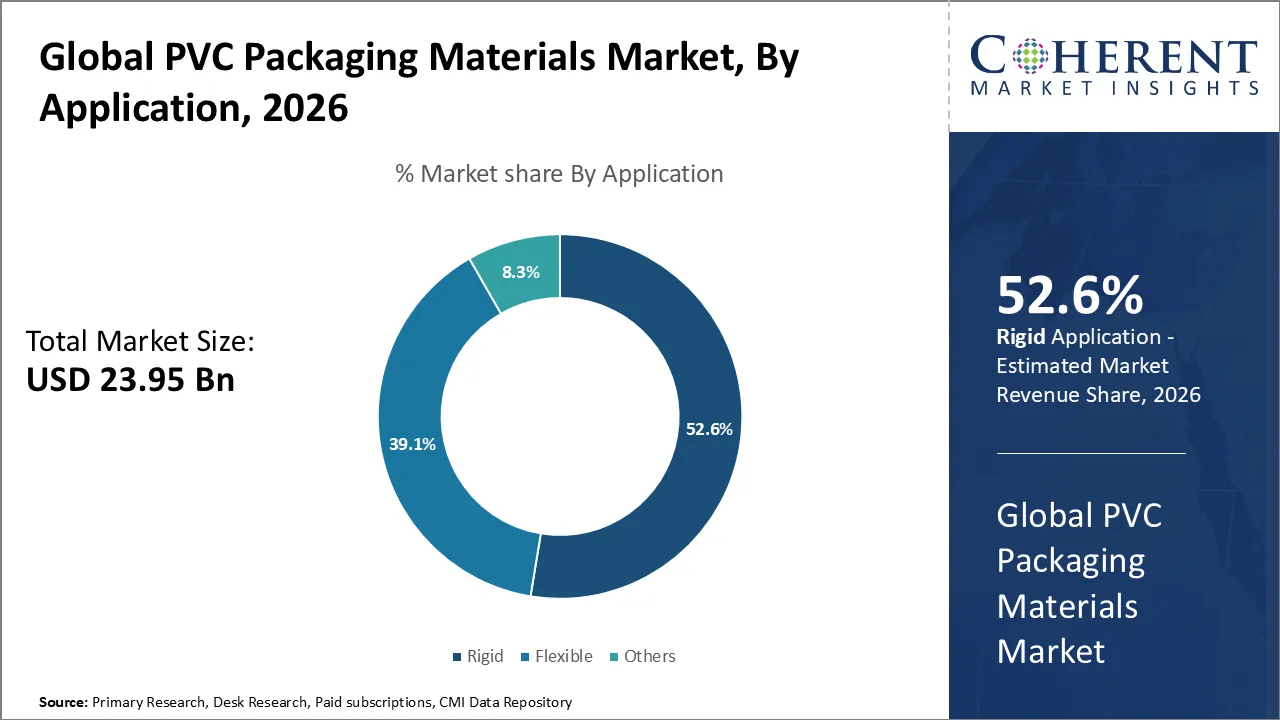
- The rigid packaging segment is likely to dominate the PVC Packaging Materials Market with 52.6% in 2026. The segment’s growth is owing to PVC’s favorable rigidity, impact resistance, chemical resistance, thermoformability, and suitability for bottles, containers, trays, pharmaceutical blister packs, and other protective packaging formats. According to Eurostat, July 2025, the value of EU production of basic pharmaceutical products and pharmaceutical preparations increased 12.7%, from EUR 234 Bn in 2023 to EUR 263 Bn in 2024.
- The food & beverages segment is set to lead with 42.3% in 2026. The segment’s growth is owing to the increasing consumption of packaged and processed foods, demand for lightweight and moisture-resistant packaging, expanding organized retail, and the need for packaging materials that protect products during storage and transportation. According to FoodDrinkEurope’s Data & Trends 2026 report, the EU food and drink industry generates approximately EUR 1.5 trillion in turnover, contributes EUR 300 Bn in value added, and employs around 4.8 million people, highlighting the large addressable packaging-intensive end-use industry.
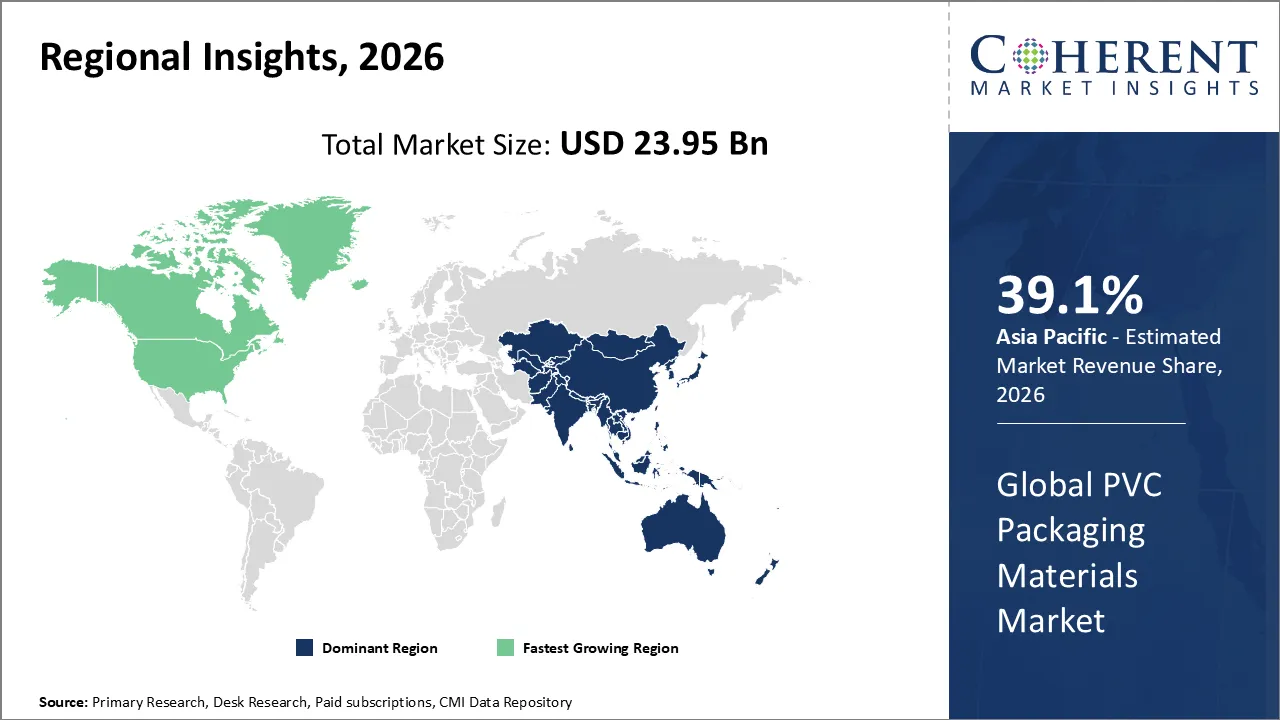
- Asia Pacific is expected to acquire the largest share of 39.1% in 2026. The region’s growth is owing to its large plastics manufacturing base, rapidly expanding food and beverage and pharmaceutical industries, rising consumption of packaged goods, growing organized retail, and strong demand for cost-effective rigid and flexible packaging across China, India, Japan, and Southeast Asia. According to Plastics Europe’s Plastics – the Fast Facts 2025, Asia accounted for 57.2% of global plastics production in 2024, with China alone representing 34.5%, highlighting the region’s strong plastics production and processing ecosystem supporting PVC packaging materials demand.
Market Drivers
Expanding Pharmaceutical Product Pipeline is Strengthening Demand for PVC Blister Packaging
The PVC Packaging Materials Market is gaining momentum from the expanding pharmaceutical sector and the continued requirement for secure unit-dose packaging. Rigid PVC film remains a standard base material for pharmaceutical blister packaging, owing to its clarity, mechanical strength, thermoformability, and ability to provide protection against moisture, oxygen, and contaminants when combined with suitable barrier layers.
The pharmaceutical packaging opportunity is particularly relevant for PVC because blister packs typically use rigid PVC films combined with aluminum foil, allowing individual-dose protection while maintaining the integrity of the remaining doses. The combination of increasing pharmaceutical product availability and established use of PVC in blister systems is therefore supporting sustained demand for rigid PVC packaging materials.
Advances in Recyclable PVC Packaging are Supporting Long-Term Market Adoption
Growing emphasis on packaging circularity is encouraging PVC film producers and converters to develop packaging structures that combine established performance characteristics with greater recyclability. The European Commission’s Packaging and Packaging Waste Regulation requires all packaging placed on the EU market to be recyclable by 2030, while recycled-content requirements for plastic packaging will also begin applying from 2030. This is accelerating material and recycling innovation throughout the PVC packaging value chain.
Recent developments show that recycled material can be increasingly incorporated in pharmaceutical PVC packaging. Under the VinylPlus PharmPack project, pharmaceutical blister packs containing 30 % recycled PVC (rPVC) have been produced at pilot scale using a recycling technology based on the PVC dissolution process. The recovered PVC was of sufficient purity for reuse in applications requiring high-quality rigid film.
Current Events and Their Impact on the PVC Packaging Materials Market
Current Event | Description and its Impact |
EU Packaging and Packaging Waste Regulation Begins Application Across the EU (2026) | Description: The European Union Packaging and Packaging Waste Regulation (PPWR) came into force on 12 August 2026 and sets harmonized rules on packaging design, waste reduction, recyclability, reuse and recycled content. It will also require that all packaging is recyclable by 2030 and plastic packaging has mandatory recycled-content standards. Without further action, the European Commission estimates that total packaging waste could increase by 19% by 2030 and plastic packaging waste could increase by 46%. Impact: The regulation is creating pressure on PVC packaging producers to improve design-for-recycling, material separation, recycled PVC incorporation and collection systems. Producers of rigid PVC films, bottles, trays and pharmaceutical blister materials are expected to invest further in recyclable structures and closed loop recycling. At the same time, PVC formats that are difficult to separate or recycle, such as complex multilayer structures, may face increased pressure to reformulate and comply as the 2030 requirements approach. |
California Implements Permanent Packaging Producer Responsibility Regulations under SB 54 (2026) | Description: In May 2026, the Office of Administrative Law in California approved permanent regulations to implement SB 54, the Plastic Pollution Prevention and Packaging Producer Responsibility Act. The policy aims for 100% of covered single-use packaging to be recyclable or compostable by 2032, a 65% recycling rate for single-use plastic packaging, and a 25% reduction in plastic covered material from 2023 levels. Producers will also have to contribute $5 billion over 10 years, starting with $500 million per year from 2027, to tackle plastic-pollution impacts. Impact: The policy shifts more end-of-life responsibility and associated costs to packaging producers, encouraging PVC packaging suppliers to reduce material intensity, increase recyclability, incorporate circular-design principles, and participate in producer-responsibility systems. For PVC packaging manufacturers serving California, compliance is likely to accelerate investment in recyclable rigid packaging, downgauged films, improved collection systems, and recycled-content solutions, while less recyclable packaging designs may experience increased cost and substitution pressure. |
- Current Industry Events of 2026
- Market Size Estimation
- Regional Breakdown
- Competitive Landscape
- Customer Intelligence
- Segmental Analysis
- Pricing Analysis
- Key Market Drivers, Challenges & Future Trends
- Customized Insights Section
Segmental Insights
Why is Rigid Packaging Acquiring the Largest Share?
On the basis of application, the rigid packaging segment is projected to account for the largest PVC Packaging Materials Market share 52.6% in 2026. The segment’s growth is owing to PVC’s high dimensional stability, impact resistance, transparency, thermoformability, and chemical resistance, which support its widespread use in pharmaceutical blister packs, rigid films, trays, containers, clamshells, and other protective packaging formats. Coherent Market Insights also highlights rigid packaging as a major application segment in the PVC packaging materials market.
The VinylPlus Progress Report 2026 shows that approximately 19,308 tonnes of rigid PVC film waste were recycled in Europe in 2025, compared with 16,942 tonnes in 2024. Of the 2025 volume, approximately 16,113 tonnes originated from post-consumer rigid PVC film waste. This demonstrates the sizeable existing material stream for rigid PVC films and the increasing development of circular recycling infrastructure around these formats.
In January 2026, Liveo Research AG introduced EZ Fill, a new coating technology for pharmaceutical blister films designed to improve processing efficiency on high-speed blister packaging lines.
Food & Beverages Hold the Largest Market Share
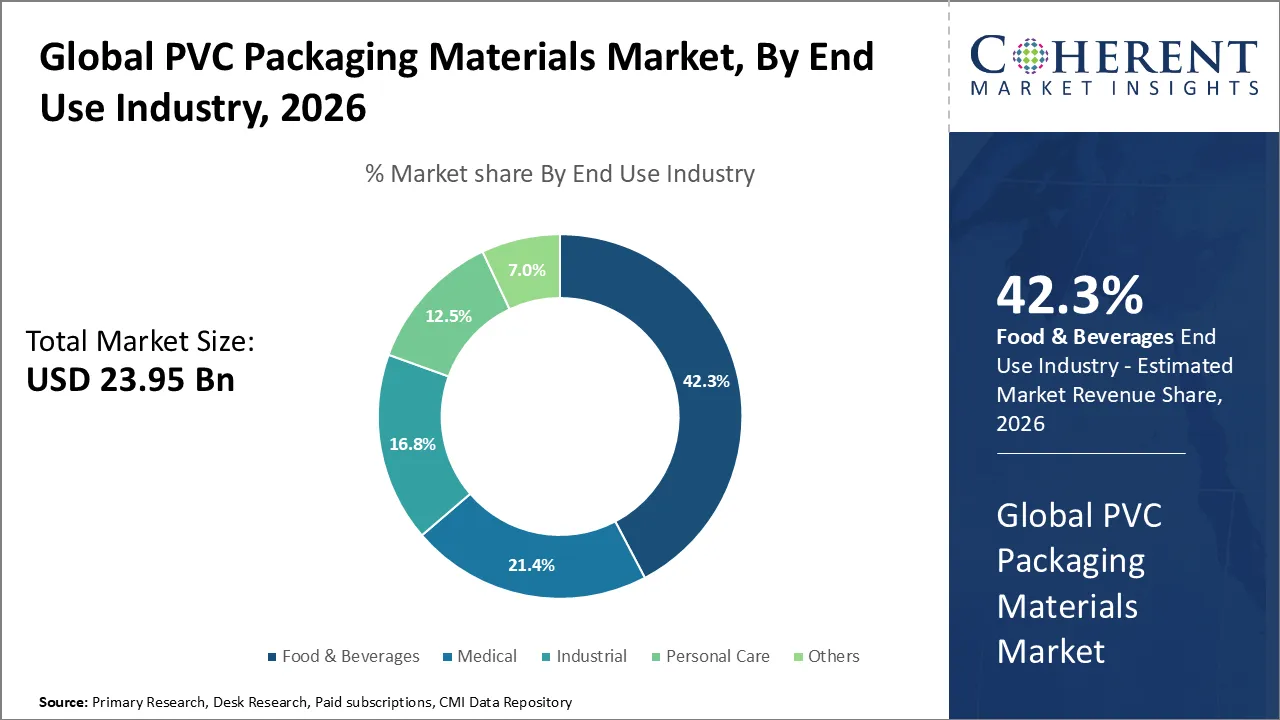
On the basis of end-use industry, the food & beverages segment is expected to hold the largest share of the PVC Packaging Materials Market 42.3% in 2026. The segment’s growth is owing to the large volumes of packaged food and beverages sold globally, increasing demand for convenient and protective packaging, growth in processed-food consumption, and PVC’s suitability for transparent films, trays, bottles, seals, and other packaging components. Coherent Market Insights specifically identifies rising processed-food demand and growing consumer expenditure on food and beverages as important contributors to PVC packaging demand.
According to the European Commission Joint Research Centre in July 2026, food and beverage applications represented approximately 97% of the packaging materials covered by its assessment, demonstrating the exceptionally high packaging intensity associated with this end-use sector. The assessment covered 19 EU Member States representing more than 97% of the EU population.
In April 2026, Jiangsu Youjin Food Packaging Co., Ltd. introduced a new generation of food-grade PVC cling film with high clarity, anti-fog properties and suitability for wide temperature ranges, aimed at supermarkets, catering businesses, food processors and cold-chain applications.
PVC Packaging Materials Market Trends
- An increasing emphasis on design-for-recycling and circular PVC packaging is leading manufacturers to redesign films, trays and blister structures to facilitate collection, separation and material recovery. Since 2026, VinylPlus has been evaluating participating companies on their ecodesign progress, by PVC application sector, including packaging and healthcare applications, on an annual basis.
- The development of advanced recycling technology for multilayer PVC packaging is increasing the ability to recover high-quality PVC from complex pharmaceutical blister structures. In May 2026, a peer-reviewed study within the VinylPlus PharmPack project demonstrated dissolution-based recycling of PVC/PVDC/aluminium blister packaging, achieving a 47% PVC recovery yield. The recovered polymer retained its chemical integrity and could be thermoformed into new blister films.
- The increased adoption of recycled polymers in food and beverage packaging is driving packaging manufacturers to develop more circular material portfolios and enhance recycled content traceability. In February 2025, Tetra Pak introduced packaging material in India containing 5% certified recycled polymers, in line with the country’s Plastic Waste Management requirements effective from April 2025.
Regional Insights
Asia Pacific Dominates Owing to the Large Plastics Manufacturing Base and Expanding Packaged Consumer Industries
Asia Pacific accounts for 39.1% of the PVC Packaging Materials Market share in 2026. The region’s dominance is owing to its large plastics and PVC processing base, expanding food and beverage and pharmaceutical industries, rising consumption of packaged consumer products, and growing demand for cost-effective rigid and flexible packaging across China, India, Japan, and Southeast Asia.
India is also strengthening Asia Pacific demand. According to the Government of India in March 2026, pharmaceutical exports increased from USD 27.75 billion in 2024 to USD 30.45 billion in 2025, representing approximately 9.7% growth. Moreover, by FY 2025–26, sales of products supported under India's food-processing PLI scheme had increased to INR 108,854 crore, while investments under the program created approximately 34 lakh metric tonnes of annual food-processing capacity.
North America PVC Packaging Materials Market Trends
North America is expected to be the fastest-growing region in the PVC Packaging Materials Market over the forecast period. The region’s growth is owing to its technologically advanced packaging industry, large pharmaceutical and healthcare packaging demand, continued innovation in flexible and protective packaging, strong domestic PVC manufacturing capabilities, and increasing investment in PVC recovery and recycling infrastructure.
According to the Flexible Packaging Association’s 2025 State of the U.S. Flexible Packaging Industry Report, the U.S. flexible packaging industry generated USD 42.6 billion in annual sales in 2024, increasing from USD 41.4 billion in 2023, representing growth of approximately 2.9%. The expanding flexible packaging ecosystem supports demand for high-performance films and protective packaging materials across food, healthcare, personal care, and consumer applications.
Strong Domestic Plastics Manufacturing Base and Packaging Film Innovation are Supporting the PVC Packaging Materials Market in the United States
The U.S. PVC Packaging Materials Market is experiencing a CAGR of 5.40% This is attributed to the presence of the country’s established plastics converting industry, strong domestic resin supply and continuous demand for PVC-based films in pharmaceutical, healthcare, food, consumer goods and shrink label applications.
In 2025, Klöckner Pentaplast (kp) highlighted continued investment in its U.S. innovation infrastructure through its dedicated kp i.center, while reporting the introduction of 120 new products over the preceding five years across pharmaceutical, health and protection, durable goods, and food packaging applications.
Large Packaging Manufacturing Base and Strengthening Pharmaceutical Packaging Standards are Driving the PVC Packaging Materials Market in China
China is expected to witness strong growth in the PVC Packaging Materials Market over the forecast period. The growth is owing to the country’s large packaging manufacturing base, expanding pharmaceutical and consumer-product industries, extensive PVC film production capabilities, and rising adoption of high-barrier PVC/PVDC structures.
According to the China Packaging Federation, China had 20,022 large-scale packaging enterprises in the first half of 2025, generating approximately RMB 995.66 billion in revenue, up 0.45% year over year, while total industry profits increased 5.05% to RMB 43.58 billion.
In June 2026, Jiangsu Baytree Composite Material Co., Ltd. announced its participation at CPHI Shanghai 2026, highlighting its pharmaceutical and food packaging material capabilities. The China-based company manufactures PVC rigid film, PVC/PVDC, PVC/PE/PVDC, PVC/PVDC/PVC, and other coated and laminated barrier films, indicating continued domestic development of specialized PVC packaging structures.
Who are the Major Companies in PVC Packaging Materials Industry
Some of the major key players in PVC Packaging Materials Market are Reliance Industries Limited, Palram Industries Ltd., Bilcare Singapore Pte Limited, Jinhua Zhong Bang Packaging Materials Co., Ltd., Teknor Apex Company, Inc.
Key News
- In April 2026, Teknor Apex Company entered into a joint venture with DCM Shriram’s Shriram Polytech to establish PolyTek, combining PVC/vinyl compound manufacturing capabilities with advanced polymer formulation technologies.
- In April 2025, Reliance announced progress on an integrated 1.5 million metric tonnes per annum PVC expansion project, which the company stated would make it the fifth-largest PVC producer globally.
PVC Packaging Materials Market Report Coverage
Report Coverage | Details | ||
Base Year: | 2025 | Market Size in 2026: | USD 23.95 Bn |
Historical Data for: | 2020 to 2024 | Forecast Period: | 2026 to 2033 |
CAGR: | 4.8% | 2033 Value Projection: | USD 33.25 Bn |
Geographies covered: |
| ||
Segments covered: |
| ||
Companies covered: | Reliance Industries Limited, Palram Industries Ltd., Bilcare Singapore Pte Limited, Jinhua Zhong Bang Packaging Materials Co., Ltd., Teknor Apex Company, Inc. | ||
Growth Drivers: |
| ||
Restraints & Challenges: |
| ||
Analyst Opinion
- The PVC Packaging Materials Market is expected to remain supported by PVC’s large established production base, cost efficiency, thermoformability, transparency, and durability, particularly across rigid films, blister packaging, food packaging, and other protective applications. According to the European Council of Vinyl Manufacturers (ECVM), global PVC resin consumption exceeds 40 million tonnes annually and is increasing by approximately 3% per year, demonstrating the material’s continued industrial relevance.
- Analysts expect circularity and material recovery to become increasingly important competitive factors for PVC packaging manufacturers. According to the Plastics Europe’s Circular Economy for Plastics 2026 report, circular plastics made up 15.8% of European plastics production in 2024, or 8.7 million tons. However, only 29.6% of the plastic waste collected was actually recycled, indicating that there are great opportunities for improvements in collection, sorting, recycling technology, and use of recycled materials in packaging applications.
- The long-term outlook is also supported by the broad consumer-product base requiring protective packaging. The European Commission Joint Research Centre’s 2026 assessment found that food and beverages, home care, beauty and personal care, and pet food together represent approximately 75% of the European consumer packaging market. Its analysis estimated 42.8 million tonnes of packaging placed on the market across the covered EU Member States in 2024, highlighting the substantial underlying demand base available to plastic and PVC packaging suppliers.
Speak to the analyst
Want personalized insights?
Take the findings above to one of our principal consultants, or have the report rebuilt around the segments, geographies and competitors you actually track.
Market Segmentation
- By Application (Revenue, USD Bn, 2021-2033)
- Rigid
- Flexible
- Others
- By End Use Industry (Revenue, USD Bn, 2021-2033)
- Food & Beverages
- Industrial
- Personal Care
- Medical
- Others
- By Region (Revenue, USD Bn, 2021-2033)
- North America
- U.S.
- Canada
- Latin America
- Brazil
- Mexico
- Argentina
- Rest of Latin America
- Europe
- Germany
- U.K.
- France
- Italy
- Spain
- Russia
- Rest of Europe
- Asia Pacific
- China
- India
- Japan
- Australia
- South Korea
- ASEAN
- Rest of Asia Pacific
- Middle East
- GCC
- Israel
- Rest of Middle East
- Africa
- South Africa
- Central Africa
- North Africa
- North America
Sources
Primary Research Interviews
- PVC resin manufacturers
- Rigid and flexible PVC packaging manufacturers
- Pharmaceutical blister film and packaging producers
- Food & beverage packaging converters
- Packaging material distributors and suppliers
- Procurement managers from pharmaceutical, food, personal care, and industrial companies
- PVC recyclers and waste-management companies
- Packaging technology and regulatory experts
Databases
- Eurostat
- United Nations Comtrade Database
- World Bank
- U.S. Food and Drug Administration (FDA)
- U.S. Environmental Protection Agency (EPA)
- European Commission – Environment and Packaging Regulations Database
- U.S. Census Bureau
Magazines
- Packaging Europe
- Packaging World
- PlasticsToday
- Healthcare Packaging
- Packaging Strategies
- Food & Beverage Packaging
Journals
- Packaging Technology and Science
- Journal of Applied Polymer Science
- Polymer Testing
- Resources, Conservation & Recycling
- Waste Management
- Journal of Plastic Film & Sheeting
Newspapers
- Financial Times
- The Wall Street Journal
- The Economic Times
- The Guardian
- Nikkei Asia
Associations
- European Council of Vinyl Manufacturers (ECVM)
- VinylPlus
- Plastics Europe
- Vinyl Institute
- Flexible Packaging Association (FPA)
- Institute of Packaging Professionals (IoPP)
- PVCMed Alliance
Public Domain Sources
- Company Annual Reports and Investor Presentations
- PVC Packaging Product Catalogs and Technical Datasheets
- Pharmaceutical Blister Film Specifications and Product Brochures
- Government Packaging and Plastic Waste Regulations
- European Union Packaging and Packaging Waste Regulation Publications
- FDA Food Contact and Pharmaceutical Packaging Guidelines
- Company Sustainability and Recycling Reports
- Patent Databases such as WIPO, USPTO, and Google Patents
- Publicly Available PVC Recycling and Circularity Reports
Proprietary Elements
- CMI Data Analytics Tool
- Proprietary CMI Existing Repository of Information for the Last 10 Years
Get access to 250+ pages report
Every segment, forecast, competitor profile and data table behind the analysis above — available for instant download.
- ESOMAR Member
- ISO 9001:2015 Certified
- D-U-N-S Registered
- GDPR & CCPA Compliant
Missing comfort of reading report in your local language? Find your preferred language:
Transform your Strategy with Exclusive Trending Reports
Frequently Asked Questions
The PVC Packaging Materials Market is expected to reach USD 33.25 Bn in 2033, compared with USD 23.95 Bn in 2026.
Major players operating in the global PVC Packaging Materials Market include Reliance Industries Limited, Palram Industries Ltd., Bilcare Singapore Pte Limited, Jinhua Zhong Bang Packaging Materials Co., Ltd., and Teknor Apex Company, Inc.
The stringent environmental regulations on PVC usage and growing concerns regarding plastic waste and recyclability are the key factors hampering growth of the market.
The increasing demand for PVC in pharmaceutical blister packaging, growing consumption of packaged food and beverage products, and demand for cost-effective, durable, transparent, and moisture-resistant packaging materials are driving growth of the PVC Packaging Materials Market.
The PVC Packaging Materials Market is anticipated to grow at a CAGR of 4.8% between 2026 and 2033.
Among regions, Asia Pacific is expected to account for the largest market share of 39.1% in 2026. The region is supported by its large plastics and PVC processing base, expanding food and beverage and pharmaceutical industries, and growing consumption of packaged consumer products.
PVC packaging materials are packaging products manufactured using polyvinyl chloride (PVC). PVC is widely used in rigid and flexible packaging owing to its transparency, durability, thermoformability, dimensional stability, chemical resistance, and suitability for protective packaging applications.