
Pyridoxine Hydrochloride (Vitamin B6) Market Size and Share Analysis –2026 To 2033
The global Pyridoxine Hydrochloride (Vitamin B6) Market size is anticipated to grow at a CAGR of 8.5%, from USD 119.33 Mn in 2026 to USD 210.69 Mn by 2033. The vitamin B6 market growth is attributed to key driving factors such as rising demand for vitamin B6 in dietary supplements, increasing usage of pyridoxine hydrochloride in pharmaceutical formulations, increasing awareness regarding micronutrient deficiencies and increasing applications in food fortification and animal nutrition. According to the National Institutes of Health (NIH), vitamin B6 is an essential part of more than 100 enzyme reactions involved in metabolism, cognitive development, and immune function. As such, it is an important ingredient in nutritional supplements, fortified food products, and pharmaceutical applications.
Key Takeaways
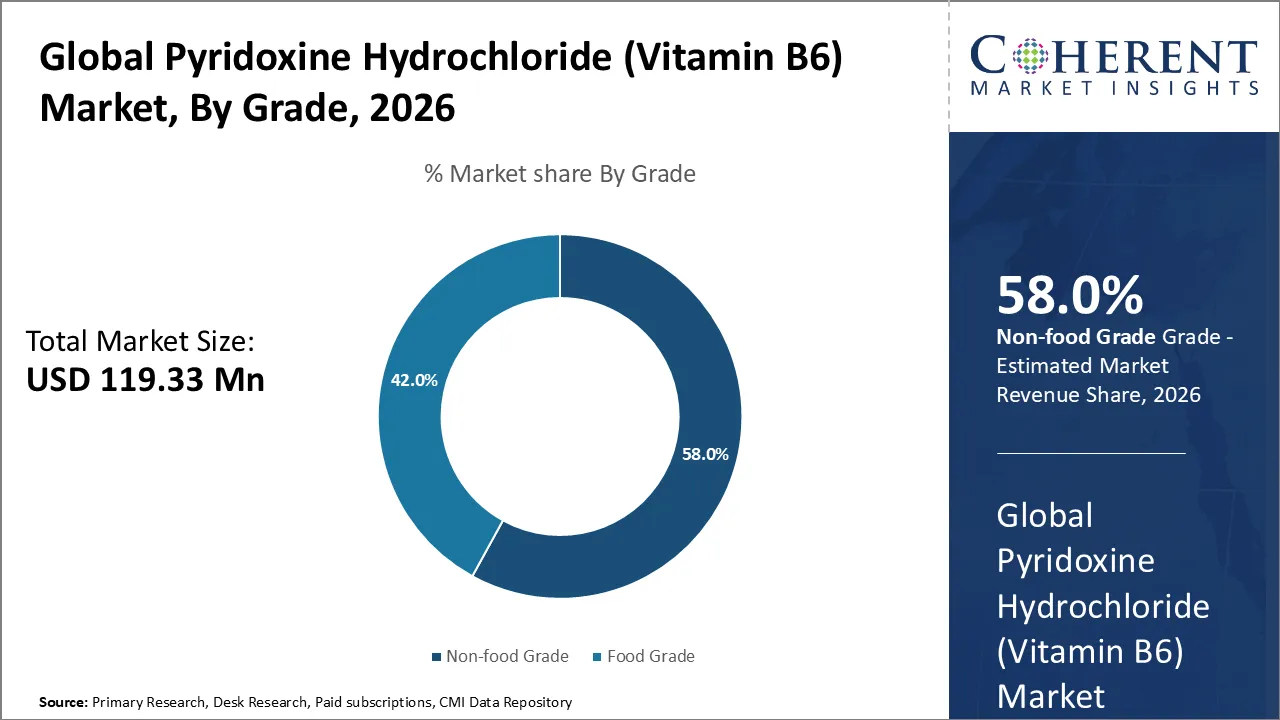
- The non-food grade segment is expected to hold a share of an estimated 58% of the market in 2026. The segment growth is attributed to the increasing application of feed-grade pyridoxine hydrochloride in livestock nutrition, pharmaceutical-grade vitamin B6 in medicinal formulations, and the growing demand for standardized vitamin ingredients. Data from China’s General Administration of Customs showed that in May 2026, China’s exports of unmixed vitamin B6 and its derivatives were 836.52 metric tons, with an average export price of USD16.46 per kg, suggesting strong international trade activity in vitamin B6 ingredients.
- The food & beverages segment is estimated to lead the end-use industry category with a market share of 38% in 2026. The growth is driven by increasing incorporation of vitamin B6 in fortified cereals, nutritional beverages, functional foods and micronutrient enriched food products. According to the World Health Organization (WHO), food fortification is an important strategy to improve micronutrient intake and address nutritional deficiencies.
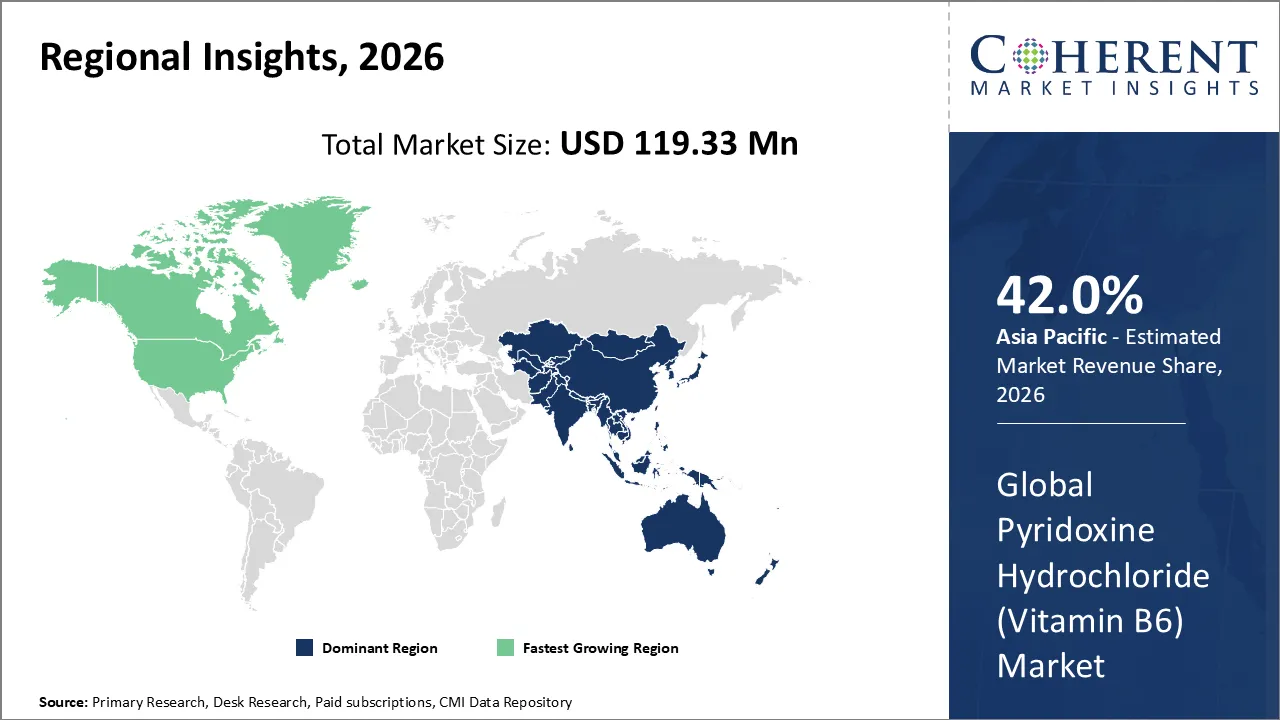
- Asia Pacific is expected to rule the global market with a share of 42% by 2026. The regional growth is driven by China’s existing vitamin manufacturing infrastructure, export-oriented production, competitive manufacturing capabilities, and rising demand from pharmaceutical and nutritional ingredient producers. According to the World Bank's World Integrated Trade Solution (WITS), in 2025 China exported about 8,382 metric tons of unmixed vitamin B6 and its derivatives, valued at USD 189.02 Mn.
Market Drivers
Rising Prevalence of Micronutrient Deficiencies is Accelerating Demand for Pyridoxine Hydrochloride in Nutritional Supplements
Increasing concerns over micronutrient deficiencies, nutritional deficiencies and requirement of balanced vitamin supplementation are fueling demand in the global Pyridoxine Hydrochloride (Vitamin B6) market. Pyridoxine hydrochloride is commonly found in vitamin B-complex and multivitamin preparations and in specialized nutritional products. It is essential for amino acid metabolism, neurotransmitter synthesis and normal immune function.
According to the United Nations Sustainable Development Goals Report 2025, in 2023, around 30.7% of the women aged 15–49 years were suffering from anemia globally. Furthermore, only 65% of women globally are consuming the minimum dietary diversity in 2019–2023, indicating continued nutritional deficiencies and the need for targeted micronutrient interventions.
In addition, the 2026 State of Food Security and Nutrition in the World Report of FAO, IFAD, UNICEF, WFP and WHO shows that the prevalence of anemia among women of 15 to 49 years of age could reach 32.6% by 2030. Persistent nutritional challenges are expected to support demand for scientifically formulated multivitamins, maternal nutrition products, and micronutrient supplements, thus creating opportunities for pyridoxine hydrochloride manufacturers, pharmaceutical and food grade.
Expanding Commercial Animal Feed Production is Strengthening Demand for Feed-Grade Vitamin B6
The rising commercialization of livestock production and the increased focus on balanced animal nutrition are creating demand for pyridoxine hydrochloride in feed premixes and compound feed formulations. Vitamin B6 is involved in protein metabolism, amino acid utilization, and normal physiological functions of livestock and poultry. Hence, the use of standardized vitamin premixes is increasing by feed manufacturers to guaranty nutritional uniformity, to promote animal performance and to satisfy species specific dietary needs.
Alltech said global production of broiler feed reached 400.38 million metric tons in 2025, up 3.7% year on year, while aquaculture feed production was up 4.7% to 55.47 million metric tons. Rise in demand for vitamin B6 premixes likely to be boosted by growth in poultry and aquaculture feed applications, especially in nutritionally balanced feed formulations. However, actual consumption of pyridoxine hydrochloride will be dependent upon feed inclusion rates, formulation practices and pricing of vitamins.
Current Events and Their Impact on the Pyridoxine Hydrochloride (Vitamin B6) Market
Current Event | Description and its Impact |
U.S. FDA Strengthens New Dietary Ingredient Safety and Documentation Guidance (October 2026) |
|
U.S. FDA Implements Revised Healthy Food Labeling Standards (2025–2026) |
|
- Current Industry Events of 2026
- Market Size Estimation
- Regional Breakdown
- Competitive Landscape
- Customer Intelligence
- Segmental Analysis
- Pricing Analysis
- Key Market Drivers, Challenges & Future Trends
- Customized Insights Section
Segmental Insights
Why is Non-food Grade Acquiring the Largest Market Share?
On the basis of grade, the non-food grade segment is projected to account for the largest Pyridoxine Hydrochloride (Vitamin B6) Market share of 58.0% in 2026. The growth of the segment can be attributed to the increasing use of pharmaceutical grade pyridoxine hydrochloride in prescription drugs, vitamin B-complex formulations, and feed grade vitamin B6 in animal nutrition. Its use in animal feed premixes, veterinary nutrition products and pharmaceutical formulations is driving demand for standardized, high purity vitamin B6 ingredients.
In February 2026, dsm-firmenich announced an agreement to divest its Animal Nutrition & Health business to CVC Capital Partners for approximately EUR 2.2 billion, which includes a potential earnout of EUR 500 million. In 2025, the business delivered about EUR 3.5 billion of annual net sales across vitamins, feed premixes, carotenoids and specialized animal nutrition solutions. This development underscores the commercial importance of the supply chains of industrial vitamin, including feed grade vitamin B6.
In September 2026, Brenntag and dsm-firmenich announced a global strategic partnership to launch BYPHAR powered by Biond a portfolio of eight high-purity, GMP-grade vitamins including Biond Pyridoxine Hydrochloride Ph Excel (Vitamin B6).
Food & Beverages Holds the Largest End-use Industry Market Share
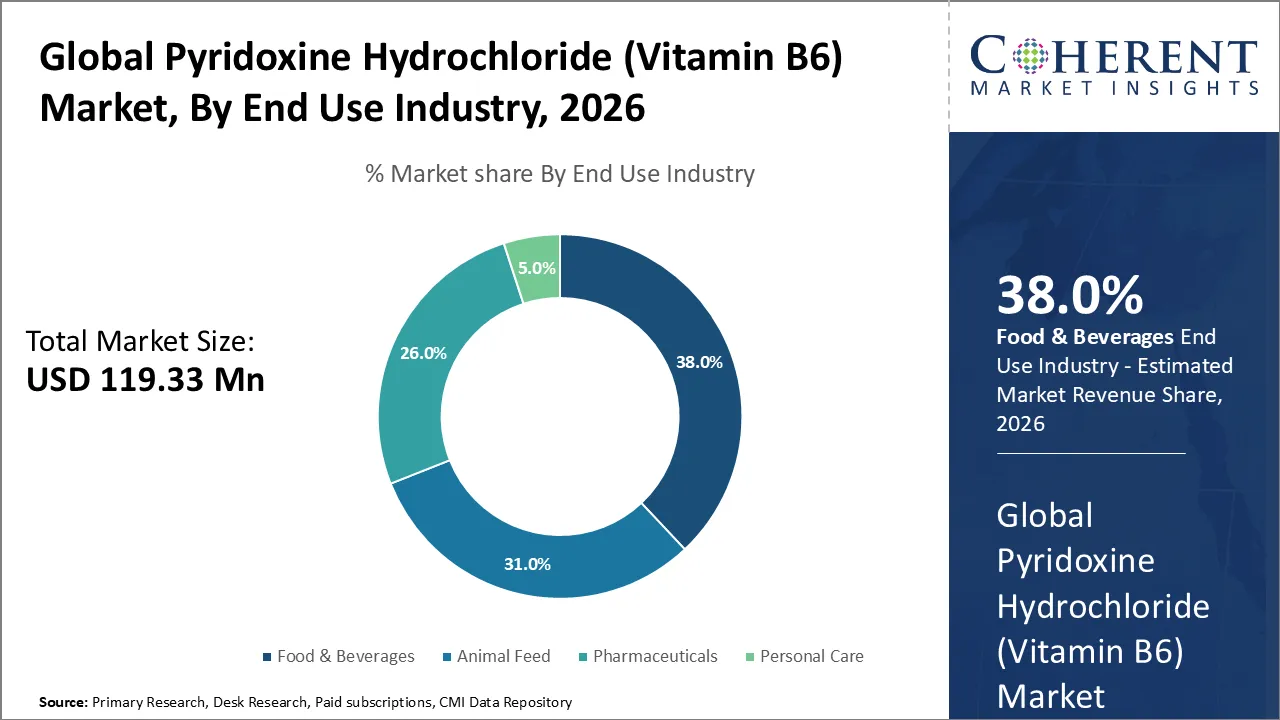
Based on the end-use industry, the food & beverages segment is projected to lead the Pyridoxine Hydrochloride (Vitamin B6) Market with a share of 38.0% in 2026. The segment growth is driven by the rising addition of vitamin B6 in fortified breakfast cereals, nutritional beverages, functional foods, and specialized dietary products. Manufacturers are using pyridoxine hydrochloride to enhance micronutrient profiles, satisfy nutritional labeling requirements and offer convenient fortified products for health-conscious consumers.
Pyridoxine hydrochloride is a nutrient supplement approved for use in food under applicable regulatory conditions by the U.S. Food and Drug Administration (FDA) (21 CFR 184.1676). This regulatory recognition supports its established application in food fortification and provides ingredient manufacturers with a defined compliance framework for supplying food-grade vitamin B6.
According to the National Institutes of Health (NIH) estimates that approximately 28%–36% of the U.S. population uses dietary supplements containing vitamin B6. Pyridoxine hydrochloride is the most frequently used form of vitamin B6 in supplements.
Pyridoxine Hydrochloride (Vitamin B6) Market Trends
- Rising use of pyridoxine hydrochloride in pharmaceutical formulations for tuberculosis treatment is creating specialized demand for pharmaceutical-grade vitamin B6. In September 2026, the Global Fund announced that 7.4 million people received treatment for tuberculosis in supported countries in 2025, including 115,000 patients with drug-resistant tuberculosis.
- The growing importance of sustainable vitamin B6 production via microbial fermentation is causing manufacturers to seek alternatives to traditional chemical synthesis. Synthetic and Systems Biotechnology published a paper on production of 3.33 g/L pyridoxine in a 5-L bioreactor by engineered Escherichia coli and optimized fermentation conditions in March 2026.
- Production efficiency and optimization of manufacturing cost research is increasing due to progress of metabolically engineered microorganisms for high yield of pyridoxine production. In June 2025 study published in the Journal of Agricultural and Food Chemistry, genetically engineered Escherichia coli produced pyridoxine titre of 2,120.1 mg/L and productivity of 32.1 mg/L/hour in batch fermentation.
Regional Insights
Asia Pacific Dominates Owing to Strong Vitamin B6 Manufacturing Capacity and Established Pharmaceutical Supply Chains
The Asia Pacific region is expected to dominate the Pyridoxine Hydrochloride (Vitamin B6) market with a share of approximately 42% by 2026. The growth in the region is attributed to the existing infrastructure for vitamin manufacturing, availability of chemical intermediates, economical manufacturing capabilities, and increasing use of pyridoxine hydrochloride in pharmaceutical formulations, food fortification, and animal nutrition applications.
In April 2026, iangxi Tianxin Pharmaceutical announced its 2025 Annual Report. It showed that the total vitamin production in China increased by 5.2% in 2025, and the market value of China’s vitamin market reached about USD 4.73 billion, with a year-on-year growth of 2.9%.
North America Pyridoxine Hydrochloride (Vitamin B6) Market Trends
North America is expected to be the fastest growing region in Pyridoxine Hydrochloride (Vitamin B6) Market during 2026-2033 due to high consumption of nutrition supplements, growing demand for clinically backed vitamin formulations and growing use of pharmaceutical grade ingredients. The established dietary supplement industry in the region, along with growing focus on product transparency and an emphasis on quality-assured ingredients, should support higher-value vitamin B6 formulations.
A September 2026 survey found that about 78% of U.S. adults report using dietary supplements, and 67% use vitamin or mineral supplements in particular. The study was done in July 2026 and included 3,554 U.S. adults. Of users of vitamin and mineral supplements, 62% reported these products were extremely or very important to their health.
In addition, the Council for Responsible Nutrition’s 2026 Consumer Survey, published in October 2026, revealed that 75% of U.S. adults consumed dietary supplements and 77% indicated that independent quality verification would boost their confidence in supplement products. The nationally weighted survey included 3,005 adults, with 81% identifying scientific evidence as important when evaluating supplement suitability.
Rising Clinical Recognition of Vitamin B6 Deficiency is Supporting the Pyridoxine Hydrochloride Market in the United States
The U.S. Pyridoxine Hydrochloride (Vitamin B6) Market is witnessing increasing opportunities owing to growing clinical recognition of vitamin B6 deficiency, expanding use of pharmaceutical-grade vitamin ingredients, and stronger emphasis on micronutrient monitoring during neurological disease treatment. The market is also benefiting from demand for quality-controlled pyridoxine hydrochloride used in prescription formulations and specialized nutritional products.
In March 2026, the U.S. Food and Drug Administration (FDA) announced new safety labeling requirements for medicines containing carbidopa/levodopa, which are commonly prescribed for Parkinson’s disease. The FDA reported 14 cases of seizures in patients taking these treatments who were also deficient in vitamin B6.
China Pyridoxine Hydrochloride (Vitamin B6) Market Trends – Strong Manufacturing Competition and Evolving Pricing Dynamics
China continues to be a key player in the Pyridoxine Hydrochloride (Vitamin B6) Market, owing to well established manufacturing capabilities, integrated chemical production infrastructure and the presence of pharmaceutical and feed-grade vitamin manufacturers. The country’s competitive supplier landscape is shaping global pricing of pyridoxine hydrochloride, as well as procurement strategies and international distribution.
The vitamin B6 market remained relatively stable, with structural oversupply limiting price increases despite broader raw material cost pressures, the dsm-firmenich Vitamin Market Outlook, published June 15, 2026, said. The company specifically mentioned competitive activity from Chinese suppliers as a key factor influencing vitamin B6 prices and the potential for new market entry.
The China Chamber of Commerce for Import & Export of Medicines & Health Products’ analysis of the first half of 2026 showed that China’s export volumes of pharmaceutical raw materials and intermediates increased by 11.1% year-on-year, while export value rose by 5.9%. It also said export prices for vitamin B6 continued to fall in the second quarter of 2026, reflecting continued competition in the vitamin manufacturing industry in China.
Who are the Major Companies in Pyridoxine Hydrochloride (Vitamin B6) Industry
Some of the major key players in Pyridoxine Hydrochloride (Vitamin B6) Market are Royal DSM N.V., Jiangxi Tianxin Pharmaceutical Co. Ltd., BASF SE, Huazhong Pharmaceutical, Acebright Pharmaceuticals Group, Now Foods, Shanghai Hegno Pharmaceutical Holding Co., Ltd., and Nanjing Pharmaceutical Factory Co. Ltd.
Key News
- In June 2026, NOW Foods announced a partnership with LeafWorks to incorporate advanced DNA sequencing into its botanical ingredient identification and quality-testing processes. The initiative strengthens the company's approach to raw-material verification and product authenticity across complex supplement formulations.
- In August 2026, Jiangxi Tianxin Pharmaceutical reported that revenue from its B-vitamin portfolio increased by 25.98% year-on-year during the second quarter of 2026, reaching approximately CNY 490.87 million.
Market Report Scope
Pyridoxine Hydrochloride (Vitamin B6) Market Report Coverage
Report Coverage | Details | ||
Base Year: | 2025 | Market Size in 2026: | USD 119.33 Mn |
Historical Data for: | 2020 to 2024 | Forecast Period: | 2026 to 2033 |
CAGR: | 8.5% | 2033 Value Projection: | USD 210.69 Mn |
Geographies covered: |
| ||
Segments covered: |
| ||
Companies covered: | Royal DSM N.V., Jiangxi Tianxin Pharmaceutical Co. Ltd., BASF SE, Huazhong Pharmaceutical, Acebright Pharmaceuticals Group, Now Foods, Shanghai Hegno Pharmaceutical Holding Co., Ltd., and Nanjing Pharmaceutical Factory Co. Ltd. | ||
Growth Drivers: |
| ||
Restraints & Challenges: |
| ||
Analyst Opinion
- The global Pyridoxine Hydrochloride (Vitamin B6) Market is expected to witness an increase in competition among manufacturers, with a focus on pricing efficiency, supply-chain optimization, and uniform quality of Pyridoxine Hydrochloride (Vitamin B6) across the value chain. According to the Vitamin Market Outlook by dsm-firmenich published in June 2026, the vitamin B6 market was relatively stable in the face of general production cost pressures.
- Technology advances are making the production of pyridoxine more sustainable and affordable. A two-step biosynthesis process resulted in a pyridoxine concentration of 2,296 mg/L, showing the potential of fermentation-based alternatives to conventional chemical synthesis, according to a study published in Process Biochemistry in September 2025. These technological advances may motivate manufacturers to invest in microbial production, process optimization and clean manufacturing.
- The growing regulatory attention on the safety of vitamin B6 dosage is likely to influence the formulation strategy and product differentiation in both pharmaceutical and dietary supplement applications. The European Food Safety Authority (EFSA) has set the tolerable upper intake level for vitamin B6 at 12 mg per day for adults, citing concerns about the risk of peripheral neuropathy from excessive intake. In contrast, the U.S. National Institutes of Health identifies an adult upper intake level of 100 mg per day, demonstrating differences in regional safety assessments.
Speak to the analyst
Want personalized insights?
Take the findings above to one of our principal consultants, or have the report rebuilt around the segments, geographies and competitors you actually track.
Market Segmentation
- By Grade (Revenue, USD Mn, 2021-2033)
- Food Grade
- Non-food Grade
- Feed Grade
- Pharmaceutical Grade
- By End Use Industry (Revenue, USD Mn, 2021-2033)
- Food & Beverages
- Animal Feed
- Pharmaceuticals
- Personal Care
- By Region (Revenue, USD Mn, 2021-2033)
- North America
- U.S.
- Canada
- Latin America
- Brazil
- Mexico
- Argentina
- Rest of Latin America
- Europe
- Germany
- U.K.
- France
- Italy
- Spain
- Russia
- Rest of Europe
- Asia Pacific
- China
- India
- Japan
- Australia
- South Korea
- ASEAN
- Rest of Asia Pacific
- Middle East
- GCC
- Israel
- Rest of Middle East
- Africa
- South Africa
- Central Africa
- North Africa
- North America
Sources
Primary Research Interviews
- Pyridoxine Hydrochloride (Vitamin B6) Manufacturers
- Pharmaceutical API and Vitamin Ingredient Manufacturers
- Dietary Supplement and Nutraceutical Formulation Experts
- Animal Feed Premix Manufacturers and Nutrition Specialists
- Food Fortification and Functional Food Product Developers
- Pharmaceutical and Nutritional Ingredient Procurement Managers
- Regulatory Affairs and Quality Assurance Professionals
- Key Opinion Leaders (KOLs) in Clinical Nutrition and Vitamin Manufacturing
Databases
- World Bank – World Integrated Trade Solution (WITS)
- United Nations Comtrade Database
- United States International Trade Commission (USITC)
- U.S. Food and Drug Administration (FDA) Databases
- National Institutes of Health (NIH) – Office of Dietary Supplements
- United Nations Food and Agriculture Organization (FAOSTAT)
- Eurostat – European Commission
- World Health Organization (WHO) Global Health Observatory
Magazines
- Nutraceuticals World
- Nutrition Insight
- FoodNavigator
- NutraIngredients
- Feed Strategy
- Pharmaceutical Technology
- Chemical & Engineering News
Journals
- Journal of Nutrition
- American Journal of Clinical Nutrition
- Nutrients
- Food Chemistry
- Journal of Agricultural and Food Chemistry
- Process Biochemistry
- Synthetic and Systems Biotechnology
- International Journal of Pharmaceutics
Newspapers
- The Wall Street Journal
- Financial Times
- Reuters
- The Economic Times
- South China Morning Post
- The Guardian
Associations
- Council for Responsible Nutrition (CRN)
- European Federation of Associations of Health Product Manufacturers (EHPM)
- International Alliance of Dietary/Food Supplement Associations (IADSA)
- American Feed Industry Association (AFIA)
- International Feed Industry Federation (IFIF)
- China Chamber of Commerce for Import & Export of Medicines & Health Products (CCCMHPIE)
- European Federation of Pharmaceutical Industries and Associations (EFPIA)
Public Domain Sources
- Company Annual Reports and Investor Presentations
- U.S. FDA Pharmaceutical and Dietary Supplement Regulatory Publications
- European Food Safety Authority (EFSA) Scientific Opinions
- National Institutes of Health (NIH) Vitamin B6 Fact Sheets
- World Health Organization (WHO) Micronutrient and Nutrition Publications
- Government Import–Export Statistics and Customs Trade Records
- Publicly Available Pharmaceutical and Nutraceutical Manufacturing Reports
- University Research Publications on Vitamin B6 Biosynthesis and Fermentation
- Patent Databases such as WIPO, USPTO, and Google Patents
- Regulatory and Quality Standards Publications Related to Food, Feed, and Pharmaceutical-grade Vitamin B6
Proprietary Elements
- CMI Data Analytics Tool
- Proprietary CMI Existing Repository of Information for the Last 10 Years
Get access to 250+ pages report
Every segment, forecast, competitor profile and data table behind the analysis above — available for instant download.
- ESOMAR Member
- ISO 9001:2015 Certified
- D-U-N-S Registered
- GDPR & CCPA Compliant
Missing comfort of reading report in your local language? Find your preferred language:
Transform your Strategy with Exclusive Trending Reports
Frequently Asked Questions
The global Pyridoxine Hydrochloride (Vitamin B6) Market is expected to reach USD 210.69 Mn by 2033, increasing from USD 119.33 Mn in 2026.
Major players operating in the global Pyridoxine Hydrochloride (Vitamin B6) Market include Royal DSM N.V., Jiangxi Tianxin Pharmaceutical Co. Ltd., BASF SE, Huazhong Pharmaceutical, Acebright Pharmaceuticals Group, NOW Foods, Shanghai Hegno Pharmaceutical Holding Co., Ltd., and Nanjing Pharmaceutical Factory Co. Ltd.
Fluctuating raw material prices, stringent regulatory and quality compliance requirements, intense manufacturing competition, and concerns regarding excessive vitamin B6 consumption are key factors hampering market growth.
Increasing demand for vitamin B6 in dietary supplements and pharmaceutical formulations, growing utilization in food fortification and animal nutrition, and rising awareness regarding micronutrient deficiencies are boosting market growth.
The Pyridoxine Hydrochloride (Vitamin B6) Market is anticipated to grow at a CAGR of approximately 8.5% between 2026 and 2033.
Among regions, Asia Pacific is expected to account for the largest market share of approximately 42% in 2026, supported by China's established vitamin manufacturing infrastructure, competitive production capabilities, and expanding pharmaceutical and animal nutrition industries.
Pyridoxine hydrochloride is a water-soluble form of vitamin B6 commonly used in dietary supplements, pharmaceutical formulations, fortified foods, and animal feed. It supports amino acid metabolism, neurotransmitter synthesis, red blood cell formation, and normal immune functioning.