

Global Remote Car Starter Market Size and Forecast – 2026 To 2033
The global remote car starter market is expected to grow from USD 2.25 Bn in 2026 to USD 3.30 Bn by 2033, registering a compound annual growth rate (CAGR) of 4.3% from 2026 to 2033. The global remote car starter market is driven by the growing adoption and integration of vehicle telematics & IoT platforms. On March 10, 2026, Ford launched Ford Pro AI, a generative AI layer built on its commercial telematics platform for fleet customers. The system analyzes telematics data such as driver behavior, fuel usage, and vehicle diagnostics to provide predictive recommendations and automated reporting. (Source: Ford)
Key Takeaways of the Global Remote Car Starter Market
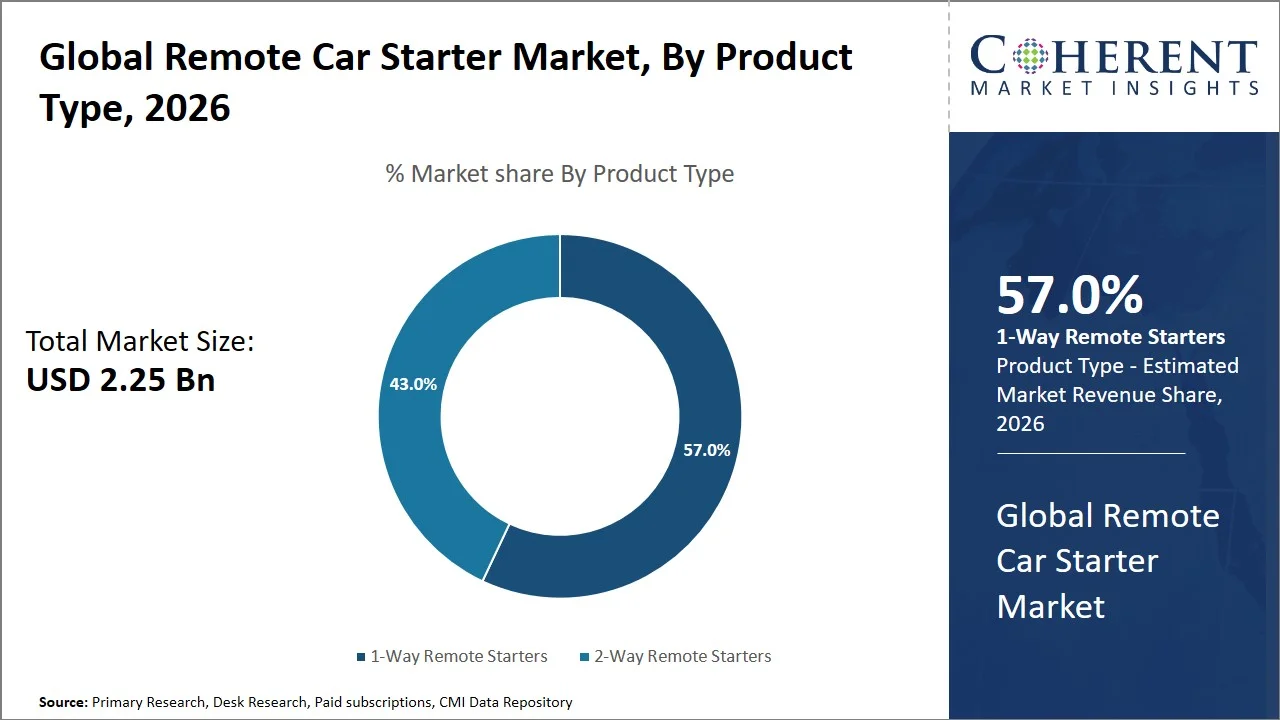
- The 1-way remote starters segment is expected to account for 57.0 % of the global remote car starter market share in 2026. The demand for 1-way remote starters is driven by the increasing need from fleet management and commercial vehicle applications. On January 21, 2026, Geotab expanded its MyGeotab platform with AI-based fleet analytics tools, the Geotab Ace, enabling fleet operators to query vehicle performance, compliance, and driver behavior using natural language. (Source: Geotab)
- The passenger vehicles segment is estimated to capture 51.0 % of the market share in 2026. Growing consumer preference for premium vehicle features is driving the segmental growth. On February 4, 2026, Mercedes-Benz expanded its MBUX Hyperscreen ecosystem across additional EQS and EQE trims, integrating AI-based personalization that adjusts cabin lighting, seating posture, infotainment, and climate automatically based on driver behavior. (Source: Mercedes-Benz)
- The RF-based systems segment is estimated to capture 42.0 % of the market share in 2026. Increasing demand for cabin pre-conditioning in extreme climates is a key factor driving the growth of the segment. For example, Kia expanded its Kia Connect platform to support enhanced remote cabin pre-conditioning in vehicles like the Sportage and Seltos, allowing users to start HVAC systems via smartphone apps before entering the vehicle. (Source: Kia)
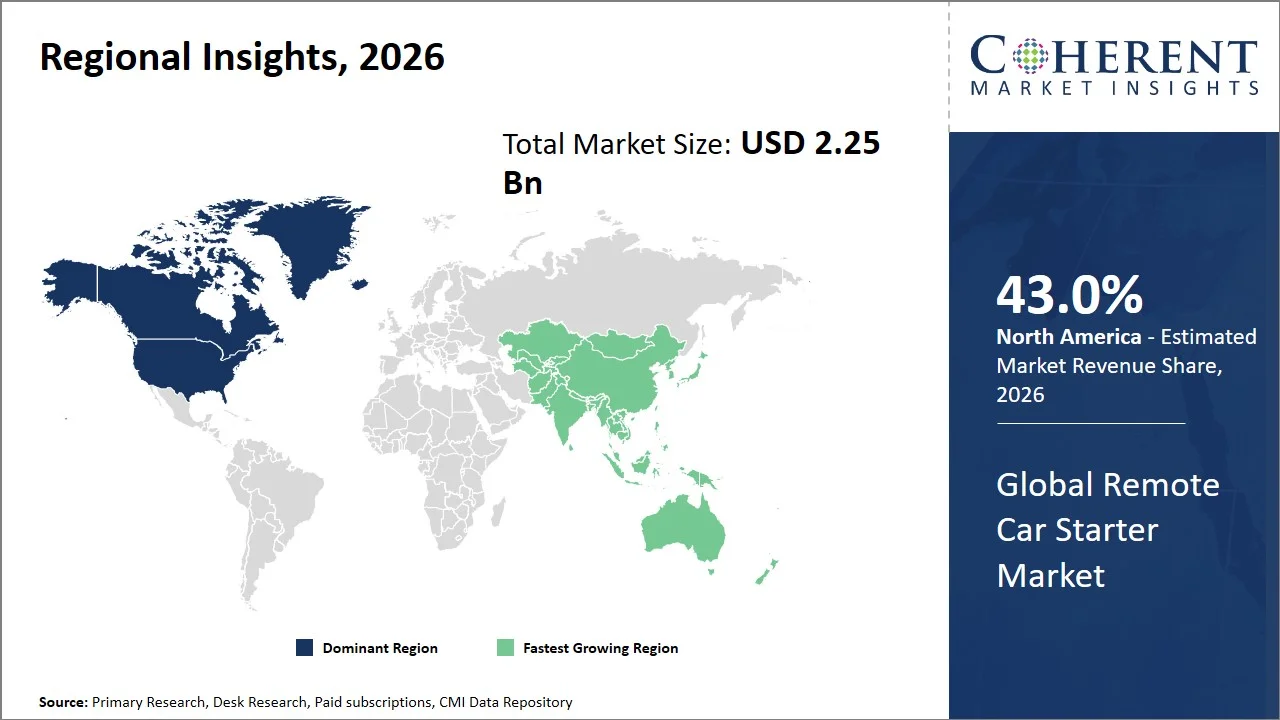
- North America is expected to dominate the remote car starter market in 2026 with a market share of 43.0 %. Growth of connected vehicle subscription services in North America is primarily driving the growth of the regional market. On January 6, 2026, General Motors reported that its OnStar connected services achieved a significant new benchmark, closing 2025 with a record 12 million global subscribers. (Source: GM Authority)
- Asia Pacific is expected to account for 25.0 % share in 2026 and is projected to record the fastest growth over the forecast period. A booming automotive landscape in Asia Pacific is actively driving the growth of the remote car starter market in the region. For example, BYD concluded 2023 with over 3.02 million units of NEVs sold, with export volume exceeding 240,000, ranking in the top 10 global new car sales. On July 4, 2024, BYD became the first car manufacturer worldwide to produce its 8 millionth new energy vehicle. (Source: BYD)
- Smartphone-Based Vehicle Control: Remote car starter systems are being incorporated into mobile apps that enable users to start, stop, lock, unlock and monitor vehicles directly from smartphones. Traditional key-fob-only systems are being gradually replaced by cloud connectivity and app-based control.
- Integration with Connected Car and IoT Ecosystems: Remote manufacturers are embedding remote starts into larger connected car platforms. These technologies now integrate with GPS tracking, car diagnostics, automotive telematics and smart-home ecosystems to create a more seamless digital driving experience.
Segmental Insights
Why Do 1-Way Remote Starters Dominate the Global Remote Car Starter Market?
The 1-way remote starters segment is expected to account for 57.0% of the global remote car starter market share in 2026. The primary reason why 1-way remote starters have become so dominant is their cost. These systems are far cheaper than 2-way and smartphone-connected counterparts, making them attractive to budget-minded consumers and the enormous aftermarket business. Their basic functionality, lower installation cost and broad vehicle compatibility enable higher usage especially in entry-level and mid-range automobiles. On September 17, 2024, Compustar expanded its lineup with the Pro G18 and RS1B systems, positioning them as compact, affordable entry-level options that bring reliable 1-way remote start and keyless entry to the everyday driver. (Source: Compustar)
- Current Industry Events of 2026
- Market Size Estimation
- Regional Breakdown
- Competitive Landscape
- Customer Intelligence
- Segmental Analysis
- Pricing Analysis
- Key Market Drivers, Challenges & Future Trends
- Customized Insights Section
Why are Passenger Vehicles the Most Crucial Vehicle Type?
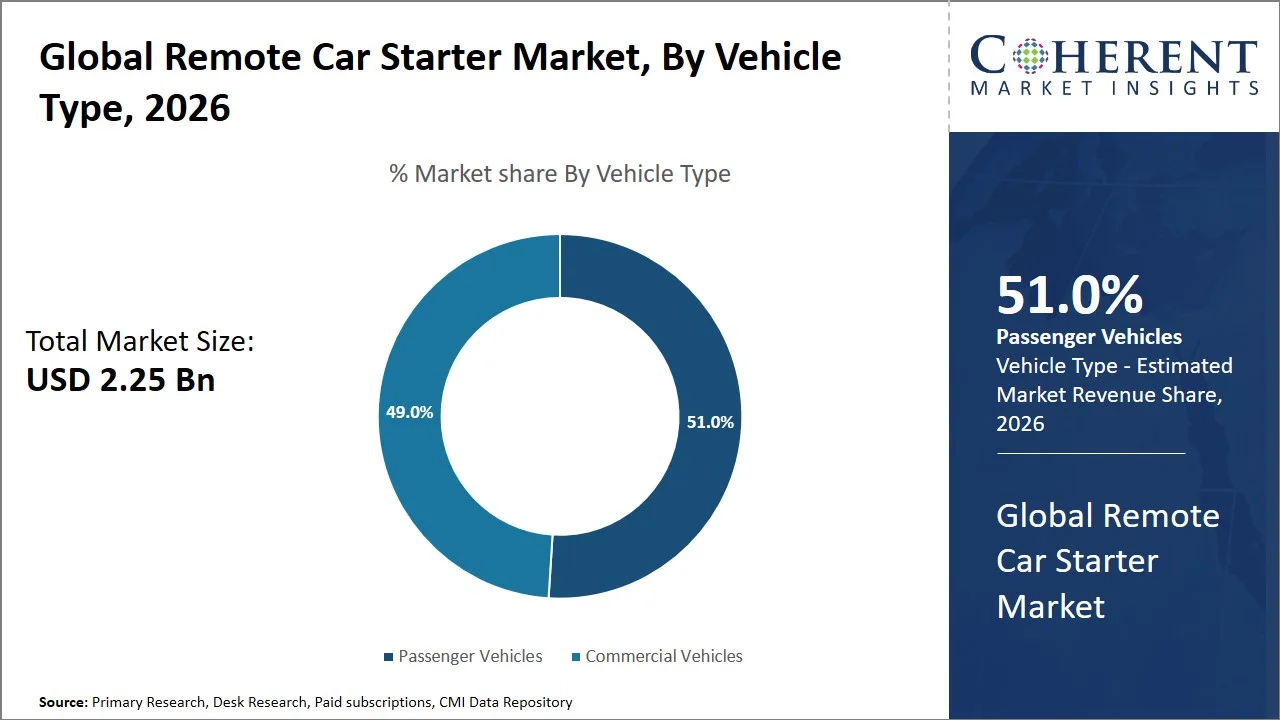
The passenger vehicles segment is expected to account for 51.0% of the global remote car starter market share in 2026. Passenger vehicles make up the lion’s share of vehicles on the road around the world, providing a far greater client base for remote car starter systems than commercial vehicles. In addition, high consumer demand for convenience, comfort, and vehicle personalization is driving adoption in this market. On May 26, 2026, Toyota expanded its Remote Connect services across popular passenger models like the Corolla, Camry, and RAV4, allowing owners to control vehicle functions seamlessly. Through the Toyota app, users can lock/unlock doors, locate their car, start the engine remotely, and check vehicle diagnostics. (Source: Toyota)
RF-Based Systems Dominate the Global Remote Car Starter Market
The RF-based systems segment is expected to account for 42.0% of the global remote car starter market share in 2026. RF-based systems are dominant because of their proven durability and long-range performance. Radio Frequency (RF) technology provides reliable remote start features at long ranges without the need for a smartphone or internet connection, making it a cost-effective and universal option for OEM and aftermarket applications. On March 5, 2026, Directed Electronics announced it continued expanding its Viper and Avital RF-based remote start systems across North American retail channels, focusing on dependable one-way and two-way RF remotes. The company maintains RF systems as core offerings because they provide consistent vehicle response without internet dependency, especially in budget aftermarket segments. (Source: DIRECTED)
Currents Events and their Impact
Current Events | Description and its Impact |
UN Regulation No. 155 (Cybersecurity Management System) |
|
U.K. Product Security and Telecommunications Infrastructure Act (PSTI) |
|
(Source: UNECE, UK Government)
Remote Car Starter Market Dynamics
Market Drivers
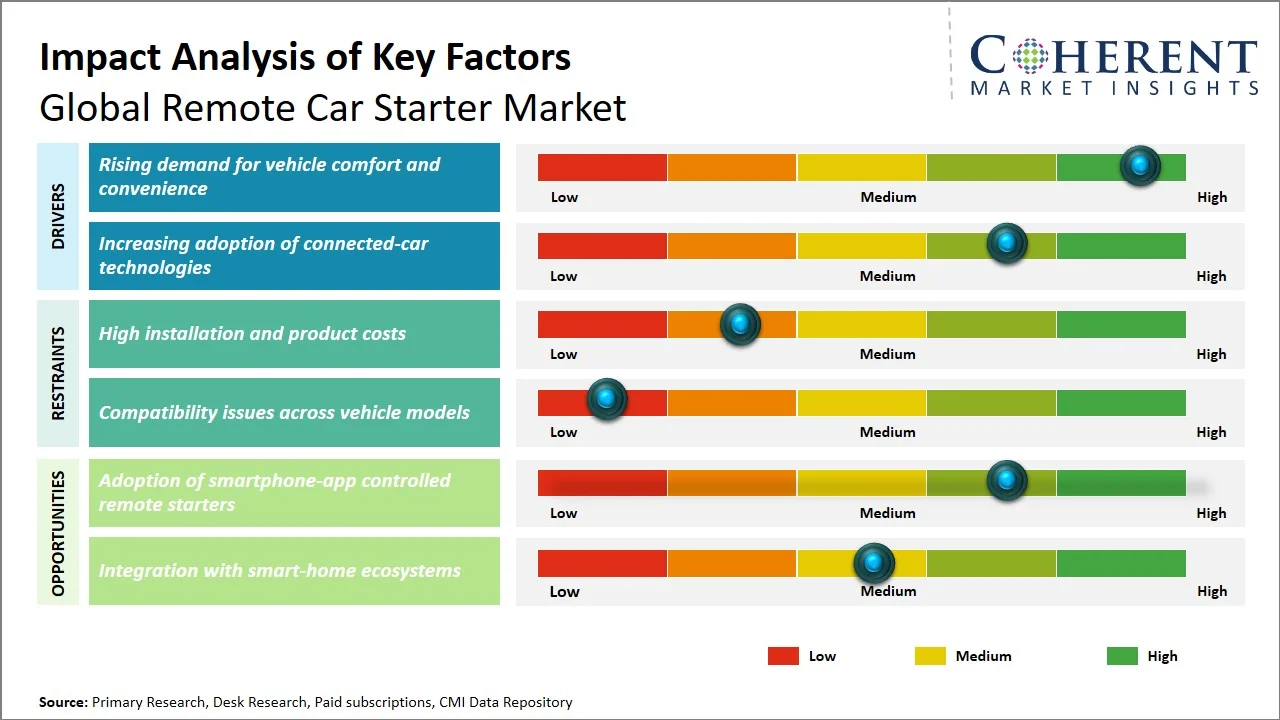
Rising demand for vehicle comfort and convenience
The rising demand for vehicle comfort and convenience is a major driver of the worldwide remote auto starter market, as consumers are increasingly looking for features that improve the overall driving experience. Remote car starter systems can be used to start the vehicle from a distance and pre-condition the cabin temperature before entering, adding comfort in adverse weather. The increasing use of convenience driven automotive technology, especially among passenger vehicle owners, is persuading automakers and aftermarket providers to include enhanced remote-start systems in their product portfolios. For example, Hyundai enhanced Bluelink connectivity to include remote climate control, heated seat activation, and steering wheel heating in SUVs such as the Tucson and Santa Fe. This reflects strong demand for multi-zone personalized comfort settings controlled directly from mobile apps. (Source: Hyundai)
Increasing adoption of connected-car technologies
The increasing acceptance of connected-car technologies is a major factor driving the growth of the remote car starter market, as modern automobiles are more integrated with digital communication and smart mobility platforms. Remote starting systems are increasingly being integrated with smartphone apps, telematics, GPS tracking and cloud-based services that enable users to control as well as monitor their vehicles remotely. This improved connectivity increases convenience, vehicle management and user experience and drives wider adoption of advanced remote-start solutions through both OEM and aftermarket channels.
On September 5, 2025, Qualcomm Technologies, Inc. and BMW Group introduced Snapdragon Ride Pilot, the companies’ new automated driving (AD) system resulting from a three-year collaborative effort. This state-of-the-art AD system is built on Qualcomm Technologies’ Snapdragon Ride system-on-chips (SoCs) using the leading-edge Snapdragon Ride AD software stack co-developed by both companies. (Source: Qualcomm)
Emerging Trends
- Shift Toward OEM-Integrated Solutions: Automakers are increasingly offering factory-installed remote start capability, as opposed to just aftermarket solutions. Integrated into the OEM, there’s improved vehicle interoperability, higher cybersecurity, and greater user convenience with native vehicle apps.
- Rise of High-Frequency Millimeter-Wave Remote Car Starters: Next-generation remote starter systems are now including encrypted communication, biometric authentication, geofencing, vehicle health monitoring and AI-driven climate pre-conditioning. These elements enhance security and user comfort, and facilitate premium vehicle placement.
Regional Insights
Why is North America a Strong Market for Remote Car Starters?
North America is expected to account for a market share of 43.0% in 2026. The greatest regional market for remote car starters is North America, mainly driven by the harsh winter weather in the northern U.S. and Canada. States like Minnesota, Michigan, Wisconsin, New York and provinces like Ontario and Quebec have extremely high adoption rates because consumers regularly utilize remote starts to warm up engines and cabin interiors before driving in sub-zero conditions. The region also has a strong automotive aftermarket ecosystem where brands such as Compustar, Viper and Avital have built large dealer networks. Factory-installed remote start systems on Ford F-Series trucks, Chevrolet Silverado, GMC Sierra, Jeep Grand Cherokee and Ram pickups further increase market penetration. In addition, the North America remote auto starter market is also being driven by the rising demand for vehicle comfort among customers in the region. On May 22, 2026, Lincoln expanded comfort features in the Aviator lineup, including multi-zone climate control, air purification systems, and massage seating in higher trims. This demonstrates increasing demand for luxury-grade interior comfort systems that personalize the driving experience for each passenger. (Source: Lincoln)
Why Does Asia Pacific Remote Car Starter Market Exhibit High Growth?
Asia Pacific is projected to account for 25.0% of the global remote car starter market and is expected to register the fastest growth. Asia Pacific is the fastest expanding remote car starter market, driven by increased vehicle ownership and growing demand for connected vehicle technology. Smartphone-controlled remote start systems connected with telematics platforms are gaining traction in China, South Korea and India. Chinese automakers such as BYD, Geely and Changan are increasingly providing app-based remote control of vehicles through their own connected-car ecosystems. South Korea’s Hyundai Bluelink and Kia Connect platforms offer remote vehicle start and cabin pre-conditioning functionality via mobile apps. Market growth in the region is fueled by the rapid rise of connected-car infrastructure and consumer preference for premium convenience features. In 2025, Honda promoted its remote engine start system across models like the CR-V, Accord, and Pilot, highlighting automatic cabin heating, cooling, and defrost functions. The system is widely used in extreme weather regions, reinforcing consumer preference for vehicles that adapt cabin conditions before the driver enters. (Source: Honda)
Global Remote Car Starter Market Outlook for Key Countries
Why is the U.S. Emerging as a Major Hub in the Remote Car Starter Market?
The U.S. is the world’s largest single market for remote car starters, due to extreme winter weather, high vehicle ownership and strong aftermarket demand. Remote start is especially popular in northern states, where temperatures often drop below freezing. Major OEMs including Ford, General Motors, Toyota, Stellantis and Honda are adding remote start capabilities into their factory-installed connected car packages. Pickup trucks and SUVs continue to be the leading vehicle categories in remote start technology usage, with customer adoption growing beyond traditional key-fob-based systems due to the prevalence of smartphone-based platforms like FordPass, myChevrolet and Toyota Connected Services.
Is China the Next Growth Engine for the Remote Car Starter Market?
The Chinese remote car starter market is moving away from classic RF-based systems towards smartphone-enabled and connected vehicle solutions. Domestic automakers including BYD, NIO, XPeng, Li Auto and Geely offer remote start and car pre-conditioning through specific mobile applications. The increasing growth of electric and connected vehicles has accelerated the integration of remote climate-control capabilities, especially in luxury and smart vehicle categories. Urban customers in cities like Beijing, Shanghai, Shenzhen and Guangzhou are adopting app-controlled vehicle management systems as part of wider smart mobility ecosystems.
Germany Remote Car Starter Market Analysis and Trends
The market for remote car starters in Germany is deeply integrated with OEMs and has stringent regulatory requirements. Premium manufacturers like Mercedes-Benz, BMW, Audi and Porsche are increasingly offering remote start functionality through connected car platforms like Mercedes me, BMW ConnectedDrive and Audi connect. Adoption is concentrated in the luxury and premium car sectors where consumers appreciate increased comfort and digital connectivity amenities. Compared to North America, growth is tempered by stricter environmental considerations and a greater focus on integrated OEM solutions rather than aftermarket installations.
India Remote Car Starter Market Analysis and Trends
India’s remote auto starter industry is still tiny compared to other economies, but is growing rapidly in premium passenger cars and connected-car categories. Car makers like Tata Motors, Mahindra, Hyundai India, MG Motor India and Kia India now provide the ability to start the car remotely through connected-car platforms like iRA, AdrenoX, BlueLink, i-SMART and Kia Connect. The demand is the highest in metropolitan cities like Delhi NCR, Mumbai, Bengaluru, Hyderabad and Pune, where consumers are adopting app-based car management capabilities. The increasing sales of connected SUVs like the Tata Harrier, Mahindra XUV700, Hyundai Creta and MG Hector are driving the growth of the market.
South Korea Remote Car Starter Market Analysis and Trends
South Korea is one of the most technologically advanced markets for remote car access and remote start systems. Hyundai and Kia have sped along adoption with Hyundai Bluelink and Kia Connect that enables remote engine start, climate control, car diagnostics and position tracking via smartphones. The country’s high smartphone penetration and advanced telecoms infrastructure have helped expedite consumer uptake of connected vehicle services. Remote start is frequently part of broader telematics subscriptions, with South Korea being a major example of connected-car-led market development.
Global Remote Car Starter Market - Average Annual Revenue Per Connected Vehicle User
The Average Revenue Per Connected Vehicle User (ARPU) in the global remote car starter / smartphone-based connected vehicle control market represents how much automakers or telematics providers earn per subscribed user per year from services like remote start, lock/unlock, climate control, and vehicle tracking apps.
Category / Region | ARPU per User per Year (2025) | ARPU per User per Year (2026 est.) |
North America | USD 150 – USD 240 | USD 160 – USD 260 |
Europe | USD 90 – USD 160 | USD 100 – USD 180 |
China | USD 60 – USD 120 | USD 70 – USD 140 |
Premium OEM users | USD 180 – USD 320 | USD 200 – USD 380 |
Mass-market OEM users | USD 70 – USD 140 | USD 80 – USD 160 |
Aftermarket remote start apps | USD 50 – USD 120 | USD 60 – USD 130 |
EV-focused connected services | USD 120 – USD 220 | USD 140 – USD 260 |
How is the Adoption of Smartphone-App Controlled Remote Starters Creating New Growth Opportunities in the Remote Car Starter Market?
The introduction of smartphone-app controlled remote starts is creating major new growth potential in the remote car starter industry, taking the product from simple RF-based convenience devices to fully connected vehicle management systems. App-based remote starters are different from classic key-fob remote starters in that they allow users to remotely start, stop and monitor automobiles from nearly wherever there is cellular or internet connectivity, and typically are part of larger telematics and infotainment platforms. This feature is generating demand particularly in connected cars from automakers such as Ford (FordPass), General Motors (myChevrolet), Hyundai (Bluelink), and Kia (Kia Connect), where remote start is combined with vehicle health reports, GPS tracking and climate pre-conditioning. Consequently, the market is moving from aftermarket installs to recurring subscription-based digital services, opening up new income streams for OEMs and software suppliers, and enhancing user engagement and long-term ecosystem lock-in. For example, Ford continues expanding smartphone-based remote start across its lineup via the FordPass / Ford App ecosystem. The app allows users to access features any time on their phone at no extra cost like remote start, lock and unlock, GPS tracking, fuel and oil stats, and much more. (Source: Ford)
Global Remote Car Starter Market - Smartphone-App-Based Remote Start Adoption
Category | 2025 Share | 2026 Share |
OEM built-in app systems (FordPass, BMW App, OnStar, etc.) | 55% | 60% |
Aftermarket smartphone modules (Compustar, Viper, etc.) | 45% | 40% |
Subscription-based remote start users | ~35% | ~40% |
EV preconditioning (app-based “remote start replacement”) | ~20% | ~28% |
Market Players, Key Development, and Competitive Intelligence
Key Developments
- On September 19, 2024, Firstech, a leading maker of automotive remote start and security technologies, announced major updates to the Compustar Pro Dealer program. These updates include exclusive access to new Compustar Pro-branded products, more direct dealer benefits, and stronger enforcement of policies to protect the program.
- On September 17, 2024, Compustar refreshed its PRO remote start and security bundles, integrating upgraded 2-way remotes and new LTE-compatible control modules. These systems were positioned for North American aftermarket installers to support newer vehicle immobilizer architectures and extended remote range performance.
Competitive Landscape
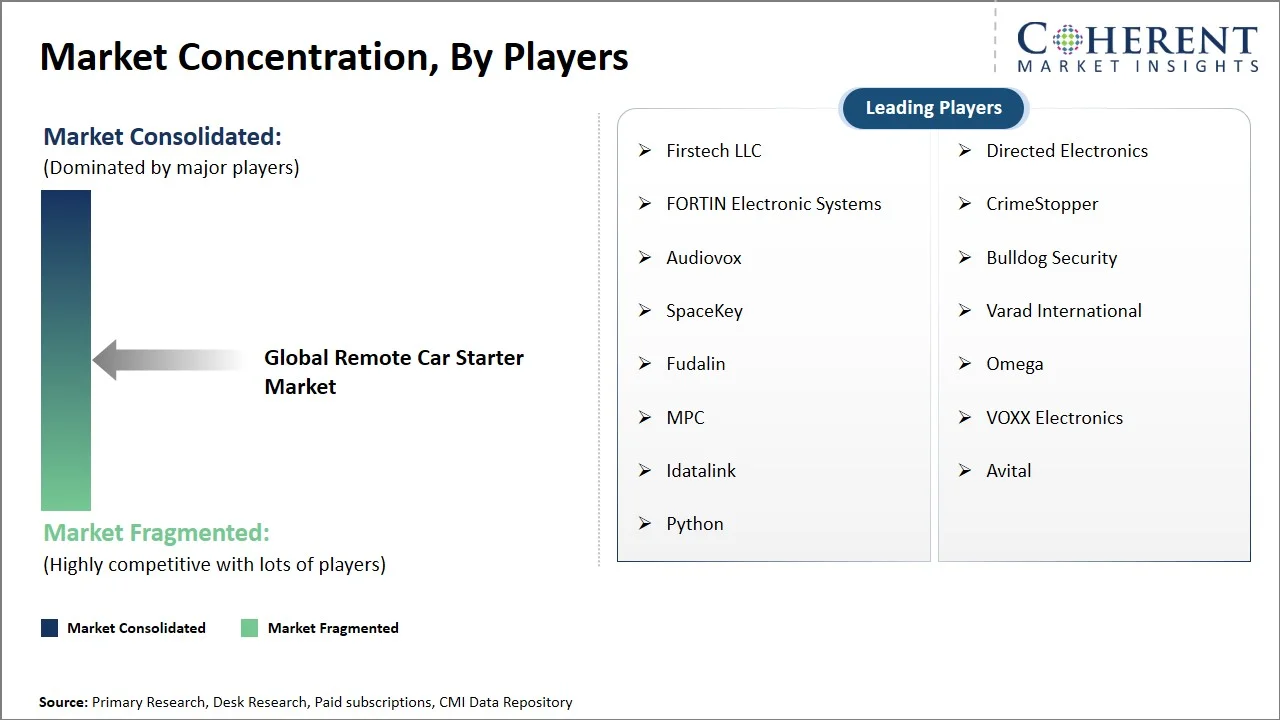
The global remote car starter market is highly fragmented with a mixture of established aftermarket experts and automotive OEM players fighting across hardware, software and connected vehicle ecosystems. Firstech (Compustar), VOXX Electronics, Directed Electronics and Fortin continue to lead the aftermarket segment through vast dealer networks and product ranges that focus on compatibility. At the same time, automakers such as Ford, General Motors, Hyundai, Kia and Stellantis are gaining market share with factory-installed, app-based remote start systems that are incorporated into broader connected-car platforms. Product innovation, cybersecurity improvements and the move to smartphone control and subscription services are driving intense competition, with differentiation increasingly dependent on software ecosystems rather than standalone hardware.
Market Report Scope
Remote Car Starter Market Report Coverage
| Report Coverage | Details | ||
|---|---|---|---|
| Base Year: | 2025 | Market Size in 2026: | USD 2.25 Bn |
| Historical Data for: | 2020 To 2024 | Forecast Period: | 2026 To 2033 |
| Forecast Period 2026 to 2033 CAGR: | 4.3% | 2033 Value Projection: | USD 3.30 Bn |
| Geographies covered: |
| ||
| Segments covered: |
| ||
| Companies covered: | Firstech LLC, Directed Electronics, FORTIN Electronic Systems, CrimeStopper, Audiovox, Bulldog Security, SpaceKey, Varad International, Fudalin, Omega, MPC, VOXX Electronics, Idatalink, Avital, and Python | ||
| Growth Drivers: |
| ||
| Restraints & Challenges: |
| ||
Analyst Opinion (Expert Opinion)
- The remote car starter market is in the midst of a structural transformation from traditional aftermarket devices to integrated connected-vehicle solutions. Strong growth momentum reflected increased consumer demand for features such as convenience, vehicle customization and remote accessibility, it said. But cybersecurity dangers, regulatory compliance and compatibility issues with developing car designs are raising worries. It also notes that OEM dominance is gaining traction in developed economies, and aftermarket businesses are being forced to pivot to app-based and cloud-enabled solutions to remain relevant.
- The future of the remote car starter market will be influenced by more profound integration with connected mobility ecosystems, artificial intelligence and electric vehicle platforms. Subscription-based vehicle services and smartphone-controlled remote access are poised to revolutionize revenue structures, shifting from one-time hardware sales toward recurring digital services. Strong growth is foreseen in Asia Pacific driven by increased car production and smartphone penetration, while North America is predicted to lead in premium and aftermarket markets. Over time, remote start capabilities are expected to become a common component of intelligent vehicle management systems, including predictive climate control, autonomous vehicle preparedness, and improved cybersecurity architectures.
Speak to the analyst
Want personalized insights?
Take the findings above to one of our principal consultants, or have the report rebuilt around the segments, geographies and competitors you actually track.
Market Segmentation
- Product Type Insights (Revenue, USD Billion, 2021 - 2033)
- 1-Way Remote Starters
- 2-Way Remote Starters
- Vehicle Type Insights (Revenue, USD Billion, 2021 - 2033)
- Passenger Vehicles
- Commercial Vehicles
- Technology Type Insights (Revenue, USD Billion, 2021 - 2033)
- RF-Based Systems
- Bluetooth-Based Systems
- GPS-Enabled Systems
- Smartphone Controlled Systems
- Range Insights (Revenue, USD Billion, 2021 - 2033)
- Short Range
- Medium Range
- Long Range
- Powertrain Compatibility Insights (Revenue, USD Billion, 2021 - 2033)
- Internal Combustion Engine (ICE)
- Hybrid Vehicles
- Electric Vehicles
- Sales Channel Insights (Revenue, USD Billion, 2021 - 2033)
- OEM
- Aftermarket
- Regional Insights (Revenue, USD Billion, 2021 - 2033)
- North America
- U.S.
- Canada
- Latin America
- Brazil
- Argentina
- Mexico
- Rest of Latin America
- Europe
- Germany
- U.K.
- Spain
- France
- Italy
- Russia
- Rest of Europe
- Asia Pacific
- China
- India
- Japan
- Australia
- South Korea
- ASEAN
- Rest of Asia Pacific
- Middle East
- GCC Countries
- Israel
- Rest of Middle East
- Africa
- South Africa
- North Africa
- Central Africa
- North America
- Key Players Insights
- Firstech LLC
- Directed Electronics
- FORTIN Electronic Systems
- CrimeStopper
- Audiovox
- Bulldog Security
- SpaceKey
- Varad International
- Fudalin
- Omega
- MPC
- VOXX Electronics
- Idatalink
- Avital
- Python
Sources
Primary Research Interviews
- Automotive aftermarket product manufacturers and suppliers
- Remote car starter technology developers and integrators
- Automotive dealership service managers and technicians
- End-user consumers and automotive enthusiasts
Magazines
- Automotive Aftermarket Magazine
- Mobile Electronics Magazine
- Auto Sound & Security Magazine
- Aftermarket Business World
Journals
- International Journal of Automotive Technology
- SAE International Journal of Passenger Cars
- IEEE Transactions on Vehicular Technology
Associations
- Mobile Electronics Certified Professional (MECP)
- Automotive Aftermarket Industry Association (AAIA)
- Specialty Equipment Market Association (SEMA)
- Consumer Electronics Association (CEA)
Public Domain Sources
- U.S. Department of Transportation statistics
- European Automobile Manufacturers Association (ACEA) reports
- International Organization of Motor Vehicle Manufacturers (OICA)
- National Highway Traffic Safety Administration (NHTSA) data
Proprietary Elements
- CMI Data Analytics Tool
- Proprietary CMI Existing Repository of information for last 10 years
Get access to 250+ pages report
Every segment, forecast, competitor profile and data table behind the analysis above — available for instant download.
- ESOMAR Member
- ISO 9001:2015 Certified
- D-U-N-S Registered
- GDPR & CCPA Compliant
Missing comfort of reading report in your local language? Find your preferred language:
Transform your Strategy with Exclusive Trending Reports
Frequently Asked Questions
The global remote car starter market is expected to stand at USD 2.25 Bn in 2026 and is expected to reach USD 3.30 Bn by 2033.
The CAGR of the global remote car starter market is projected to be 4.3% from 2026 to 2033.
Rising demand for vehicle comfort and convenience and increasing adoption of connected-car technologies are the major factors driving the growth of the global remote car starter market.
High installation and product costs and compatibility issues across vehicle models are the major factors hampering the growth of the global remote car starter market.
In terms of product type, the 1-way remote starters segment is estimated to dominate the market revenue share in 2026.
They work through mobile apps connected to cloud or telematics systems that communicate with the vehicle remotely.
Yes, but they are often integrated as remote climate-control systems rather than traditional engine-start systems.