

Automotive Gear Shifter Market Size and Forecast — 2026-2033
The Global Automotive Gear Shifter Market size is estimated to be valued at USD 8.94 billion in 2026 and is expected to reach USD 13.9 billion by 2033, exhibiting a compound annual growth rate (CAGR) of 7.7% from 2026 to 2033.
Overview
Automotive gear shifters are mechanical or electronic assemblies that enable drivers to change transmission modes, directly impacting driving dynamics and comfort. Traditional mechanical shifters use linkage or cable mechanisms, whereas modern electronic gear shifters (shift-by-wire systems) rely on sensors, actuators, and control modules that transmit signals to the transmission unit without physical cables. Contemporary designs integrate ergonomic and aesthetic considerations, featuring touch controls, rotary dials, and electronic selectors in luxury and EV models. Safety interlocks and illumination indicators enhance operational feedback and user experience. The trend toward lightweight and compact designs supports interior space optimization, while integration with vehicle control networks allows features like automatic park assist and drive mode selection.
Key Takeaways
The Electronic Gear Shifter segment leads the market with 59% market share, driven by superior compatibility with modern vehicle architectures and electric drivetrains.
The Passenger Cars segment dominates the vehicle type category, emphasizing comfort and advanced control, accounting for over 56% of total market revenue.
Asia Pacific emerges as the dominating region in market size due to robust automotive manufacturing bases in China and India, accounting for approximately 40% industry revenue as of 2026.
North America demonstrates the fastest growth with a CAGR of 8.2%, propelled by stringent emission norms and expanding EV adoption, fueled by regulatory support and advanced consumer preferences.
Automotive Gear Shifter Market Segmentation Analysis
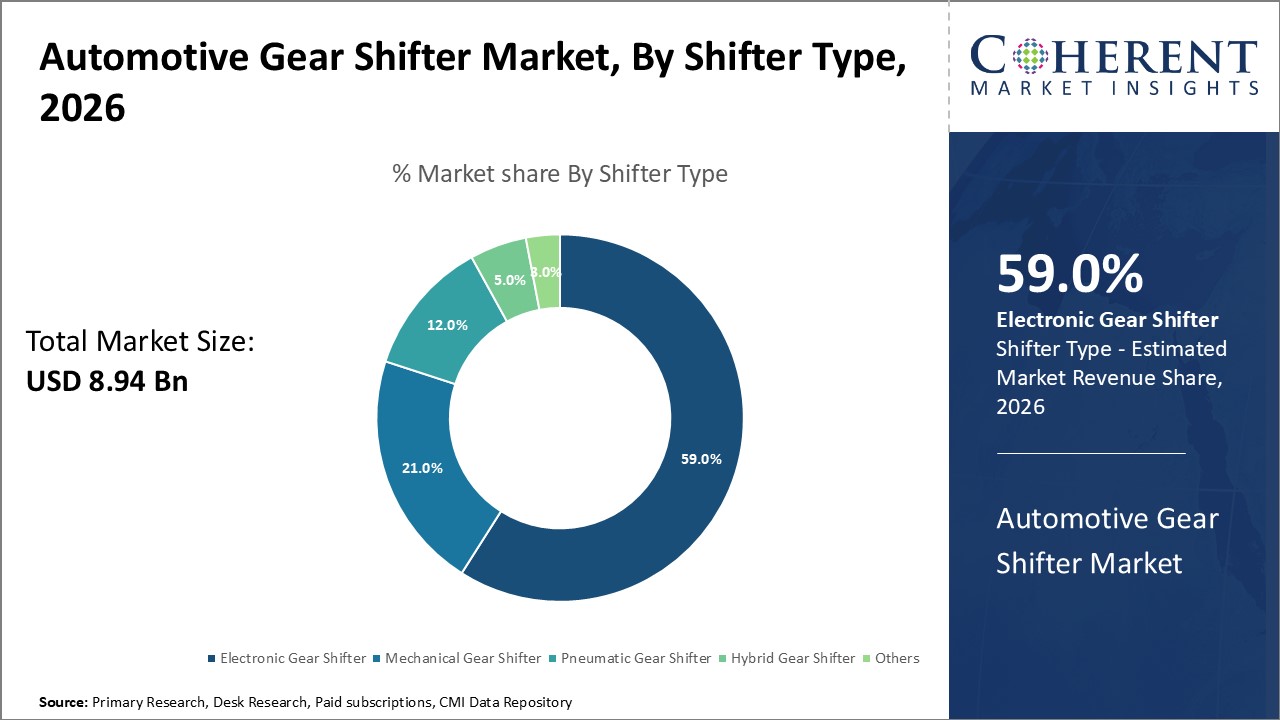
Automotive Gear Shifter Market Insights, By Shifter Type
Electronic Gear Shifter dominates the market share with 59%, primarily due to its widespread adoption in electric and premium vehicles offering enhanced precision and integration with vehicle control systems. The fastest-growing segment within this category is the Hybrid Gear Shifter, which blends mechanical and electronic technologies, gaining traction mainly in semi-automatic transmissions for commercial vehicles. The Mechanical Gear Shifter remains relevant in lower-cost passenger cars and in markets with slower automation adoption due to its lower production costs and reliability. Pneumatic Gear Shifters occupy a niche segment, mostly in specialized commercial and industrial vehicles, offering durability under extreme conditions, but are limited in overall volume.
Automotive Gear Shifter Market Insights, By Vehicle Type
Passenger Cars dominate the market share as they incorporate the latest gear shifting technologies to enhance driving comfort and fuel efficiency. The fastest-growing segment is Electric Vehicles (EVs), witnessing exponential growth attributable to global electrification efforts and government policies promoting clean energy transportation. Commercial Vehicles rely heavily on rugged and durable gear shifters, including semi-automatic types, ensuring operational reliability in demanding logistics and transportation industries.
Automotive Gear Shifter Market Insights, By Transmission Type
Automatic transmissions hold the dominant market share, reflecting consumer preferences for ease of use and technological advancements in gear shifting that optimize fuel economy and vehicle performance. The fastest-growing transmission type is Semi-Automatic, bridging manual control with automated functions, especially favored in commercial and niche passenger segments demanding both control and convenience. Manual transmissions continue to serve budget vehicles and regions with less penetration of advanced transmission systems. CVT maintains steady adoption in small to mid-size passenger cars due to its seamless speed variation and fuel efficiency.
Automotive Gear Shifter Market Trends
The automotive gear shifter industry trends are underscored by a decisive shift towards electrification and integration with smart vehicle systems.
In particular, drive-by-wire technology adoption enables seamless interface with vehicle control units, improving responsiveness and safety metrics.
For example, in Europe, over 35% of premium vehicles launched in 2026 featured electronic gear shifters integrated with autonomous parking systems, showcasing the trend’s growth trajectory.
Another key trend is the expansion in aftermarket upgrades, where consumers demand personalized gear shifters equipped with customizable controls and aesthetic enhancements, predominantly seen in North America.
Automotive Gear Shifter Market Insights, By Geography
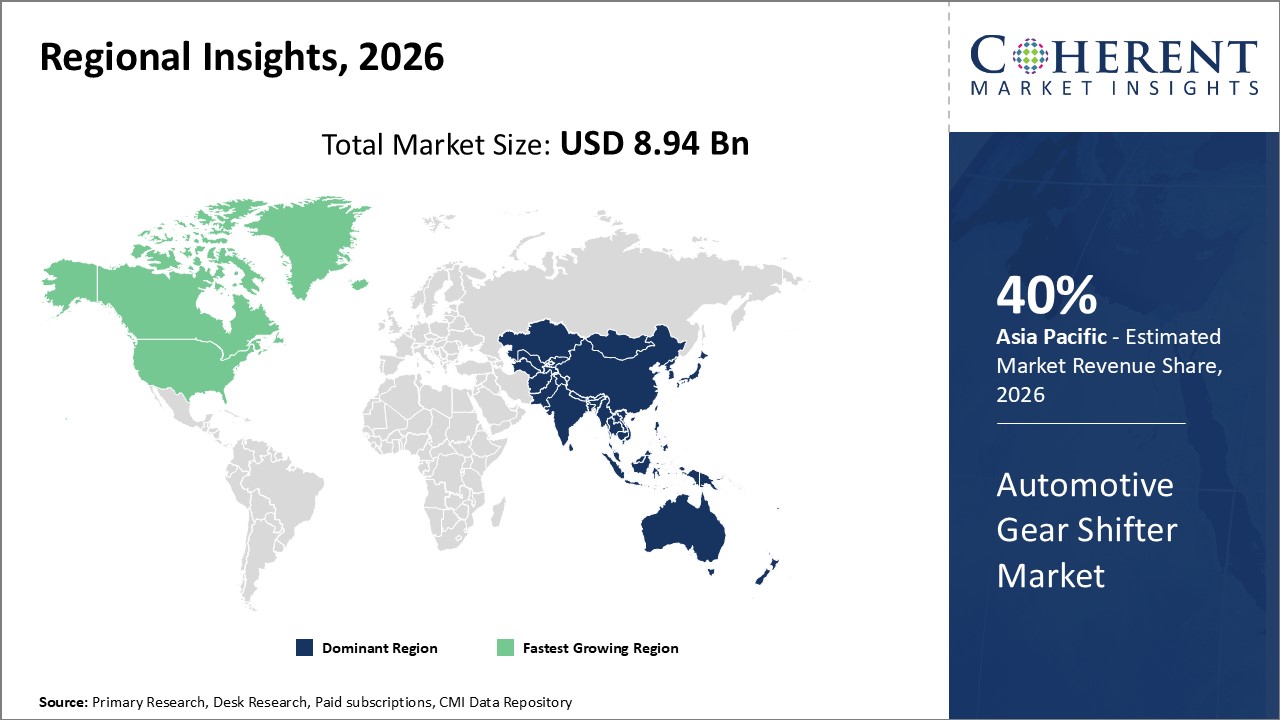
Asia Pacific Automotive Gear Shifter Market Analysis and Trends
In the Asia Pacific region, the dominance in the Automotive Gear Shifter market is driven by extensive automotive manufacturing hubs in China and India, where mass vehicle production supports large-scale adoption of advanced gear shifters. This region accounts for approximately 40% of the market share, propelled by rapid electrification and strong government incentives for clean mobility, shaping the industry dynamics with suppliers investing heavily in local R&D and production infrastructure.
North America Automotive Gear Shifter Market Analysis and Trends
Meanwhile, North America exhibits the fastest growth at a CAGR of 8.2%, underpinned by progressive emission regulations, increasing electric vehicle penetration, and consumer preference for advanced transmission technologies. The presence of leading market companies such as Magna International and Bosch, boosting innovation, accelerates regional growth, supported by government subsidies, enhancing EV adoption rates.
Automotive Gear Shifter Market Outlook for Key Countries
USA Automotive Gear Shifter Market Analysis and Trends
The USA's Automotive Gear Shifter market benefits from advanced automotive industry infrastructure and high EV adoption, estimated to represent nearly 30% of North America's market revenue in 2026. Strong regulatory frameworks, such as the Corporate Average Fuel Economy (CAFE) standards, drive demand for innovative and efficient gear shifting solutions. Leading companies like Lear Corporation and BorgWarner have established robust manufacturing footprints, providing cutting-edge electronic gear shifters tailored to American OEMs' needs, which supports vigorous market momentum.
China Automotive Gear Shifter Market Analysis and Trends
China's market is pivotal in the Asia Pacific region, fueled by its status as the largest vehicle producer and consumer worldwide. The nation's emphasis on electric vehicles, supported by subsidies and infrastructure expansion, drives substantial demand for electronic gear shifters. Companies, including Bosch and ZF Friedrichshafen AG, have localized production and R&D centers, accelerating innovation and responsiveness to government policies. Increasing domestic OEM partnerships have led to steady growth in segment revenue and business expansion across the Chinese automotive ecosystem.
Analyst Opinion
The increasing adoption of electronic gear shifters is a significant supply-side indicator driving market size expansion. In 2025, over 60% of newly launched vehicles across the Asia Pacific incorporated electronic gear shifters, contributing to a 15% production capacity rise in related components.
Demand-side drivers also include the growing preference for automatic transmission vehicles across Europe and North America, where automatic gear shifter imports surged by 12% year-over-year in 2026. This trend is fueled by urbanization and changing consumer driving habits.
The rising use of automotive gear shifters in electric vehicles (EVs) is a micro-indicator affecting market revenue. For instance, in 2026, EVs constituted nearly 23% of total vehicle production in China, directly correlating with the increased demand for compact and electronically controlled gear shifters.
Analyzing nano-size indicators, aftermarket parts and upgrades accounted for a steady 9% increase in market share in 2025, driven by consumers seeking bespoke tuning options and enhanced driving ergonomics, particularly in high-performance and luxury vehicle segments.
- Current Industry Events of 2026
- Market Size Estimation
- Regional Breakdown
- Competitive Landscape
- Customer Intelligence
- Segmental Analysis
- Pricing Analysis
- Key Market Drivers, Challenges & Future Trends
- Customized Insights Section
Market Scope
| Report Coverage | Details | ||
|---|---|---|---|
| Base Year: | 2025 | Market Size in 2026: | USD 8.94 billion |
| Historical Data for: | 2020 To 2024 | Forecast Period: | 2026 To 2033 |
| Forecast Period 2026 to 2033 CAGR: | 7.7% | 2033 Value Projection: | USD 13.9 billion |
| Geographies covered: |
| ||
| Segments covered: |
| ||
| Companies covered: | Magna International, ZF Friedrichshafen AG, Bosch Mobility Solutions, Hyundai Mobis, Denso Corporation, Lear Corporation, Schaeffler AG, Johnson Electric Holdings Ltd., Nexteer Automotive Group, Aisin Seiki Co., Ltd. | ||
| Growth Drivers: |
| ||
Automotive Gear Shifter Market Growth Factors
The surge in electric vehicle adoption worldwide has propelled the demand for electronically controlled automotive gear shifters due to their compatibility with EV powertrains and space-saving designs. Government incentives toward electric mobility in regions like Europe and the Asia Pacific accelerated vehicle electrification by an average of 18% in 2025, directly impacting gear shifter market dynamics. Secondly, the rising complexity and automation in transmissions have increased the demand for hybrid and semi-automatic gear shifters, where advanced sensors and controls improve driving comfort and fuel efficiency.
For example, manual transmission installations declined by 7% in North America in 2026, fueling growth in advanced shifter technologies. Furthermore, stringent vehicle safety and emission regulations globally encourage manufacturers to adopt innovative gear shifters that optimize transmission performance, reducing fuel consumption. Regulatory compliance upgrades contributed to a 9% market revenue increase for shifter component suppliers in 2025.
Automotive Gear Shifter Market Development
In October 2026, Lumax Industries launched a next-generation shift-by-wire gear shifter, engineered specifically for electric and hybrid vehicles. The system integrates advanced electronics and compact actuators to replace traditional mechanical linkages, offering a simplified, space-efficient, and intuitive driving interface. This innovation enhances vehicle safety, responsiveness, and interior design flexibility, aligning with the growing shift toward smart mobility technologies.
In February 2022, Lear Corporation acquired Kongsberg Automotive's interior comfort systems business to strengthen its offerings in advanced thermal and comfort seating solutions. This acquisition expanded Lear's product portfolio to include systems for seat heating, ventilation, and massage, allowing it to provide a more complete suite of comfort seating systems and capture more content per vehicle.
Key Players
Leading Companies of the Market
Magna International
ZF Friedrichshafen AG
Bosch Mobility Solutions
Hyundai Mobis
Denso Corporation
Lear Corporation
Schaeffler AG
Johnson Electric Holdings Ltd.
Nexteer Automotive Group
Aisin Seiki Co., Ltd.
BorgWarner Inc.
Competitive strategies center around product innovation, strategic partnerships, and expanding production facilities. For instance, ZF Friedrichshafen AG invested $120 million in 2026 to enhance their electronic shifter R&D, yielding a 10% improvement in product efficiency. Additionally, Bosch Mobility Solutions collaborated with leading EV manufacturers, successfully integrating lightweight electronic gear shifters that contributed to a 5% increase in vehicle battery efficiency.
Automotive Gear Shifter Market Future Outlook
In the coming years, the automotive gear shifter market will experience transformative growth driven by the expansion of electric vehicles (EVs) and autonomous driving technologies. As EVs simplify the transmission system, manufacturers are focusing on compact, software-driven shifters that provide customizable user interfaces and haptic feedback. Integration with advanced driver assistance systems (ADAS) and vehicle control units will enhance safety and automation. The market will also see growing adoption of modular and reconfigurable shifter systems to reduce production complexity across vehicle models. Lightweight materials and digital connectivity will dominate future designs, supporting sustainability goals and seamless integration with digital dashboards. Asia-Pacific and Europe are expected to remain the largest markets, propelled by rapid EV adoption and premium vehicle production.
Automotive Gear Shifter Market Historical Analysis
The automotive gear shifter market has evolved from purely mechanical linkages in manual transmissions to highly sophisticated electronic systems integrated into modern vehicle architectures. Historically, gear shifters were designed for mechanical robustness and tactile feedback, primarily using rods and cables to engage gears. The rise of automatic and dual-clutch transmissions during the 1980s–2000s introduced hydraulic and electro-mechanical actuation systems, improving shift precision and reducing driver effort. The 2010s marked a major technological shift with the introduction of shift-by-wire systems that replaced physical linkages with electronic signals. This enabled innovative designs such as rotary dials, push-button selectors, and column-mounted electronic controls. Additionally, vehicle interior aesthetics became a key differentiator, leading OEMs to incorporate premium materials, ambient lighting, and ergonomic design into gear shifters.
Sources
Primary Research Interviews:
Automotive design engineers
Powertrain system developers
Mechatronics specialists
OEM procurement managers
Databases:
SAE MOBILUS Technical Papers
National Highway Traffic Safety Administration (NHTSA) Database
International Organization for Standardization (ISO) TC 22 Data
European Automobile Manufacturers Association (ACEA) Statistics
Magazines:
Automotive News
AutoTech Review
Car and Driver Industry Reports
Automotive Design & Production
Journals:
SAE International Journal of Passenger Cars
IEEE Transactions on Vehicular Technology
International Journal of Automotive Technology
Newspapers:
Reuters (Automotive)
The Detroit News (Mobility)
Nikkei Asia (Auto Industry)
Associations:
SAE International
ISO/TC 22 (Road Vehicles)
Automotive Electronics Council (AEC)
Get access to 250+ pages report
Every segment, forecast, competitor profile and data table behind the analysis above — available for instant download.
- ESOMAR Member
- ISO 9001:2015 Certified
- D-U-N-S Registered
- GDPR & CCPA Compliant
Missing comfort of reading report in your local language? Find your preferred language:
Transform your Strategy with Exclusive Trending Reports
Frequently Asked Questions
Dominant players include Magna International, ZF Friedrichshafen AG, Bosch Mobility Solutions, Hyundai Mobis, and Denso Corporation, leading through innovation and strategic partnerships.
The market is projected to grow from USD 8.94 billion in 2026 to USD 13.9 billion by 2033, reflecting a CAGR of 7.7% driven by electronic shifter adoption and EV trends.
Passenger car manufacturers present the largest growth opportunity as they increasingly integrate advanced gear shifting technologies in both traditional and electric vehicles.
Market trends show rapid electronic gear shifter adoption and growing drive-by-wire systems, alongside increased customization demand in aftermarket segments.
The landscape is highly competitive, focusing on innovation, with challenges including technology integration complexities and shifting consumer preferences requiring agility.
Companies emphasize R&D investments, strategic alliances with OEMs, and regional expansion to capitalize on emerging market trends and technological advancements.