

ASEAN Automotive Aftermarket Size and Forecast – 2026-2033
The ASEAN Automotive Aftermarket is estimated to be valued at USD 38.07 billion in 2026 and is expected to reach USD 74.19 billion by 2033, exhibiting a compound annual growth rate (CAGR) of 10.0% from 2026 to 2033.
Key Takeaways of the ASEAN Automotive Aftermarket:
- The engine components segment leads the market holding an estimated share of 16.3% in 2026.
- The car (passenger cars) segment leads the market holding an estimated share of 67.1% in 2026.
- The Do it For Me (DIFM) segment leads the market holding an estimated share of 55.5% in 2026.
- The offline segment leads the market holding an estimated share of 80.4% in 2026.
Market Overview:
The ASEAN automotive aftermarket is growing steadily, fueled by an aging vehicle fleet, rising car ownership, and increasing maintenance demand. Passenger cars dominate the market, with engine components and tires leading sales. While offline channels remain dominant, online platforms are expanding rapidly. The market is fragmented, with global and local players targeting both budget and premium segments. EV adoption and digital diagnostics are emerging as key growth drivers.
Current Events and their Impact
Current Events | Description and its impact |
ASEAN Regional Economic Integration Initiatives |
|
Technological Shift within Automotive Sector |
|
Segmental Insights:
- Current Industry Events of 2026
- Market Size Estimation
- Regional Breakdown
- Competitive Landscape
- Customer Intelligence
- Segmental Analysis
- Pricing Analysis
- Key Market Drivers, Challenges & Future Trends
- Customized Insights Section
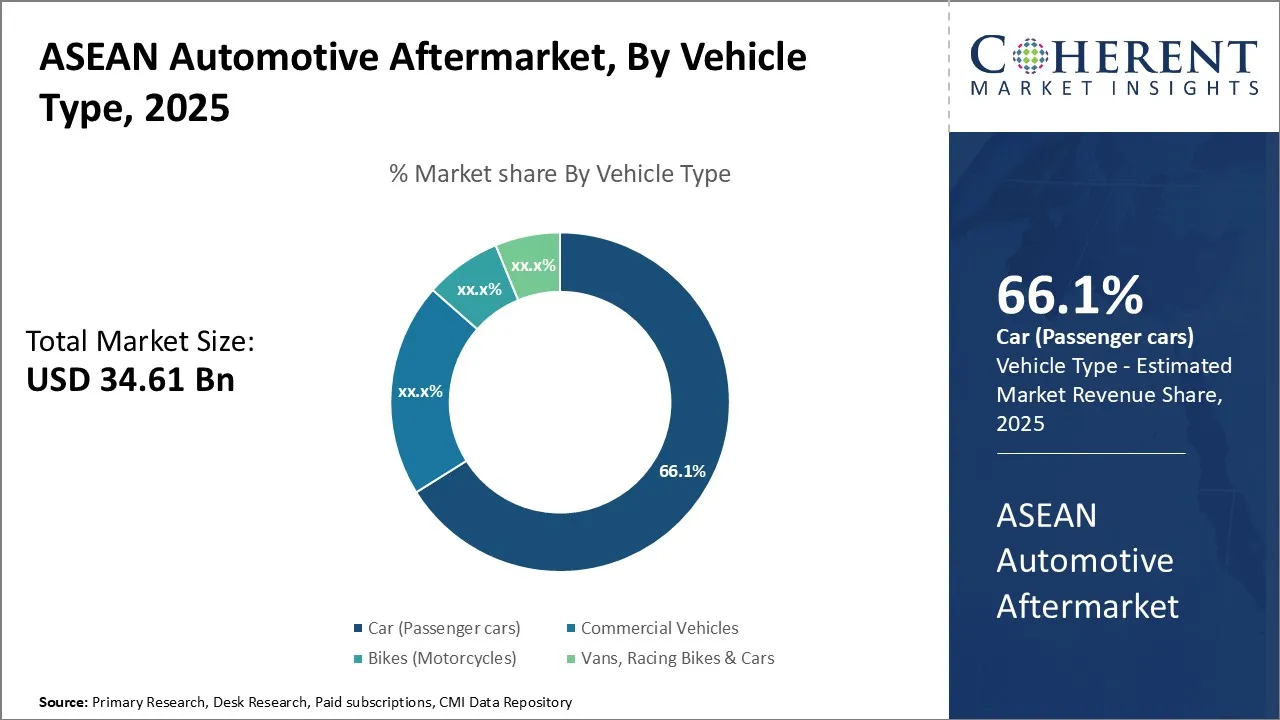
ASEAN Automotive Aftermarket Insights, by Vehicle Type – Passenger Cars Dominate Through Mass Market Penetration and Urbanization Trends
Car (passenger cars) segment is expected to contribute the highest share of 67.1% in the market in 2026. The rising disposable income levels across key ASEAN markets, particularly in Thailand, Malaysia, Indonesia, and Vietnam, have transformed car ownership from a luxury to a necessity for many households. This demographic shift has resulted in an expanding base of passenger vehicles requiring regular maintenance, repairs, and component replacements.
Urban congestion and traffic conditions prevalent in major ASEAN cities significantly impact passenger car maintenance requirements. Stop-and-go traffic patterns, extended idling periods, and frequent short-distance trips create unique wear patterns that necessitate more frequent replacement of components such as brake pads, air filters, and engine oils.
Consumer behavior patterns in ASEAN countries favor cost-effective maintenance solutions, driving the demand for aftermarket alternatives to expensive OEM parts. Price-conscious consumers often seek quality aftermarket components that offer similar performance at lower costs, especially for routine maintenance items. This behavior is reinforced by the growing network of independent service providers and parts retailers who actively promote aftermarket solutions.
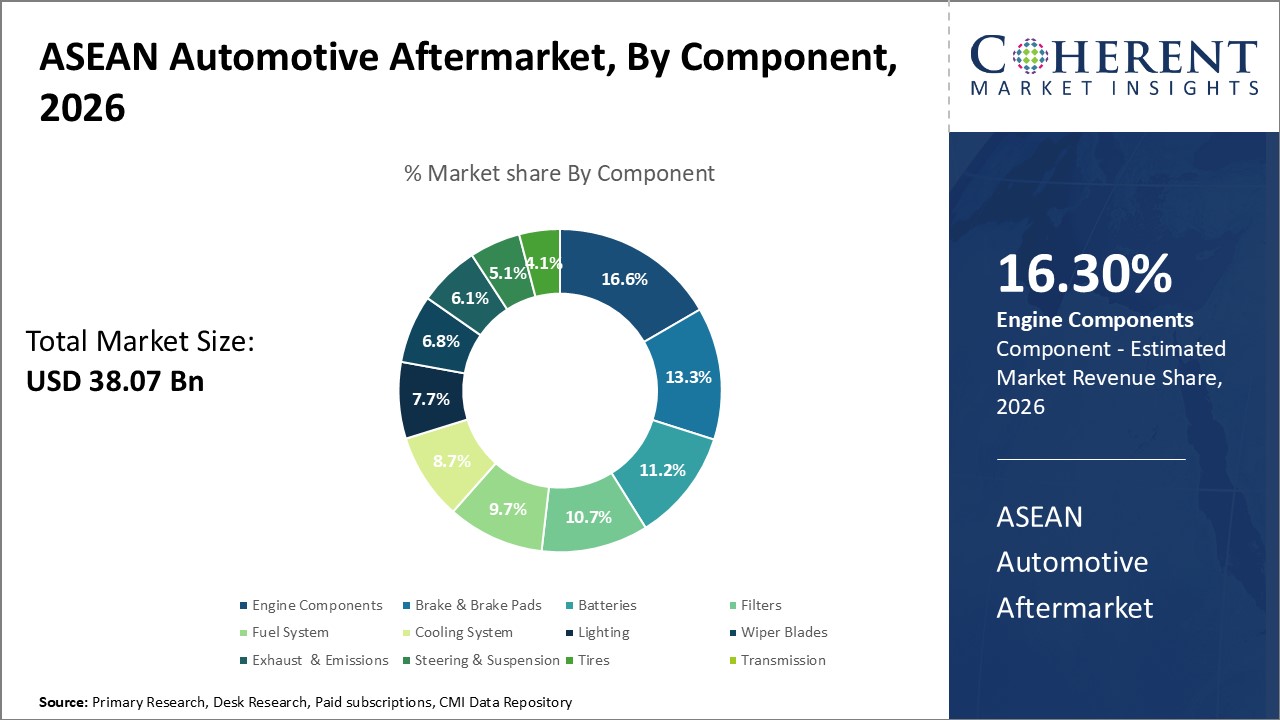
ASEAN Automotive Aftermarket Insights, by Component – Engine Components Lead Through Critical Performance Requirements and Maintenance Frequency
The engine components segment is expected to contribute the highest share of 16.3% in the market in 2026. The engine represents the heart of any vehicle, and its components face the most demanding operational conditions, creating consistent replacement and maintenance demand. Modern engines incorporate advanced technologies such as turbocharging, direct injection, and variable valve timing systems, each introducing additional components that require periodic maintenance or replacement. This technological sophistication has expanded the universe of engine-related aftermarket opportunities beyond traditional items like spark plugs and filters to include sensors, actuators, and control modules.
Stricter emission standards require optimal engine functioning, driving the demand for high-quality aftermarket components that maintain engine efficiency and environmental compliance. Components such as oxygen sensors, catalytic converters, and exhaust gas recirculation systems have become critical maintenance items, expanding the engine components aftermarket segment.
Pricing Analysis
Component/Service | Unit | Typical Price Range (USD) |
Tire (passenger car) | per tire | 45 – 80 |
Brake Pads (pair, front) | per axle pair | 20 – 40 |
Battery (lead-acid) | per unit | 50 – 90 |
Engine Oil + Filter Change | service | 25 – 50 |
Cabin Air Filter | per unit | 10 – 20 |
Engine Air Filter | per unit | 8 – 15 |
Spark Plug | per plug | 2 – 5 |
Cooling System Coolant Flush | service | 30 – 60 |
Headlight Bulb (halogen) | per bulb | 5 – 12 |
Wiper Blade Set | pair/set | 8 – 20 |
Exhaust Gasket Replacement | part + labor | 15 – 35 |
Shock Absorber (front) | per unit | 40 – 80 |
Transmission Fluid Change | service | 60 – 120 |
Full Service (DIFM) | 4-hour service | 80 – 150 |
Market Players, Key Development, and Competitive Intelligence
Key Developments:
- In June 2023, Continental, an automotive company specializing in brake systems, systems, and components, introduced the UltraContact NXT series tire, notable for its significant use of sustainable materials. The tire incorporates a substantial portion of recycled, renewable, and ISCC PLUS mass balance-certified materials, accounting for up to 65% of its composition. The UltraContact NXT tires will be offered in a total of 19 different sizes to cater to various vehicle requirements.
- In April 2023, Delphi Technologies, an autonomous automotive firm, unveiled a total of 87 products in its lineup. Among them, 65 parts catered to the company's core range, focusing on chassis, fuel delivery, and engine management. Meanwhile, Sparta, the company's specialized brand, introduced the remaining 22 parts, specifically designed for its fuel portfolio.
- In April 2021, Lippert Components Inc., a company that manufacturers and suppliers of highly engineered components to the RV industry, announced the acquisition of Kaspar Ranch Hand Equipment, LLC. With this acquisition, Lippert Components Inc. aimed to expand its presence in the automotive parts aftermarket.
- In February 2021, Goodyear Tire & Rubber Company acquired Cooper Tire & Rubber Company with the aim of consolidating their brand portfolio and offering comprehensive services across the entire market value spectrum
Top Strategies Followed by ASEAN Automotive Aftermarket Players
- Established players dominate through substantial R&D investments, recognizing that innovation drives long-term competitiveness.
- Robert Bosch GmbH (Bosch Automotive Aftermarket) is heavily investing in EV component development, including battery diagnostics tools, to support the upcoming ASEAN EV service boom.
- Mid-level players compete primarily through cost-effective solutions, understanding that price sensitivity remains crucial in emerging ASEAN markets.
- KYB Corporation (Shock absorbers & suspension systems) offers localized manufacturing in Thailand and Indonesia to reduce costs.
- Small-scale players survive through niche specialization, identifying underserved market segments or specific vehicle categories.
- Bangkok Diecasting and Injection Co. Ltd. (Thailand) specializes in precision die-cast engine parts and supplies niche components to Thai and Malaysian motorcycle aftermarkets.
Market Report Scope
ASEAN Automotive Aftermarket Report Coverage
| Report Coverage | Details | ||
|---|---|---|---|
| Base Year: | 2025 | Market Size in 2026: | USD 38.07 Bn |
| Historical Data for: | 2020 To 2024 | Forecast Period: | 2026 To 2033 |
| Forecast Period 2026 to 2033 CAGR: | 10.0% | 2033 Value Projection: | USD 74.19 Bn |
| Segments covered: |
| ||
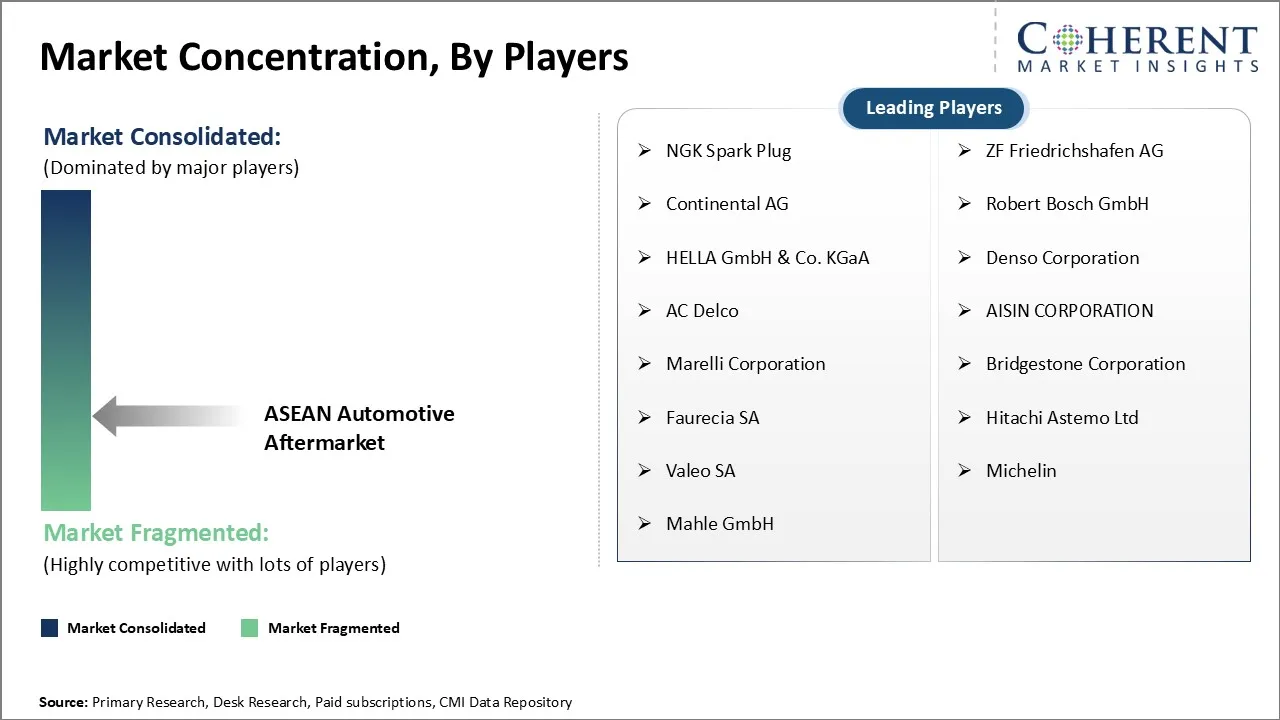
| Companies covered: | NGK Spark Plug, ZF Friedrichshafen AG, Continental AG, Robert Bosch GmbH, HELLA GmbH & Co. KGaA, Denso Corporation, AC Delco, AISIN CORPORATION, Marelli Corporation, Bridgestone Corporation, Faurecia SA, Hitachi Astemo Ltd, Valeo SA, Michelin, and Mahle GmbH | ||
| Growth Drivers: |
| ||
| Restraints & Challenges: |
| ||
Market Dynamics
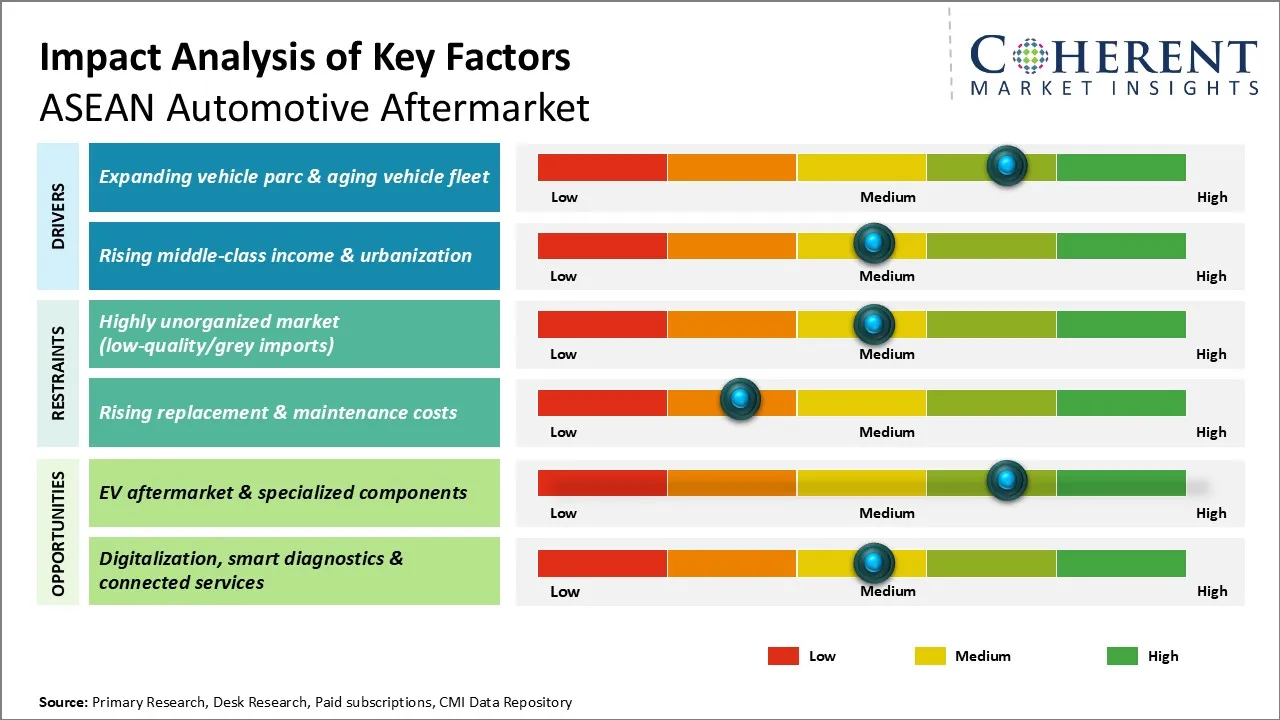
ASEAN Automotive Aftermarket Driver - Expanding Vehicle Parc & Aging Vehicle Fleet
As vehicle ownership rates continue to rise throughout Southeast Asian countries, particularly in emerging economies like Indonesia, Thailand, and Vietnam, the total number of vehicles requiring maintenance and replacement parts is increasing substantially. Simultaneously, the aging of vehicle fleets presents significant opportunities for aftermarket players, as older vehicles typically require more frequent servicing, repairs, and component replacements compared to newer models. According to Gaikindo (Association of Indonesian Automotive Industries), over 60% of registered vehicles in Indonesia are more than 7 years old (as of 2024).
This demographic shift in vehicle age creates a sustained demand for both original equipment manufacturer parts and aftermarket alternatives. The combination of longer vehicle ownership cycles, driven by economic considerations and improved vehicle durability, means consumers are increasingly investing in maintenance and upgrades rather than purchasing new vehicles.
ASEAN Automotive Aftermarket Opportunity – EV Aftermarket & Specialized Components
As governments across the region implement aggressive EV adoption targets and incentive programs, the demand for EV-specific aftermarket products is experiencing exponential growth. Thailand’s “30@30” EV roadmap targets 30% EV production by 2030, with over 100,000 EVs already on the road by late 2024. This emerging segment encompasses battery management systems, charging infrastructure components, electric motor maintenance parts, and specialized diagnostic equipment tailored for electric powertrains. The opportunity extends beyond traditional replacement parts to include performance enhancement components, battery upgrade solutions, and retrofitting services for conventional vehicles transitioning to hybrid systems.
Furthermore, the technological complexity of EVs creates substantial demand for specialized service tools, training programs, and certification systems, positioning knowledgeable aftermarket players as essential partners in the EV ecosystem. The relatively nascent nature of the automotive aftermarket in ASEAN provides first-mover advantages for companies investing in research and development, local manufacturing capabilities, and strategic partnerships with OEMs and technology providers.
Analyst Opinion (Expert Opinion)
- Rising digital adoption, including telematics and connected diagnostics, is pushing the aftermarket toward data-driven, predictive maintenance. This will lead to a transition from traditional, schedule-based services to real-time condition-based repairs, favoring tech-integrated workshops and service aggregators.
- As EV adoption accelerates, especially in Thailand, Malaysia, and Vietnam, the market will bifurcate—with declining demand for conventional engine components and growing demand for specialized EV parts and diagnostics. Players that invest early in EV-compatible inventory and technician training will gain a durable competitive edge.
- Despite rising vehicle sophistication, the market remains highly price-sensitive, particularly in Indonesia and the Philippines. This ensures ongoing demand for low-cost, non-OEM alternatives, remanufactured parts, and localized brands—prompting players to tier their offerings for premium, mid-tier, and value segments to capture broader share.
Speak to the analyst
Want personalized insights?
Take the findings above to one of our principal consultants, or have the report rebuilt around the segments, geographies and competitors you actually track.
Market Segmentation
- Vehicle Type Insights (Revenue, USD Bn, 2021 - 2033)
- Car (Passenger cars)
- Commercial Vehicles
- Bikes (Motorcycles)
- Vans, Racing Bikes & Cars
- Component Insights (Revenue, USD Bn, 2021 - 2033)
- Engine Components
- Brake & Brake Pads
- Batteries
- Filters (Cabin Air, Engine, etc.)
- Fuel System
- Cooling System
- Lighting
- Wiper Blades
- Exhaust & Emissions
- Steering & Suspension
- Tires
- Transmission & Others (Fluids & Lubricants)
- Service Type Insights (Revenue, USD Bn, 2021 - 2033)
- Do it For Me (DIFM)
- Do it Yourself (DIY)
- Delegating to OEMs
- Sales Channel Insights (Revenue, USD Bn, 2021 - 2033)
- Offline
- Online
- Key Players Insights (Revenue, USD Bn, 2021 - 2033)
- NGK Spark Plug
- ZF Friedrichshafen AG
- Continental AG
- Robert Bosch GmbH
- HELLA GmbH & Co. KGaA
- Denso Corporation
- AC Delco
- AISIN CORPORATION
- Marelli Corporation
- Bridgestone Corporation
- Faurecia SA
- Hitachi Astemo Ltd
- Valeo SA
- Michelin
- Mahle GmbH
Sources
Primary Research Interviews:
Stakeholders:
- Automotive Parts Distributors (e.g., regional wholesalers, importers)
- Independent Garage Owners & Franchise Workshop Operators
- OEM Parts Manufacturers (e.g., Bosch ASEAN, Denso Thailand, NGK Indonesia)
- Online Auto Parts Retailers (e.g., Tokopedia Auto, Shopee Car Parts)
- Local Vehicle Dealerships & Authorized Service Providers
- Fleet Operators and Vehicle Leasing Companies
- EV Workshop Owners and Battery Recycling Specialists
Databases:
- ASEAN Trade & Automotive Integration Portal (ATAIP)
- Indonesia Automotive Statistics Bureau (IASB)
- Thailand Vehicle Maintenance Report Series (TVMRS)
- Malaysian Road Transport Analytics Board (MRTAB)
Magazines:
- AutoRepair Southeast Asia
- Parts & Performance Asia
- ASEAN Garage Monthly
- EV Workshop World – Asia Edition
Journals:
- Journal of Automotive Parts and Mobility in ASEAN (JAPMA)
- ASEAN Journal of Transport & Aftermarket Economics (AJTAE)
- Regional Journal of Vehicle Maintenance & Diagnostics (RJVMD)
- Journal of Southeast Asian Automotive Engineering (JSAE)
Newspapers:
- The ASEAN Auto Times
- Jakarta Industrial Post
- Bangkok Vehicle Review
- The Manila Motoring Bulletin
Associations:
- ASEAN Automotive Aftermarket Association (AAAA)
- Federation of Automotive Repair & Services Malaysia (FARSM)
- Thailand Auto Components Association (TACA)
- Indonesia Independent Garage Alliance (IIGA)
- ASEAN EV Maintenance & Infrastructure Association (AEMIA)
Public Domain Sources:
- ASEANStats (ASEAN Statistical Yearbook)
- United Nations ESCAP (Economic and Social Commission for Asia and the Pacific)
- World Bank – ASEAN Urbanization & Mobility Data
- Ministry of Transport – Thailand, Malaysia, Indonesia
- ResearchGate (Automotive Engineering Publications in Southeast Asia)
Proprietary Elements:
- CMI Data Analytics Tool, Proprietary CMI Existing Repository of information for last 8 years
Get access to 250+ pages report
Every segment, forecast, competitor profile and data table behind the analysis above — available for instant download.
- ESOMAR Member
- ISO 9001:2015 Certified
- D-U-N-S Registered
- GDPR & CCPA Compliant
Missing comfort of reading report in your local language? Find your preferred language:
Transform your Strategy with Exclusive Trending Reports
Frequently Asked Questions
The ASEAN automotive aftermarket is estimated to be valued at USD 38.07 billion in 2026 and is expected to reach USD 74.19 billion by 2033.
The CAGR of the ASEAN automotive aftermarket is projected to be 10.0% from 2026 to 2033.
Expanding vehicle parc & aging vehicle fleet and rising middle-class income & urbanization are the major factors driving the growth of the ASEAN automotive aftermarket.
Highly unorganized market (low‑quality/grey imports) and rising replacement & maintenance costs are the major factors hampering the growth of the ASEAN automotive aftermarket.
In terms of vehicle type, the car (passenger cars) segment is estimated to dominate the market revenue share in 2026.
NGK Spark Plug, ZF Friedrichshafen AG, Continental AG, Robert Bosch GmbH, HELLA GmbH & Co. KGaA, Denso Corporation, AC Delco, AISIN CORPORATION, Marelli Corporation, Bridgestone Corporation, Faurecia SA, Hitachi Astemo Ltd, Valeo SA, Michelin, and Mahle GmbH are the major players.
North America is expected to lead the ASEAN automotive aftermarket in 2026.