

Automotive Lead Acid Battery Market Analysis & Forecast: 2026-2033
Automotive lead acid battery market is likely to reach at USD 33.16 Bn in 2026 and will surpass at USD 44.52 Bn in 2033, exhibiting a compound annual growth rate (CAGR) of 4.3% from 2026 to 2033.
Key Takeaways
- Based on Vehicle Type, Passenger Car segment is likely to hold around 57% shares in the global market in 2026.
- By Battery Type, Flooded division will hold largest share in the global automotive lead acid battery market in 2026.
- Based on Sales Channel, OEM segment will dominate the global market during the forecast period.
- Asia Pacific is likely to dominate the global market with 36% shares during the forecast period.
Market Overview
The global automotive lead-acid battery market is experiencing steady growth. This growth is driven by expanding vehicle production and the adoption of start-stop and mild hybrid systems. Lead-acid batteries are cost-effective for entry- and mid-segment vehicles. Their high recyclability also supports sustainability trends.
Current Events and their Impact on the Automotive Lead Acid Battery Market
Current Event | Description and its Impact |
Automotive Industry Production and Demand Shifts |
|
China's Manufacturing and Export Dynamics |
|
Automotive Lead Acid Battery Market – Pricing Analysis
- Conventional Flooded Batteries (SLI - Starting, Lighting, Ignition)
- Entry Level: $45-80
- Mid-Range: $80-150
- Premium: $150-300
- Absorbed Glass Mat (AGM) Batteries
- Standard AGM: $120-250
- High-Performance AGM: $200-400
- Premium AGM: $300-600
- Enhanced Flooded Batteries (EFB)
- Standard EFB: $90-180
- Premium EFB: $150-280
- Gel Batteries
- Standard Gel: $150-300
- Deep Cycle Gel: $200-500
- Current Industry Events of 2026
- Market Size Estimation
- Regional Breakdown
- Competitive Landscape
- Customer Intelligence
- Segmental Analysis
- Pricing Analysis
- Key Market Drivers, Challenges & Future Trends
- Customized Insights Section
Segmental Insights
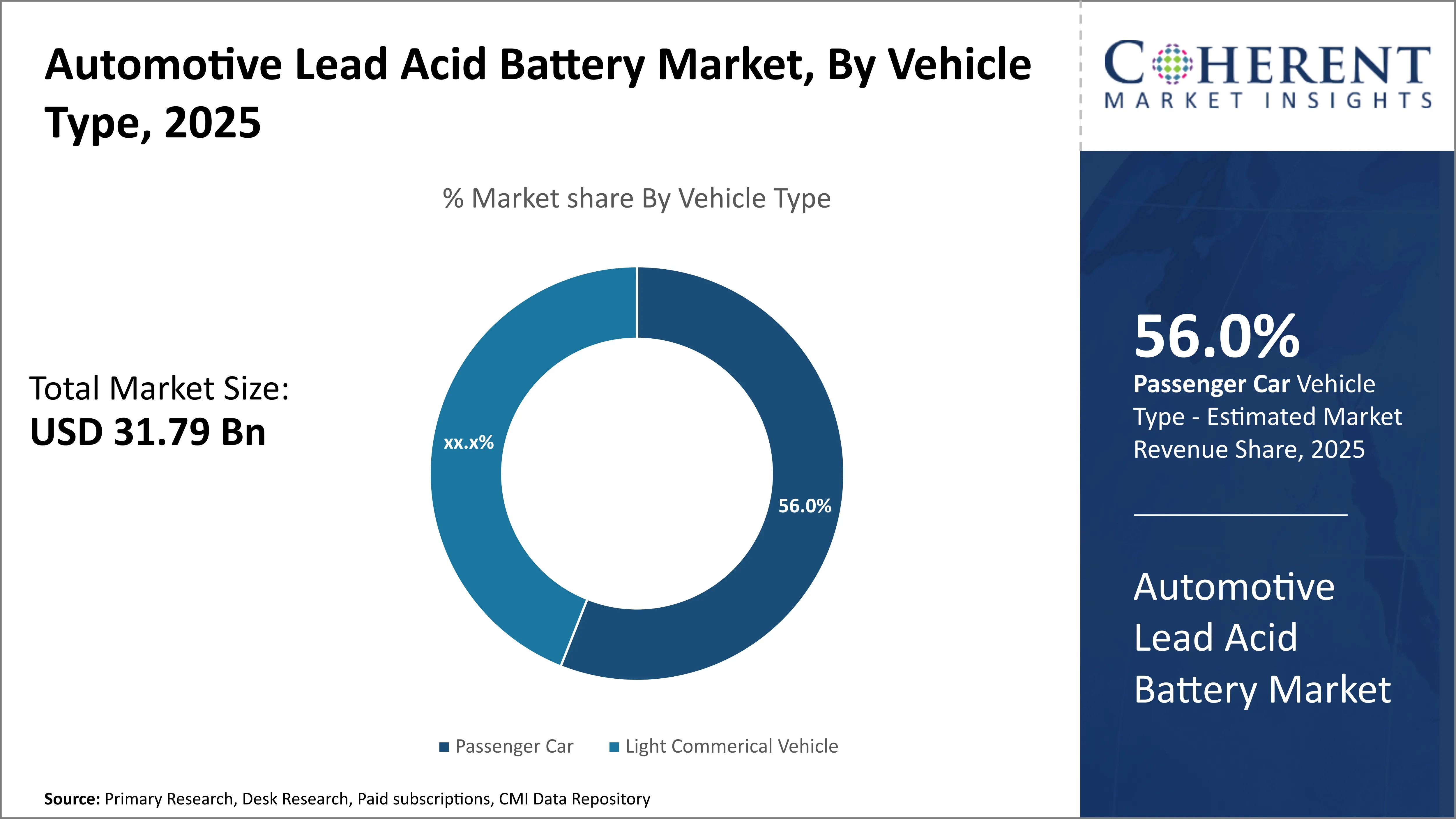
Global Automotive Lead Acid Battery Market Insight, By Vehicle Type
In 2025, the passenger car segment will hold 56% of the global automotive lead-acid battery market. Demand for passenger cars is rising, especially in India, Bangladesh, and China. Rapid urbanization is expanding cities and increasing commuting distances.
For instance, in October 2024, Kinetic Green Energy and Power Solutions launched a limited edition of the Safar Smart passenger vehicle. It comes in both lead acid and lithium battery variants.
Global Automotive Lead Acid Battery Market Insight, By Battery Channel
By battery type, the flooded segment will lead the lead-acid battery market in 2025. It is popular for its low cost, easy manufacturing, and wide use in automotive and industrial applications.
For instance, VARTA® Automotive announced a new range of flooded 12-volt batteries to support vehicles electrical demand.
Regional Insights
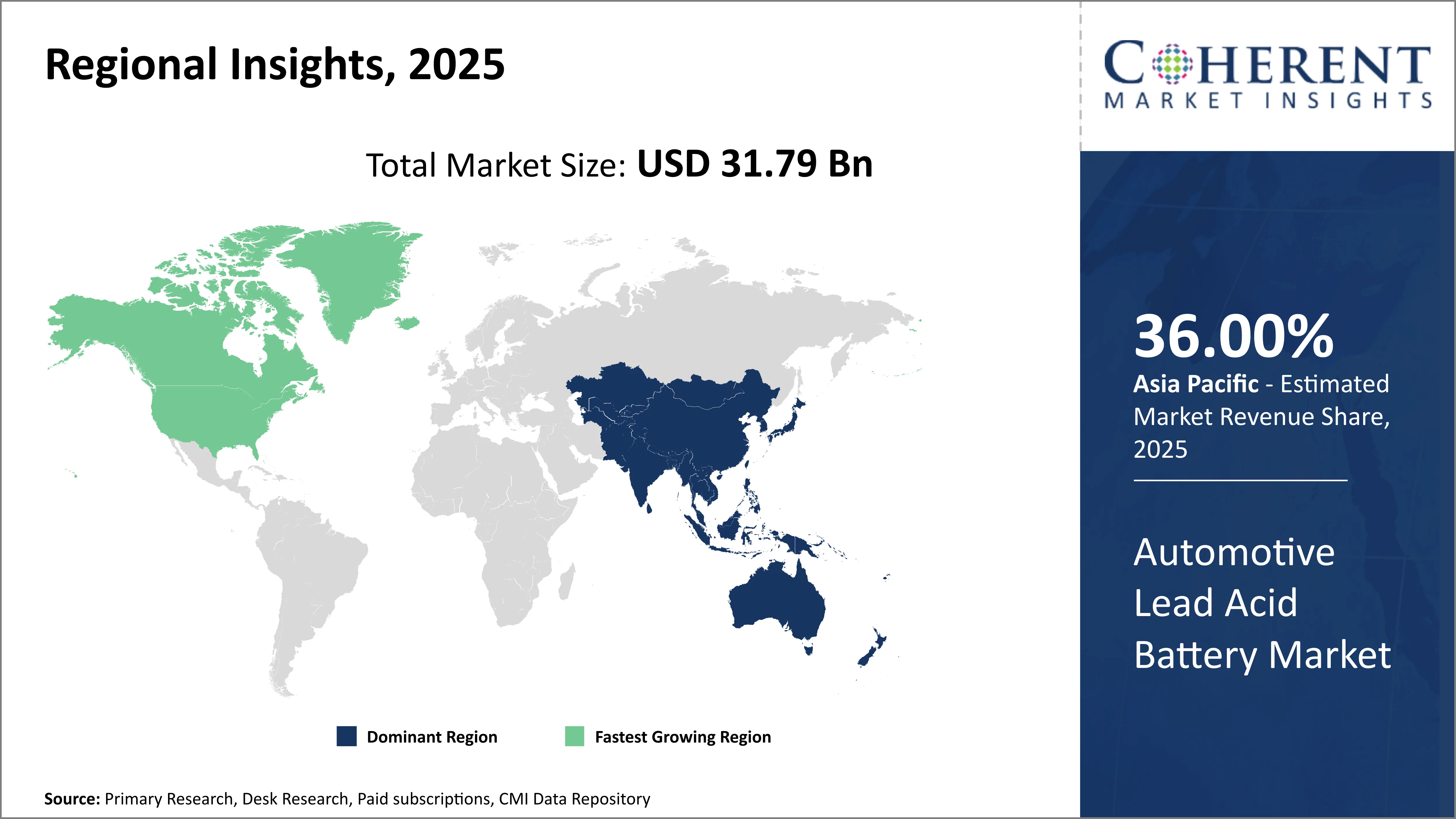
Asia Pacific Automotive Lead Acid Battery Market Analysis and Trends
Asia Pacific will dominate the global automotive lead acid battery market in 2026. This is owing to factors like rapidly expanding automotive sector, rising EV (Electric Vehicle) infrastructure backed by the rapid economic development in the region, is driving the growth of automotive lead acid battery market during the forecast period. The demand for personal and commercial vehicles in India, China, Bangladesh growing substantially.
For instance, in October 2026, Toshiba introduced the SCiB™ 24V battery pack (P25H20-3), a lithium-ion solution for automotive, marine, and heavy equipment sectors. It allows seamless replacement of conventional lead-acid batteries. This battery was installed in Yamaha Motor’s electric boat, “e-Float Terrace.” The boat was scheduled to offer cruise experiences in Yokohama, Japan, in October.
North America Automotive Lead Acid Battery Market Analysis and Trends
North America is a key market for lead-acid batteries. The region’s auto sector depends on them to start and power vehicles. A big replacement market also exists, driven by old car restoration and customization.
For instance, East Penn entered into an exclusive agreement with Furukawa Battery Co., LTD., a Japanese battery manufacturing company, to release a revolutionary new battery technology in North America.
Automotive Lead Acid Battery Market – Dominating Countries
India Automotive Lead Acid Battery Market Analysis and Trends
India is likely to dominate the global automotive lead-acid battery market. This is due to its well-established automotive industry, advanced manufacturing infrastructure, and strong presence of key battery manufacturers.
For instance, in December 2024, Assurance Intl unveiled its new battery manufacturing plant in Haryana. It received major production orders from STP, Goodyear, ACDelco, Duracell, and many other brands. This manufacturing plant was designed to produce 1 million two-wheeler batteries, 0.3 million automotive batteries, 0.25 million tubular batteries, and 0.10 million solar batteries.
China Automotive Lead Acid Battery Market Analysis and Trends
China is likely to dominate the global automotive lead-acid battery market. This is due to its large-scale automotive production, high vehicle demand, and significant investments in battery manufacturing infrastructure.
For instance, in December 2023, TAILG, announced the release of its latest sodium-ion battery technology for electric two-wheelers.
Analyst Opinion
The global automotive lead-acid battery market stays steady. Demand from internal combustion vehicles and the replacement market supports growth. Advanced types like EFB and AGM also boost it, though lithium-ion batteries add pressure. Asia Pacific leads the market, making up over half of global use. High vehicle output in China and India, a large old vehicle fleet, and strong local production drive this growth.
Speak to the analyst
Want personalized insights?
Take the findings above to one of our principal consultants, or have the report rebuilt around the segments, geographies and competitors you actually track.
Global Automotive Lead Acid Battery Market- Recent Developments
- In November 2024, Exide Technologies announced new additions to its Absorbed Glass Mat (AGM) range. The expansion extended coverage to nearly one million additional vehicles in Europe.
- In July 2025, Varroc, an auto components manufacturer, launched Valve Regulated Lead Acid (VRLA) batteries for two-wheelers. The battery capacities ranged from 2.5 AH to 9 AH, making them compatible with all major two-wheeler OEMs.
Market Report Scope
Automotive Lead Acid Battery Market Report Coverage
| Report Coverage | Details | ||
|---|---|---|---|
| Base Year: | 2025 | Market Size in 2026: | USD 33.16 Bn |
| Historical Data for: | 2020 To 2024 | Forecast Period: | 2026 To 2033 |
| Forecast Period 2026 to 2033 CAGR: | 4.3% | 2033 Value Projection: | USD 44.52 Bn |
| Geographies covered: |
| ||
| Segments covered: |
| ||
| Companies covered: | Exide Technologies, Enersys Inc., FIAMM S.p.A, Johnson Controls Inc., GS Yuasa Corporation, CSB Battery Technologies, Panasonic Corporation, East Penn Manufacturing Company, and Leoch International Technology Limited. And Others. | ||
| Growth Drivers: |
| ||
| Restraints & Challenges: |
| ||
Global Automotive Lead Acid Battery Market- Drivers
- Advancements in lead acid battery technology
Lead-acid batteries are rechargeable and have low energy density. While lithium-ion batteries dominate EVs, lead-acid batteries still power many regular vehicles. They are known for being cheap and reliable. Better designs and production have improved their energy and power density.
- Increasing demand for automotive
Rising vehicle demand drives the global lead-acid battery market. More vehicles increase the need for reliable, low-cost batteries. Population growth, urbanization, and economic development boost demand for personal and commercial vehicles.
Global Automotive Lead Acid Battery Market- Opportunity
- Emergence of techniques to increase durability and performance of lead acid batteries
The lead-acid battery market is evolving with new techniques that improve battery performance. Researchers are exploring advanced lead alloys with better chemical and mechanical properties. These alloys enhance battery lifespan, increase corrosion resistance, and improve charge-discharge cycles.
Global Automotive Lead Acid Battery Market- Trends
- Focus on Battery Recycling and Sustainability
The global automotive lead-acid battery market is increasingly focused on recycling and sustainability. This shift is driven by growing environmental awareness and the need for responsible waste management. The trend emphasizes sustainable practices throughout the battery lifecycle, including production, use, and end-of-life recycling.
- Increasing demand for automotive start-stop systems
The global automotive lead-acid battery market is seeing a rise in demand for start-stop systems. These systems have become popular in recent years. They help improve fuel efficiency and reduce emissions in internal combustion engine (ICE) vehicles.
Market Segmentation
- Battery Tye Insights (Revenue, USD Bn, 2021 - 2033)
- Flooded
- Enhanced Flooded
- AGM
- Sales Channel Insights (Revenue, USD Bn, 2021 - 2033)
- OEM
- Aftermarket
- Vehicle Type Insights (Revenue, USD Bn, 2021 - 2033)
- Passenger Car
- Light Commercial Vehicle
- Regional Insights (Revenue, USD Bn, 2021 - 2033)
- North America
- U.S.
- Canada
- Latin America
- Brazil
- Argentina
- Mexico
- Rest of Latin America
- Europe
- Germany
- U.K.
- Spain
- France
- Italy
- Russia
- Rest of Europe
- Asia Pacific
- China
- India
- Japan
- Australia
- South Korea
- ASEAN
- Rest of Asia Pacific
- Middle East
- GCC Countries
- Israel
- Rest of Middle East
- Africa
- South Africa
- North Africa
- Central Africa
- North America
- Key Players Insights
- Exide Technologies
- Enersys Inc.
- FIAMM S.p.A
- Johnson Control Inc
- GS Yuasa Corporation
- CSB Battery Technologies
- Panasonic Corporation
- East Penn Manufacturing Company
- Leoch International Technology Limited
- Others
Sources
Primary Research Interviews
- Automotive Lead Acid Battery Manufacturers
- Automotive OEMs and Tier-1 Suppliers
- Battery Distributors and Retailers
- Automotive Service Centers and Aftermarket Players
- Others
Databases
- Euromonitor Passport
- Others
Magazines
- Battery Power Products & Technology
- Automotive News
- Auto Service Professional
- Fleet Equipment Magazine
- Others
Journals
- Journal of Power Sources
- Battery Industry Magazine
- Automotive Engineering International
- Others
Newspapers
- The Wall Street Journal
- Financial Times
- Automotive News Europe
- Nikkei Asian Review
- Others
Associations
- Battery Council International (BCI)
- International Lead Association (ILA)
- Society of Automotive Engineers (SAE)
- Automotive Aftermarket Industry Association (AAIA)
- Others
Public Domain Sources
- U.S. Environmental Protection Agency (EPA)
- International Energy Agency (IEA)
- World Health Organization (WHO) Reports
- Government Statistical Offices
- Others
Proprietary Elements
- CMI Data Analytics Tool
- Proprietary CMI Existing Repository of information for last 8 years
*Definition: A lead-acid battery is a type of rechargeable battery that uses lead dioxide and sponge lead as electrodes immersed in a sulfuric acid electrolyte to store and release electrical energy. It is one of the oldest and most widely used battery technologies, commonly found in various applications, including automotive vehicles, backup power systems, and industrial applications.
Get access to 250+ pages report
Every segment, forecast, competitor profile and data table behind the analysis above — available for instant download.
- ESOMAR Member
- ISO 9001:2015 Certified
- D-U-N-S Registered
- GDPR & CCPA Compliant
Missing comfort of reading report in your local language? Find your preferred language:
Transform your Strategy with Exclusive Trending Reports
Frequently Asked Questions
The Automotive Lead Acid Battery Market is estimated to be valued at USD 33.16 Bn in 2026, and is expected to reach USD 44.52 Bn by 2033.
The global market is likely to surpass USD 44.52 Bn by 2033.
The major players include Exide Technologies, Enersys Inc., FIAMM S.p.A, Johnson Controls Inc., GS Yuasa Corporation, CSB Battery Technologies, Panasonic Corporation, East Penn Manufacturing Company, and Leoch International Technology Limited., and Others.
The passenger car segment will hold dominating position in the market in 2026.
Advancements in lead acid battery technology will drive demand for lead acid batteries.
The global market is likely to expand at 4.3% CAGR from 2026 to 2033.