

Global Rigid Foam Market Size and Forecast – 2026-2033
According to Coherent Market Insights, the global rigid foam market is estimated to be valued at USD 87.56 Bn in 2026 and is expected to reach USD 119.16 Bn by 2033, expanding at a compound annual growth rate (CAGR) of 4.5% from 2026 to 2033.
Key Takeaways of the Rigid Foam Market
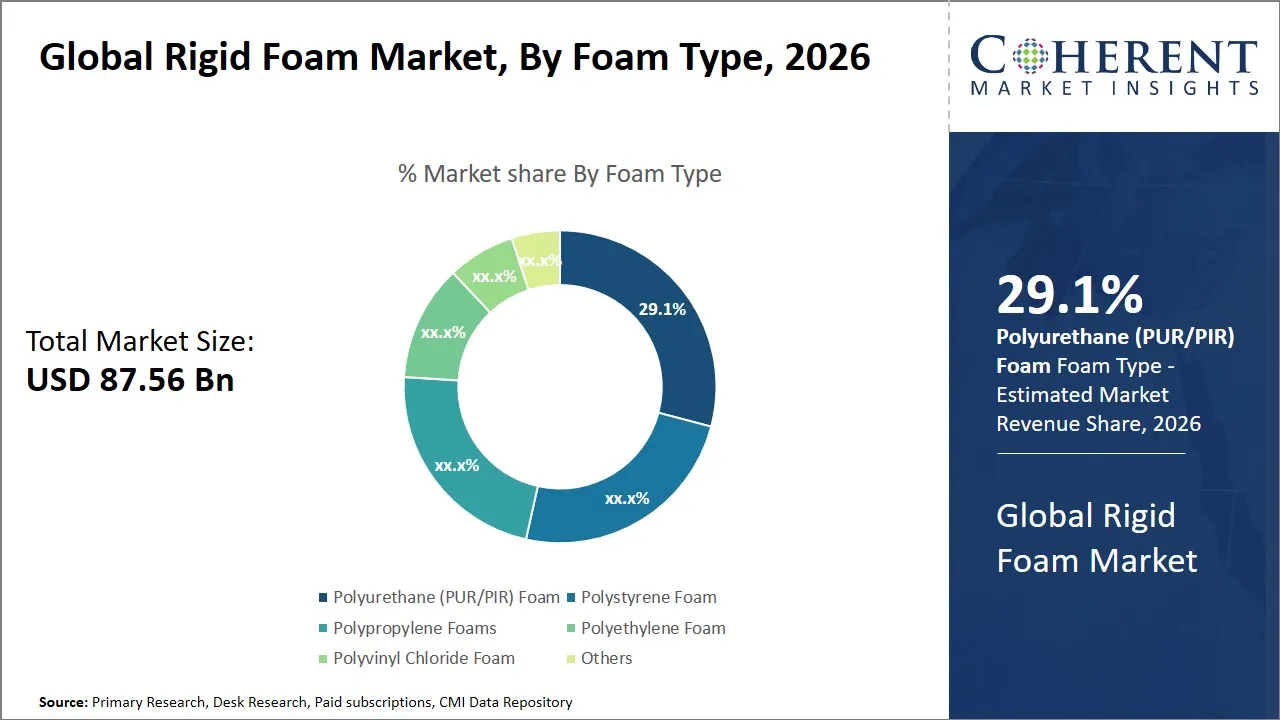
- The polyurethane (PUR/PIR) foam segment is estimated to capture 29.1% of the market share in 2026.
- The molded foam segment is projected to account for 41.7% of the global rigid foam market share in 2026.
- The building & construction segment is expected to hold 34.7 % of the rigid foam market share in 2026.
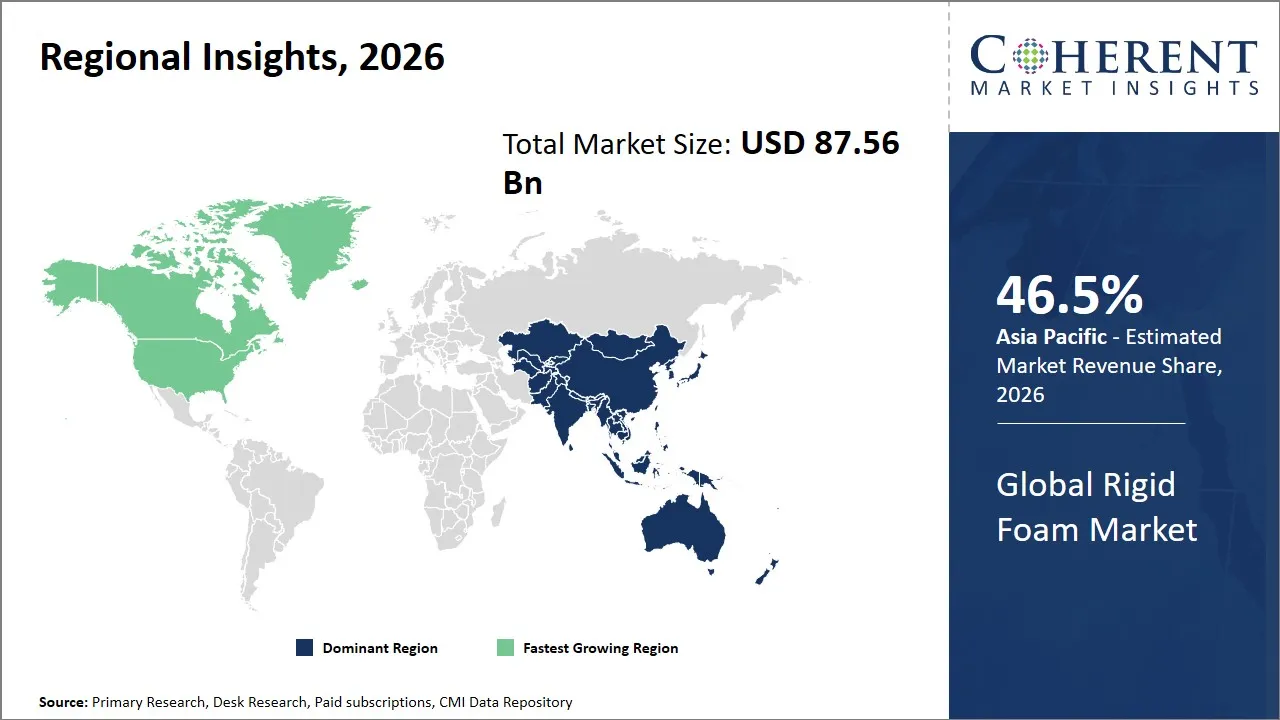
- The Asia Pacific region is expected to dominate the rigid foam market with a 46.5 % share in 2026.
- The North America region is expected to experience the fastest growth in the market, contributing a 20.3 % share in 2026.
Market Overview
- In terms of market trends, there is a significant shift towards sustainable and eco-friendly rigid foam products fueled by increasing environmental awareness and stringent government policies.
- Innovations in bio-based rigid foams and recyclable materials are gaining traction, aiming to reduce the carbon footprint associated with traditional petrochemical-based foams.
- Additionally, the growing adoption of rigid foam in green building materials applications and electric vehicles is creating new avenues for growth.
- Industry players are focusing on developing advanced formulations that enhance performance while meeting evolving regulatory standards.
Current Events and Its Impact
Current Events | Description and its Impact |
Rise of Sustainable/Bio‑Based Foam Alternatives (2026) |
|
Raw Material Price Volatility (2025‑2026) |
|
Segmental Insights
- Current Industry Events of 2026
- Market Size Estimation
- Regional Breakdown
- Competitive Landscape
- Customer Intelligence
- Segmental Analysis
- Pricing Analysis
- Key Market Drivers, Challenges & Future Trends
- Customized Insights Section
Why Does the Polyurethane (PUR/PIR) Foam Segment Dominate the Global Rigid Foam Market in 2026?
Polyurethane (PUR/PIR) foam segment is expected to hold 29.1% of the global rigid foam market share in 2026, owing to its exceptional versatility and superior performance characteristics. Polyurethane (PUR) and polyisocyanurate (PIR) foams have excellent thermal insulation, which is why they are extremely in demand in the projects where the energy saving is crucial. They have a very good thermal resistance given by their cellular structure that is important in minimizing energy use in buildings, and refrigeration system. In addition, the higher fire-resistance of PIR foam than that of PUR foam makes it accessible in locations where fire safety standards are highly pursued.
In the construction industry, PIR foam is increasingly used in building insulation for high-rise buildings in fire-prone areas, such as parts of California, due to its superior fire-resistant properties. This has led to a rise in demand for PIR foam in construction projects following stricter fire safety codes implemented in recent years.
Molded Foam Leads by Offering Customization and Enhanced Structural Performance
Molded foam segment is projected to hold 41.7% of the rigid form market share in 2026, driven by its ability to deliver tailored shapes and sizes suited for specialized industrial applications. The popularity of molded foams is based on their accuracy in manufacturing processes whereby elaborate geometric designs can be produced easily that cannot be attained by other types of foams such as slab stock polyether or polyester. The ability is specifically useful in such sectors as auto industries and packaging where individual cushioning, shock-absorbers, and protective wrappings are needed.
The greater mechanical characteristics of molded foam, including an increased impact resistance and dimensional stability also add to the preference of its use over other forms of products. Molded rigid foams can also be designed to fit the high-performance criteria requirements whereby the original equipment manufacturers (OEMs) and other product developers can enhance safety, durability, and comfort in their final products. The data is essential in safety-critical parts in automobiles, the packaging of an electronic device and sports equipment.
Building & Construction Dominates the Global Rigid Foam Market
The building & construction segment is expected to hold 34.7% of the global rigid foam market share in 2026. There has been the integration of rigid foams particularly the polyurethane and polystyrene types of foams in modern construction due to its superior insulating qualities which have been useful in achieving the global objectives of minimizing the use of energy in the building structures.
Regulations which require increased thermal insulation standards are being actively promoted by governments in regions as a way of ensuring sustainable building practice. These regulations have the effect of causing an increase in demand of rigid foam insulation materials to be used in residential, commercial, and industrial construction works. Rigid foams also help preserve heat in cold climates, which cuts down on the costs of heating, whereas in hot climates they keep the heat out which reduces the amount of energy required to heat the system. In this way, the need to promote the adoption of green buildings supports the popularity of rigid foam products.
Regional Insights
Asia Pacific Rigid Foam Market Analysis and Trends
The Asia Pacific region is projected to lead the market with a 46.5% share in 2026, due to the boom in urbanization, industrialization and growing infrastructure investments in the region of China, India and South Korea. The growing construction sector, surging-middle-income and the growing consciousness of energy-saving insulations building materials are major factors of growth.
A positive environment has been created through government efforts aiming at sustainable use of the environment, including Chinas campaign to adopt green buildings and Indias campaign to encourage energy saving. The availability of international firms like Huntsman Corporation, Armacell and the local firms like Jindal Poly Films enhance market growth by collaborating, local productions and product innovations of contours to the regional needs.
North America Rigid Foam Market Analysis and Trends
The North America region is expected to exhibit the fastest growth in the market contributing 20.3% share in 2026, due to the strong industrial ecosystem, high energy efficiency policies, and construction and automotive industries. The area enjoys a well-established manufacturing infrastructure and is home to some of the strongest chemical and materials firms like Dow Inc., BASF Corporation and Owens Corning.
The government policies which focus on environmental requirements such as the green building standards and insulation efficiency such as those which the U.S. Department of Energy preaches have increased the demand of the advanced rigid foam insulation solutions. Additionally, well established supply chains and centers of innovation in North Americas enable quick product development and commercialization which helps the company to maintain a dominant role in the market.
Rigid Foam Market Outlook for Key Countries
Is the U.S. Rigid Foam Market Poised for Continued Growth with Sustainability and Innovation Driving Demand?
The rigid foam market in the U.S is a market that is dominated by a large number of applications in the residential, commercial and industrial markets. Dow Chemical and Owens Corning are major companies which utilize highly developed research facilities to produce high performance insulation and packaging materials. Good government incentives on energy efficiency such as tax rebates and efficiency requirements keep the demand alive. Moreover, the development of new foam products that are eco-friendly and circular economy projects lead to the evolution of the market, and the U.S. will act as a major platform concerning technology and products development.
China Rigid Foam Market Trends
The rigid foam market in China is in a boom as the country is developing its infrastructure with rapidity and the increasing emphasis on green building certification. The companies such as BASF and the local giants such as Wanhua Chemical group are major suppliers of raw materials and finished foam products. Market growth is also precipitated by government regulations that encourage energy conservation in construction and industrial use. The transformation to environmentally friendly and bio-based rigid foams indicates continuous implementation of the environmental policies, and the need of the consumers to use sustainable products.
Is Germany Driving Growth in the Rigid Foam Market with Sustainability and Government Support?
Germany remains the market leader in the rigid foam division of the European market and puts a heavy focus on the innovation of environmentally-friendly insulation materials, in accordance with the strict European Union regulations of energy efficiency. The companies like BASF SE, Covestro AG have significant market share, which promotes development of low-impact foam formula. The country has developed construction industry which coupled with the active government strategies to favor renovation and new sustainable building codes further boost market demand.
India Rigid Foam Market Trends
The India rigid foam market is in an upward trend with urban housing boom, industrial production growth and thermal insulation increment in commercial projects. The governments pay attention to sustainable development and such measures as the Energy Conservation Building Code promote the use of rigid foam products. Multinational and local players such as Huntsman International and Supreme industries serve local markets, usually specializing their products to respond to climatic differences and cost sensitivity.
Brazil Rigid Foam Market Trends
The market of the rigid foam is growing in Brazil’s, with the support of the growing construction and refrigeration market. The major stakeholders like Reticle and local manufacturers play a significant role in the growth of the market. The government policies that promote the use of energy-efficient appliances and infrastructure have established a good platform upon which rigid foam insulation can be utilized. But in some cases, the market conditions are affected by the fluctuations of the trade and economic changes, and companies concentrate on the distribution channels of efficient production and distribution within the region.
Fire Safety & Performance Trade-offs
Rigid Foam Type | Fire Safety Characteristics | Performance Characteristics | Trade-offs/Considerations |
Polyurethane Foam | Low smoke emission, High flammability without fire retardants | High insulation performance, Lightweight | Requires added fire retardants for better fire resistance; trade-off between performance and fire resistance. |
Phenolic Foam | Excellent fire resistance, low flame spread, low smoke production | High thermal insulation, Good for high-temperature applications | Higher cost compared to other foam types, but offers significant fire safety benefits. |
Extruded Polystyrene Foam (XPS) | Moderate flammability, requires fire retardant treatments | High moisture resistance, good durability in harsh conditions | Fire retardants compromise long-term performance and cost-efficiency. |
Market Players, Key Development, and Competitive Intelligence
Key Developments
- In March 2024, Covestro AG announced the expansion of its Baytherm product line for thermal insulation solutions. The new products are designed to meet the growing demand for energy-efficient materials in the construction and refrigeration sectors. These advanced rigid foams offer superior thermal insulation and are tailored for use in both residential and industrial applications, helping reduce energy consumption globally.
- In February 2024, BASF SE announced the expansion of its Elastopor and Elastopir rigid foam production lines at its Ludwigshafen site in Germany. The investment aims to meet growing demand for energy-efficient insulation materials in Europe’s construction and refrigeration sectors. The expanded capacity will allow BASF to better serve the increasing need for high-performance, eco-friendly foam solutions in residential and commercial buildings.
- In December 2023, Recticel expanded its GreenTech initiative by launching a new line of rigid polyurethane foams that use renewable raw materials. This initiative is part of the company’s sustainability drive to meet growing consumer demand for eco-friendly construction materials. The new foams are designed for use in walls, roofs, and floors, offering excellent insulation while also contributing to reducing carbon emissions in the construction industry.
Top Strategies Followed by Global Rigid Foam Market Players
Player Type | Strategic Focus | Example |
Established Market Leaders | Heavy investment in R&D and innovation | For instance, An example of them is BASF, which has made great progress in improving the insulation properties and sustainability of its Neopor, a silver-based expandable polystyrene (ESP) foam that offers better thermal performance of insulation. Also, Dow Chemical has been working with large automotive OEMs to enable their use of its rigid foam products in insulating vehicles, in order to make them lighter and more energy efficient. |
Mid-Level Players | Cost-effective solutions with balanced quality | For example, Owosso Motor Oil, as an example, has streamlined its manufacturing operations through lean manufacturing methods in an attempt to minimize the amount of material wastage, besides reducing costs, without compromising on the quality of its rigid foam products. |
Small-Scale Players | Niche specialization & innovative variants | For example, GreenFoam Technologies has specialized in creating bio-based rigid foam insulation products based on plant-based oils and renewable sources and is serving the rising environmental awareness of people. |
Market Report Scope
Rigid Foam Market Report Coverage
| Report Coverage | Details | ||
|---|---|---|---|
| Base Year: | 2025 | Market Size in 2026: | USD 87.56 Bn |
| Historical Data for: | 2020 To 2024 | Forecast Period: | 2026 To 2033 |
| Forecast Period 2026 to 2033 CAGR: | 4.5% | 2033 Value Projection: | USD 119.16 Bn |
| Geographies covered: |
| ||
| Segments covered: |
| ||
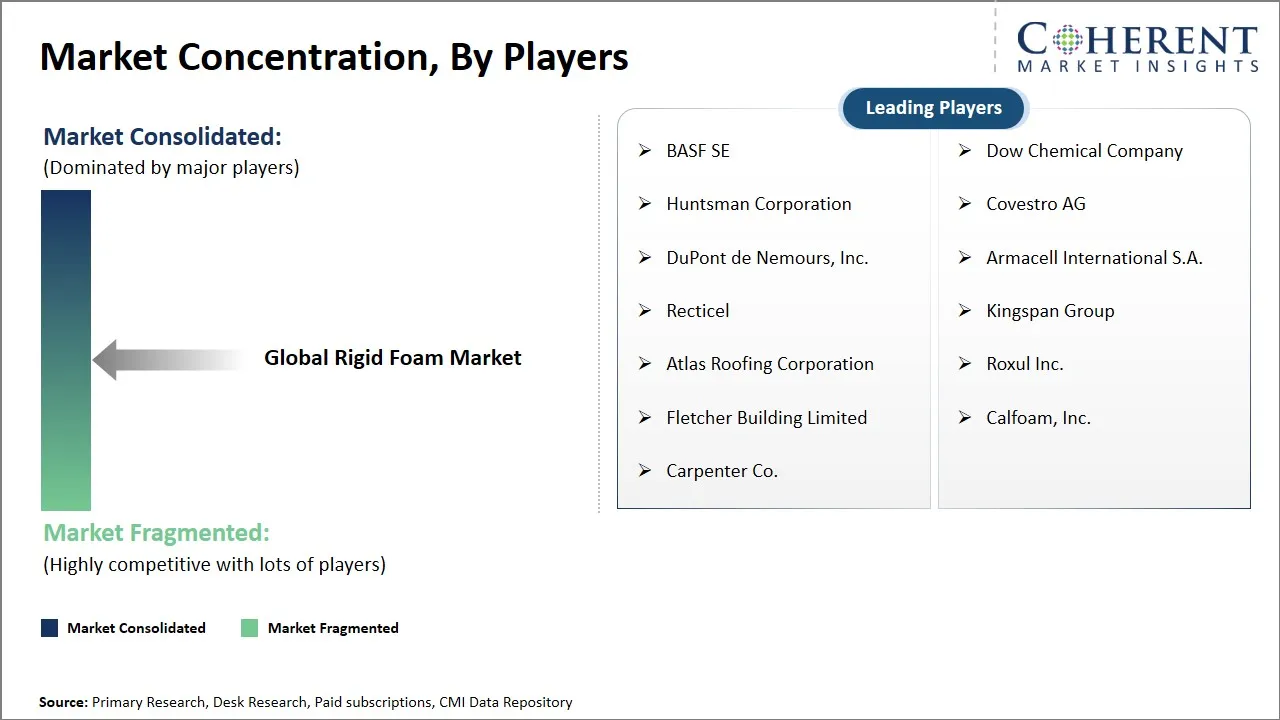
| Companies covered: | BASF SE, Dow Chemical Company, Huntsman Corporation, Covestro AG, DuPont de Nemours, Inc., Armacell International S.A., Recticel, Kingspan Group, Atlas Roofing Corporation, Roxul Inc., Fletcher Building Limited, Calfoam, Inc., and Carpenter Co. | ||
| Growth Drivers: |
| ||
| Restraints & Challenges: |
| ||
Rigid Foam Market Dynamics
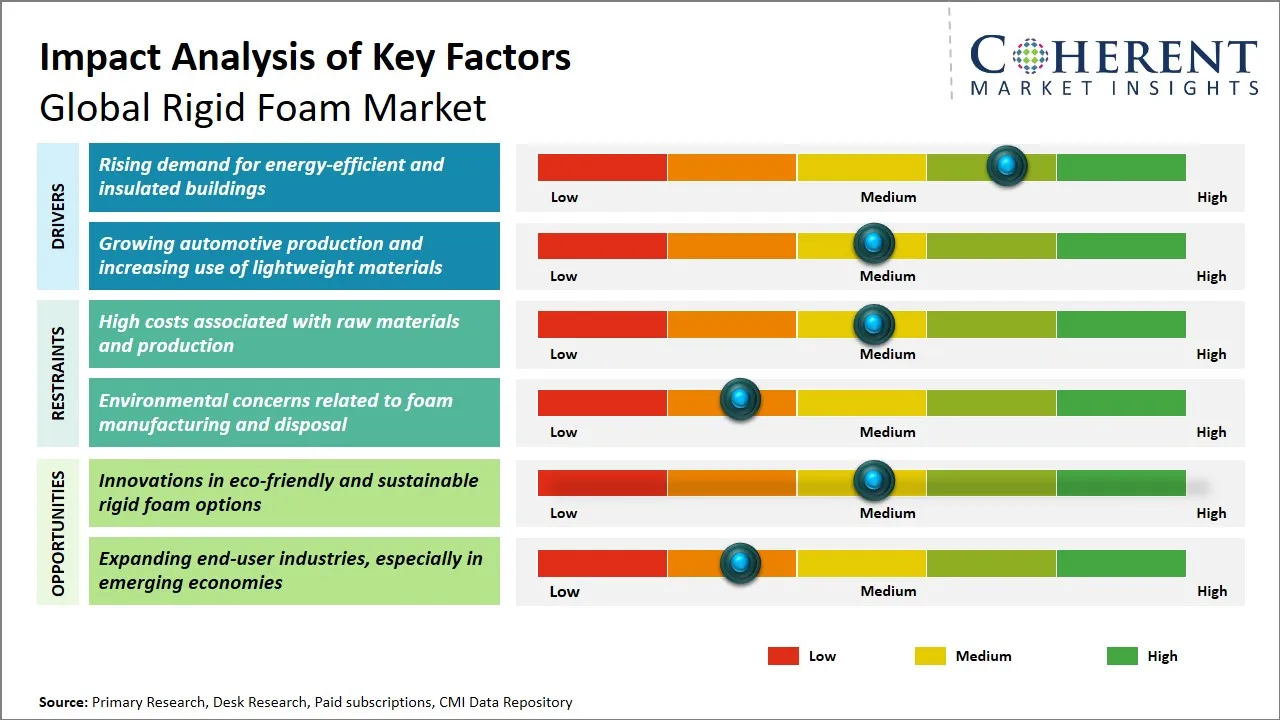
Rigid Foam Market Driver - Rising Demand for Energy-Efficient and Insulated Buildings
The increasing trend of energy efficiency and sustainability in the construction sector has greatly increased the demand of the rigid polyurethane foam insulation materials. As government restrictions and environmental considerations become stricter, constructors and developers are now focusing on materials, which will promote greater thermal insulation to minimize the amount of energy used in residential, commercial, and industrial structures. Rigid foam boards also have better insulating capabilities such as low thermal conductivity and high moisture resistance thereby making them a better choice in enhancing the building envelopes. The materials are useful in keeping the indoor temperatures stable, which would minimize the use of heating and cooling systems and the total energy expenses.
As an example, in Europe, the Energy Performance of Buildings Directive (EPBD) of the European Union creates the requirement that by 2020 all new buildings should be nearly zero-energy buildings, and thus more energy- efficient building materials such as rigid foam insulation will be used more frequently. An important example is that of Kingspan Insulation, the pre-eminent international player in the insulation industry which includes products like Kingspan Kooltherm rigid foam insulation, which boasts of a high thermal efficiency as well as a high moisture resistance and low carbon footprint.
Rigid Foam Market Opportunity - Innovations in Eco-Friendly and Sustainable Rigid Foam Options
The rigid foam industry in the world is experiencing a high opportunity owing to the increased need in eco-friendly and sustainable insulation products. The growing level of environmental awareness is also being accompanied by tougher government regulations on carbon emissions and waste management which are forcing manufacturers to develop more environmentally-friendly alternatives to the conventional petroleum-based rigid foams. Recent progress in bio-based raw materials, including polyols made of plants and the use of recycled materials, allows the creation of rigid foams with lower carbon footprints and better biodegradability. Also, studies on non-toxic blowing agents with low global warming potential (GWP) are changing the production processes and have provided solutions to problems that are sustainable without affecting performance.
As an example, BASF, a company producing chemicals and chemical products, has introduced ecoflex, a flexible foam which is produced using renewable plant-based resources, and is currently in the process of ensuring that bio-based polyols are also present in rigid foams.
(Source: https://www.ecoflex.basf.com/)
Analyst Opinion (Expert Opinion)
- The growth of the rigid foam market is expected to be tremendous due to rising demand in construction, automotive, and packaging industry in lightweight and energy efficient solutions. Reports of the International Rigid Foam Symposium (2023) and the Global Materials Expo (2022) show promising new trends in the sphere with such companies as BASF and Huntsman at the forefront of the innovation curve building formulations that maximize use of thermal insulation characteristics and limit environmental impact.
- The change to the use of sustainability in the industry can be illustrated by recent introduction of the eco-friendly rigid foam variant by BASF that has lower greenhouse gas emissions in its production. Conferences held on these topics pointed out the increasing pressure of adherence to strict regulations on the safety of material, and environmental effect, which are transforming the world of rigid foam production. The unstable prices of raw materials and the necessity to develop new innovations constantly in the performance indicators were the obvious obstacles to the manufacturers, mentioned numerous times.
- Firms that invest in research and development and partner with the end-user industries to offer customized solutions are likely to have a huge market share. Finally, the prospect of the rigid foam market will be determined by its capability to be innovative and react swiftly to the changing need of sustainability, effectiveness, and functionality in different applications.
Speak to the analyst
Want personalized insights?
Take the findings above to one of our principal consultants, or have the report rebuilt around the segments, geographies and competitors you actually track.
Market Segmentation
- Foam Type Insights (Revenue, USD Bn, 2021 - 2033)
- Polyurethane (PUR/PIR) Foam
- Polystyrene Foam
- Polypropylene Foams
- Polyethylene Foam
- Polyvinyl Chloride Foam
- Others
- Product Type Insights (Revenue, USD Bn, 2021 - 2033)
- Molded Foam
- Slab Stock Polyether
- Slab Stock Polyester
- Others
- End-Use Industry Insights (Revenue, USD Bn, 2021 - 2033)
- Building & Construction
- Appliances
- Packaging
- Automotive
- Others
- Regional Insights (Revenue, USD Bn, 2021 - 2033)
- North America
- U.S.
- Canada
- Latin America
- Brazil
- Argentina
- Mexico
- Rest of Latin America
- Europe
- Germany
- U.K.
- Spain
- France
- Italy
- Russia
- Rest of Europe
- Asia Pacific
- China
- India
- Japan
- Australia
- South Korea
- ASEAN
- Rest of Asia Pacific
- Middle East
- GCC Countries
- Israel
- Rest of Middle East
- Africa
- South Africa
- North Africa
- Central Africa
- North America
- Key Players Insights
- BASF SE
- Dow Chemical Company
- Huntsman Corporation
- Covestro AG
- DuPont de Nemours, Inc.
- Armacell International S.A.
- Recticel
- Kingspan Group
- Atlas Roofing Corporation
- Roxul Inc.
- Fletcher Building Limited
- Calfoam, Inc.
- Carpenter Co.
Sources
Primary Research Interviews
- CEO – Leading Rigid Polyurethane Foam Producer (e.g., BASF, Dow, or General Plastics equivalent)
- Supply Chain Director – Major Foam Insulation Distributor
- Production Lead – Rigid Foam Manufacturer for Appliances
- Sustainability Officer – Polyurethane Foam Certification Authority (e.g., CertiPUR-US)
Stakeholders
- Manufacturers
- End-use Sectors
- Building & Construction (Insulation Panels, Roofing)
- Appliances & Refrigeration (Fridges, Cold Storage)
- Automotive & Transportation
- Packaging & Industrial Applications
- Regulatory & Certification Bodies (e.g., EPA for foam emissions, REACH for polyurethanes in EU)
- E-commerce Platforms and Retailers (Alibaba, Industrial Suppliers, Sigma-Aldrich equivalents)
- Technology Integration Players: Bio-based foam and low-GWP producers
Databases
- UN Comtrade Database (HS codes for polyurethane foams)
- India Import Export (EXIM) Database
- USGS Mineral Commodity Summaries (related polymers/chemicals)
- Eurostat Trade Statistics for Chemicals
Magazines
- PU Magazine – Rigid foam processing and sustainability
- Foam Expo Publications – Foam innovations and interviews
- Chemical Processing Magazine – Foam chemical trends
- Industrial Insulation Magazine – Market dynamics for rigid foams
Journals
- Journal of Materials Science – Rigid foam durability
- Polymer Degradation and Stability – Foam fire safety
- ACS Publications – Bio-based rigid polyurethane foams
- Construction and Building Materials – Insulation performance
- Journal of Hazardous Materials – Emissions from foam processing
Newspapers
- The Wall Street Journal – Chemical demand for insulation foams
- Business Standard (India) – Asia foam market growth
- Chemical Week – Supply disruptions in polyurethane production
- Reuters – Price volatility in foam raw materials
Associations
- Polyurethane Foam Association (PFA)
- Center for the Polyurethanes Industry (CPI)
- Federation of European Rigid Polyurethane Foam Manufacturers (PU Europe)
- Polyisocyanurate Insulation Manufacturers Association (PIMA)
- American Chemistry Council (ACC) Polyurethanes Division
- European Chemical Industry Council (Cefic)
Public Domain Sources
- EPA – Guidelines for polyurethane foam handling and emissions
- European Commission – REACH regulations on isocyanates and foams
- World Health Organization – Safety standards for foam chemicals
- OECD – Chemical trade and sustainability reports for polyurethanes
Proprietary Elements
- CMI Data Analytics Tool, Proprietary CMI Existing Repository of information for last 8 years.
Get access to 250+ pages report
Every segment, forecast, competitor profile and data table behind the analysis above — available for instant download.
- ESOMAR Member
- ISO 9001:2015 Certified
- D-U-N-S Registered
- GDPR & CCPA Compliant
Missing comfort of reading report in your local language? Find your preferred language:
Transform your Strategy with Exclusive Trending Reports
Frequently Asked Questions
The global rigid foam market is estimated to be valued at USD 87.56 Bn in 2026 and is expected to reach USD 119.16 Bn by 2033.
The CAGR of global rigid foam market is projected to be 4.5% from 2026 to 2033.
Focus on low-GWP blowing agents, bio-based polyols, and recycling initiatives.
Volatility in raw material prices and regulatory challenges around blowing agents.
Rising demand for energy-efficient and insulated buildings and growing automotive production and increasing use of lightweight materials are the major factors driving the growth of the global rigid foam market.
High costs associated with raw materials and production and environmental concerns related to foam manufacturing and disposal are the major factors hampering the growth of the global rigid foam market.
In terms of foam type, polyurethane (PUR/PIR) foam is estimated to dominate the market revenue share in 2026.