

Global Rocket Propulsion Market Size and Forecast – 2026 To 2033
The global rocket propulsion market is expected to grow from USD 10 Bn in 2026 to USD 17 Bn by 2033, registering a compound annual growth rate (CAGR) of 6.6% from 2026 to 2033. The global rocket propulsion market is driven by the expansion of commercial launch service providers. On May 26, 2026, a space company, Isar Aerospace, and spaceport operator, Maritime Launch Services (MLS), signed a Letter of Intent to advance sovereign orbital launch readiness from Nova Scotia, Canada.
Key Takeaways of the Global Rocket Propulsion Market
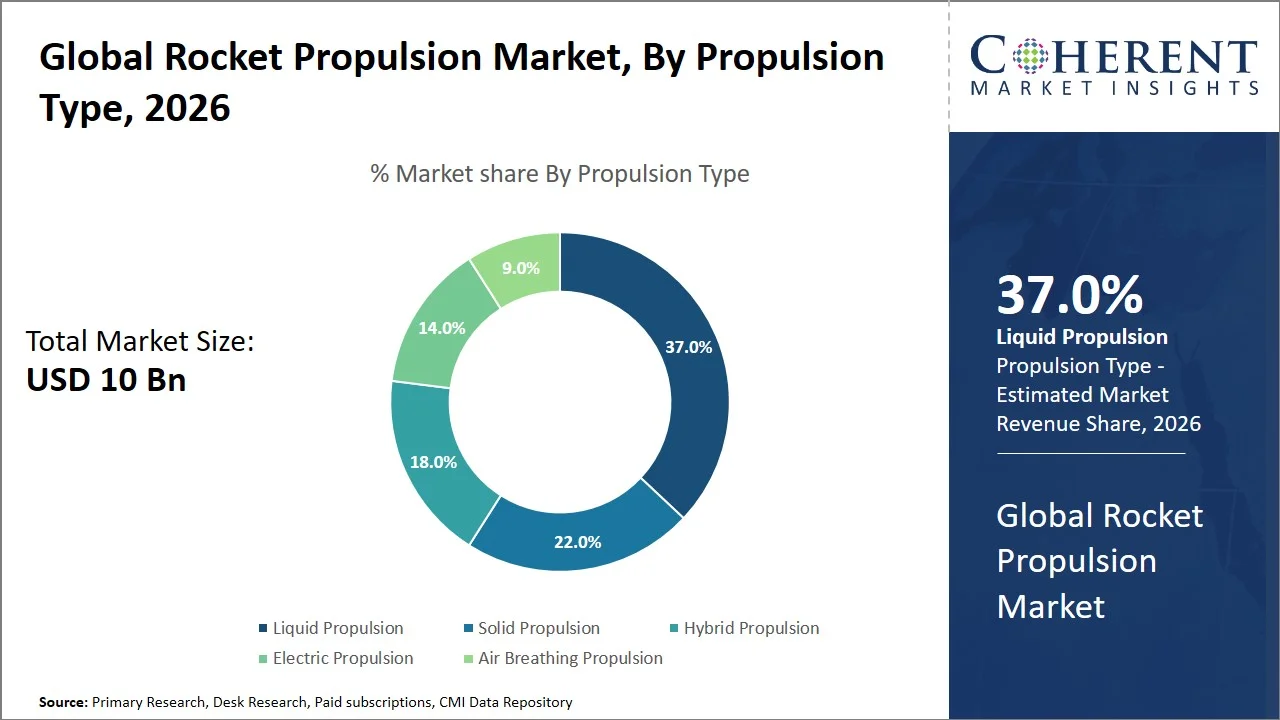
- The liquid propulsion segment is expected to account for 37.0 % of the global rocket propulsion market share in 2026. Increasing satellite launch frequency worldwide is driving the growth of the segment. For instance, by the end of 2025, SpaceX completed a record 165 Falcon 9 missions during 2025, with approximately 122 launches dedicated to deploying Starlink satellites.
- The launch vehicles segment is estimated to capture 34.0 % of the market share in 2026. Advancements in reusable rocket propulsion technologies is majorly driving the growth of the segment. On June 17, 2025, Honda R&D Co., Ltd. conducted a launch and landing test of an experimental reusable rocket (6.3 m in length, 85 cm in diameter, 900 kg dry weight/1,312 kg wet weight) developed independently by Honda.
- The liquid hydrogen segment is estimated to capture 32.0 % of the market share in 2026. Development of green and high efficiency propulsion systems is driving the growth of the segment. On February 27, 2026, ISPTech announced a USD 5.8 million seed round to ramp up its production of green spacecraft thrusters. The new capital will also help the company grow its workforce, and build a new in-house test facility to increase ISPTech’s production rate.
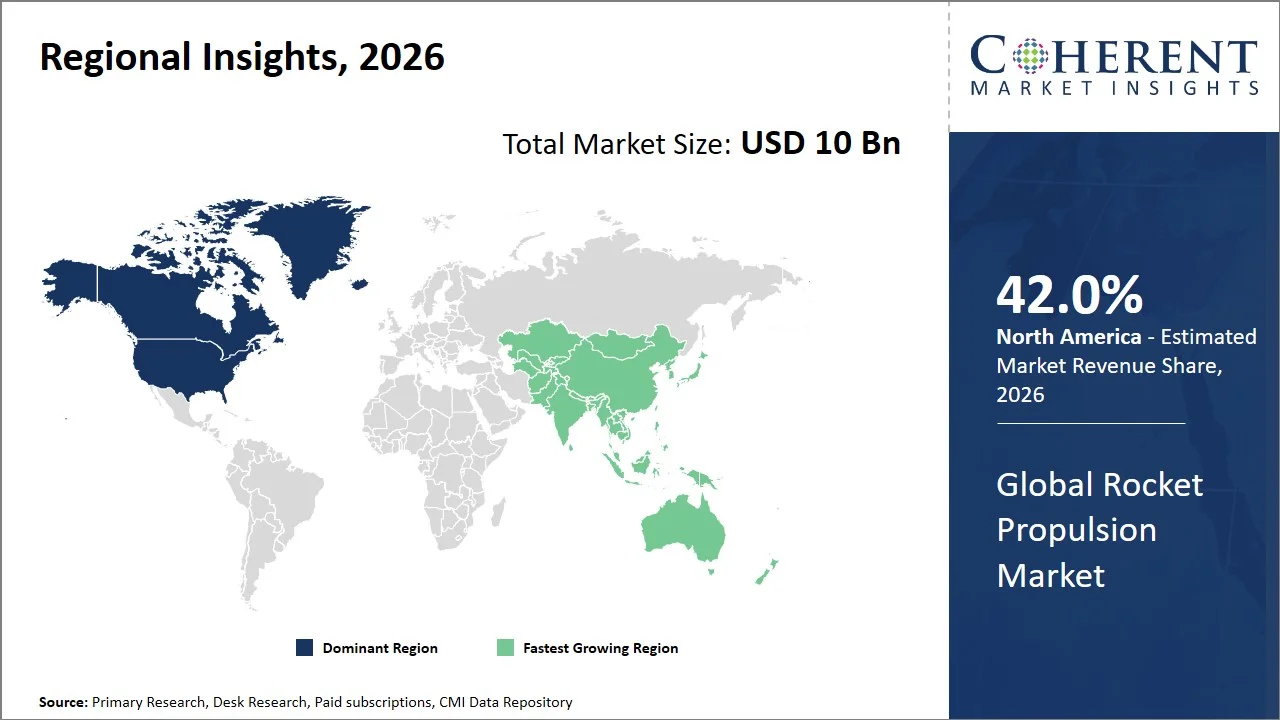
- North America is expected to dominate the rocket propulsion market in 2026 with a market share of 42.0 %. Increasing development in hypersonic propulsion technologies in North America is driving the growth of the regional market. On July 8, 2026, Venus Aerospace announced that it raised USD 91 million in a Series B funding round to expand development and production of its rotating detonation rocket engine technology.
- Asia Pacific is expected to account for 29.0 % of the market share in 2026 and is projected to record the fastest growth over the forecast period. Rising public private partnerships in space programs across Asia Pacific are driving the growth of the regional market. On January 21, 2026, Pixxel signed an agreement with the Indian National Space Promotion and Authorisation Centre (IN-SPACe) to construct India’s national Earth Observation constellation.
- Rapid Transition Toward Methane-Fueled Rocket Engines: Rocket makers are quickly switching to liquid methane as a preferred propellant as it burns more efficiently, produces less soot and is more suitable for reusable launch vehicles compared with traditional kerosene-based systems. Continued investment in methane engine development is resulting in reduced refurbishment costs, increased engine reliability and higher launch rates for commercial and government space missions.
- Growing Integration of Additive Manufacturing in Propulsion Systems: Metal additive manufacturing is picking up pace across the board in rocket engine manufacturing, enabling manufacturers to create intricate combustion chambers, injectors, turbopumps, and nozzles using fewer parts and shorter production times. This trend is cutting manufacturing costs, increasing design flexibility, and quickening the development of future generation propulsion systems while improving engine performance and dependability.
Segmental Insights
Why Does Liquid Propulsion Dominate the Global Rocket Propulsion Market?
The liquid propulsion segment is expected to account for 37.0% of the global rocket propulsion market share in 2026. Liquid propulsion has better thrust control and mission flexibility and is the preferred choice for orbital launch vehicles and complex space missions. Unlike solid propulsion, liquid engines can be throttled, shut down and restarted in flight, allowing accurate trajectory corrections, repeated orbital insertions and better payload deployment precision. These characteristics are critical for commercial satellite launches, crewed missions, deep space exploration, and reusable launch vehicles. Therefore, government space agencies and business launch providers are eager to invest in liquid propulsion technology. On June 24, 2025, NASA and L3Harris Technologies successfully test-fired the first RS-25 rocket engine slated to help power the fifth launch of the Space Launch System or SLS rocket for the Artemis Moon exploration campaign.
- Current Industry Events of 2026
- Market Size Estimation
- Regional Breakdown
- Competitive Landscape
- Customer Intelligence
- Segmental Analysis
- Pricing Analysis
- Key Market Drivers, Challenges & Future Trends
- Customized Insights Section
Why are Launch Vehicles the Most Preferred Platform Type?
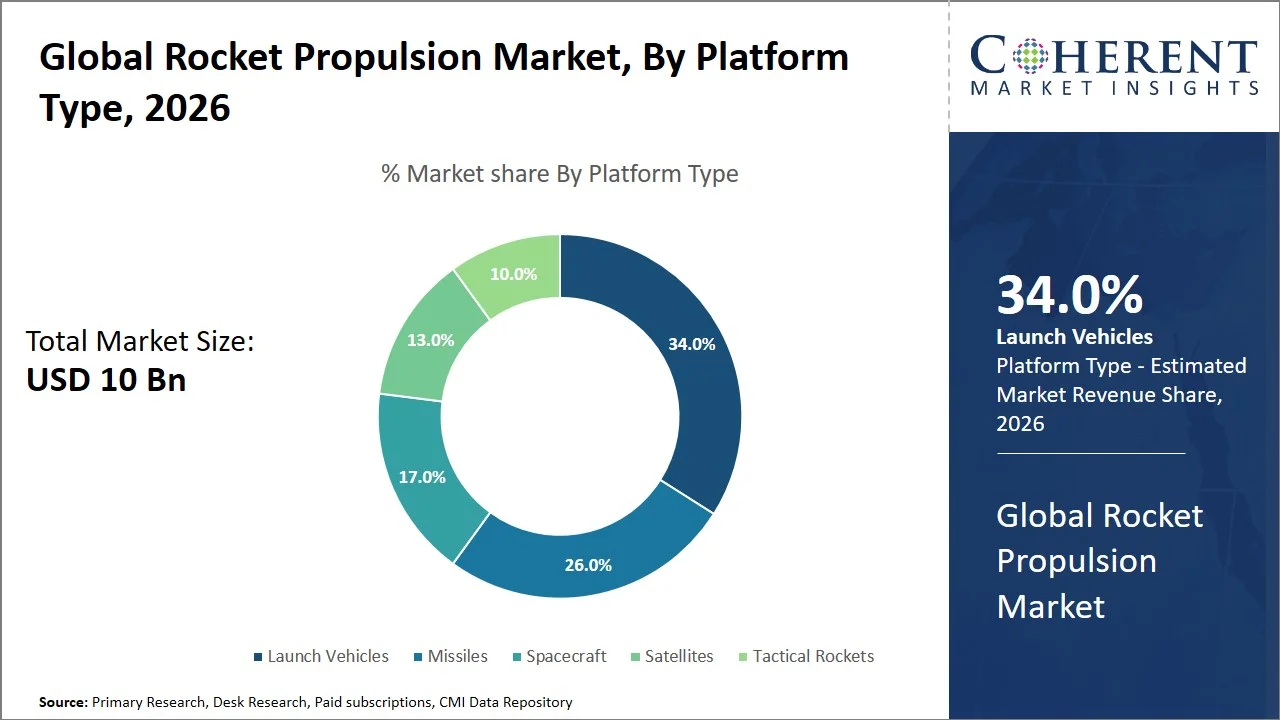
The launch vehicles segment is expected to account for 34.0% of the global rocket propulsion market share in 2026. Launch vehicles are the most popular platform type since they are the main way of sending satellites, scientific payloads and human missions into space, hence producing persistent demand for sophisticated propulsion systems. The dramatic increase in commercial satellite constellations, national space exploration programs and reusable launch missions has resulted in a significant growth in the number of launches around the world. Consequently, governments and private space companies are making significant investments in dependable, high-performance launch vehicles based on efficient rocket propulsion technologies. On May 29, 2025, Northrop Grumman Corporation announced that it has invested USD 50 million into Firefly Aerospace to further advance production of their co-developed medium launch vehicle, known as Eclipse. The companies continue to make progress in the development of Eclipse flight hardware with qualification testing underway and more than 60 Miranda engine hot fire tests performed to date.
Liquid Hydrogen Dominates the Global Rocket Propulsion Market
The liquid hydrogen segment is expected to account for 32.0% of the global rocket propulsion market share in 2026. Liquid hydrogen is the preferred propellant due to its exceptionally high specific impulse, one of the highest among conventional chemical rocket propellants, enabling greater payload capacity and superior performance for energy-intensive missions. When paired with liquid oxygen, it delivers outstanding propulsion efficiency while producing water vapor as the primary exhaust product. This combination makes it highly suitable for upper-stage launch vehicles and deep-space exploration missions. As a result, liquid hydrogen continues to be the propellant of choice for heavy-lift rockets operated by leading government space agencies and commercial launch service providers. On March 6, 2026, NASA formally selected United flight Alliance’s Centaur 5 to be the upper stage for the agency’s Space Launch System rocket for its Artemis 4 mission targeted for flight no earlier than early 2028. ULA’s Vulcan rocket uses the Centaur 5 as its top stage.
Currents Events and their Impact
Current Events | Description and its Impact |
United States International Traffic in Arms Regulations (ITAR) Modernization Updates |
|
U.S. Federal Aviation Administration Commercial Space Launch Licensing Rule Implementation |
|
Rocket Propulsion Market Dynamics
Market Drivers
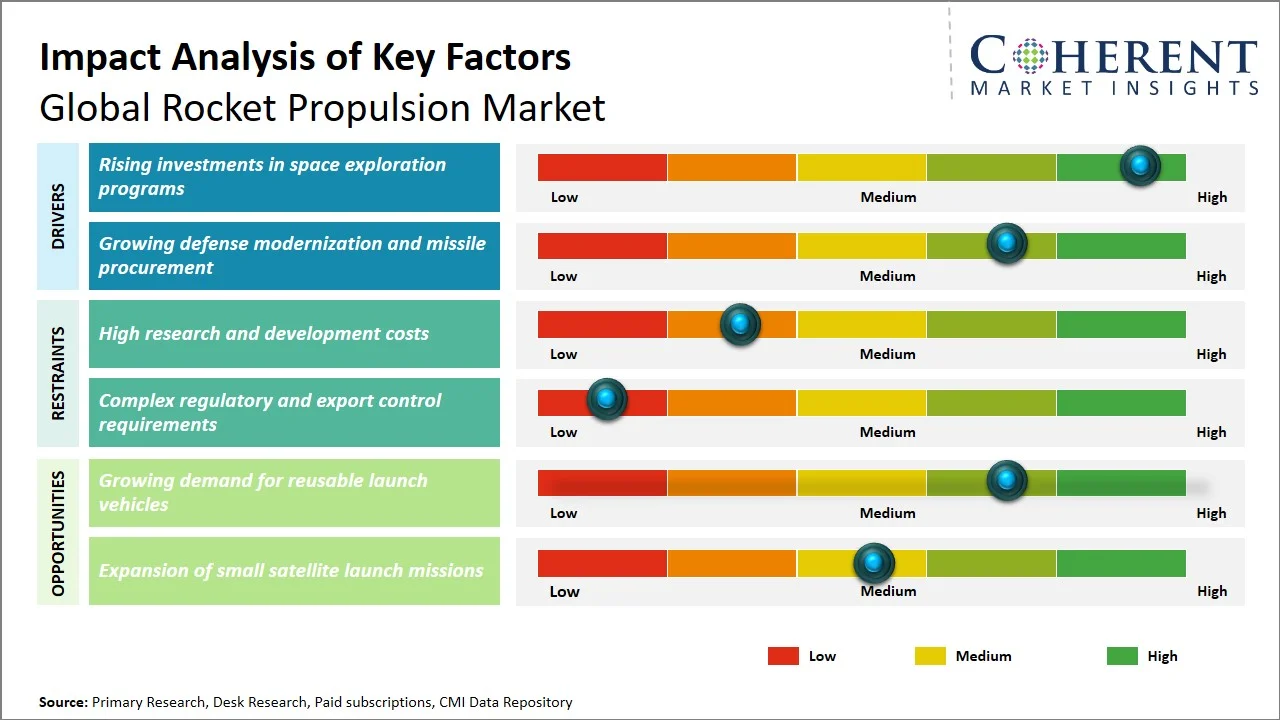
- Rising investments in space exploration programs: Governments and commercial space organizations are putting more and more money into space exploration programs, including lunar missions, Mars exploration, space stations, and the expansion of satellite deployment, which is driving steady demand for advanced rocket propulsion systems. Procurement of high-performance liquid, solid and hybrid propulsion technologies is underway to support programs such as NASA’s Artemis missions, the European Space Agency’s exploration programs, China’s lunar and deep-space missions and India’s growing launch vehicle development. At the same time, private companies are pouring money into reusable rocket engines and next-generation propulsion systems, designed to cut the cost of launching and enable more missions more often, so boosting the expansion of the market.
- On January 23, 2025, NASA awarded new study contracts to help support life and work on the lunar surface. As part of the agency’s blueprint for deep space exploration to support the Artemis campaign, nine American companies in seven states are receiving awards. The Next Space Technologies for Exploration Partnerships Appendix R contracts will advance learning in managing everyday challenges in the lunar environment identified in the agency’s Moon to Mars architecture.
- Growing defense modernization and missile procurement: The defense modernization programs are leading to considerable investments in new missile systems which require reliable, high-performance rocket propulsion technology for strategic, tactical and hypersonic applications. The U.S., China, India, Japan, South Korea and numerous European countries are building up stockpiles of ballistic missiles, interceptor missiles, air defense systems and long-range precision strike weapons, all in the name of national security. Growing procurement of next generation missile platforms is boosting demand for sophisticated solid and liquid propulsion systems with higher thrust, maneuverability and operational reliability.
- On June 24, 2026, the U.S. government awarded Lockheed Martin a seven-year undefinitized contract action (UCA) for up to USD 35 billion to quadruple production of Terminal High Altitude Area Defense (THAAD) interceptors. The award is one of the first major multiyear procurement contracts executed under the Department of War's Acquisition Transformation Strategy and represents one of the first full-scale transitions from framework agreement to contract execution under the initiative.
Emerging Trends
- Rising Development of Reusable High-Thrust Propulsion Technologies: Launch providers are developing propulsion systems that are capable of numerous flight cycles with limited refurbishment to cut launch costs and boost mission frequency. Advanced engine monitoring, autonomous health diagnostics and better thermal protection technologies are now able to do more operational life and quicker turn-around between flights for rocket engines.
- Increasing Investment in Advanced Hypersonic and Dual-Use Propulsion Programs: Governments and defense groups are investing heavily in scramjet, combined-cycle, and other advanced propulsion technologies to support hypersonic weapons and high-speed aircraft systems. These breakthroughs are spurring innovation in high-temperature materials, fuel efficiency and propulsion control systems, further blurring the lines between commercial space technologies and defense uses.
Regional Insights
Why is North America a Strong Market for Rocket Propulsion?
North America is expected to account for a market share of 42.0% in 2026. North America is still the world center for rocket propulsion innovation, supported by huge government spending, commercial launch operations and advanced defense programs. The U.S. remains leading the way in propulsion development, with NASA’s Artemis program and commercial companies like SpaceX creating reusable Raptor methane engines for the Starship launch system and Blue Origin developing BE-4 engines for heavy-lift launch vehicles. RTX, Northrop Grumman and L3Harris are ramping up solid rocket motor manufacturing for missile defense and strategic weapon systems, while Aerojet Rocketdyne continues to provide RL10 and RS-25 engines for important government space missions. The region is also seeing increasing investment in additive manufacturing, digital engine testing and hypersonic propulsion research backed by the U.S. Department of Defense.
Why Does the Asia Pacific Rocket Propulsion Market Exhibit High Growth?
Asia Pacific is projected to account for 29.0% of the global rocket propulsion market and is expected to register the fastest growth. The Asia Pacific region is rapidly developing in rocket propulsion development, with governments boosting indigenous launch capability and expanding commercial space activity. China is speeding up research of reusable rocket engines via the China Aerospace Science and Technology Corporation, while India’s ISRO and private firms like Skyroot Aerospace and Agnikul Cosmos are making progress on liquid and semi-cryogenic propulsion systems produced locally. High-efficiency hydrogen propulsion technologies for the H3 launch vehicle are being further developed by Japan with Mitsubishi Heavy Industries and IHI Corporation spearheading the efforts, while South Korea is expanding propulsion capabilities for the Nuri launch program. Regions are putting more emphasis on reusable launch vehicles, satellite deployment and strategic missile propulsion technology.
Global Rocket Propulsion Market Outlook for Key Countries
Why is the U.S. Emerging as a Major Hub in the Rocket Propulsion Market?
Continued investment in reusable propulsion, hypersonic technologies and next-generation launch vehicles ensures U.S. leadership in technology. NASA is still using RS-25 engines on Artemis flights, while SpaceX is testing and producing lots of full-flow staged combustion Raptor engines for Starship. Blue Origin produces BE-4 engines for the United Launch Alliance’s Vulcan rocket, and Northrop Grumman makes solid rocket boosters for the Space Launch System. Continued demand for liquid and solid propulsion platforms is being driven by the Department of Defense’s financing of innovative propulsion technologies for long-range missile systems and hypersonic weapons.
Is China the Next Growth Engine for the Rocket Propulsion Market?
China is quickly strengthening its rocket propulsion capabilities through coordinated government and private activities aimed at boosting launch frequency and gaining greater technological independence. The Long March family of rockets continues to use upgraded liquid-propulsion systems developed by the China Academy of Launch Vehicle Technology, while commercial launch companies such as LandSpace have successfully advanced methane-fuel rocket engine technologies for reusable launch vehicles. The government is also investing extensively on heavy-lift launch systems, lunar exploration missions and hypersonic propulsion research, and is bolstering local manufacturing of advanced propulsion components and cryogenic engines.
Russia Rocket Propulsion Market Analysis and Trends
Russia is still relying on its lengthy experience with liquid rocket propulsion, but is upgrading propulsion technology for future launch systems and strategic defense. High-performance liquid rocket engines, such as the RD-series engines used in orbital launch vehicles, are still largely manufactured by such enterprises as NPO Energomash. Roscosmos is backing modifications to the engines for the Angara class of launch vehicles and is also funding the development of next-generation oxygen-kerosene and hydrogen engines for future heavy-lift missions. In addition, the country’s defense industry is continuing to push solid propulsion technologies for the modernization plans of ballistic and tactical missiles.
France Rocket Propulsion Market Analysis and Trends
France serves as the key propulsion development hub within Europe's launch industry through the work of ArianeGroup and Safran. ArianeGroup builds the Vulcain 2.1 and Vinci rocket engines for the Ariane 6 launcher and is carrying out major propulsion research into reusable engine technologies within the framework of European Space Agency initiatives. French aerospace organizations are also working on environmentally sustainable propulsion concepts, innovative cryogenic systems and additive manufacturing techniques to boost engine efficiency and minimize production costs. These activities strengthen France’s strategic position in Europe’s autonomous access to space.
India Rocket Propulsion Market Analysis and Trends
India is fast advancing the development of its rocket propulsion ecosystem by combining government-led efforts and private sector involvement. Indian Space Research Organisation continues to deploy cryogenic propulsion in the LVM3 program, and is advancing development of semi-cryogenic engines to increase the payload capability of future launch vehicles. Private businesses such as Skyroot Aerospace have successfully tested the Kalam series of solid rocket motors, while Agnikul Cosmos has developed the single-piece, additively built Agnilet liquid rocket engine for tiny satellite launches. IN-SPACe has enabled the policy reforms which have accelerated private investment, propulsion testing infrastructure and local manufacturing of innovative rocket engine technologies.
Global Rocket Propulsion Market - Methane Engine Development Pipeline By Manufacturer
Manufacturer | Methane Engine | Engine Cycle | Development Status (2026) |
SpaceX | Raptor 3 | Full-flow staged combustion | Serial production and operational flights |
Blue Origin | BE-4 | Oxygen-rich staged combustion | Operational production |
Rocket Lab | Archimedes | Oxidizer-rich staged combustion | Advanced qualification and production ramp |
ArianeGroup | Prometheus | Gas generator | Advanced ground testing |
LandSpace | TQ-12A | Gas generator | Operational and flight proven |
LandSpace | TQ-15 | Full-flow staged combustion | Flight qualification |
Relativity Space | Aeon R | Gas generator | Integrated engine development |
Ursa Major | Arroway | Staged combustion | Prototype testing |
Stoke Space | Zenith | Full-flow staged combustion | Hot-fire testing |
Impulse Space | Deneb | Liquid oxygen–methane | Flight qualification |
How is the Growing Demand for Reusable Launch Vehicles Creating New Growth Opportunities in the Rocket Propulsion Market?
The increasing need for reusable launch vehicles is opening up lucrative growth prospects for the rocket propulsion industry by driving the demand for engines that can be reused several times in flight with minimum refurbishment while meeting high performance and reliability requirements. Rocket makers are investing in sophisticated propulsion technologies with better heat management, durable combustion chambers, precision engine control systems and predictive health monitoring to help achieve rapid turnaround between launches. This trend is also creating the demand for methane-fueled engines, light-weight materials, additive manufacturing and modular propulsion systems to minimize maintenance costs and enhance operational efficiency. As commercial satellite deployments, human spaceflight missions, and national space exploration projects continue to rise, propulsion vendors are finding new opportunities to create next-generation reusable engines for government agencies and private launch providers.
On July 2, 2025, ArianeGroup announced that a series of Prometheus rocket engine test ignitions had been completed on June 20, 2025, marking a critical milestone in the program. Prometheus is a reusable rocket engine created for the European Space Agency, generating around 100 tons of thrust.
Market Players, Key Development, and Competitive Landscape
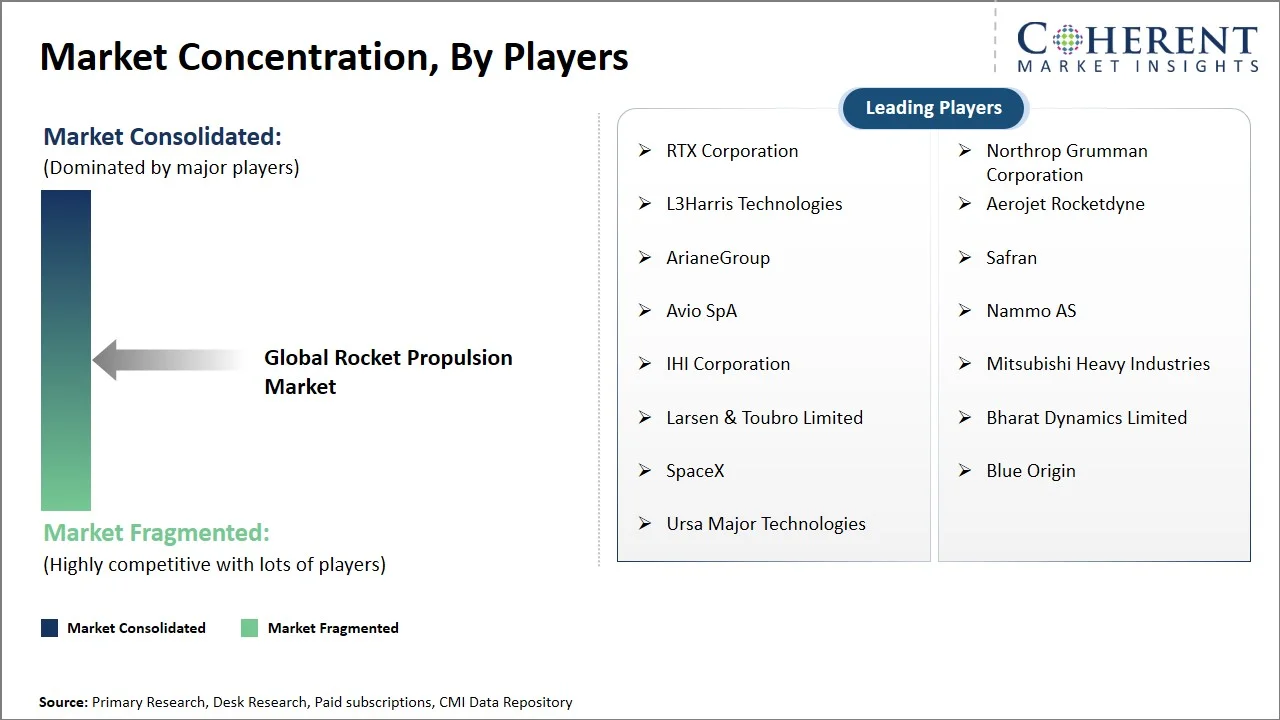
Key Developments
- On September 18, 2024, Ursa Major, a leading privately funded rocket propulsion company, was chosen by the U.S. Department of Defense (DoD) as one of the inaugural recipients of investments from the Office of Strategic Capital (OSC) to strengthen critical supply chain technologies needed for national security. The OSC announced a USD 12.5 million joint investment contract in partnership with the U.S. Navy to mature Ursa Major’s Lynx solid rocket motor (SRM) manufacturing process.
- On July 8, 2024, Aerojet Rocketdyne, a L3Harris Technologies company, completed modernizing the four flight-proven RS-25 engines that will help power NASA’s Space Launch System (SLS) rocket on the Artemis IV mission.
Competitive Landscape
The rocket propulsion market is competitive not just in traditional engine production but also in reusable liquid propulsion, sophisticated solid rocket motors, cryogenic engines, methane-fueled propulsion and hypersonic technology. SpaceX has developed a technological lead based on its high-volume production of Raptor engines and rapid iterative testing, while RTX, Northrop Grumman and L3Harris have strong positions in strategic missile propulsion and solid rocket motor manufacturing. Next generation cryogenic propulsion systems are strengthening Europe’s and Japan’s independent launch capabilities via ArianeGroup, Safran, Mitsubishi Heavy Industries, IHI Corporation and Avio, while new space companies such as Ursa Major Technologies, Agnikul Cosmos and Skyroot Aerospace are differentiating through additive manufacturing, fast engine development cycles and cost-effective propulsion platforms for small launch vehicles.
Market Report Scope
Rocket Propulsion Market Report Coverage
| Report Coverage | Details | ||
|---|---|---|---|
| Base Year: | 2025 | Market Size in 2026: | USD 10 Bn |
| Historical Data for: | 2020 To 2024 | Forecast Period: | 2026 To 2033 |
| Forecast Period 2026 to 2033 CAGR: | 6.60% | 2033 Value Projection: | USD 17 Bn |
| Geographies covered: |
| ||
| Segments covered: |
| ||
| Companies covered: | RTX Corporation, Northrop Grumman Corporation, L3Harris Technologies, Aerojet Rocketdyne, ArianeGroup, Safran, Avio SpA, Nammo AS, IHI Corporation, Mitsubishi Heavy Industries, Larsen & Toubro Limited, Bharat Dynamics Limited, SpaceX, Blue Origin, and Ursa Major Technologies | ||
| Growth Drivers: |
| ||
| Restraints & Challenges: |
| ||
Analyst Opinion (Expert Opinion)
- The rocket propulsion market is expected to become increasingly defined by technological maturity, production scalability, and propulsion system reliability rather than solely by thrust performance. Competitive positioning is likely to shift toward manufacturers capable of combining reusable engine architectures, automated production processes, and rapid qualification methodologies with consistent operational success. The industry is also anticipated to witness greater specialization, with companies focusing on distinct propulsion niches such as heavy-lift launch systems, hypersonic applications, upper-stage engines, and in-space propulsion. Over the long term, leadership is expected to be determined by the ability to consistently deliver certified, cost-efficient, and mission-specific propulsion systems that meet the evolving technical requirements of both commercial and government space programs.
- Propulsion certification is emerging as a stronger competitive differentiator than peak engine performance, as customers increasingly prioritize proven flight heritage, rapid reusability, and manufacturing consistency when awarding long-term contracts. The value for corporations of combining additive manufacturing, digital twin-based engine validation and automated production with established operational reliability is increasing. Thus, reliable delivery of certified propulsion systems at larger rates of production, while supporting ever more frequent commercial and government launch missions, will likely define future market leadership.
- The future of the rocket propulsion industry will be driven by the commercialization of reusable heavy-lift launch vehicles, the rapid growth of satellite constellation deployment, and the increasing demand for high-frequency launch operations. Engine development is expected to focus on extending operational life, integrating autonomous diagnostic capabilities, utilizing lightweight high-temperature materials, and adopting modular propulsion architectures to simplify maintenance and certification processes.At the same time, increased investments in lunar exploration, space logistics, orbital servicing, hypersonic defense platforms and commercial space stations are expected to diversify propulsion requirements, prompting manufacturers to develop specialized engine platforms optimized for distinct mission profiles, rather than relying on a single propulsion architecture.
Speak to the analyst
Want personalized insights?
Take the findings above to one of our principal consultants, or have the report rebuilt around the segments, geographies and competitors you actually track.
Market Segmentation
- Propulsion Type Insights (Revenue, USD Billion, 2021 - 2033)
- Liquid Propulsion
- Solid Propulsion
- Hybrid Propulsion
- Electric Propulsion
- Air Breathing Propulsion
- Platform Type Insights (Revenue, USD Billion, 2021 - 2033)
- Launch Vehicles
- Missiles
- Spacecraft
- Satellites
- Tactical Rockets
- Propellant Type Insights (Revenue, USD Billion, 2021 - 2033)
- Liquid Oxygen
- Liquid Hydrogen
- RP 1 Kerosene
- Solid Propellants
- Methane
- Hypergolic Propellants
- End User Insights (Revenue, USD Billion, 2021 - 2033)
- Government and Defense
- Commercial Space Companies
- Research Organizations
- Regional Insights (Revenue, USD Billion, 2021 - 2033)
- North America
- U.S.
- Canada
- Latin America
- Brazil
- Argentina
- Mexico
- Rest of Latin America
- Europe
- Germany
- U.K.
- Spain
- France
- Italy
- Russia
- Rest of Europe
- Asia Pacific
- China
- India
- Japan
- Australia
- South Korea
- ASEAN
- Rest of Asia Pacific
- Middle East
- GCC Countries
- Israel
- Rest of Middle East
- Africa
- South Africa
- North Africa
- Central Africa
- North America
- Key Players Insights
- RTX Corporation
- Northrop Grumman Corporation
- L3Harris Technologies
- Aerojet Rocketdyne
- ArianeGroup
- Safran
- Avio SpA
- Nammo AS
- IHI Corporation
- Mitsubishi Heavy Industries
- Larsen & Toubro Limited
- Bharat Dynamics Limited
- SpaceX
- Blue Origin
- Ursa Major Technologies
Sources
Primary Research Interviews
- Rocket Propulsion System Manufacturers
- Space Launch Service Providers
- Defense & Aerospace Procurement Officials
- Satellite Operators & Space Agencies
- Aviation Week Intelligence Network (AWIN)
Magazines
- Aviation Week & Space Technology
- Aerospace America
- Space News Magazine
- Propulsion & Power Today
Journals
- Journal of Propulsion and Power (AIAA)
- Acta Astronautica (Elsevier)
- Aerospace Science and Technology (Elsevier)
Associations
- American Institute of Aeronautics and Astronautics (AIAA)
- International Astronautical Federation (IAF)
- Aerospace Industries Association (AIA)
- Space Foundation
Public Domain Sources
- NASA Official Website (nasa.gov)
- European Space Agency Official Website (esa.int)
- U.S. Department of Defense Publications (defense.gov)
- Federal Aviation Administration (FAA) – Office of Commercial Space Transportation
Proprietary Elements
- CMI Data Analytics Tool
- Proprietary CMI Existing Repository of Information for the Last 10 Years
Get access to 250+ pages report
Every segment, forecast, competitor profile and data table behind the analysis above — available for instant download.
- ESOMAR Member
- ISO 9001:2015 Certified
- D-U-N-S Registered
- GDPR & CCPA Compliant
Missing comfort of reading report in your local language? Find your preferred language:
Transform your Strategy with Exclusive Trending Reports
Frequently Asked Questions
The global rocket propulsion market is expected to stand at USD 10 Bn in 2026 and is expected to reach USD 17 Bn by 2033.
The CAGR of the global rocket propulsion market is projected to be 6.6% from 2026 to 2033.
Rising investments in space exploration programs and growing defense modernization and missile procurement are the major factors driving the growth of the global rocket propulsion market.
High research and development costs and complex regulatory and export control requirements are the major factors hampering the growth of the global rocket propulsion market.
In terms of propulsion type, the liquid propulsion segment is estimated to dominate the market revenue share in 2026.
They are accelerating innovation through reusable launch systems and high-frequency launch operations.
Cryogenic propulsion provides high efficiency and greater payload capability for orbital and deep-space missions.