

Global Semiconductor Modeling Market Size and Forecast – 2026 To 2033
The global semiconductor modeling market is expected to grow from USD 1.15 Bn in 2026 to USD 2.40 Bn by 2033, registering a compound annual growth rate (CAGR) of 10% from 2026 to 2033. The global semiconductor modeling market is increasingly being pushed by developments in AI integrated edge computing. On March 10, 2026, Synaptics Incorporated announced the launch of SYN765x, an AI-native wireless solution that redefines Edge intelligence. (Source: Synaptics Incorporated)
Key Takeaways of the Global Semiconductor Modeling Market
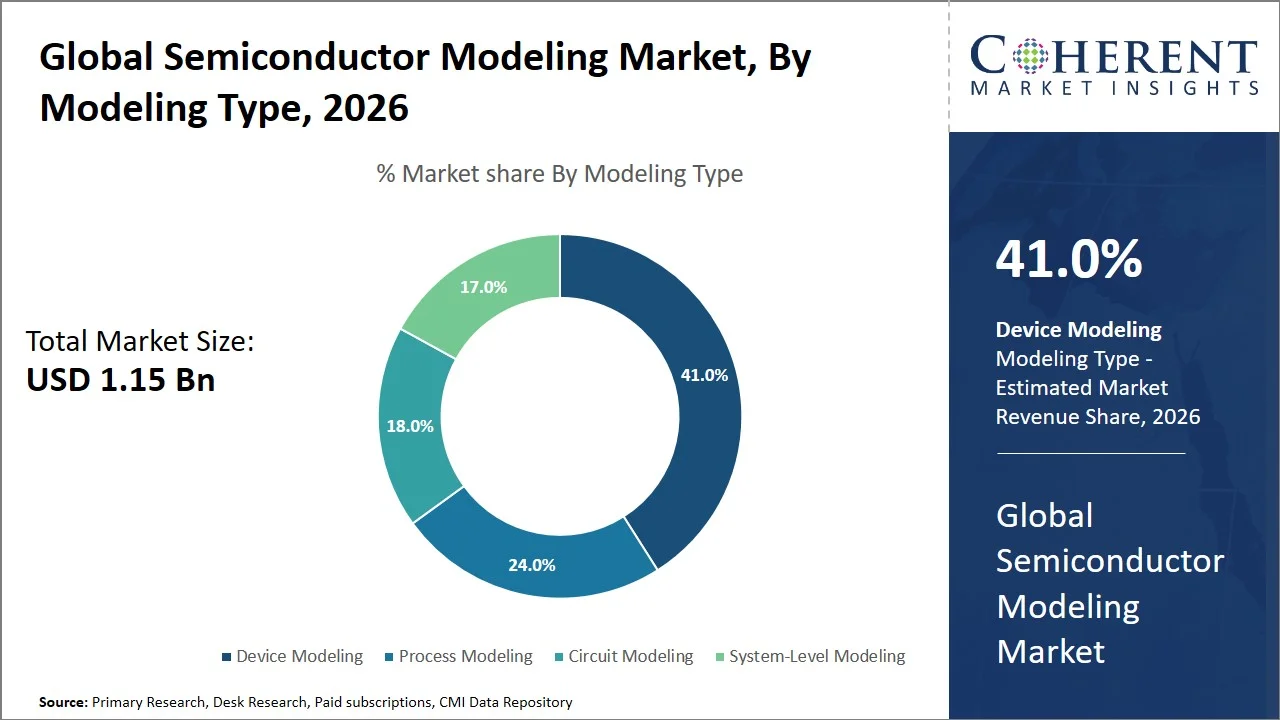
- The device modeling segment is expected to account for 41.0 % of the global semiconductor modeling market share in 2026. The integration of new technologies for device modeling is a key factor driving the segment growth. For instance, on April 23, 2026, Synopsys expanded its collaboration with Atomera, specifically to advance GaN transistor device modeling using Sentaurus TCAD, focusing on radio frequency and power devices.
- The semiconductor foundries segment is estimated to capture 33.0 % of the market share in 2026. Increasing need for high-purity semiconductor manufacturing is a major factor driving the segment growth. On November 25, 2025, FUJIFILM Corporation announced the successful completion of a new building for development and evaluation at the Shizuoka Factory of FUJIFILM Electronic Materials Co., Ltd. (FFEM), the core company that leads Fujifilm’s semiconductor materials business. (Source: FUJIFILM)
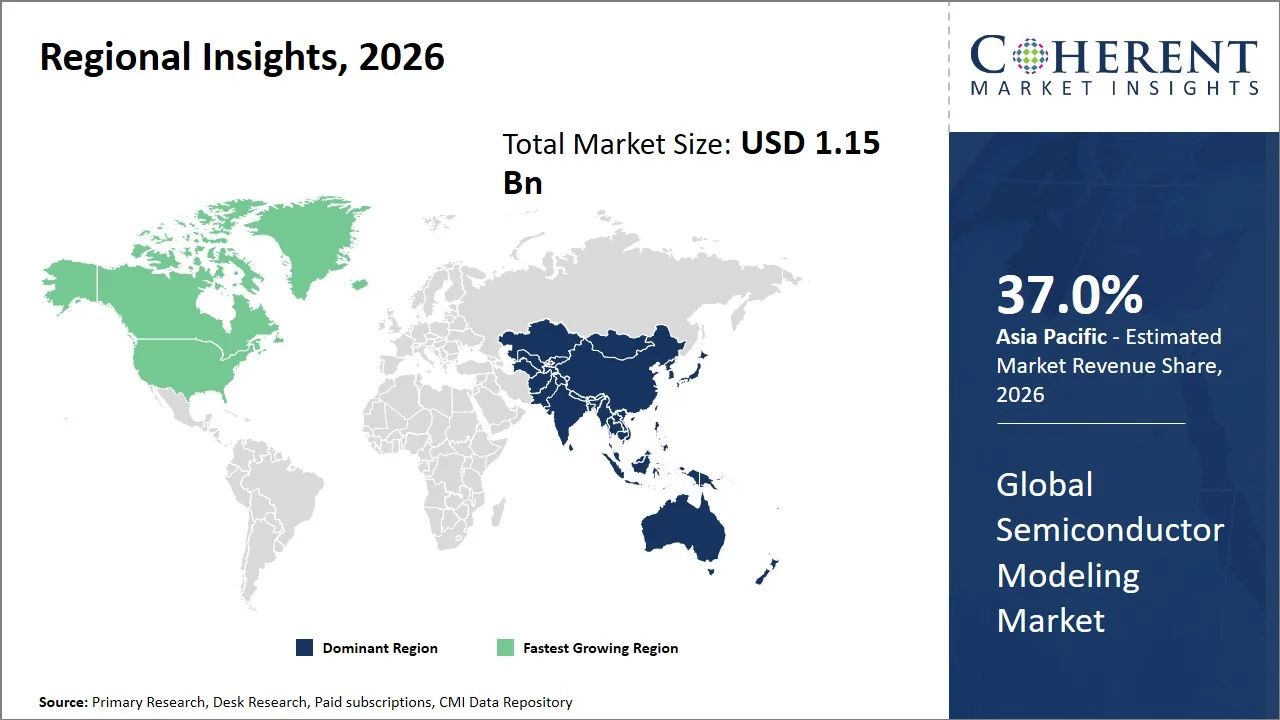
- Asia Pacific is expected to dominate the semiconductor modeling market in 2026 with a market share of 37.0 %. Strong investments in the region by key market players is a major factor driving the market growth in Asia Pacific. On December 1, 2025, Merck inaugurated its semiconductor solutions mega site in Kaohsiung, Taiwan. (Source: Merck)
- North America is expected to account for 26.0 % share in 2026 and is projected to record the fastest growth over the forecast period. The expansion of product portfolios by major market players and continuous innovation is leading the North America semiconductor modeling market growth. On October 2, 2025, FUJIFILM Electronic Materials U.S.A., Inc announced that it will participate in SEMICON West 2025, an international exhibition of semiconductor manufacturing equipment and materials, where it will highlight its broad portfolio of advanced high-purity semiconductor materials. (Source: FUJIFILM)
- AI-Driven Design and Simulation Automation: Artificial intelligence is being incorporated into semiconductor modeling tools to automate circuit optimization, predict device behavior, and decrease simulation time; companies like Synopsys and Cadence are embedding AI engines capable of automatically optimizing chip layouts and improving yield prediction accuracy.
- Rise of Advanced Packaging and 3D Integrated Circuit Modeling: Semiconductor modeling is quickly migrating to cloud infrastructure, enabling engineers to run large-scale simulations without expensive on-premise hardware; cloud-enabled platforms from Ansys and Siemens EDA, for example, enable distributed simulation for complex automotive and industrial chip designs across global engineering teams.
Segmental Insights
Why Does Device Modeling Segment Dominate the Global Semiconductor Modeling Market?
The device modeling segment is expected to account for 41.0% of the global semiconductor modeling market share in 2026, because the direct prediction of electrical, thermal and physical behavior of transistors and integrated devices on nanoscale scales are critical for performance and reliability prior to manufacture. Modern chips designed by companies like Intel and Samsung Electronics are moving towards advanced architectures like FinFET and GAA transistors, hence device-level simulation is becoming more and more important to correctly model leakage, switching speed and power consumption. Device-level simulation is the most common and irreplaceable segment in semiconductor design workflows. On October 15, 2025, Synopsys upgraded its Sentaurus TCAD device simulation platform by integrating AI-based calibration and optimization, enabling faster transistor-level modeling for advanced nodes like 2nm and 3nm. (Source: Synopsys)
- Current Industry Events of 2026
- Market Size Estimation
- Regional Breakdown
- Competitive Landscape
- Customer Intelligence
- Segmental Analysis
- Pricing Analysis
- Key Market Drivers, Challenges & Future Trends
- Customized Insights Section
Why are Semiconductor Foundries the Most Crucial End User?
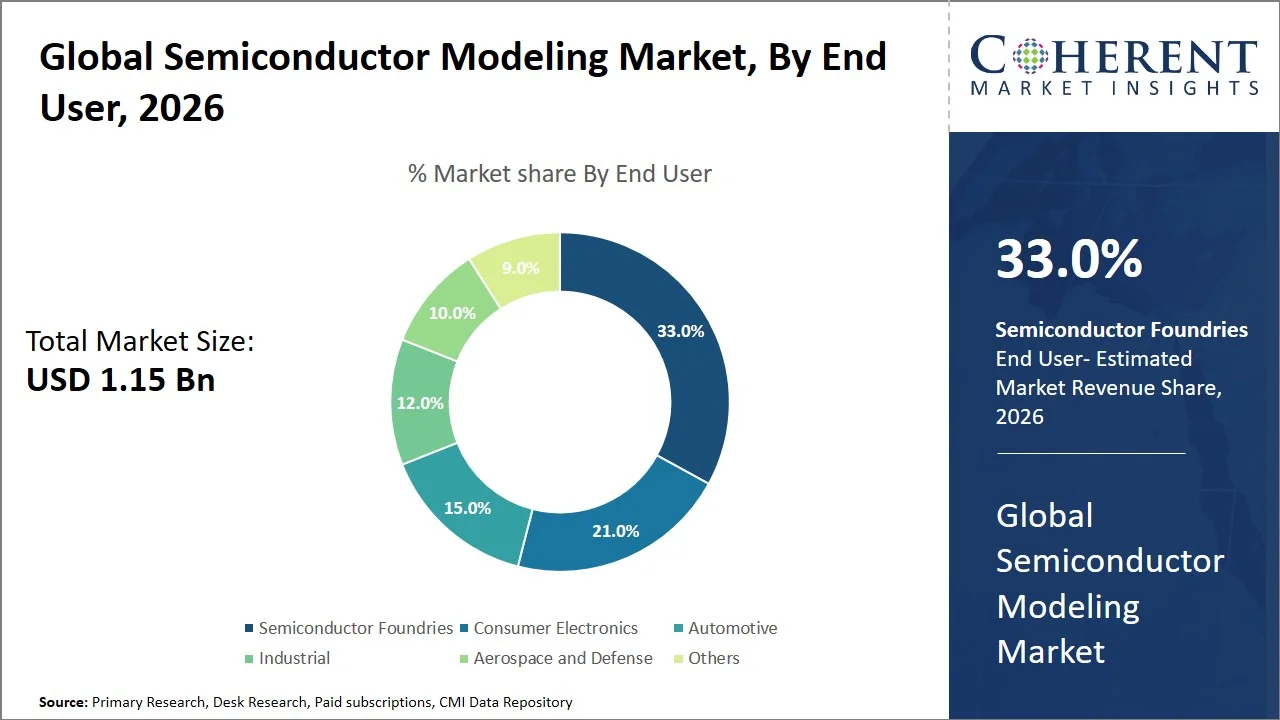
The semiconductor foundries segment is expected to account for 33.0% of the global semiconductor modeling market share in 2026. The most important end users are the semiconductor foundries, because they work at the manufacturing level, where the design accuracy has a direct impact on the yield and the production cost, and thus even a small inaccuracy in the modeling of a chip can cause huge losses of wafers. For companies like TSMC, extensive process and device modeling is critical to optimize lithography, transistor behavior and process variability at the most advanced nodes, including 3nm and down. This makes simulation tools critical to achieving high yield and consistent performance in mass production.
On October 28, 2025, GlobalFoundries announced plans to expand its manufacturing capabilities at its Dresden, Germany site. The new manufacturing capacity will focus on GF’s highly differentiated technologies, all essential for meeting Europe’s chip demand for automotive, internet of things (IoT), defense and critical infrastructure applications. (Source: GlobalFoundries)
Currents Events and their Impact
Current Events | Description and its Impact |
U.S. CHIPS and Science Act |
|
European Chips Act |
|
(Source: Congress, European Commission)
Global Semiconductor Modeling Market Dynamics
Market Drivers
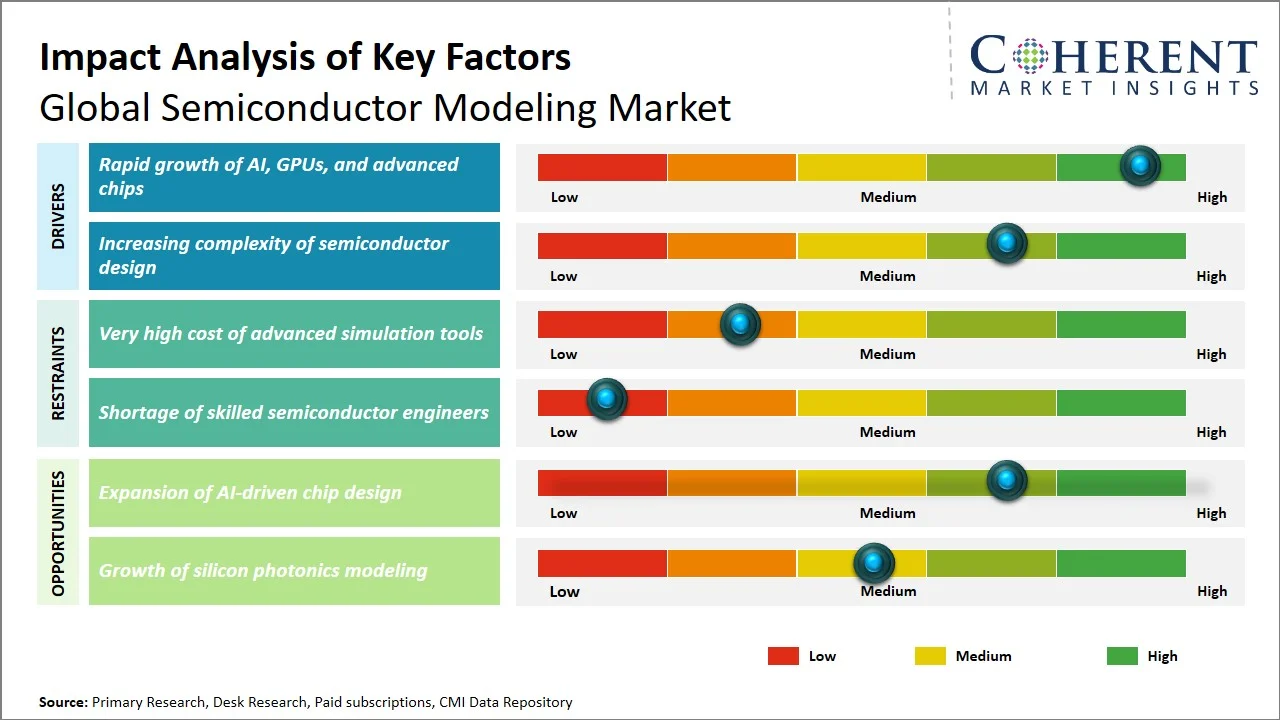
- Rapid growth of AI, GPUs, and advanced chips: The rapid rise of AI, graphics processing unit and advanced chips are increasing the demand for high-performance semiconductor modeling tools, as modern AI workloads require increasingly complex architectures with large parallel processing capabilities. Companies such as NVIDIA and Advanced Micro Devices are always working on the next generation of GPUs and AI accelerators and require accurate simulation of power, thermal behavior, and transistor-level performance before they are manufactured. A substantial part of this rise is also due to the large-scale AI training models and data centers, which are very sensitive to even tiny inefficiencies in chip design, impacting energy and cost, making improved modeling vital to optimize performance and efficiency. On June 12, 2025, AMD launched the AMD Instinct MI350 Series, delivering up to 4x generation-on-generation AI compute improvement and up to 35x leap in inferencing performance. (Source: AMD)
- Increasing complexity of semiconductor design: Semiconductor design complexity is growing as a result of continual scaling to advanced nodes such as 5nm, 3nm and beyond, combined with the adoption of heterogeneous integration, chiplets and 3D IC architectures. Modern chips integrate many functional blocks such as CPUs, GPUs, AI accelerators, memory and RF components onto a single system, and so electrical, thermal and physical interactions are significantly more complex to forecast. This complexity requires designers to rely heavily on sophisticated semiconductor modeling tools to accurately simulate performance, power density and reliability before fabrication, since even a small design error at these scales can lead to significant yield losses and costly redesign cycles.
Emerging Trends
- Shift Toward Cloud-Based Electronic Design Automation and Modeling Platforms: Semiconductor modeling is quickly migrating to the cloud infrastructure, enabling engineers to conduct large-scale simulations without the need for expensive on-premise hardware. For instance, cloud-enabled platforms from Ansys and Siemens EDA offer distributed simulation for complex chip designs across global engineering teams.
- Expansion of Silicon Photonics and Wide-Bandgap Material Modeling: Silicon photonics, silicon carbide (SiC), and gallium nitride (GaN) are increasingly used in high-performance and power electronics, requiring modeling tools to address new physics domains. Infineon is using cutting-edge simulation to optimize SiC-based EV power devices for higher efficiency and heat resistance.
Regional Insights
Why is Asia Pacific a Strong Market for Semiconductor Modeling?
Asia Pacific is expected to account for a market share of 37.0% in 2026. Asia Pacific semiconductor modeling market is strongly anchored by Taiwan, South Korea, Japan, and India, where real-world deployment is tightly linked to advanced fabrication ecosystems; for example, TSMC in Taiwan uses TCAD and lithography process modeling extensively for 3nm and 2nm-class nodes, while Samsung Electronics in South Korea applies device-level simulation for GAA transistor structures and HBM memory scaling, and Japan’s Renesas Electronics leverages circuit modeling for automotive microcontrollers used in EV control systems. On December 30, 2025, TSMC announced that its 2 nm process has entered mass production, extending its lead in the world’s most advanced semiconductor manufacturing. TSMC also developed low-resistance redistribution layer (RDL) and super high-performance metal-insulator-metal (MiM) capacitors to further boost performance. (Source: TSMC)
Why Does North America Semiconductor Modeling Market Exhibit High Growth?
North America is projected to account for 26.0% of the global semiconductor modeling market and expected to register the fastest growth. North America is dominated by EDA leadership and advanced chip design workflows, where companies like Synopsys and Cadence Design Systems provide simulation platforms used by NVIDIA for AI GPU architecture modeling and by Intel for process-node scaling and advanced packaging technologies such as Foveros and EMIB, particularly for high-performance computing and AI accelerators.
On October 9, 2025, Intel revealed the architectural details for the company’s next generation client processor Intel Core Ultra series 3 (code-named Panther Lake), which is expected to begin shipping later this year. Panther Lake is the company’s first product built on Intel 18A, the most advanced semiconductor process ever developed and manufactured in the U.S. (Source: Intel)
Why is China Emerging as a Major Hub in the Semiconductor Modeling Market?
China semiconductor modeling market is expanding rapidly as companies reduce dependency on foreign EDA tools, with firms like SMIC and Huawei’s HiSilicon using domestic and partially licensed simulation platforms to support chip development for 7nm-class processes; for example, Huawei applies modeling tools in Kirin AI chip development and 5G baseband processor optimization.
Is U.S. the Next Growth Engine for the Semiconductor Modeling Market?
In the U.S., semiconductor modeling is strongly driven by AI, defense, and HPC applications, where NVIDIA uses simulation-driven design for GPU architecture scaling and AMD relies on modeling for chiplet-based CPU/GPU integration; additionally, defense contractors use Multiphysics modeling for radiation-hardened semiconductor systems in aerospace and military applications.
Germany Semiconductor Modeling Market Analysis and Trends
Germany semiconductor modeling activities are concentrated in automotive and industrial applications, where companies like Infineon Technologies use device modeling to design power semiconductors such as silicon carbide (SiC) and gallium nitride (GaN) components for EV powertrains and industrial automation systems, especially for efficiency and thermal reliability optimization.
Taiwan plays a central role in advanced semiconductor modeling through TSMC’s leadership in global foundry services, where extensive use of process simulation and lithography modeling supports mass production of 3nm chips for clients like Apple and AMD; for example, TSMC applies EUV process modeling to improve yield and reduce variability in advanced logic nodes.
How is the Expansion of AI-Driven Chip Design Creating New Growth Opportunities in the Global Semiconductor Modeling Market?
The rise of AI-driven chip design is opening up new avenues for growth in the semiconductor modeling sector, as it dramatically speeds up, improves the accuracy of, and automates the processes of simulation and optimization. “AI algorithms can predict the behavior of chips, optimize layouts and find design flaws much earlier in the development cycle, reducing the need for time-consuming manual simulations. This sets a new standard for sophisticated modeling tools that combine machine learning and data-driven approaches, accelerating the development of sophisticated AI, HPC and edge computing devices.
On Aril 22, 2026, Synopsys, Inc. announced major advances in silicon-proven IP, AI-powered EDA flows, and system-level enablement across TSMC's most advanced processes and packaging technology nodes, including the TSMC 3nm and 2nm families, as well as A16 with Super Power Rail and A14. (Source: Synopsys)
Global Semiconductor Modeling Market - Semiconductor Fab Investments
Company | Country | Investment / Expansion | Scale & Capacity |
TSMC | Taiwan / U.S. / Japan / Germany | ~USD 38–56B annual CapEx (2025–2026), plus multi-fab global expansion | 8–9 new fabs + advanced packaging lines (CoWoS) |
Samsung Electronics | South Korea / U.S. | ~USD 44B Texas fab program (delayed phases) | Large-scale advanced node fab (3nm–2nm roadmap) |
Intel | U.S. | Multi-hundred-billion expansion under CHIPS Act support | New fabs: Fab 52 & Fab 62 + Ohio mega-fab |
ASML (India ecosystem support) | India | Equipment + ecosystem support for USD 11B Tata fab | 50,000 wafers/month planned fab |
Market Players, Key Development, and Competitive Intelligence
Key Developments
- On December 1, 2025, NVIDIA and Synopsys, Inc announced an expanded, strategic partnership to revolutionize design and engineering across industries. This expanded partnership will integrate the strengths of NVIDIA’s AI and accelerated computing with Synopsys’ market-leading engineering solutions to deliver capabilities enabling R&D teams to design, simulate and verify intelligent products with greater precision, speed and at lower cost.
- On July 17, 2025, Synopsys announced the completion of its acquisition of Ansys. The transaction, which was announced on January 16, 2024, combines leaders in silicon design, IP and simulation and analysis to enable customers to rapidly innovate AI-powered products.
Competitive Landscape
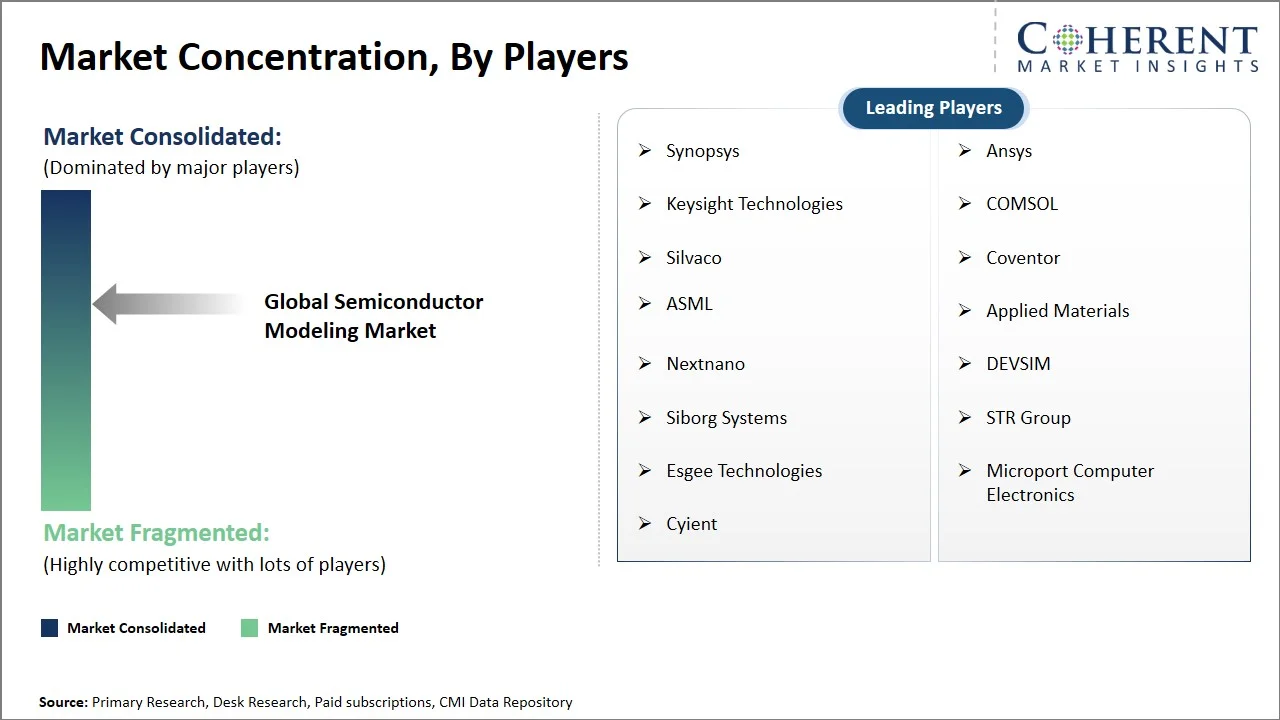
The global semiconductor modeling industry is heavily consolidated and technology-driven, with a few major EDA and simulation software providers dominating the space. Market leaders such as Synopsys, Ansys, Cadence Design Systems and Keysight Technologies are constantly innovating TCAD, SPICE and Multiphysics simulation technologies. These firms compete on the basis of simulation accuracy, speed of processing, integration with sophisticated chip design routines and support for upcoming technologies such as AI chips and advanced process nodes. Smaller niche firms and startups also play their part by providing specialized solutions, frequently targeting specific modeling domains, such as photonics, materials or device-level simulation.
Market Report Scope
Semiconductor Modeling Market Report Coverage
| Report Coverage | Details | ||
|---|---|---|---|
| Base Year: | 2025 | Market Size in 2026: | USD 1.15 Bn |
| Historical Data for: | 2020 To 2024 | Forecast Period: | 2026 To 2033 |
| Forecast Period 2026 to 2033 CAGR: | 10% | 2033 Value Projection: | USD 2.40 Bn |
| Geographies covered: |
| ||
| Segments covered: |
| ||
| Companies covered: | Synopsys, Ansys, Keysight Technologies, COMSOL, Silvaco, Coventor, ASML, Applied Materials, Nextnano, DEVSIM, Siborg Systems, STR Group, Esgee Technologies, Microport Computer Electronics, and Cyient | ||
| Growth Drivers: |
| ||
| Restraints & Challenges: |
| ||
Analyst Opinion (Expert Opinion)
- The global semiconductor modeling market is a critical enabler of next-generation chip innovation, especially as semiconductor geometries continue to shrink and design complexity increases exponentially. Without advanced modeling tools, achieving reliable performance in AI, automotive, and high-performance computing chips would be extremely difficult and cost-intensive. It can be also observed a strong shift toward AI-assisted design automation and cloud-based simulation platforms, which are expected to democratize access to high-end modeling capabilities and accelerate design cycles across the industry.
- The future of the semiconductor modeling market is expected to be strongly growth-oriented, driven by advancements in AI-powered design tools, digital twin technologies, and emerging semiconductor materials like silicon carbide and gallium nitride. Increasing demand from electric vehicles, 6G networks, and edge computing devices will further expand the need for highly accurate and fast simulation platforms. Additionally, integration of cloud computing and machine learning is likely to make semiconductor modeling more scalable and efficient, positioning it as a core pillar of future chip development ecosystems.
Speak to the analyst
Want personalized insights?
Take the findings above to one of our principal consultants, or have the report rebuilt around the segments, geographies and competitors you actually track.
Market Segmentation
- Modeling Type Insights (Revenue, USD Billion, 2021 - 2033)
- Device Modeling
- Process Modeling
- Circuit Modeling
- System-Level Modeling
- End User Insights (Revenue, USD Billion, 2021 - 2033)
- Semiconductor Foundries
- Consumer Electronics
- Automotive
- Industrial
- Aerospace and Defense
- Others
- Regional Insights (Revenue, USD Billion, 2021 - 2033)
- North America
- U.S.
- Canada
- Latin America
- Brazil
- Argentina
- Mexico
- Rest of Latin America
- Europe
- Germany
- U.K.
- Spain
- France
- Italy
- Russia
- Rest of Europe
- Asia Pacific
- China
- India
- Japan
- Australia
- South Korea
- ASEAN
- Rest of Asia Pacific
- Middle East
- GCC Countries
- Israel
- Rest of Middle East
- Africa
- South Africa
- North Africa
- Central Africa
- North America
- Key Players Insights
- Synopsys
- Ansys
- Keysight Technologies
- COMSOL
- Silvaco
- Coventor
- ASML
- Applied Materials
- Nextnano
- DEVSIM
- Siborg Systems
- STR Group
- Esgee Technologies
- Microport Computer Electronics
- Cyient
Sources
Primary Research Interviews
- Semiconductor Design Engineers at leading chip manufacturers
- EDA Software Solution Providers and Technology Directors
- TCAD Modeling Specialists and Process Engineers
- Foundry Operations Managers and Process Development Teams
Magazines
- Semiconductor Engineering Magazine
- EE Times Magazine
- Electronic Design Magazine
- Chip Design MagazineEDN Magazine
Journals
- IEEE Transactions on Computer-Aided Design
- Journal of Semiconductor Technology and Science
- Solid-State Electronics Journal
Associations
- Semiconductor Industry Association (SIA)
- Electronic System Design Alliance (ESD Alliance)
- SEMI (Semiconductor Equipment and Materials International)
- IEEE Computer Society
Public Domain Sources
- U.S. Patent and Trademark Office (USPTO) Semiconductor Patents
- National Institute of Standards and Technology (NIST) Publications
- Department of Energy Semiconductor Research Reports
- European Commission Digital Single Market Reports
Proprietary Elements
- CMI Data Analytics Tool
- Proprietary CMI Existing Repository of information for last 10 years
Get access to 250+ pages report
Every segment, forecast, competitor profile and data table behind the analysis above — available for instant download.
- ESOMAR Member
- ISO 9001:2015 Certified
- D-U-N-S Registered
- GDPR & CCPA Compliant
Missing comfort of reading report in your local language? Find your preferred language:
Transform your Strategy with Exclusive Trending Reports
Frequently Asked Questions
The global semiconductor modeling market is expected to stand at USD 1.15 Bn in 2026 and is expected to reach USD 2.40 Bn by 2033.
The CAGR of the global semiconductor modeling market is projected to be 10% from 2026 to 2033.
Rapid growth of AI, GPUs, and advanced chips and increasing complexity of semiconductor design are the major factors driving the growth of the global semiconductor modeling market.
Very high cost of advanced simulation tools and shortage of skilled semiconductor engineers are the major factors hampering the growth of the global semiconductor modeling market.
In terms of modeling type, device modeling segment is estimated to dominate the market revenue share in 2026.
It reduces the need for repeated physical prototyping, lowering development expenses.
Cloud platforms make semiconductor simulation more scalable and accessible.