

GaN Semiconductor Market Analysis & Forecast: 2026 to 2033
GaN semiconductor market is estimated to be valued at USD 4.84 Bn in 2026 and is expected to reach USD 14.71 Bn in 2033, exhibiting a compound annual growth rate (CAGR) of 17.2% from 2026 to 2033.
Key Takeaways
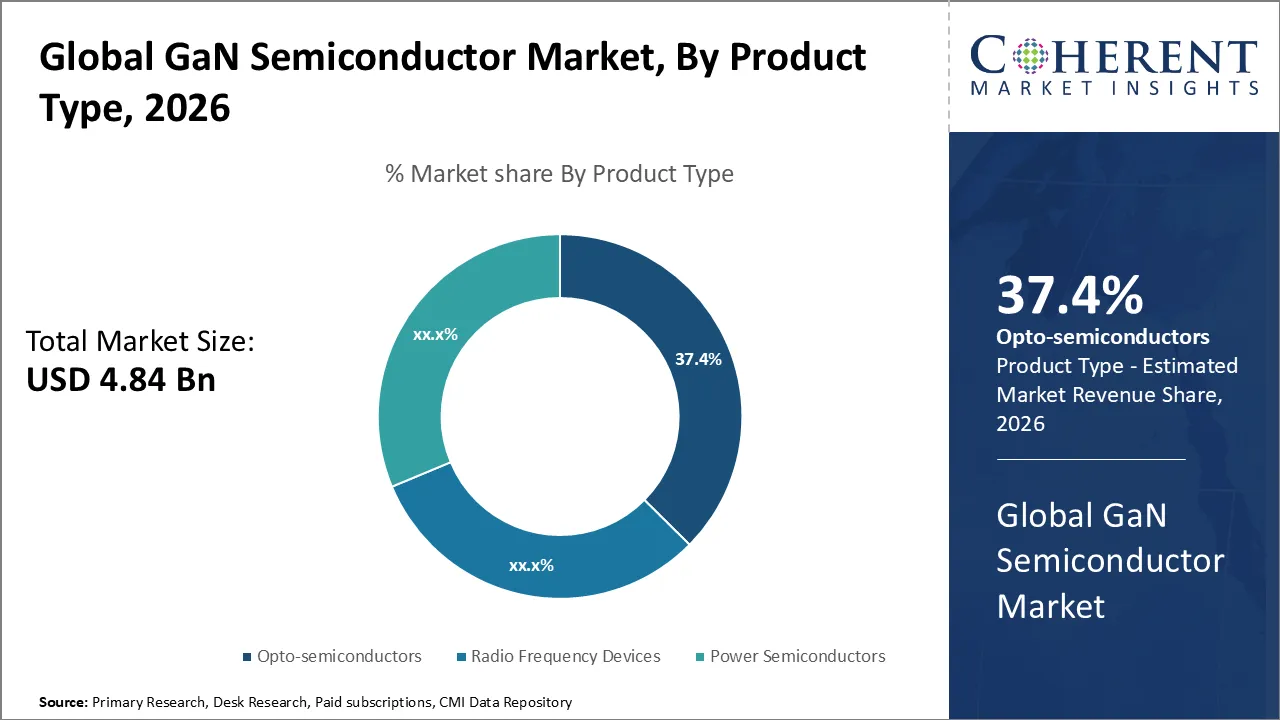
- Based on Product Type, the Opto-semiconductors segment is expected to lead the market with 37.42% share in 2026.
- Based on Component, the Transistor segment is expected to hold 32.87% share in 2026.
- Based on Wafer Size, the 6-inch wafer segment is projected to account for 47.19% share in 2026.
- Based on End-use Industry, the Consumer Electronic segment is projected to capture 33.54% share in 2026.
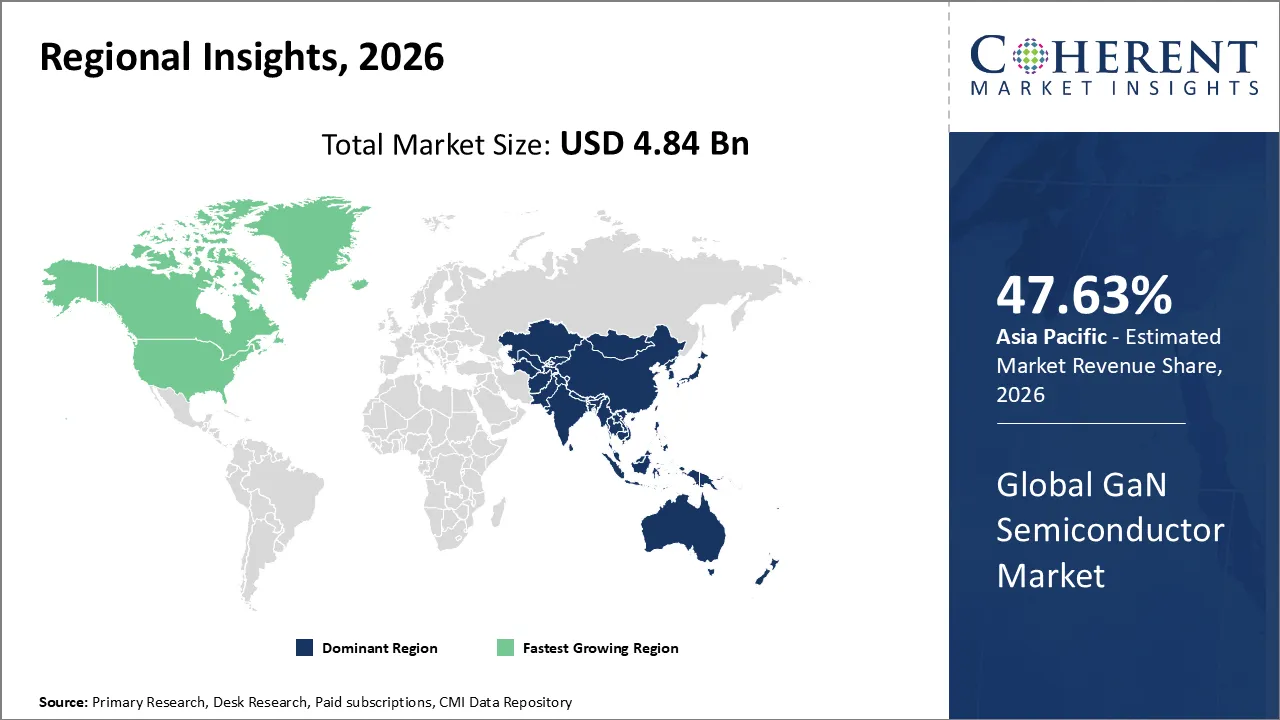
- Based on Region, Asia Pacific is set to lead the GaN semiconductor market with 47.63% share in 2026. While, North America is anticipated to be the fastest growing region.
Market Overview
GaN stands for Gallium nitride and it is very hard, mechanically stable wide band gap semiconductor. GaN is used to manufacture semiconductor power devices as well as radio frequency (RF) components, and light emitting display (LEDs). GaN exhibits its capability to replace the other old slow silicon (Si) technology for silicon semiconductors in power conversion, RF (radio frequency), and analog applications.
Current Events and Its Impacts on the GaN Semiconductor Market
Current Event | Description and its Impact |
Electric Vehicle Market Acceleration and Energy Transition |
|
5G/6G Infrastructure Rollout and Telecommunications Evolution |
|
What Are the Key End Users and Unmet Needs in the GaN Semiconductor Market?
- Automotive (EVs): Efficient chargers, inverters, and fast charging systems; need lower cost and reliability.
- Telecom/5G: RF amplifiers and base stations; need scalability and cost efficiency.
- Renewable Energy: Solar/wind inverters; need long‑term reliability and reduced system cost.
- Datacenters/AI: Power supplies; need efficiency, sustainability, and mass production.
- Consumer Electronics: Fast chargers; need affordability and mainstream availability.
- Current Industry Events of 2026
- Market Size Estimation
- Regional Breakdown
- Competitive Landscape
- Customer Intelligence
- Segmental Analysis
- Pricing Analysis
- Key Market Drivers, Challenges & Future Trends
- Customized Insights Section
Segmental Insights
Will opto‑semiconductors lead driven By LED, laser, and optical communication demand?
In terms of product type, the Opto-semiconductors segment is expected to hold 37.4% share in 2026, due to widespread LED lighting, laser diodes, and optical communication systems. Their efficiency, durability, and role in displays and sensors make them indispensable. Asia-Pacific drives demand, especially in consumer electronics and telecom, ensuring opto-semiconductors remain the largest product type in 2026.
Will transistors, especially GaN HEMTs, lead as the backbone of RF, power, and EV applications?
In terms of component, the transistors segment is expected to lead the market with 32.87% share in 2026, particularly high electron mobility transistors (HEMTs), lead the component segment. They enable superior switching speeds, high-frequency performance, and energy efficiency. Critical for RF devices, power amplifiers, and EV chargers, transistors form the backbone of GaN applications, ensuring their dominance in 2026.
For instance, in October 2025, Infineon's release of its automotive-qualified CoolGaN transistor family shows how GaN semiconductors have improved. The new 100 V devices are meant to help automotive systems and high-quality Class D audio amplifiers convert power more efficiently. This new feature makes Infineon the leader in GaN transistor technology even stronger by focusing on reliability, energy efficiency, and next-generation electronics uses.
Will 6‑inch wafers remain the mainstream choice despite larger wafers reducing costs and 8‑inch emerging?
In terms of wafer size, the 6-inch wafers segment is projected to account for 47.19% share in 2026, balancing cost efficiency and higher yield. Larger wafers reduce production costs per device and support scaling for mass adoption. While 8-inch wafers are emerging, 6-inch remains the mainstream choice in 2026, driving manufacturing consistency and commercial viability.
For instance, in July 2025, Singapore's A-STAR opened NSTIC (GaN), a national research center with 6-inch GaN-on-SiC and 8-inch GaN-on-Si wafer fabrication lines. The facility supports advanced RF and communication applications, such as 5G/6G, satellites, and radars. It strengthens Singapore's semiconductor ecosystem by prototyping, commercializing, and working with other companies on next-generation GaN technologies.
Will consumer electronics drive GaN adoption through 5G, smartphones, data centers, and high‑performance computing?
In terms of end-user industry, the consumer electronic segment is projected to capture 33.54% share in 2026, fueled by 5G rollout, smartphones, data centers, and high-performance computing. GaN devices deliver faster charging, efficient power conversion, and compact designs. Their integration into everyday electronics ensures this segment leads in 2026, with automotive and defense following closely.
For instance, in December 2025, Innoscience and Onsemi worked together to make more GaN power devices using 200 mm GaN-on-silicon technology. Target markets include consumer electronics like fast chargers, adapters, audio systems, and light e-mobility, as well as automotive, industrial, telecom, and AI data centers. This allows for efficient, compact, and scalable next-generation semiconductor solutions to be used all over the world.
Regional Insights
Asia Pacific GaN Semiconductor Market Analysis & Trends
Asia Pacific is dominating the GaN semiconductor market with 47.63% share in 2026, through booming consumer electronics, rapid 5G rollout, and widespread LED adoption. Strong manufacturing hubs in China, Japan, and South Korea ensure supply, while electric vehicle growth and industrial power needs accelerate usage, making the region the largest and most influential market.
For instance, in April 2025, Navitas Semiconductor and GigaDevice annouced they are working together to combine GaNFast power ICs with advanced microcontrollers. The alliance, which started in China and works with the U.S., focuses on AI data centers, electric vehicles, solar energy, and energy storage. This integration speeds up the global adoption of GaN, making next-generation power electronics markets more efficient, easier to control, and more scalable.
North America GaN Semiconductor Market Analysis & Trends
North America is expected to exhibit the fastest growth of the market, due to defense and aerospace reliance on high-frequency transistors, rapid 5G infrastructure expansion, and electric vehicle adoption. Strong R&D ecosystems, government investments, and advanced manufacturing drive growth, positioning the region as the fastest-growing market with diverse high-tech applications across industries.
For instance, in December 2025, Onsemi and GlobalFoundries worked together in the US to make the next generation of GaN power devices. The partnership aims at the automotive, industrial, and datacenter markets by combining onsemi's knowledge with GF's manufacturing. This U.S.-based program boosts semiconductor production in the U.S. while making it easier for countries around the world to use efficient, high-frequency GaN technology for advanced power applications.
GaN Semiconductor Market Outlook Country-Wise
China GaN Semiconductor Market Trends
China’s GaN semiconductor demand is driven by rapid 5G rollout, electric vehicle expansion, renewable energy adoption, and consumer electronics growth. Strong government support, local manufacturing capacity, and aggressive patent activity make China a global leader. GaN enables efficient, compact power systems, fueling nationwide innovation and industrial competitiveness.
For instance, in February 2025, In China, Changan Automobile released the first commercial GaN-based on-board charger that uses Navitas GaNFast ICs. With this new technology, EV charging can be done faster and more efficiently with small, light systems. The milestone shows that GaN is moving from consumer electronics to automotive applications, which will help more people around the world use advanced power semiconductors for sustainable mobility solutions.
The U.S. GaN Semiconductor Market Trends
The U.S. GaN semiconductor market is driven by electric vehicle growth, renewable energy adoption, 5G infrastructure, and defense applications. Strong government support for domestic manufacturing, partnerships with global leaders, and demand for efficient, compact power systems fuel GaN adoption, enhancing energy efficiency, supply chain resilience, and technological competitiveness.
For instance, in April 2025, In the U.S., Polar Semiconductor worked with Japan's Renesas to license GaN-on-Si technology and make advanced GaN devices on 200mm wafers in the U.S. This partnership makes U.S. semiconductor manufacturing stronger, makes the supply chain more resilient, and speeds up the use of GaN in automotive, industrial, renewable energy, and datacenter applications around the world with solutions that can grow and work well.
Market Report Scope
GaN Semiconductor Market Report Coverage
| Report Coverage | Details | ||
|---|---|---|---|
| Base Year: | 2025 | Market Size in 2026: | USD 4.84 Bn |
| Historical Data for: | 2020 To 2024 | Forecast Period: | 2026 To 2033 |
| Forecast Period 2026 to 2033 CAGR: | 17.2% | 2033 Value Projection: | USD 14.71 Bn |
| Geographies covered: |
| ||
| Segments covered: |
| ||
| Companies covered: | Cree, Inc., Efficient Power Conversion Corporation, Fujitsu Ltd, GaN Systems, Infineon Technologies AG, NexGen Power Systems, NXP Semiconductor, Qorvo, Inc., Texas Instruments Incorporated, Toshiba Corporation, and others. | ||
| Growth Drivers: |
| ||
| Restraints & Challenges: |
| ||
GaN Semiconductor Market Driver
Energy Efficiency & Performance
GaN semiconductors deliver superior energy efficiency and performance compared to silicon, enabling higher power density, faster switching speeds, and reduced energy losses. These advantages drive adoption in EVs, 5G, datacenters, and renewable energy systems. As demand grows, the GaN Semiconductor Market size expands globally, reflecting its transformative impact on power electronics.
GaN Semiconductor Market Trends
Shift to Larger Wafers (200mm → 300mm)
Scaling GaN manufacturing from 200mm to 300mm wafers reduces production costs and enables higher output, supporting mass adoption. This transition is vital for automotive and datacenter applications requiring efficient, compact power solutions. As scalability improves, GaN Semiconductor Market demand rises globally, driving growth across EVs, telecom, renewables, and advanced electronics.
Automotive Integration
Automotive integration is a key catalyst for GaN Semiconductor Market growth, as electric vehicles demand efficient on‑board chargers, compact inverters, and ultra‑fast charging systems. GaN technology delivers higher power density and reduced energy losses, prompting OEMs to partner with GaN suppliers, enhancing performance, sustainability, and accelerating adoption across global automotive applications.
Analyst Opinion (Expert Opinions)
The gallium nitride (GaN) semiconductor market value is becoming a more important part of the larger semiconductor industry because of clear trends in adoption and a wide range of end-use applications. GaN's built-in benefits, like a wide bandgap, fast switching speeds, and better thermal performance, are making it more common in power electronics, radio-frequency (RF) systems, and optoelectronic parts. Power transistors and RF amplifiers made up most of the GaN shipments around the world in the last few years. Discrete transistor designs were especially popular among unit volumes.
Device output data show that GaN transistors and RF components have been used in many industries, including telecommunications, consumer power adapters, and automotive electronics. GaN's ability to make small, high-efficiency power modules has led to its use in advanced power conversion equipment and electronics that charge quickly. The telecom infrastructure sector, particularly 5G base stations and defense radar, has significantly propelled the adoption of RF GaN due to its high-frequency performance and enhanced thermal stability.
Insights from the region show that Asia-Pacific and North America are the main markets. This is due to they have strong manufacturing bases and are investing in technology. In Asia-Pacific, the demand for electronics in electric vehicles and semiconductor production ecosystems help GaN grow. Defense, telecom, and data center applications that value GaN's performance envelope help boost demand in North America.
Participants in the industry say that high substrate costs and low yields are still problems that need to be solved. But ongoing improvements in wafer scaling and substrate technology, like GaN-on-silicon solutions, are slowly lowering costs and opening up new markets.
Speak to the analyst
Want personalized insights?
Take the findings above to one of our principal consultants, or have the report rebuilt around the segments, geographies and competitors you actually track.
Recent Developments
- In December 2025, VisIC Technologies, which is based in Israel, got $26 million to help develop GaN semiconductors for electric vehicles. The money helps with high-efficiency power conversion, which lowers energy use and makes EVs work better. This milestone makes GaN's role in electrifying cars even stronger, with effects felt around the world in the growing electric vehicle markets in Europe, Asia, and North America.
- In October 2025, Imec, which is based in Belgium, started a 300mm GaN program with GlobalFoundries, AIXTRON, KLA, Synopsys, and Veeco as partners. The goal of the project is to make low- and high-voltage GaN power devices for CPUs, GPUs, electric vehicles, solar power, telecom, and data centers. Scaling up to 300mm wafers lowers costs, making it possible to make next-generation power electronics that are efficient and small.
- In March 2025, STMicroelectronics and Innoscience teamed up to make GaN power devices better in Europe and China. ST can use Innoscience's factories in China, and Innoscience can use ST's factories in Europe. This partnership makes global supply chains stronger and speeds up the use of GaN in consumer electronics, data centers, cars, and renewable energy. It also makes it possible to create efficient, small, next-generation semiconductor solutions.
Market Segmentation
- By Product Type
- Radio Frequency Devices
- Opto-semiconductors
- Power Semiconductors
- By Component
- Transistors
- Diodes
- Rectifiers
- Power ICs
- Others
- By Wafer Size
- 2-inch
- 4-inch
- 6-inch
- 8-inch
- By End-Use Industry
- Automotive
- Consumer Electronics
- Defense & Aerospace
- Healthcare
- Information & Communication Technology
- Industrial & Power
- Others
- By Region
- North America
- U.S.
- Canada
- Latin America
- Brazil
- Argentina
- Mexico
- Rest of Latin America
- Europe
- Germany
- U.K.
- Spain
- France
- Italy
- Benelux
- Denmark
- Norway
- Sweden
- Russia
- Rest of Europe
- Asia Pacific
- China
- Taiwan
- India
- Japan
- South Korea
- Indonesia
- Malaysia
- Philippines
- Singapore
- Australia
- Rest of Asia Pacific
- Middle East & Africa
- Bahrain
- Kuwait
- Oman
- Qatar
- Saudi Arabia
- United Arab Emirates
- Israel
- South Africa
- North Africa
- Central Africa
- Rest of MEA
- North America
- Key Players in the global GaN Semiconductor market
- Cree, Inc.
- Efficient Power Conversion Corporation
- Fujitsu Ltd
- GaN Systems
- Infineon Technologies AG
- NexGen Power Systems
- NXP Semiconductor
- Qorvo, Inc.
- Texas Instruments Incorporated
- Toshiba Corporation
- Others
Sources
Primary Research Interviews
- GaN Semiconductor Device Manufacturers
- Power Electronics OEMs & Module Integrators
- Automotive EV Powertrain Engineers
- Telecom & Data Center Infrastructure Providers
- RF & Microwave Component Designers
- Others
Databases
- Bloomberg Terminal
- Thomson Reuters Eikon
- S&P Global Market Intelligence
- IHS Markit
- FactSet
- Others
Magazines
- Power Electronics News
- Semiconductor Engineering Magazine
- EE Times
- Electronics Weekly
- Others
Journals
- IEEE Transactions on Power Electronics
- IEEE Transactions on Electron Devices
- Journal of Compound Semiconductors
- Applied Physics Letters
- Others
Newspapers
- Financial Times
- The Wall Street Journal
- Reuters
- Bloomberg News
- Others
Associations
- IEEE Power Electronics Society (PELS)
- Semiconductor Industry Association (SIA)
- JEDEC Solid State Technology Association
- European Power Electronics and Drives Association (EPE)
- Others
Public Domain Sources
- U.S. Department of Energy (DOE) – Power Electronics Program
- National Institute of Standards and Technology (NIST)
- European Commission – Digital & Semiconductor Initiatives
- World Semiconductor Trade Statistics (WSTS)
- U.S. International Trade Commission (USITC)
- Others
Proprietary Elements
- CMI Data Analytics Tool
- Proprietary CMI Existing Repository of Information for the Last 8 Years
Get access to 250+ pages report
Every segment, forecast, competitor profile and data table behind the analysis above — available for instant download.
- ESOMAR Member
- ISO 9001:2015 Certified
- D-U-N-S Registered
- GDPR & CCPA Compliant
Missing comfort of reading report in your local language? Find your preferred language:
Transform your Strategy with Exclusive Trending Reports
Frequently Asked Questions
The GaN semiconductor market is estimated to be valued at USD 4.84 Bn in 2026, and is expected to reach USD 14.71 Bn by 2033.
The CAGR of the GaN semiconductor market is projected to be 17.2% from 2026 to 2033.
Energy Efficiency & Performance and Electric Vehicles (EVs)are expected to drive the market growth.
The Opto-semiconductors is the leading product type segment in the market.
High production cost is expected to hinder the global GaN semiconductor market over the forecast period.
The major players operating in the market include Cree, Inc., Efficient Power Conversion Corporation, Fujitsu Ltd, GaN Systems, Infineon Technologies AG, NexGen Power Systems, NXP Semiconductor, Qorvo, Inc., Texas Instruments Incorporated, Toshiba Corporation, and others.