

Electronic Toll Collection Market Size and Trends – 2026-2033
The Global Electronic Toll Collection Market is estimated to be valued at USD 11.60 Bn in 2026 and is expected to reach USD 19.17 Bn by 2033, exhibiting a compound annual growth rate (CAGR) of 7.4% from 2026 to 2033.
Key Takeaways of the Electronic Toll Collection Market
- Based on Type, the transponder/tag-based tolling systems segment is expected to lead the market, holding an estimated share of 70.3% in 2026 due to their convenience and cost-effectiveness.
- Based on Offering, the Hardware segment is estimated to lead the market with a share of 62.6% in 2026, driven by ongoing infrastructure upgrades in the electronic tolling industry.
- Based on Technology, the Radio Frequency Identification (RFID) segment is projected to dominate with a share of 58.2% in 2026, driven by its widespread adoption and reliability.
- North America is expected to dominate the market with an estimated of share of 41.7% in 2026. While, Asia Pacific, holding a share of 30.3% in 2026, is projected to show the fastest growth over the forecast period.
Market Overview
The increasing demand for efficient toll collection solutions, coupled with stringent government regulations promoting digital payment methods, is expected to significantly drive the adoption of electronic toll collection systems worldwide. The electronic toll collection market is witnessing rapid innovation, with AI integration and Dedicated Short-Range Communications (DSRC) technologies gaining prominence. Developing economies in the Asia Pacific region, particularly India and China, are leading the adoption of new toll collection methods, while North America remains dominant due to its mature infrastructure and ongoing technological advancements.
Current Events and Its Impact
Current Event | Description and its Impact |
Global Digital Payment Infrastructure Evolution |
|
Asia-Pacific Infrastructure Development Programs |
|
Technology & innovation in the Electronic Toll Collection Market
The Electronic Toll Collection (ETC) market is undergoing rapid transformation driven by technological innovation. Key advancements include the deployment of RFID, DSRC (Dedicated Short-Range Communication), and GNSS (Global Navigation Satellite Systems), each offering distinct benefits in terms of accuracy, scalability, and cost-efficiency. These technologies enable seamless toll transactions, reducing congestion and enhancing road safety. Integration with Intelligent Transportation Systems (ITS) allows for real-time traffic monitoring and dynamic toll pricing, optimizing road usage. Artificial intelligence and machine learning are increasingly being used to predict traffic patterns, detect anomalies, and personalize tolling experiences. Additionally, blockchain is emerging as a secure solution for toll payment verification and data transparency. These innovations are not only improving operational efficiency but also paving the way for future-ready infrastructure that supports autonomous vehicles and smart mobility ecosystems.
- Current Industry Events of 2026
- Market Size Estimation
- Regional Breakdown
- Competitive Landscape
- Customer Intelligence
- Segmental Analysis
- Pricing Analysis
- Key Market Drivers, Challenges & Future Trends
- Customized Insights Section
Segmental Insights
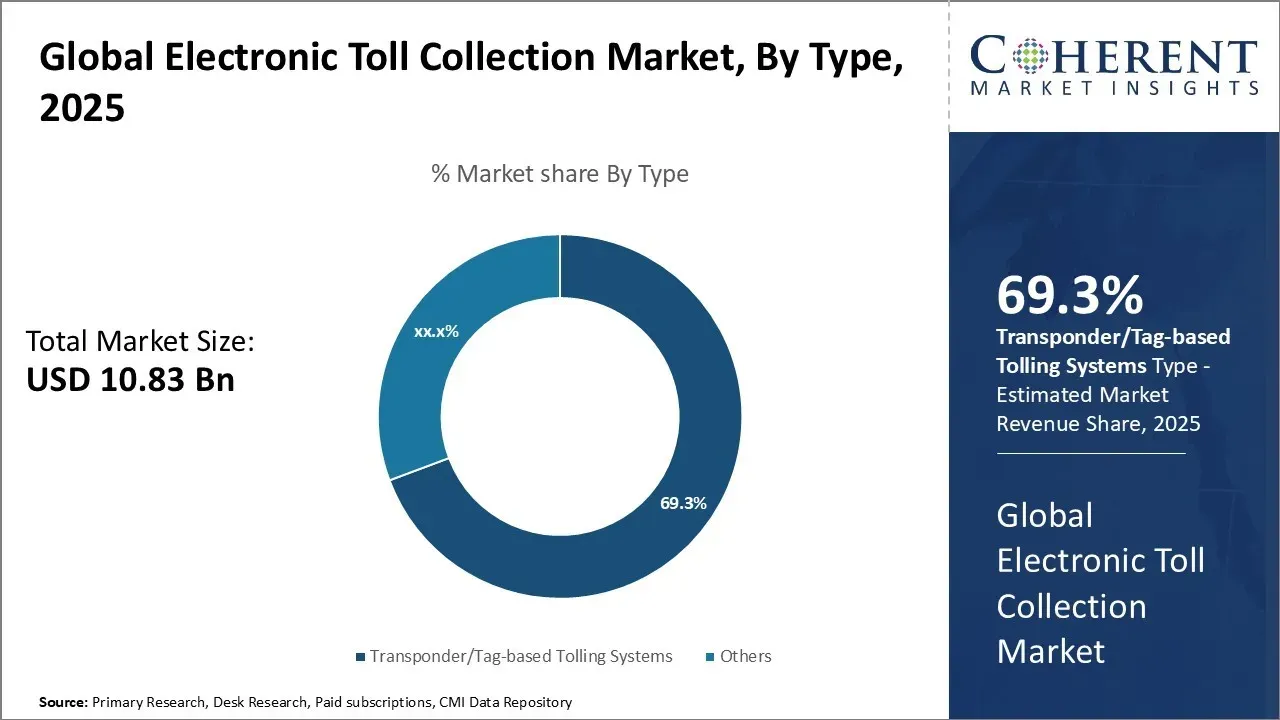
Electronic Toll Collection Market Insights, By Type - Convenience and Cost-Effectiveness Drive Demand for Transponder-Based Tolling Systems
In terms of type, the transponder/tag-based tolling systems segment are projected to dominate the market in 2026 with a 70.3% share due to their convenience and cost-effectiveness. These systems allow drivers to pass through toll plazas without stopping, enhancing traffic flow and reducing emissions. Mounted on windshields, transponders automatically charge users, improving road safety and user experience. For toll operators, they lower operational costs by eliminating the need for toll collectors and extensive infrastructure. Transponders also enable higher vehicle throughput, boosting toll revenue and project viability. Their ease-of-use drives consumer adoption, prompting regions to shift toward fully electronic tolling. Prepaid accounts offer volume-based discounts, making them more economical for frequent commuters. Authorities often provide transponders at subsidized rates to encourage uptake. Overall, the blend of user convenience, environmental benefits, and financial efficiency has positioned transponder systems as the preferred global solution for electronic toll collection.
For instance, in June 2025, the Indian government introduced a FASTag-based annual toll pass system to streamline highway travel and reduce congestion. Designed for frequent commuters, the pass allows unlimited toll access for a fixed yearly fee, eliminating the need for multiple transactions. The initiative aims to enhance digital toll collection, improve traffic flow, and offer cost-effective convenience to regular highway users. This is further proliferating the electronic toll collection market demand.
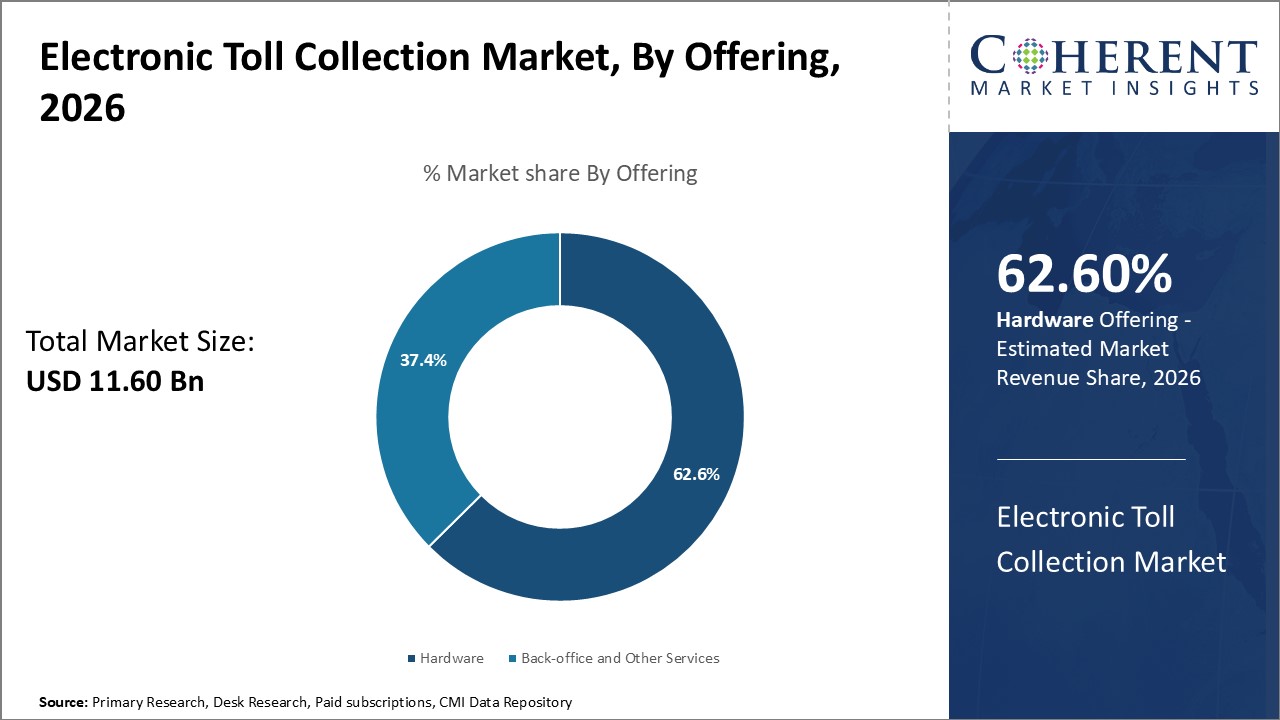
Electronic Toll Collection Market Insights, By Offering - Hardware Dominates Due to Ongoing Infrastructure Upgrade Requirements
In terms of offering, the hardware segment is projected to hold a 62.6% market share in 2026, driven by ongoing infrastructure upgrades in the electronic tolling industry. Establishing a functional ETC network requires various hardware components like transponders, RFID readers, smart cameras, servers, and Violation Enforcement Systems. As toll agencies expand or convert routes to all-electronic systems, demand for these components remains strong. Projects such as hybrid lane additions or interoperability setups between operators involve significant investment in new hardware. Additionally, tolling hardware faces regular replacement due to wear, tech advancements, and configuration changes—transponders, for instance, typically last only 3–5 years.
For instance, in April 2025, the Indian government clarified that satellite-based tolling will not be implemented from May 1. Instead, a pilot program featuring a hybrid toll collection system using Automatic Number Plate Recognition (ANPR) and FASTag will be launched. The system will rely on high-resolution cameras installed at toll plazas and strategic highway points to capture vehicle plates and verify FASTag data. This approach aims to enhance tolling accuracy, reduce congestion, and improve compliance through real-time monitoring.
Electronic Toll Collection Market Insights, By Technology - Growing Popularity of RFID Driving Adoption of Electronic Toll Collection
In terms of technology, the Radio Frequency Identification (RFID) is projected to lead tolling technologies with a 58.2% market share in 2026, driven by its widespread adoption and reliability. RFID enables contactless tolling via electromagnetic fields and transponders, allowing seamless transactions at highway speeds. For over two decades, toll authorities have standardized RFID across vast infrastructure networks, creating a large base of compatible vehicles and users who value its simplicity. This entrenched ecosystem discourages short-term migration to newer protocols due to high switchover costs. Instead, governments and operators focus on enhancing existing RFID systems with upgraded variants that offer improved features while maintaining compatibility. The combination of operational efficiency, user familiarity, and scalable infrastructure ensures RFID’s continued dominance in the Electronic Toll Collection (ETC) market.
For instance, in September 2025, Bangladesh launched electronic toll collection on the Padma Bridge, marking a major step toward smart infrastructure. The system uses RFID-enabled FASTag technology to automate toll payments, allowing vehicles to pass without stopping. Installed scanners read tags instantly, reducing congestion and improving travel efficiency. This move supports the country’s push for digital transformation in transport and public services.
Regional Insights
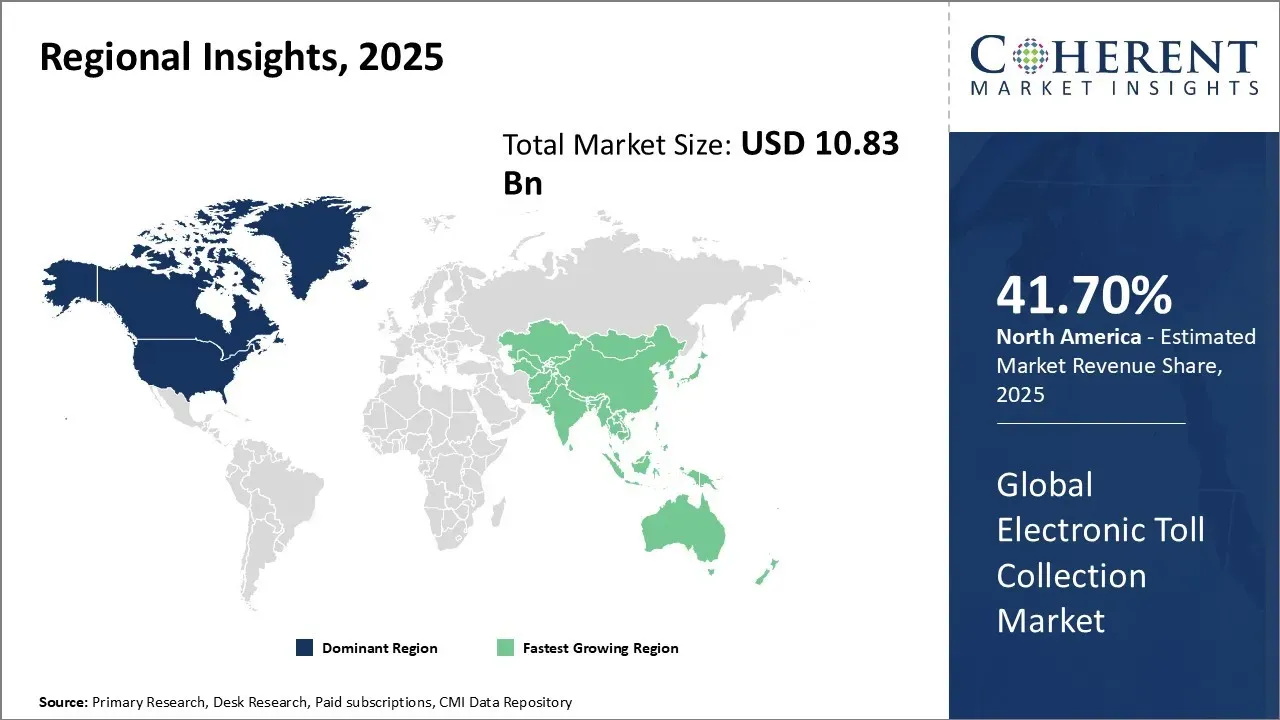
North America Electronic Toll Collection Market Trends
North America is expected to dominate the electronic toll collection market, holding a share of 41.7% in 2026. This lead can be attributed to factors such as a well-established road infrastructure and the widespread adoption of advanced technologies. Governments in the region have implemented favorable policies to promote the development and usage of electronic toll collection systems for improved traffic management and commuter experience. Major players like Xerox Corporation and Kapsch TrafficCom have established a strong presence in North America contributing to the region's leadership.
For instance, in August 2026, the North Carolina Turnpike Authority launched the world’s first production-ready Vehicle-to-Everything (V2X) toll collection system. This cutting-edge technology enables toll payments through direct communication between vehicles and roadside units, eliminating the need for traditional gantries or RFID tags. The V2X system enhances accuracy, reduces congestion, and supports real-time data exchange for smarter mobility.
Asia Pacific Electronic Toll Collection Market Trends
The Asia Pacific region, holding a share of 30.3% in 2026, is expected to exhibit the fastest growth in the electronic toll collection market, driven by the rising demand from emerging economies like India and China. These countries are investing heavily in developing their highway networks, and leveraging electronic tolling for efficient toll collection. Local companies have also intensified their efforts to provide innovative solutions.
For instance, in July 2026, Da Nang International Airport implemented an Electronic Toll Collection (ETC) system from July 1, streamlining vehicle access and reducing congestion. The system uses RFID technology to enable automatic toll payments, allowing vehicles to pass through entry and exit points without stopping. This move supports Vietnam’s push toward smart transportation and enhances operational efficiency at one of the country’s busiest airports.
Electronic Toll Collection Market Outlook for Key Countries
U.S. Electronic Toll Collection Market Trends
The U.S. electronic toll collection market is led by established organizations focusing on augmenting their product portfolios through continuous innovation and strategic partnerships. Major companies like TransCore and Conduent are actively investing in next-generation tolling solutions, leveraging AI and IoT for efficiency. Local players also play a crucial role in maintaining service standards and integrating new technologies for smoother toll operations.
For instance, in January 2026, TransCore launched a next-generation tolling system on the West Virginia Turnpike, enhancing speed and accuracy in toll collection. The new technology integrates RFID readers, high-resolution cameras, and real-time vehicle recognition to streamline traffic flow and reduce delays. This marks a major upgrade in intelligent transportation infrastructure, supporting safer and more efficient highway travel.
China Electronic Toll Collection Market Trends
China is experiencing substantial investment from both international and domestic brands seeking to capitalize on infrastructure expansion projects. Government-backed initiatives, such as smart city developments and high-speed expressways, provide significant opportunities for ETC providers. Domestic giants like Huawei and ZTE are pioneering advancements in tolling technology, ensuring seamless integration with China's expanding transportation networks.
For instance, in April 2026, JHC Technology unveiled its latest Electronic Toll Collection (ETC) solutions at the Intel Exhibition, highlighting advancements in smart mobility. The company demonstrated RFID-enabled tolling systems designed to streamline traffic flow and reduce congestion across highways and urban corridors. With real-time data integration and cloud-based management, JHC’s ETC platforms promise enhanced accuracy, faster transactions, and scalable deployment for future-ready infrastructure.
India Electronic Toll Collection Market Trends
India continues to lead in ambitious projects incorporating advanced technologies for seamless mobility. The introduction of FASTag by the National Highway Authority of India (NHAI) has revolutionized electronic toll collection, reduced congestion and improving efficiency. Local companies, including Paytm Payments Bank and Reliance Jio, are increasingly entering the market, fostering healthy competition and accelerating adoption across highways and urban areas.
For instance, in January 2026, FASTag will be mandatory for all vehicles in Maharashtra, as per the state cabinet’s directive. The move aims to streamline toll collection, reduce fuel consumption, and cut emissions. FASTag enables seamless toll payments via RFID technology, eliminating the need to stop at toll plazas.
Japan Electronic Toll Collection Market Trends
Japan electronic toll collection market is driven by technological pioneers advancing solutions for efficient transportation networks. With a strong emphasis on automation and precision, Japanese firms like Mitsubishi Heavy Industries and Panasonic are at the forefront of ETC innovation. Local governments are also collaborating with private entities to enhance road safety and reduce travel time through AI-powered tolling systems.
Market Players, Key Development, and Competitive Intelligence
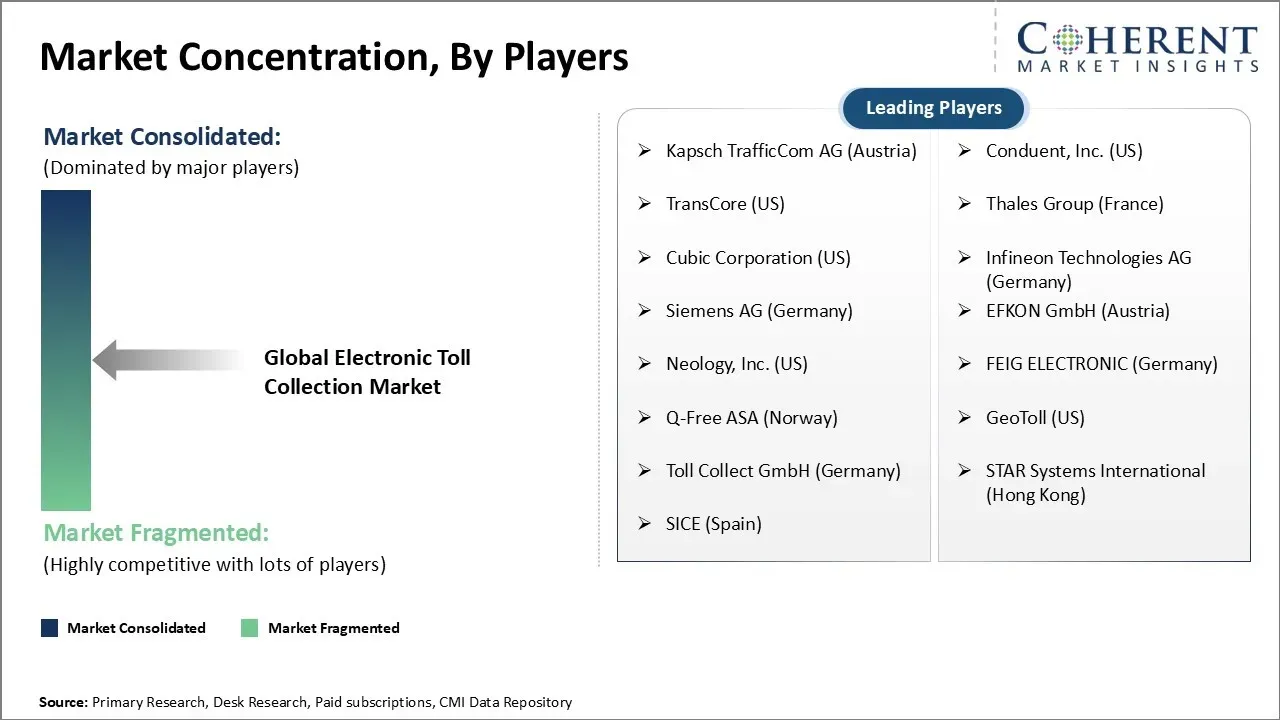
Key Developments
- In January 2024, Neology, a global technology company, secured a contract with Humber Bridge Board (U.K.), a highway authority, to provide end-to-end tolling solutions.
- In December 2023, Kapsch TrafficCom AG, a transportation solutions provider, won a contract to provide customer service for the e-TOLL system at 100 distribution points across Poland
Market Report Scope
Electronic Toll Collection Market Report Coverage
| Report Coverage | Details | ||
|---|---|---|---|
| Base Year: | 2025 | Market Size in 2026: | USD 11.60 Bn |
| Historical Data for: | 2020 To 2024 | Forecast Period: | 2026 To 2033 |
| Forecast Period 2026 to 2033 CAGR: | 7.4% | 2033 Value Projection: | USD 19.17 Bn |
| Geographies covered: |
| ||
| Segments covered: |
| ||
| Companies covered: | Kapsch TrafficCom AG (Austria), Conduent, Inc. (US), TransCore (US), Thales Group (France), Cubic Corporation (US), Infineon Technologies AG (Germany), Siemens AG (Germany), EFKON GmbH (Austria), Neology, Inc. (US), FEIG ELECTRONIC (Germany), Q-Free ASA (Norway), GeoToll (US), Toll Collect GmbH (Germany), STAR Systems International (Hong Kong), and SICE (Spain) | ||
| Growth Drivers: |
| ||
| Restraints & Challenges: |
| ||
Market Dynamics
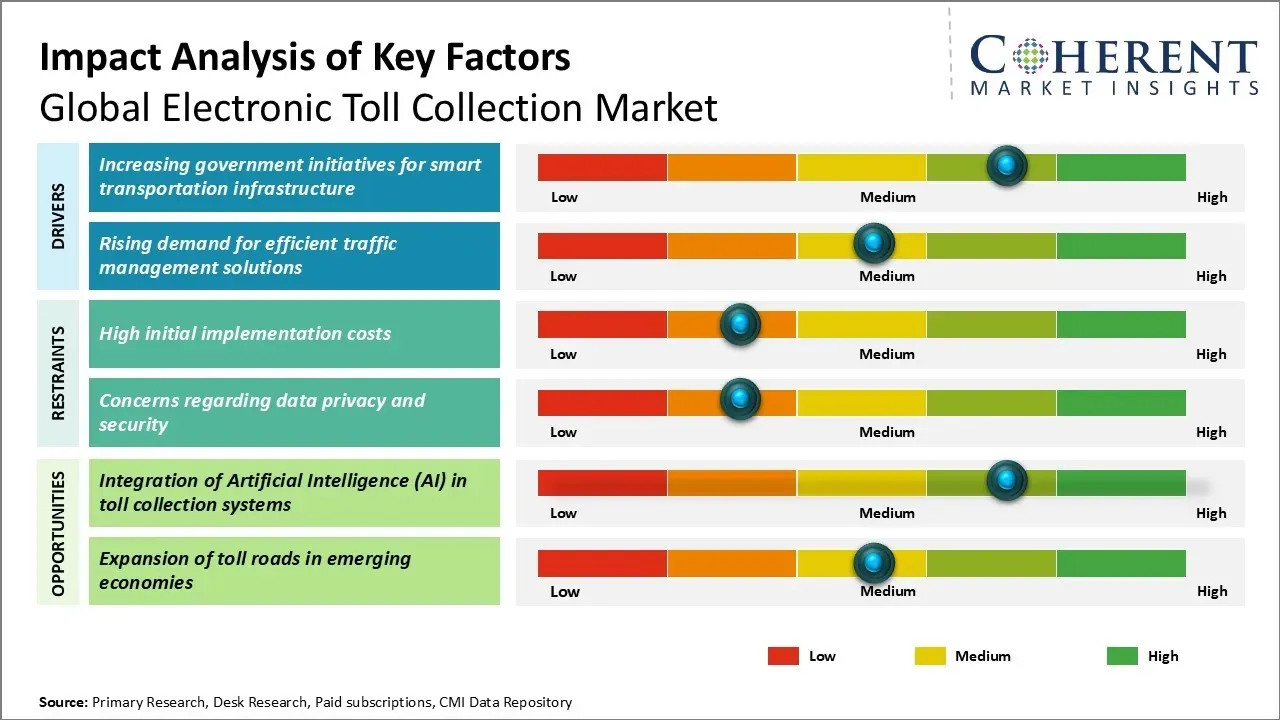
Global Electronic Toll Collection Market Driver
Increasing Government Initiatives for Smart Transportation Infrastructure
Rapid urbanization and population growth have made traffic management a major challenge globally, prompting governments to modernize infrastructure with digital technologies. A key focus is electronic toll collection (ETC), which enables seamless toll payments without stopping at booths, reducing congestion, fuel costs, and pollution. While Europe and North America have mature ETC networks, developing regions like India and China are driving future growth with large-scale projects involving gantries, sensors, and interoperable payment platforms. ETC helps streamline traffic, enforce tolling policies, and generate revenue for infrastructure expansion. Governments are also integrating ETC with smart city systems to enhance navigation, emergency response, and parking services. Increased public spending supports new installations and upgrades, while regulatory mandates in countries like the U.S. and China require ETC-enabled vehicles within 5–10 years. These efforts are accelerating global adoption and market expansion of ETC systems.
Rising Demand for Efficient Traffic Management Solutions
The rising demand for efficient traffic management solutions is significantly boosting the Electronic Toll Collection (ETC) market share. As urban congestion intensifies, governments and transport authorities are turning to ETC systems to streamline toll operations, reduce bottlenecks, and enhance road safety. These systems enable automatic toll payments, minimizing delays at toll plazas and improving overall traffic flow. By integrating ETC with smart transportation networks, cities can better manage vehicle movement, optimize infrastructure usage, and reduce fuel consumption and emissions. This growing emphasis on intelligent mobility is expected to drive substantial growth in the Electronic Toll Collection market share globally.
Analyst Opinion (Expert Opinion)
- The electronic toll collection market is poised for substantial growth in the coming years, driven by increasing government investments in smart transportation infrastructure, and the rising need for efficient traffic management solutions.
- However, the high initial costs associated with implementing ETC systems and concerns over data privacy may pose challenges to market expansion.
- North America is expected to maintain its dominance in the market, supported by advanced infrastructure and early adoption of ETC technologies. Simultaneously, the Asia Pacific region is projected to witness the fastest growth, fueled by rapid urbanization, and government initiatives to modernize transportation systems.
Speak to the analyst
Want personalized insights?
Take the findings above to one of our principal consultants, or have the report rebuilt around the segments, geographies and competitors you actually track.
Market Segmentation
- Type Insights (Revenue, USD Bn, 2026 - 2033)
- Transponder/Tag-based Tolling Systems
- Others
- Offering Insights (Revenue, USD Bn, 2026 - 2033)
- Hardware
- Back-office and Other Services
- Technology Insights (Revenue, USD Bn, 2026 - 2033)
- Radio Frequency Identification (RFID)
- Dedicated Short-Range Communication (DSRC)
- Regional Insights (Revenue, USD Bn, 2026 - 2033)
- North America
- U.S.
- Canada
- Latin America
- Brazil
- Argentina
- Mexico
- Rest of Latin America
- Europe
- Germany
- U.K.
- Spain
- France
- Italy
- Russia
- Rest of Europe
- Asia Pacific
- China
- India
- Japan
- Australia
- South Korea
- ASEAN
- Rest of Asia Pacific
- Middle East
- GCC Countries
- Israel
- Rest of Middle East
- Africa
- South Africa
- North Africa
- Central Africa
- Key Players Insights (Revenue, USD Bn, 2021 - 2033)
- Kapsch TrafficCom AG (Austria)
- Conduent, Inc. (US)
- TransCore (US)
- Thales Group (France)
- Cubic Corporation (US)
- Infineon Technologies AG (Germany)
- Siemens AG (Germany)
- EFKON GmbH (Austria)
- Neology, Inc. (US)
- FEIG ELECTRONIC (Germany)
- Q-Free ASA (Norway)
- GeoToll (US)
- Toll Collect GmbH (Germany)
- STAR Systems International (Hong Kong)
- SICE (Spain)
Sources
Primary Research
Interviews from the following stakeholders
Stakeholders
- Interviews with toll system operators, highway concessionaires, traffic management authorities, transport infrastructure developers, electronic payment service providers, and automotive OEMs across leading global markets.
Specific stakeholders
- Project managers and technology heads at national/state highway authorities (e.g., NHAI – India, Federal Highway Administration – U.S., Transport for London – U.K.)
- Operations and IT heads at toll plaza operators and concessionaires (e.g., TransCore, Egis Road Operation, Autostrade per l’Italia)
- CIOs and digital payment heads at mobility payment service providers (e.g., FASTag issuers, EZ-Pass network, Telepass)
- Automotive OEM connectivity teams (working on in-vehicle tolling/ITS integration)
- Urban mobility and transport planners at smart city projects
- Financial institutions and banks managing ETC-linked prepaid wallets and accounts
- Technology integrators and suppliers of RFID, DSRC, GNSS, ANPR cameras, and IoT modules
- Road transport and logistics fleet operators using ETC for fleet efficiency and fuel cost savings
Databases
- World Road Statistics (International Road Federation – IRF)
- UN Comtrade Database (Trade flows of RFID, DSRC modules, sensors, cameras)
- U.S. Department of Transportation (DOT) – Tolling Data & Statistics
- European Tolling Service (EETS) regulatory data
- Eurostat – Transport Infrastructure and Vehicle Usage Statistics
- China Ministry of Transport Database
- Japan Road Traffic Information Center (JARTIC) Data
- Korea Expressway Corporation Statistics Portal
- Directorate General of Commercial Intelligence and Statistics (DGCIS), India
Magazines
- Tolling Review Magazine
- ITS International (Intelligent Transport Systems)
- Traffic Technology International
- Mobility Payments News
- Electronic Payments International
- Smart Highways Magazine
- Transport Times
- RFID Journal
Journals
- IEEE Transactions on Intelligent Transportation Systems
- Journal of Intelligent Transportation Systems (Taylor & Francis)
- Transportation Research Part C: Emerging Technologies (Elsevier)
- Journal of Transport Geography
- International Journal of Transport Development and Integration
- Journal of Infrastructure Systems (ASCE)
- IET Intelligent Transport Systems
Newspapers
- The Wall Street Journal – Transportation & Infrastructure
- The Economic Times – Mobility & Transport Technology
- The Hindu Business Line – Roads & Transport Sector
- Financial Times – Infrastructure and Digital Economy
- Nikkei Asia – Smart Mobility and Technology Supply Chain
- South China Morning Post – Transport & Technology
- The Times of India – Infrastructure & FASTag Updates
Associations
- International Bridge, Tunnel and Turnpike Association (IBTTA)
- Intelligent Transportation Society of America (ITS America)
- European Association of Operators of Toll Road Infrastructures (ASECAP)
- Institute of Transportation Engineers (ITE)
- Asia-Pacific Intelligent Transport Systems Association (ITS Asia-Pacific)
- Confederation of Indian Industry (CII) – Mobility and Infrastructure Forum
- Society of Automotive Engineers (SAE) – Connected Vehicle Standards Committees
Public Domain Sources
- Ministry of Road Transport and Highways (MoRTH), India
- National Highways Authority of India (NHAI) – FASTag and tolling data
- Federal Highway Administration (FHWA), U.S.
- European Commission – DG MOVE (Mobility and Transport) Reports
- Ministry of Land, Infrastructure, Transport and Tourism (MLIT), Japan
- U.S. International Trade Commission (USITC) – Automotive electronics trade data
- Reserve Bank of India (RBI) – Digital Payments and Mobility Transactions Reports
- World Bank Transport Global Practice – Road Infrastructure and Tolling Initiatives
Proprietary Elements
- CMI Data Analytics Tool, and Proprietary CMI Existing Repository of information for last 8 years
Get access to 250+ pages report
Every segment, forecast, competitor profile and data table behind the analysis above — available for instant download.
- ESOMAR Member
- ISO 9001:2015 Certified
- D-U-N-S Registered
- GDPR & CCPA Compliant
Missing comfort of reading report in your local language? Find your preferred language:
Transform your Strategy with Exclusive Trending Reports
Frequently Asked Questions
The global electronic toll collection market is estimated to be valued at USD 10.83 billion in 2025 and is expected to reach USD 17.62 billion by 2032, exhibiting a compound annual growth rate (CAGR) of 7.2% from 2025 to 2032.
The CAGR of the global electronic toll collection market is projected to be 7.2% from 2025 to 2032.
Increasing government initiatives for smart transportation infrastructure and rising demand for efficient traffic management solutions are the major factors driving the growth of the global electronic toll collection market.
High initial implementation costs and concerns regarding data privacy and security are the major factors hampering the growth of the global electronic toll collection market.
In terms of type, the transponder/tag-based tolling systems segment is estimated to dominate the market revenue share in 2025.
Kapsch TrafficCom AG (Austria), Conduent, Inc. (US), TransCore (US), Thales Group (France), Cubic Corporation (US), Infineon Technologies AG (Germany), Siemens AG (Germany), EFKON GmbH (Austria), Neology, Inc. (US), FEIG ELECTRONIC (Germany), Q-Free ASA (Norway), GeoToll (US), Toll Collect GmbH (Germany), and STAR Systems International (Hong Kong), and SICE (Spain) are the major players.
North America is expected to lead the global electronic toll collection market in 2025, holding a share of 41.7%.